
Predicting FaultProne Modules Based on Metrics Transitions Yoshiki

Predicting Fault-Prone Modules Based on Metrics Transitions Yoshiki Higo, Kenji Murao, Shinji Kusumoto, Katsuro Inoue {higo, k-murao, kusumoto, inoue}@ist. osaka-u. ac. jp 2/27/2021 1 Graduate School of Information Science and Technology, Osaka University
Outline • Background • Preliminaries – Software Metrics – Version Control System • Proposal – Predict fault-prone modules • Case Study • Conclusion 2/27/2021 2 Graduate School of Information Science and Technology, Osaka University

Background • It is becoming more and more difficult for developers to devote their energies to all modules of a developing system – Larger and more complex – Faster time to market • It is important to identify modules that hinder software development and maintenance, and we should concentrate on such modules – Manual identification requires much costs depending on the size of the target software Automatic identification is essential for efficient software development and maintenance 2/27/2021 Graduate School of Information Science and Technology, Osaka University 3
Preliminaries -Software Metrics • Measures for evaluating various attributes of software • There are many software metrics • CK metrics suite is one of the most widely used metrics – CK metrics suite evaluates complexities of OO systems from • Inheritance (DIT, NOC) • Coupling between classes (RFC, CBO) • Complexity within each class (WMC, LCOM) – CK metrics suite is a good indicator to predict fault-prone classes[1] V. R. Basili, L. C. Briand, and W. L. Melo. A Validation of Object-Oriented Design Metrics as Quality Indicators. IEEE Transactions on Software Engineering, 22(10): 751– 761, Oct 1996. 2/27/2021 Graduate School of Information Science and Technology, Osaka University 4
Preliminaries -Version Control System • Tool for efficiently developing and maintaining software systems with many other developers • Every developer 1. gets a copy of the software from the repository (checkout) 2. modifies the copy 3. sends the modified copy to the repository (commit) • The repository contains various data – – Modified code of every commitment Developer names of every commitment Commitment time of every commitment Log messages of every commitment 2/27/2021 5 Graduate School of Information Science and Technology, Osaka University
Motivation • Software Metrics evaluate the latest (or the past) software product – They represent the states of the software at the version • How the software evolved is an important attribute of the software 2/27/2021 6 Graduate School of Information Science and Technology, Osaka University
Motivation -example • In the latest version, the complexity of a certain module is high – The complexity of the module is stable at high through multiple versions? – The complexity is getting higher according to development progress? – The complexity is up and down through the development? • The stability of metrics is an indicator of maintainability – If the complexity is stable, the module may not be problematic – If the complexity is unstable, big changes may be added repeatedly 2/27/2021 7 Graduate School of Information Science and Technology, Osaka University
Proposal: Metrics Constancy • Metrics Constancy (MC) is proposed for identifying problematic modules – MC evaluates the changeability of the metrics of each module • MC is calculated using the following statistical tools – – – 2/27/2021 – Entropy Normalized Entropy Quartile Deviation Quartile Dispersion Coefficient Hamming Distance Euclidean Distance Mahalanobis Distance Graduate School of Information Science and Technology, Osaka University 8
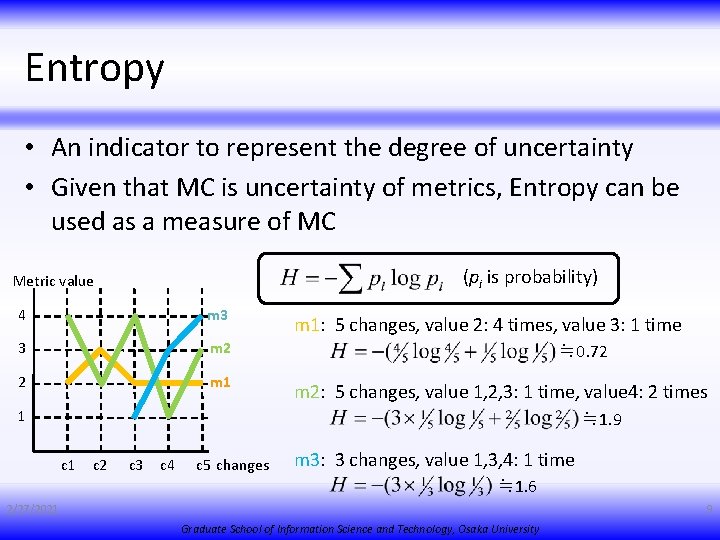
Entropy • An indicator to represent the degree of uncertainty • Given that MC is uncertainty of metrics, Entropy can be used as a measure of MC (pi is probability) Metric value 4 m 3 3 m 2 2 m 1: 5 changes, value 2: 4 times, value 3: 1 time ≒ 0. 72 m 2: 5 changes, value 1, 2, 3: 1 time, value 4: 2 times 1 ≒ 1. 9 c 1 c 2 c 3 c 4 c 5 changes m 3: 3 changes, value 1, 3, 4: 1 time ≒ 1. 6 2/27/2021 9 Graduate School of Information Science and Technology, Osaka University

Calculating MC from Entropy • MC of module i is calculated from the following formula – MT is a set of used metrics • The more unstable the metrics of module i are, the greater MC(i) is 2/27/2021 10 Graduate School of Information Science and Technology, Osaka University
Procedure for calculating MC • STEP 1: Retrieves snapshots – A snapshot is a set of source files just after at least one source file in the repository was updated by a commitment • STEP 2: Measures metrics from all of the snapshots – It is necessary to select appropriate software metrics fitting for the purpose • If the unit of modules is class, class metrics should be used • If we focus on the coupling/cohesion of the target software, coupling/cohesion metrics should be used • STEP 3: Calculates MC – Currently, the 7 MCs are calculated 2/27/2021 11 Graduate School of Information Science and Technology, Osaka University
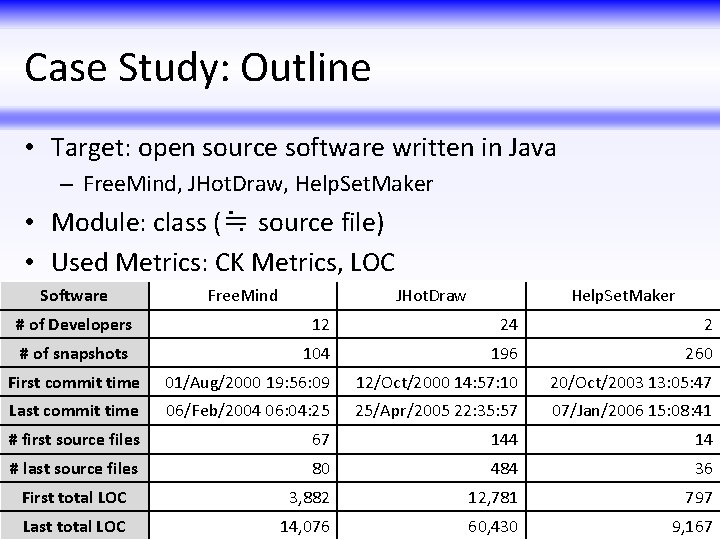
Case Study: Outline • Target: open source software written in Java – Free. Mind, JHot. Draw, Help. Set. Maker • Module: class (≒ source file) • Used Metrics: CK Metrics, LOC Software Free. Mind JHot. Draw Help. Set. Maker # of Developers 12 24 2 # of snapshots 104 196 260 First commit time 01/Aug/2000 19: 56: 09 12/Oct/2000 14: 57: 10 20/Oct/2003 13: 05: 47 Last commit time 06/Feb/2004 06: 04: 25 25/Apr/2005 22: 35: 57 07/Jan/2006 15: 08: 41 # first source files 67 144 14 # last source files 80 484 36 3, 882 12, 781 797 First total LOC 2/27/2021 Last total LOC 14, 076 Science and Technology, Osaka 60, 430 Graduate School of Information University 12 9, 167
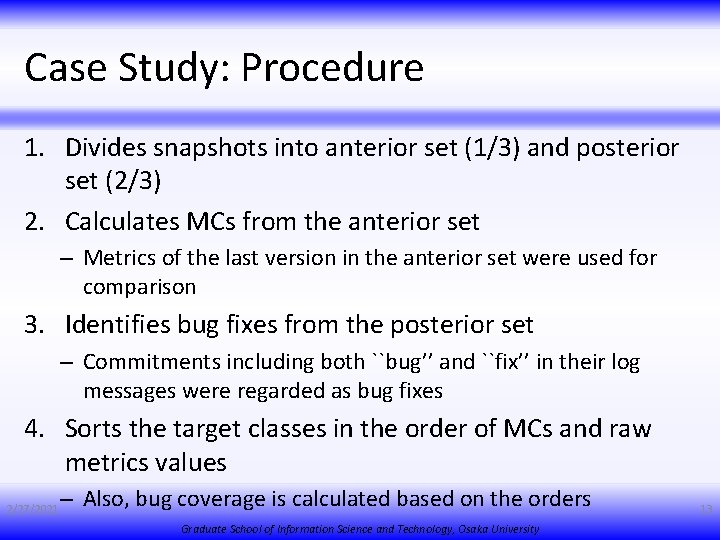
Case Study: Procedure 1. Divides snapshots into anterior set (1/3) and posterior set (2/3) 2. Calculates MCs from the anterior set – Metrics of the last version in the anterior set were used for comparison 3. Identifies bug fixes from the posterior set – Commitments including both ``bug’’ and ``fix’’ in their log messages were regarded as bug fixes 4. Sorts the target classes in the order of MCs and raw metrics values 2/27/2021 – Also, bug coverage is calculated based on the orders Graduate School of Information Science and Technology, Osaka University 13
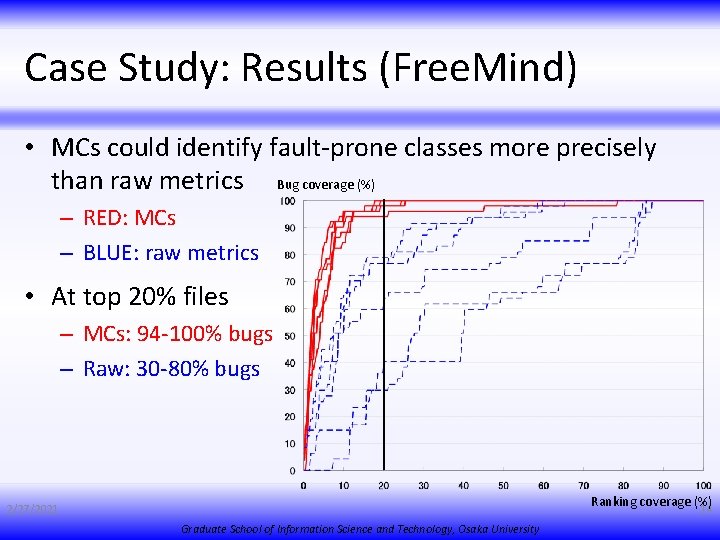
Case Study: Results (Free. Mind) • MCs could identify fault-prone classes more precisely than raw metrics Bug coverage (%) – RED: MCs – BLUE: raw metrics • At top 20% files – MCs: 94 -100% bugs – Raw: 30 -80% bugs Ranking coverage (%) 2/27/2021 14 Graduate School of Information Science and Technology, Osaka University
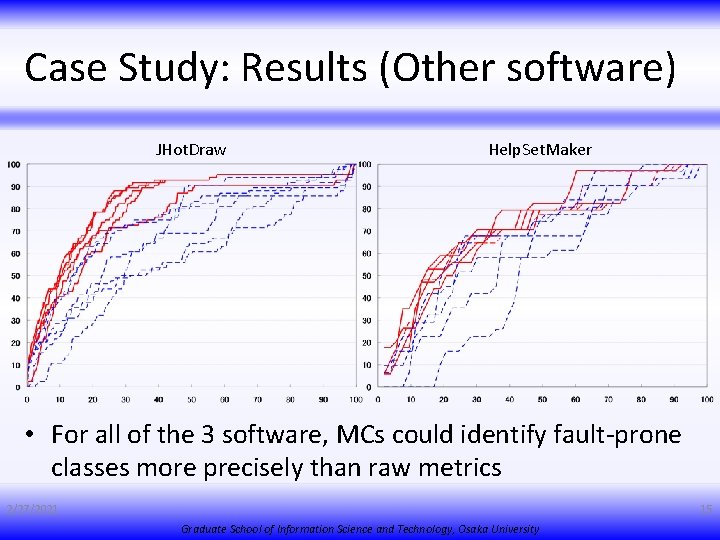
Case Study: Results (Other software) JHot. Draw Help. Set. Maker • For all of the 3 software, MCs could identify fault-prone classes more precisely than raw metrics 2/27/2021 15 Graduate School of Information Science and Technology, Osaka University
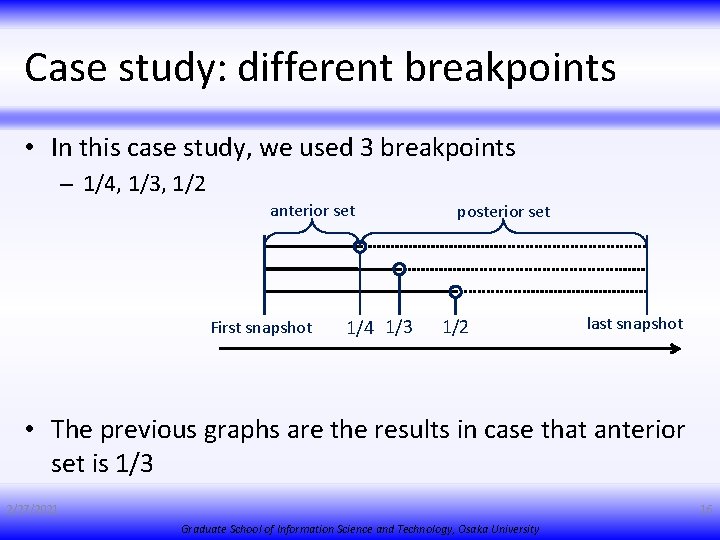
Case study: different breakpoints • In this case study, we used 3 breakpoints – 1/4, 1/3, 1/2 anterior set First snapshot 1/4 1/3 posterior set 1/2 last snapshot • The previous graphs are the results in case that anterior set is 1/3 2/27/2021 16 Graduate School of Information Science and Technology, Osaka University
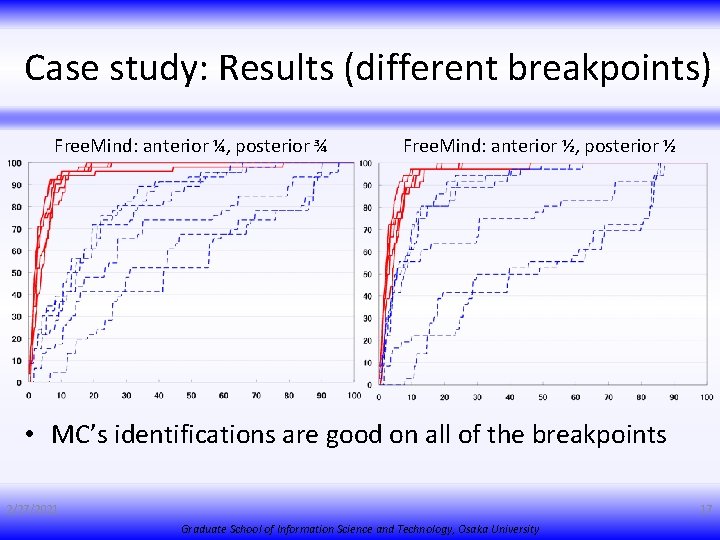
Case study: Results (different breakpoints) Free. Mind: anterior ¼, posterior ¾ Free. Mind: anterior ½, posterior ½ • MC’s identifications are good on all of the breakpoints 2/27/2021 17 Graduate School of Information Science and Technology, Osaka University
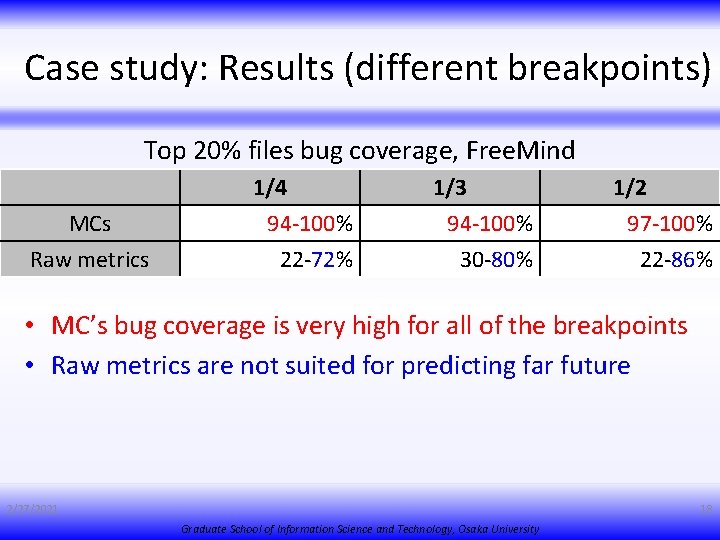
Case study: Results (different breakpoints) Top 20% files bug coverage, Free. Mind MCs Raw metrics 1/4 94 -100% 22 -72% 1/3 94 -100% 30 -80% 1/2 97 -100% 22 -86% • MC’s bug coverage is very high for all of the breakpoints • Raw metrics are not suited for predicting far future 2/27/2021 18 Graduate School of Information Science and Technology, Osaka University
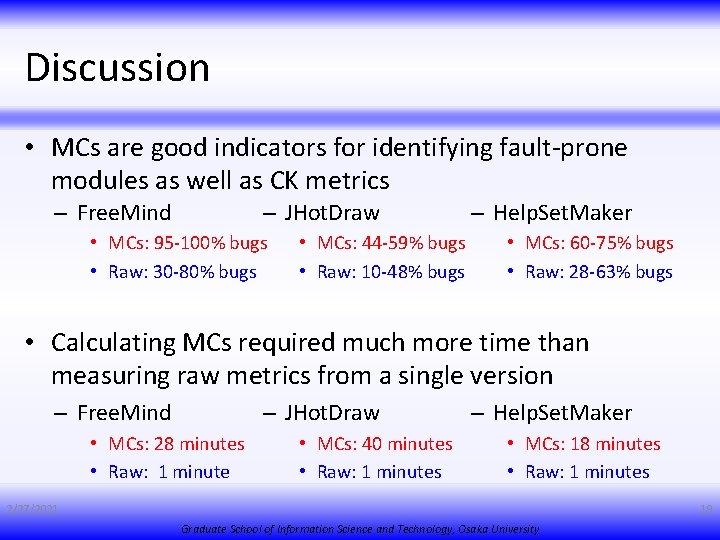
Discussion • MCs are good indicators for identifying fault-prone modules as well as CK metrics – JHot. Draw – Free. Mind • MCs: 95 -100% bugs • Raw: 30 -80% bugs • MCs: 44 -59% bugs • Raw: 10 -48% bugs – Help. Set. Maker • MCs: 60 -75% bugs • Raw: 28 -63% bugs • Calculating MCs required much more time than measuring raw metrics from a single version – JHot. Draw – Free. Mind • MCs: 28 minutes • Raw: 1 minute • MCs: 40 minutes • Raw: 1 minutes – Help. Set. Maker • MCs: 18 minutes • Raw: 1 minutes 2/27/2021 19 Graduate School of Information Science and Technology, Osaka University
Conclusion • Metrics Constancy (MC), which is an indicator for predicting problematic modules, was proposed • MCs were compared with raw CK metrics – The case study showed that MCs could identify fault-prone modules more precisely than raw CK metrics • In the future, we are going to – conduct more case studies on software written in other programming languages (e. g. , C++, C#) – compare MCs with other identification methods 2/27/2021 20 Graduate School of Information Science and Technology, Osaka University
- Slides: 20