
Predictable Routing Ryan Kastner Elaheh Borzorgzadeh and Majid
Predictable Routing Ryan Kastner, Elaheh Borzorgzadeh, and Majid Sarrafzadeh ER Group Dept. of Computer Science UCLA Los Angeles, CA Nu. CAD Group Dept. of Electrical & Computer Engineering Northwestern University Evanston, IL ER ICCAD: November 5, 2000 UCLA
Outline l l l Pattern Routing Predictable Routing Experiments l l Smallest First Pattern Routing x-density Pattern Routing Wire length and Run time Conclusion ER ICCAD: November 5, 2000 UCLA
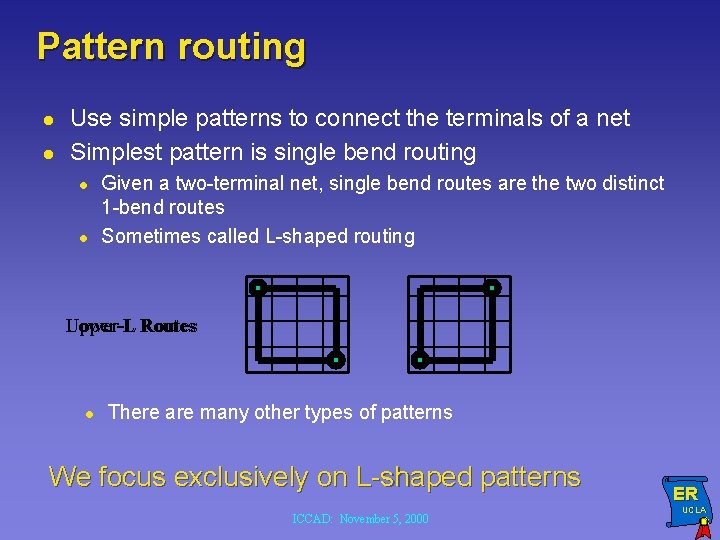
Pattern routing l l Use simple patterns to connect the terminals of a net Simplest pattern is single bend routing l l Given a two-terminal net, single bend routes are the two distinct 1 -bend routes Sometimes called L-shaped routing Lower-L Routes Upper-L l There are many other types of patterns We focus exclusively on L-shaped patterns ICCAD: November 5, 2000 ER UCLA
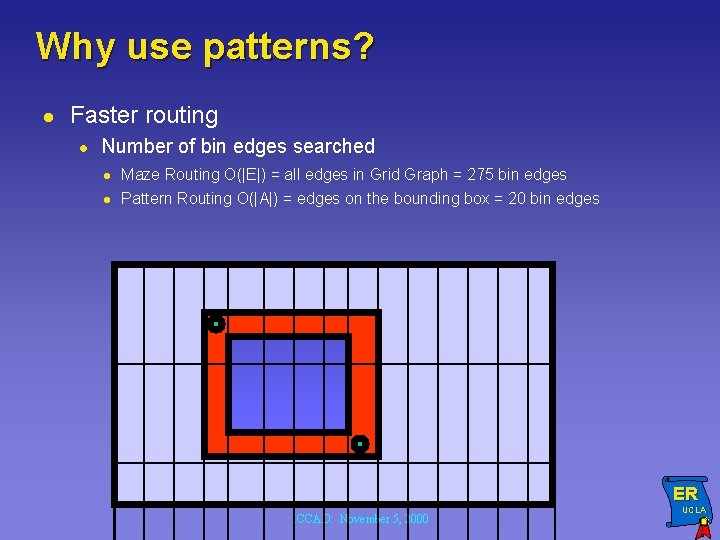
Why use patterns? l Faster routing l Number of bin edges searched l l Maze Routing O(|E|) = all edges in Grid Graph = 275 bin edges Pattern Routing O(|A|) = edges on the bounding box = 20 bin edges ER ICCAD: November 5, 2000 UCLA
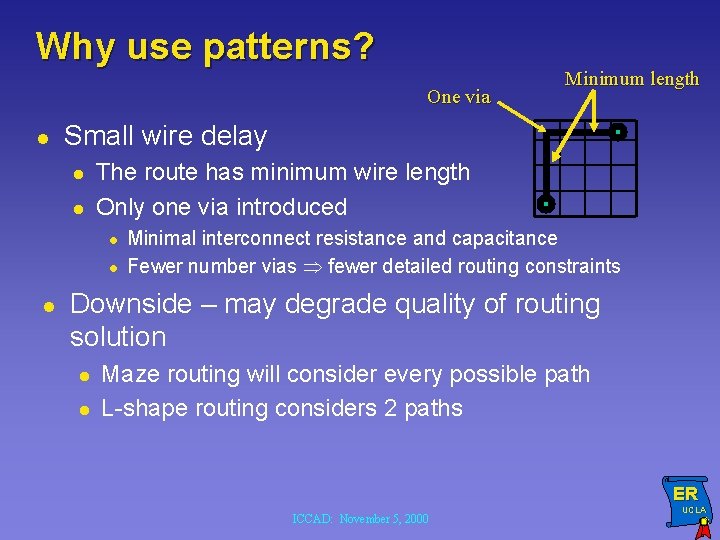
Why use patterns? One via l Small wire delay l l The route has minimum wire length Only one via introduced l l l Minimum length Minimal interconnect resistance and capacitance Fewer number vias fewer detailed routing constraints Downside – may degrade quality of routing solution l l Maze routing will consider every possible path L-shape routing considers 2 paths ER ICCAD: November 5, 2000 UCLA
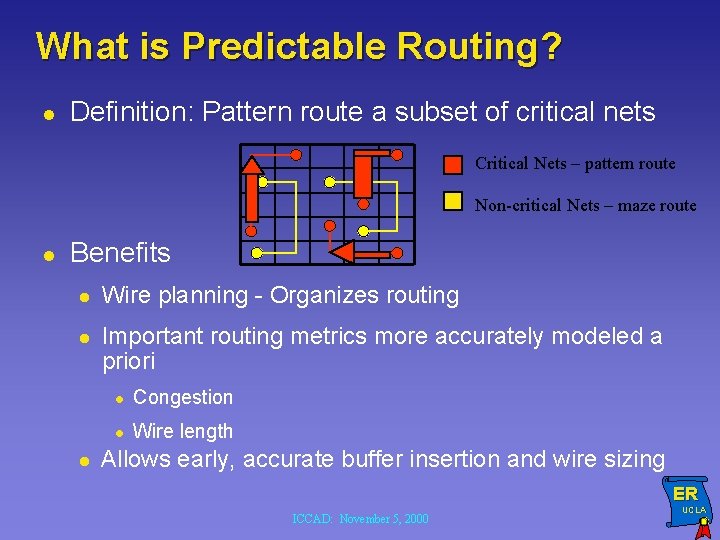
What is Predictable Routing? l Definition: Pattern route a subset of critical nets Critical Nets – pattern route Non-critical Nets – maze route l Benefits l l l Wire planning - Organizes routing Important routing metrics more accurately modeled a priori l Congestion l Wire length Allows early, accurate buffer insertion and wire sizing ER ICCAD: November 5, 2000 UCLA
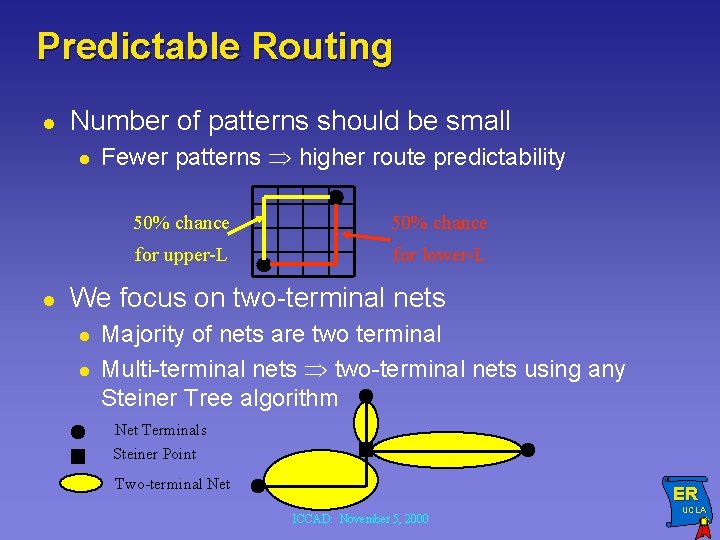
Predictable Routing l Number of patterns should be small l l Fewer patterns higher route predictability 50% chance for upper-L for lower-L We focus on two-terminal nets l l Majority of nets are two terminal Multi-terminal nets two-terminal nets using any Steiner Tree algorithm Net Terminals Steiner Point Two-terminal Net ER ICCAD: November 5, 2000 UCLA
Experiments l Focus on pattern routing “critical” nets l l l Criticality label by high level CAD tools Criticality increasingly dependent on wire length Goal: Show that you can pattern route critical nets without degrading the routing solution quality l l We focus on routability Wire length, run time considered as secondary factors ER ICCAD: November 5, 2000 UCLA
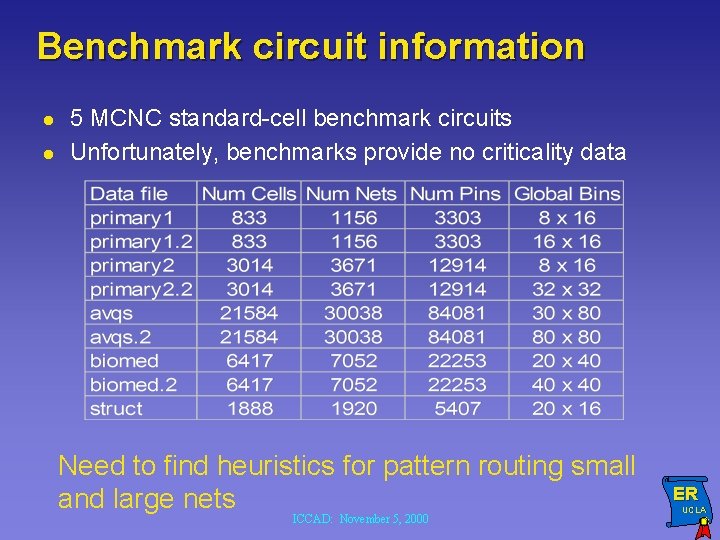
Benchmark circuit information l l 5 MCNC standard-cell benchmark circuits Unfortunately, benchmarks provide no criticality data Need to find heuristics for pattern routing small and large nets ICCAD: November 5, 2000 ER UCLA
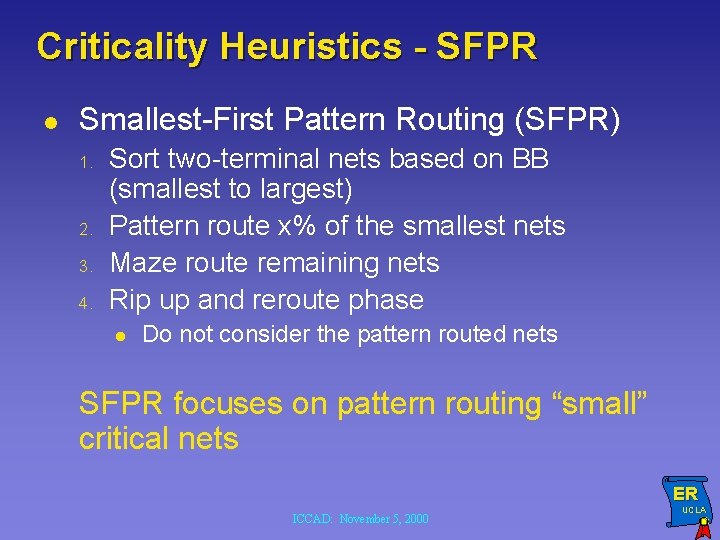
Criticality Heuristics - SFPR l Smallest-First Pattern Routing (SFPR) 1. 2. 3. 4. Sort two-terminal nets based on BB (smallest to largest) Pattern route x% of the smallest nets Maze route remaining nets Rip up and reroute phase l Do not consider the pattern routed nets SFPR focuses on pattern routing “small” critical nets ER ICCAD: November 5, 2000 UCLA
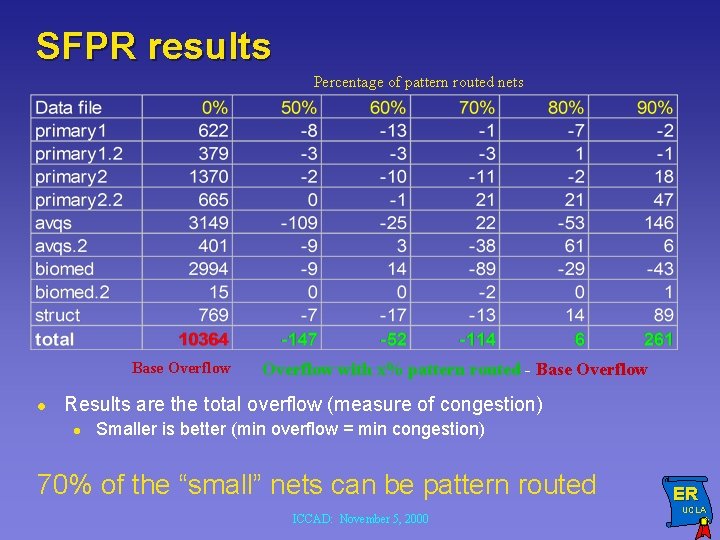
SFPR results Percentage of pattern routed nets Base Overflow l Overflow with x% pattern routed - Base Overflow Results are the total overflow (measure of congestion) l Smaller is better (min overflow = min congestion) 70% of the “small” nets can be pattern routed ICCAD: November 5, 2000 ER UCLA
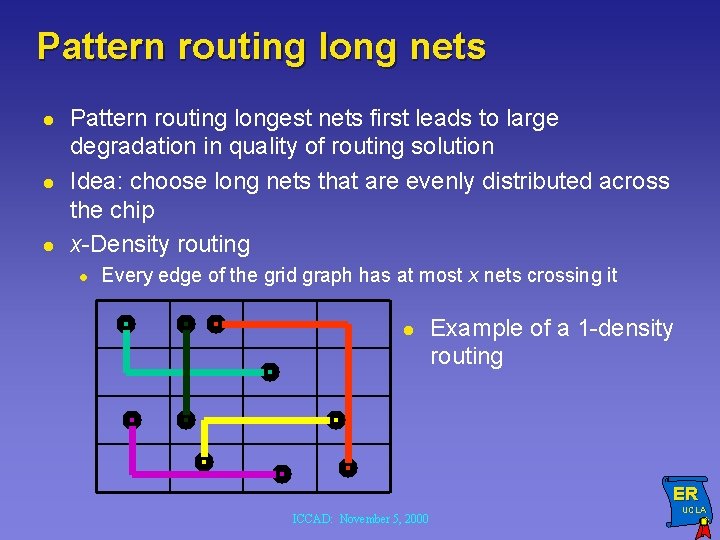
Pattern routing long nets l l l Pattern routing longest nets first leads to large degradation in quality of routing solution Idea: choose long nets that are evenly distributed across the chip x-Density routing l Every edge of the grid graph has at most x nets crossing it l Example of a 1 -density routing ER ICCAD: November 5, 2000 UCLA
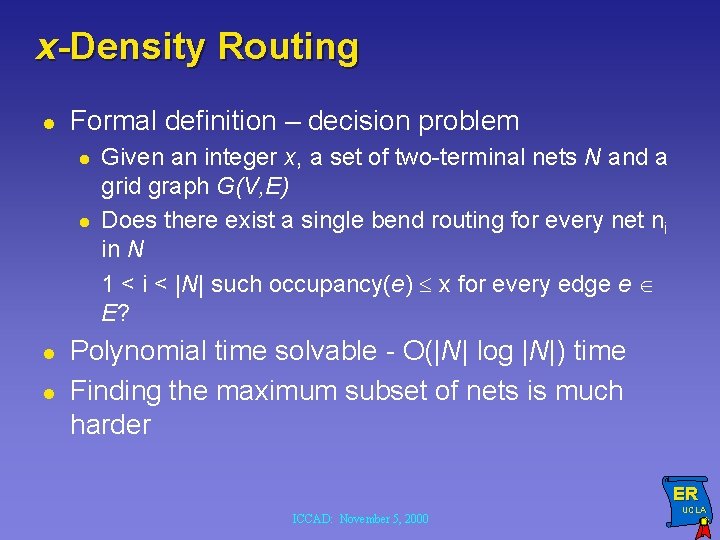
x-Density Routing l Formal definition – decision problem l l Given an integer x, a set of two-terminal nets N and a grid graph G(V, E) Does there exist a single bend routing for every net ni in N 1 < i < |N| such occupancy(e) x for every edge e E? Polynomial time solvable - O(|N| log |N|) time Finding the maximum subset of nets is much harder ER ICCAD: November 5, 2000 UCLA
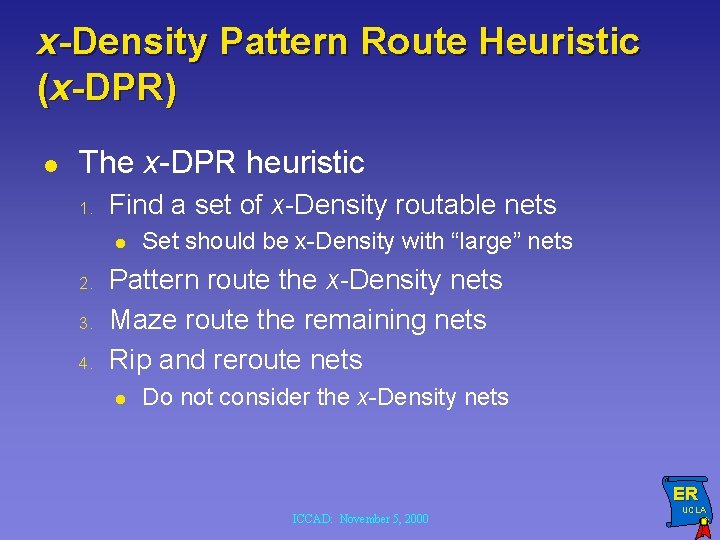
x-Density Pattern Route Heuristic (x-DPR) l The x-DPR heuristic 1. Find a set of x-Density routable nets l 2. 3. 4. Set should be x-Density with “large” nets Pattern route the x-Density nets Maze route the remaining nets Rip and reroute nets l Do not consider the x-Density nets ER ICCAD: November 5, 2000 UCLA
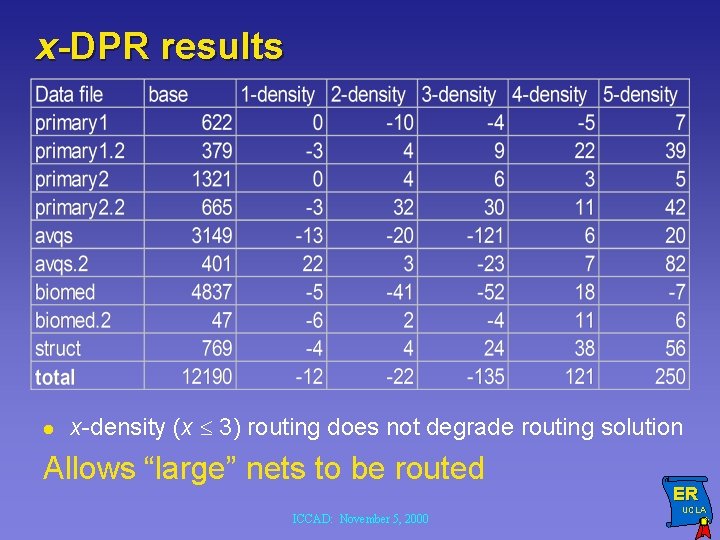
x-DPR results l x-density (x 3) routing does not degrade routing solution Allows “large” nets to be routed ICCAD: November 5, 2000 ER UCLA
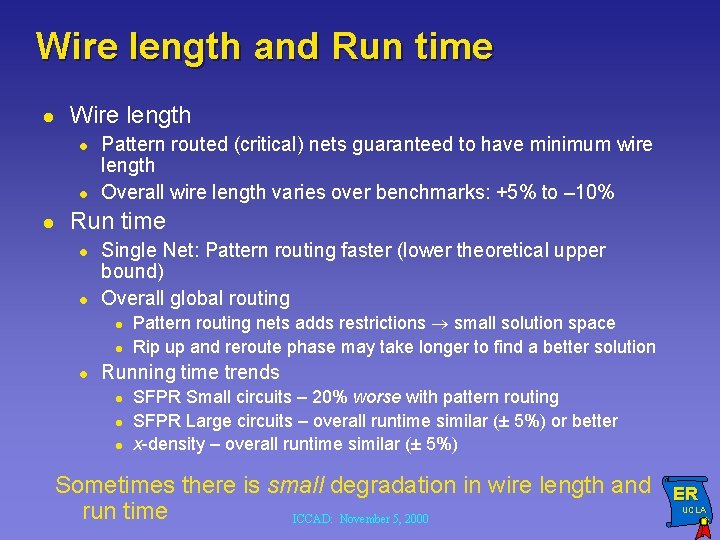
Wire length and Run time l Wire length l l l Pattern routed (critical) nets guaranteed to have minimum wire length Overall wire length varies over benchmarks: +5% to – 10% Run time l l Single Net: Pattern routing faster (lower theoretical upper bound) Overall global routing l l l Pattern routing nets adds restrictions small solution space Rip up and reroute phase may take longer to find a better solution Running time trends l l l SFPR Small circuits – 20% worse with pattern routing SFPR Large circuits – overall runtime similar (± 5%) or better x-density – overall runtime similar (± 5%) Sometimes there is small degradation in wire length and run time ICCAD: November 5, 2000 ER UCLA
Conclusions l l l We showed that you can pattern route up to 70% of small nets We showed that you can pattern route large nets using x -density routing We showed that pattern routing has many benefits l l l Better prediction of routing metrics Pattern routed nets have small interconnect delay Allows early accurate buffer insertion, wire sizing and wire planning ER ICCAD: November 5, 2000 UCLA
- Slides: 17