
Predictable and Efficient Regulation Certificate Program on Regulatory
Predictable and Efficient Regulation Certificate Program on Regulatory Leadership Cohort V, Team 3 June 12, 2018
2 Predictable and Efficient Regulation Issue Modernization of the Canadian regulatory system would enhance the capacity for regulatory reform to respond to an evolving economy. Areas of focus are: Agility Transparency Responsiveness Current system does not easily respond to emerging technologies and business models Regulation that is predictable and efficient would allow Canadian business to manage costs and administrative burden, encouraging growth A system that balances the priorities of predictability, efficiency, and facilitating innovation is needed; a principles-based approach can achieve this balance
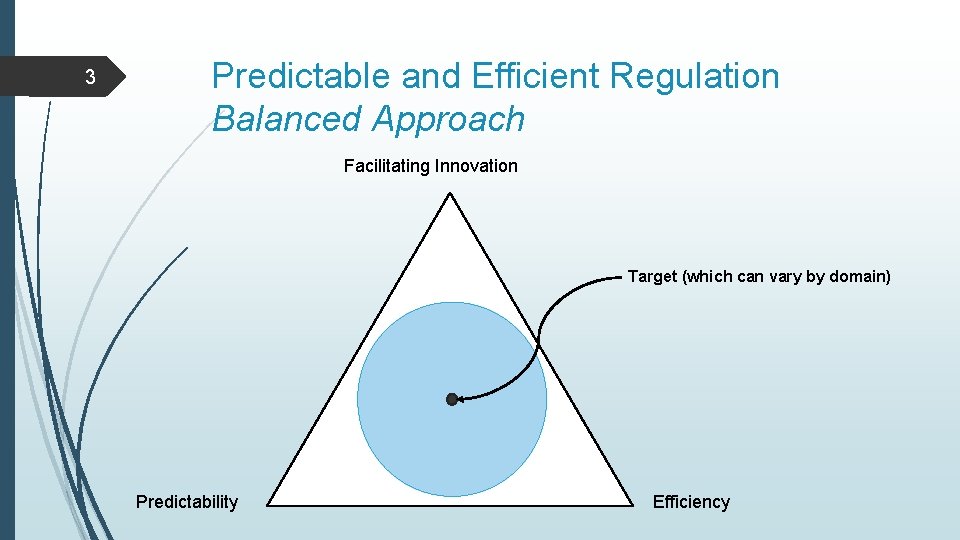
3 Predictable and Efficient Regulation Balanced Approach Facilitating Innovation Target (which can vary by domain) Predictability Efficiency
4 Predictable and Efficient Regulation Predictability Organization for Economic Co-operation and Development (OECD) Guiding Principles for Regulatory Quality and Performance Adopt, at the political level, broad programs of regulatory reform that establish clear objectives and frameworks for implementation Ensure that regulations, regulatory institutions charged with implementation, and regulatory processes are transparent and non-discriminatory Identify important linkages with other policy objectives and develop policies to achieve those objectives in ways that support reform Predictable regulations applied in a consistent manner enables business to account for costs of compliance.

5 Predictable and Efficient Regulation Efficiency Regulatory performance measures need to demonstrate the following characteristics: Relevant – a close connection to what is being done or considered, appropriate to the time, period, or circumstances of applicability Reliable – consistently good in quality or performance; able to be trusted Realistic – having or showing a sensible and practical idea of what can be achieved or expected (informed by publicly-communicated cost/benefit analysis) Efficient regulations achieve outcomes without burdening business with unnecessary costs or delays.
6 Predictable and Efficient Regulation Facilitating Innovation is often accredited to small and medium-sized enterprises, and new entrants in search of a niche, looking for a tailored approach to regulatory requirements. Large incumbent enterprises may favour standardization for operational purposes. Innovation can be driven by several factors including: Competitiveness Crisis / Problem New legislation and policy
7 Predictable and Efficient Regulation Guiding Principles Regulation can be complex, and can vary in design depending on several factors, including the subject, maturity of the sector, and complexity of the area under consideration. Some key principles that should be built into any regulatory reform initiative to achieve Predictability, Efficiency, and to facilitate innovation: Close and active collaboration with industry on regulatory development Transparency and openness to discussion and change Considerations related to social licence Consideration of organizational cultures of the regulator
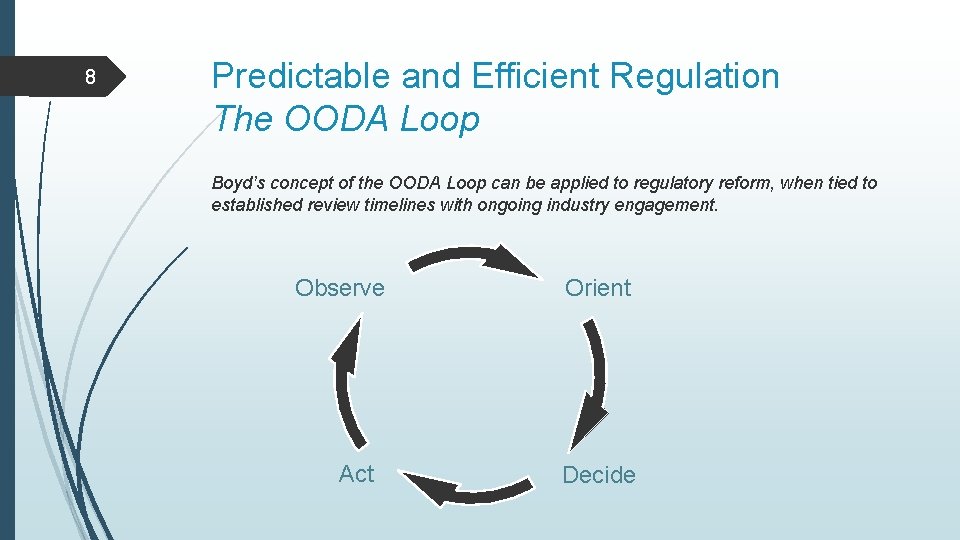
8 Predictable and Efficient Regulation The OODA Loop Boyd’s concept of the OODA Loop can be applied to regulatory reform, when tied to established review timelines with ongoing industry engagement. Observe Act Orient Decide
9 Predictable and Efficient Regulation Case Study – Sustainable Aquaculture Program (SAP) Purpose: Evaluation of the SAP to provide information to support decision making, and to assess the impacts of the Aquaculture Activities Regulations on the Program’s operations Findings: The program must address a limited number of minor regulatory incongruences that are negatively affecting the industry; however, other barriers have acted as greater impediments to the growth of the sector When one regulator streamlines regulations, the overall regulatory complexity can actually increase – this was found to be the case in the past four years of the Sustainable Aquaculture Program. Unintended consequences included regulatory overlap with provincial programs, increased reporting burden on industry, and persisting uncertainties Metrics to assess impact of regulation on industry are extremely difficult to develop, as industry can be impacted by multiple factors at once. Status quo of the regulated industry/production has been used as a proxy.

10 Questions?
- Slides: 10