
Predication Verbs EVENTS and STATES Presenter Emily Lu
+ Predication: Verbs, EVENTS, and STATES Presenter: Emily Lu
+ Outline n 1. Intro n 2. The semantics of verbs n 3. STATES and EVENTS n 4. MOTION verbs n 5. Non-verb predicates n 6. Summary and Conclusion
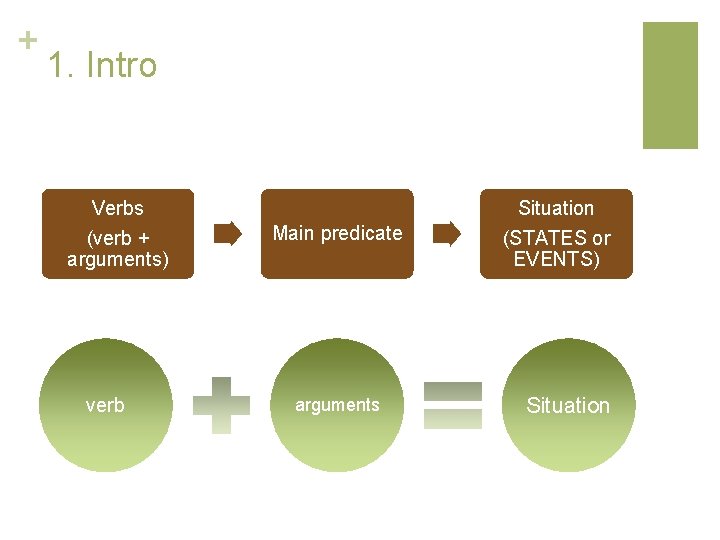
+ 1. Intro Verbs (verb + arguments) verb Main predicate arguments Situation (STATES or EVENTS) Situation
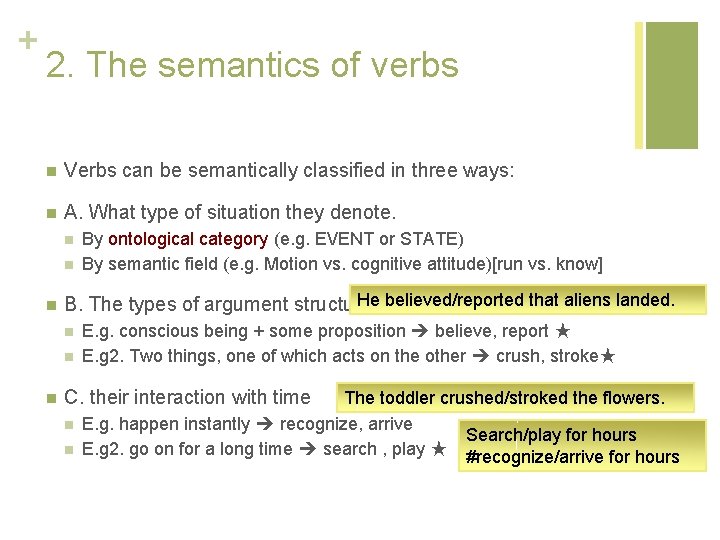
+ 2. The semantics of verbs n Verbs can be semantically classified in three ways: n A. What type of situation they denote. n n n He believed/reported that aliens landed. B. The types of argument structures n n n By ontological category (e. g. EVENT or STATE) By semantic field (e. g. Motion vs. cognitive attitude)[run vs. know] E. g. conscious being + some proposition believe, report ★ E. g 2. Two things, one of which acts on the other crush, stroke★ C. their interaction with time n n The toddler crushed/stroked the flowers. E. g. happen instantly recognize, arrive Search/play for hours E. g 2. go on for a long time search , play ★ #recognize/arrive for hours
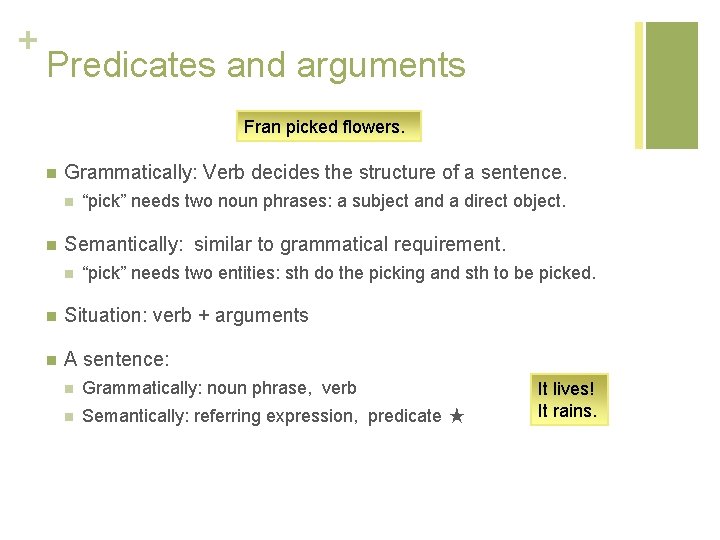
+ Predicates and arguments Fran picked flowers. n Grammatically: Verb decides the structure of a sentence. n n “pick” needs two noun phrases: a subject and a direct object. Semantically: similar to grammatical requirement. n “pick” needs two entities: sth do the picking and sth to be picked. n Situation: verb + arguments n A sentence: n Grammatically: noun phrase, verb n Semantically: referring expression, predicate ★ It lives! It rains.
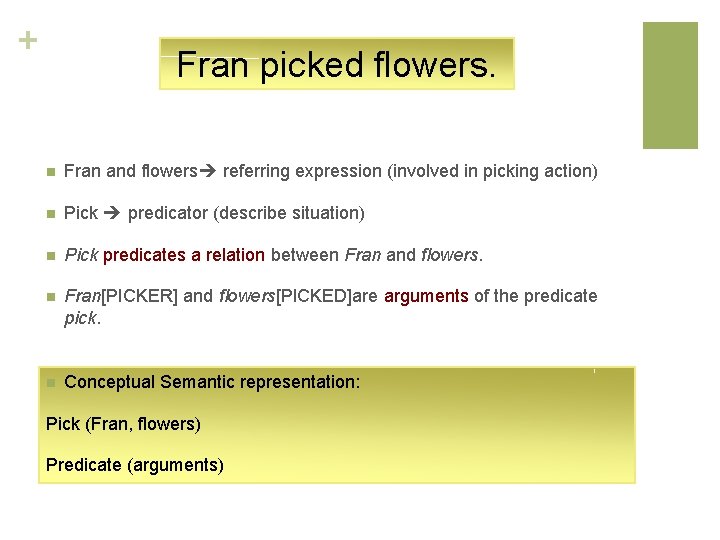
+ Fran picked flowers. n Fran and flowers referring expression (involved in picking action) n Pick predicator (describe situation) n Pick predicates a relation between Fran and flowers. n Fran[PICKER] and flowers[PICKED]are arguments of the predicate pick. n Conceptual Semantic representation: Pick (Fran, flowers) Predicate (arguments)
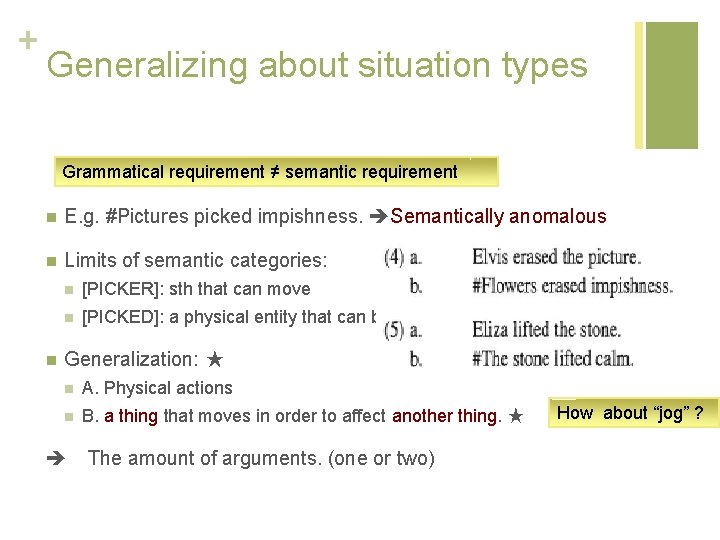
+ Generalizing about situation types Grammatical requirement ≠ semantic requirement n E. g. #Pictures picked impishness. Semantically anomalous n Limits of semantic categories: n n [PICKER]: sth that can move n [PICKED]: a physical entity that can be grasped. Generalization: ★ n A. Physical actions n B. a thing that moves in order to affect another thing. ★ The amount of arguments. (one or two) How about “jog” ?
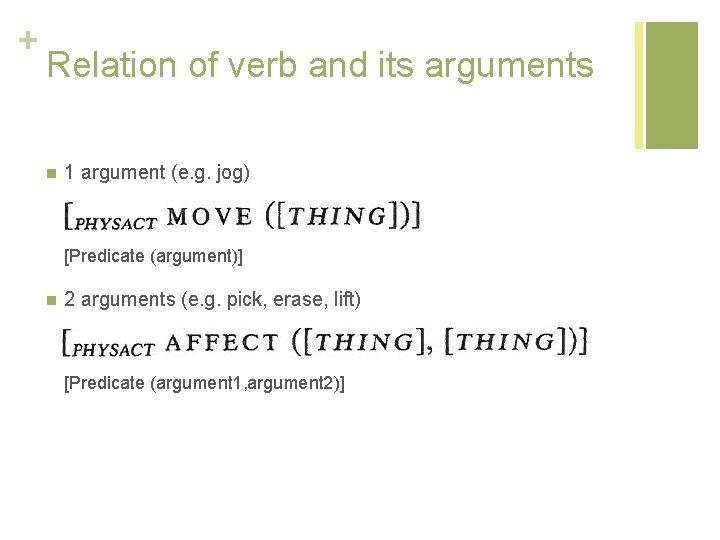
+ Relation of verb and its arguments n 1 argument (e. g. jog) [Predicate (argument)] n 2 arguments (e. g. pick, erase, lift) [Predicate (argument 1, argument 2)]
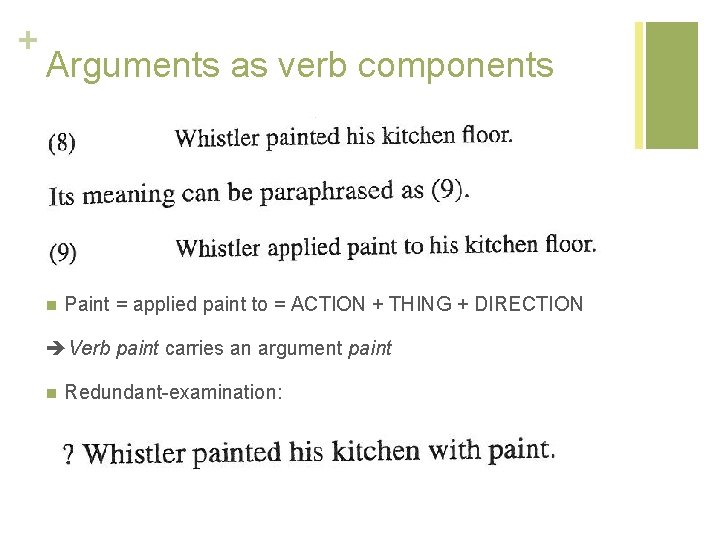
+ Arguments as verb components n Paint = applied paint to = ACTION + THING + DIRECTION Verb paint carries an argument paint n Redundant-examination:
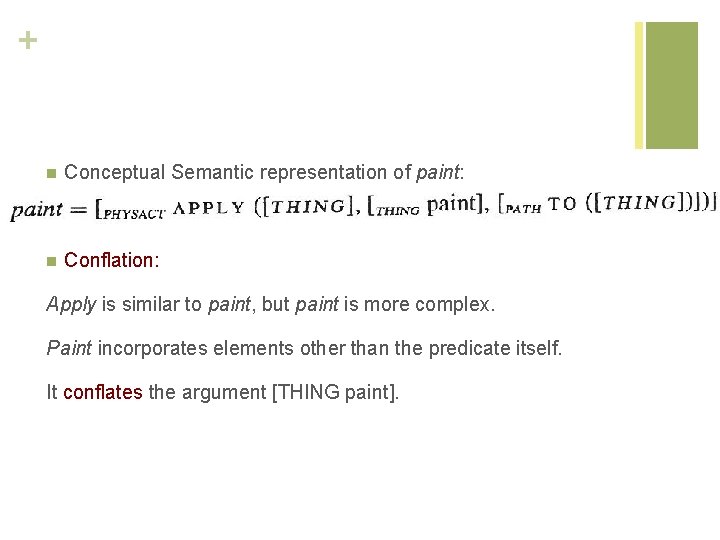
+ n Conceptual Semantic representation of paint: n Conflation: Apply is similar to paint, but paint is more complex. Paint incorporates elements other than the predicate itself. It conflates the argument [THING paint].
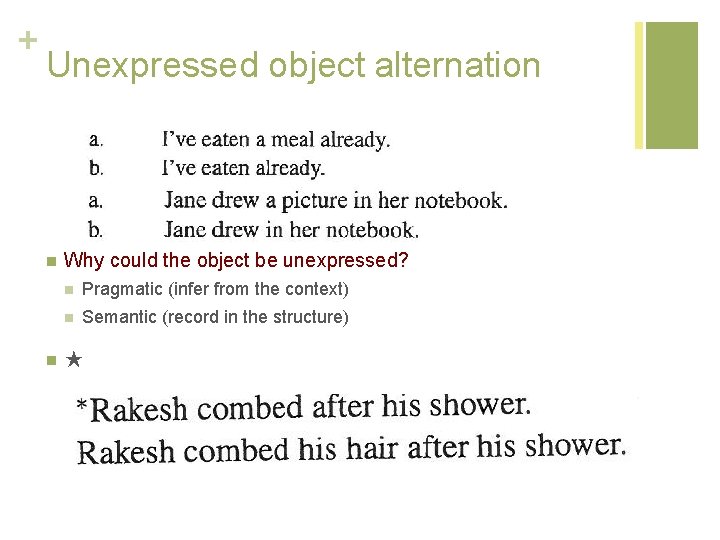
+ Unexpressed object alternation n n Why could the object be unexpressed? n Pragmatic (infer from the context) n Semantic (record in the structure) ★
+ Summary n Sentence meanings are organized around a main predicating expression, which is usually a verb. n Predicators: tell us sth about the referring expressions in the sentences. (what are they, what are they doing, what’s their relation) n The nature of the predicate determine the kinds of ENTITIES for the arguments. n The number of referring expressions is not necessary equal to the number of arguments. E. g. Paint n Some verbs have complex meaning that conflate some of their arguments. E. g. paint n Some verbs can be involved in grammatical alternations, which can affect their interpretation.
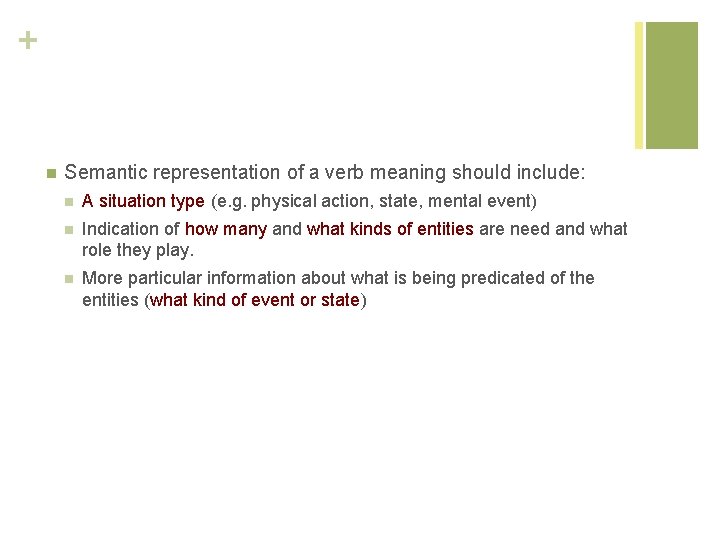
+ n Semantic representation of a verb meaning should include: n A situation type (e. g. physical action, state, mental event) n Indication of how many and what kinds of entities are need and what role they play. n More particular information about what is being predicated of the entities (what kind of event or state)
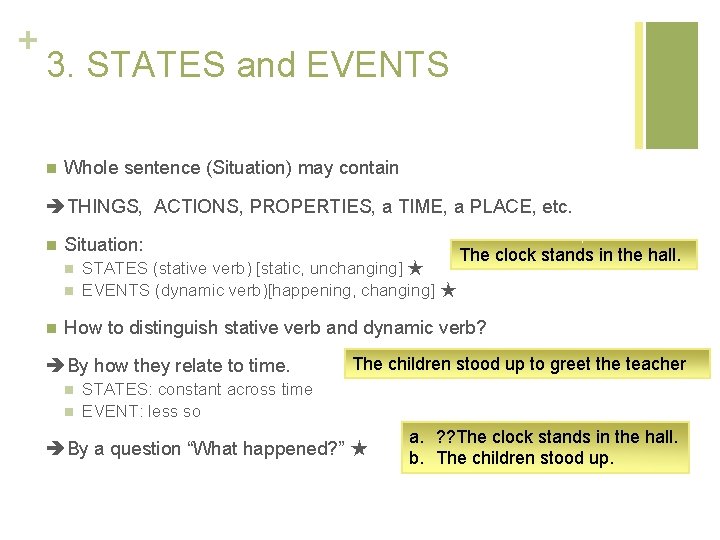
+ 3. STATES and EVENTS n Whole sentence (Situation) may contain THINGS, ACTIONS, PROPERTIES, a TIME, a PLACE, etc. n Situation: n n n STATES (stative verb) [static, unchanging] ★ EVENTS (dynamic verb)[happening, changing] ★ The clock stands in the hall. How to distinguish stative verb and dynamic verb? By how they relate to time. n n The children stood up to greet the teacher STATES: constant across time EVENT: less so By a question “What happened? ” ★ a. ? ? The clock stands in the hall. b. The children stood up.
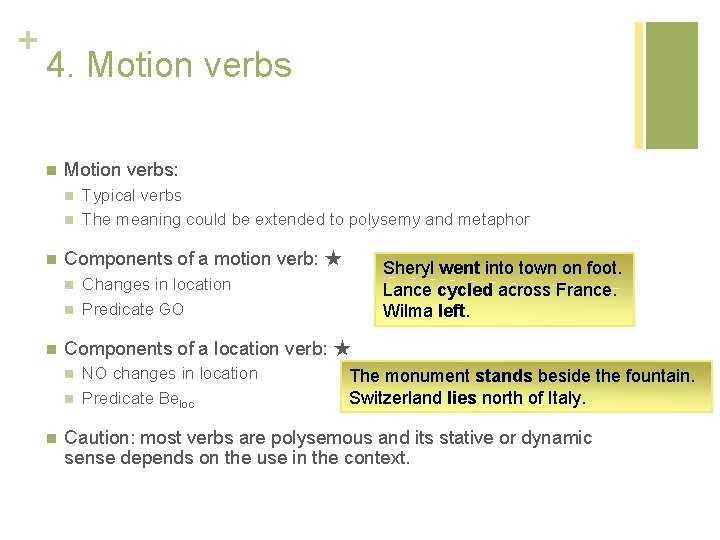
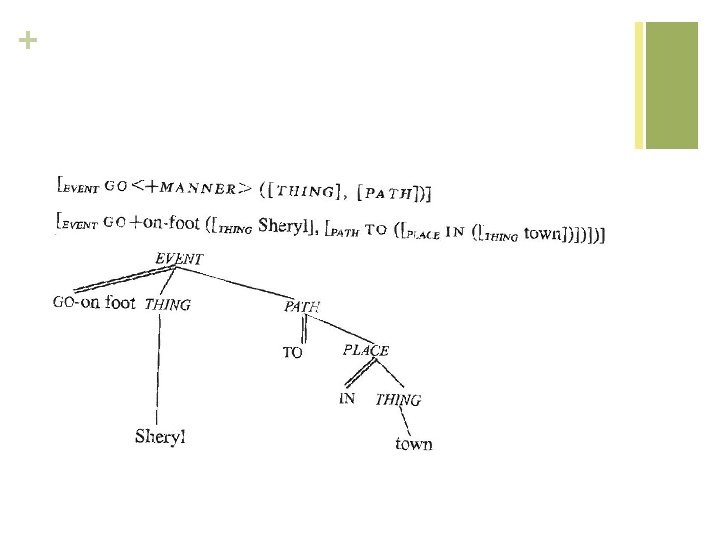
+ 4. Motion verbs n Motion verbs: n n n Components of a motion verb: ★ n n n Sheryl went into town on foot. Lance cycled across France. Wilma left. Changes in location Predicate GO Components of a location verb: ★ n n n Typical verbs The meaning could be extended to polysemy and metaphor NO changes in location Predicate Beloc The monument stands beside the fountain. Switzerland lies north of Italy. Caution: most verbs are polysemous and its stative or dynamic sense depends on the use in the context.
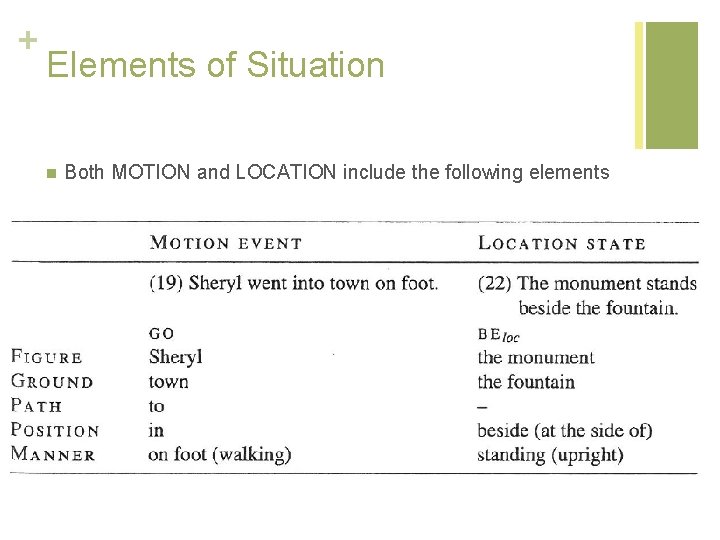
+ Elements of Situation n Both MOTION and LOCATION include the following elements
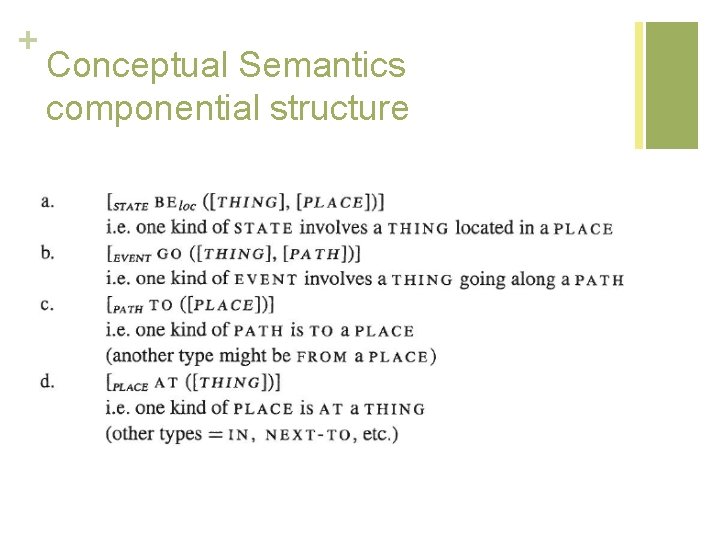
+ Conceptual Semantics componential structure
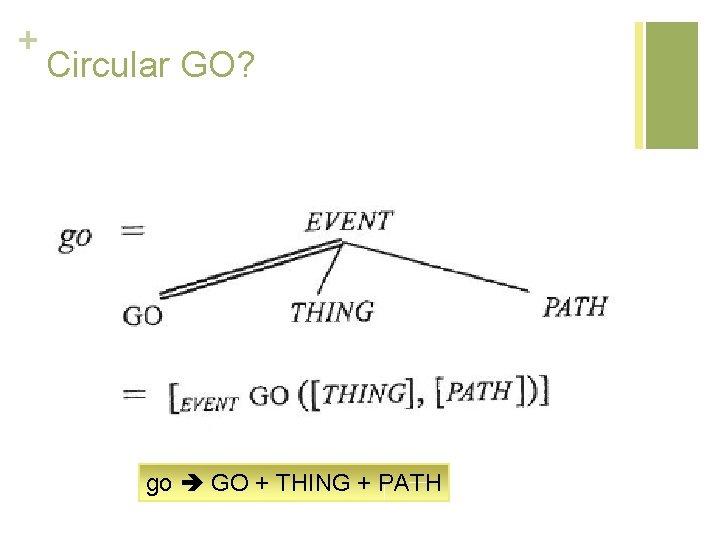
+ Circular GO? go GO + THING + PATH
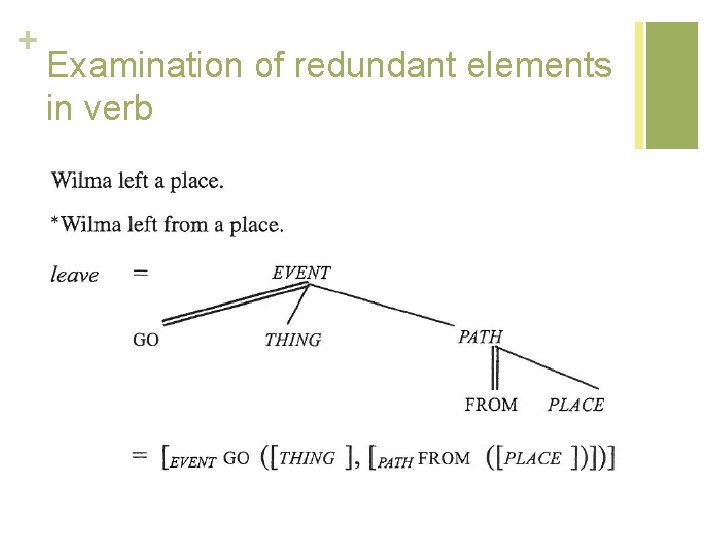
+ Examination of redundant elements in verb
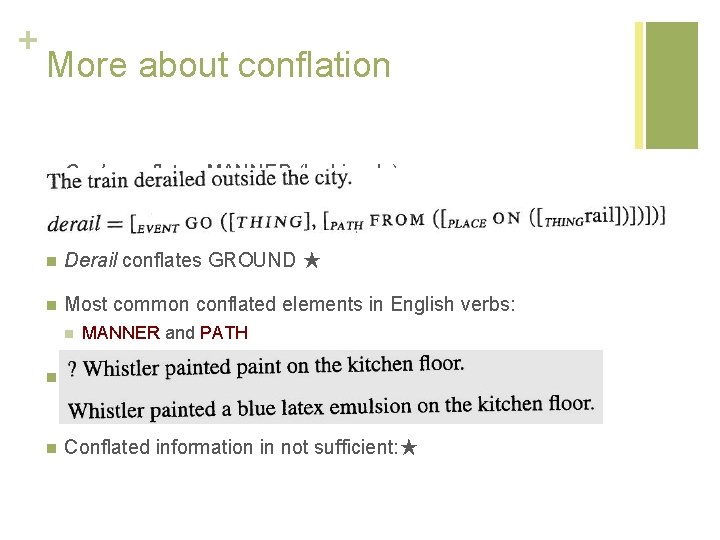
+ More about conflation n Cycle conflates MANNER (by bicycle) n Leave conflates PATH n Derail conflates GROUND ★ n Most common conflated elements in English verbs: n n Languages differ in their preferred patterns of conflation: n n MANNER and PATH Motion verbs in North American languages conflates FIGURE. Conflated information in not sufficient: ★
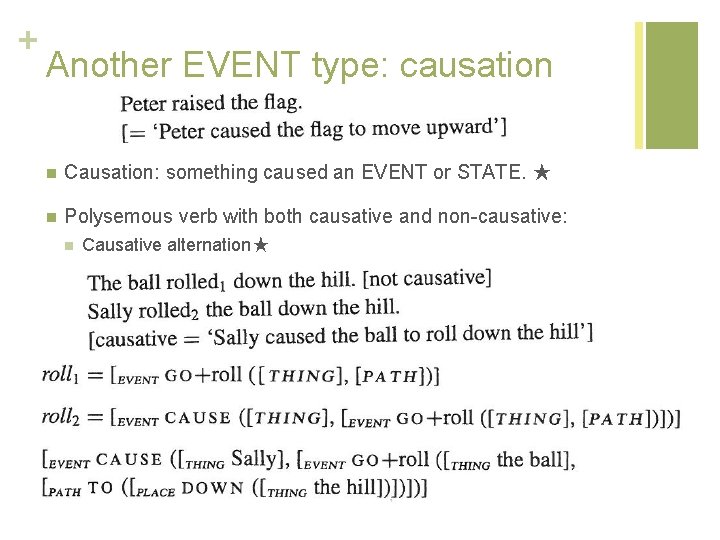
+ Another EVENT type: causation n Causation: something caused an EVENT or STATE. ★ n Polysemous verb with both causative and non-causative: n Causative alternation★
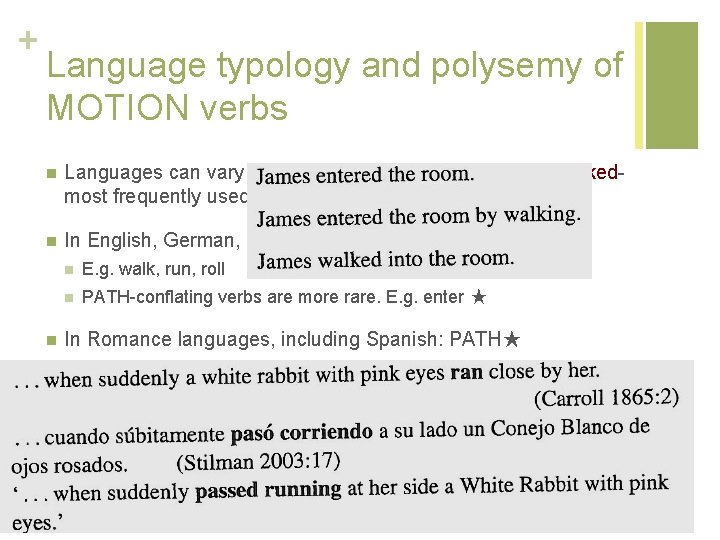
+ Language typology and polysemy of MOTION verbs n Languages can vary in which pattern of conflation is unmarkedmost frequently used. n In English, German, and Chinese: MANNER/CAUSE n n E. g. walk, run, roll n PATH-conflating verbs are more rare. E. g. enter ★ In Romance languages, including Spanish: PATH★
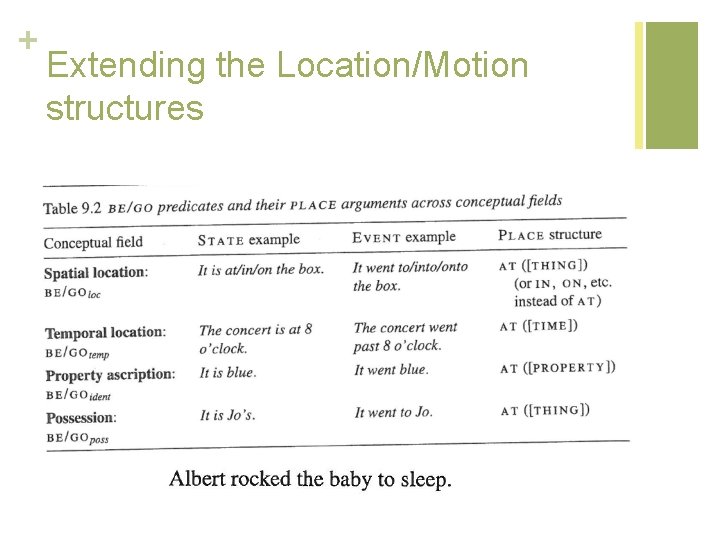
+ Extending the Location/Motion structures
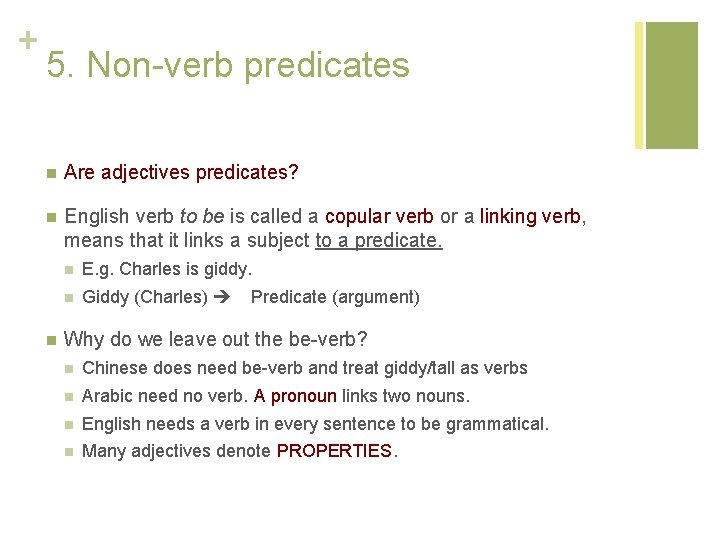
+ 5. Non-verb predicates n Are adjectives predicates? n English verb to be is called a copular verb or a linking verb, means that it links a subject to a predicate. n n E. g. Charles is giddy. n Giddy (Charles) Predicate (argument) Why do we leave out the be-verb? n Chinese does need be-verb and treat giddy/tall as verbs n Arabic need no verb. A pronoun links two nouns. n English needs a verb in every sentence to be grammatical. n Many adjectives denote PROPERTIES.
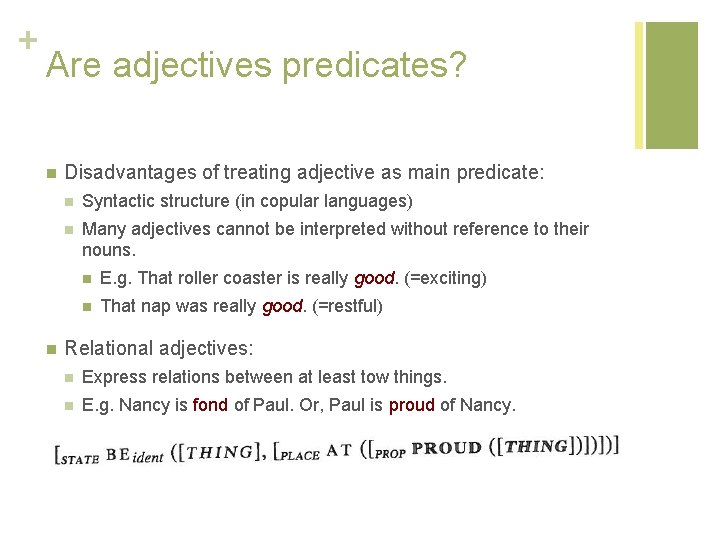
+ Are adjectives predicates? n n Disadvantages of treating adjective as main predicate: n Syntactic structure (in copular languages) n Many adjectives cannot be interpreted without reference to their nouns. n E. g. That roller coaster is really good. (=exciting) n That nap was really good. (=restful) Relational adjectives: n Express relations between at least tow things. n E. g. Nancy is fond of Paul. Or, Paul is proud of Nancy.
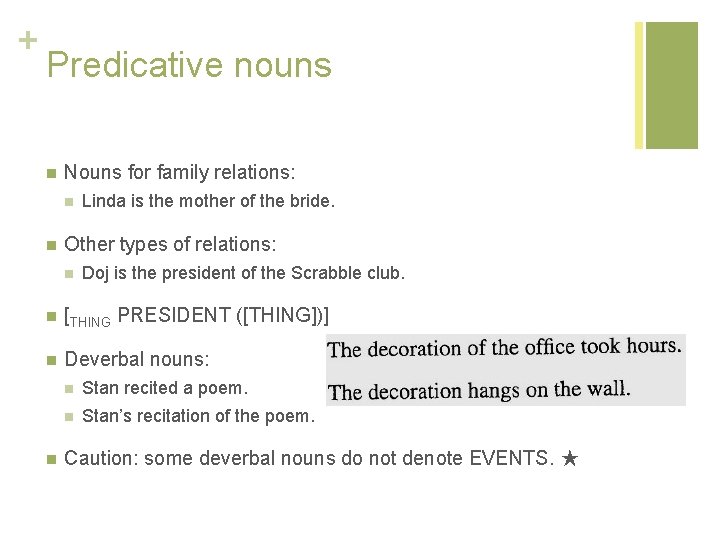
+ Predicative nouns n Nouns for family relations: n n Linda is the mother of the bride. Other types of relations: n Doj is the president of the Scrabble club. n [THING n n PRESIDENT ([THING])] Deverbal nouns: n Stan recited a poem. n Stan’s recitation of the poem. Caution: some deverbal nouns do not denote EVENTS. ★
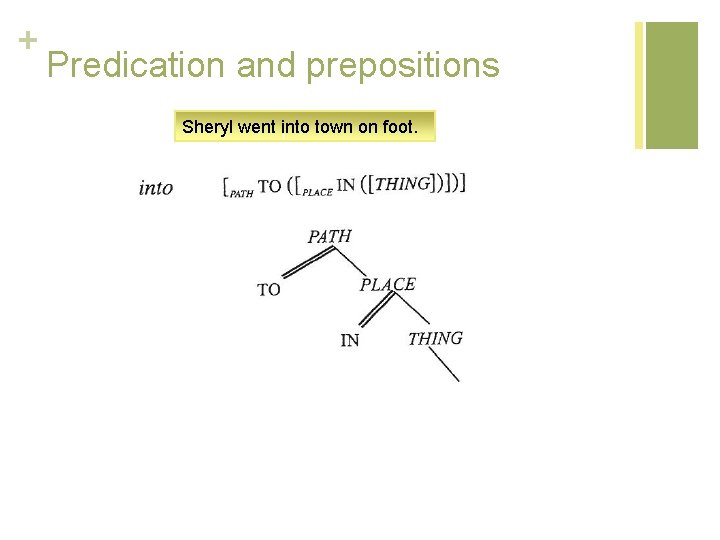
+ Predication and prepositions Sheryl went into town on foot.
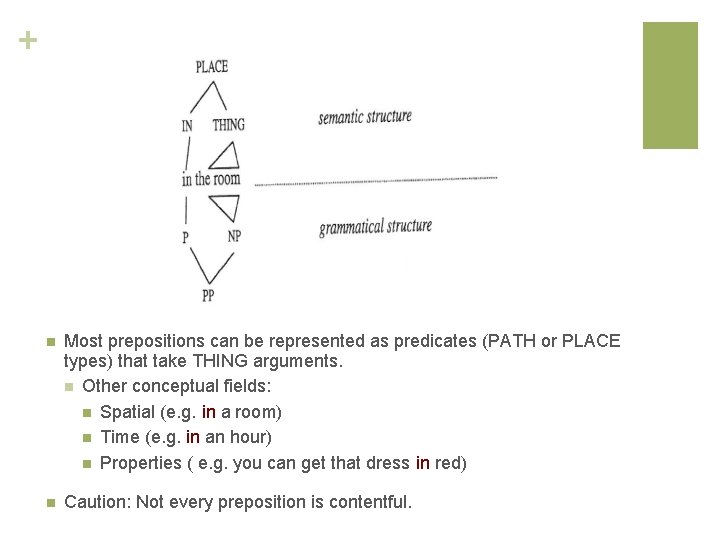
+ n Most prepositions can be represented as predicates (PATH or PLACE types) that take THING arguments. n Other conceptual fields: n Spatial (e. g. in a room) n Time (e. g. in an hour) n Properties ( e. g. you can get that dress in red) n Caution: Not every preposition is contentful.
+ Conclusion n 4 key concepts related to verb meaning: n Predication n Argument structure n Argument alternation n Conflation Situation: n EVENT Motion GO, CAUSE n STATE Location BE Predication of other word classes
- Slides: 30