
Predator Prey Interactions Activity 1 Learning the Rules



- Slides: 34
Predator Prey Interactions: Activity 1 – Learning the Rules Activity 2 – Coyotes Go Hunting Simulated Mark-Recapture: Activity 1 – Simple Mark-Recapture Activity 2 – Repeated Mark-Recapture Week of November 26 th 2018 Version 1. 2. Last updated: 11/27/2018 12: 38: 27 PM
Final Field Trip: Natural History Museum Saturday, December 1 st 11 a. m. �How do diseases spread among humans, domestic animals and wild populations? �What are the implications for environmental science? �Can you find patient zero? https: //naturalhistory. si. edu/exhibits/outbreak/
Predator-Prey Interactions – Activity 1: Learning the Rules of the Community
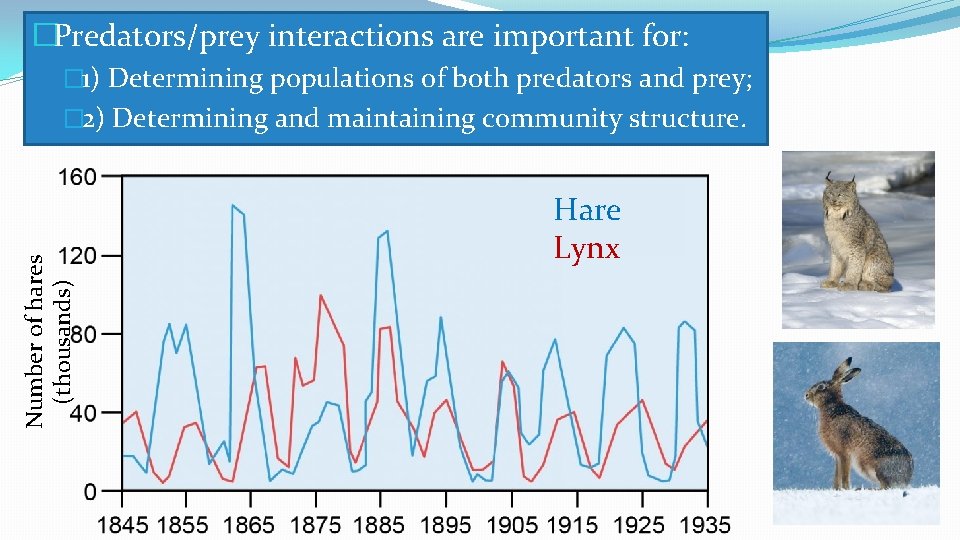
�Predators/prey interactions are important for: � 1) Determining populations of both predators and prey; Number of hares (thousands) � 2) Determining and maintaining community structure. Hare Lynx
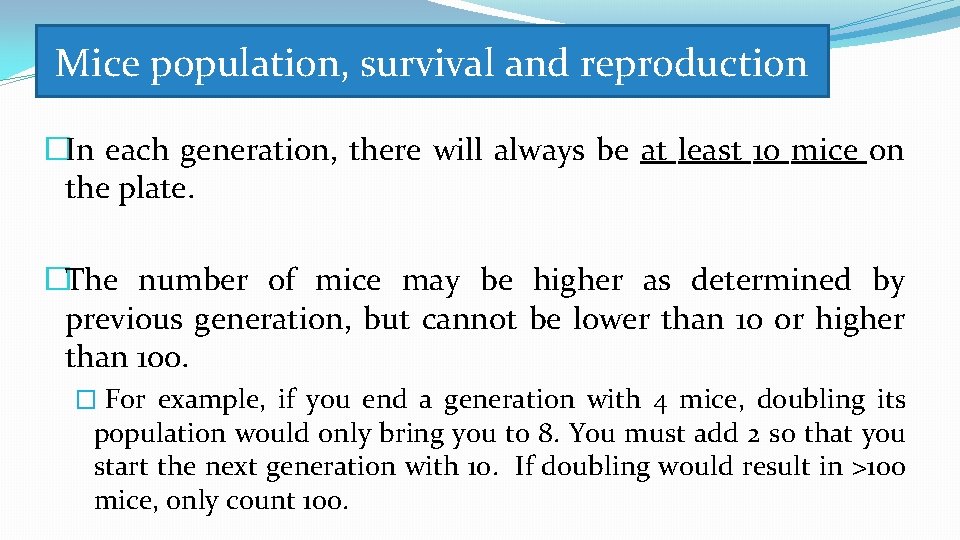
Mice population, survival and reproduction �In each generation, there will always be at least 10 mice on the plate. �The number of mice may be higher as determined by previous generation, but cannot be lower than 10 or higher than 100. � For example, if you end a generation with 4 mice, doubling its population would only bring you to 8. You must add 2 so that you start the next generation with 10. If doubling would result in >100 mice, only count 100.
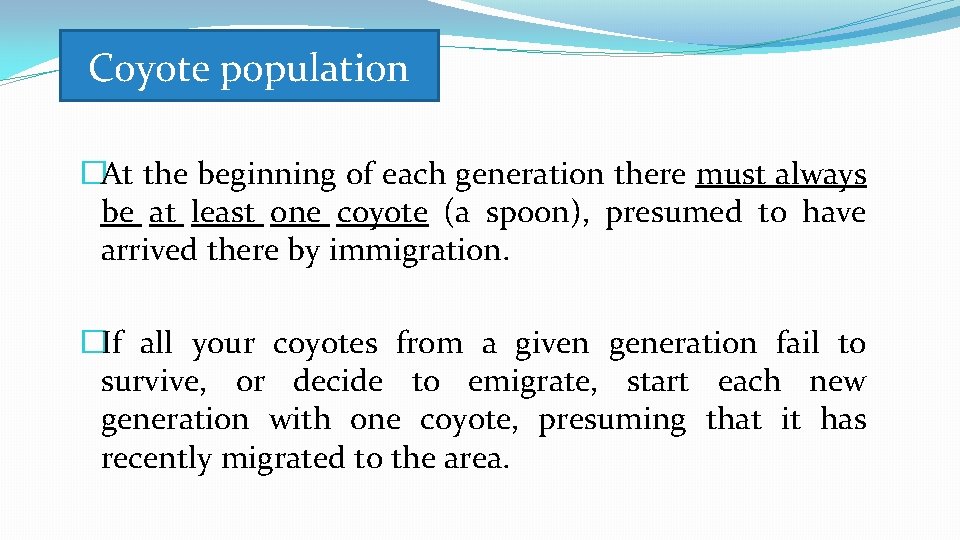
Coyote population �At the beginning of each generation there must always be at least one coyote (a spoon), presumed to have arrived there by immigration. �If all your coyotes from a given generation fail to survive, or decide to emigrate, start each new generation with one coyote, presuming that it has recently migrated to the area.
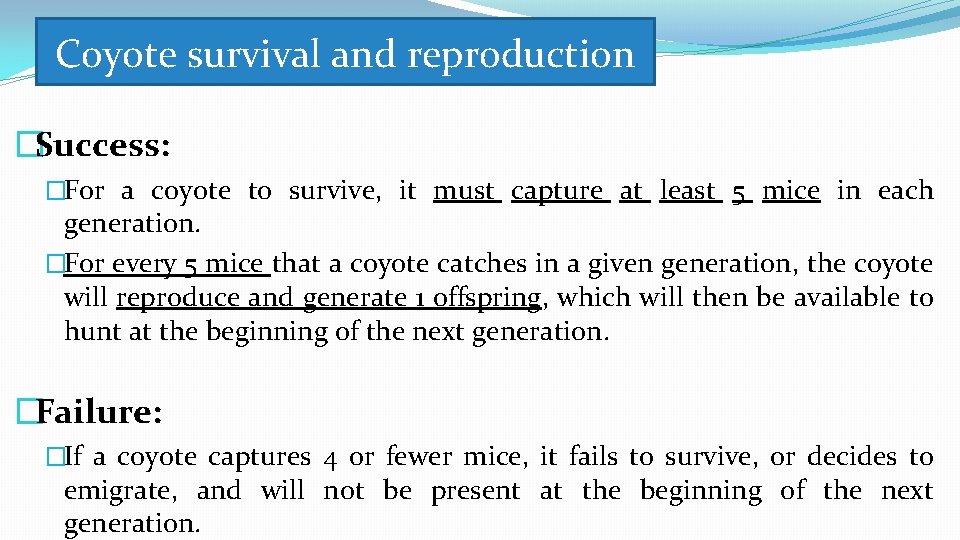
Coyote survival and reproduction �Success: �For a coyote to survive, it must capture at least 5 mice in each generation. �For every 5 mice that a coyote catches in a given generation, the coyote will reproduce and generate 1 offspring, which will then be available to hunt at the beginning of the next generation. �Failure: �If a coyote captures 4 or fewer mice, it fails to survive, or decides to emigrate, and will not be present at the beginning of the next generation.
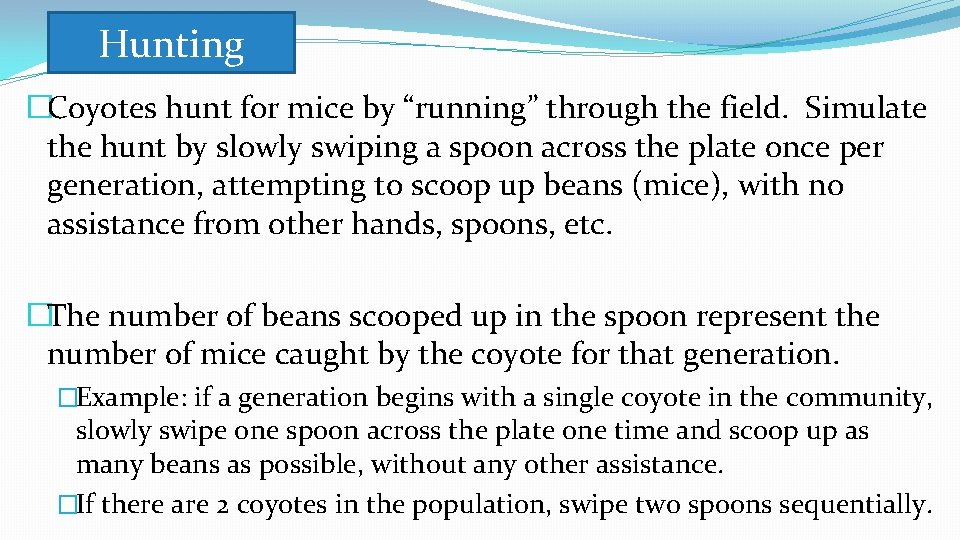
Hunting �Coyotes hunt for mice by “running” through the field. Simulate the hunt by slowly swiping a spoon across the plate once per generation, attempting to scoop up beans (mice), with no assistance from other hands, spoons, etc. �The number of beans scooped up in the spoon represent the number of mice caught by the coyote for that generation. �Example: if a generation begins with a single coyote in the community, slowly swipe one spoon across the plate one time and scoop up as many beans as possible, without any other assistance. �If there are 2 coyotes in the population, swipe two spoons sequentially.
Predator-Prey Interactions Activity 2 – Coyotes Go Hunting
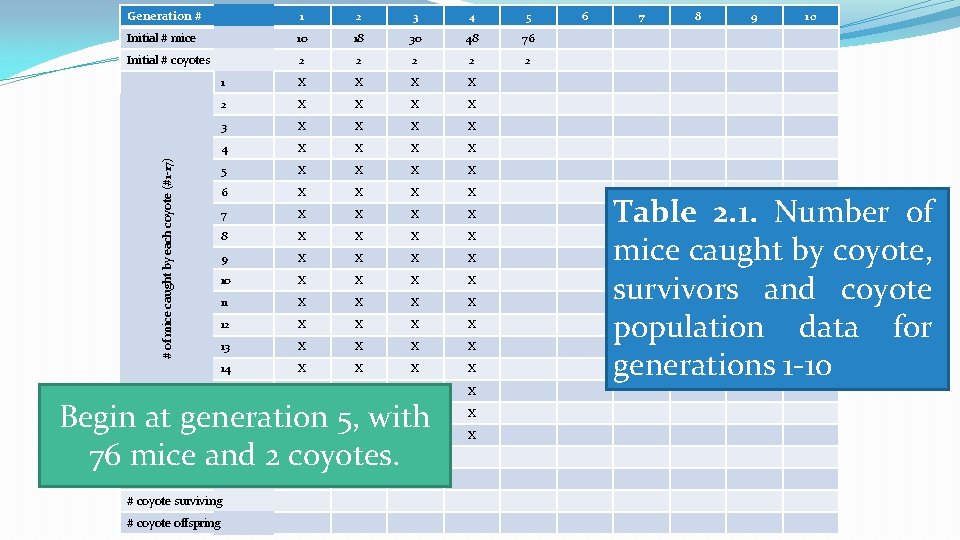
1 2 3 4 5 Initial # mice 10 18 30 48 76 Initial # coyotes 2 2 2 1 X X 2 X X 3 X X 4 X X 5 X X 6 X X 7 X X 8 X X 9 X X 10 X X 11 X X 12 X X 13 X X 14 X X 15 X X 16 X X 17 X X # of mice caught by each coyote (#1 -17) Generation # Begin at generation 5, with 76 mice and 2 coyotes. # mice captured # mice surviving # coyote offspring 6 7 8 9 10 Table 2. 1. Number of mice caught by coyote, survivors and coyote population data for generations 1 -10
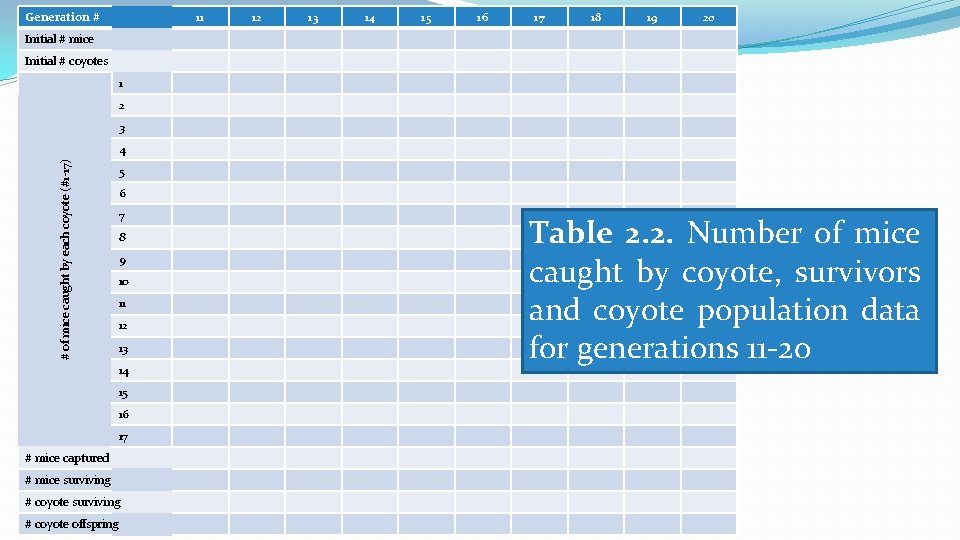
Generation # 11 12 13 14 15 16 17 18 19 20 Initial # mice Initial # coyotes 1 2 3 # of mice caught by each coyote (#1 -17) 4 5 6 7 8 9 10 11 12 13 14 15 16 17 # mice captured # mice surviving # coyote offspring Table 2. 2. Number of mice caught by coyote, survivors and coyote population data for generations 11 -20
Simulated Mark-Recapture Activity 1 – Simple Mark-Recapture
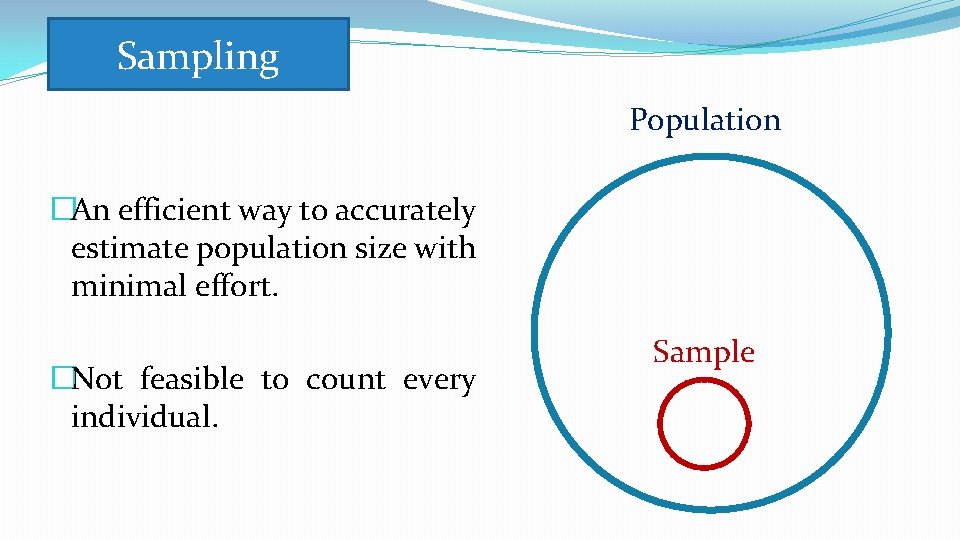
Sampling Population �An efficient way to accurately estimate population size with minimal effort. �Not feasible to count every individual. Sample
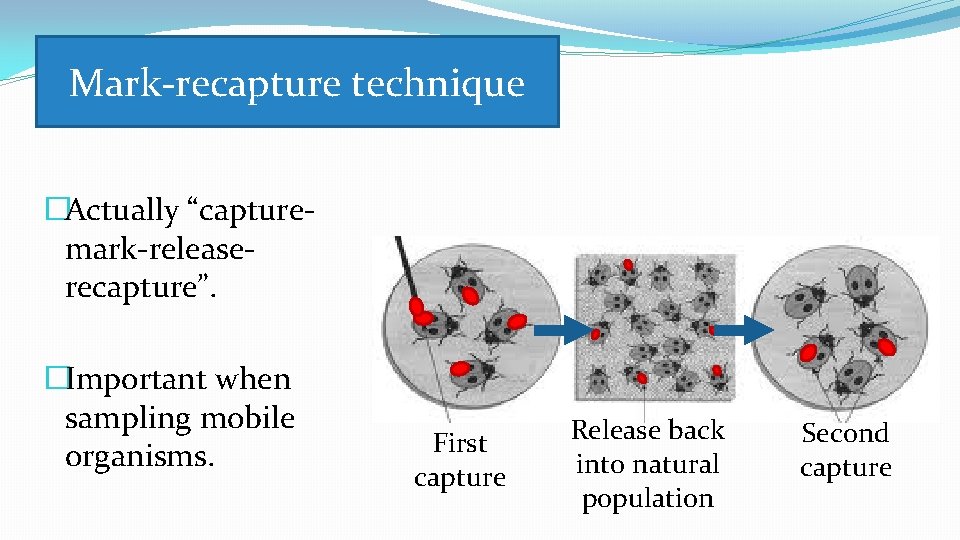
Mark-recapture technique �Actually “capturemark-releaserecapture”. �Important when sampling mobile organisms. First capture Release back into natural population Second capture
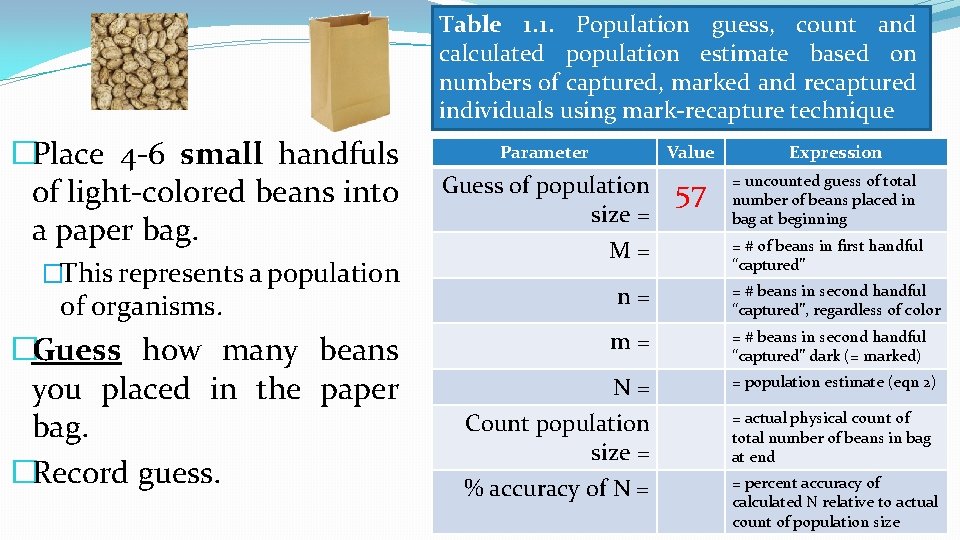
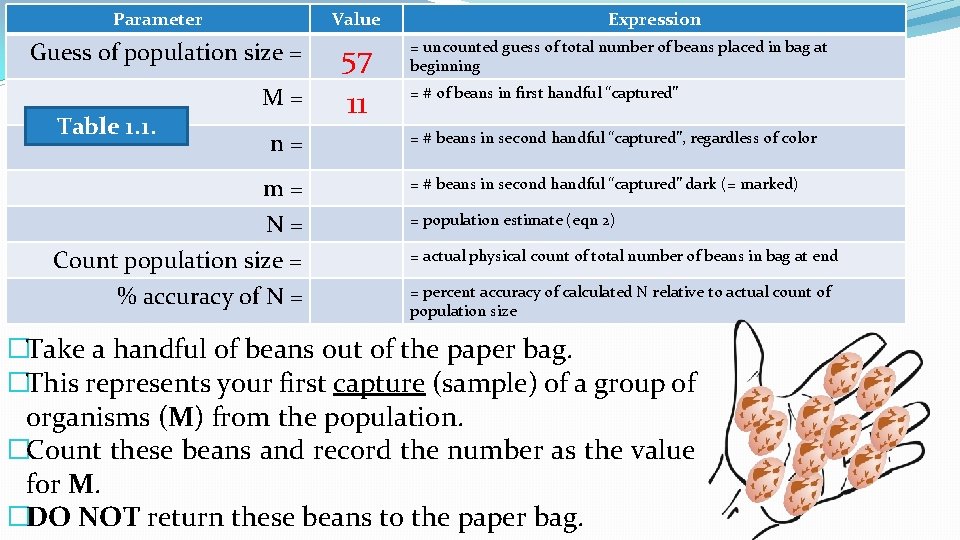
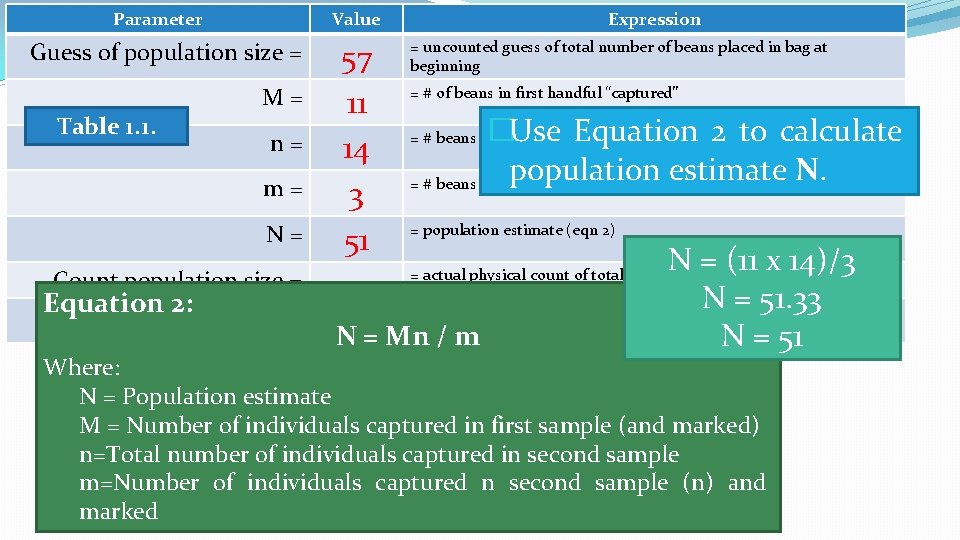
Table 1. 1. Population guess, count and calculated population estimate based on numbers of captured, marked and recaptured individuals using mark-recapture technique �Place 4 -6 small handfuls of light-colored beans into a paper bag. �This represents a population of organisms. �Guess how many beans you placed in the paper bag. �Record guess. Parameter Value Guess of population size = 57 M= n= Expression = uncounted guess of total number of beans placed in bag at beginning = # of beans in first handful “captured” = # beans in second handful “captured”, regardless of color m= = # beans in second handful “captured” dark (= marked) N= = population estimate (eqn 2) Count population size = % accuracy of N = = actual physical count of total number of beans in bag at end = percent accuracy of calculated N relative to actual count of population size
Parameter Value Guess of population size = Table 1. 1. M= n= m= N= Count population size = % accuracy of N = 57 11 Expression = uncounted guess of total number of beans placed in bag at beginning = # of beans in first handful “captured” = # beans in second handful “captured”, regardless of color = # beans in second handful “captured” dark (= marked) = population estimate (eqn 2) = actual physical count of total number of beans in bag at end = percent accuracy of calculated N relative to actual count of population size �Take a handful of beans out of the paper bag. �This represents your first capture (sample) of a group of organisms (M) from the population. �Count these beans and record the number as the value for M. �DO NOT return these beans to the paper bag.
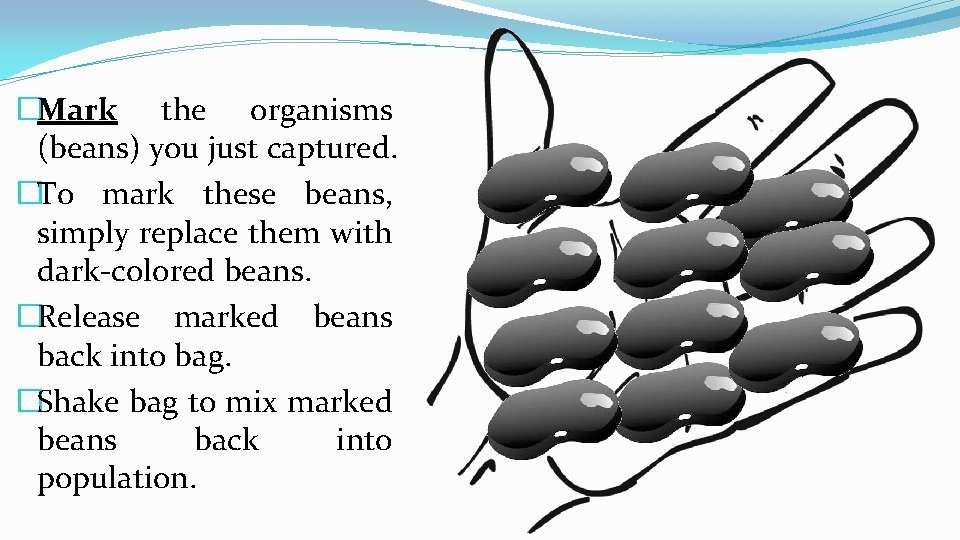
�Mark the organisms (beans) you just captured. �To mark these beans, simply replace them with dark-colored beans. �Release marked beans back into bag. �Shake bag to mix marked beans back into population.
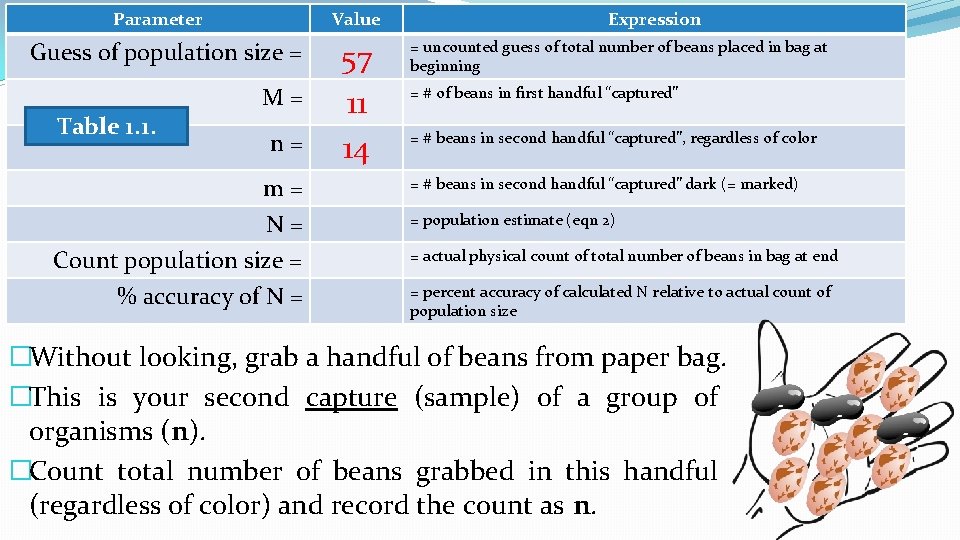
Parameter Value Guess of population size = Table 1. 1. M= n= m= N= Count population size = % accuracy of N = 57 11 14 Expression = uncounted guess of total number of beans placed in bag at beginning = # of beans in first handful “captured” = # beans in second handful “captured”, regardless of color = # beans in second handful “captured” dark (= marked) = population estimate (eqn 2) = actual physical count of total number of beans in bag at end = percent accuracy of calculated N relative to actual count of population size �Without looking, grab a handful of beans from paper bag. �This is your second capture (sample) of a group of organisms (n). �Count total number of beans grabbed in this handful (regardless of color) and record the count as n.
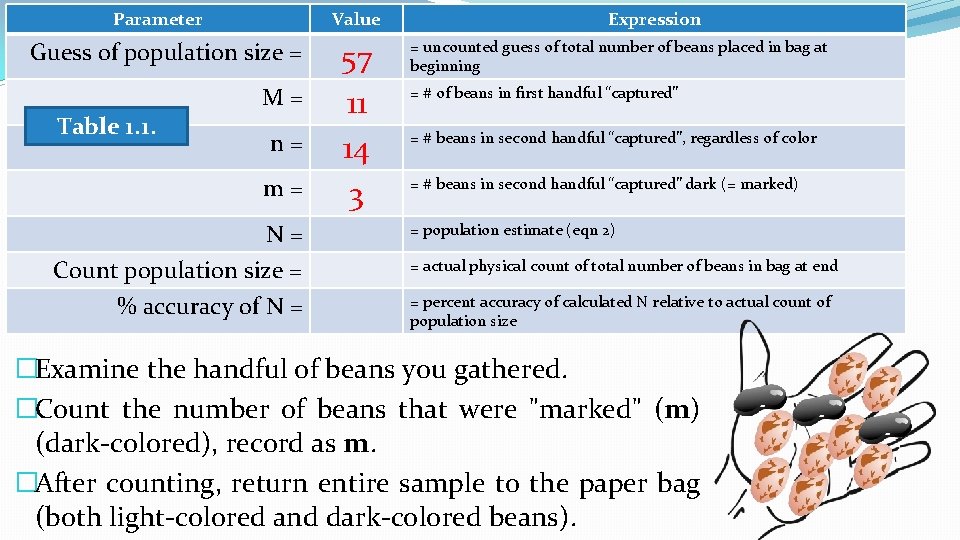
Parameter Value Guess of population size = Table 1. 1. M= n= m= N= Count population size = % accuracy of N = 57 11 14 3 Expression = uncounted guess of total number of beans placed in bag at beginning = # of beans in first handful “captured” = # beans in second handful “captured”, regardless of color = # beans in second handful “captured” dark (= marked) = population estimate (eqn 2) = actual physical count of total number of beans in bag at end = percent accuracy of calculated N relative to actual count of population size �Examine the handful of beans you gathered. �Count the number of beans that were "marked" (m) (dark-colored), record as m. �After counting, return entire sample to the paper bag (both light-colored and dark-colored beans).
Parameter Value Guess of population size = Table 1. 1. M= n= m= N= Count population size = Equation 2: % accuracy of N = 57 11 14 3 51 Expression = uncounted guess of total number of beans placed in bag at beginning = # of beans in first handful “captured” �Use Equation 2 to calculate population estimate N. = # beans in second handful “captured” dark (= marked) = # beans in second handful “captured”, regardless of color = population estimate (eqn 2) N = (11 x 14)/3 N = 51. 33 = percent accuracy of calculated N relative to actual count of population size N = Mn /m N = 51 = actual physical count of total number of beans in bag at end Where: N = Population estimate M = Number of individuals captured in first sample (and marked) n=Total number of individuals captured in second sample m=Number of individuals captured n second sample (n) and marked
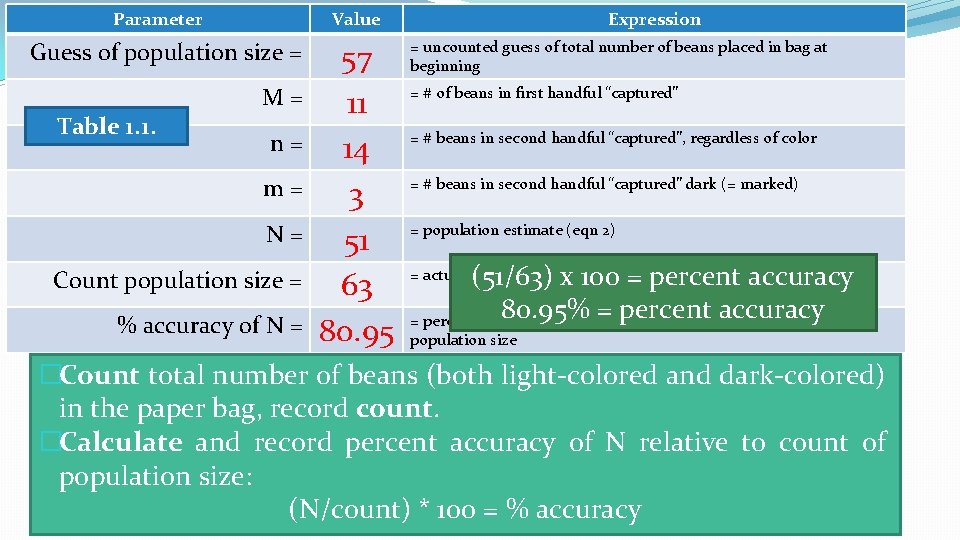
Parameter Value Guess of population size = Table 1. 1. M= n= m= N= Count population size = % accuracy of N = 57 11 14 3 51 63 80. 95 Expression = uncounted guess of total number of beans placed in bag at beginning = # of beans in first handful “captured” = # beans in second handful “captured”, regardless of color = # beans in second handful “captured” dark (= marked) = population estimate (eqn 2) (51/63) x 100 = percent accuracy 80. 95% = percent accuracy of calculated N relative toaccuracy actual count of = actual physical count of total number of beans in bag at end population size �Count total number of beans (both light-colored and dark-colored) in the paper bag, record count. �Calculate and record percent accuracy of N relative to count of population size: (N/count) * 100 = % accuracy
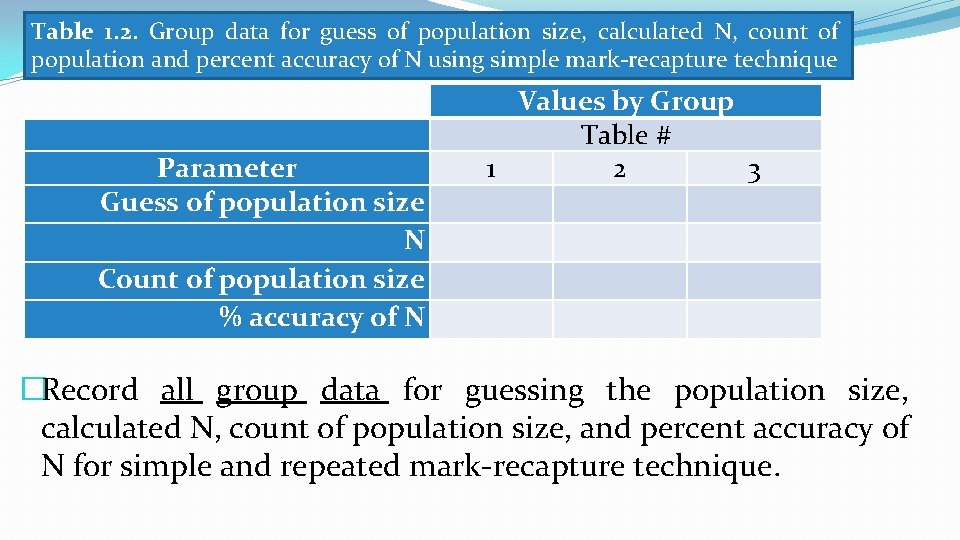
Table 1. 2. Group data for guess of population size, calculated N, count of population and percent accuracy of N using simple mark-recapture technique Parameter Guess of population size N Count of population size % accuracy of N Values by Group Table # 1 2 3 �Record all group data for guessing the population size, calculated N, count of population size, and percent accuracy of N for simple and repeated mark-recapture technique.
Simulated Mark-Recapture Activity 2 – Repeated Mark-Recapture
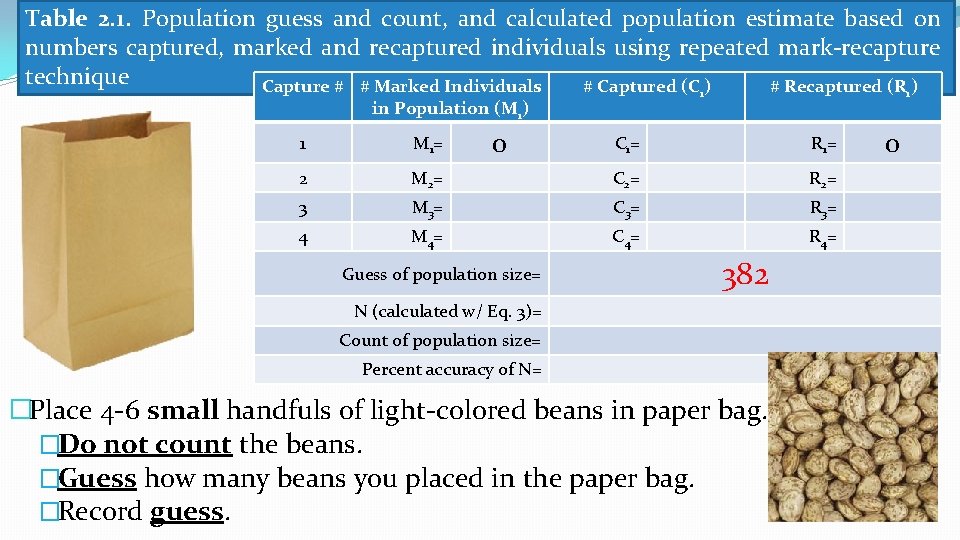
Table 2. 1. Population guess and count, and calculated population estimate based on numbers captured, marked and recaptured individuals using repeated mark-recapture technique Capture # # Marked Individuals # Captured (C ) # Recaptured (R ) 1 in Population (M 1) 1 M 1 = 2 0 1 C 1 = R 1 = M 2= C 2= R 2= 3 M 3= C 3= R 3= 4 M 4= C 4= R 4= Guess of population size= 382 N (calculated w/ Eq. 3)= Count of population size= Percent accuracy of N= �Place 4 -6 small handfuls of light-colored beans in paper bag. �Do not count the beans. �Guess how many beans you placed in the paper bag. �Record guess. 0
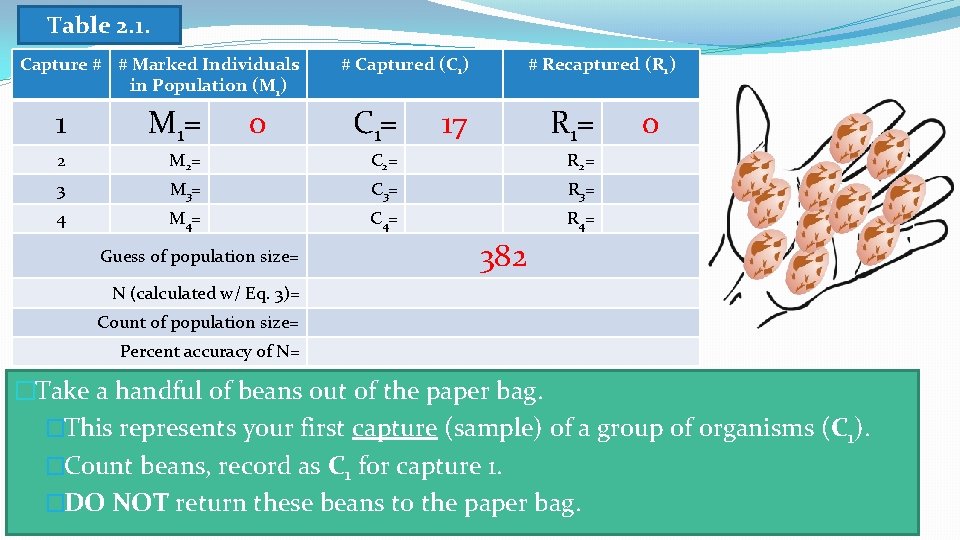
Table 2. 1. Capture # # Marked Individuals in Population (M 1) 0 # Captured (C 1) 1 M 1 = 2 M 2= C 2= R 2= 3 M 3= C 3= R 3= 4 M 4= C 4= R 4= Guess of population size= C 1 = # Recaptured (R 1) 17 R 1 = 0 382 N (calculated w/ Eq. 3)= Count of population size= Percent accuracy of N= �Take a handful of beans out of the paper bag. �This represents your first capture (sample) of a group of organisms (C 1). �Count beans, record as C 1 for capture 1. �DO NOT return these beans to the paper bag.
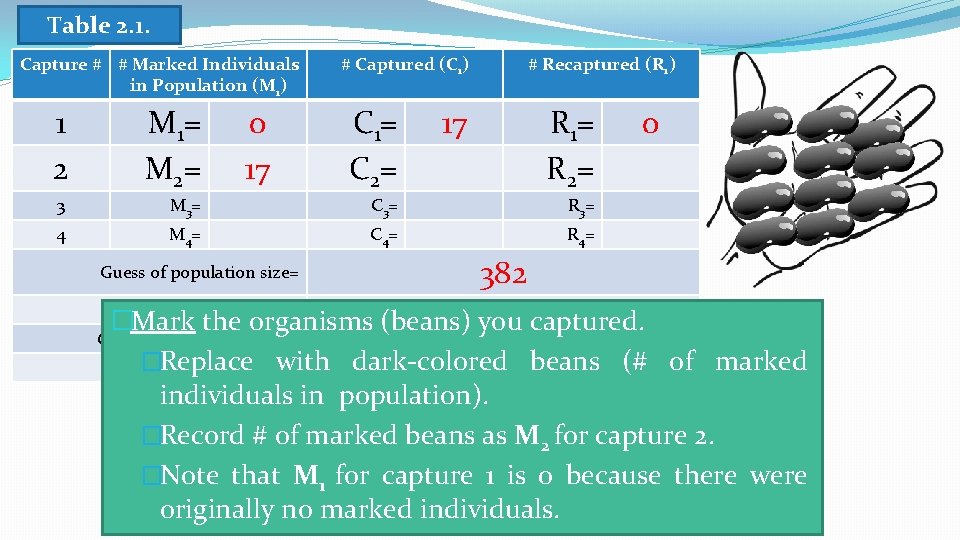
Table 2. 1. Capture # # Marked Individuals in Population (M 1) 0 17 # Captured (C 1) 1 2 M 1 = M 2= 3 M 3= C 3= R 3= 4 M 4= C 4= R 4= Guess of population size= N (calculated w/ Eq. 3)= C 1 = C 2= # Recaptured (R 1) 17 R 1 = R 2= 0 382 �Mark the organisms (beans) you captured. Count of population size= �Replace dark-colored beans (# of marked Percent accuracy of with N= individuals in population). �Record # of marked beans as M 2 for capture 2. �Note that M 1 for capture 1 is 0 because there were originally no marked individuals.
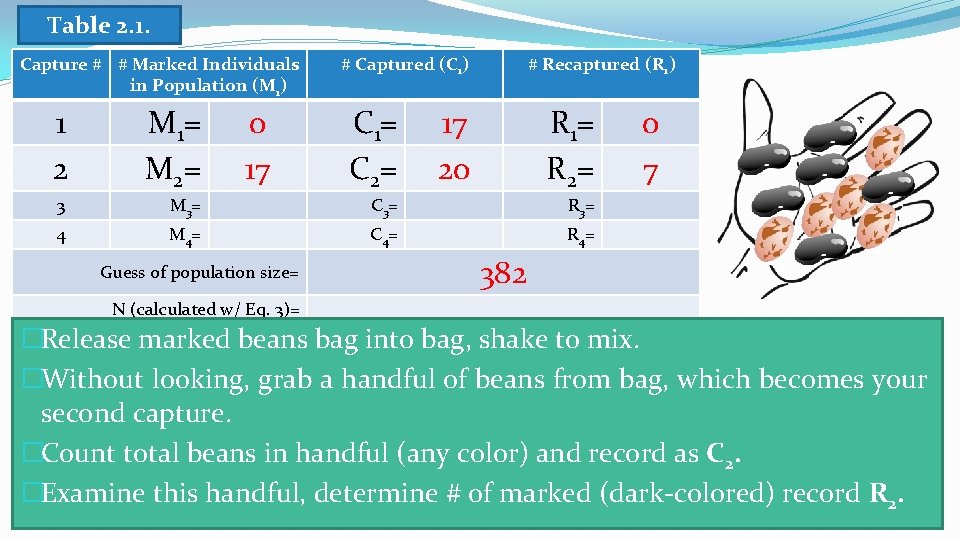
Table 2. 1. Capture # # Marked Individuals in Population (M 1) 0 17 # Captured (C 1) 1 2 M 1 = M 2= 3 M 3= C 3= R 3= 4 M 4= C 4= R 4= Guess of population size= C 1 = C 2= # Recaptured (R 1) 17 20 R 1 = R 2= 0 7 382 N (calculated w/ Eq. 3)= Countmarked of population size= bag into bag, shake to mix. �Release beans Percent accuracy of N= �Without looking, grab a handful of beans from bag, which becomes your second capture. �Count total beans in handful (any color) and record as C 2. �Examine this handful, determine # of marked (dark-colored) record R 2.
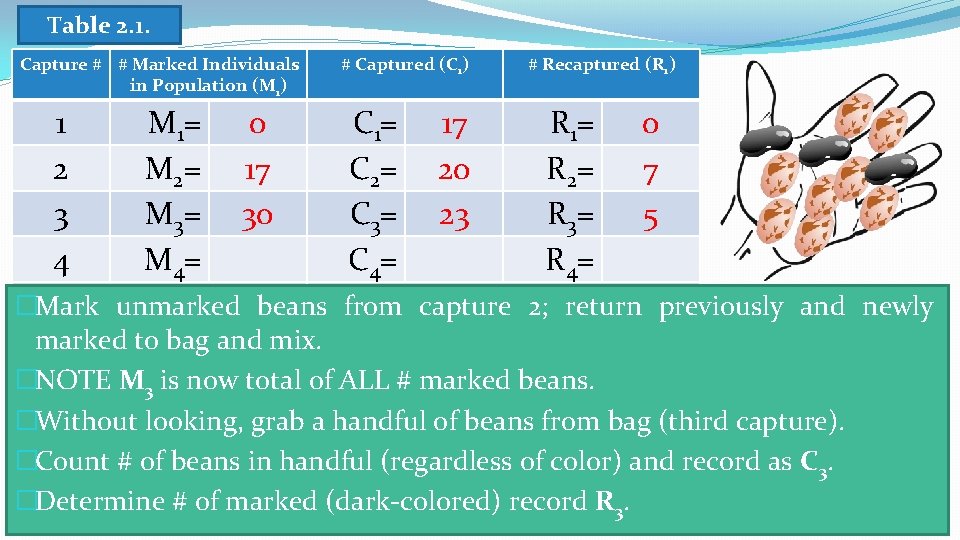
Table 2. 1. Capture # # Marked Individuals in Population (M 1) 1 2 3 4 M 1 = M 2= M 3 = M 4 = 0 17 30 # Captured (C 1) C 1 = C 2= C 3= C 4 = 17 20 23 # Recaptured (R 1) R 1 = R 2= R 3= R 4 = 0 7 5 of population beans size= �Mark. Guess unmarked from capture 3822; return previously and newly N (calculated w/ Eq. mix. 3)= marked to bag and Count of population size= �NOTE M 3 is now total of ALL # marked beans. Percent accuracy of N= �Without looking, grab a handful of beans from bag (third capture). �Count # of beans in handful (regardless of color) and record as C 3. �Determine # of marked (dark-colored) record R 3.
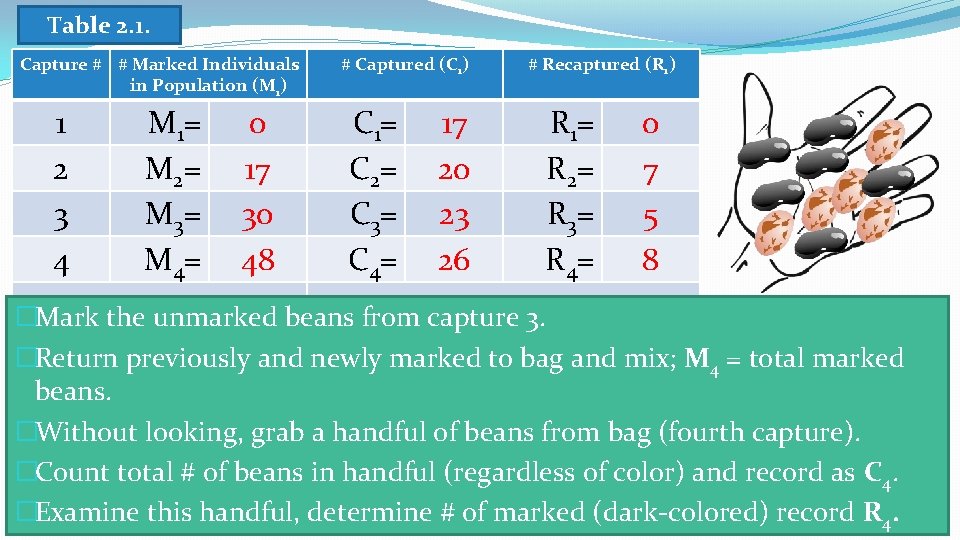
Table 2. 1. Capture # # Marked Individuals in Population (M 1) 1 2 3 4 M 1 = M 2= M 3 = M 4 = 0 17 30 48 # Captured (C 1) C 1 = C 2= C 3= C 4 = 17 20 23 26 # Recaptured (R 1) R 1 = R 2= R 3= R 4 = 0 7 5 8 3823. �Mark the unmarked beans from capture N (calculated w/ Eq. 3)= �Return previously and newly marked to bag and mix; M 4 = total marked Count of population size= beans. Percent accuracy of N= �Without looking, grab a handful of beans from bag (fourth capture). �Count total # of beans in handful (regardless of color) and record as C 4. �Examine this handful, determine # of marked (dark-colored) record R 4. Guess of population size=
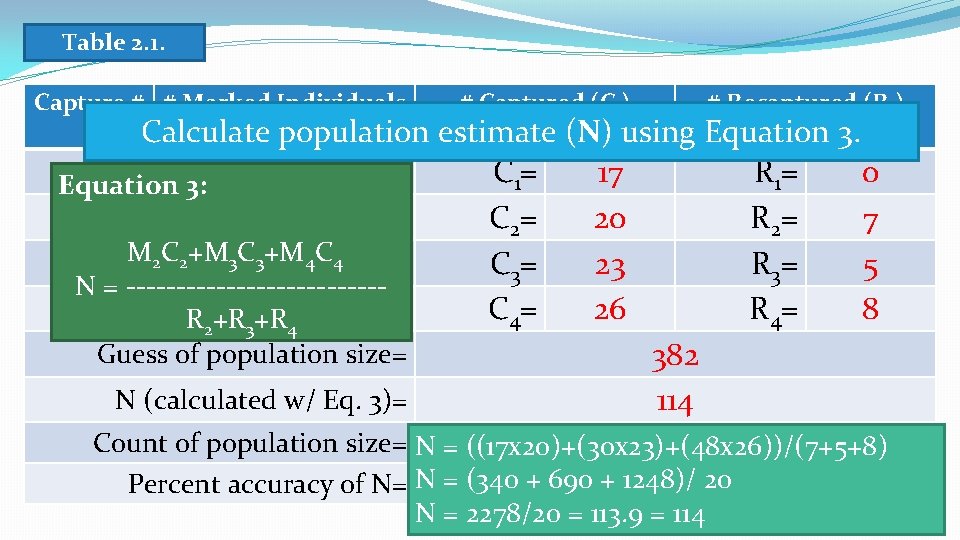
Table 2. 1. Capture # # Marked Individuals in Population (M 1) Calculate population # Captured (C 1) # Recaptured (R 1) estimate (N) using Equation 3. 1 0 C 1 = 17 R 1 = 0 Equation 3: M 1= 2 M 2= 17 C 2= 20 R 2= 7 +M 4 C 430 3 C 3= 3 M 2 C 2+MM C 3= 23 R 3= 5 3 N = -------------4 M 4+R = 48 C 4 = 26 R 4 = 8 R 2+R 3 4 Guess of population size= 382 N (calculated w/ Eq. 3)= 114 Count of population size= N = ((17 x 20)+(30 x 23)+(48 x 26))/(7+5+8) Percent accuracy of N= N = (340 + 690 + 1248)/ 20 N = 2278/20 = 113. 9 = 114
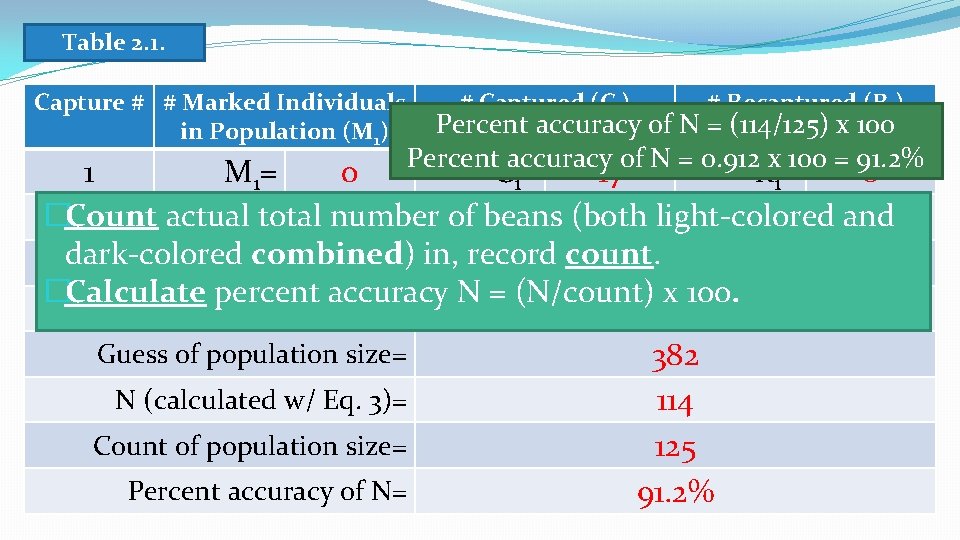
Table 2. 1. Capture # # Marked Individuals in Population (M 1) # Captured (C 1) # Recaptured (R 1) Percent accuracy of N = (114/125) x 100 Percent accuracy of N = 0. 912 x 100 = 91. 2% 1 M 1 = 0 C 1 = 17 R 1 = 0 �Count actual number of beans 2 M 2 total = 17 C 2= (both 20 light-colored R 2= and 7 dark-colored in, record 3 M 3 combined) = 30 C 3= count. 23 R 3= 5 �Calculate percent accuracy N = (N/count) x 100. 4 M 4 = 48 C 4 = 26 R 4 = 8 Guess of population size= 382 N (calculated w/ Eq. 3)= 114 Count of population size= 125 Percent accuracy of N= 91. 2%
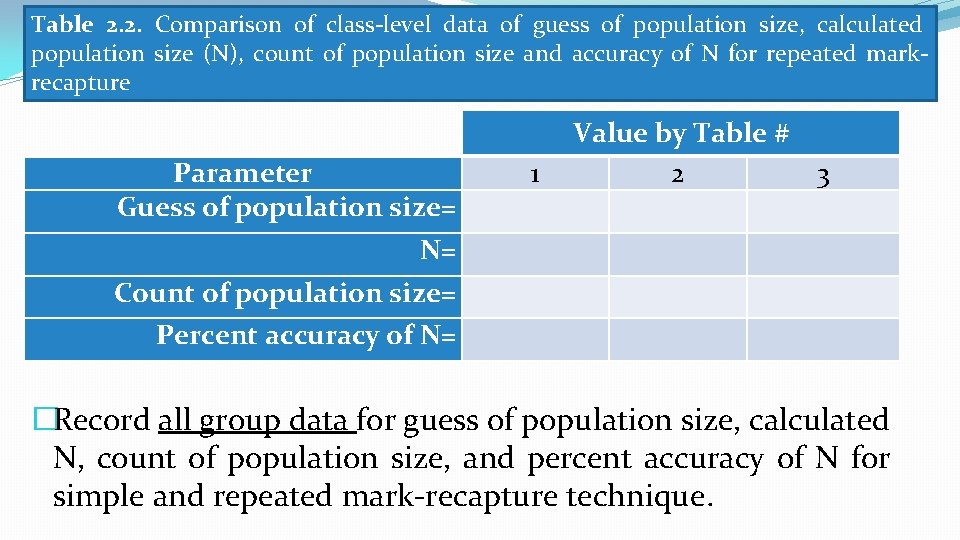
Table 2. 2. Comparison of class-level data of guess of population size, calculated population size (N), count of population size and accuracy of N for repeated markrecapture Parameter Guess of population size= 1 Value by Table # 2 3 N= Count of population size= Percent accuracy of N= �Record all group data for guess of population size, calculated N, count of population size, and percent accuracy of N for simple and repeated mark-recapture technique.
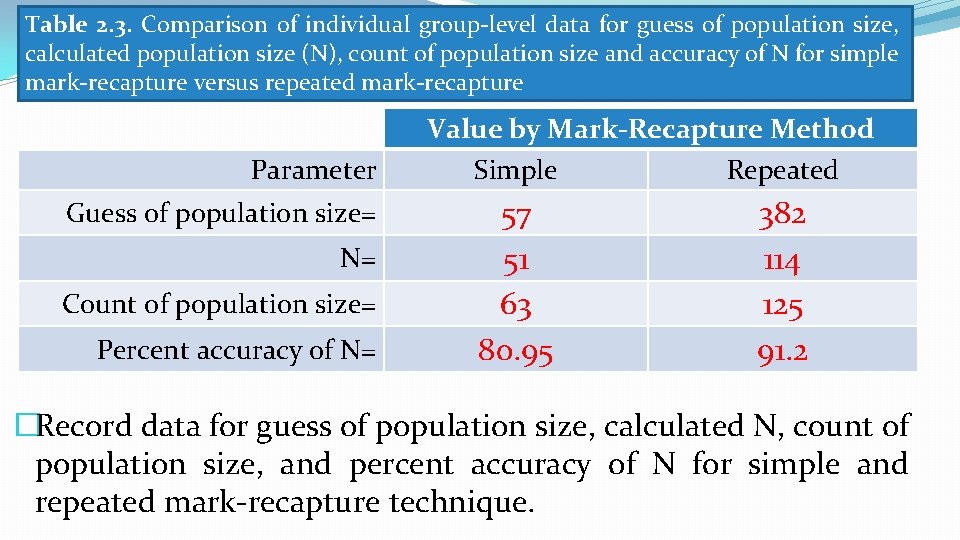
Table 2. 3. Comparison of individual group-level data for guess of population size, calculated population size (N), count of population size and accuracy of N for simple mark-recapture versus repeated mark-recapture Parameter Guess of population size= N= Count of population size= Percent accuracy of N= Value by Mark-Recapture Method Simple Repeated 57 51 63 80. 95 382 114 125 91. 2 �Record data for guess of population size, calculated N, count of population size, and percent accuracy of N for simple and repeated mark-recapture technique.
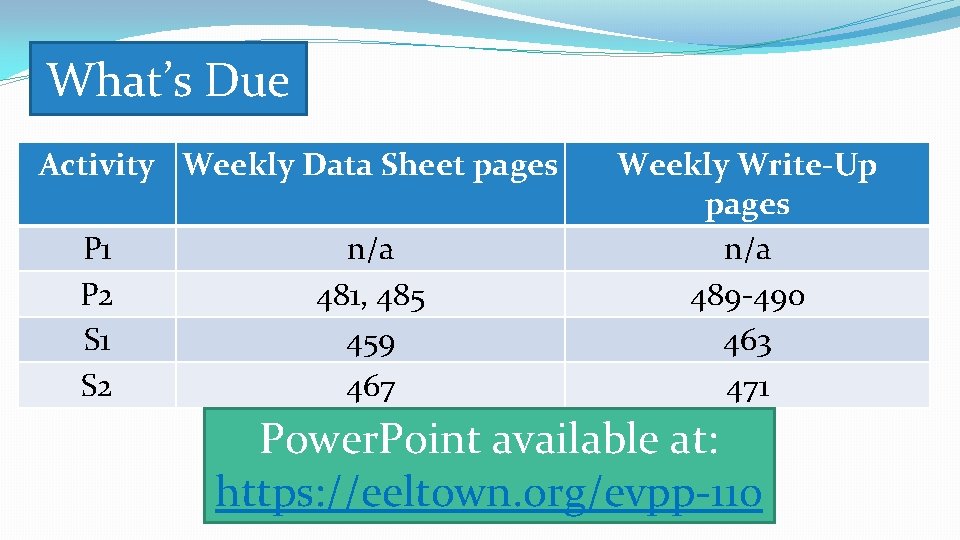
What’s Due Activity Weekly Data Sheet pages P 1 P 2 S 1 S 2 n/a 481, 485 459 467 Weekly Write-Up pages n/a 489 -490 463 471 Power. Point available at: https: //eeltown. org/evpp-110