
Predation Lecture 13 Overview Chapter in Text 15

- Slides: 32
Predation Lecture 13
• • • Overview Chapter in Text: 15, 17 Predation and Herbivory Responses of individuals to predation Responses of populations to predation – refuges Importance of Predators – Maintenance of ecosystem diversity – as a Keystone species
What is a predator? • Narrow sense • Broad sense • Ecological definition of predator: – Herbivores: • Grazers and browsers – consume part of plant/plant not killed • Seed eaters + planktinovores: consume entire plant – Parasite: generally do not kill host – Parasitoid: lay eggs in host – feeding by larvae eventually kill host
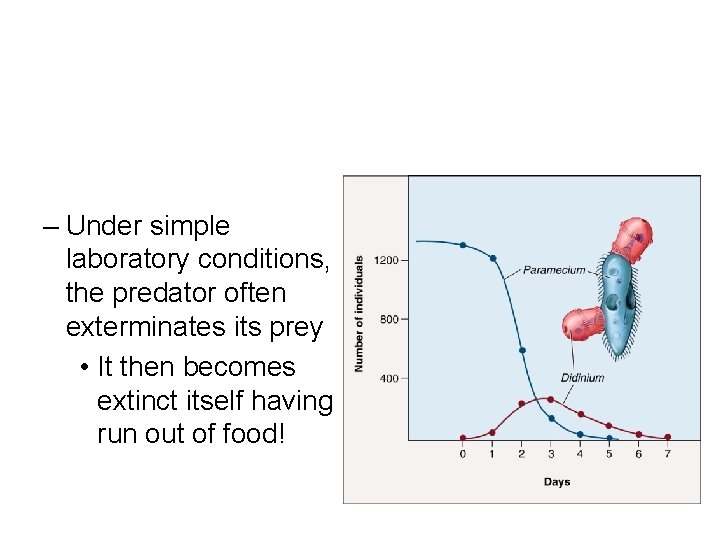
– Under simple laboratory conditions, the predator often exterminates its prey • It then becomes extinct itself having run out of food!
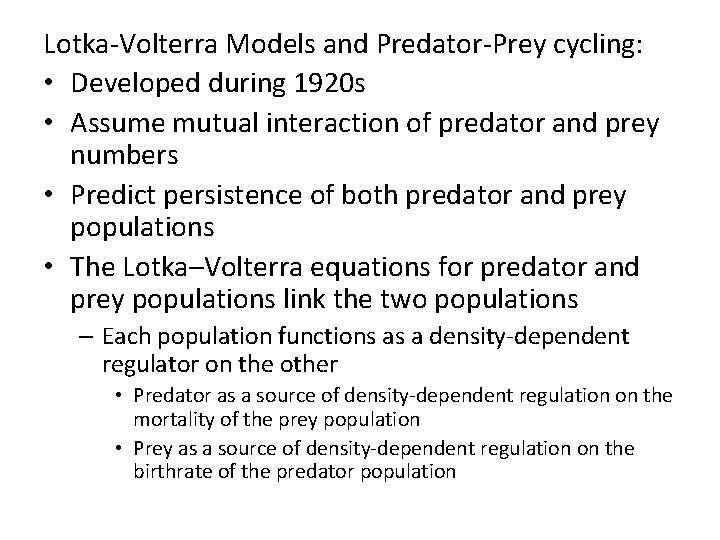
Lotka-Volterra Models and Predator-Prey cycling: • Developed during 1920 s • Assume mutual interaction of predator and prey numbers • Predict persistence of both predator and prey populations • The Lotka–Volterra equations for predator and prey populations link the two populations – Each population functions as a density-dependent regulator on the other • Predator as a source of density-dependent regulation on the mortality of the prey population • Prey as a source of density-dependent regulation on the birthrate of the predator population
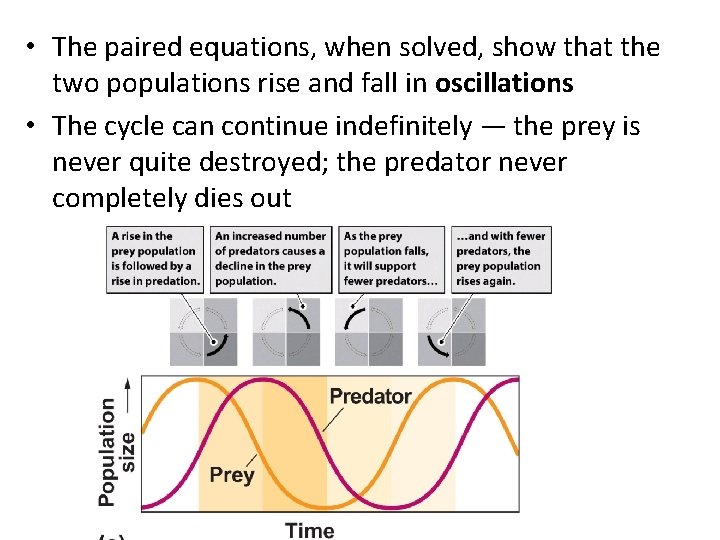
• The paired equations, when solved, show that the two populations rise and fall in oscillations • The cycle can continue indefinitely — the prey is never quite destroyed; the predator never completely dies out
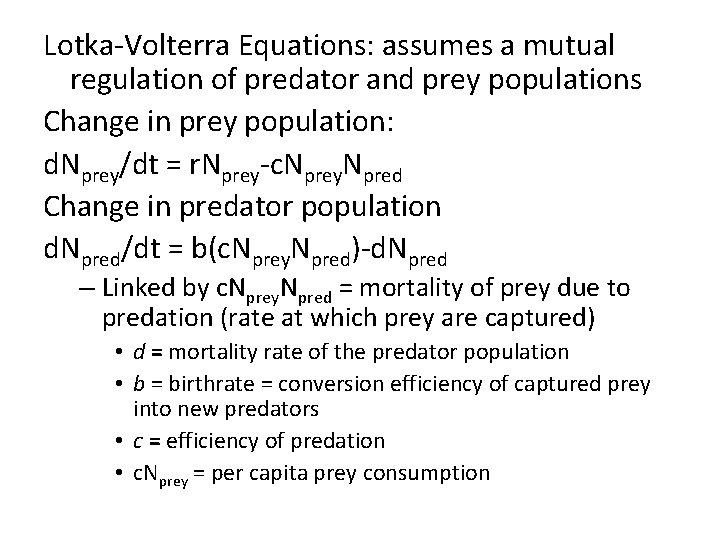
Lotka-Volterra Equations: assumes a mutual regulation of predator and prey populations Change in prey population: d. Nprey/dt = r. Nprey-c. Nprey. Npred Change in predator population d. Npred/dt = b(c. Nprey. Npred)-d. Npred – Linked by c. Nprey. Npred = mortality of prey due to predation (rate at which prey are captured) • d = mortality rate of the predator population • b = birthrate = conversion efficiency of captured prey into new predators • c = efficiency of predation • c. Nprey = per capita prey consumption
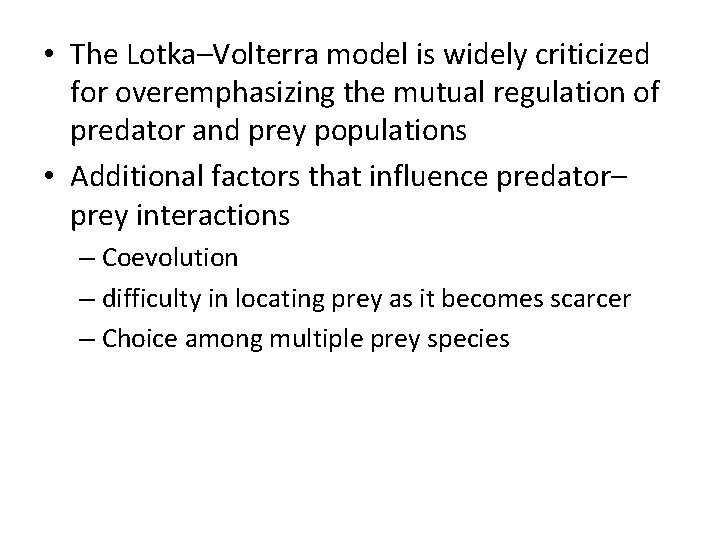
• The Lotka–Volterra model is widely criticized for overemphasizing the mutual regulation of predator and prey populations • Additional factors that influence predator– prey interactions – Coevolution – difficulty in locating prey as it becomes scarcer – Choice among multiple prey species
“Now, here you see, it takes all the running you can do, to keep in the same place” – the Red Queen • Coevolution: as prey species evolve ways to avoid being caught, predators evolve more effective means to capture them • Natural selection (think in terms of fitness) – “smarter, ” more evasive prey – “smarter, ” more skilled predators
• Prey defenses to avoid being detected, selected, and captured by predators: – Chemical defense • Alarm pheromones • Repellants • Toxins – Cryptic coloration – Warning coloration – Protective armor – Behavioral defense
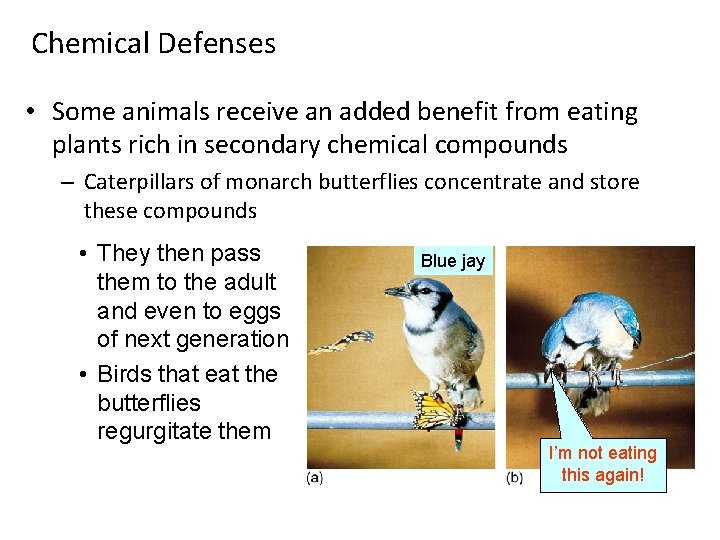
Chemical Defenses • Some animals receive an added benefit from eating plants rich in secondary chemical compounds – Caterpillars of monarch butterflies concentrate and store these compounds • They then pass them to the adult and even to eggs of next generation • Birds that eat the butterflies regurgitate them Blue jay I’m not eating this again!
Plant Responses to Herbivores • Physical – Thorns – Height – Heavy seed coat • Chemical – Toxins – Digestion inhibitors • Nutritional – Low levels of N in older foliage – Tough, difficult to masticate foliage
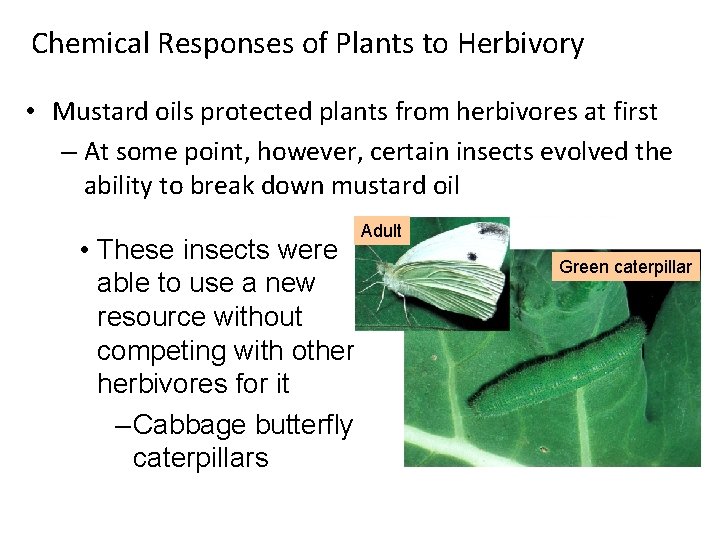
Chemical Responses of Plants to Herbivory • Mustard oils protected plants from herbivores at first – At some point, however, certain insects evolved the ability to break down mustard oil • These insects were able to use a new resource without competing with other herbivores for it – Cabbage butterfly caterpillars Adult Green caterpillar
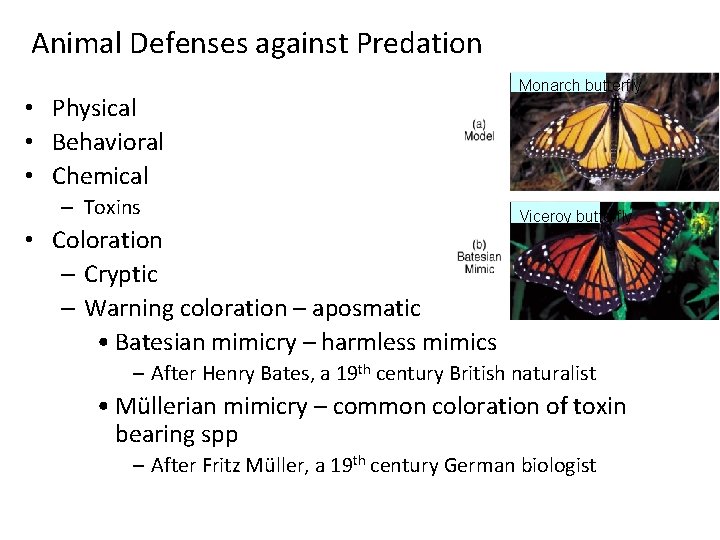
Animal Defenses against Predation • Physical • Behavioral • Chemical – Toxins • Coloration – Cryptic – Warning coloration – aposmatic • Batesian mimicry – harmless mimics Monarch butterfly Viceroy butterfly – After Henry Bates, a 19 th century British naturalist • Müllerian mimicry – common coloration of toxin bearing spp – After Fritz Müller, a 19 th century German biologist
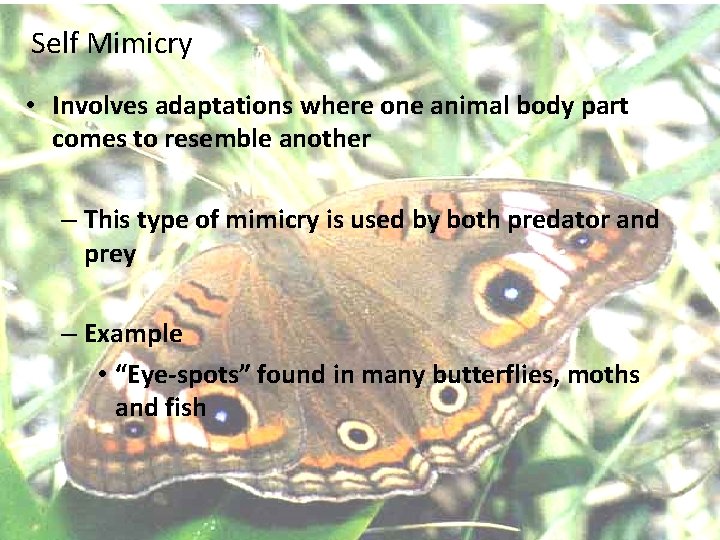
Self Mimicry • Involves adaptations where one animal body part comes to resemble another – This type of mimicry is used by both predator and prey – Example • “Eye-spots” found in many butterflies, moths and fish
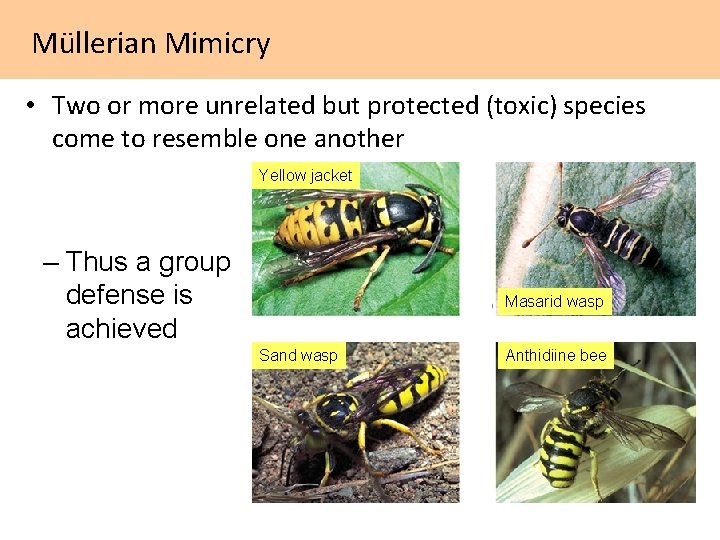
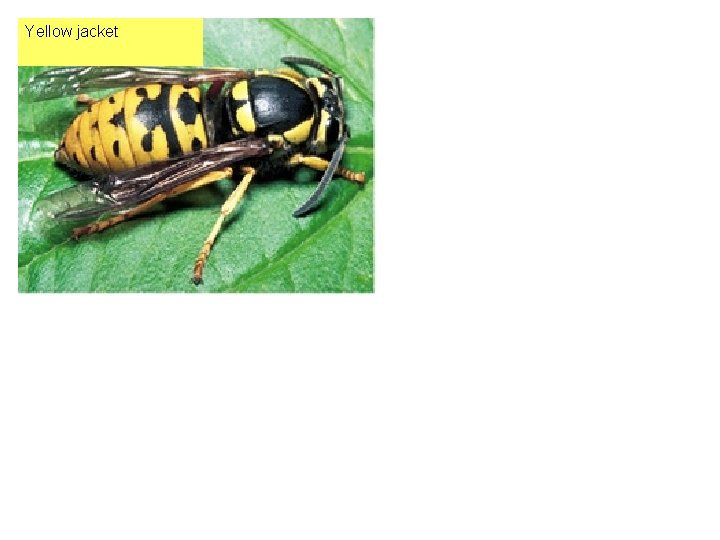
Müllerian Mimicry • Two or more unrelated but protected (toxic) species come to resemble one another Yellow jacket – Thus a group defense is achieved Masarid wasp Sand wasp Anthidiine bee
Yellow jacket
Predation and Behavior Modification - Refuges • Schooling of prey fish – response to predator attack – some survive • Alarm calls – Prairie dogs, ground squirrels • Song birds mob and harass predator bird species • Avoidance – temporal, spatial • Refuges
Refuges • A mechanism that allows exploited population to escape predation/parasitism – many forms: – Place/form of cover, schooling, synchronized reproduction (large numbers at one time), size – May not provide absolute sanctuary, enough for species to survive – Important for survival of predator too!
Protection in Numbers • Living in a large group provides a “refuge. ” • Predator’s response to increased prey density: Prey consumed x Predators = Prey Consumed Predator Area • Wide variety of organisms employ predator satiation defense. – Prey can reduce individual probability of being eaten by living in dense populations.
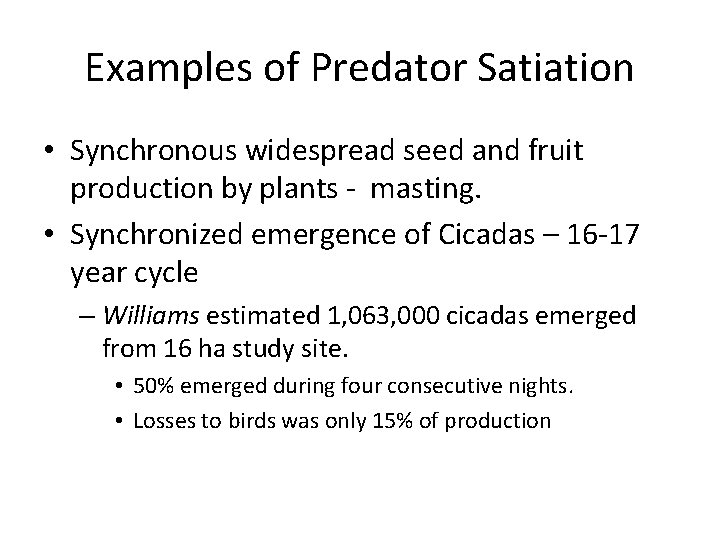
Examples of Predator Satiation • Synchronous widespread seed and fruit production by plants - masting. • Synchronized emergence of Cicadas – 16 -17 year cycle – Williams estimated 1, 063, 000 cicadas emerged from 16 ha study site. • 50% emerged during four consecutive nights. • Losses to birds was only 15% of production
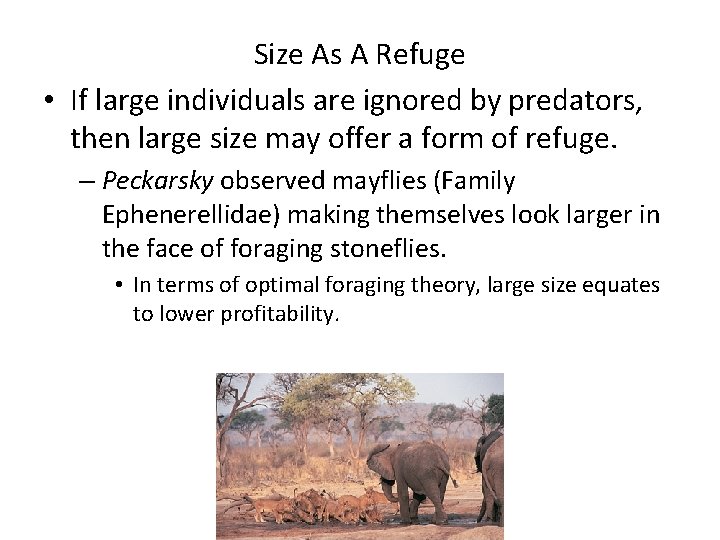
Size As A Refuge • If large individuals are ignored by predators, then large size may offer a form of refuge. – Peckarsky observed mayflies (Family Ephenerellidae) making themselves look larger in the face of foraging stoneflies. • In terms of optimal foraging theory, large size equates to lower profitability.
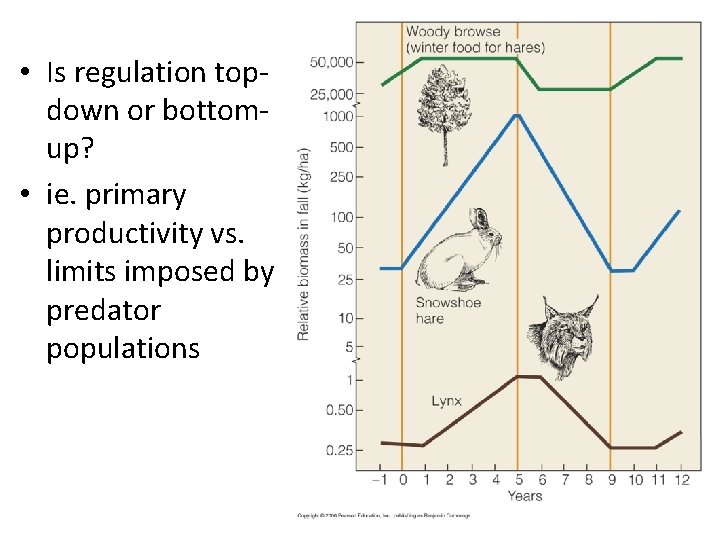
• Is regulation top-down or bottom-up? • ie. primary productivity versus limits imposed by predator populations
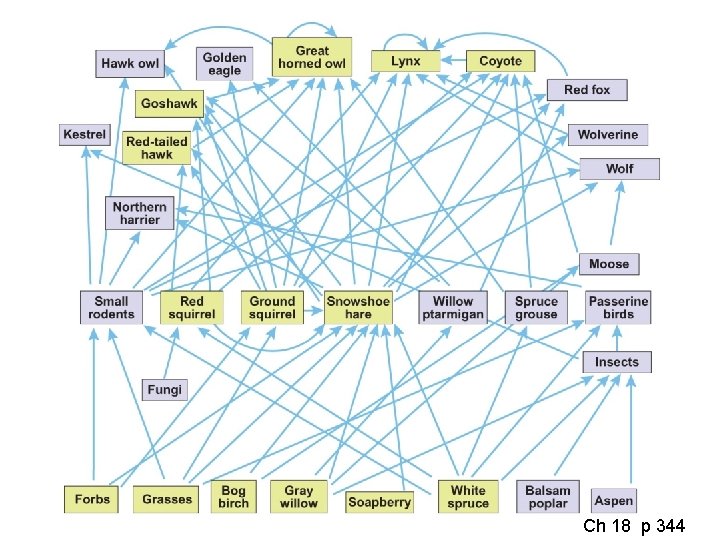
Ch 18 p 344
• Diffuse predator–prey interactions – The lynx, coyote, and horned owl are responsible for the periodic cycles in the snowshoe hare population • Diffuse mutualism – A single plant species may depend on a variety of animal species for successful reproduction
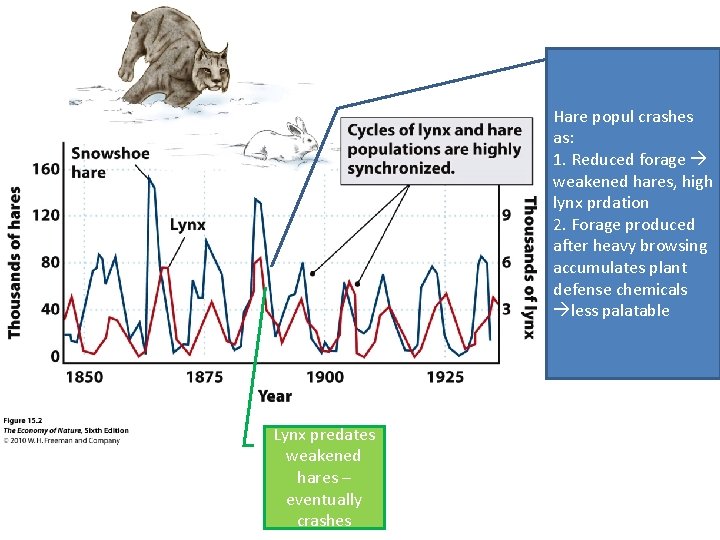
Hare popul crashes as: 1. Reduced forage weakened hares, high lynx prdation 2. Forage produced after heavy browsing accumulates plant defense chemicals less palatable Lynx predates weakened hares – eventually crashes
• Is regulation topdown or bottomup? • ie. primary productivity vs. limits imposed by predator populations
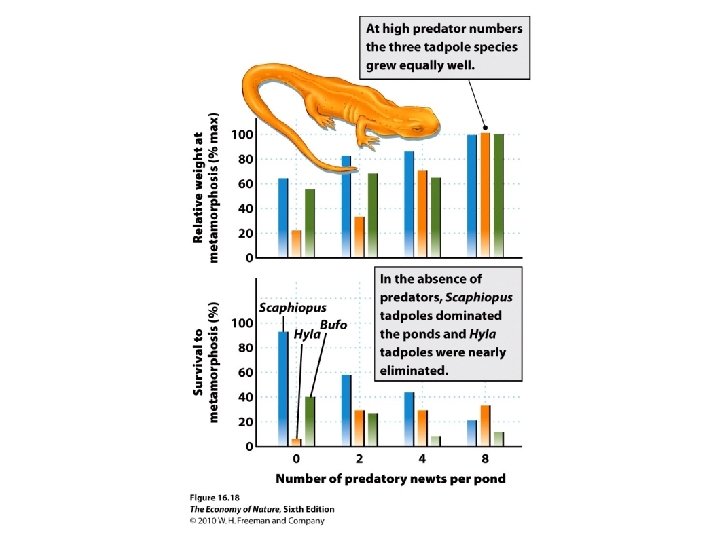
Predators and Diversity – see pages 340 -344 • Alter competitive balance amongst prey spp. – Robert Paine studies: sea star exclusion in intertidal plots decreased prey diversity (15 8 spp) • Selective alteration of competitive relationships – Peter Morin studies – altered competitive relationships amongst immature frog spp by predatory newt
Keystone Predator (or Keystone Consumer – p 379 + ) • Species essential to maintenance of ecosystem structure/diversity • Example (there are many): CA sea otter – kelp forest community
THINGS TO WORRY ABOUT • Your Pores — Portals for Invasion? • Musty Dankness • Fleas & Ticks — Tiny Terrorists What's Embedded in Your Bed? • What Your Mother Never Told You About Those Hidden Corners and Cracks • Pink Mold — Slime or Scourge? Mildew — Mold's Evil Twin