
Precoded VBLAST for ISI MIMO Channels Chunyang Chen
Precoded V-BLAST for ISI MIMO Channels Chun-yang Chen and P. P. Vaidyanathan California Institute of Technology DSP Group, EE, Caltech, Pasadena CA 1
Outline o o Introduction Review of the related work n V-BLAST system [Wolniansky et al. 1998] n Precoded V-BLAST system [Jiang et al. 2004, Xu et al. 2004] n FIR MMSE DFE system for ISI MIMO channels [Al. Dhahir and Sayed 2000] Extend the precoded V-BLAST system from flat-fading channels to ISI channels n FIR based method n OFDM based method Numerical examples DSP Group, EE, Caltech, Pasadena CA 2
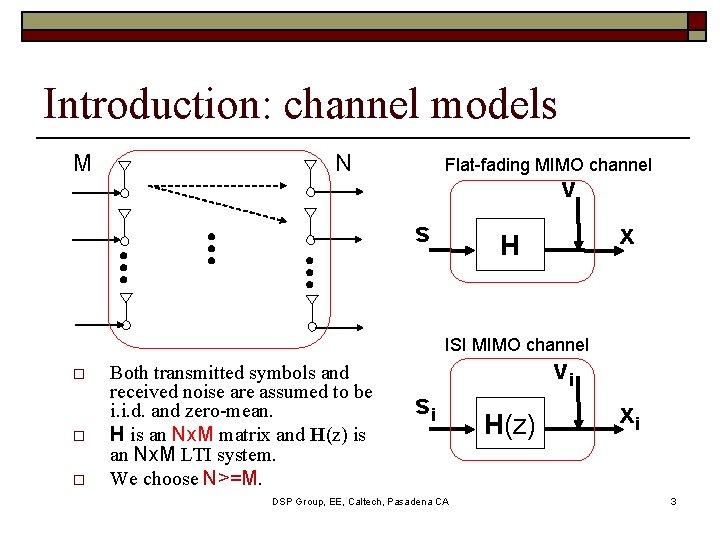
Introduction: channel models M N Flat-fading MIMO channel v s x H ISI MIMO channel o o o Both transmitted symbols and received noise are assumed to be i. i. d. and zero-mean. H is an Nx. M matrix and H(z) is an Nx. M LTI system. We choose N>=M. si DSP Group, EE, Caltech, Pasadena CA vi H(z) xi 3
![Introduction: transceivers v s n[Jiang Precoder n[Wolniansky V-BLAST decoder H ^ s et al.](http://slidetodoc.com/presentation_image_h/82e222da7486ffa30ad05f7d1db601c0/image-4.jpg "Introduction: transceivers v s n[Jiang Precoder n[Wolniansky V-BLAST decoder H ^ s et al.")
Introduction: transceivers v s n[Jiang Precoder n[Wolniansky V-BLAST decoder H ^ s et al. 2004, Xu et al. 2005] v s et al. 1998] Precoder H(z) n[Al-Dhahir DFE decoder and Sayed 2000] ^ s Our goal DSP Group, EE, Caltech, Pasadena CA 4
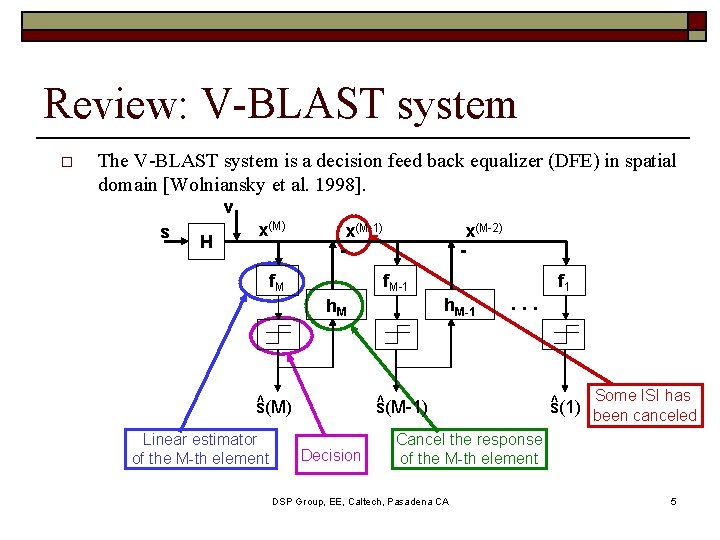
Review: V-BLAST system o The V-BLAST system is a decision feed back equalizer (DFE) in spatial domain [Wolniansky et al. 1998]. v s H x(M) x(M-1) - f. M x(M-2) - f. M-1 h. M ^ s(M) Linear estimator of the M-th element … ^ s(M-1) Decision f 1 Some ISI has ^ s(1) been canceled Cancel the response of the M-th element DSP Group, EE, Caltech, Pasadena CA 5
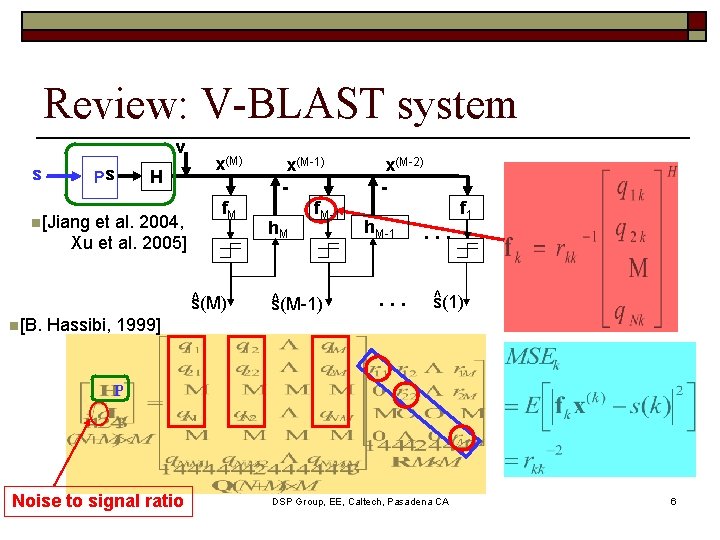
Review: V-BLAST system v s Ps H n[Jiang et al. 2004, Xu et al. 2005] x(M) f. M ^ s(M) n[B. x(M-1) f. M-1 h. M ^ s(M-1) x(M-2) h. M-1 … … f 1 ^ s(1) Hassibi, 1999] P Noise to signal ratio DSP Group, EE, Caltech, Pasadena CA 6
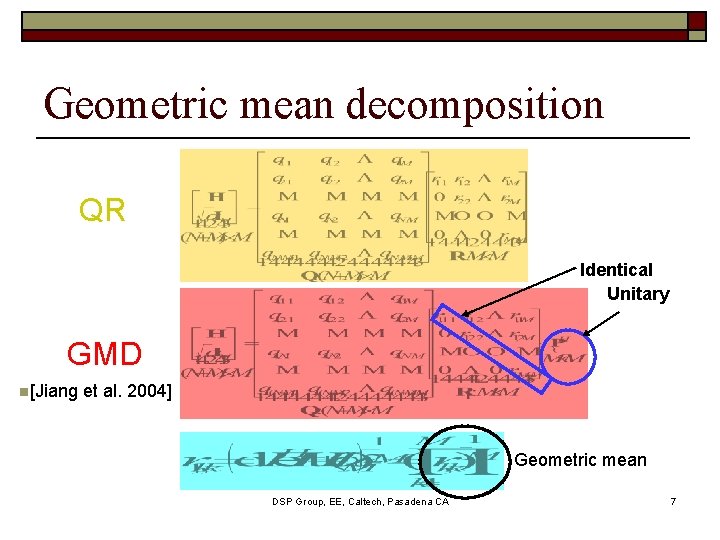
Geometric mean decomposition QR Identical Unitary GMD n[Jiang et al. 2004] Geometric mean DSP Group, EE, Caltech, Pasadena CA 7
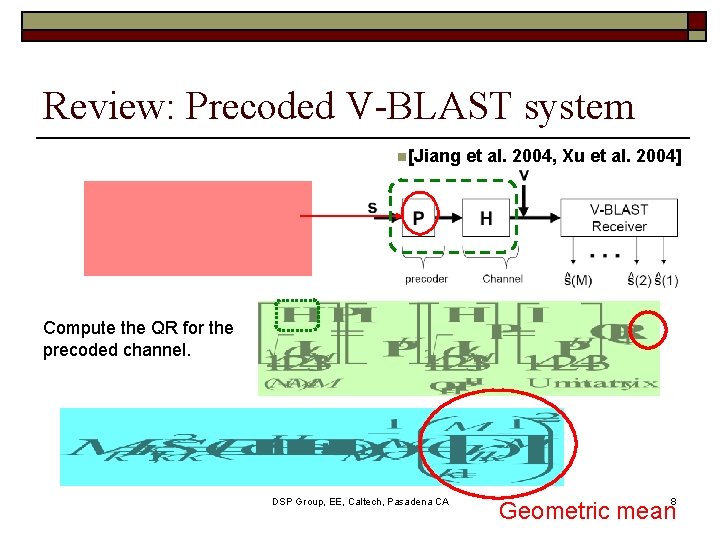
Review: Precoded V-BLAST system n[Jiang et al. 2004, Xu et al. 2004] Compute the QR for the precoded channel. DSP Group, EE, Caltech, Pasadena CA 8 Geometric mean
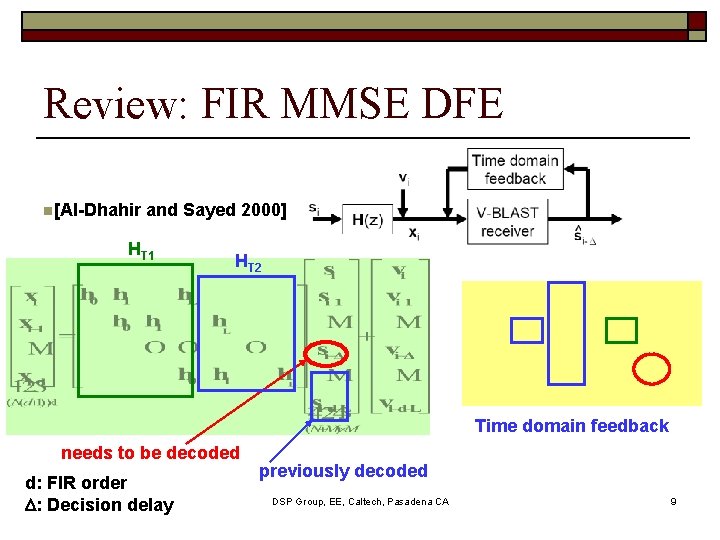
Review: FIR MMSE DFE n[Al-Dhahir and Sayed 2000] HT 1 HT 2 Time domain feedback needs to be decoded d: FIR order D: Decision delay previously decoded DSP Group, EE, Caltech, Pasadena CA 9
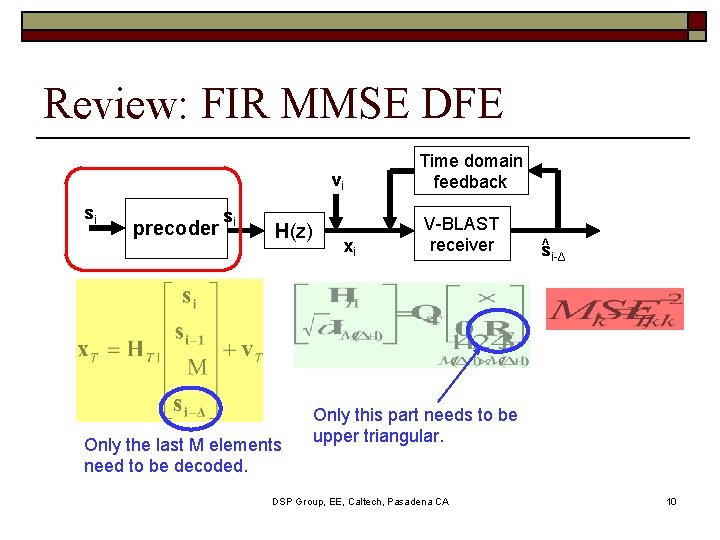
Review: FIR MMSE DFE vi si precoder si H(z) Only the last M elements need to be decoded. xi Time domain feedback V-BLAST receiver s^i-Δ Only this part needs to be upper triangular. DSP Group, EE, Caltech, Pasadena CA 10
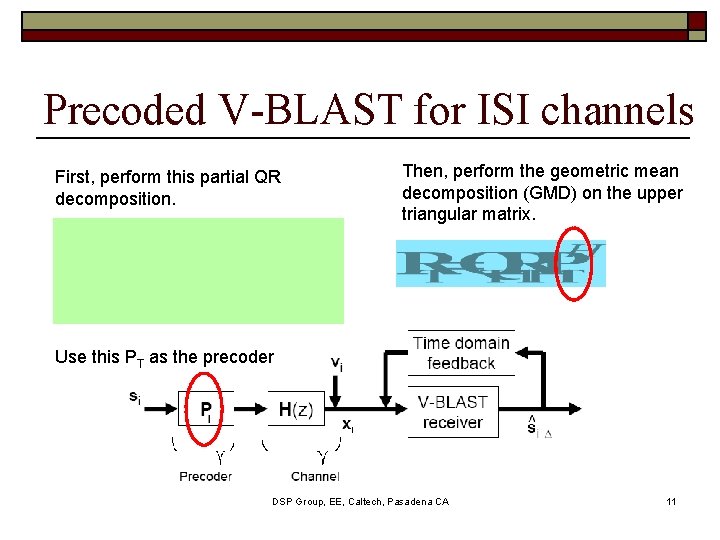
Precoded V-BLAST for ISI channels First, perform this partial QR decomposition. Then, perform the geometric mean decomposition (GMD) on the upper triangular matrix. Use this PT as the precoder DSP Group, EE, Caltech, Pasadena CA 11
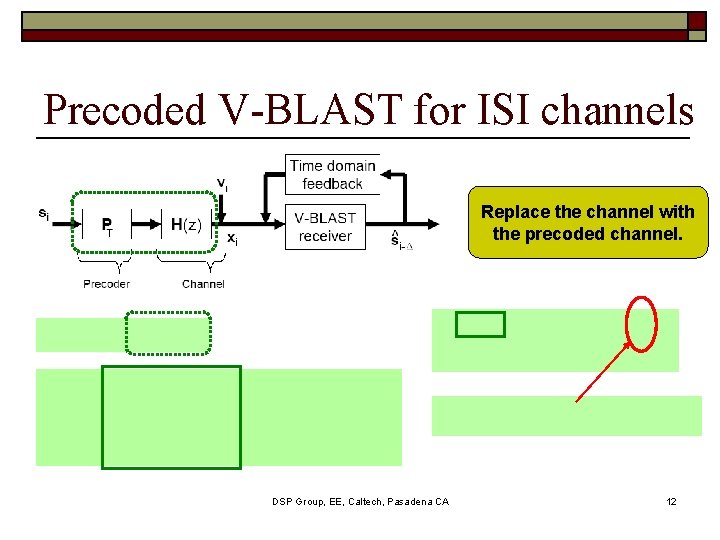
Precoded V-BLAST for ISI channels Replace the channel with the precoded channel. DSP Group, EE, Caltech, Pasadena CA 12
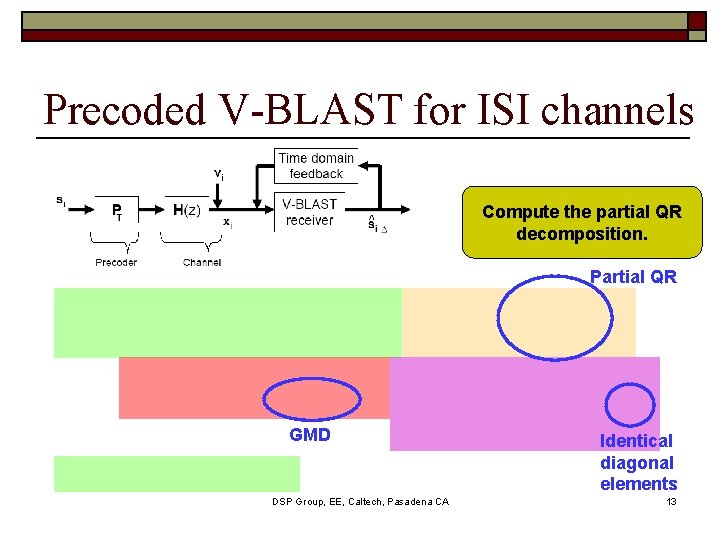
Precoded V-BLAST for ISI channels Compute the partial QR decomposition. Partial QR GMD DSP Group, EE, Caltech, Pasadena CA Identical diagonal elements 13
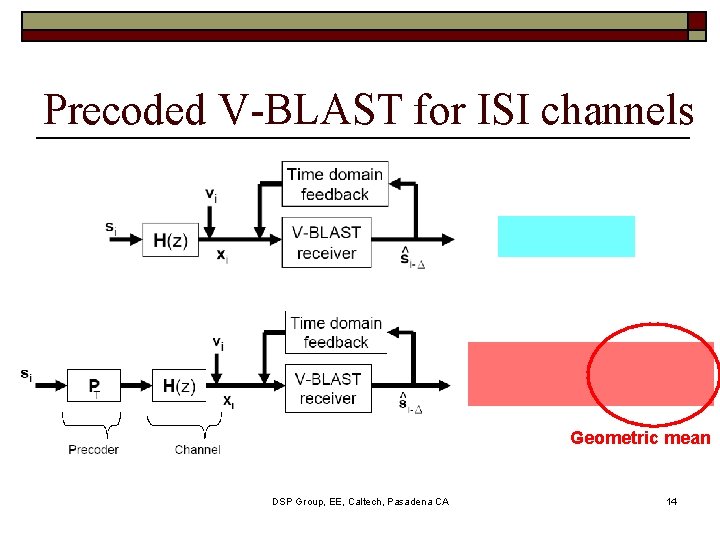
Precoded V-BLAST for ISI channels Geometric mean DSP Group, EE, Caltech, Pasadena CA 14
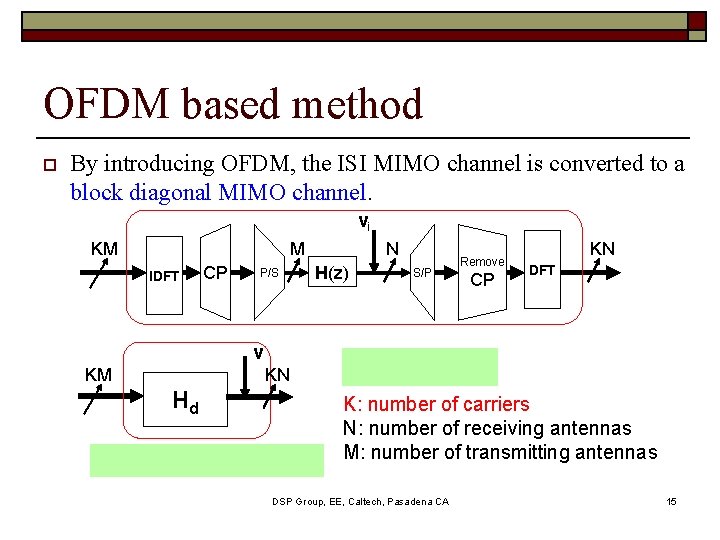
OFDM based method o By introducing OFDM, the ISI MIMO channel is converted to a block diagonal MIMO channel. vi KM M IDFT CP P/S N H(z) S/P Remove CP KN DFT v KM KN Hd K: number of carriers N: number of receiving antennas M: number of transmitting antennas DSP Group, EE, Caltech, Pasadena CA 15
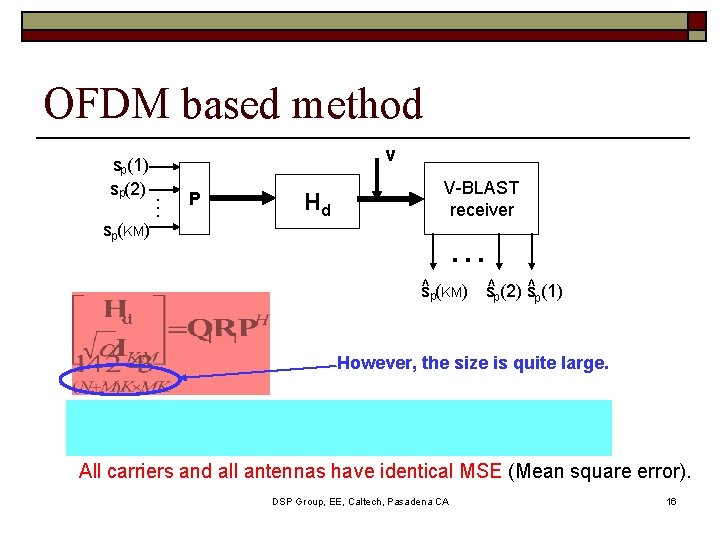
OFDM based method sp(KM) v … sp(1) sp(2) P Hd V-BLAST receiver … s^p(KM) s^p(2) s^p(1) However, the size is quite large. All carriers and all antennas have identical MSE (Mean square error). DSP Group, EE, Caltech, Pasadena CA 16
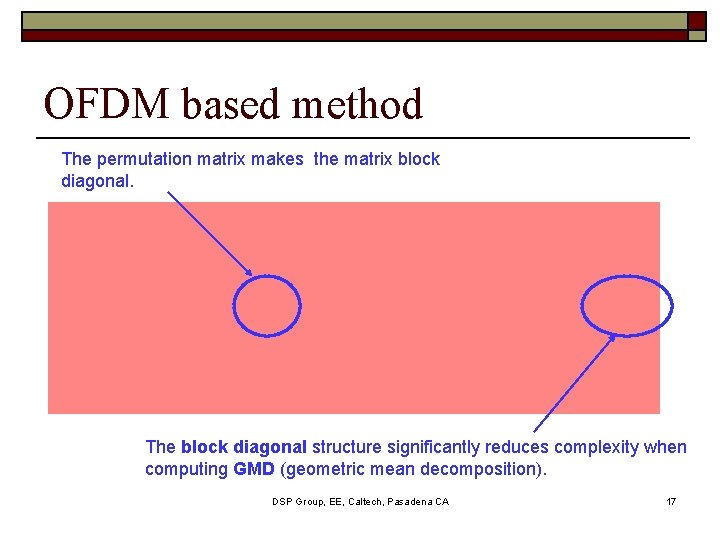
OFDM based method The permutation matrix makes the matrix block diagonal. The block diagonal structure significantly reduces complexity when computing GMD (geometric mean decomposition). DSP Group, EE, Caltech, Pasadena CA 17
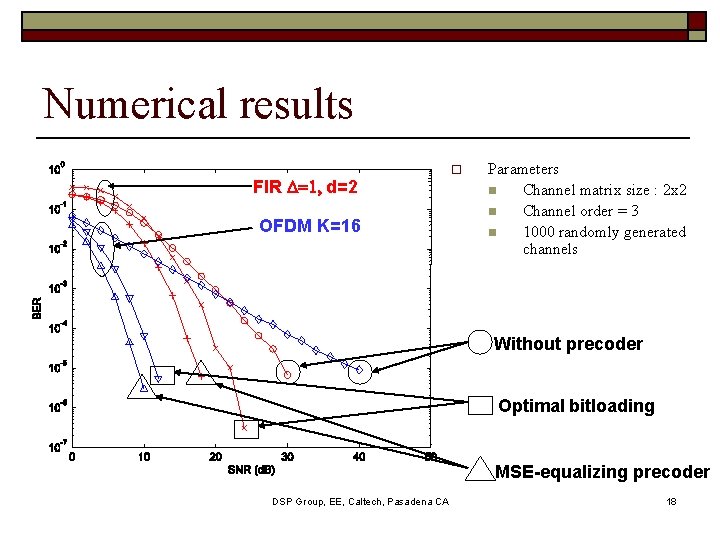
Numerical results FIR D=1, d=2 OFDM K=16 o Parameters n Channel matrix size : 2 x 2 n Channel order = 3 n 1000 randomly generated channels Without precoder Optimal bitloading MSE-equalizing precoder DSP Group, EE, Caltech, Pasadena CA 18
Conclusion o The precoded V-BLAST system is generalized for ISI MIMO channels in two ways. n n o o FIR based method OFDM based method The simulation shows MSE-equalizing precoder has better performance than bitloading. The simulation shows the precoded OFDM VBLAST system has the best performance among the tested systems. DSP Group, EE, Caltech, Pasadena CA 19
References [1] P. W. Wolniansky, G. J. Foschini, G. D. Golden, and R. A. Valenzela, “V-Blast: An architectre for realizing very high data rates over the rich-scattering channel, ” Proc. Int. Symp. Signals, Systems and Electronics (ISSE 1998), pp. 295 -300. [2] B. Hassibi, “An efficient square-root algorithm for BLAST, ” Proc. of the ICCASP, vol. 2, pp. II 737 - II 740, June. 1999. [3] Y. Jiang, J. Li, and W. W. Hager “Joint transceiver design for MIMO communications using geometric mean decomposition, ” IEEE Trans. Sig. Proc. , pp. 3791 -3803, Oct. 2005. [4] F. Xu, T. N. Davidson, J. K. Zhang, S. S. Chan, and K. M. Wong, “Design of block transceivers with MMSE decision feedback detection, ” Proc. of the ICASSP, pp. 1109 - 1112 , March. 2004. [5] Y. Jiang, W. W. Hager, and J. Li, “The Geometric Mean Decomposition and Generalized Triangular Decomposition, ” 2004 SIAM Annual Meeting, Portland, Oregon, July 12 - 16. [6] N. Al-Dhahir, A. H. Sayed, “The finite-length multi-input multi-output MMSEDFE, ” IEEE Trans. Sig. Proc. , pp. 2921 - 2936, Oct. 2000. DSP Group, EE, Caltech, Pasadena CA 20
Thank you DSP Group, EE, Caltech, Pasadena CA 21
- Slides: 21