
PreClass Wednesday 8 10 11 On a scale
- Slides: 12
Pre-Class Wednesday 8 -10 -11 § On a scale of 1 to 10, how would you rate your computer skills?
Engineering Problem from Yesterday’s class Did you… § Brainstorm? § Draw a sketch? § Design before building? § Make a model? § Keep it simple… § Just to get by? § To succeed? § To do your best?
Engineering Design Process (p. 2 -8) 1. Refining the problem statement and structuring the problem. 2. Making a sketch or diagram that helps you understand the problem. 3. Assembling and organizing background knowledge. 4. Making appropriate simplifying assumptions and approximations. 5. Decomposing the problem to a series of simpler problems. 6. Performing a dimensional analysis. 7. Computing the detailed answer and discussing the results.
Engineering Design Process (continued) 1. Refining the problem statement and structuring the problem (identify the problem). § Rewriting the initial question § List input and output parameters 2. Making a sketch or diagram that helps you understand the problem. § Visualizing the physical situation § Does not have to be detailed 3. Assembling and organizing background knowledge. § Research the problem
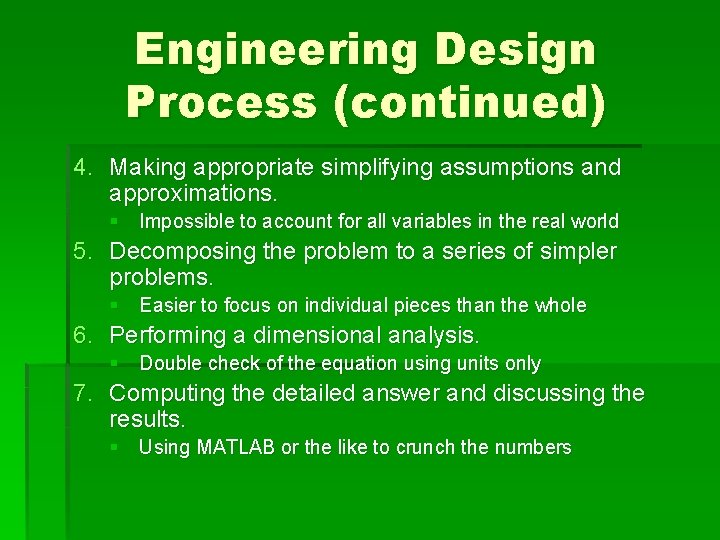
Engineering Design Process (continued) 4. Making appropriate simplifying assumptions and approximations. § Impossible to account for all variables in the real world 5. Decomposing the problem to a series of simpler problems. § Easier to focus on individual pieces than the whole 6. Performing a dimensional analysis. § Double check of the equation using units only 7. Computing the detailed answer and discussing the results. § Using MATLAB or the like to crunch the numbers
Keeping Time § When developing a design, engineers must look at its form to ensure that it’s acceptable in both the operating and engineering environments. § Every product has a type of “engineering evolution” that relates the purpose, form, environment, and acceptability of that product.
Keeping Time § Since the beginning of time, humanity has had a desire keep track of that time. The methods for keeping time have changed over the many years, but so have the necessities for the use of that time. § The most basic purpose of a clock is to keep time. Let’s go back and look at the engineering evolution of the clock. § How has the method, purpose, form, environment, and acceptability of keeping time changed or “evolved” over the centuries?
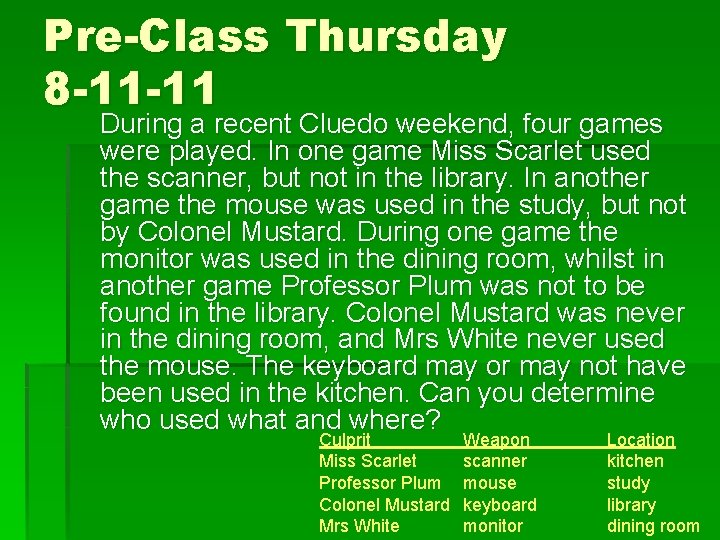
Pre-Class Thursday 8 -11 -11 During a recent Cluedo weekend, four games were played. In one game Miss Scarlet used the scanner, but not in the library. In another game the mouse was used in the study, but not by Colonel Mustard. During one game the monitor was used in the dining room, whilst in another game Professor Plum was not to be found in the library. Colonel Mustard was never in the dining room, and Mrs White never used the mouse. The keyboard may or may not have been used in the kitchen. Can you determine who used what and where? Culprit Miss Scarlet Professor Plum Colonel Mustard Mrs White Weapon scanner mouse keyboard monitor Location kitchen study library dining room
How many floor of tiles are on the this classroom? Objective: to practice prediction and measuring techniques Procedures: 1) Predict the # of tiles. 2) Detail the technique to find the # of tiles. 3) Use the technique to find the # of tiles.
Pre-Class Friday 1 -7 -11 § Using the Engineering Design Process (or the Technical Problem Solving steps), which step do you think is the most important? least important? § Don’t forget to turn your Pre-Class in today! You should have three of them.
Pre-Class Monday 1 -12 -09 What is an “open-ended” problem?
Acceleration of a Car § The Porsche 911 can accelerate from 0 to 60 mph in 3. 6 sec. § Using the Framework for Technical Problem Solving, what is the acceleration of the car during this time?