
Precision Medicine Legal and Ethical Challenges Precision Medicine















- Slides: 43
Precision Medicine: Legal and Ethical Challenges Precision Medicine Ethics: Prospects on Clinical Application and Ethical Issues Ock-Joo Kim, M. D. , Ph. D. *, Yoon-Jung Chang M. D. , Ph. D. ** *Professor and Chair in the Department of Medical History and Medical Humanities, Seoul National University College of Medicine, South Korea **Department of Cancer Control and Policy, Graduate School of Cancer Science and Policy, National Cancer Center, South Korea
Contents • Part I – Precision Medicine in Korea • Background • Current States and Strengths in Precision Medicine • USA NIH – Korea • Legal Issues and the Bill on genomic personalized medicine (2013) Ethical Issues • Part II – Precision medicine and health care system in Korea • National Cancer Center experiences • Recent regulatory reform • Ethical consideration 2
PART 1. PRECISION MEDICINE IN KOREA Ock-Joo Kim *Professor and Chair in the Department of Medical History and Medical Humanities, Seoul National University College of Medicine, South Korea 3
Precision Medicine in Korea • In South Korea, discussion on the possibility of personalized medicine became active since 2010, including forums and grants supported by Ministry of Health and Welfare. • Korea has several strengths in the infrastructure toward the development of precision medicine. • Since 2015 October, Precision Medicine became a focus of a concerted effort from the various stakeholders driven by the government initiative. 4
Precision Medicine in Korea: Current Status and Strengths • National Biobanks in KOREA - Korea Center for Disease Control has established large biobanks for population based cohorts and patient cohorts. - National Biobanks infrastructure retaining biospecimen of 670, 000 people - Cohort study on 250, 000 people, genomic information of 100, 000 Koreans scheduled for completion in 2018 5
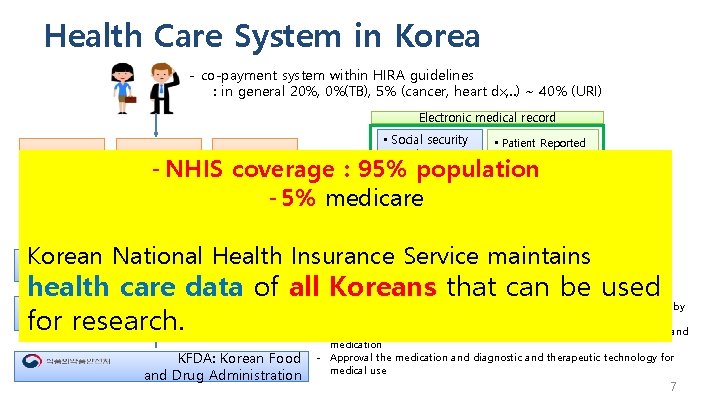
Health Care System in Korea - co-payment system within HIRA guidelines : in general 20%, 0%(TB), 5% (cancer, heart dx, . . ) ~ 40% (URI) Electronic medical record Hospital insurance refund Clinic Hospital • Social security number • Disease diagnosis (ICD 10) • lab test title, medication, treatment Hx • Patient Reported outcome • Lab result • Doctor / Nurse medical records • Other treatment beyond HIRA guidelines NHIC : National Health - Nation-wide coverage : 95% population Insurance Company - 5% medicare HIRA : Health Insurance Review & Assessment service KFDA: Korean Food and Drug Administration - Control the Insurance payment guidelines for medication, test, practice by ICD 10 and patients conditions - Review and evaluation the new diagnostic and therapeutic technology and medication - Approval the medication and diagnostic and therapeutic technology for medical use 6
Health Care System in Korea - co-payment system within HIRA guidelines : in general 20%, 0%(TB), 5% (cancer, heart dx, . . ) ~ 40% (URI) Electronic medical record Hospital Clinic Hospital • Social security number • Disease diagnosis (ICD 10) • lab test title, medication, treatment Hx • Patient Reported outcome • Lab result • Doctor / Nurse medical records • Other treatment beyond HIRA guidelines - NHIS coverage : 95% population - 5% medicare insurance refund NHIC : National Health Korean National Health Insurance Service maintains - Nation-wide coverage : 95% population Insurance Company health care data of all Koreans that can be used HIRA : Health Insurance Review & Assessment service for research. KFDA: Korean Food and Drug Administration - 5% medicare - Control the Insurance payment guidelines for medication, test, practice by ICD 10 and patients conditions - Review and evaluation the new diagnostic and therapeutic technology and medication - Approval the medication and diagnostic and therapeutic technology for medical use 7
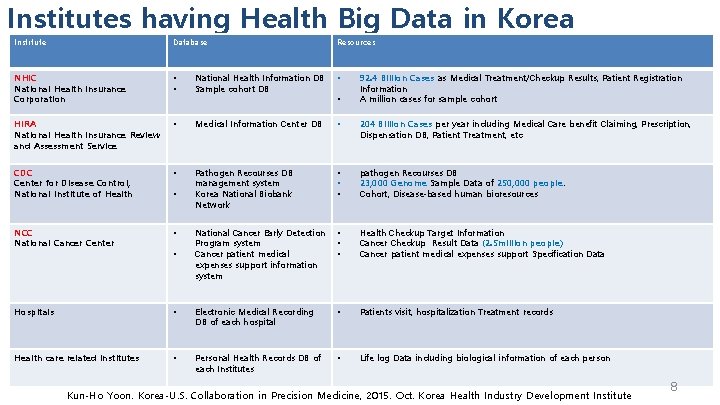
Institutes having Health Big Data in Korea Institute Database NHIC National Health Insurance Corporation • • HIRA National Health Insurance Review and Assessment Service • Medical Information Center DB • 204 Billion Cases per year including Medical Care benefit Claiming, Prescription, Dispensation DB, Patient Treatment, etc CDC Center for Disease Control, National Institute of Health • Pathogen Recourses DB management system Korea National Biobank Network • • • pathogen Recourses DB 23, 000 Genome Sample Data of 250, 000 people. Cohort, Disease-based human bioresources NCC National Cancer Center • National Cancer Early Detection Program system Cancer patient medical expenses support information system • • • Health Checkup Target Information Cancer Checkup Result Data (2. 5 million people) Cancer patient medical expenses support Specification Data National Health Information DB Sample cohort DB Resources • • 92. 4 Billion Cases as Medical Treatment/Checkup Results, Patient Registration Information A million cases for sample cohort Hospitals • Electronic Medical Recording DB of each hospital • Patients visit, hospitalization Treatment records Health care related Institutes • Personal Health Records DB of each Institutes • Life log Data including biological information of each person Kun-Ho Yoon. Korea-U. S. Collaboration in Precision Medicine, 2015. Oct. Korea Health Industry Development Institute 8
Health Big Data Resources in Korea Young Chan Lee. Republic of Korea-United States Cooperative Agenda for Health Industry 2015. OCT. Korea Health Industry Development Institute. 9
Acceleration of precision medicine after. . • 2015 Oct 14 -16 • Visit of President Park Geun-hye of South Korea to meet President Obama United State 10
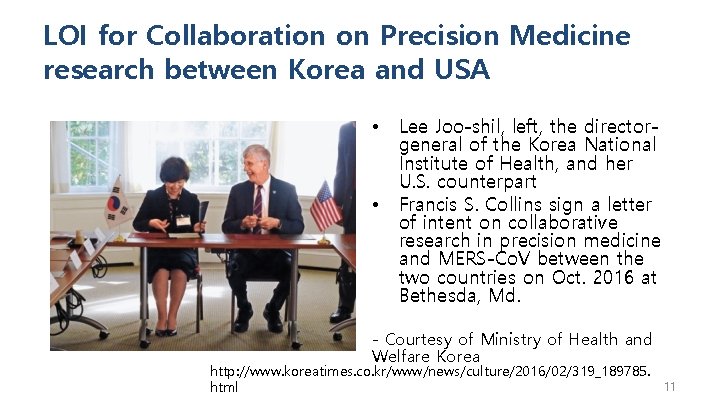
LOI for Collaboration on Precision Medicine research between Korea and USA • • Lee Joo-shil, left, the directorgeneral of the Korea National Institute of Health, and her U. S. counterpart Francis S. Collins sign a letter of intent on collaborative research in precision medicine and MERS-Co. V between the two countries on Oct. 2016 at Bethesda, Md. - Courtesy of Ministry of Health and Welfare Korea http: //www. koreatimes. co. kr/www/news/culture/2016/02/319_189785. 11 html
“Precision medicine as a typical case of Creative Economy” (2015. 11) • Korea President Park Geun-hye (2016. 1. 18) “Bio-health industry should lead for creation of a new source for national wealth in the future. For this, we need to establish Government-Civil Collaboration model, regulatory reform, Research and Development, and manpower training. ” • “Precision medicine as a typical case of Creative Economy” (Korea Ministry of Health, 2015. 11) - President Park Geun-hye defined the creative economy as: “A creative economy is defined by the convergence of science and technology with industry, the fusion of culture with industry, and the blossoming of creativity in the very borders that were once permeated by barriers. It is about going beyond the rudimentary expansion of existing markets, and creating new markets and new jobs by building on the bedrock of convergence. At the very heart of a creative economy lie science technology and the IT industry, areas that I have earmarked as key priorities. ” -During her 2013 inaugural address 12
http: //hmnews. co. kr/bbs/board. php? bo_table=B 01&wr_id=220 13
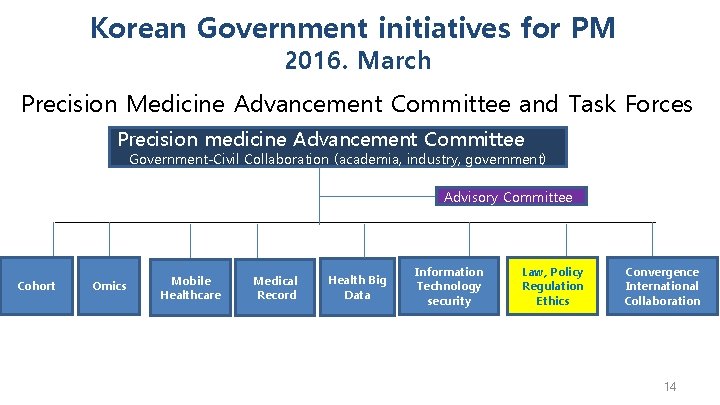
Korean Government initiatives for PM 2016. March Precision Medicine Advancement Committee and Task Forces Precision medicine Advancement Committee Government-Civil Collaboration (academia, industry, government) Advisory Committee Cohort Omics Mobile Healthcare Medical Record Health Big Data Information Technology security Law, Policy Regulation Ethics Convergence International Collaboration 14
Korean Government: Three Domains and Seven Key Initiatives in Precision Medicine (2016. March 23) 1 Domain Key Initiatives Building Precision Medicine Cohorts Building New Precision Medicine Cohorts Utilization and Linking Plans of Preexisting Cohorts and Biobanks 2 Building Platform for Precision Medicine Big Data and Its Association with Industries Standardization and Linking Plans of Medical Information and Genomic Data Building Open Portals For Precision Medicine Information Development of Artificial intelligence-based alpha-MED 3 Improving Law, Regulation, and Policy related to Precision Medicine Improvement of Law, Regulation, and Policy Professional Workforce Development for Bioinformatics and Precision Medicine 15
Laws related to Precision Medicine, Korea • Bioethics and Safety Act, Korea (Law No. 13651) - Genetic test, Biobank, Human material research, Human subject research • • • Personal Information Protection Law (Privacy Law) Pharmaceutical Affairs Law Medical Device Law National Health Act Medical Affairs Law Resident Registration Act 16
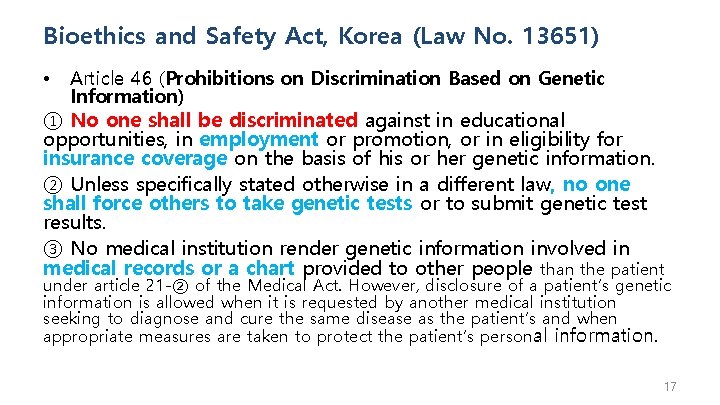
Bioethics and Safety Act, Korea (Law No. 13651) • Article 46 (Prohibitions on Discrimination Based on Genetic Information) ① No one shall be discriminated against in educational opportunities, in employment or promotion, or in eligibility for insurance coverage on the basis of his or her genetic information. ② Unless specifically stated otherwise in a different law, no one shall force others to take genetic tests or to submit genetic test results. ③ No medical institution render genetic information involved in medical records or a chart provided to other people than the patient under article 21 -② of the Medical Act. However, disclosure of a patient’s genetic information is allowed when it is requested by another medical institution seeking to diagnose and cure the same disease as the patient’s and when appropriate measures are taken to protect the patient’s personal information. 17
Issues related to the linking identifier: Resident Registration Number 住民登錄番號 in Korea • Resident Registration Number, RRN(住民登錄番號, ) is the national identification number written on the ID card system, which is issued to all citizens residing in the Republic of Korea, is granted by the social security law. • RRN is a unprecedented powerful personal identification number "that gives collectively to all citizens without any specific purpose, such as "social security number "of South Korea. • The leakage of personal information of almost all citizens of Korea through RRN became a serious social problem • In 2014 Privacy Act was revised to prohibit the collection of RRN and only permitted in exceptional cases based upon law. 18
Linking Identifier? Who/what will be control tower? http: //hmnews. co. kr/bbs/board. php? bo_table=B 01&wr_id=220 19
A bill for promotion of personalized medicine using genome, Korea • 遺傳體を活用したカスタム医療技術開発の促進法案 • 遺傳體活用 定做医療技術開発促進法案 • • • Bill No. 5136 The bill number 5136 Submission date: 2013. 5. 27. Current status: Pending on 19 th National Congress After the election of the 20 th National Congress on 2016 April 13, the bill needs to be submitted again as a new bill. 20
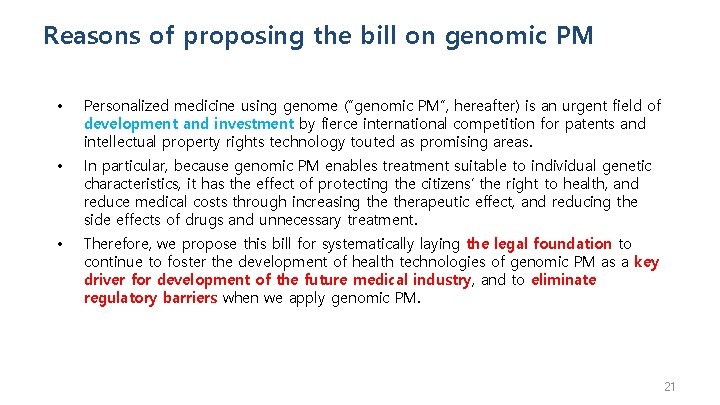
Reasons of proposing the bill on genomic PM • Personalized medicine using genome (“genomic PM”, hereafter) is an urgent field of development and investment by fierce international competition for patents and intellectual property rights technology touted as promising areas. • In particular, because genomic PM enables treatment suitable to individual genetic characteristics, it has the effect of protecting the citizens’ the right to health, and reduce medical costs through increasing therapeutic effect, and reducing the side effects of drugs and unnecessary treatment. • Therefore, we propose this bill for systematically laying the legal foundation to continue to foster the development of health technologies of genomic PM as a key driver for development of the future medical industry, and to eliminate regulatory barriers when we apply genomic PM. 21
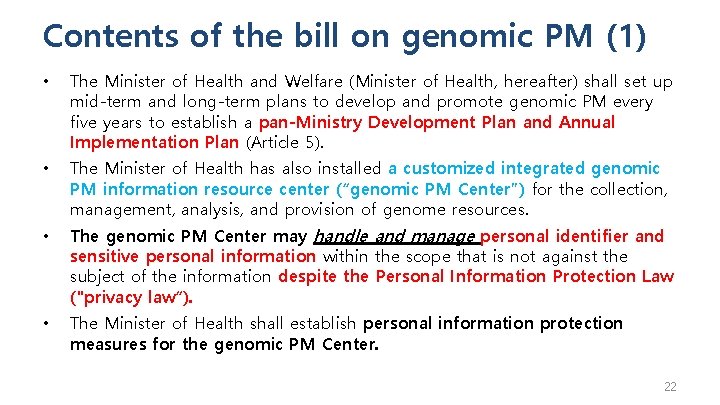
Contents of the bill on genomic PM (1) • The Minister of Health and Welfare (Minister of Health, hereafter) shall set up mid-term and long-term plans to develop and promote genomic PM every five years to establish a pan-Ministry Development Plan and Annual Implementation Plan (Article 5). • The Minister of Health has also installed a customized integrated genomic PM information resource center (“genomic PM Center”) for the collection, management, analysis, and provision of genome resources. • The genomic PM Center may handle and manage personal identifier and sensitive personal information within the scope that is not against the subject of the information despite the Personal Information Protection Law ("privacy law“). • The Minister of Health shall establish personal information protection measures for the genomic PM Center. 22
Contents of the bill on genomic PM (2) • Article 8 (genomic resource utilization) Minister of Health can provide the genomic resources despite the Personal Information Protection Law ("privacy law“) if the parties to study the genome to develop PM, research and development objectives require the provision of a genomic resources. • Article 15 (collection of information) ① Minister of Health, in order to promote the genomic PM and collect the genomic information resources, may request information from the NHIS (National Health Insurance Service) and HIRA (National Health Insurance Review and Assessment Service), and other related authorities. Requested authorities shall provide information to the Minister of Health, despite the Personal Information Protection Law ("privacy law“). • Article 16 Minister of Health may request the data submission to researchers, research institutions, businesses, and organizations when they are necessary to analyze ‧ investigate. The researchers, research institutions, businesses, and organizations are asked to submit data shall cooperate in this case if there is no special reason for this. 23
Linking identifier issues: Override Privacy Law Ministry of Health, Genomic PM Center? http: //hmnews. co. kr/bbs/board. php? bo_table=B 01&wr_id=2 24
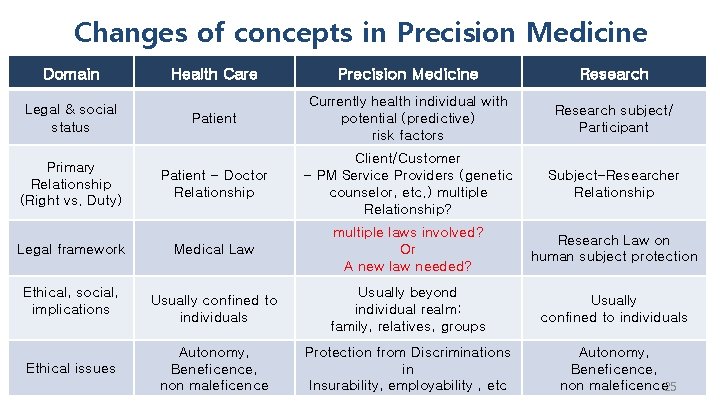
Changes of concepts in Precision Medicine Domain Legal & social status Primary Relationship (Right vs. Duty) Legal framework Ethical, social, implications Ethical issues Health Care Precision Medicine Research Patient Currently health individual with potential (predictive) risk factors Research subject/ Participant Patient - Doctor Relationship Client/Customer - PM Service Providers (genetic counselor, etc. ) multiple Relationship? Subject-Researcher Relationship Medical Law multiple laws involved? Or A new law needed? Research Law on human subject protection Usually confined to individuals Usually beyond individual realm: family, relatives, groups Usually confined to individuals Autonomy, Beneficence, non maleficence Protection from Discriminations in Insurability, employability , etc Autonomy, Beneficence, non maleficence 25
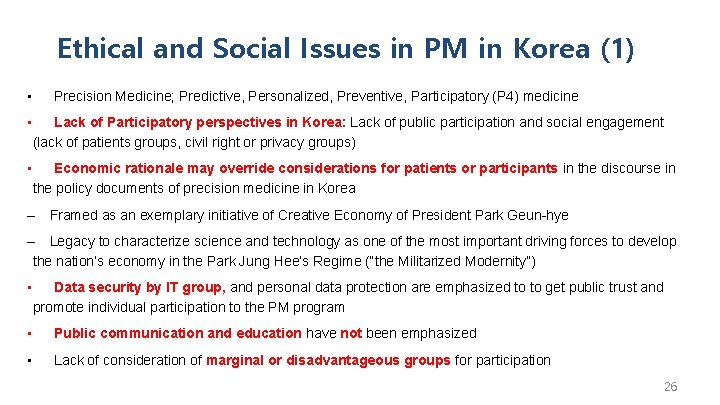
Ethical and Social Issues in PM in Korea (1) • Precision Medicine; Predictive, Personalized, Preventive, Participatory (P 4) medicine • Lack of Participatory perspectives in Korea: Lack of public participation and social engagement (lack of patients groups, civil right or privacy groups) • Economic rationale may override considerations for patients or participants in the discourse in the policy documents of precision medicine in Korea – Framed as an exemplary initiative of Creative Economy of President Park Geun-hye – Legacy to characterize science and technology as one of the most important driving forces to develop the nation’s economy in the Park Jung Hee’s Regime (“the Militarized Modernity”) • Data security by IT group, and personal data protection are emphasized to to get public trust and promote individual participation to the PM program • Public communication and education have not been emphasized • Lack of consideration of marginal or disadvantageous groups for participation 26
Ethical and Social Issues in PM in Korea (2) • Citizens’ participation & public engagement are necessary to get public trust • Ethical issues such as informed consent, return of results, privacy issues, data sharing, and governance have not been addressed fully and openly • Public understanding, awareness, and provision of information on uncertainties, risks and limitations, as well as potential benefits • Legislation for a new legal framework also needs to seek wide public consultation and participation 27
PART II: PRECISION MEDICINE AND HEALTH CARE SYSTEM IN KOREA NATIONAL CANCER CENTER EXPERIENCES Yoon-Jung CHANG Department of Cancer Control and Policy, Graduate School of Cancer Science and Policy, National Cancer Center, South Korea 28
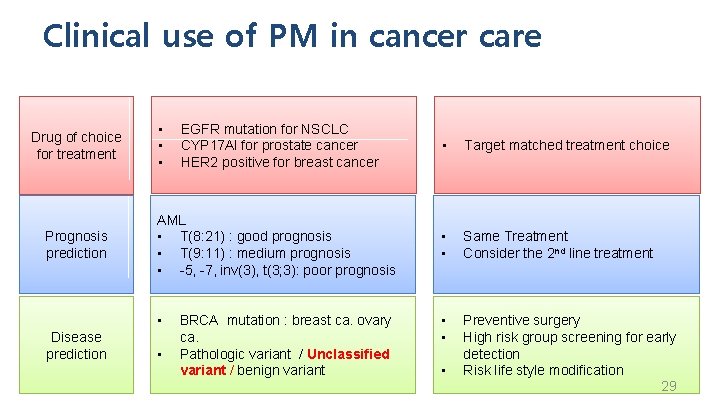
Clinical use of PM in cancer care Drug of choice for treatment Prognosis prediction • • • EGFR mutation for NSCLC CYP 17 Al for prostate cancer HER 2 positive for breast cancer • Target matched treatment choice AML • T(8: 21) : good prognosis • T(9: 11) : medium prognosis • -5, -7, inv(3), t(3; 3): poor prognosis • • Same Treatment Consider the 2 nd line treatment • • Preventive surgery High risk group screening for early detection Risk life style modification 29 • Disease prediction • BRCA mutation : breast ca. ovary ca. Pathologic variant / Unclassified variant / benign variant •
Genetic test + life style + race EGFR mutation in NSCLC + Non-smoker + Asian 30
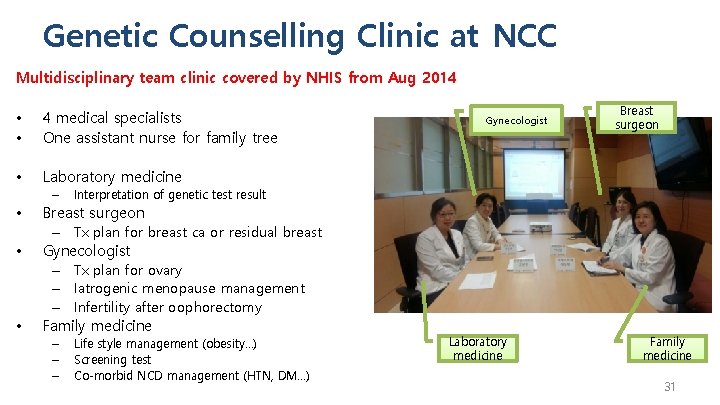
Genetic Counselling Clinic at NCC Multidisciplinary team clinic covered by NHIS from Aug 2014 • • 4 medical specialists One assistant nurse for family tree • Laboratory medicine – • • • Breast surgeon Interpretation of genetic test result Breast surgeon – Tx plan for breast ca or residual breast Gynecologist – Tx plan for ovary – Iatrogenic menopause management – Infertility after oophorectomy Family medicine – – – Gynecologist Life style management (obesity…) Screening test Co-morbid NCD management (HTN, DM…) Laboratory medicine Family medicine 31
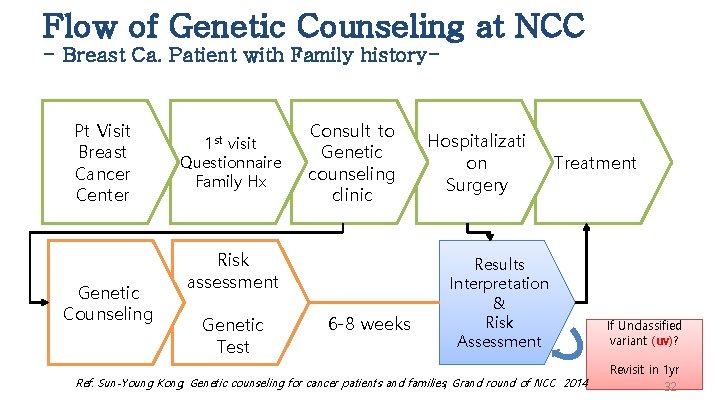
Flow of Genetic Counseling at NCC - Breast Ca. Patient with Family history- Pt Visit Breast Cancer Center Genetic Counseling 1 st visit Questionnaire Family Hx Consult to Genetic counseling clinic Risk assessment Genetic Test 6 -8 weeks Hospitalizati on Surgery Treatment Results Interpretation & Risk Assessment Ref. Sun-Young Kong, Genetic counseling for cancer patients and families, Grand round of NCC 2014 If Unclassified variant (uv)? Revisit in 1 yr 32
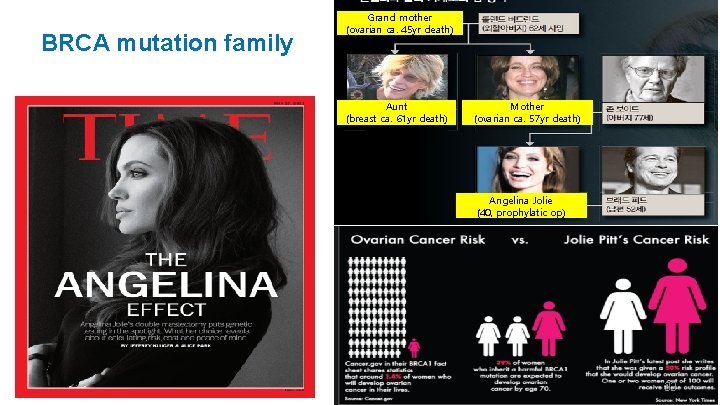
BRCA mutation family Grand mother (ovarian ca. 45 yr death) Aunt (breast ca. 61 yr death) Mother (ovarian ca. 57 yr death) Angelina Jolie (40, prophylatic op) 33
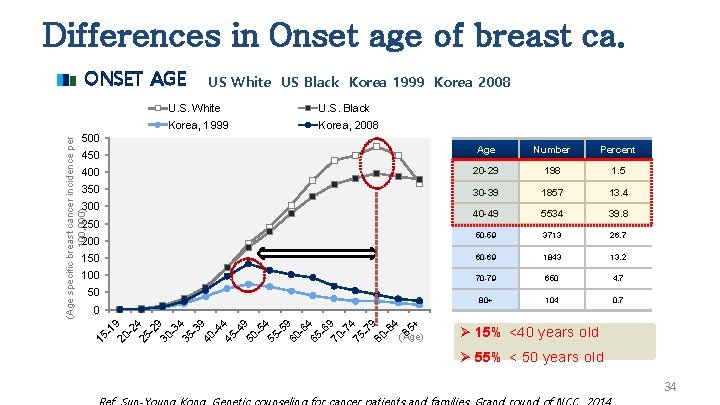
Differences in Onset age of breast ca. ONSET AGE US White US Black Korea 1999 Korea 2008 U. S. White U. S. Black Korea, 1999 Korea, 2008 (Age specific breast cancer incidence per 100, 000) 500 Age Number Percent 400 20 -29 198 1. 5 350 30 -39 1857 13. 4 40 -49 5534 39. 8 200 50 -59 3713 26. 7 150 60 -69 1843 13. 2 100 70 -79 650 4. 7 80+ 104 0. 7 450 300 250 50 49 50 -5 4 55 -5 9 60 -6 4 65 -6 9 70 -7 4 75 -7 9 80 -8 4 85 + 44 45 - 39 40 - 34 35 - 29 30 - 24 25 - 20 - 15 - 19 0 (Age) Ø 15% <40 years old Ø 55% < 50 years old 34
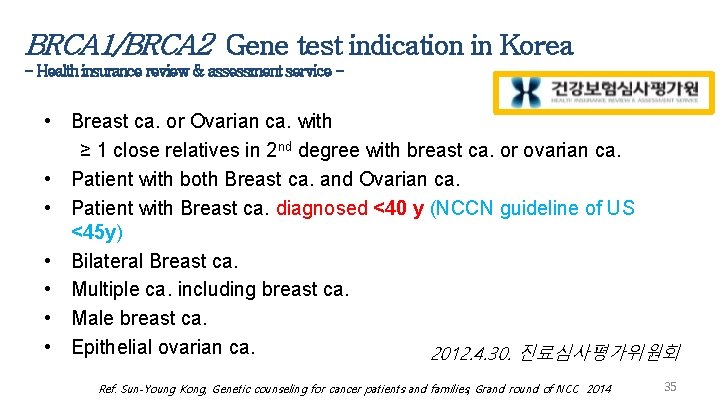
BRCA 1/BRCA 2 Gene test indication in Korea - Health insurance review & assessment service - • Breast ca. or Ovarian ca. with ≥ 1 close relatives in 2 nd degree with breast ca. or ovarian ca. • Patient with both Breast ca. and Ovarian ca. • Patient with Breast ca. diagnosed <40 y (NCCN guideline of US <45 y) • Bilateral Breast ca. • Multiple ca. including breast ca. • Male breast ca. • Epithelial ovarian ca. 2012. 4. 30. 진료심사평가위원회 Ref. Sun-Young Kong, Genetic counseling for cancer patients and families, Grand round of NCC 2014 35
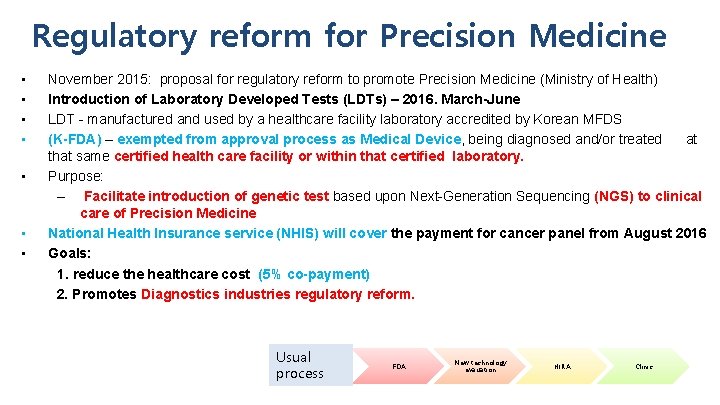
Regulatory reform for Precision Medicine • • November 2015: proposal for regulatory reform to promote Precision Medicine (Ministry of Health) Introduction of Laboratory Developed Tests (LDTs) – 2016. March-June LDT - manufactured and used by a healthcare facility laboratory accredited by Korean MFDS (K-FDA) – exempted from approval process as Medical Device, being diagnosed and/or treated at that same certified health care facility or within that certified laboratory. Purpose: – Facilitate introduction of genetic test based upon Next-Generation Sequencing (NGS) to clinical care of Precision Medicine National Health Insurance service (NHIS) will cover the payment for cancer panel from August 2016 Goals: 1. reduce the healthcare cost (5% co-payment) 2. Promotes Diagnostics industries regulatory reform. Usual process FDA New technology evauation HIRA Clinic
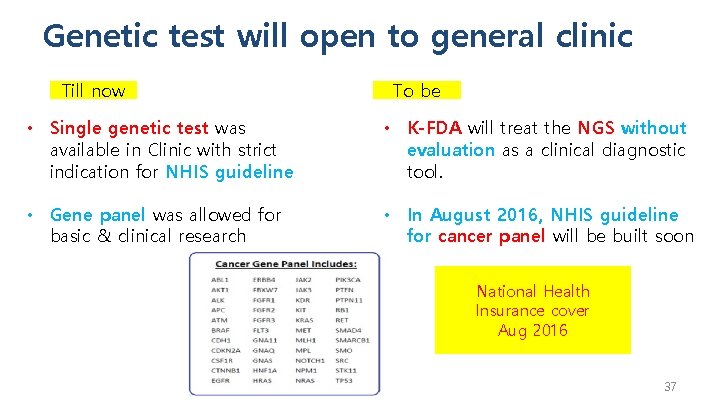
Genetic test will open to general clinic Till now To be • Single genetic test was available in Clinic with strict indication for NHIS guideline • K-FDA will treat the NGS without evaluation as a clinical diagnostic tool. • Gene panel was allowed for basic & clinical research • In August 2016, NHIS guideline for cancer panel will be built soon National Health Insurance cover Aug 2016 37
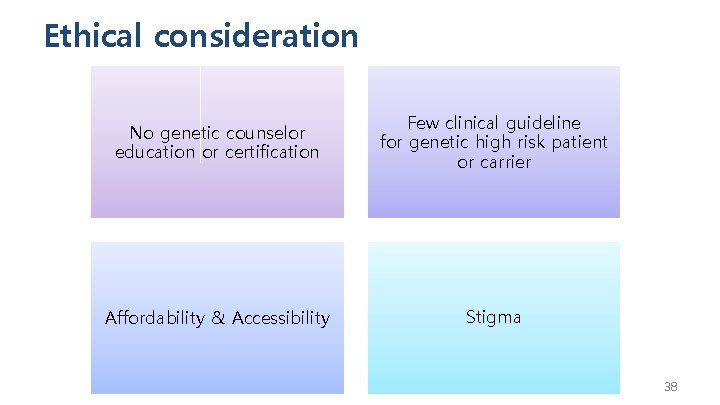
Ethical consideration No genetic counselor education or certification Few clinical guideline for genetic high risk patient or carrier Affordability & Accessibility Stigma 38
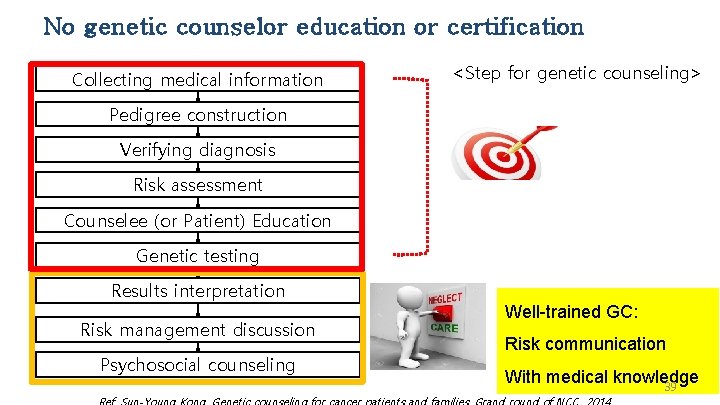
No genetic counselor education or certification Collecting medical information <Step for genetic counseling> Pedigree construction Verifying diagnosis Risk assessment Counselee (or Patient) Education Genetic testing Results interpretation Risk management discussion Psychosocial counseling Well-trained GC: Risk communication With medical knowledge 39
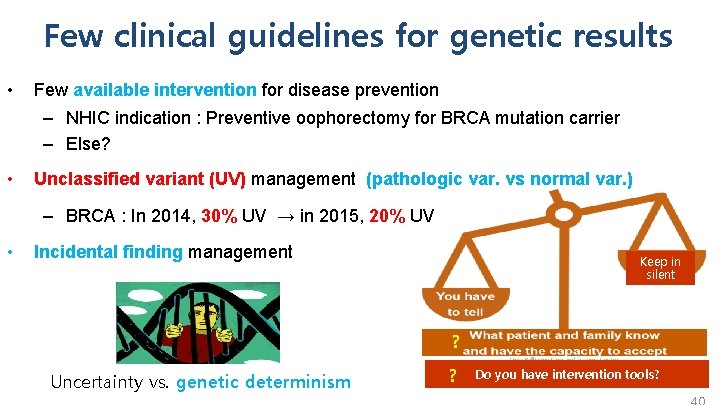
Few clinical guidelines for genetic results • Few available intervention for disease prevention – NHIC indication : Preventive oophorectomy for BRCA mutation carrier – Else? • Unclassified variant (UV) management (pathologic var. vs normal var. ) – BRCA : In 2014, 30% UV → in 2015, 20% UV • Incidental finding management Keep in silent ? Uncertainty vs. genetic determinism ? Do you have intervention tools?
Affordability & accessibility • Strict indication for genetic test (only cancer? ) • Few available target Treatment • Few patients gets benefit with high-cost test and target treatment by national insurance • Lots of health information & bio-materials was needed for research…. . for long term goals MAKE IT? TAKE IT? 41
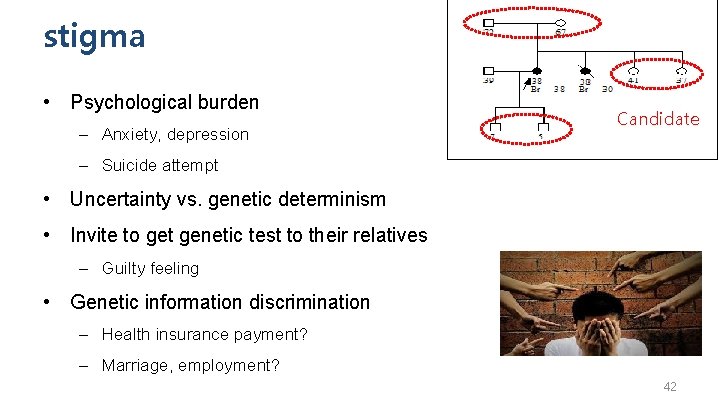
stigma • Psychological burden – Anxiety, depression Candidate – Suicide attempt • Uncertainty vs. genetic determinism • Invite to get genetic test to their relatives – Guilty feeling • Genetic information discrimination – Health insurance payment? – Marriage, employment? 42
Special thanks to Sun-Young Gong, MD 43