
Precision measurement of the halflife and branching ratio
Precision measurement of the half-life and branching ratio of T=1/2 mirror β decay of 37 K T. Kurtukian-Nieto 1, B. Blank 1, P. Ascher 1, G. Benzoni 2, A. De Roubin 1, X. Fléchard 3, M. Gerbaux 1, J. Giovinazzo 1, S. Grévy 1, G. Grinyer 4, A. Husson 1, E. Liénard 3, J. Liendo 5, J. Michaud 1, M. Pomorski 1, G. Quéméner 3, J. C. Thomas 6, M. Versteegen 1 CENBG, IN 2 P 3/CNRS/Université Bordeaux 1, BP 120 F-33175 Gradignan, France 2 INFN, Sezione di Milano, via Celoria 16, I-20133 Milano, Italy 3 LPC CAEN-ENSICAEN, 6 Boulevard du Marechal Juin, 14050 Caen Cedex, France 4 Department of Physics, University of Regina, SK S 4 S 0 A 2, Canada 5 Universidad Simon Bolivar, Baruta. AP 89000, Caracas, Venezuela. 6 GANIL, CEA/DRF-CNRS/IN 2 P 3, Bvd Henri Becquerel, 14076 Caen, France 1 62 th Meeting of the INTC. CERN, November 6 -7, 2019
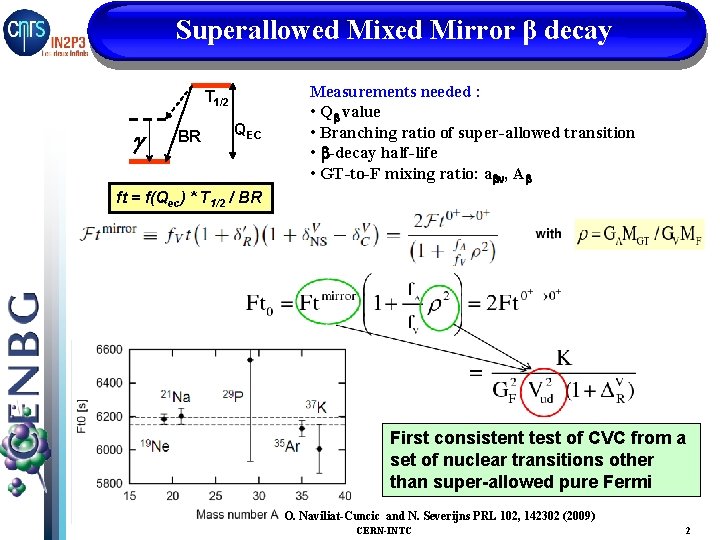
Superallowed Mixed Mirror β decay T 1/2 g BR QEC Measurements needed : • Qb value • Branching ratio of super-allowed transition • b-decay half-life • GT-to-F mixing ratio: abn, Ab ft = f(Qec) * T 1/2 / BR First consistent test of CVC from a set of nuclear transitions other than super-allowed pure Fermi O. Naviliat-Cuncic and N. Severijns PRL 102, 142302 (2009) CERN-INTC 2
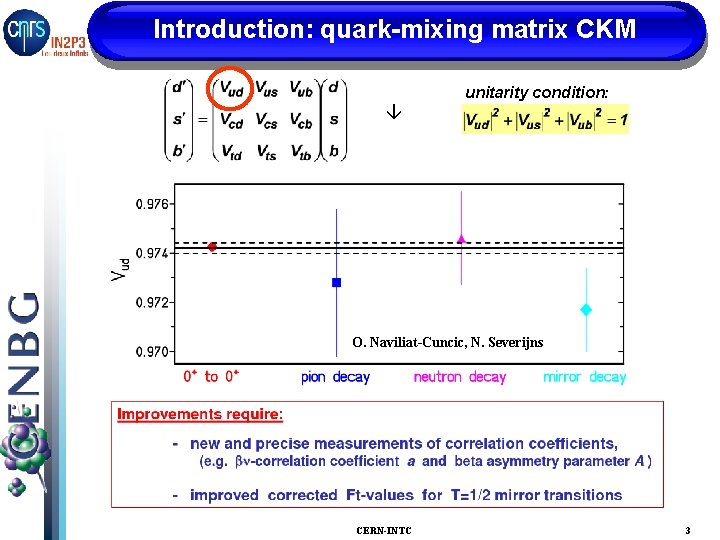
Introduction: quark-mixing matrix CKM unitarity condition: O. Naviliat-Cuncic, N. Severijns CERN-INTC 3
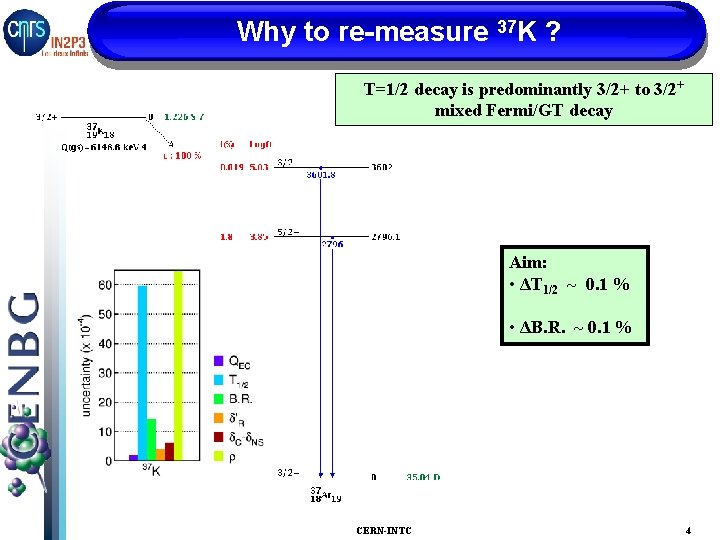
Why to re-measure 37 K ? T=1/2 decay is predominantly 3/2+ to 3/2+ mixed Fermi/GT decay Aim: • ΔT 1/2 ~ 0. 1 % • ΔB. R. ~ 0. 1 % CERN-INTC 4
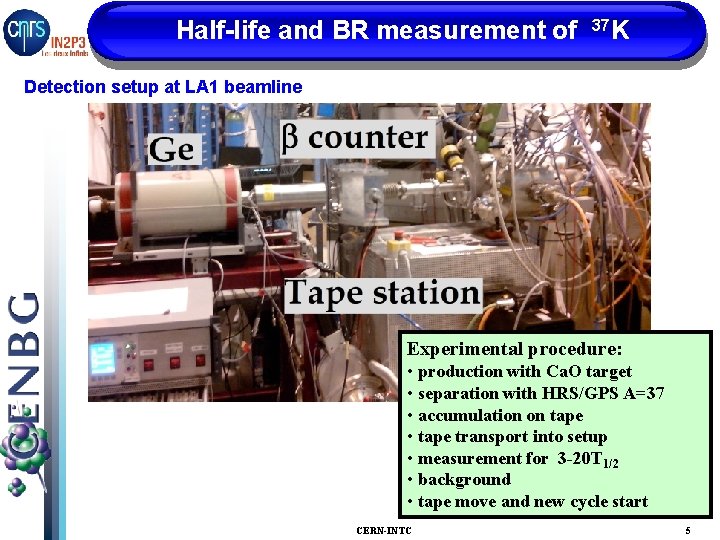
Half-life and BR measurement of 37 K Detection setup at LA 1 beamline Experimental procedure: • production with Ca. O target • separation with HRS/GPS A=37 • accumulation on tape • tape transport into setup • measurement for 3 -20 T 1/2 • background • tape move and new cycle start CERN-INTC 5
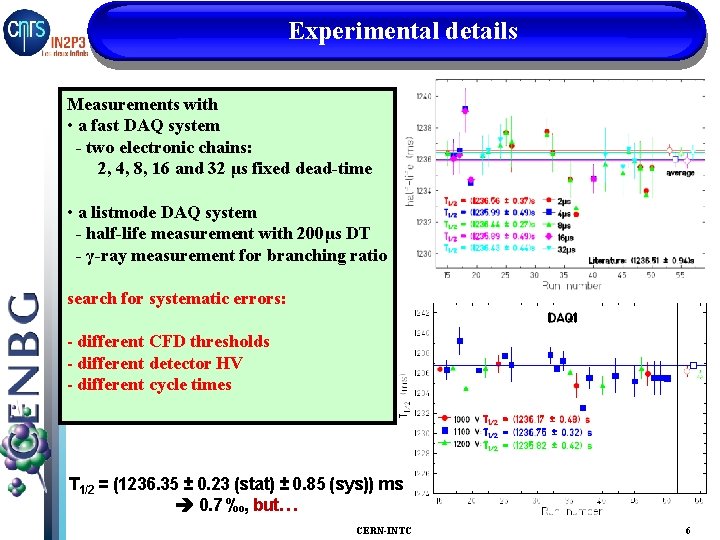
Experimental details Measurements with • a fast DAQ system - two electronic chains: 2, 4, 8, 16 and 32 μs fixed dead-time • a listmode DAQ system - half-life measurement with 200μs DT - γ-ray measurement for branching ratio search for systematic errors: - different CFD thresholds - different detector HV - different cycle times T 1/2 = (1236. 35 ± 0. 23 (stat) ± 0. 85 (sys)) ms 0. 7 ‰, but… CERN-INTC 6
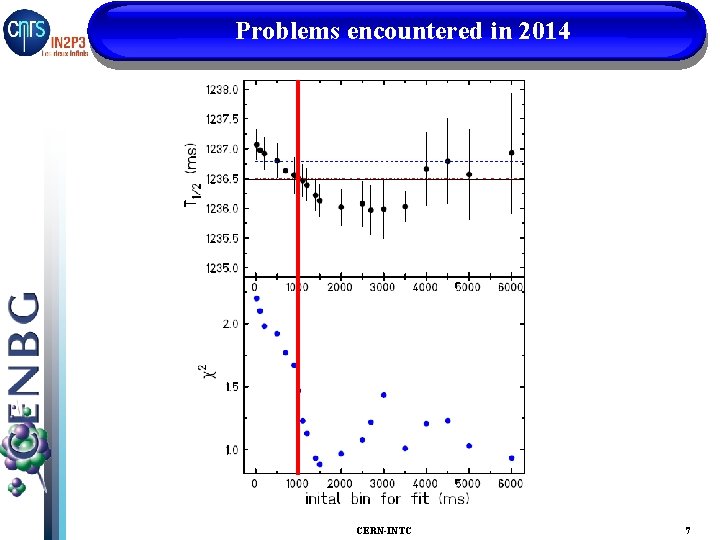
Problems encountered in 2014 CERN-INTC 7
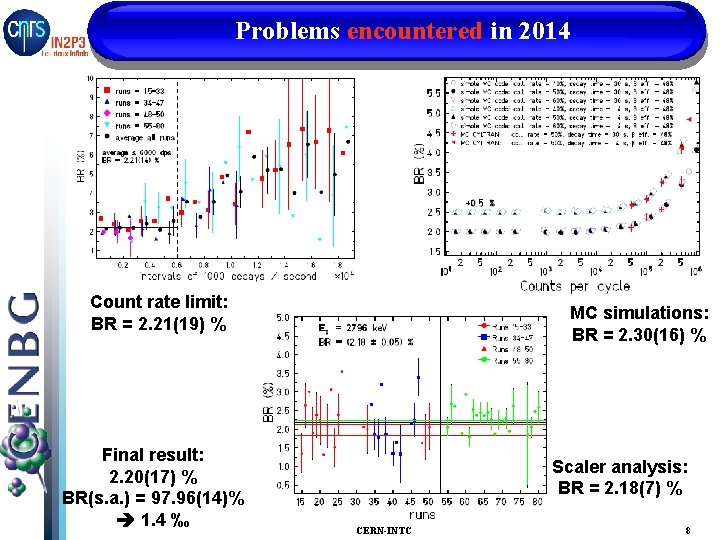
Problems encountered in 2014 Count rate limit: BR = 2. 21(19) % Final result: 2. 20(17) % BR(s. a. ) = 97. 96(14)% 1. 4 ‰ MC simulations: BR = 2. 30(16) % Scaler analysis: BR = 2. 18(7) % CERN-INTC 8
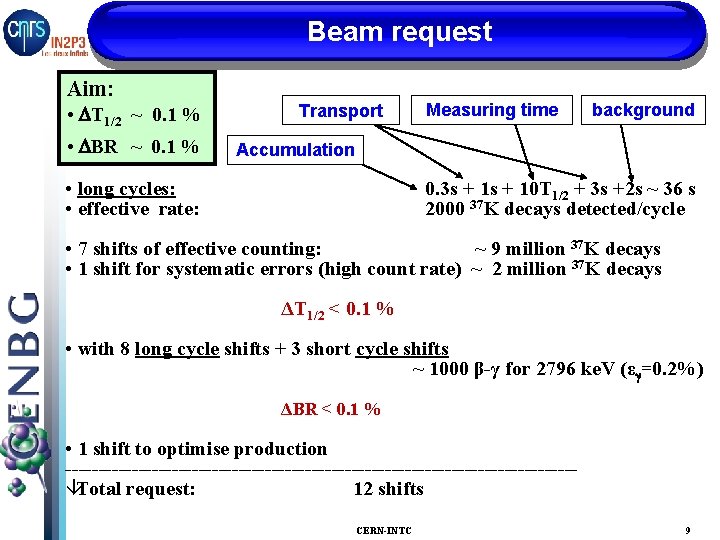
Beam request Aim: • DT 1/2 ~ 0. 1 % • DBR ~ 0. 1 % Transport Measuring time background Accumulation • long cycles: • effective rate: 0. 3 s + 10 T 1/2 + 3 s +2 s ~ 36 s 2000 37 K decays detected/cycle • 7 shifts of effective counting: ~ 9 million 37 K decays • 1 shift for systematic errors (high count rate) ~ 2 million 37 K decays ΔT 1/2 < 0. 1 % • with 8 long cycle shifts + 3 short cycle shifts ~ 1000 β-γ for 2796 ke. V (εg=0. 2%) ΔBR < 0. 1 % • 1 shift to optimise production -------------------------------------- Total request: 12 shifts CERN-INTC 9
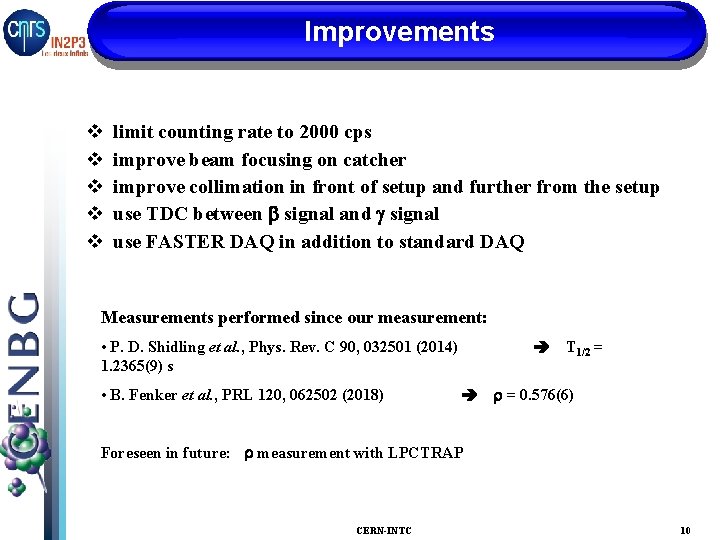
Improvements v v v limit counting rate to 2000 cps improve beam focusing on catcher improve collimation in front of setup and further from the setup use TDC between b signal and g signal use FASTER DAQ in addition to standard DAQ Measurements performed since our measurement: • P. D. Shidling et al. , Phys. Rev. C 90, 032501 (2014) 1. 2365(9) s • B. Fenker et al. , PRL 120, 062502 (2018) T 1/2 = r = 0. 576(6) Foreseen in future: r measurement with LPCTRAP CERN-INTC 10

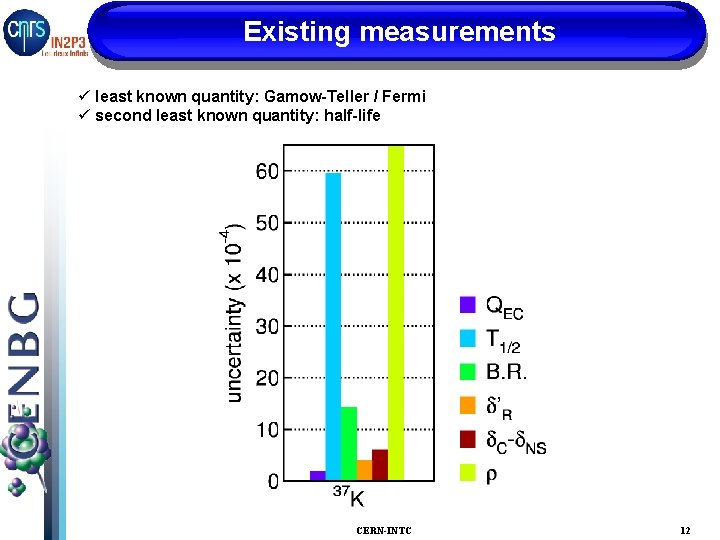
Existing measurements ü least known quantity: Gamow-Teller / Fermi ü second least known quantity: half-life CERN-INTC 12
- Slides: 12