
Precision and Accuracy Precision The degree of exactness


- Slides: 10
Precision and Accuracy
Precision • The degree of exactness of a measurement • Is determined by the equipment used to measure and is usually the smallest division on the instrument. E. g. the precision of this ruler is 1 mm (or 1/16”).
Accuracy • How close the measured value is to the true value. This ruler, for example, isn’t accurate (unless the eraser is huge).
Uncertainty • A plus or minus range that covers any doubtful area in a measurement • Say a measurement is between 2 and 3 cm. It can be stated as 2. 5± 0. 5 cm, where 0. 5 cm is the uncertainty. • The value of uncertainty is based on the precision of the instrument. • The range should be large enough so that the measurement is deemed accurate but as small as to make that possible.
• The value of uncertainty should always have exactly one significant digit. • The precision of your measurement must be equal to the precision of your uncertainty, i. e. have the same decimal place. E. g. 2. 35± 0. 05 g not 2. 325± 0. 05 g and 500± 100 N (5 x 10²± 10² N) not 511± 100 N. • The precision of your uncertainty should never be less than half the precision of your instrument. • Uncertainty can be expressed as a percentage. E. g. an instrument claims to be accurate up to 2%. A measurement of 2. 30± 2% can be rewritten as 2. 30± 0. 05 since 2% of 2. 30 is 0. 046 which rounds to 0. 05.
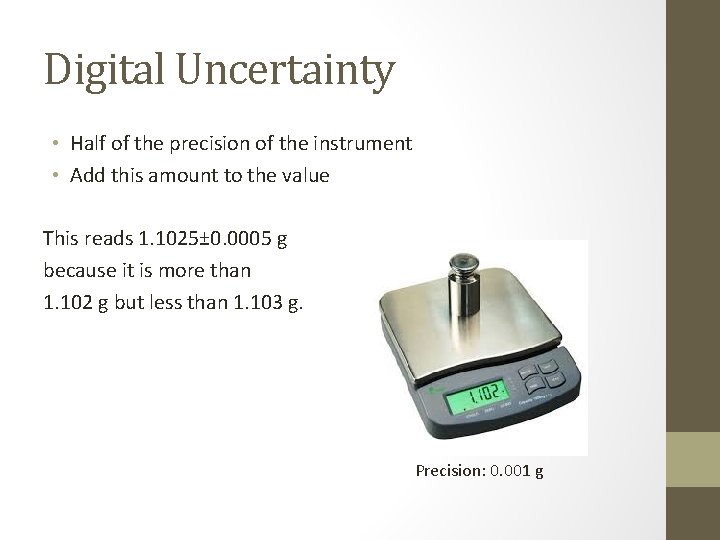
Digital Uncertainty • Half of the precision of the instrument • Add this amount to the value This reads 1. 1025± 0. 0005 g because it is more than 1. 102 g but less than 1. 103 g. Precision: 0. 001 g
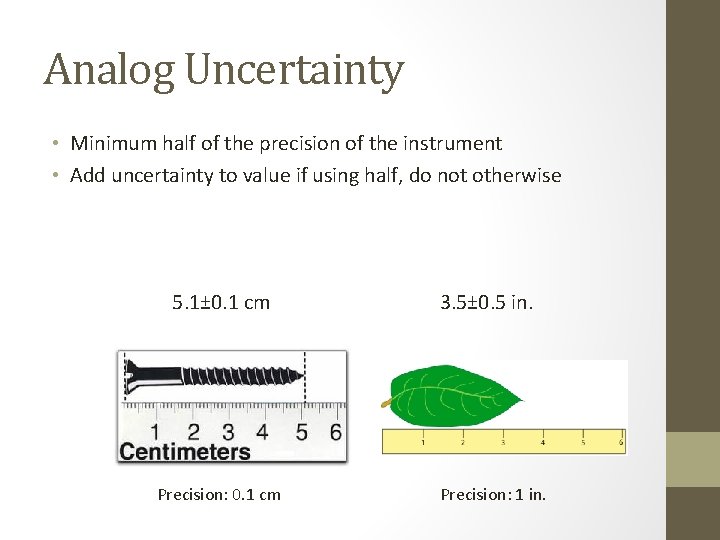
Analog Uncertainty • Minimum half of the precision of the instrument • Add uncertainty to value if using half, do not otherwise 5. 1± 0. 1 cm Precision: 0. 1 cm 3. 5± 0. 5 in. Precision: 1 in.
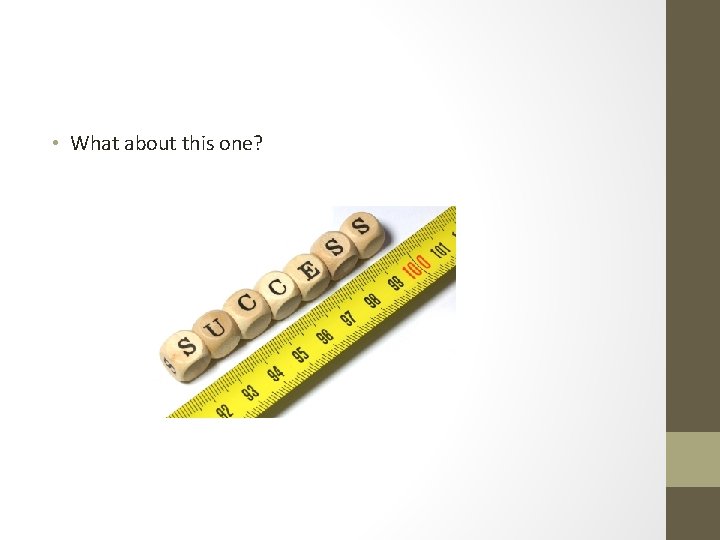
• What about this one?
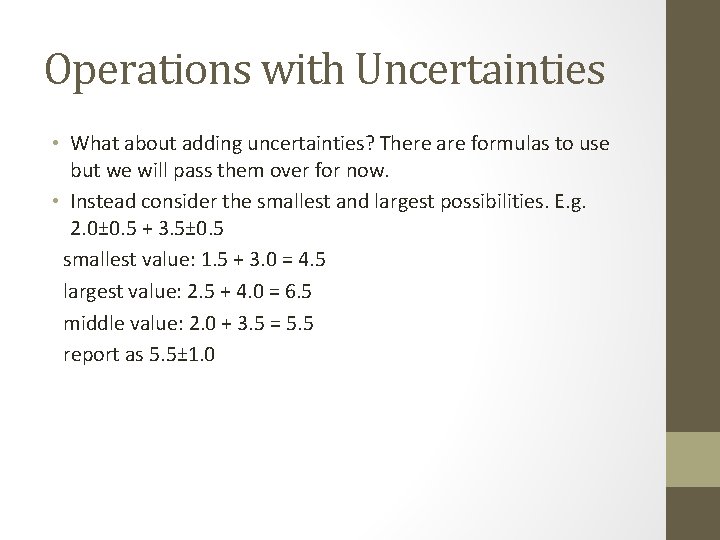
Operations with Uncertainties • What about adding uncertainties? There are formulas to use but we will pass them over for now. • Instead consider the smallest and largest possibilities. E. g. 2. 0± 0. 5 + 3. 5± 0. 5 smallest value: 1. 5 + 3. 0 = 4. 5 largest value: 2. 5 + 4. 0 = 6. 5 middle value: 2. 0 + 3. 5 = 5. 5 report as 5. 5± 1. 0
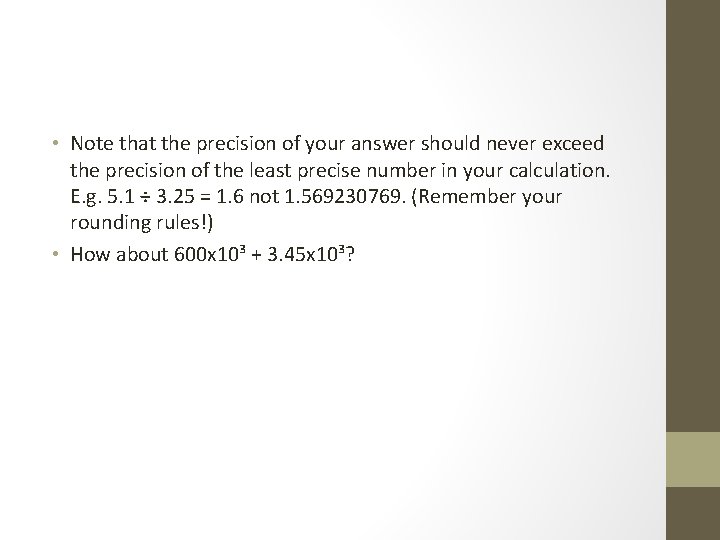
• Note that the precision of your answer should never exceed the precision of the least precise number in your calculation. E. g. 5. 1 ÷ 3. 25 = 1. 6 not 1. 569230769. (Remember your rounding rules!) • How about 600 x 10³ + 3. 45 x 10³?