
Precise Thermometry for Next Generation LHC Superconducting Magnets
- Slides: 1
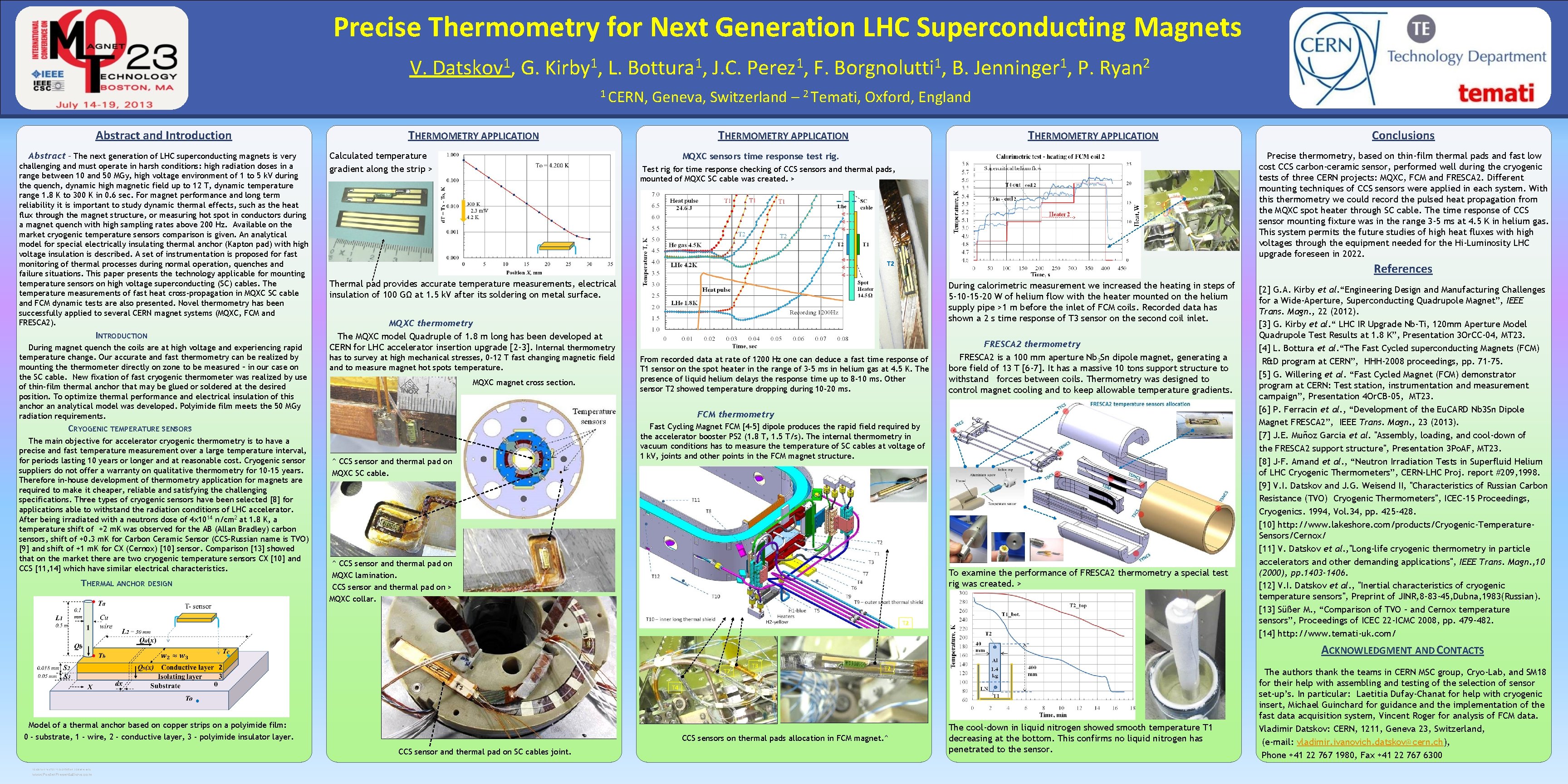
Precise Thermometry for Next Generation LHC Superconducting Magnets V. Datskov 1, G. Kirby 1, L. Bottura 1, J. C. Perez 1, F. Borgnolutti 1, B. Jenninger 1, P. Ryan 2 1 CERN, Abstract and Introduction Abstract – The next generation of LHC superconducting magnets is very challenging and must operate in harsh conditions: high radiation doses in a range between 10 and 50 MGy, high voltage environment of 1 to 5 k. V during the quench, dynamic high magnetic field up to 12 T, dynamic temperature range 1. 8 K to 300 K in 0. 6 sec. For magnet performance and long term reliability it is important to study dynamic thermal effects, such as the heat flux through the magnet structure, or measuring hot spot in conductors during a magnet quench with high sampling rates above 200 Hz. Available on the market cryogenic temperature sensors comparison is given. An analytical model for special electrically insulating thermal anchor (Kapton pad) with high voltage insulation is described. A set of instrumentation is proposed for fast monitoring of thermal processes during normal operation, quenches and failure situations. This paper presents the technology applicable for mounting temperature sensors on high voltage superconducting (SC) cables. The temperature measurements of fast heat cross-propagation in MQXC SC cable and FCM dynamic tests are also presented. Novel thermometry has been successfully applied to several CERN magnet systems (MQXC, FCM and FRESCA 2). INTRODUCTION During magnet quench the coils are at high voltage and experiencing rapid temperature change. Our accurate and fast thermometry can be realized by mounting thermometer directly on zone to be measured – in our case on the SC cable. New fixation of fast cryogenic thermometer was realized by use of thin-film thermal anchor that may be glued or soldered at the desired position. To optimize thermal performance and electrical insulation of this anchor an analytical model was developed. Polyimide film meets the 50 MGy radiation requirements. THERMOMETRY APPLICATION Calculated temperature gradient along the strip > THERMAL ANCHOR DESIGN THERMOMETRY APPLICATION Test rig for time response checking of CCS sensors and thermal pads, mounted of MQXC SC cable was created. > T 2 References Thermal pad provides accurate temperature measurements, electrical insulation of 100 GΩ at 1. 5 k. V after its soldering on metal surface. During calorimetric measurement we increased the heating in steps of 5 -10 -15 -20 W of helium flow with the heater mounted on the helium supply pipe >1 m before the inlet of FCM coils. Recorded data has shown a 2 s time response of T 3 sensor on the second coil inlet. MQXC thermometry The MQXC model Quadruple of 1. 8 m long has been developed at CERN for LHC accelerator insertion upgrade [2 -3]. Internal thermometry has to survey at high mechanical stresses, 0 -12 T fast changing magnetic field and to measure magnet hot spots temperature. MQXC magnet cross section. From recorded data at rate of 1200 Hz one can deduce a fast time response of T 1 sensor on the spot heater in the range of 3 -5 ms in helium gas at 4. 5 K. The presence of liquid helium delays the response time up to 8 -10 ms. Other sensor T 2 showed temperature dropping during 10 -20 ms. FRESCA 2 thermometry FRESCA 2 is a 100 mm aperture Nb 3 Sn dipole magnet, generating a bore field of 13 T [6 -7]. It has a massive 10 tons support structure to withstand forces between coils. Thermometry was designed to control magnet cooling and to keep allowable temperature gradients. FCM thermometry ^ CCS sensor and thermal pad on MQXC SC cable. Conclusions Precise thermometry, based on thin-film thermal pads and fast low cost CCS carbon-ceramic sensor, performed well during the cryogenic tests of three CERN projects: MQXC, FCM and FRESCA 2. Different mounting techniques of CCS sensors were applied in each system. With this thermometry we could record the pulsed heat propagation from the MQXC spot heater through SC cable. The time response of CCS sensor mounting fixture was in the range 3 -5 ms at 4. 5 K in helium gas. This system permits the future studies of high heat fluxes with high voltages through the equipment needed for the Hi-Luminosity LHC upgrade foreseen in 2022. MQXC sensors time response test rig. CRYOGENIC TEMPERATURE SENSORS The main objective for accelerator cryogenic thermometry is to have a precise and fast temperature measurement over a large temperature interval, for periods lasting 10 years or longer and at reasonable cost. Cryogenic sensor suppliers do not offer a warranty on qualitative thermometry for 10 -15 years. Therefore in-house development of thermometry application for magnets are required to make it cheaper, reliable and satisfying the challenging specifications. Three types of cryogenic sensors have been selected [8] for applications able to withstand the radiation conditions of LHC accelerator. After being irradiated with a neutrons dose of 4 x 10¹⁴ n/cm 2 at 1. 8 K, a temperature shift of +2 m. K was observed for the AB (Allan Bradley) carbon sensors, shift of +0. 3 m. K for Carbon Ceramic Sensor (CCS-Russian name is TVO) [9] and shift of +1 m. K for CX (Cernox) [10] sensor. Comparison [13] showed that on the market there are two cryogenic temperature sensors CX [10] and CCS [11, 14] which have similar electrical characteristics. Geneva, Switzerland – 2 Temati, Oxford, England Fast Cycling Magnet FCM [4 -5] dipole produces the rapid field required by the accelerator booster PS 2 (1. 8 T, 1. 5 T/s). The internal thermometry in vacuum conditions has to measure the temperature of SC cables at voltage of 1 k. V, joints and other points in the FCM magnet structure. ^ CCS sensor and thermal pad on MQXC lamination. CCS sensor and thermal pad on > MQXC collar. To examine the performance of FRESCA 2 thermometry a special test rig was created. > T 2 [2] G. A. Kirby et al. “Engineering Design and Manufacturing Challenges for a Wide-Aperture, Superconducting Quadrupole Magnet”, IEEE Trans. Magn. , 22 (2012). [3] G. Kirby et al. “ LHC IR Upgrade Nb-Ti, 120 mm Aperture Model Quadrupole Test Results at 1. 8 K”, Presentation 3 Or. CC-04, MT 23. [4] L. Bottura et al. “The Fast Cycled superconducting Magnets (FCM) R&D program at CERN”, HHH-2008 proceedings, pp. 71 -75. [5] G. Willering et al. “Fast Cycled Magnet (FCM) demonstrator program at CERN: Test station, instrumentation and measurement campaign”, Presentation 4 Or. CB-05, MT 23. [6] P. Ferracin et al. , “Development of the Eu. CARD Nb 3 Sn Dipole Magnet FRESCA 2”, IEEE Trans. Magn. , 23 (2013). [7] J. E. Muñoz Garcia et al. "Assembly, loading, and cool-down of the FRESCA 2 support structure", Presentation 3 Po. AF, MT 23. [8] J-F. Amand et al. , “Neutron Irradiation Tests in Superfluid Helium of LHC Cryogenic Thermometers”, CERN-LHC Proj. report #209, 1998. [9] V. I. Datskov and J. G. Weisend II, "Characteristics of Russian Carbon Resistance (TVO) Cryogenic Thermometers", ICEC-15 Proceedings, Cryogenics. 1994, Vol. 34, pp. 425 -428. [10] http: //www. lakeshore. com/products/Cryogenic-Temperature. Sensors/Cernox/ [11] V. Datskov et al. , "Long-life cryogenic thermometry in particle accelerators and other demanding applications", IEEE Trans. Magn. , 10 (2000), pp. 1403 -1406. [12] V. I. Datskov et al. , "Inertial characteristics of cryogenic temperature sensors", Preprint of JINR, 8 -83 -45, Dubna, 1983(Russian). [13] Süßer M. , “Comparison of TVO – and Cernox temperature sensors”, Proceedings of ICEC 22 -ICMC 2008, pp. 479 -482. [14] http: //www. temati-uk. com/ ACKNOWLEDGMENT AND CONTACTS T 7 T 3 T 2 T 4 Model of a thermal anchor based on copper strips on a polyimide film: 0 - substrate, 1 - wire, 2 - conductive layer, 3 - polyimide insulator layer. CCS sensors on thermal pads allocation in FCM magnet. ^ CCS sensor and thermal pad on SC cables joint. RESEARCH POSTER PRESENTATION DESIGN © 2012 www. Poster. Presentations. com The cool-down in liquid nitrogen showed smooth temperature T 1 decreasing at the bottom. This confirms no liquid nitrogen has penetrated to the sensor. The authors thank the teams in CERN MSC group, Cryo-Lab, and SM 18 for their help with assembling and testing of the selection of sensor set-up’s. In particular: Laetitia Dufay-Chanat for help with cryogenic insert, Michael Guinchard for guidance and the implementation of the fast data acquisition system, Vincent Roger for analysis of FCM data. Vladimir Datskov: CERN, 1211, Geneva 23, Switzerland, (e-mail: vladimir. ivanovich. datskov@cern. ch), Phone +41 22 767 1980, Fax +41 22 767 6300