
PRECIS Providing REgional Climates for Impact Studies The
- Slides: 41
PRECIS Providing REgional Climates for Impact Studies The Hadley Centre regional climate modelling system A presentation to the Tyndall Centre AIACC training workshop by Richard Jones and Simon Wilson 23 April 2002 Hadley Centre for Climate Prediction and Research
Outline n Background: Motivation and PRECIS overview n PRECIS components and how to operate them n Future climate scenarios available from PRECIS n Applying PRECIS in impacts assessment n Limitations of PRECIS and future developments Hadley Centre for Climate Prediction and Research
Motivation n UNFCCC requirement to assess national vulnerability and plans for adaptation n UNFCCC requirement to submit National Communications n Both need estimate of impacts n Impacts need scenarios of future climate Hadley Centre for Climate Prediction and Research
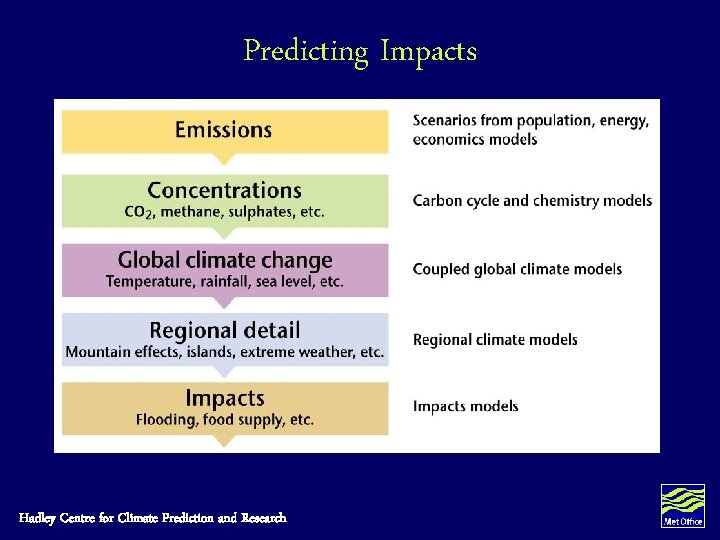
Predicting Impacts Hadley Centre for Climate Prediction and Research
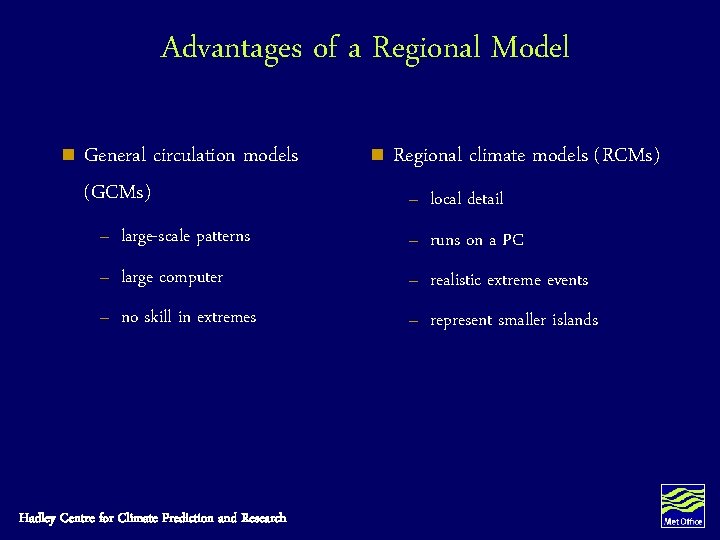
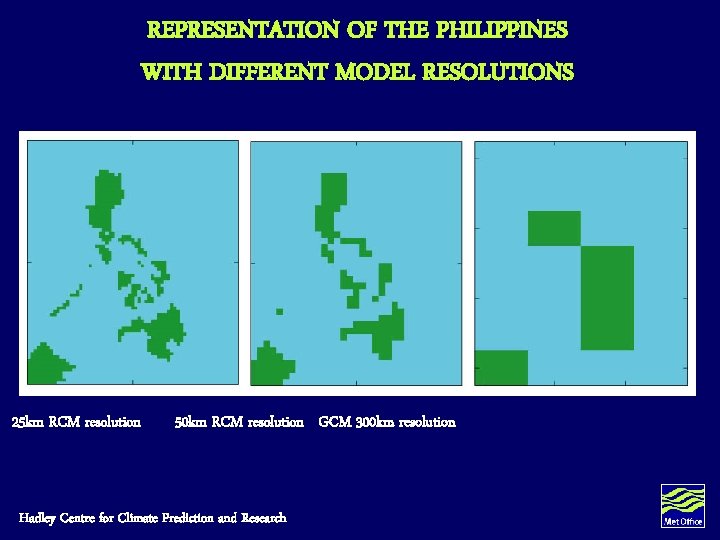
Advantages of a Regional Model n General circulation models (GCMs) n Regional climate models (RCMs) – local detail – large-scale patterns – runs on a PC – large computer – realistic extreme events – no skill in extremes – represent smaller islands Hadley Centre for Climate Prediction and Research
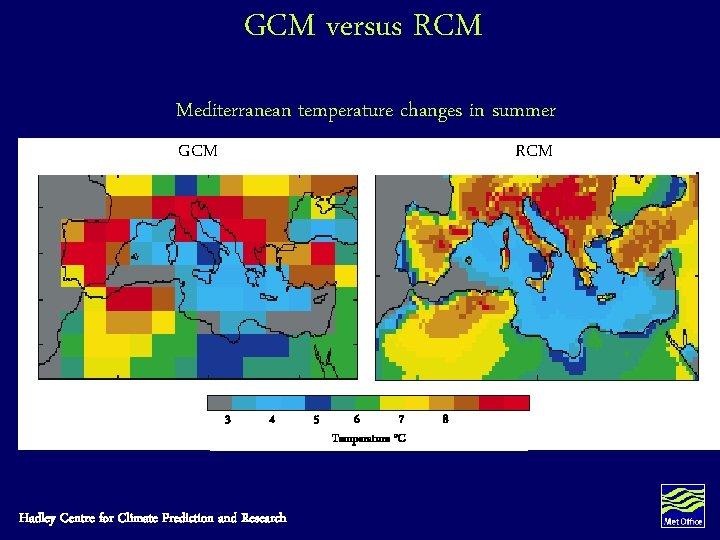
GCM versus RCM Mediterranean temperature changes in summer GCM RCM 3 4 Hadley Centre for Climate Prediction and Research 5 6 7 Temperature °C 8
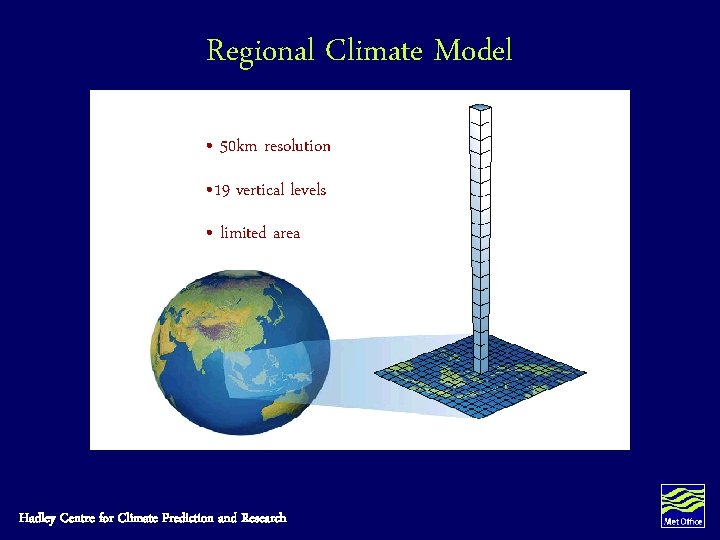
Regional Climate Model • 50 km resolution • 19 vertical levels • limited area Hadley Centre for Climate Prediction and Research
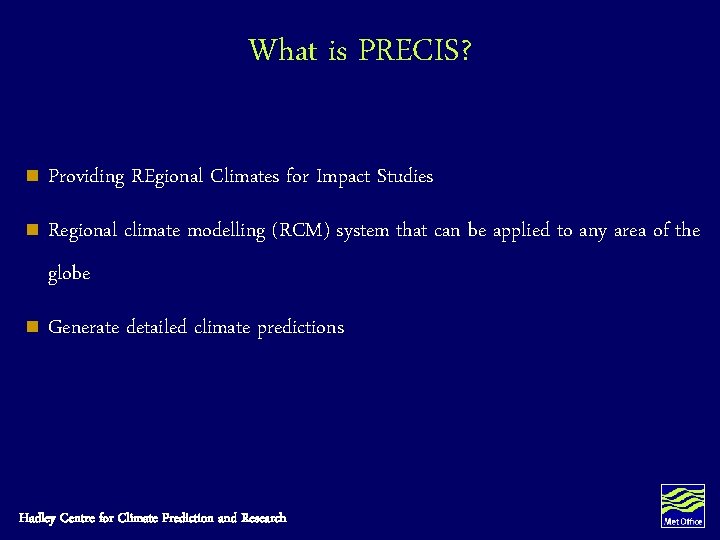
What is PRECIS? n Providing REgional Climates for Impact Studies n Regional climate modelling (RCM) system that can be applied to any area of the globe n Generate detailed climate predictions Hadley Centre for Climate Prediction and Research
Why develop PRECIS? n Need of all countries for detailed climate change scenarios to assess vulnerability. n A PC version of the RCM will enable developing countries to generate their own national scenarios n Capacity building n Technology transfer Hadley Centre for Climate Prediction and Research
Who funds PRECIS? Hadley Centre for Climate Prediction and Research
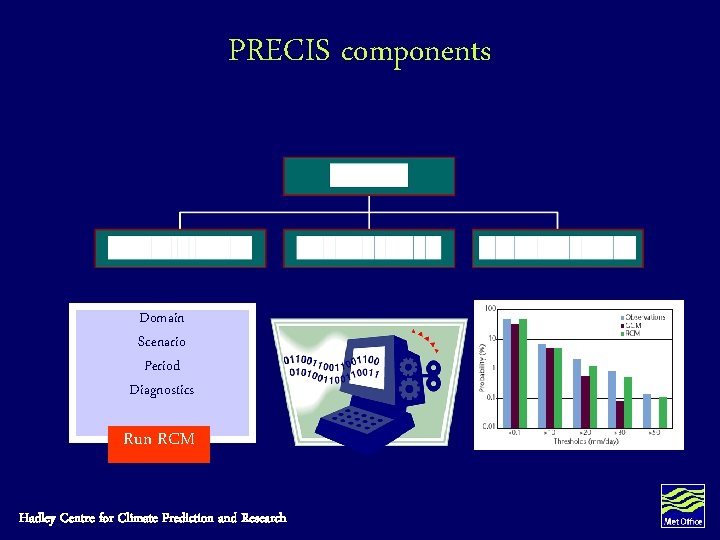
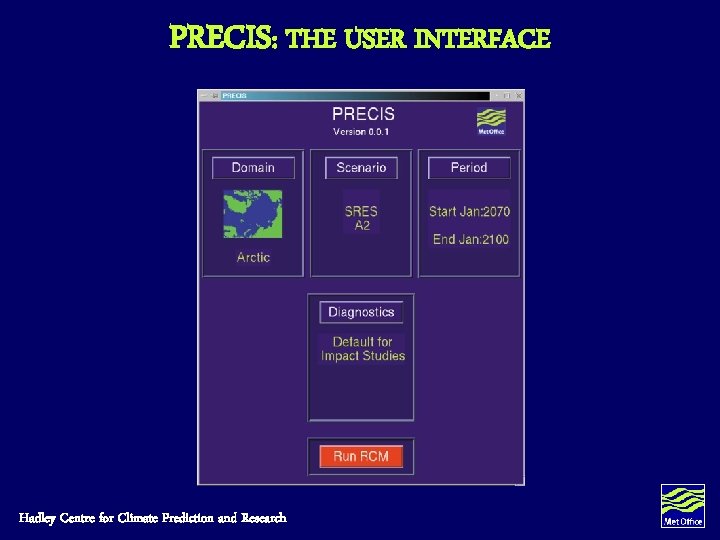
PRECIS components Domain Scenario Period Diagnostics Run RCM Hadley Centre for Climate Prediction and Research
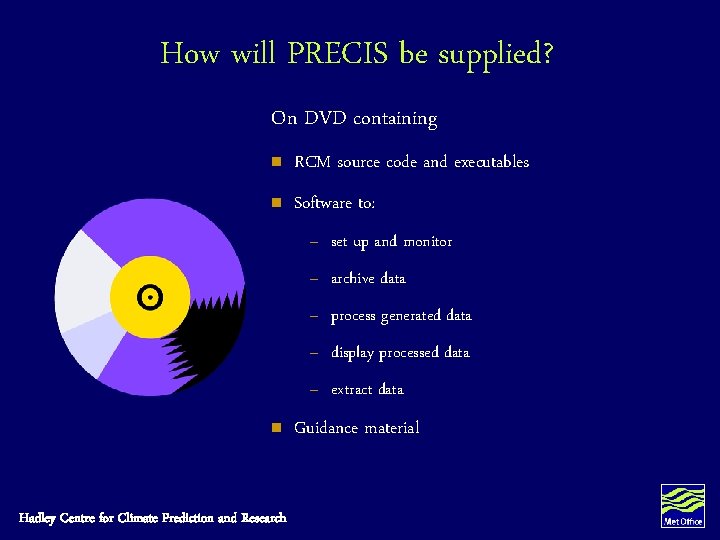
How will PRECIS be supplied? On DVD containing n RCM source code and executables n Software to: – set up and monitor – archive data – process generated data – display processed data – extract data n Hadley Centre for Climate Prediction and Research Guidance material
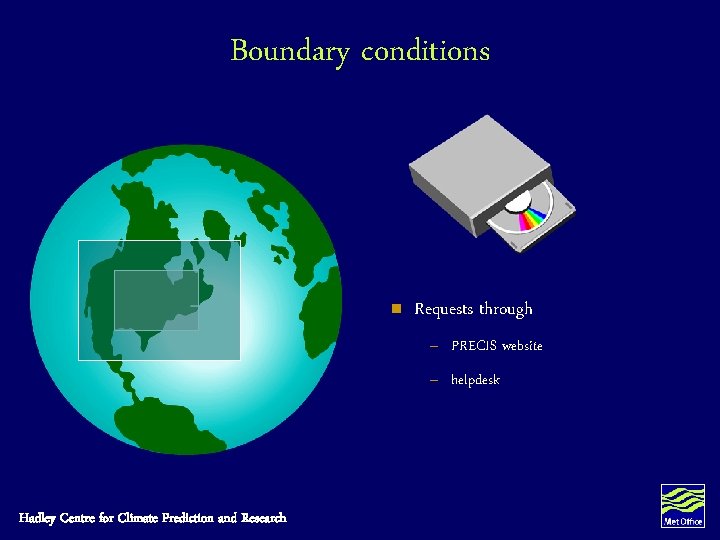
Boundary conditions n Requests through – PRECIS website – helpdesk Hadley Centre for Climate Prediction and Research
Support and follow-up n Helpdesk – voice – web-based n Updates n Exchange of data and methods Hadley Centre for Climate Prediction and Research
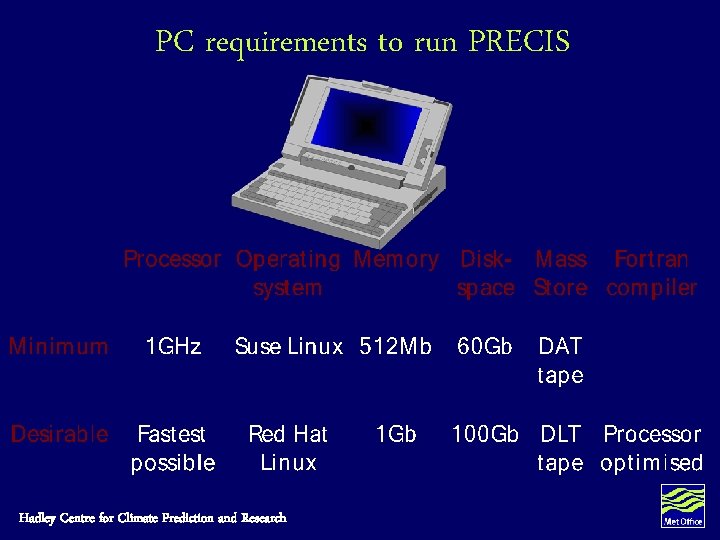
PC requirements to run PRECIS Hadley Centre for Climate Prediction and Research
PRECIS components and their use n User-interface to set up RCM experiments n The latest Hadley Centre RCM n Data-processing and graphics software n Boundary conditions from latest Hadley Centre GCM n Training course and materials Hadley Centre for Climate Prediction and Research
PRECIS: THE USER INTERFACE Hadley Centre for Climate Prediction and Research
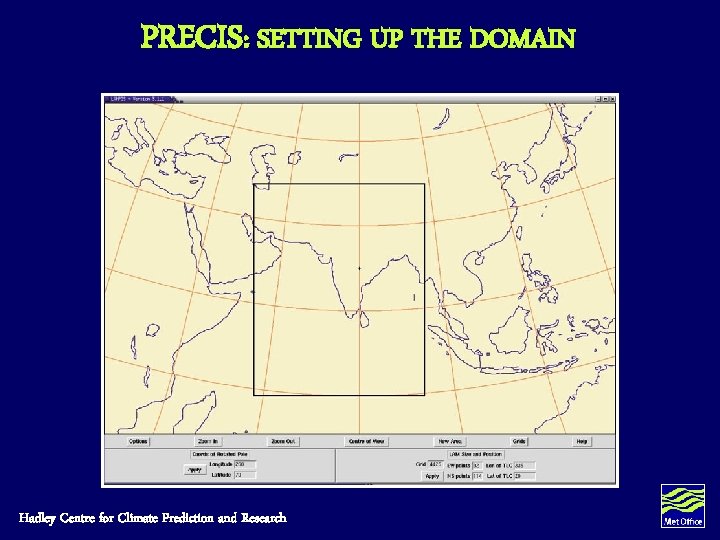
PRECIS: SETTING UP THE DOMAIN Hadley Centre for Climate Prediction and Research
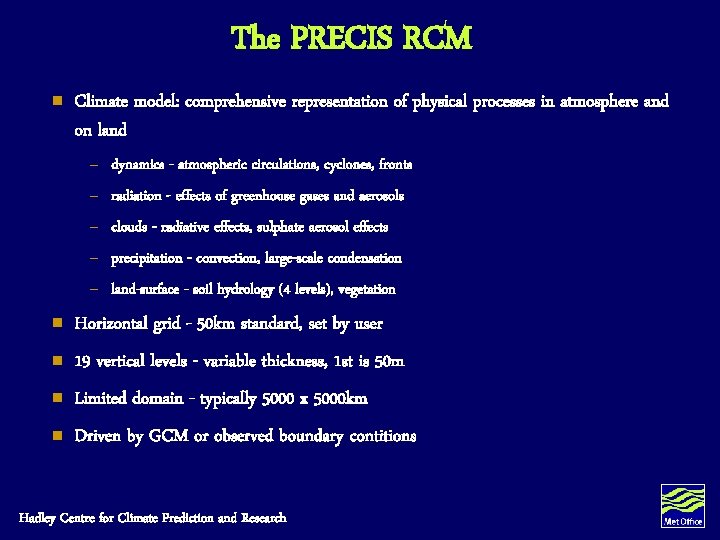
The PRECIS RCM n Climate model: comprehensive representation of physical processes in atmosphere and on land – dynamics - atmospheric circulations, cyclones, fronts – radiation - effects of greenhouse gases and aerosols – clouds - radiative effects, sulphate aerosol effects – precipitation - convection, large-scale condensation – land-surface - soil hydrology (4 levels), vegetation n Horizontal grid - 50 km standard, set by user n 19 vertical levels - variable thickness, 1 st is 50 m n Limited domain - typically 5000 x 5000 km n Driven by GCM or observed boundary contitions Hadley Centre for Climate Prediction and Research
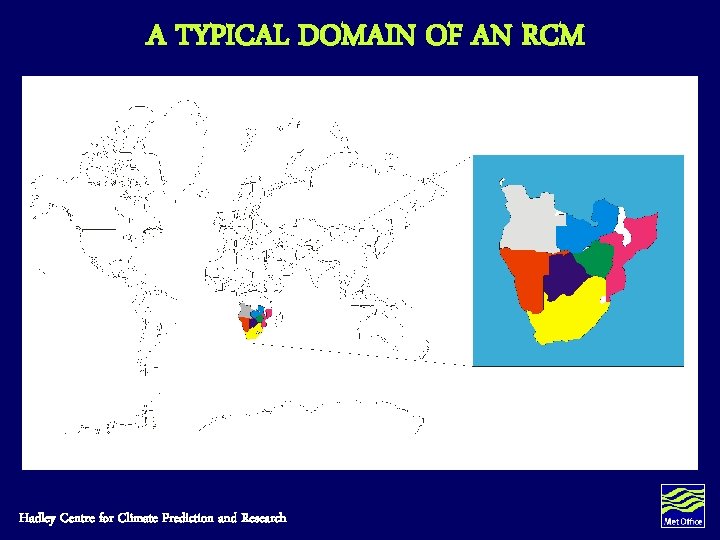
A TYPICAL DOMAIN OF AN RCM Hadley Centre for Climate Prediction and Research
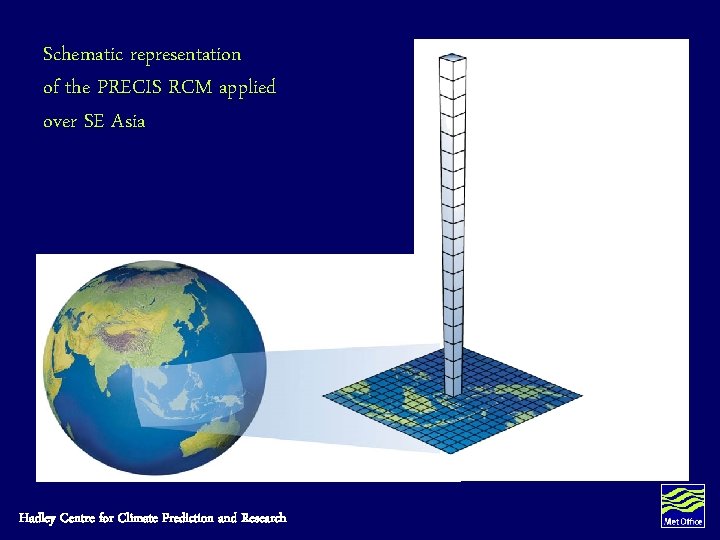
Schematic representation of the PRECIS RCM applied over SE Asia Hadley Centre for Climate Prediction and Research
Data-processing and graphics (CDAT- available freely from PCMDI) n Data display system: – to monitor ongoing experiments – to display (processed) results of experiments n Data processing system: – to calculate climate statistics – to calculate changes in climate – to form climate scenarios Hadley Centre for Climate Prediction and Research
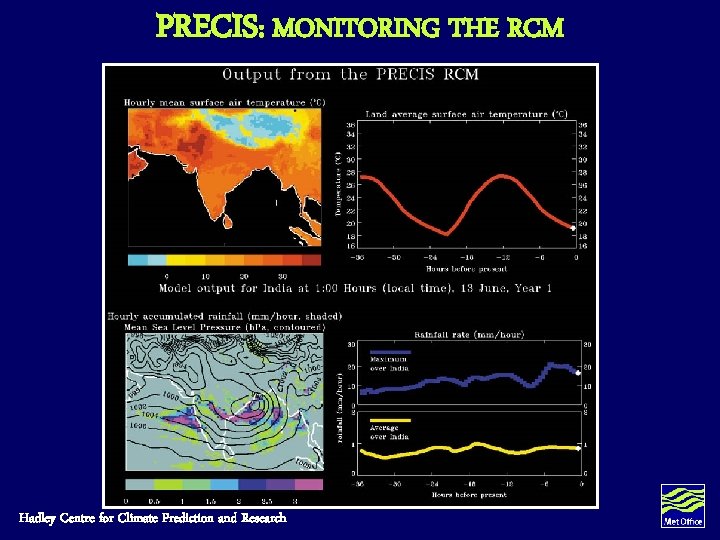
PRECIS: MONITORING THE RCM Hadley Centre for Climate Prediction and Research
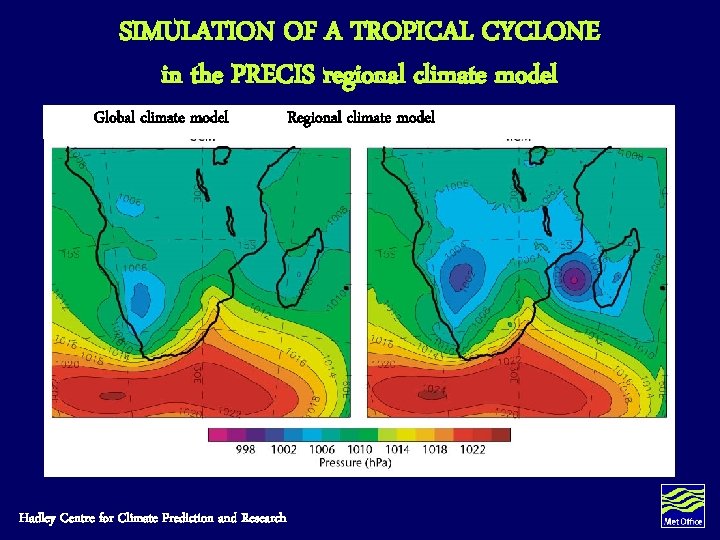
SIMULATION OF A TROPICAL CYCLONE in the PRECIS regional climate model Global climate model Hadley Centre for Climate Prediction and Research Regional climate model
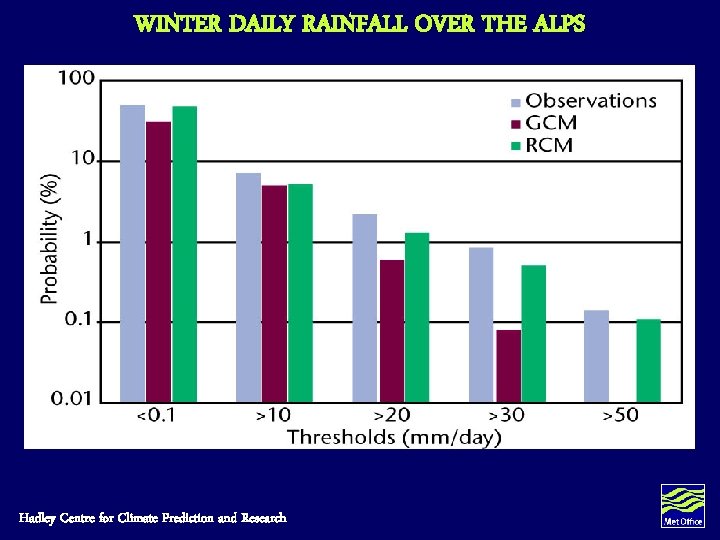
WINTER DAILY RAINFALL OVER THE ALPS Hadley Centre for Climate Prediction and Research
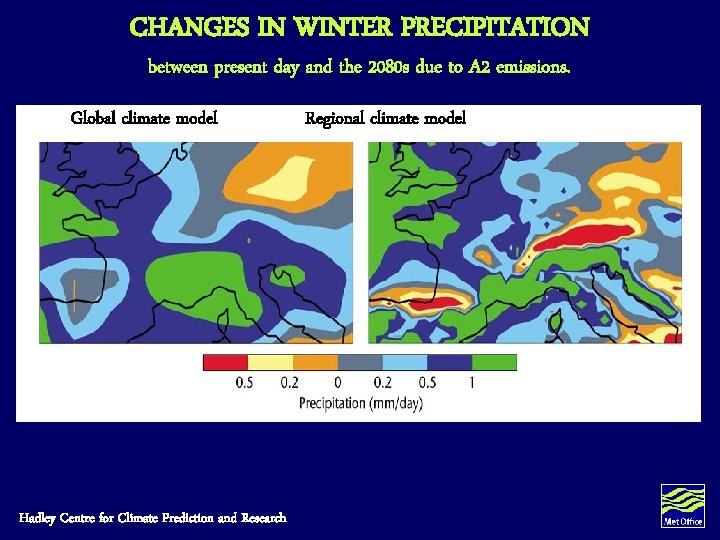
CHANGES IN WINTER PRECIPITATION between present day and the 2080 s due to A 2 emissions. Global climate model Hadley Centre for Climate Prediction and Research Regional climate model
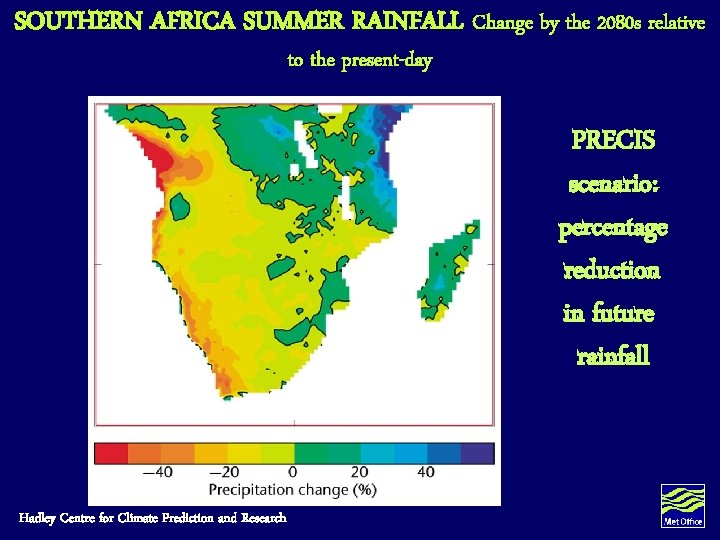
SOUTHERN AFRICA SUMMER RAINFALL Change by the 2080 s relative to the present-day PRECIS scenario: percentage reduction in future rainfall Hadley Centre for Climate Prediction and Research
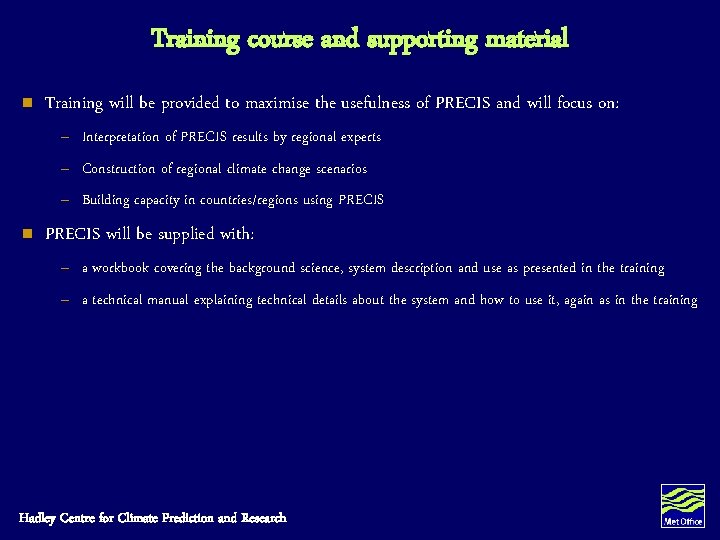
Training course and supporting material n Training will be provided to maximise the usefulness of PRECIS and will focus on: – Interpretation of PRECIS results by regional experts – Construction of regional climate change scenarios – Building capacity in countries/regions using PRECIS n PRECIS will be supplied with: – a workbook covering the background science, system description and use as presented in the training – a technical manual explaining technical details about the system and how to use it, again as in the training Hadley Centre for Climate Prediction and Research
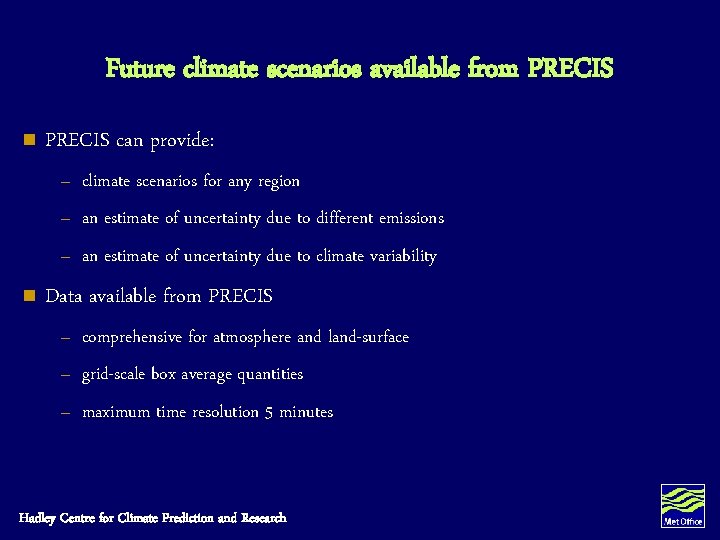
Future climate scenarios available from PRECIS n PRECIS can provide: – climate scenarios for any region – an estimate of uncertainty due to different emissions – an estimate of uncertainty due to climate variability n Data available from PRECIS – comprehensive for atmosphere and land-surface – grid-scale box average quantities – maximum time resolution 5 minutes Hadley Centre for Climate Prediction and Research
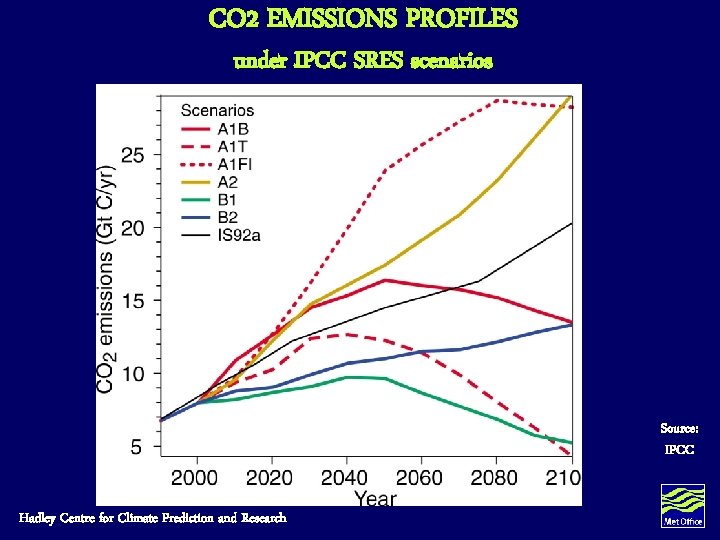
CO 2 EMISSIONS PROFILES under IPCC SRES scenarios Source: IPCC Hadley Centre for Climate Prediction and Research
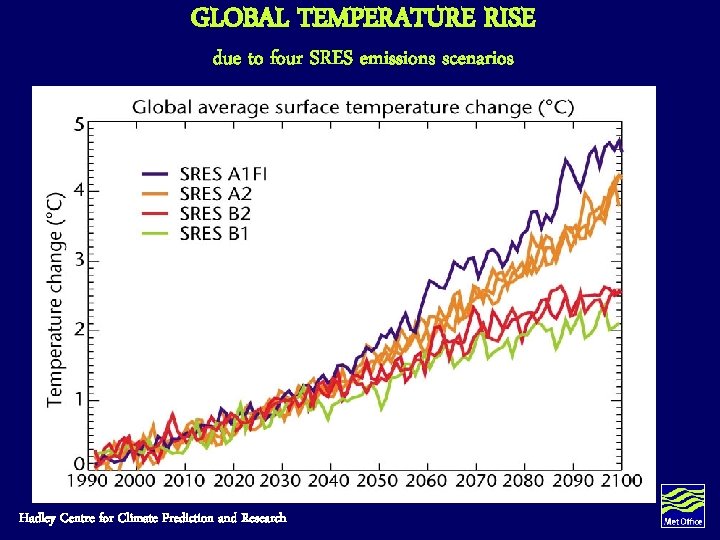
GLOBAL TEMPERATURE RISE due to four SRES emissions scenarios Hadley Centre for Climate Prediction and Research
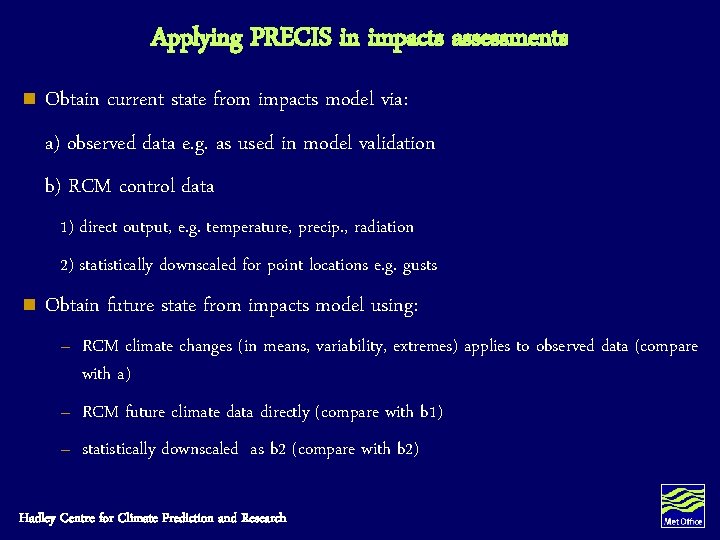
Applying PRECIS in impacts assessments n Obtain current state from impacts model via: a) observed data e. g. as used in model validation b) RCM control data 1) direct output, e. g. temperature, precip. , radiation 2) statistically downscaled for point locations e. g. gusts n Obtain future state from impacts model using: – RCM climate changes (in means, variability, extremes) applies to observed data (compare with a) – RCM future climate data directly (compare with b 1) – statistically downscaled as b 2 (compare with b 2) Hadley Centre for Climate Prediction and Research
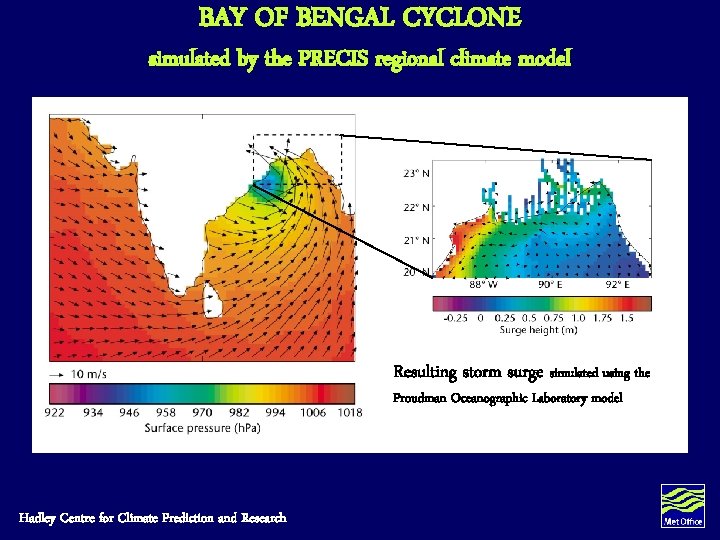
BAY OF BENGAL CYCLONE simulated by the PRECIS regional climate model Resulting storm surge simulated using the Proudman Oceanographic Laboratory model Hadley Centre for Climate Prediction and Research
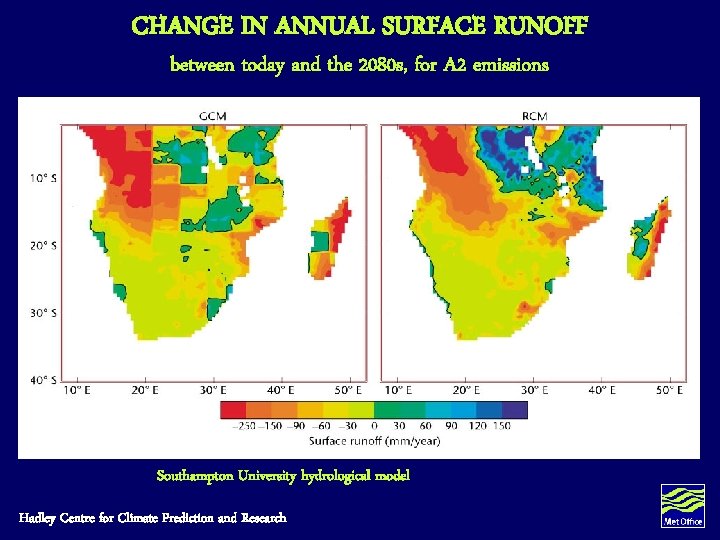
CHANGE IN ANNUAL SURFACE RUNOFF between today and the 2080 s, for A 2 emissions Southampton University hydrological model Hadley Centre for Climate Prediction and Research
CURRENT LIMITATIONS OF PRECIS n 10 year simulations take over a month n It is a model hence imperfect, i. e. uncertainty due to use of only one RCM is not captured n Uncertainty due to imperfect driving data (i. e. from only one GCM) is not captured n Resolution of 50 km insufficient for some impacts applications n Coastal or marine impacts have to be inferred (e. g. storm surges) or data is not available Hadley Centre for Climate Prediction and Research
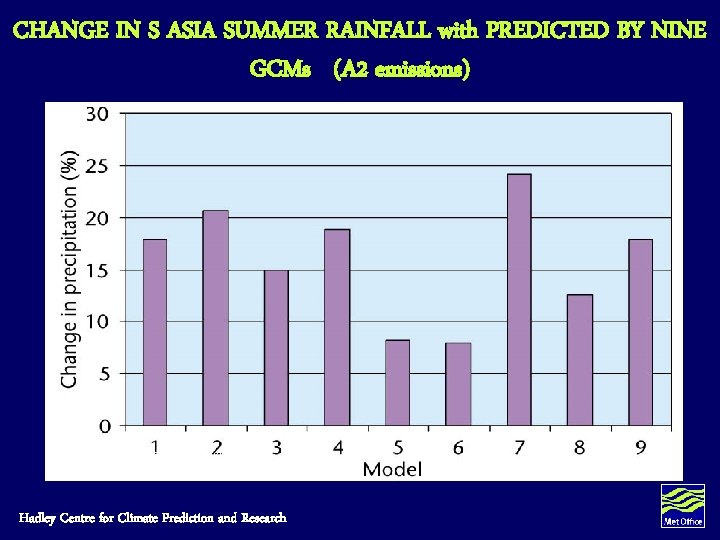
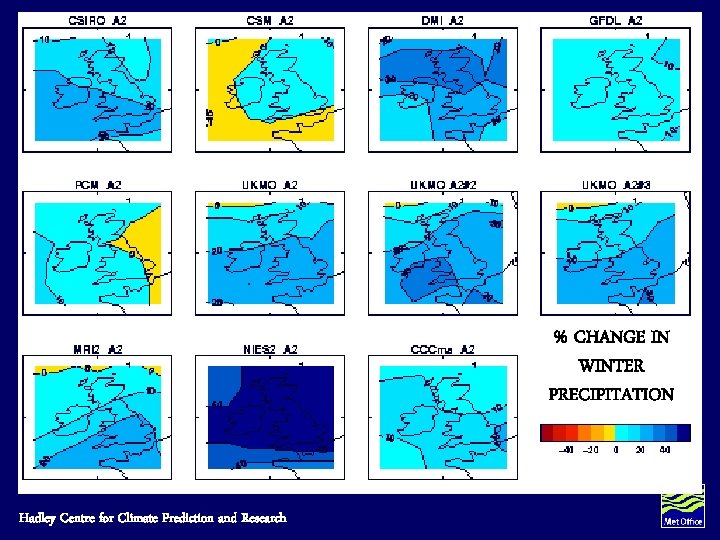
UNCERTAINTIES IN DETAILED CLIMATE CHANGE SCENARIOS n Uncertainty in future emissions – PRECIS uses 4 SRES emissions scenarios n Natural variability – PRECIS can run in ensemble mode n Uncertainty in the response of the climate system – PRECIS uses boundary conditsion from 1 GCM n Uncertainty in the detailed climate change – PRECIS uses only one RCM Hadley Centre for Climate Prediction and Research
CHANGE IN S ASIA SUMMER RAINFALL with PREDICTED BY NINE GCMs (A 2 emissions) A 2 emissions scenario Hadley Centre for Climate Prediction and Research
% CHANGE IN WINTER PRECIPITATION Hadley Centre for Climate Prediction and Research
REPRESENTATION OF THE PHILIPPINES WITH DIFFERENT MODEL RESOLUTIONS 25 km RCM resolution 50 km RCM resolution GCM 300 km resolution Hadley Centre for Climate Prediction and Research
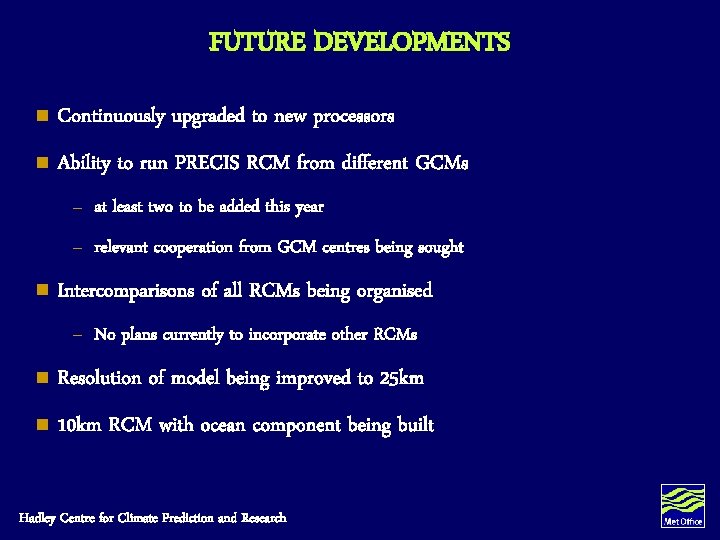
FUTURE DEVELOPMENTS n Continuously upgraded to new processors n Ability to run PRECIS RCM from different GCMs – at least two to be added this year – relevant cooperation from GCM centres being sought n Intercomparisons of all RCMs being organised – No plans currently to incorporate other RCMs n Resolution of model being improved to 25 km n 10 km RCM with ocean component being built Hadley Centre for Climate Prediction and Research
Final remarks n You can contact us via: – Email: precis@metoffice. com – Tel: +44 1344 854938 – Fax: +44 1344 854898 n Web-site for information on PRECIS – www. hadleycentre. com/models/PRECIS. html Hadley Centre for Climate Prediction and Research