
Precipitation Reactions Double Replacement reactions in which a
Precipitation Reactions Double Replacement reactions in which a solid is formed
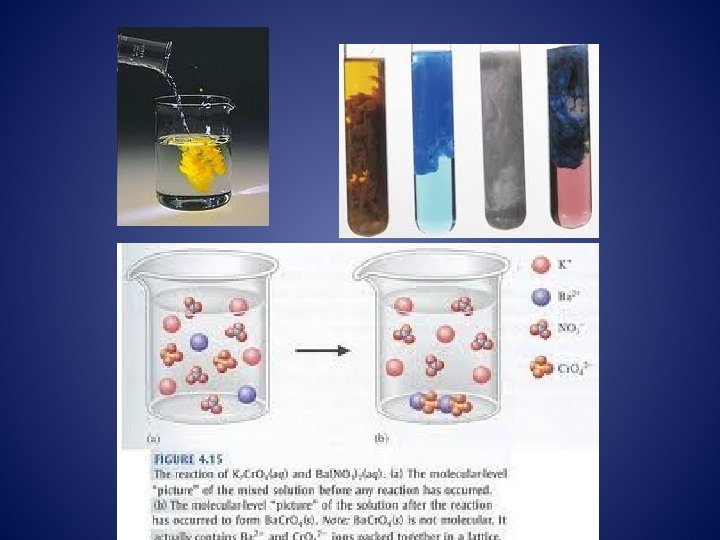
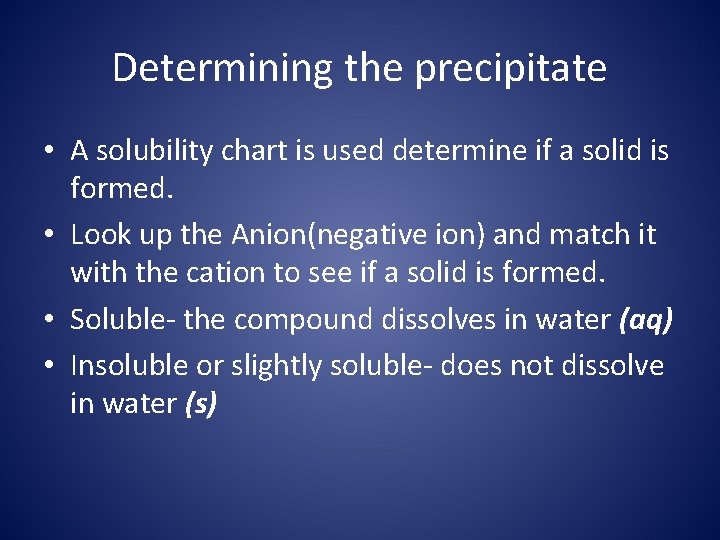
Ch. 8 Section 1 (pp. 240 -253) • What is precipitation? • What is a precipitate? • What happens when an ionic compound dissolves in water? – What is an electrolyte? – Ba(NO 3)2(aq) _______(__) + ____(__) – K 2 Cr. O 4(aq) _______(__) + _______ (__) – Draw the beakers on top of p. 242.
Aqueous Solutions • When ionic compounds are dissolved in water, they dissociate, i. e. they separate into their ions. • Ba(NO 3)2(aq) Ba+2 (aq) + 2 NO 3 - (aq) • K 2 SO 4(aq) 2 K+(aq) + SO 4 -2 (aq)
Predicting Products • Double replacement reactions switch cations to form new compounds. Cation with Anion) AB + CD AD + CB • Rebalance the new compounds so that the formulas are neutral before you balance the equation.
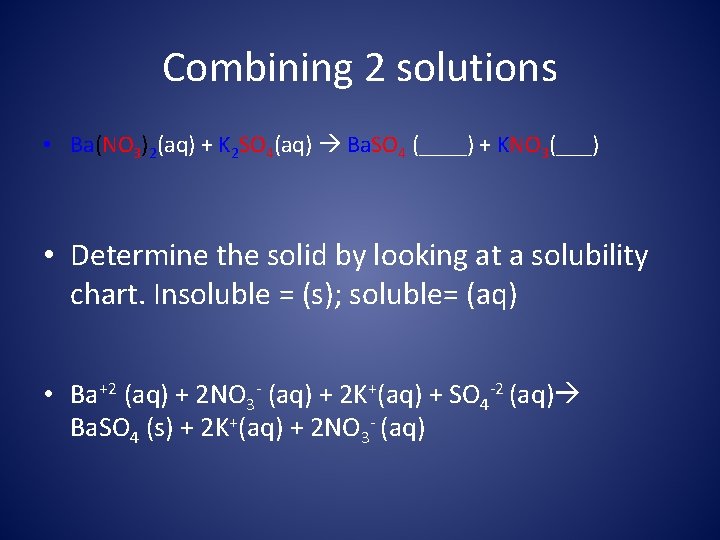
Determining the precipitate • A solubility chart is used determine if a solid is formed. • Look up the Anion(negative ion) and match it with the cation to see if a solid is formed. • Soluble- the compound dissolves in water (aq) • Insoluble or slightly soluble- does not dissolve in water (s)
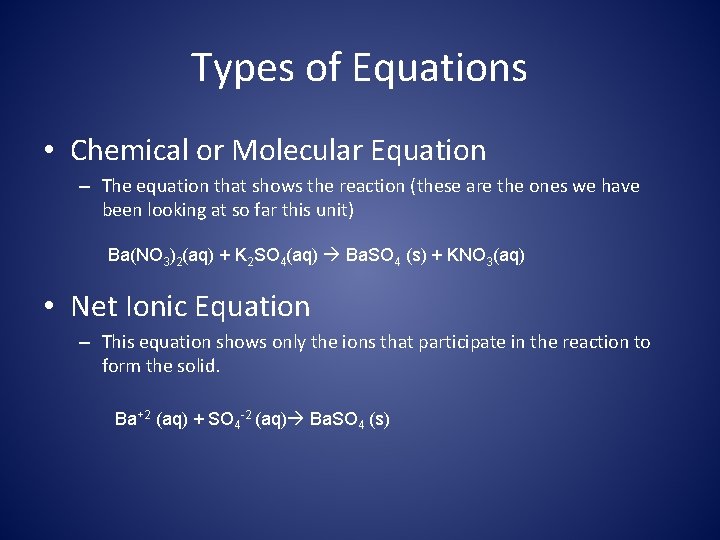
Combining 2 solutions • Ba(NO 3)2(aq) + K 2 SO 4(aq) Ba. SO 4 (____) + KNO 3(___) • Determine the solid by looking at a solubility chart. Insoluble = (s); soluble= (aq) • Ba+2 (aq) + 2 NO 3 - (aq) + 2 K+(aq) + SO 4 -2 (aq) Ba. SO 4 (s) + 2 K+(aq) + 2 NO 3 - (aq)
Types of Equations • Chemical or Molecular Equation – The equation that shows the reaction (these are the ones we have been looking at so far this unit) Ba(NO 3)2(aq) + K 2 SO 4(aq) Ba. SO 4 (s) + KNO 3(aq) • Net Ionic Equation – This equation shows only the ions that participate in the reaction to form the solid. Ba+2 (aq) + SO 4 -2 (aq) Ba. SO 4 (s)
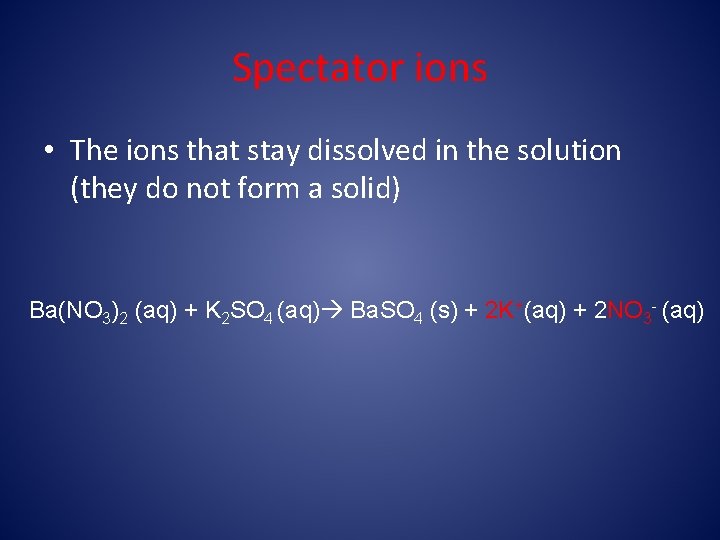
Spectator ions • The ions that stay dissolved in the solution (they do not form a solid) Ba(NO 3)2 (aq) + K 2 SO 4 (aq) Ba. SO 4 (s) + 2 K+(aq) + 2 NO 3 - (aq)
- Slides: 9