
Precepting Techniques in the Modern Age Mike De
- Slides: 53
Precepting Techniques in the Modern Age Mike De Luna, Pharm. D, BCPS September 16 th, 2017 CTSHP Fall Seminar San Antonio, TX
Learning Objectives 1. The learner will become familiar with learning principles used in adult education and how to apply them to the technologically advanced student 2. The learner will be able to discuss the advantages/disadvantages of electronics in the setting of precepting pharmacy students 3. The learner will become familiar with the various mediums that pharmacy students today may be using to access information 4. The learner will be able to identify legal pitfalls with having access to social media in the workplace 5. The learner will be able to modify teaching methods to responsibly use electronic media to enhance the student's learning experience
Disclosure • I have nothing to disclose and do not represent the views or opinions of any employer or organization • The information presented here today is gathered from evidence based research as well as publicized tertiary materials, as well as some of my personal experiences • The patient cases presented are fictitious and any likeness to an actual patient is purely coincidental
Pre-Test Questions 1. Which term relates to how adults learn and the method of teaching them? a) b) c) d) e) Androgogy Pedagogy Gerontology Kinesiology None of the above 4
Pre-Test Questions 2. Which term best describes “the attitudes and behaviors (some of which may occur in private settings) reflecting traditional professional paradigms that are manifested through digital media” a) b) c) d) Social media Microblog E-professionalism Electronic ethics 5
Pre-Test Questions 3. True or False. An adult will most likely draw from his/her life experiences as a source of information when learning a new behavior or task? a) True b) False 6
Pre-Test Questions 4. Is “freedom of speech” guaranteed to the pharmacy student on your rotation in terms of what they post on social media? a) Yes, it is a Constitutional right b) Yes, but not if it is talking about a patient’s private information c) No, there are precedents set that may dismiss the “freedom of speech” argument d) No, “freedom of speech” does not apply to social media 7
And admit that the waters Around you have grown And accept it that soon You’ll be drenched to the bone If your time to you is worth savin’ Then you better start swimmin’ or you’ll sink like a stone ………… For the times they are a-changin’ (Bob Dylan, 1964, Track 1)
Facilitating Learning • Preceptors are tasked with facilitating a student’s experience through: • • • Introductory Pharmaceutical Practice Experiences Advanced Pharmaceutical Practice Experiences Internship/Externship programs Fellowship programs Residency programs • A preceptor must also be ready to handle the ever changing environment of healthcare and education
Student Pharmacists are… • The average of the graduating pharmacy student is around 23 to 26 years old • Based on the average student age, they were most likely born between 1990 and 1992 • Several technologies and changes have occurred in their lifetimes
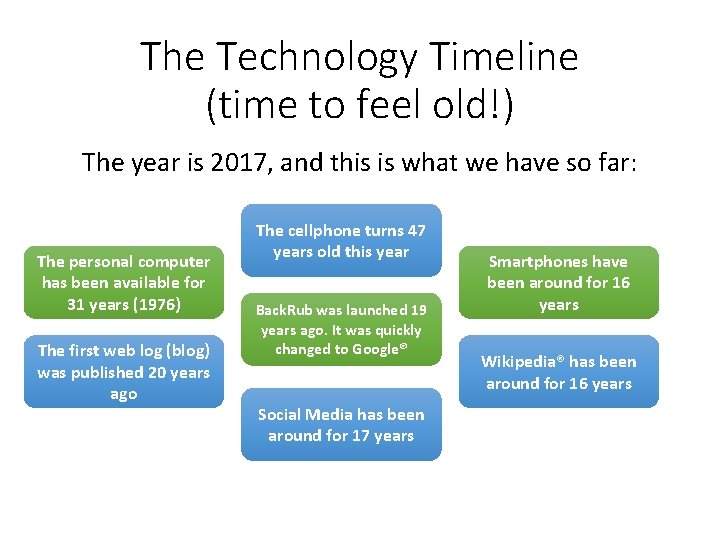
The Technology Timeline (time to feel old!) The year is 2017, and this is what we have so far: The personal computer has been available for 31 years (1976) The first web log (blog) was published 20 years ago The cellphone turns 47 years old this year Back. Rub was launched 19 years ago. It was quickly changed to Google® Social Media has been around for 17 years Smartphones have been around for 16 years Wikipedia® has been around for 16 years
Preceptor Challenges • Students are more computer literate and often familiar with other forms of technology • Students have completed programs that are highly technology based and may have adjusted their learning style to it • Social media has provided a venue for people to express themselves, but also brings its own set of legal and privacy challenges • Modern technology and social media may have changed the way students memorize information and their ability to focus
Learning as an Adult Pedagogy vs. Androgogy
Principles of Adult Learning “We all exist as or own universe and react to the fields around us. The professor must not think of what is happening to them but consider what is happening in the student's field. ” - Carl Rogers, Humanistic Psychologist
Principles of Adult Learning • Teaching in the traditional pedagogical style may not be the most effective when teaching an adult • Androgogy is the study of teaching adults and how they learn • Adults will draw from their own life experiences when they receive information they feel they know something about • Awareness of the adult learning style can help us modify our techniques in teaching students that will have more experience with technology and the modern culture (i. e. , social media)
Principles of Adult Learning The Six Core Adult Learning Principles (Knowles, 2015) 1. Adults need to know why they need to learn something 2. The self-concept of adults is heavily dependent upon a move toward selfdirection 3. Prior experiences of the learner provide a rich resource for learning
Principles of Adult Learning The Six Core Adult Learning Principles (Knowles, 2015) 4. Adults typically become ready to learn when they experience a need to cope with a situation or perform a task 5. Adults’ orientation to learning is lifecentered; education is a process of developing increased competency levels to achieve their full potential
Principles of Adult Learning The Six Core Adult Learning Principles (Knowles, 2015) 6. The motivation for adult learners is internal rather than external
Learning Styles • The word “learning” is extremely difficult to define and can refer to a behavior or conditioning • A well-accepted definition for a “learning style” on the other hand that is: • Characteristic cognitive, effective, and psychosocial behaviors that serve as relatively stable indicators of how learners perceive, interact with, and respond to the learning environment Robles et al. The Impact of Preceptor and Student Learning Styles on Experiential Performance Measures. AJPE 2012; 76 (7) Article 128
Learning Styles • Through research in education, various tools have been examined to determine learning styles and personality types: • Kolb’s Learning Style Inventory • Meyer-Briggs Type Indicator • Flemming’s Visual, Aural, Read/Write and Kinesthetic (VARK) questionnaire • Pharmacists Inventory of Learning Styles (PILS) Robles et al. The Impact of Preceptor and Student Learning Styles on Experiential Performance Measures. AJPE 2012; 76 (7) Article 128
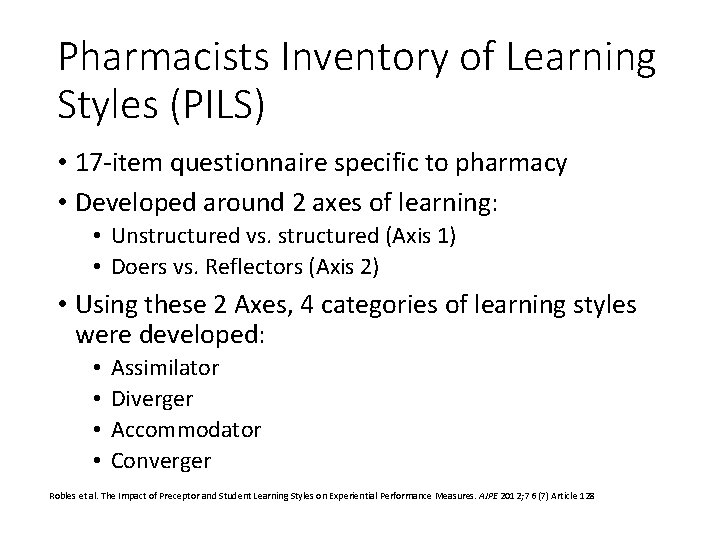
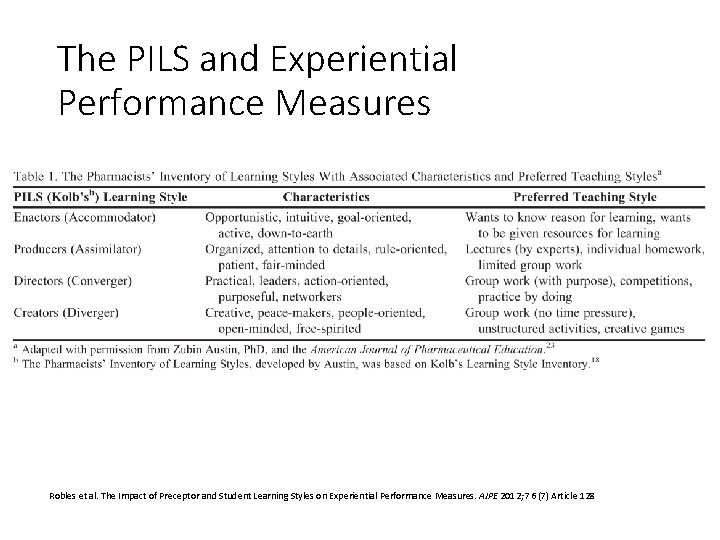
Pharmacists Inventory of Learning Styles (PILS) • 17 -item questionnaire specific to pharmacy • Developed around 2 axes of learning: • Unstructured vs. structured (Axis 1) • Doers vs. Reflectors (Axis 2) • Using these 2 Axes, 4 categories of learning styles were developed: • • Assimilator Diverger Accommodator Converger Robles et al. The Impact of Preceptor and Student Learning Styles on Experiential Performance Measures. AJPE 2012; 76 (7) Article 128
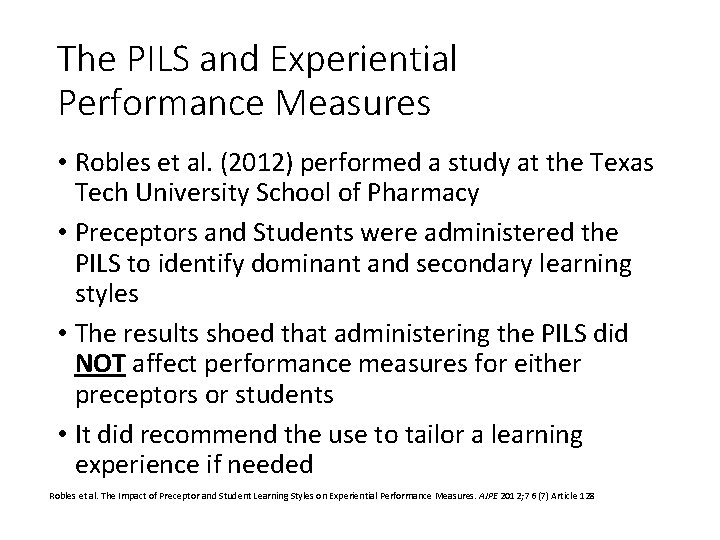
The PILS and Experiential Performance Measures • Robles et al. (2012) performed a study at the Texas Tech University School of Pharmacy • Preceptors and Students were administered the PILS to identify dominant and secondary learning styles • The results shoed that administering the PILS did NOT affect performance measures for either preceptors or students • It did recommend the use to tailor a learning experience if needed Robles et al. The Impact of Preceptor and Student Learning Styles on Experiential Performance Measures. AJPE 2012; 76 (7) Article 128
The PILS and Experiential Performance Measures Robles et al. The Impact of Preceptor and Student Learning Styles on Experiential Performance Measures. AJPE 2012; 76 (7) Article 128
Technology and Social Media The use of technology and social media amongst pharmacy students has increased and will provide new challenges for preceptors.
Pharmacy Students and Technology Today’s pharmacy student went through school in a time where they were exposed to more: • Online medical references • Social media/Microblogging applications • Crowd-sourcing websites • Advanced computer software such as: • • • Electronic spreadsheets Electronic databases Multimedia presentation software (e. g. , Power. Point, Prezi) Electronic mail Electronic file sharing
Technology in the Classroom • Classrooms today may include the following technology: • • • Electronic mail and instant messaging Flipped classroom models Online learning systems (e. g. , Blackboard) Electronic student response systems Online assignment submission and test taking Video conferencing between satellite schools as well as remote faculty
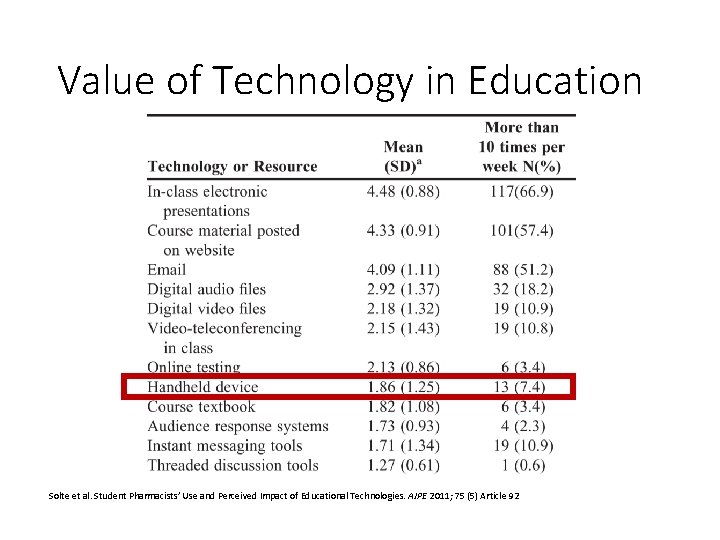
Value of Technology in Education • A study in 2011 by Solte et al. at the Dunn School of Pharmacy (Shenandoah University, Virginia) evaluated students’ perceived views of technology and learning • The Dunn School of Pharmacy was one of the first schools to require students to own laptops starting in 1997 • In 2009, Shenandoah University switched to an Apple® platform and provided the following to incoming students: • Mac. Book Pros® • i. Phones® • i. Pod Touches® Solte et al. Student Pharmacists’ Use and Perceived Impact of Educational Technologies. AJPE 2011; 75 (5) Article 92
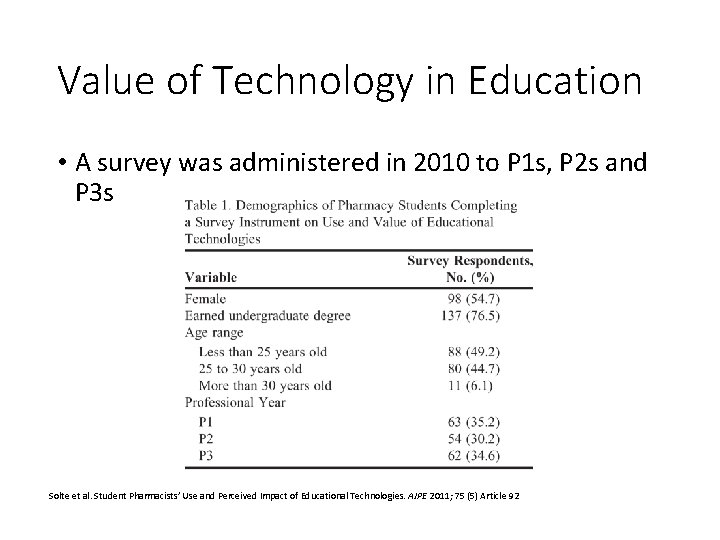
Value of Technology in Education • A survey was administered in 2010 to P 1 s, P 2 s and P 3 s Solte et al. Student Pharmacists’ Use and Perceived Impact of Educational Technologies. AJPE 2011; 75 (5) Article 92
Value of Technology in Education Solte et al. Student Pharmacists’ Use and Perceived Impact of Educational Technologies. AJPE 2011; 75 (5) Article 92
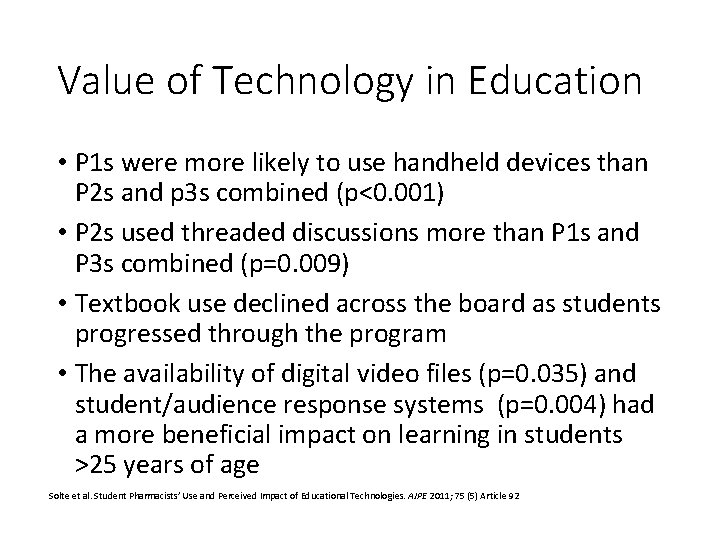
Value of Technology in Education • P 1 s were more likely to use handheld devices than P 2 s and p 3 s combined (p<0. 001) • P 2 s used threaded discussions more than P 1 s and P 3 s combined (p=0. 009) • Textbook use declined across the board as students progressed through the program • The availability of digital video files (p=0. 035) and student/audience response systems (p=0. 004) had a more beneficial impact on learning in students >25 years of age Solte et al. Student Pharmacists’ Use and Perceived Impact of Educational Technologies. AJPE 2011; 75 (5) Article 92
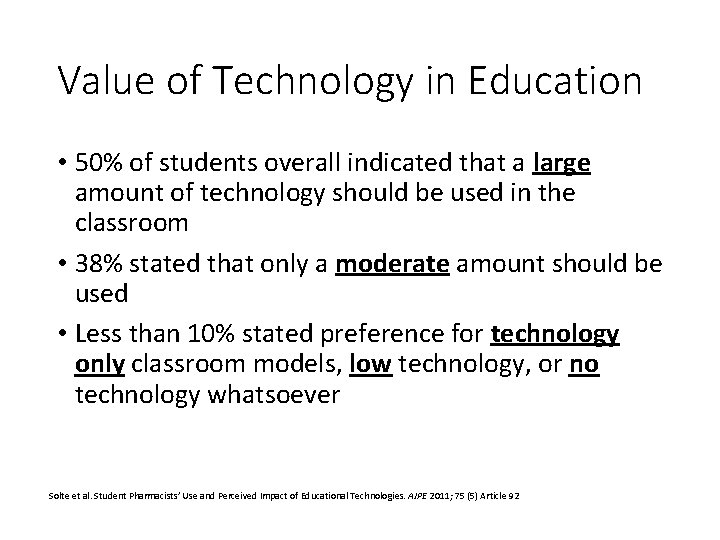
Value of Technology in Education • 50% of students overall indicated that a large amount of technology should be used in the classroom • 38% stated that only a moderate amount should be used • Less than 10% stated preference for technology only classroom models, low technology, or no technology whatsoever Solte et al. Student Pharmacists’ Use and Perceived Impact of Educational Technologies. AJPE 2011; 75 (5) Article 92
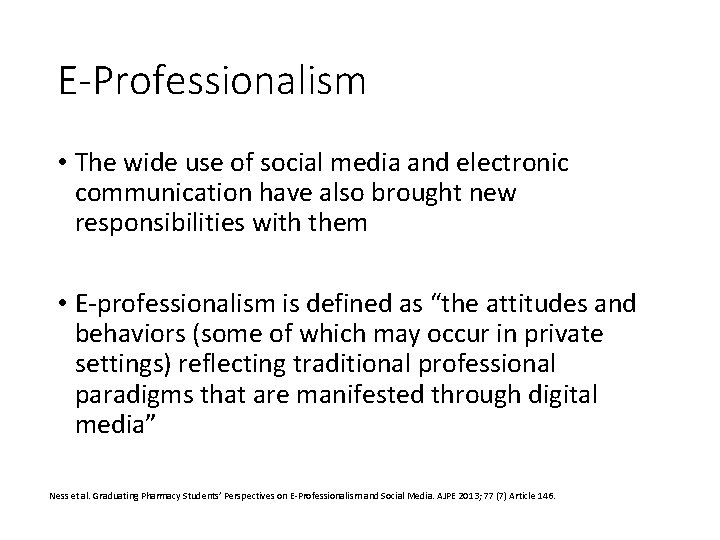
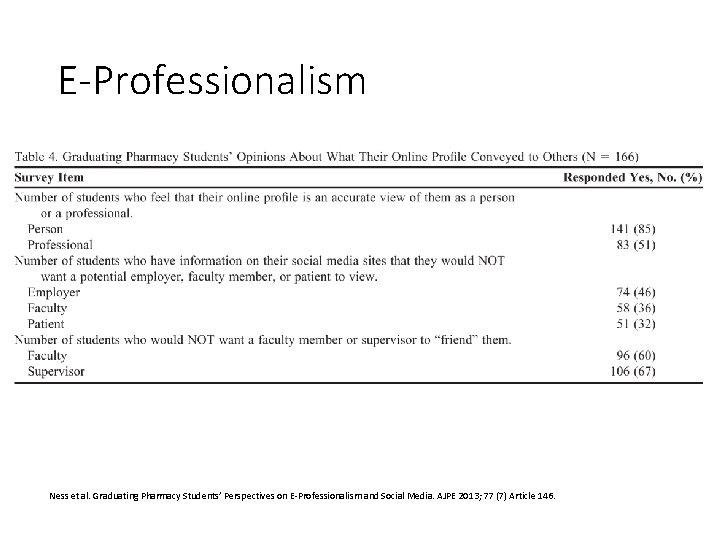
E-Professionalism • The wide use of social media and electronic communication have also brought new responsibilities with them • E-professionalism is defined as “the attitudes and behaviors (some of which may occur in private settings) reflecting traditional professional paradigms that are manifested through digital media” Ness et al. Graduating Pharmacy Students’ Perspectives on E-Professionalism and Social Media. AJPE 2013; 77 (7) Article 146.
E-Professionalism • Characteristics associated with professionalism: • • • Altruism Respect Honesty Integrity Excellence Accountability • Many instances of disregard for professionalism on social media have been reported Ness et al. Graduating Pharmacy Students’ Perspectives on E-Professionalism and Social Media. AJPE 2013; 77 (7) Article 146.
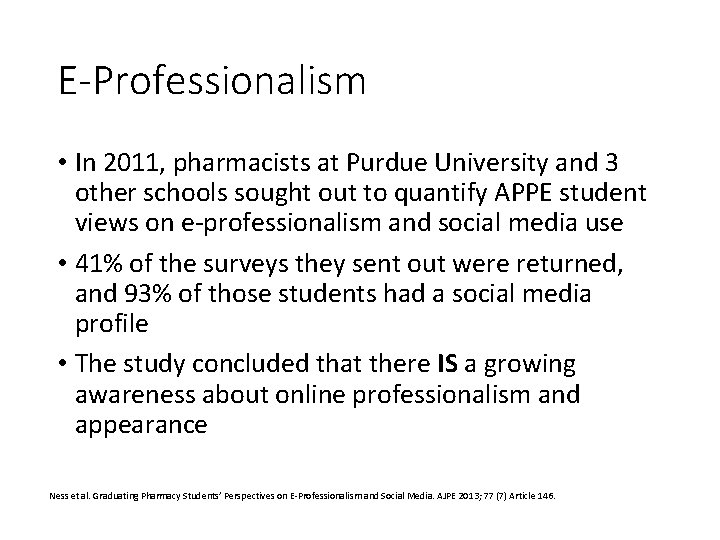
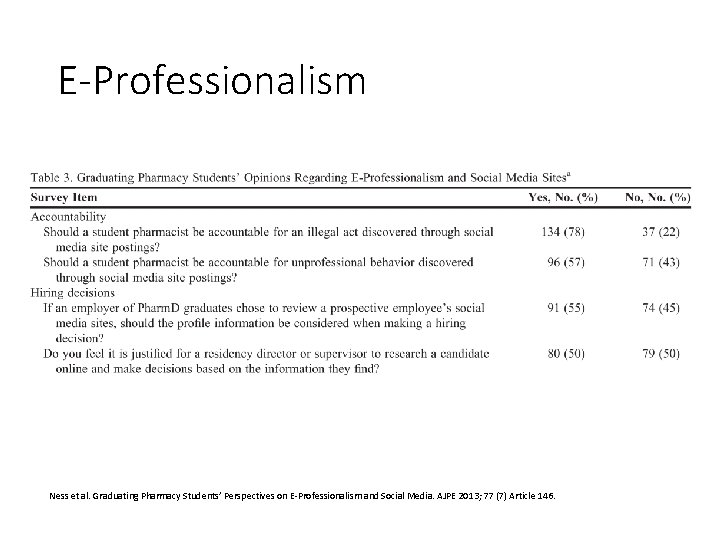
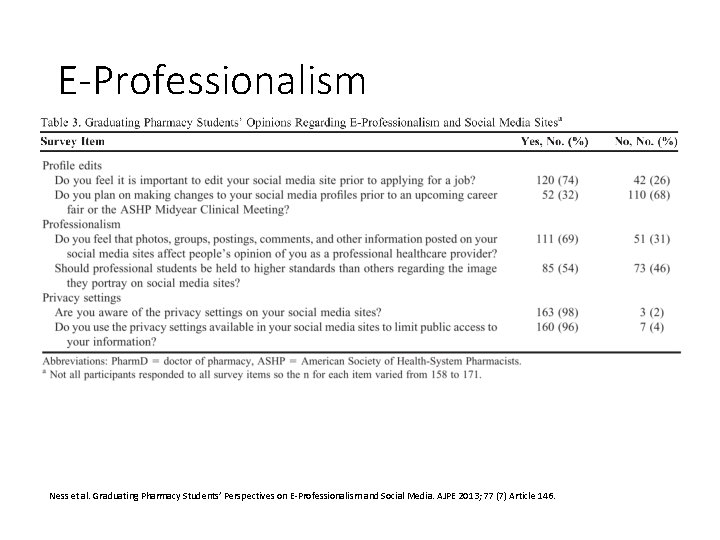
E-Professionalism • In 2011, pharmacists at Purdue University and 3 other schools sought out to quantify APPE student views on e-professionalism and social media use • 41% of the surveys they sent out were returned, and 93% of those students had a social media profile • The study concluded that there IS a growing awareness about online professionalism and appearance Ness et al. Graduating Pharmacy Students’ Perspectives on E-Professionalism and Social Media. AJPE 2013; 77 (7) Article 146.
E-Professionalism Ness et al. Graduating Pharmacy Students’ Perspectives on E-Professionalism and Social Media. AJPE 2013; 77 (7) Article 146.
E-Professionalism Ness et al. Graduating Pharmacy Students’ Perspectives on E-Professionalism and Social Media. AJPE 2013; 77 (7) Article 146.
E-Professionalism Ness et al. Graduating Pharmacy Students’ Perspectives on E-Professionalism and Social Media. AJPE 2013; 77 (7) Article 146.
Social Media – Why the attraction? • Social media is any electronic venue that allows users to create a profile and present themselves as an online personality • Often users can express themselves without fear of repercussion or with control of who responds • Newer venues are even offering an expiration window for postings of photos and context (e. g. , Snap. Chat®, Instagram stories®)
Legal and Ethical Issues with Social Media • The ability to instantaneously post pictures, small paragraphs or other media to the internet can lead to legal issues in terms of: • • Patient privacy Professionalism Organizational reputation Libel and slander issues may arise • It is important you go over your organization’s policies on social media and personal electronic devices prior to each rotation Cain J, Fink J. Legal and Ethical Issues Regarding Social Media and Pharmacy Education. AJPE 2010; 74 (10) Article 184
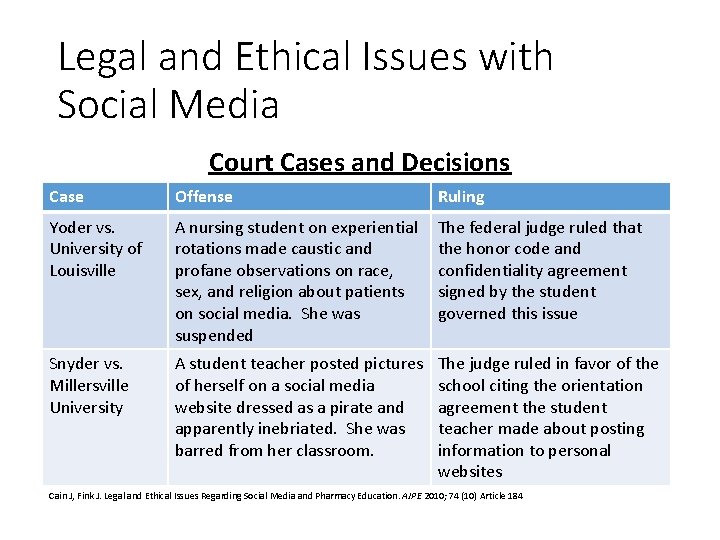
Legal and Ethical Issues with Social Media • Social media may bring up the issues of the following rights: • • Freedom of speech Search and seizure Right to privacy Denial of due process • The legal battles that have occurred due to social media and students have not ended well for the student Cain J, Fink J. Legal and Ethical Issues Regarding Social Media and Pharmacy Education. AJPE 2010; 74 (10) Article 184
Legal and Ethical Issues with Social Media Court Cases and Decisions Case Offense Ruling Yoder vs. University of Louisville A nursing student on experiential rotations made caustic and profane observations on race, sex, and religion about patients on social media. She was suspended The federal judge ruled that the honor code and confidentiality agreement signed by the student governed this issue Snyder vs. Millersville University A student teacher posted pictures of herself on a social media website dressed as a pirate and apparently inebriated. She was barred from her classroom. The judge ruled in favor of the school citing the orientation agreement the student teacher made about posting information to personal websites Cain J, Fink J. Legal and Ethical Issues Regarding Social Media and Pharmacy Education. AJPE 2010; 74 (10) Article 184
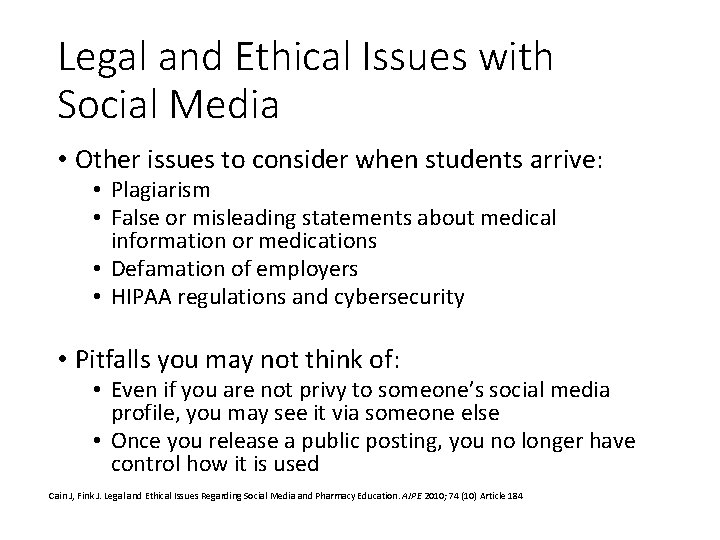
Legal and Ethical Issues with Social Media • Other issues to consider when students arrive: • Plagiarism • False or misleading statements about medical information or medications • Defamation of employers • HIPAA regulations and cybersecurity • Pitfalls you may not think of: • Even if you are not privy to someone’s social media profile, you may see it via someone else • Once you release a public posting, you no longer have control how it is used Cain J, Fink J. Legal and Ethical Issues Regarding Social Media and Pharmacy Education. AJPE 2010; 74 (10) Article 184
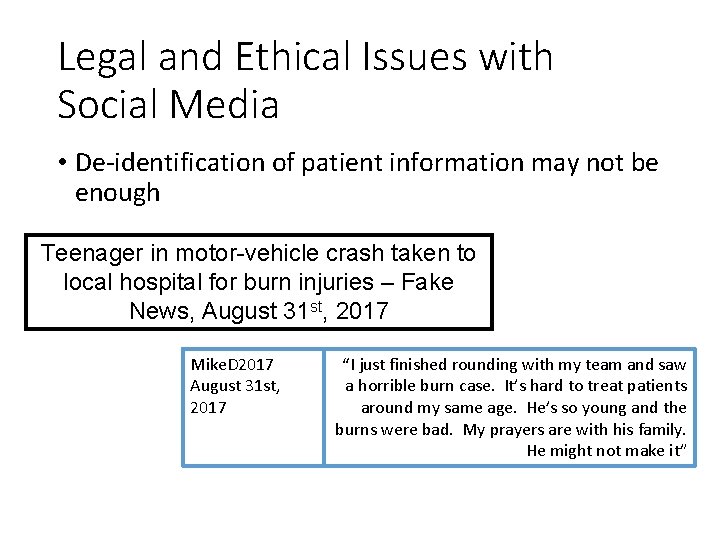
Legal and Ethical Issues with Social Media • De-identification of patient information may not be enough Teenager in motor-vehicle crash taken to local hospital for burn injuries – Fake News, August 31 st, 2017 Mike. D 2017 August 31 st, 2017 “I just finished rounding with my team and saw a horrible burn case. It’s hard to treat patients around my same age. He’s so young and the burns were bad. My prayers are with his family. He might not make it”
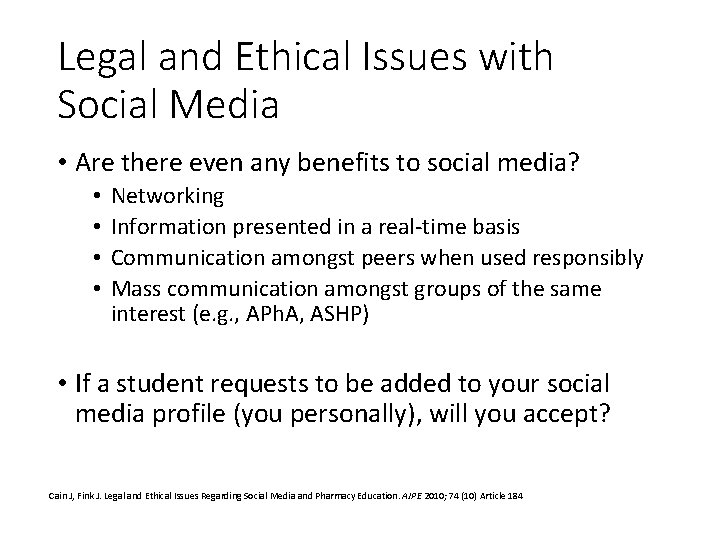
Legal and Ethical Issues with Social Media • Are there even any benefits to social media? • • Networking Information presented in a real-time basis Communication amongst peers when used responsibly Mass communication amongst groups of the same interest (e. g. , APh. A, ASHP) • If a student requests to be added to your social media profile (you personally), will you accept? Cain J, Fink J. Legal and Ethical Issues Regarding Social Media and Pharmacy Education. AJPE 2010; 74 (10) Article 184
Pharmacy Rotations and Technology Are you ready to adapt?
Creating a Rotation with Technology • First and foremost, you are in control • Clearly state what is and what is not acceptable in terms of personal handheld devices, social media, electronic resources in your syllabus or orientation • Determine how the student uses technology to advance their learning and find a way to include it • Remember, we are facilitators of learning for this “adult” student • If you are unfamiliar with some aspect, use the rotation to learn about it as well
Examples of Activities 1. Assign your student the task of listing all the professional pharmacy organizations they can find on a social media website 2. Assign your student the task of writing an article on how to use social media to stay up to date on drug shortages or changes in healthcare 3. Using adequate evaluation tools for online information, have your student find a website and determine its validity
Summary • Students are going to continue to learn using technology and become more adept • Rotations must learn to gauge how the student learns and how they are going to be using their experiences (especially with technology) to benefit their experience • Technology can be used as a learning tool, but it can bring up legal and ethical issues • As preceptors in a field that is also including more technology, we need to be ready to change the way we facilitate
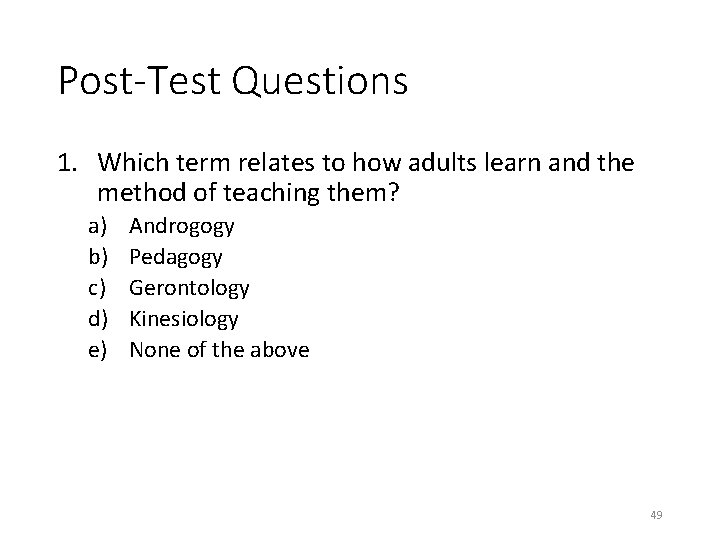
Post-Test Questions 1. Which term relates to how adults learn and the method of teaching them? a) b) c) d) e) Androgogy Pedagogy Gerontology Kinesiology None of the above 49
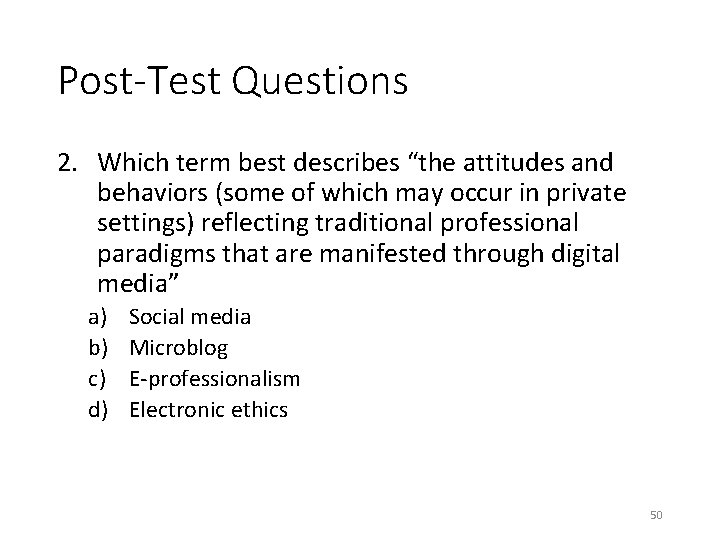
Post-Test Questions 2. Which term best describes “the attitudes and behaviors (some of which may occur in private settings) reflecting traditional professional paradigms that are manifested through digital media” a) b) c) d) Social media Microblog E-professionalism Electronic ethics 50
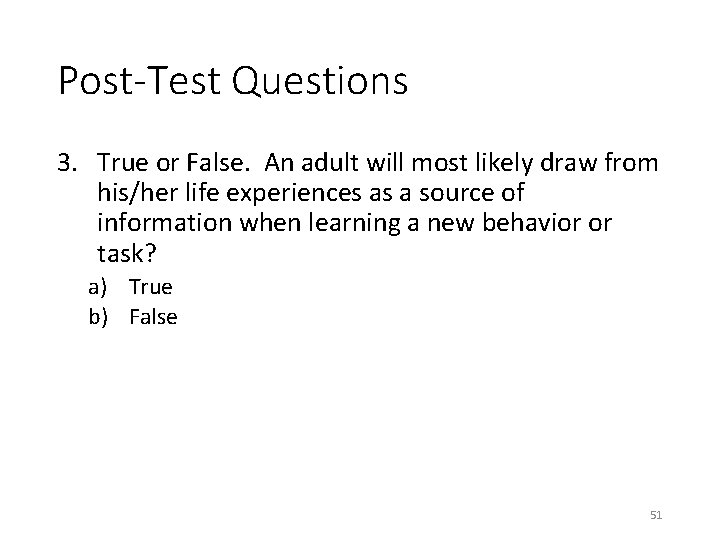
Post-Test Questions 3. True or False. An adult will most likely draw from his/her life experiences as a source of information when learning a new behavior or task? a) True b) False 51
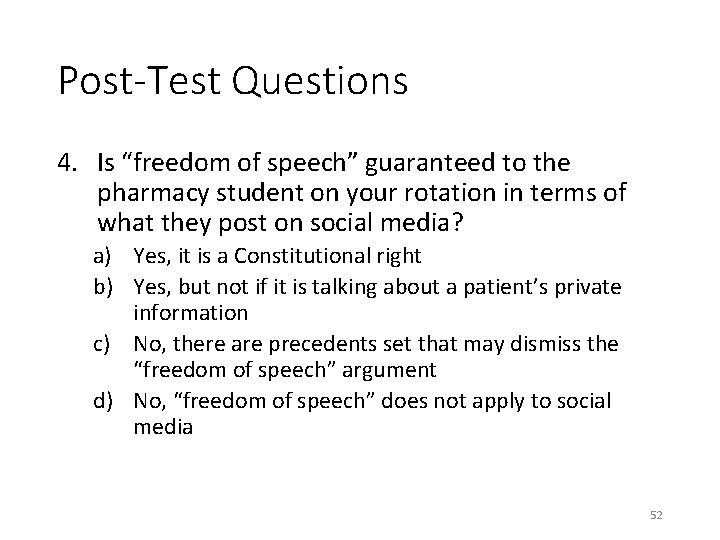
Post-Test Questions 4. Is “freedom of speech” guaranteed to the pharmacy student on your rotation in terms of what they post on social media? a) Yes, it is a Constitutional right b) Yes, but not if it is talking about a patient’s private information c) No, there are precedents set that may dismiss the “freedom of speech” argument d) No, “freedom of speech” does not apply to social media 52
Questions? 53