
Precambrian Rocks of Yellowstone National Park YNP and
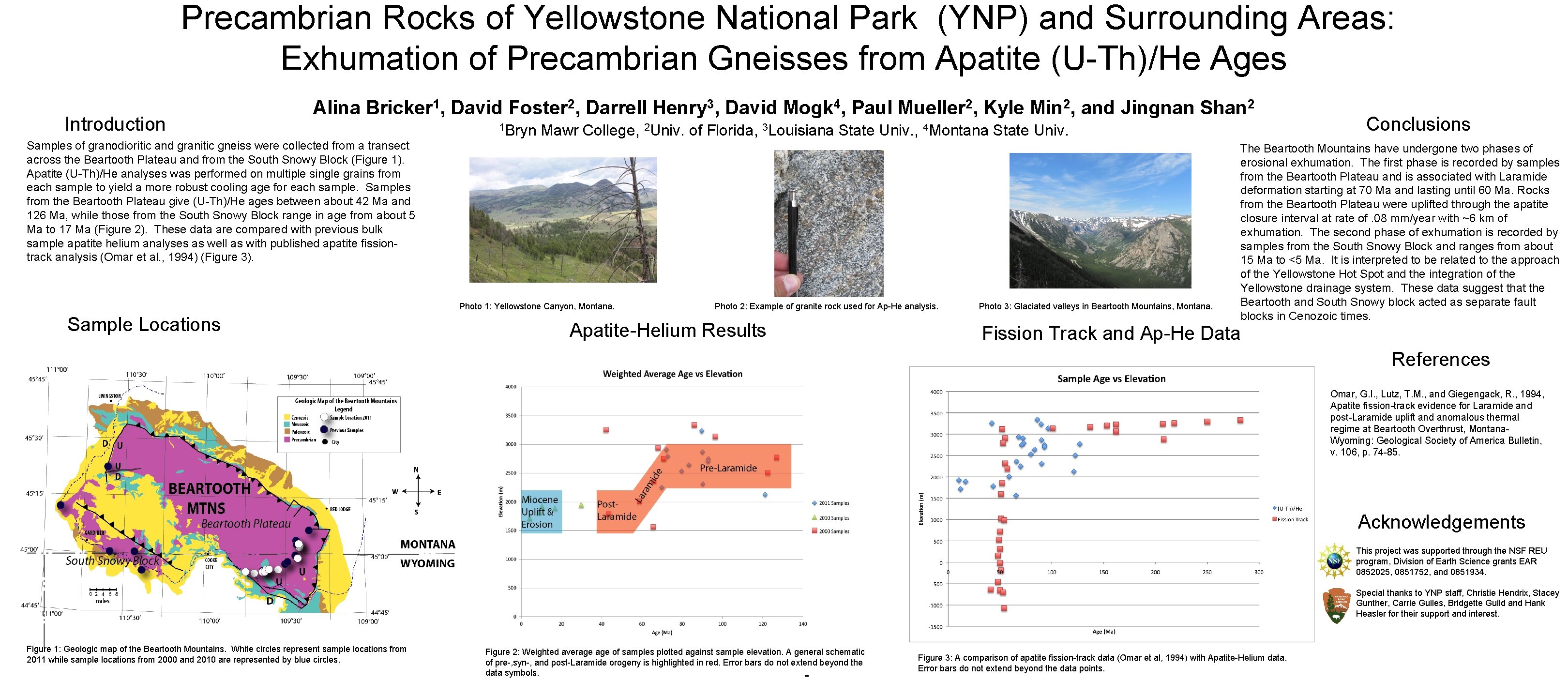
Precambrian Rocks of Yellowstone National Park (YNP) and Surrounding Areas: Exhumation of Precambrian Gneisses from Apatite (U-Th)/He Ages Introduction Alina Bricker 1, David Foster 2, Darrell Henry 3, David Mogk 4, Paul Mueller 2, Kyle Min 2, and Jingnan Shan 2 1 Bryn Mawr College, 2 Univ. of Florida, 3 Louisiana State Univ. , 4 Montana State Univ. Samples of granodioritic and granitic gneiss were collected from a transect across the Beartooth Plateau and from the South Snowy Block (Figure 1). Apatite (U-Th)/He analyses was performed on multiple single grains from each sample to yield a more robust cooling age for each sample. Samples from the Beartooth Plateau give (U-Th)/He ages between about 42 Ma and 126 Ma, while those from the South Snowy Block range in age from about 5 Ma to 17 Ma (Figure 2). These data are compared with previous bulk sample apatite helium analyses as well as with published apatite fissiontrack analysis (Omar et al. , 1994) (Figure 3). Photo 1: Yellowstone Canyon, Montana. Sample Locations Photo 2: Example of granite rock used for Ap-He analysis. Apatite-Helium Results Photo 3: Glaciated valleys in Beartooth Mountains, Montana. Conclusions The Beartooth Mountains have undergone two phases of erosional exhumation. The first phase is recorded by samples from the Beartooth Plateau and is associated with Laramide deformation starting at 70 Ma and lasting until 60 Ma. Rocks from the Beartooth Plateau were uplifted through the apatite closure interval at rate of. 08 mm/year with ~6 km of exhumation. The second phase of exhumation is recorded by samples from the South Snowy Block and ranges from about 15 Ma to <5 Ma. It is interpreted to be related to the approach of the Yellowstone Hot Spot and the integration of the Yellowstone drainage system. These data suggest that the Beartooth and South Snowy block acted as separate fault blocks in Cenozoic times. Fission Track and Ap-He Data References Omar, G. I. , Lutz, T. M. , and Giegengack, R. , 1994, Apatite fission-track evidence for Laramide and post-Laramide uplift and anomalous thermal regime at Beartooth Overthrust, Montana. Wyoming: Geological Society of America Bulletin, v. 106, p. 74 -85. A B Acknowledgements C Figure 1: Geologic map of the Beartooth Mountains. White circles represent sample locations from 2011 while sample locations from 2000 and 2010 are represented by blue circles. This project was supported through the NSF REU program, Division of Earth Science grants EAR 0852025, 0851752, and 0851934. D Figure 2: Weighted average of samples plotted against sample elevation. A general schematic of pre-, syn-, and post-Laramide orogeny is highlighted in red. Error bars do not extend beyond the data symbols. Special thanks to YNP staff, Christie Hendrix, Stacey Gunther, Carrie Guiles, Bridgette Guild and Hank Heasler for their support and interest. Figure 3: A comparison of apatite fission-track data (Omar et al, 1994) with Apatite-Helium data. Error bars do not extend beyond the data points.
- Slides: 1