
Precalculus Day 3 of lines and parabolas Agenda
Precalculus Day 3 of lines and parabolas
Agenda • • • New seats Warm-up- start on quadratic problems Name cards Notes/info on linear functions Notes/info on quadratic functions Notes/info on imaginary numbers – Evaluate – Simplify – Operations with imaginary numbers
Name Card Activity 1. Fold your name tag (hot dog bun direction) 2. Make both sides the same
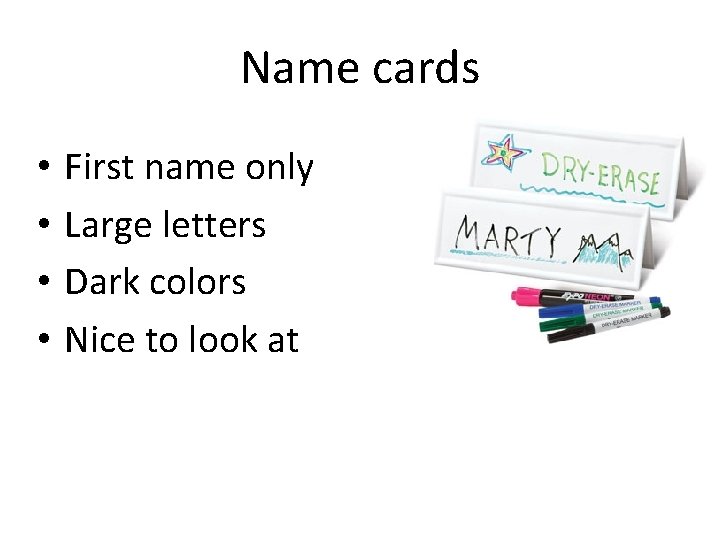
Name cards • • First name only Large letters Dark colors Nice to look at
Chapter 1 - Sections 1 through 4 Main Ideas • Coordinate Geometry • Linear Equations • Linear Functions Key Terms Linear Equation y-intercept Slope Solution of an Equation Linear Function Graph of an Equation Zero of a Function x-intercept Mathematical Model
Chapter 1 - Sections 1 through 4 Main Ideas • Coordinate Geometry • Linear Equations • Linear Functions Key Terms Linear Equation y-intercept Slope Solution of an Equation Linear Function Graph of an Equation Zero of a Function x-intercept Mathematical Model
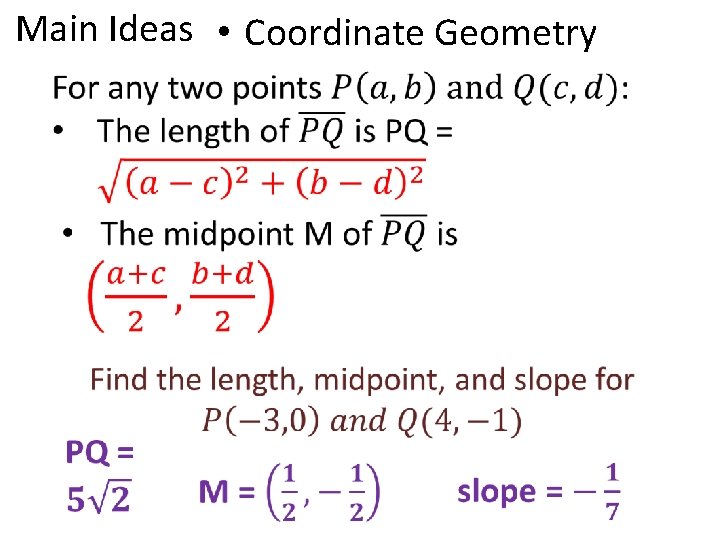
Main Ideas • Coordinate Geometry
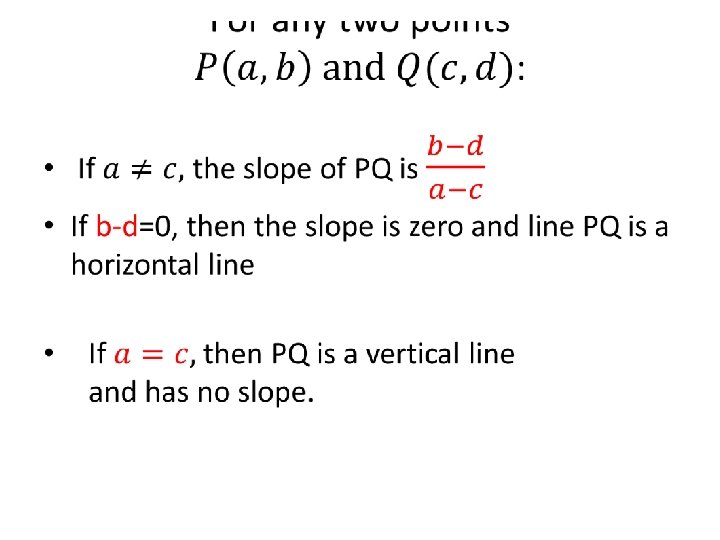
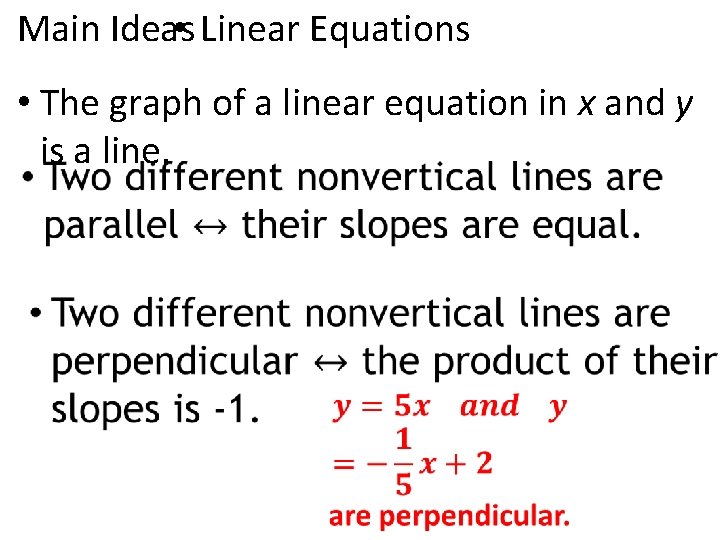
• Linear Equations Main Ideas • The graph of a linear equation in x and y is a line.
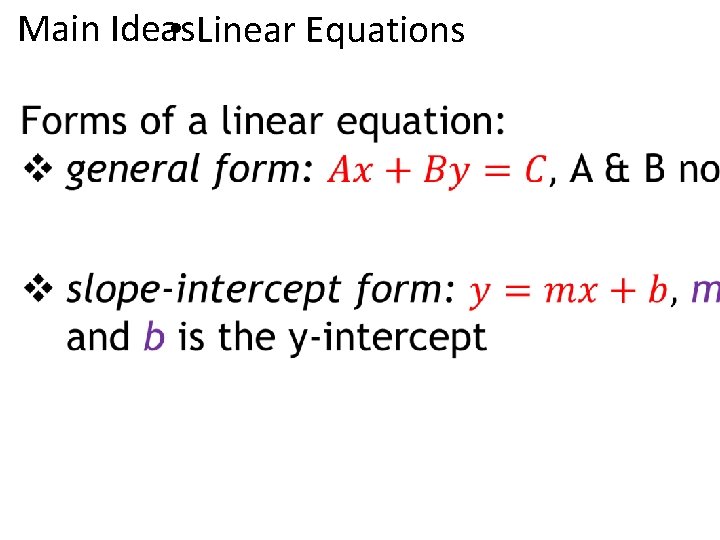
Main Ideas • Linear Equations
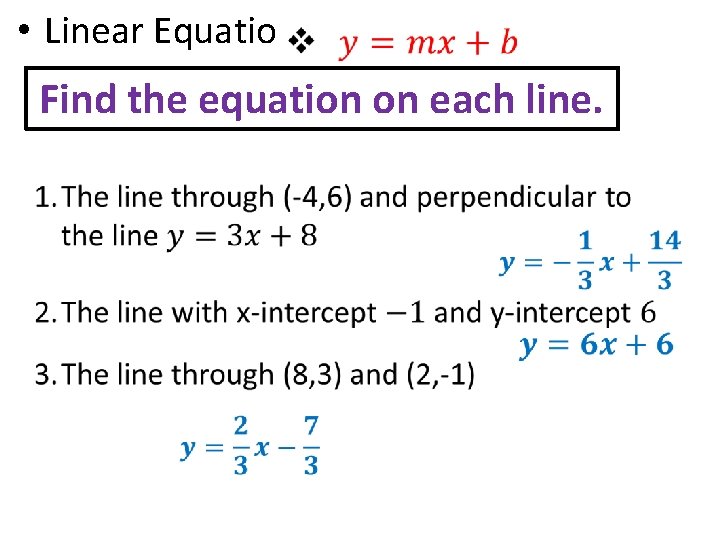
• Linear Equations Find the equation on each line.
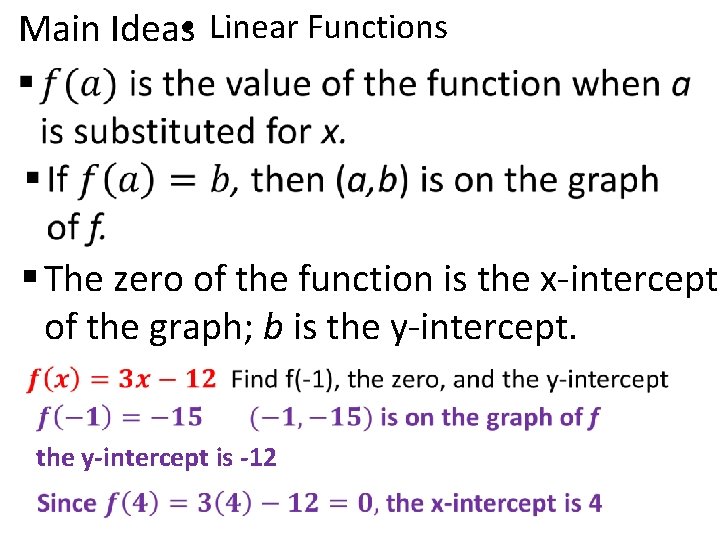
Main Ideas • Linear Functions § The zero of the function is the x-intercept of the graph; b is the y-intercept is -12
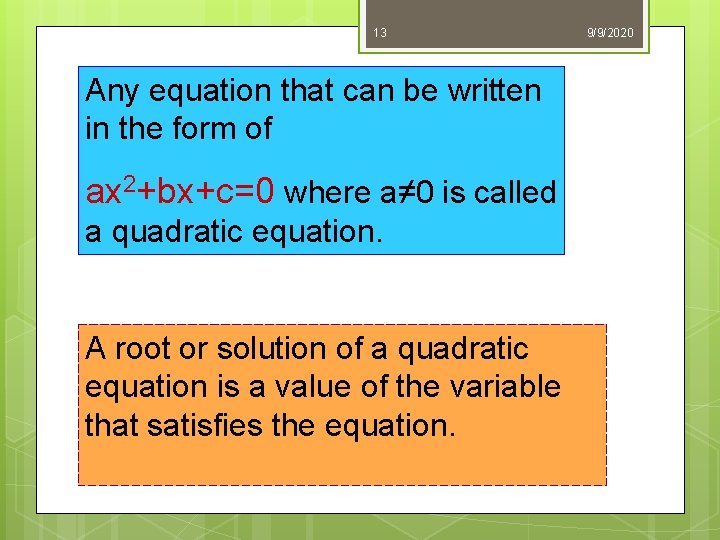
13 Any equation that can be written in the form of ax 2+bx+c=0 where a≠ 0 is called a quadratic equation. A root or solution of a quadratic equation is a value of the variable that satisfies the equation. 9/9/2020
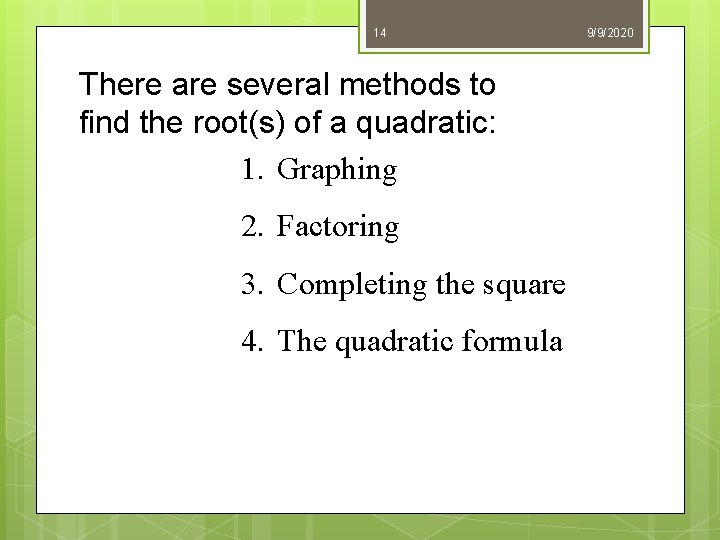
14 There are several methods to find the root(s) of a quadratic: 1. Graphing 2. Factoring 3. Completing the square 4. The quadratic formula 9/9/2020
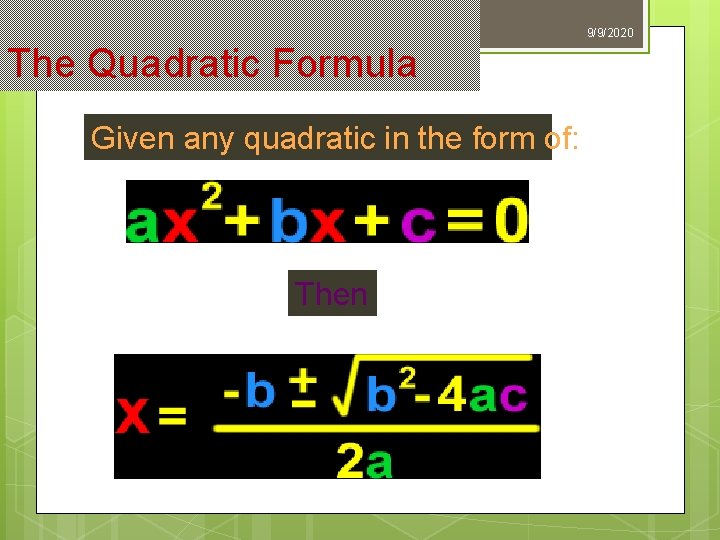
15 The Quadratic Formula Given any quadratic in the form of: Then 9/9/2020
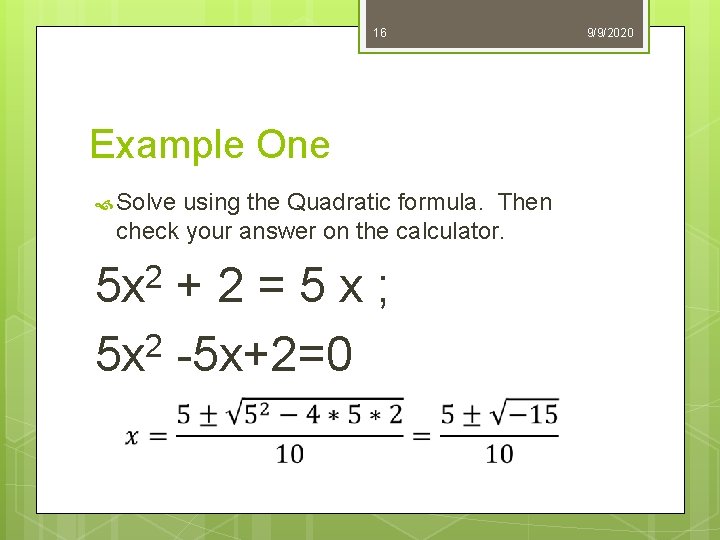
16 Example One Solve using the Quadratic formula. Then check your answer on the calculator. 2 5 x + 2 = 5 x ; 5 x 2 -5 x+2=0 9/9/2020
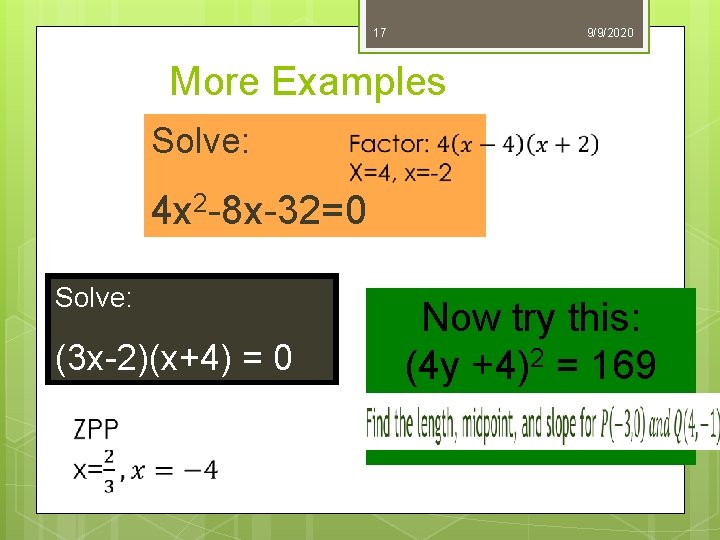
17 9/9/2020 More Examples Solve: 4 x 2 -8 x-32=0 Solve: Now try this: (4 y +4)2 = 169 (3 x-2)(x+4) = 0
Solve by factoring Solve each: 1. x 2 + 6 x =0 2. x 2 − 6 x =0 3. x 2 + 6 x+9=0 4. x 2 − 6 x +9=0 5. x 2 +6 x +5=0
Complete the square
What to include on your graph The y intercept The x-intercept(s) the vertex Line of symmetry
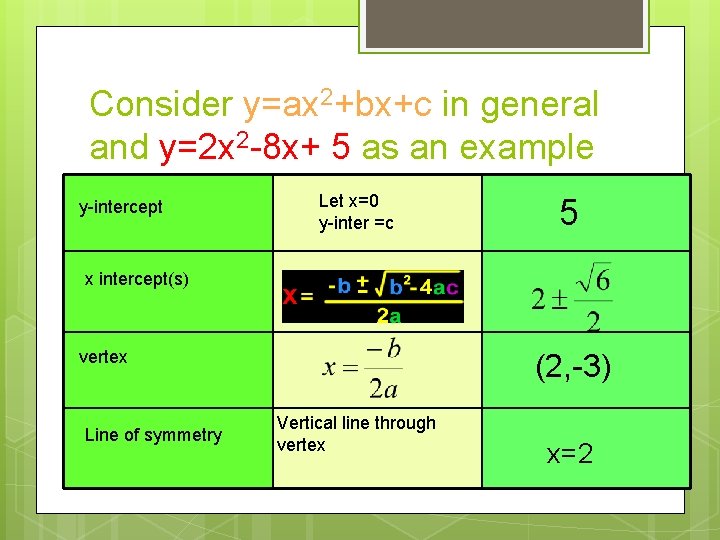
Consider y=ax 2+bx+c in general and y=2 x 2 -8 x+ 5 as an example y-intercept Let x=0 y-inter =c 5 x intercept(s) vertex Line of symmetry (2, -3) Vertical line through vertex x=2
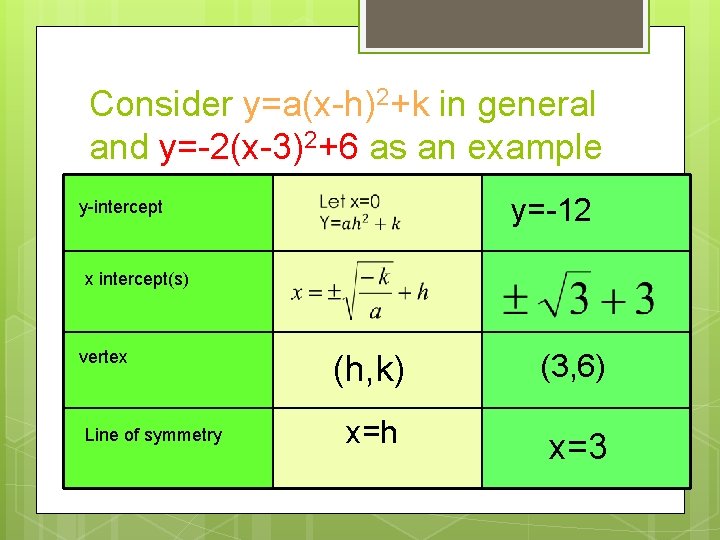
Consider y=a(x-h)2+k in general and y=-2(x-3)2+6 as an example y-intercept y=-12 x intercept(s) vertex Line of symmetry (h, k) (3, 6) x=h x=3
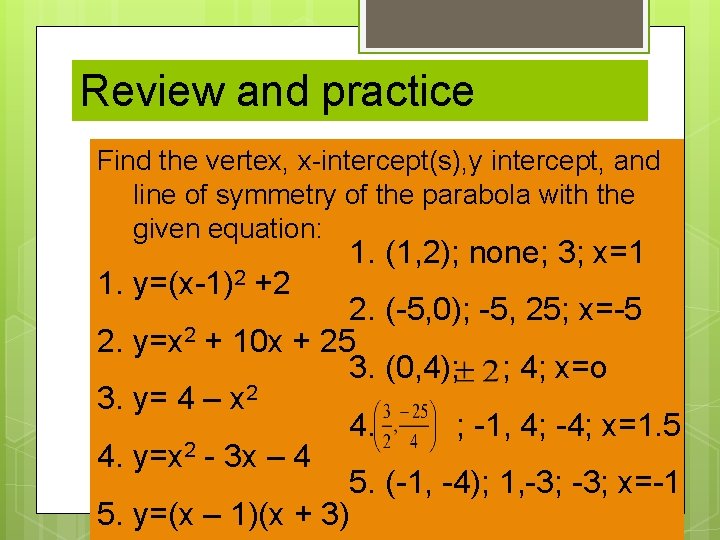
Review and practice Find the vertex, x-intercept(s), y intercept, and line of symmetry of the parabola with the given equation: 1. y=(x-1)2 +2 1. (1, 2); none; 3; x=1 2. (-5, 0); -5, 25; x=-5 2. y=x 2 + 10 x + 25 3. (0, 4); ; 4; x=o 3. y= 4 – x 2 4. ; -1, 4; -4; x=1. 5 4. y=x 2 - 3 x – 4 5. (-1, -4); 1, -3; x=-1 5. y=(x – 1)(x + 3)
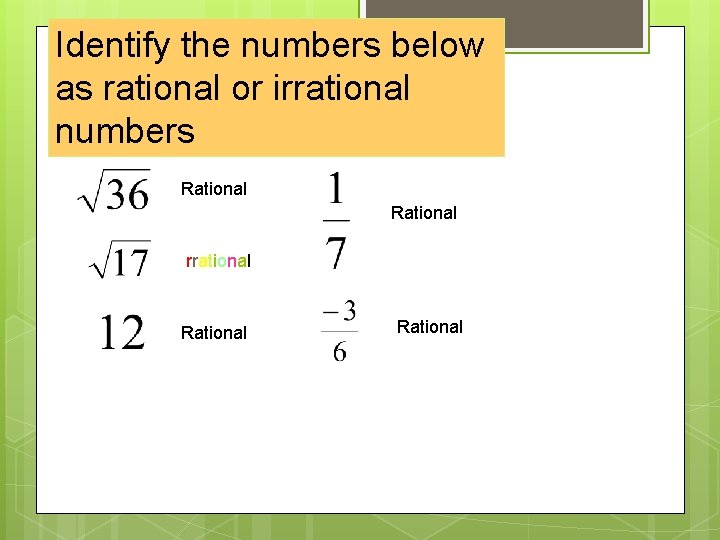
Identify the numbers below as rational or irrational numbers Rational Irrational Rational
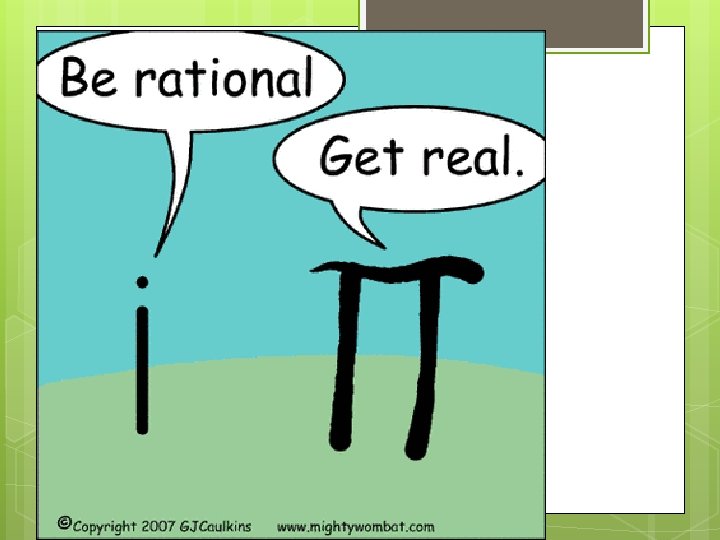
Complex numbers Any number of the form a+bi, where a and b are real numbers and i is the imaginary unit is called a complex a is the called the real part and b is called the imaginary part. number. If b≠ 0, the number is called an imaginary number.
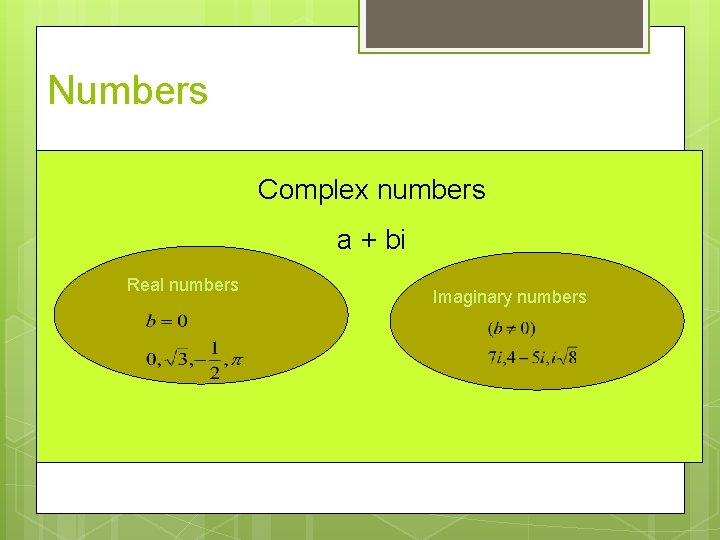
Numbers Complex numbers a + bi Real numbers Imaginary numbers
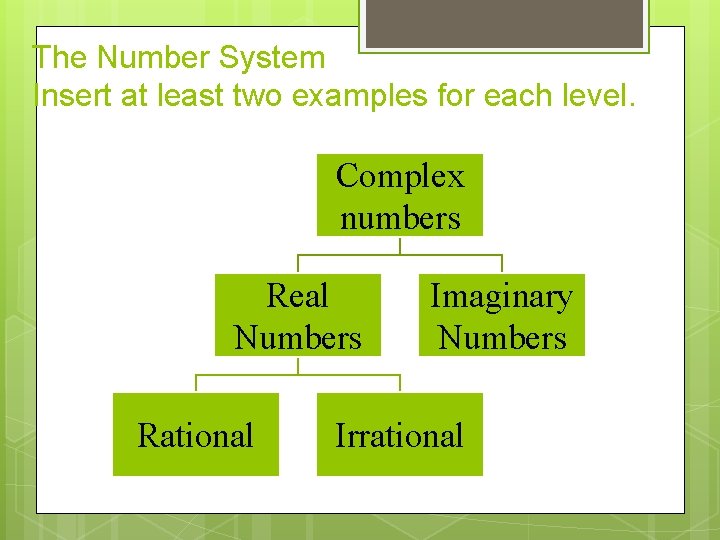
The Number System Insert at least two examples for each level. Complex numbers Real Numbers Rational Imaginary Numbers Irrational
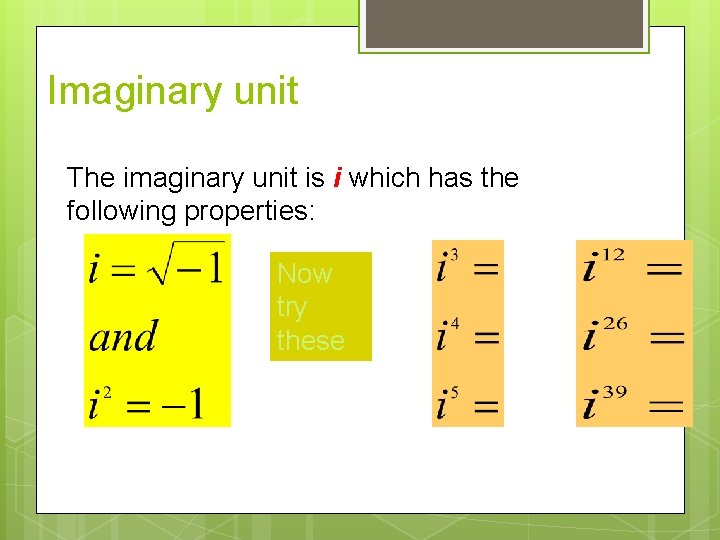
Imaginary unit The imaginary unit is i which has the following properties: Now try these
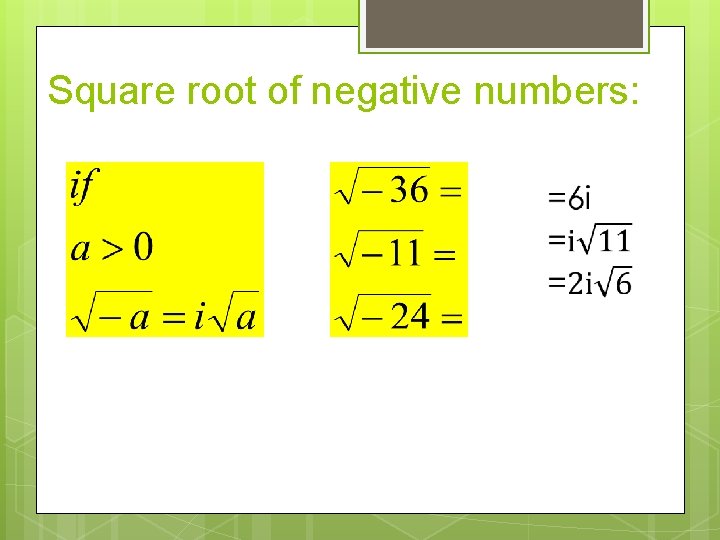
Square root of negative numbers:
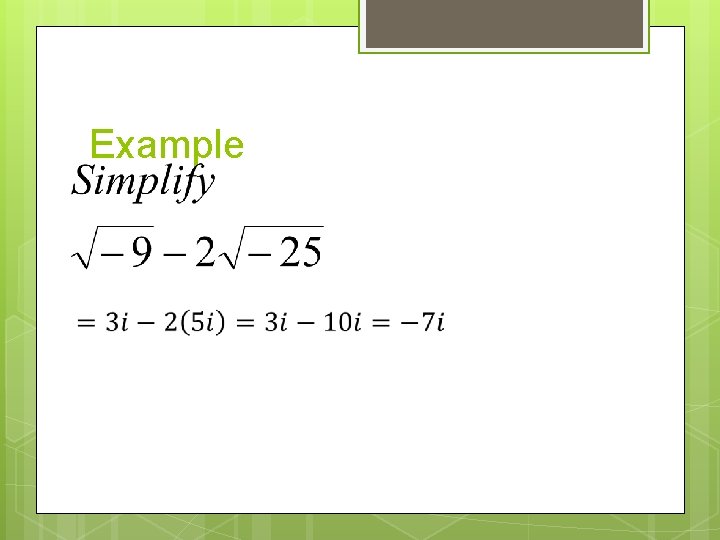
Example
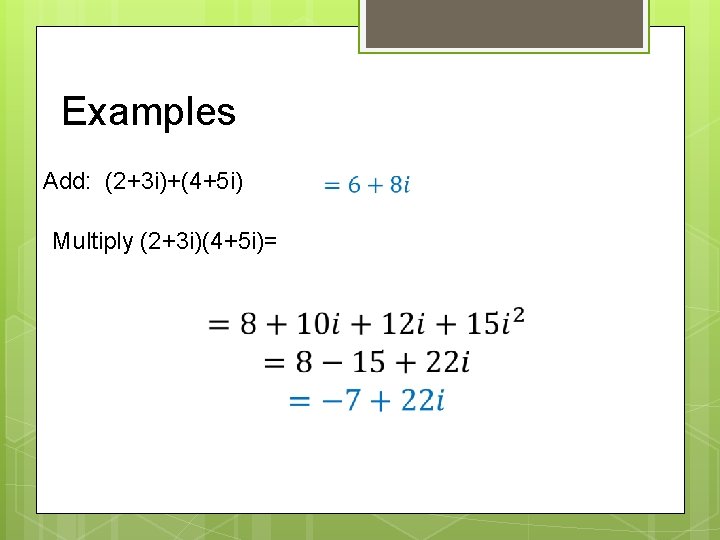
Examples Add: (2+3 i)+(4+5 i) Multiply (2+3 i)(4+5 i)=
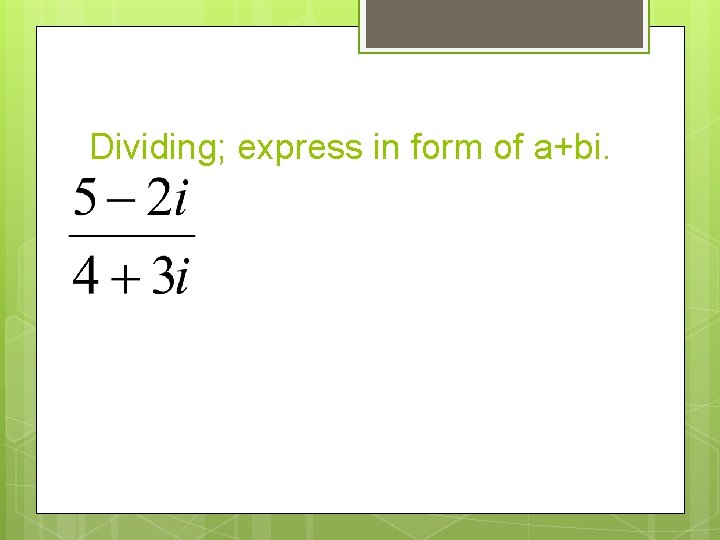
Dividing; express in form of a+bi.
- Slides: 33