
PreCalc Section 4 4 Stretching and Translating Graphs
- Slides: 5
Pre-Calc Section 4. 4 Stretching and Translating Graphs Various functions ‘repeat’ a set of values. Their graphs will be a repetition of a ‘basic’ curve. The length of the ‘x’ ‘range’ that it takes for the curve to repeat it’s ‘cycle’ is called the Period of the function. When ‘p’ equals the period of the function (the interval of ‘x’ values it takes for a curve to repeat its cycle) we can say, f(x+p) = f(x) for all ‘x’ in the domain of ‘x’. Example The graph of a periodic function f is shown on page 139. Find: a) The ‘fundamental period’ of ‘f’ b) f(99)
a) If you start at the origin and follow the graph to the right, the graph takes 4 units to complete one ‘up-and-down’ cycle. Then another such cycle begins. Thus, period = 4 b) If we take x = 99, divide by 4—(the period), we get 24 with a remainder of 3. Therefore we can show: f(99) = f(4(24) + 3) ‘forget about 4(24) as this represents ‘ 24 complete cycles’ sew = f(3) = -2 If a periodic function has a maximum value ‘M’ and a Minimum value ‘m’, then the amplitude of a function Is given by: A = Max – min = M - m 2 2 Look at the additional example #1 on page 139
Stretches and shrinks: a) Vertical stretches and shrinks y = 2 f(x) vertical ‘stretch’ of 2 times each ‘y’ value y = ½ f(x) vertical ‘shrink’ of ½ times each ‘y’ value Therefore y = ‘c’f(x) will provide a ‘vertical stretch’ or ‘vertical shrink’ of ‘c’ times each ‘y’ value b) Horizontal stretches or shrinks y = f(2 x) -- Horizontal ‘shrink’ of ½ times each ‘x’ y = f(½ x) – Horizontal ‘stretch’ of 2 times each ‘y’ value Therefore ‘y = f(cx)’ will provide a Horizontal stretch or shrink of 1/c --reciprocal of ‘c’ – times each ‘x’ values.
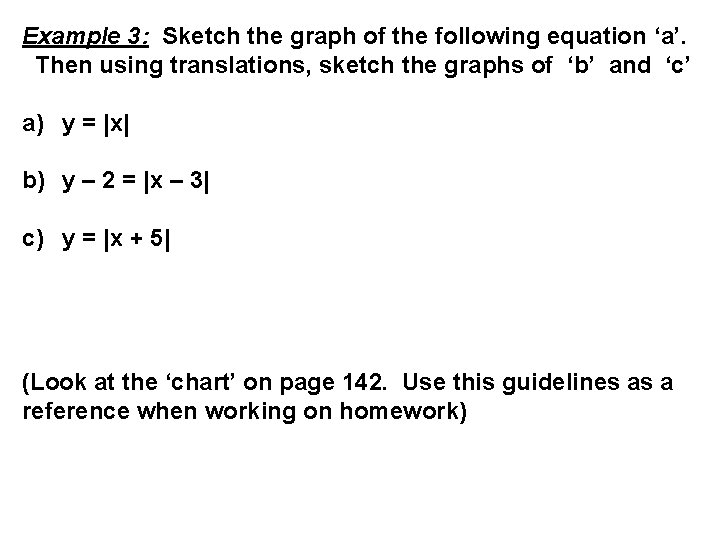
These will cause the following changes to occur in your graph: If a periodic function ‘f’ has period ‘p’ and amplitude ‘A’ then: y = c(f(x)) has period ‘p’ and amplitude (c)(A) y = f(cx) has period ‘p’ or c p(1/c) and amplitude ‘A’ Translating graphs: The graphs of y – k = f(x – h) is obtained by translating the graph of y = f(x) horizontally ‘h’ units and vertically ‘k’ units. (Take a look at the two graphs on page 141 )
Example 3: Sketch the graph of the following equation ‘a’. Then using translations, sketch the graphs of ‘b’ and ‘c’ a) y = |x| b) y – 2 = |x – 3| c) y = |x + 5| (Look at the ‘chart’ on page 142. Use this guidelines as a reference when working on homework)