
PRAN Programmable Radio Access Networks Wenfei Wu Li
PRAN: Programmable Radio Access Networks Wenfei Wu, Li Erran Li, Aurojit Panday, Scott Shenkery Bell Labs, Alcatel-Lucent UW-Madison UC Berkeley ACM Workshop
Problems in current RAN architecture • Distributed coordination with unplanned and dense deployment makes radio resource allocation very inefficient and makes managing interference harder • current RAN data plane at layer 1 and layer 2 (L 1/L 2) is not programmable and only offers a small number of Qo. S classes. • Base stations are provisioned for peak demands and the excess capacity is idle at other points.
Introduction • PRAN, a Programmable Radio Access Network. • centralize the L 1/L 2 processing of base stations into a cluster of commodity servers.
Feature • Coordinates radio resource (time, frequency, location) and enables each operator to flexibly control its radio resources. • Offers programmability to configure different data paths • easily upgraded and replaced. • Resources sharing and scheduling among base stations' processing • increase the utilization of the infrastructure. • Based on real traces of more than 3000 base stations from a national cellular operator, our initial evaluation shows PRAN reduces CPU requirements by a factor of 30.
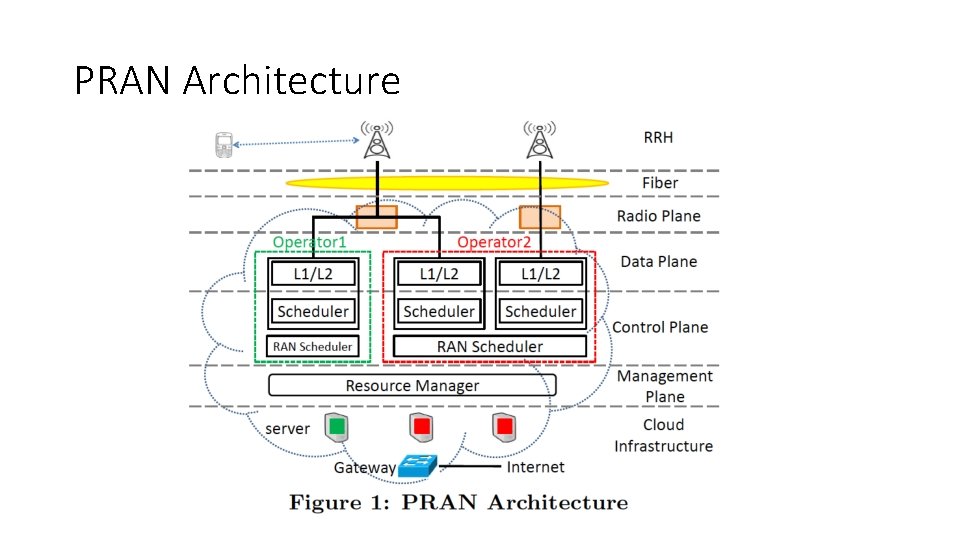
PRAN Architecture
PRAN 4 planes • Radio plane : isolates radio resources among different operators • Data plane : includes data paths of UEs’ data streams • Control plane : configures the data plane and directs each data stream • The management plane assigns computational resources to tasks.
Challenges 1: Satisfy Time Constraint • Many Data operations in L 1/L 2 have very strict time constraints. • Transport block of a sub frame (1 ms in LTE) • Received transport block (4 ms in LTE) • Solutions : • we can allocate computation resources to the processing operations to satisfy a given deadline. • most processing operations in L 1/L 2 take time proportional to length of the input and are independent of the exact input (e. g. turbo coding, FFT). • Future : offload to hardware reducing processing time.
Challenge 2: Handle Bursty Traffic • When bursty traffic comes, it is hard to reallocate computational resources to busy base stations • Solution: • Different UE's L 1/L 2 data block processing can be performed independently. • Offloading at the granularity of per UE per data block makes it easier to use dynamic resources to meet deadline requirements.
Challenge 3: Provide Programmability • RANs should support the need for rapid change of L 1/L 2 functions and per operator customization of data paths. • Solution: • PRAN modularizes L 1/L 2 processing into blocks which are used to implement basic processing. • PRAN provides mechanisms for operators to program and implement their own processing blocks. • Further, we envision providing a compiler that is capable of targeting multiple back ends (i. e. , x 86, DSPs, FPGAs, etc. ) and can use this compiler to allow the scheduler to place processing blocks on a variety of hardware.
Radio Plan • Isolation of radio resources among different operators applying the technique in Radio. Visor • Operator controls its own match-action table at the radio slicing tier which performs i. FFT and demaps the I and Q samples of resource blocks to their relevant operators. • An operator can match on RRH, one or more resource blocks and direct the I and Q samples to a specific server for further processing.
Data Plan • The data streams are segmented into fixed sized data blocks. • These data blocks are called transport blocks in MAC, code blocks in PHY. • In the downlink, an IP packet experiences header compression in Packet data convergence protocol, segmentation in Radio link control, coding, scrambling and modulation in PHY. • Reverse in uplink • PRAN attaches meta data to each block which are used to select specific data path
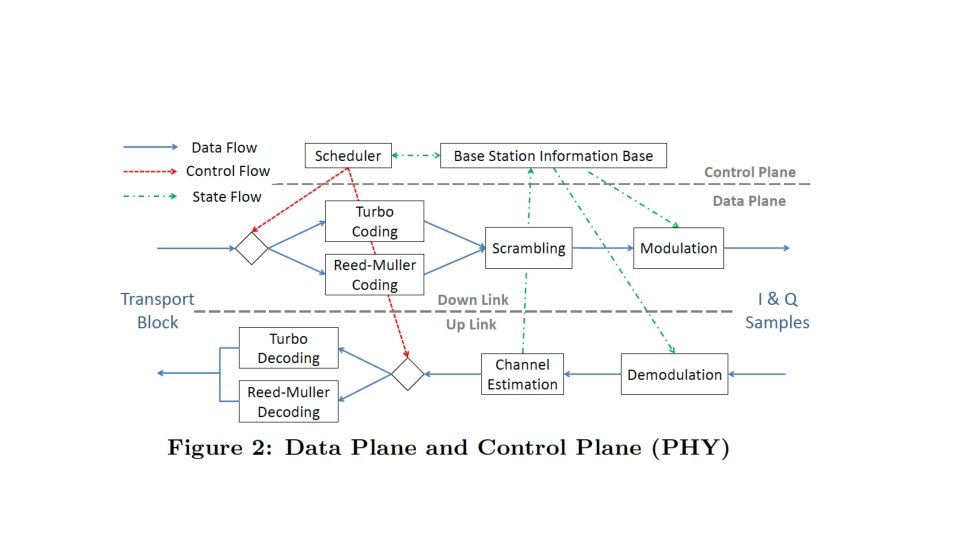
Control Plane • The control plane of a base station consists of a scheduler and a base station information base (BIB). • BIB is used to share information between the scheduler and the processing blocks in the data plane. 1. cell (each base station has multiple cells) specific information 2. UE specific information 3. network-wide configuration information
Control Plane : Base station scheduler • In an LTE control plane, each base station scheduler basically implements the following logic: • Setup per-flow data path. • Receive channel condition estimation from UEs and determine their Modulation and coding schemes and transmission modes (e. g. MIMO or not). • The RAN scheduler may make partial decisions on resource block (time and frequency) allocation in order to reduce interference. • The base station scheduler assign resource blocks to UEs within the constraints made by the RAN scheduler. • Schedule retransmission of failed data blocks (no acknowledgement or validation failure).
Management Plane • The management plane is in charge of allocating computational resources to these tasks. • PRAN dedicates computational resources to each base-station task adaptively and periodically, and it also reserves a share resource pool. • When a task receives bursty traffic whose processing requirement increase and the task offloads computation onto a shared-pool of idle resources.
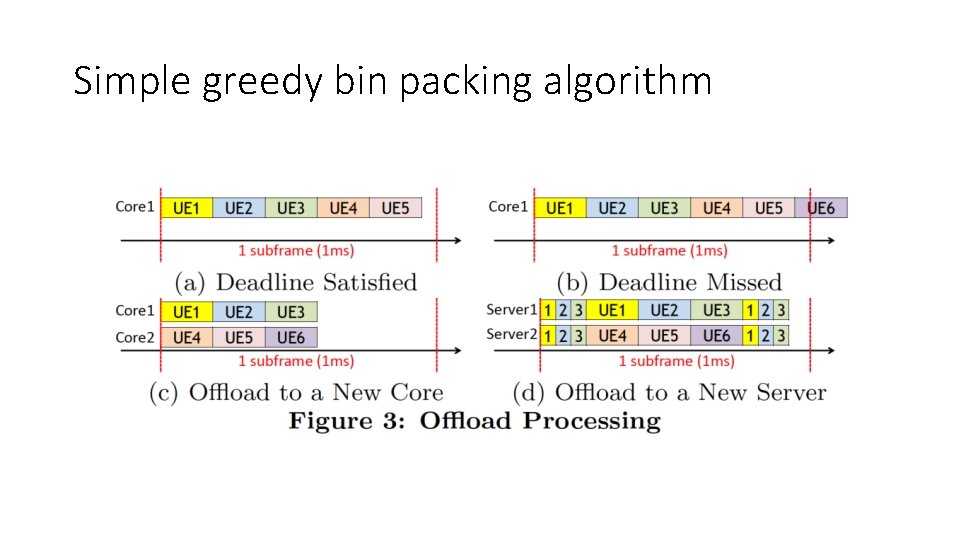
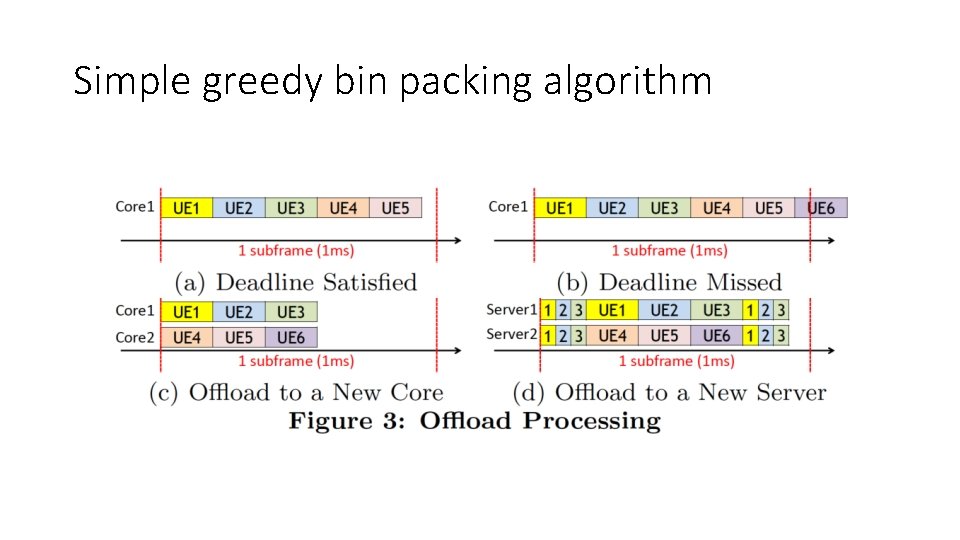
Management • We can predict the resource utilization of a base station in a sub frame in terms of CPU cores. • Simple greedy bin packing algorithm are used that leaves sufficient slack times at each core.
Simple greedy bin packing algorithm
Resources reallocation • it is not feasible to dynamically allocate resources for every sub frame. • when a base station task is reallocated to another server, the state migration consumes a significant amount of its sub frame duration, and the remaining time is little for data processing. • Solution • We propose to use historical data to reallocate resources periodically
Dynamic resource pooling • We propose to reserve a shared resource pool for bursty traffic • The resource pool can be an idle core in each server, or a few idle servers. • E. g. When a scheduler predicts that it would miss deadline based on current dedicated resources, it would offload a part of its workload to the shared resource pool.
Simple greedy bin packing algorithm
Evaluation • Open. Air. Interface LTE implementation to restructure the downlink processing into our data plane blocks. • We measure base station traces from a national cellular operator and estimate the resource requirements in sharing and dedicating modes • Testbed: • Dell T 5500 servers connected via Ethernet, each with 8 cores and 16 GB memory.
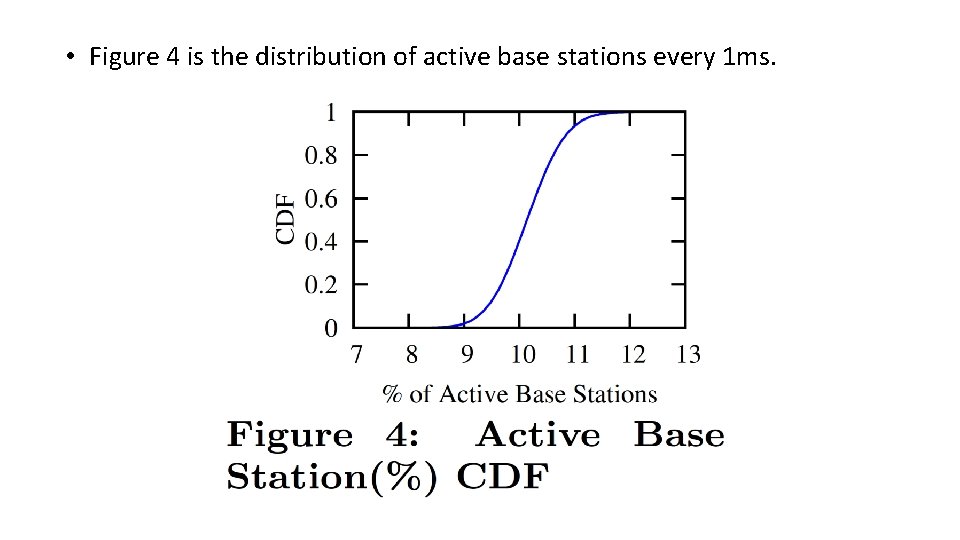
• Figure 4 is the distribution of active base stations every 1 ms.
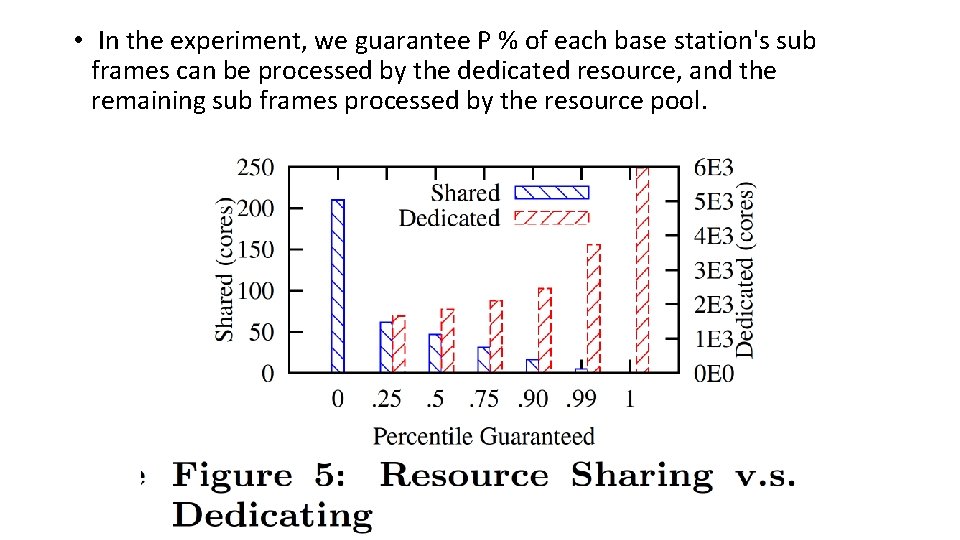
• In the experiment, we guarantee P % of each base station's sub frames can be processed by the dedicated resource, and the remaining sub frames processed by the resource pool.
Resource using • When P = 0, the shared resource is 210 cores, • When P = 1, the dedicated resource is 5972 cores • if each base station is provided resources for its peak-time workload, they need 5972 cores in total. • As shown in Figure 4, in our traces, only 12% (400) base stations have data to transmit for more than 99% of subframes. Therefore, P = 0 is optimal in terms of total resources used.
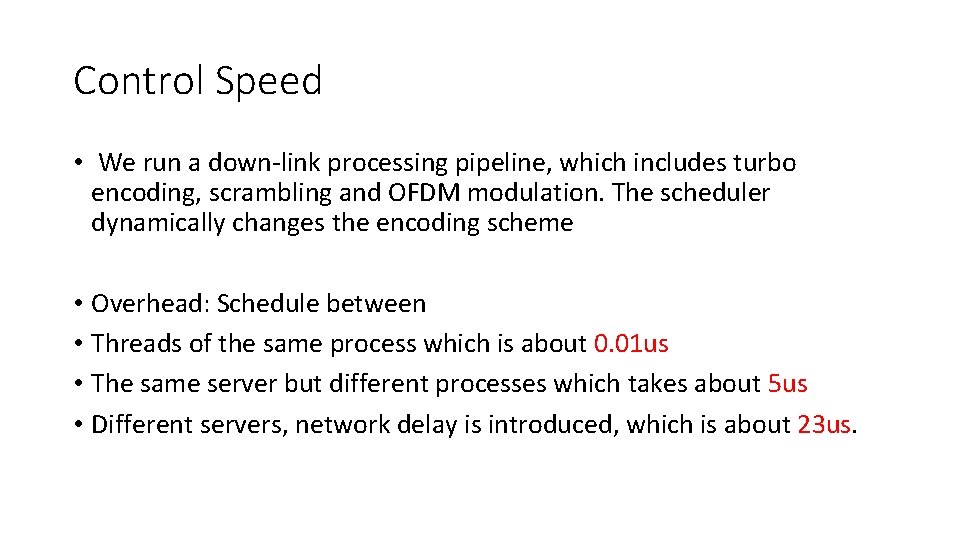
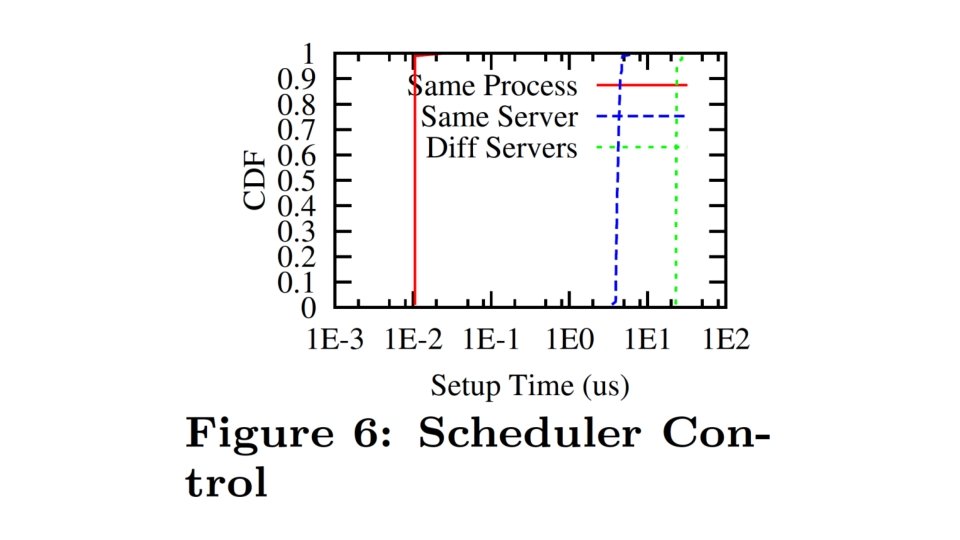
Control Speed • We run a down-link processing pipeline, which includes turbo encoding, scrambling and OFDM modulation. The scheduler dynamically changes the encoding scheme • Overhead: Schedule between • Threads of the same process which is about 0. 01 us • The same server but different processes which takes about 5 us • Different servers, network delay is introduced, which is about 23 us.
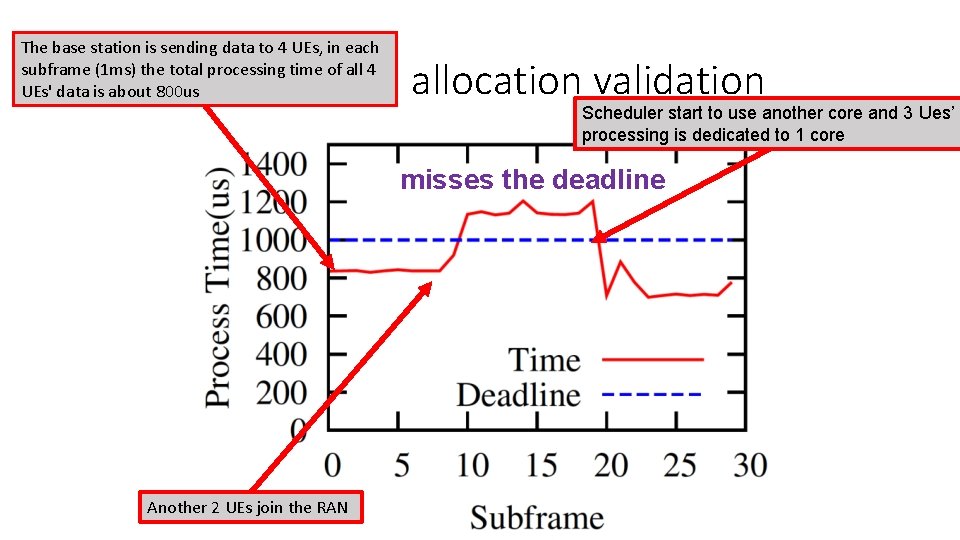
The base station is sending data to 4 UEs, in each subframe (1 ms) the total processing time of all 4 UEs' data is about 800 us Dynamic resource allocation validation Scheduler start to use another core and 3 Ues’ processing is dedicated to 1 core misses the deadline Another 2 UEs join the RAN
Related Work • Cloud. RAN [7, 20] statically associates each base station to a base band unit (BBU), is not programmable and does not provide centralized control.
Conclusion • With the rapid evolution towards an untethered and connected mobile world, radio access networks can no longer remain monolithic and inflexible. • PRAN, a programmable radio access network architecture, can meet the changing requirements of RANs.
Progress Update r P l a n i F s t c oje
- Slides: 30