
PRAISED BE Laudato Si On Care for Our
PRAISED BE “Laudato Si’ On Care for Our Common Home” Pope Francis I’s Encyclical on the Environment: A Call for Humility, Dialogue and Conversion Powerpoint by Roger Bergman, Ph. D. Adapted by Jennifer Reed-Bouley, Ph. D.
Francis the First! First pope from the Global South (Argentina) First Jesuit pope (follower of St. Ignatius of Loyola) First pope to take the name Francis, after the saint of Assisi, named patron of ecologists by Pope John Paul II First pope to write an encyclical on the environment First pope to write an encyclical using gender-inclusive language First pope to write an encyclical citing national bishops’ conferences, from around the world First pope to appoint nine cardinals as papal advisors
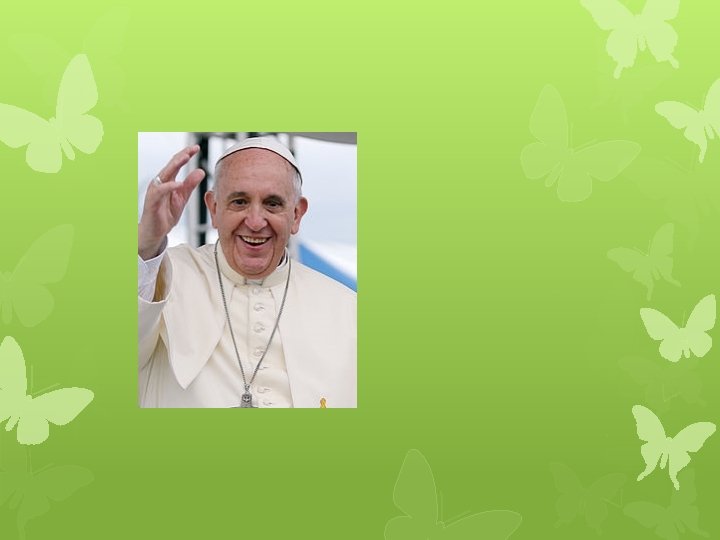
More about Francis: “Who am I to judge? ” He once worked as a bouncer in a Buenos Aires bar. He flies economy class and carries his own bag. When elected pope in March 2013, he chose to appear on the balcony, as the newly elected pope, without the traditional red cape and Prada (expensive, showy) shoes. He bowed before the people and asked them to pray for him. He is the first Pope not to live not in papal quarters, but in an apartment alongside Vatican guests and employees. Drives himself around Rome in a 1984 Renault; as Archbishop, he rode the bus. As Archbishop, he criticized priests who refused to baptize children of unmarried mothers. During pre-Easter services, he has washed and kissed the feet of prisoners, including Muslims and women – to the dismay of Vatican traditionalists. He beatified Archbishop Oscar Romero of El Salvador as a martyr of the faith. He Tweets daily and has 6. 6 million followers.
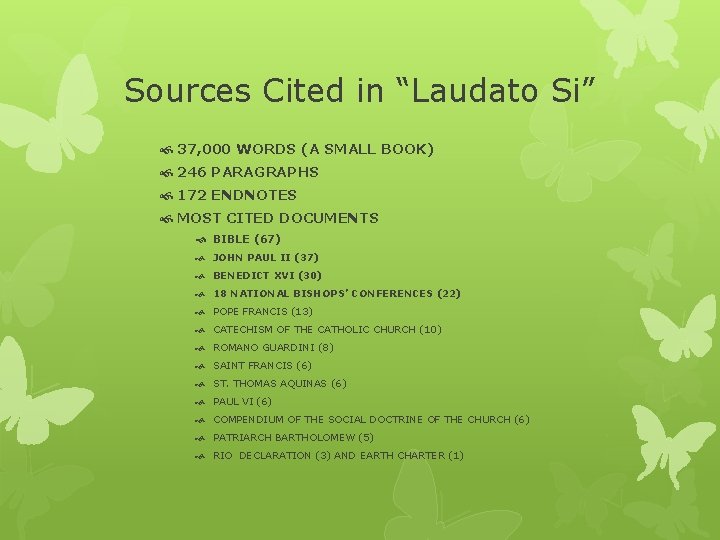
Sources Cited in “Laudato Si” 37, 000 WORDS (A SMALL BOOK) 246 PARAGRAPHS 172 ENDNOTES MOST CITED DOCUMENTS BIBLE (67) JOHN PAUL II (37) BENEDICT XVI (30) 18 NATIONAL BISHOPS’ CONFERENCES (22) POPE FRANCIS (13) CATECHISM OF THE CATHOLIC CHURCH (10) ROMANO GUARDINI (8) SAINT FRANCIS (6) ST. THOMAS AQUINAS (6) PAUL VI (6) COMPENDIUM OF THE SOCIAL DOCTRINE OF THE CHURCH (6) PATRIARCH BARTHOLOMEW (5) RIO DECLARATION (3) AND EARTH CHARTER (1)
Table of Contents: The Pope’s Strategy Introduction 1. What Is Happening to Our Common Home 2. The Gospel of Creation 3. The Human Roots of the Ecological Crisis 4. Integral Ecology 5. Lines of Approach and Action 6. Ecological Education and Spirituality
Ten Themes of the Encyclical 1. the intimate relationship between the poor and the fragility of the planet 2. the conviction that everything in the world is connected 3. the critique of new paradigms and forms of power derived from technology 4. the call to seek other ways of understanding the economy and progress 5. the value proper to each creature 6. the human meaning of ecology 7. the need forthright and honest debate 8. the serious responsibility of international and local policy 9. the throwaway culture 10. the proposal of a new lifestyle
Introduction to the Letter 1. “LAUDATO SI’, mi’ Signore” – “Praise be to you, my Lord”. In the words of this beautiful canticle, Saint Francis of Assisi reminds us that our common home is like a sister with whom we share our life and a beautiful mother who opens her arms to embrace us. “Praise be to you, my Lord, through our Sister, Mother Earth, who sustains and governs us, and who produces various fruit with colored flowers and herbs”.
Introduction 2. “This sister now cries out to us because of the harm we have inflicted on her by our irresponsible use and abuse of the goods with which God has endowed her. We have come to see ourselves as her lords and masters, entitled to plunder her at will. The violence present in our hearts, wounded by sin, is also reflected in the symptoms of sickness evident in the soil, in the water, in the air and in all forms of life. This is why the earth herself, burdened and laid waste, is among the most abandoned and maltreated of our poor; she “groans in travail” (Rom 8: 22). We have forgotten that we ourselves are dust of the earth (cf. Gen 2: 7); our very bodies are made up of her elements, we breathe her air and we receive life and refreshment from her waters. ”
To whom is this letter addressed? “Now, faced as we are with global environmental deterioration, I wish to address every person living on this planet. In this Encyclical, I would like to enter into dialogue with all people about our common home. ” 3 Significant that addressed to ALL!
CHAPTER 1 WHAT IS HAPPENING TO OUR COMMON HOME I. POLLUTION AND CLIMATE CHANGE II. THE ISSUE OF WATER III. LOSS OF BIODIVERSITY IV. DECLINE IN THE QUALITY OF HUMAN LIFE AND BREAKDOWN OF SOCIETY V. GLOBAL INEQUALITY VI. WEAK RESPONSES VII. A VARIETY OF OPINIONS
An Unusual Pastoral Tactic Our goal is not to amass information or to satisfy curiosity, but rather to become painfully aware, to dare to turn what is happening to the world into our own personal suffering and thus to discover what each of us can do about it. 19
The Climate as a Common Good The Pope quotes the Vatican II definition of the common good later in the document: The common good is “the sum of those conditions of social life which allow social groups and their individual members relatively thorough and ready access to their own fulfilment”. 156 He refers to it here in an innovative way: “The climate is a common good, belonging to all and meant for all. …A very solid scientific consensus indicates that we are presently witnessing a disturbing warming of the climatic system…. due to the great concentration of greenhouse gases…released mainly as a result of human activity. …The problem is aggravated by a model of development based on the intensive use of fossil fuels, which is at the heart of the worldwide energy system. ” 23
Global Inequality “…the deterioration of the environment and of society affects the most vulnerable people on the planet…. 48…. the majority of the planet’s population, billions of people. ” 49 “…a true ecological approach always becomes a social approach; it must integrate questions of justice in debates on the environment, so as to hear both the cry of the earth and the cry of the poor. ” 49
A Variety of Opinions “On many concrete questions, the Church has no reason to offer a definitive opinion; she knows that honest debate must be encouraged among experts, while respecting divergent views. ” 61
CHAPTER 2 THE GOSPEL OF CREATION I. THE LIGHT OFFERED BY FAITH II. THE WISDOM OF THE BIBLICAL ACCOUNTS III. THE MYSTERY OF THE UNIVERSE IV. THE MESSAGE OF THE EACH CREATURE IN THE HARMONY OF CREATION V. A UNIVERSAL COMMUNION VI. THE COMMON DESTINATION OF GOODS VII. THE GAZE OF JESUS
The creation accounts in the book of Genesis… “…suggest that human life is grounded in three fundamental and closely intertwined relationships: with God, with our neighbor and with the earth itself…The harmony between the Creator, humanity and creation as a whole was disrupted by our presuming to take the place of God and refusing to acknowledge our creaturely limitations. This in turn distorted our mandate to “have dominion” over the earth (cf. Gen 1: 28), to “till it and keep it” (Gen 2: 15)…Saint Bonaventure held that, through universal reconciliation with every creature, Saint Francis in some way returned to the state of original innocence. ” 66
THE COMMON DESTINATION OF GOODS “God created the world for everyone. Hence every ecological approach needs to incorporate a social perspective which takes into account the fundamental rights of the poor and the underprivileged…. The Christian tradition has never recognized the right to private property as absolute or inviolable, and has stressed the social purpose of all forms of private property. ” 93
CHAPTER 3 THE HUMAN ROOTS OF THE ECOLOGICAL CRISIS I. TECHNOLOGY: CREATIVITY AND POWER II. THE GLOBALIZATION OF THE TECHNOCRATIC PARADIGM III. THE CRISIS AND EFFECTS OF MODERN ANTHROPOCENTRISM A. PRACTICAL RELATIVISM B. THE NEED TO PROTECT EMPLOYMENT C. NEW BIOLOGICAL TECHNIQUES
A Crossroads for Humanity “Humanity has entered a new era in which our technical prowess has brought us to a crossroads…. Technology has remedied countless evils which used to harm and limit human beings…. 102…but we cannot claim to have a sound ethics, a culture and spirituality genuinely capable of setting limits and teaching clear-minded self-restraint. ” 105
THE GLOBALIZATION OF THE TECHNOCRATIC PARADIGM “The basic problem goes even deeper: it is the way that humanity has taken up technology and its development according to an undifferentiated and one-dimensional paradigm…. based on the lie that there is an infinite supply of the earth’s goods, and this leads to the planet being squeezed dry beyond every limit. ” 106
“A Bold Cultural Revolution” “Nobody is suggesting a return to the Stone Age, but we do need to slow down and look at reality in a different way, to appropriate the positive and sustainable progress which has been made, but also to recover the values and the great goals swept away by our unrestrained delusions of grandeur. ” 114
CHAPTER 4 INTEGRAL ECOLOGY I. ENVIRONMENTAL, ECONOMIC AND SOCIAL ECOLOGY II. CULTURAL ECOLOGY III. ECOLOGY OF DAILY LIFE IV. THE PRINCIPLE OF THE COMMON GOOD V. JUSTICE BETWEEN GENERATIONS
It cannot be emphasized enough how everything is interconnected. 138 “We are faced not with two separate crises, one environmental and the other social, but rather with one complex crisis which is both social and environmental. Strategies for a solution demand an integrated approach to combating poverty, restoring dignity to the excluded, and at the same time protecting nature. ” 139 “Thus, for example, drug use in affluent societies creates a continual and growing demand for products imported from poorer regions, where behavior is corrupted, lives are destroyed, and the environment continues to deteriorate. ” 142
The common good “the sum of those conditions of social life which allow social groups and their individual members relatively thorough and ready access to their own fulfilment” 156
JUSTICE BETWEEN THE GENERATIONS “The notion of the common good also extends to future generations…. We can no longer speak of sustainable development apart from intergenerational solidarity. ” 159 “Doomsday predictions can no longer be met with irony or disdain. We may well be leaving to coming generations debris, desolation and filth. ” 161
CHAPTER 5 LINES OF APPROACH AND ACTION I. DIALOGUE ON THE ENVIRONMENT IN THE INTERNATIONAL COMMUNITY II. DIALOGUE FOR NEW NATIONAL AND LOCAL POLICIES III. DIALOGUE AND TRANSPARENCY IN DECISIONMAKING IV. POLITICS AND ECONOMY IN DIALOGUE FOR HUMAN FULFILLMENT V. RELIGIONS IN DIALOGUE WITH SCIENCE
International Dialogue “[Global] Interdependence obliges us to think of one world with a common plan…. A global consensus is essential for confronting the deeper problems, which cannot be resolved by unilateral actions on the part of individual countries. ” 164 “[But] As the bishops of Bolivia have stated, ‘the countries which have benefited from a high degree of industrialization, at the cost of enormous emissions of greenhouse gases, have a greater responsibility for providing a solution to the problems they have caused. ’” 170
Citizens’ Movements “In some places, cooperatives are being developed to exploit renewable sources of energy which ensure local self-sufficiency and even the sale of surplus energy…. Unless citizens control political power – national, regional and municipal – it will not be possible to control damage to the environment. ” 179
“Put simply… …it is a matter of redefining our notion of progress. ” 194 It might be said that the purpose of the encyclical is to provoke a global (and local) dialogue about what a true and worthy progress would look like.
CHAPTER 6 ECOLOGICAL EDUCATION AND SPIRITUALITY I. TOWARDS A NEW LIFESTYLE II. EDUCATING FOR THE COVENANT BETWEEN HUMANITY AND THE ENVIRONMENT III. ECOLOGICAL CONVERSION IV. JOY AND PEACE V. CIVIC AND POLITICAL LOVE VI. SACRAMENTAL SIGNS AND THE CELEBRATION OF REST VII. THE TRINITY AND THE RELATIONSHIP BETWEEN CREATURES VIII. QUEEN OF ALL CREATION IX. BEYOND THE SUN
Yet all is not lost. “Obsession with a consumerist lifestyle, above all when few people are capable of maintaining it, can only lead to violence and mutual destruction. ” 204 “Human beings, while capable of the worst, are also capable of rising above themselves, choosing again what is good, and making a new start, despite their mental and social conditioning. ” 205
ECOLOGICAL CONVERSION “There is a nobility in the duty to care for creation through little daily actions, and it is wonderful how education can bring about real changes in lifestyle. ” 211 “Living our vocation to be protectors of God’s handiwork is essential to a life of virtue; it is not an optional or a secondary aspect of our Christian experience. ” 217 “Nevertheless, self-improvement on the part of individuals will not by itself remedy the extremely complex situation facing our world today…. The ecological conversion needed to bring about lasting change is also a community conversion. ” 219
The Franciscan Spirituality of a Jesuit Pope “Christian spirituality proposes an alternative understanding of the quality of life, and encourages a prophetic and contemplative lifestyle, one capable of deep enjoyment free of the obsession with consumption. We need to take up an ancient lesson…“’less is more’”. 222 “…there is a mystical meaning to be found in a leaf, in a mountain trail, in a dewdrop, in a poor person’s face. The ideal is not only to pass from the exterior to the interior to discover the action of God in the soul, but also to discover God in all things. ” 233
Ten Themes of the Encyclical 1. the intimate relationship between the poor and the fragility of the planet 2. the conviction that everything in the world is connected 3. the critique of new paradigms and forms of power derived from technology 4. the call to seek other ways of understanding the economy and progress 5. the value proper to each creature 6. the human meaning of ecology 7. the need forthright and honest debate 8. the serious responsibility of international and local policy 9. the throwaway culture 10. the proposal of a new lifestyle
Q & A What needs clarification? What surprises you? What encourages you? What disappoints you? What do you resist? What changes will you make in response? In your lifestyle, home, church, work, politics, spirituality?
A prayer for our earth All-powerful God, you are present in the whole universe and in the smallest of your creatures. You embrace with your tenderness all that exists. Pour out upon us the power of your love, that we may protect life and beauty. Fill us with peace, that we may live as brothers and sisters, harming no one. O God of the poor, help us to rescue the abandoned and forgotten of this earth, so precious in your eyes….
A prayer for our earth …. Bring healing to our lives, that we may protect the world and not prey on it, that we may sow beauty, not pollution and destruction. Touch the hearts of those who look only for gain at the expense of the poor and the earth. Teach us to discover the worth of each thing, to be filled with awe and contemplation, to recognize that we are profoundly united with every creature as we journey towards your infinite light. We thank you for being with us each day. Encourage us, we pray, in our struggle for justice, love and peace.
NASA ON THE SCIENTIFIC CONSENSUS Multiple studies published in peer-reviewed scientific journals show that 97 percent or more of actively publishing climate scientists agree: Climate-warming trends over the past century are very likely due to human activities. In addition, most of the leading scientific organizations worldwide have issued public statements endorsing this position. The following is a partial list of these organizations, along with links to their published statements and a selection of related resources…. http: //climate. nasa. gov/scientific-consensus/
The Scientific Consensus (NASA website) Joint statement from 18 U. S. scientific associations American Association for the Advancement of Science American Chemical Society American Geophysical Union American Medical Association American Meteorological Society American Physical Society The Geological Society of America Joint statement of 11 international science academies U. S. National Academy of Sciences U. S. Global Change Research Program Intergovernmental Panel on Climate Change 200 worldwide scientific organizations hold the position that climate change has been caused by human action. http: //opr. ca. gov/s_listoforganizations. php
Pentagon calls climate change a matter of ‘national security’ “The Pentagon's new report maps out four areas of climate change deemed the most threatening to the U. S. military -- rising global temperatures, changing precipitation patterns, more extreme weather and rising sea levels. And it warns about the impact they could have on food and water supplies, the environment and American security itself. ” http: //www. foxnews. com/politics/2014/10/13/pentagon -calls-climate-change-matter-national-security
Climate Change: What Does It Mean for Nebraska? A composite of the various climate models projects a warming in Nebraska of about 4°F for the annual average by 2050 and 8°F or higher by 2090. …There are expected to be changes in the frequency and severity of extreme events in a warmer climate, such as heat waves and heavy precipitation…The number of days per year with daytime high temperatures greater than 95°F are expected to increase by about 15 days by the middle of this century, along with more consecutive days with highs above this threshold…. Authored by four climate scientists at the University of Nebraska-Lincoln http: //www. ianrpubs. unl. edu/epublic/live/g 2208/build/#target 5
Pope Francis’ View of Population Growth “To blame [climate change on] population growth instead of extreme and selective consumerism on the part of some, is one way of refusing to face the issues. It is an attempt to legitimize the present model of distribution, where a minority believes that it has the right to consume in a way which can never be universalized, since the planet could not even contain the waste products of such consumption. Besides, we know that approximately a third of all food produced is discarded, and “whenever food is thrown out it is as if it were stolen from the table of the poor”. Still, attention needs to be paid to imbalances in population density…” 50
- Slides: 43