
Pragmatics Pragmatics may mean The study of the


- Slides: 45
Pragmatics
Pragmatics may mean … “ The study of the speaker’s meaning “
"Pragmatics focuses on what is not explicitly stated and on how we interpret utterances in situational contexts. It is concerned not so much with the sense of what is said , that is, with what is communicated by the manner and style of an utterance. "
Invisible Meaning
The way we recognize or understand what is meant even it isn’t actually said or written
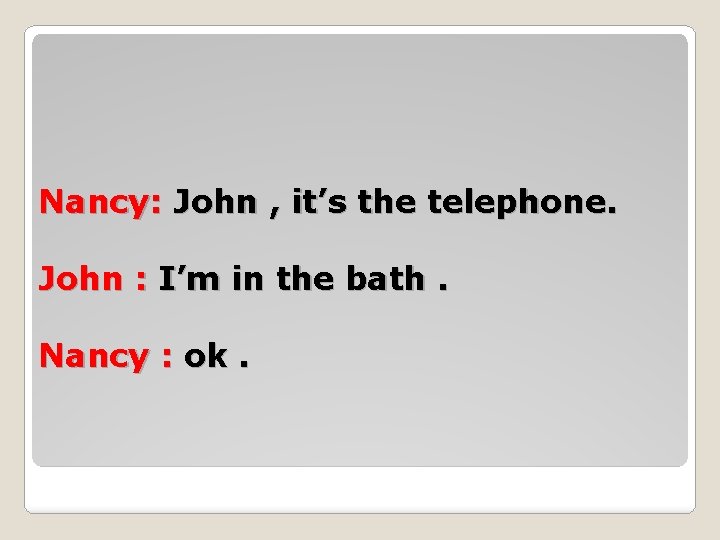
Nancy: John , it’s the telephone. John : I’m in the bath. Nancy : ok.
Context
Linguistic context ( co-text): The set of other words used in the same phrase or sentence. The surrounding co-text has strong effect on what we think the word probably means.
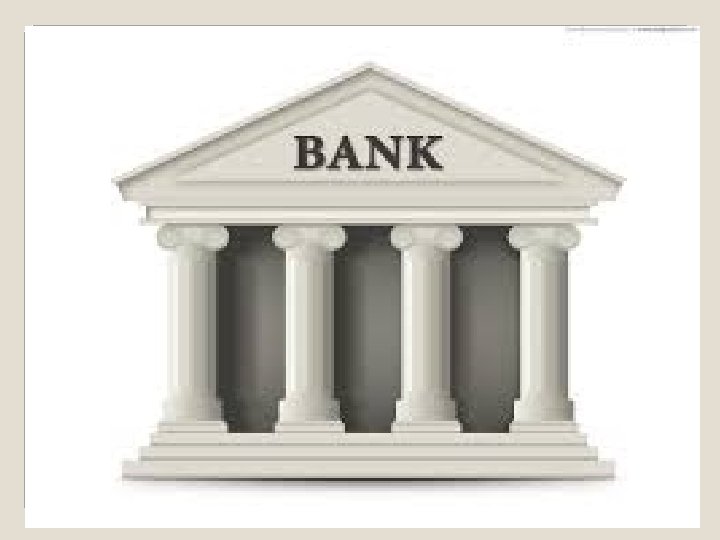
The word “ bank “ - The river bank was soapy and steep. he has to go to the bank to withdraw some cash.
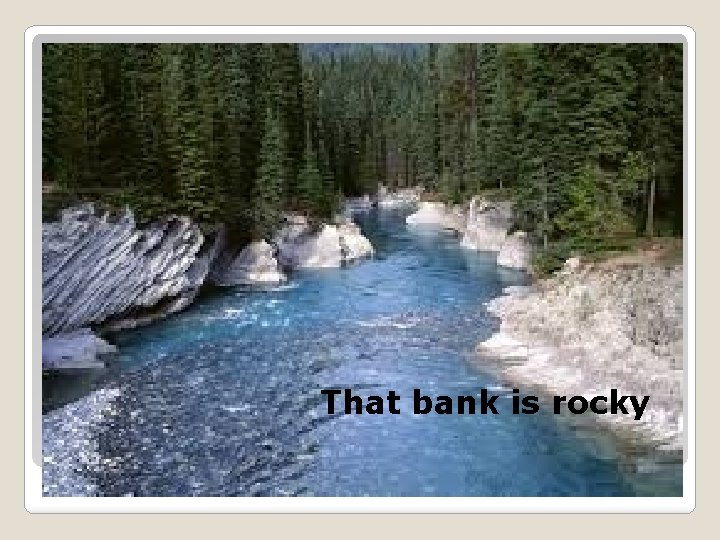
Physical context The physical location influences our interpretation (the time and place in which we encounter linguistic expressions ).
That bank is rocky
Deixis
refers to words and phrases that cannot be fully understood without additional contextual information. Words are deictic if their semantic meaning is fixed but their denotational meaning varies depending on time and/or place.
Some very common words in our language that can’t be interpreted if we don’t know the physical context of the speaker
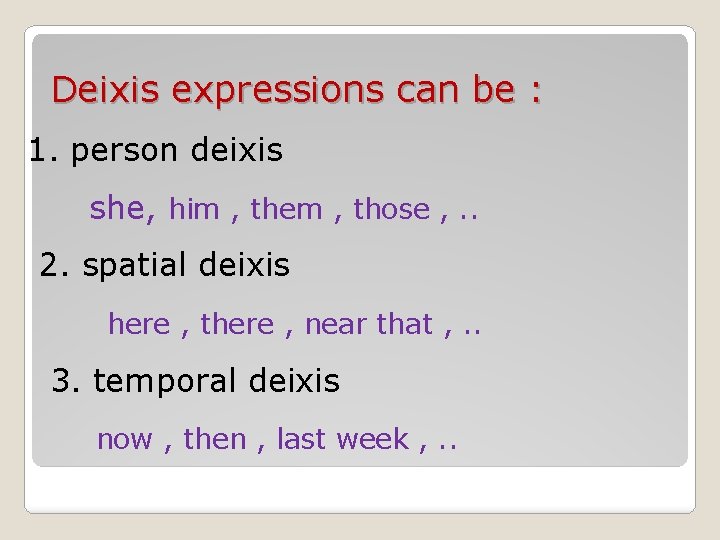
Deixis expressions can be : 1. person deixis she, him , them , those , . . 2. spatial deixis here , there , near that , . . 3. temporal deixis now , then , last week , . .
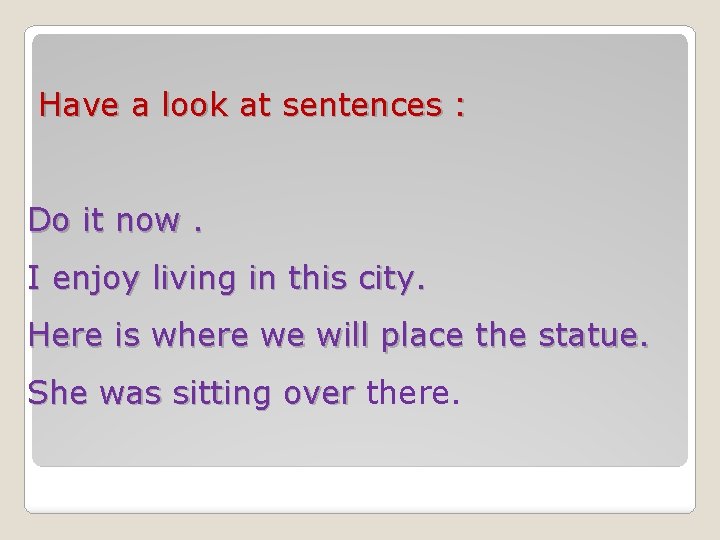
Have a look at sentences : Do it now. I enjoy living in this city. Here is where we will place the statue. She was sitting over there.
Reference
An act by which a speaker uses language to enable a listener to identify something. We can use proper , common nouns or pronouns. such as the use of cat , man, …etc.
Anaphora �
"The man was holding the cat while the woman poured water on it. " The word cat in the antecedent. The word “it” is anaphoric reference. Anaphora means referring back.
“I turned the corner and almost stepped on it. There was a large snake in the middle of the path. ” The word “it”, is more explained about the snake ( cataphoric ).
Inference
A successful act of reference depends more on the listener’s ability to recognize what we mean than on the listener’s knowledge of a word use.
An inference is additional information used by the listener to create a connection between what is said and what must be meant.
es : - Sally arrives at home at 4: 30 and knows that her mother does not get off of work until 5. Sally also sees that the lights are off in their house. Sally can ot yet home.
- A child tries a new fruit and makes a disgusted face. His mother can infer that he does not like the taste of the fruit. - When the phone rang and Liz picked it up, she was all smiles. It can be inferred that she was pleased to receive the phone call.
Presupposition
We design our linguistic messages on the basis of assumptions about what our listeners already know. So, what a speaker assumes is true or known by a listener.
It is an implicit assumption about the world or background belief relating to an utterance whose truth is taken for granted
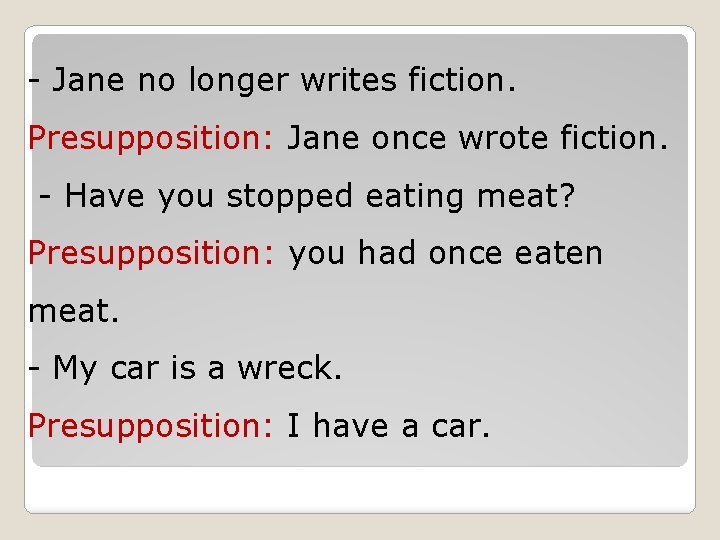
- Jane no longer writes fiction. Presupposition: Jane once wrote fiction. - Have you stopped eating meat? Presupposition: you had once eaten meat. - My car is a wreck. Presupposition: I have a car.
Speech acts
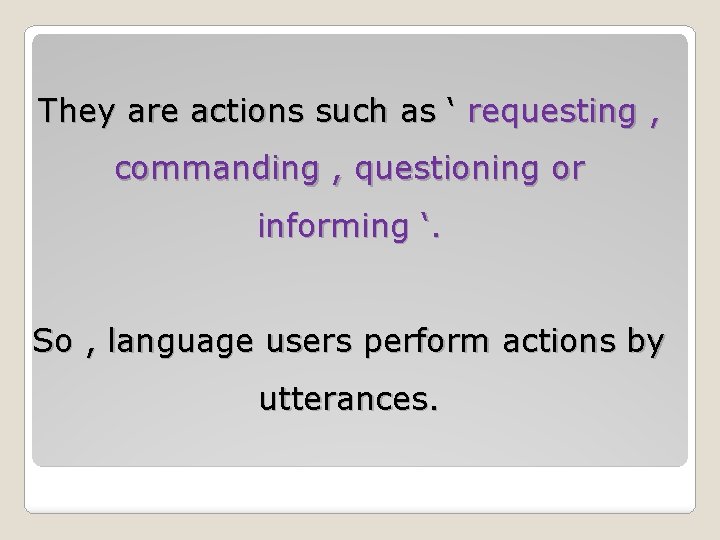
They are actions such as ‘ requesting , commanding , questioning or informing ‘. So , language users perform actions by utterances.
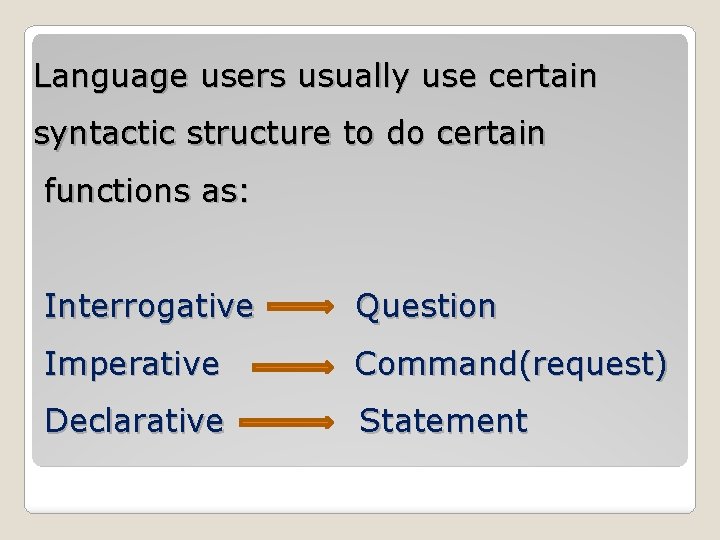
Language users usually use certain syntactic structure to do certain functions as: Interrogative Question Imperative Command(request) Declarative Statement
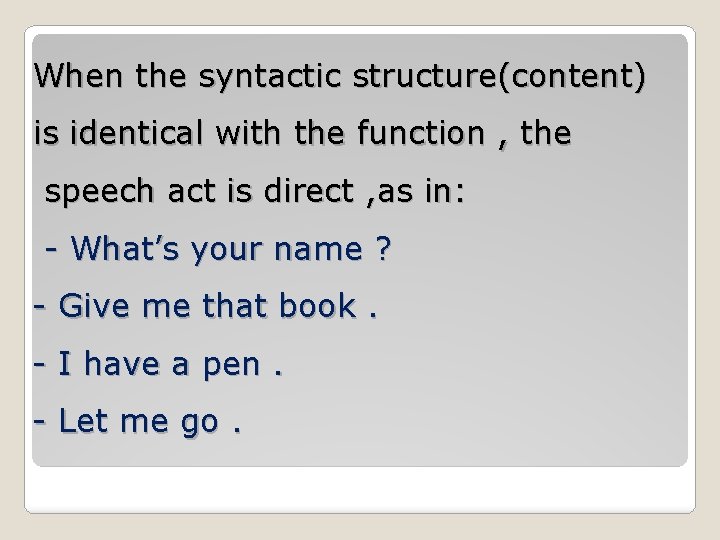
When the syntactic structure(content) is identical with the function , the speech act is direct , as in: - What’s your name ? - Give me that book. - I have a pen. - Let me go.
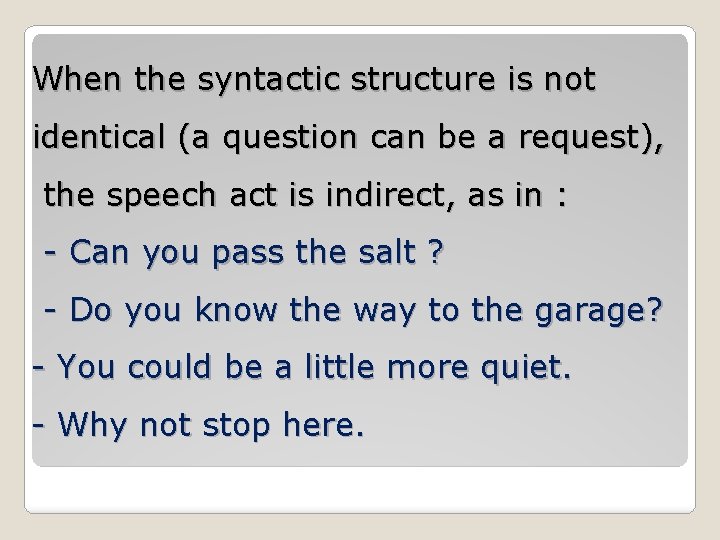
When the syntactic structure is not identical (a question can be a request), the speech act is indirect, as in : - Can you pass the salt ? - Do you know the way to the garage? - You could be a little more quiet. - Why not stop here.
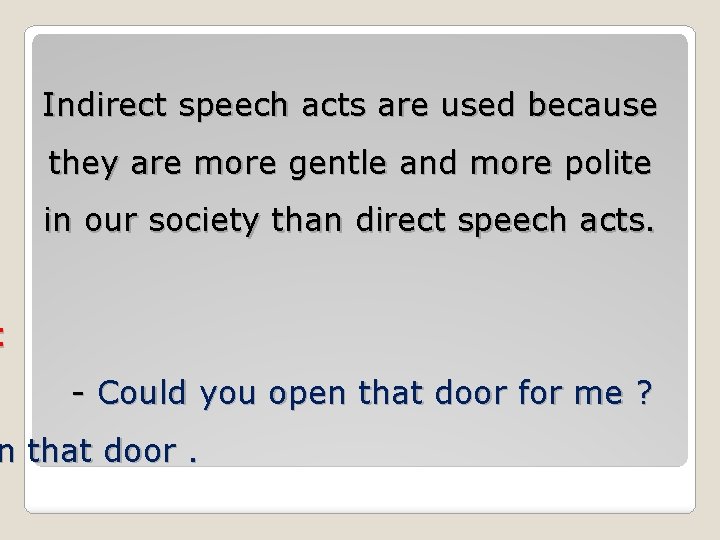
Indirect speech acts are used because they are more gentle and more polite in our society than direct speech acts. : - Could you open that door for me ? n that door.
Politeness
Politeness is best expressed as the practical application of good manners or etiquette. It has to do with ideas as being tactful , modest and nice.
Face Self-image
Negative face refers to the want of � every competent adult member that his actions be unimpeded by others Positive face refers to the want of every member that his wants be desirable to at least some others
Face Threatening Those acts that by their nature run contrary to the face wants of the addressee and/or of the speaker`s The negative face is threatened by. . . …acts that appear to impede the addressee´s independence of movement and freedom of action The positive face is threatened by… …acts which appear as disapproving of their wants