
Pragmatics Introduction to Linguistics What does pragmatics study


- Slides: 33
Pragmatics Introduction to Linguistics
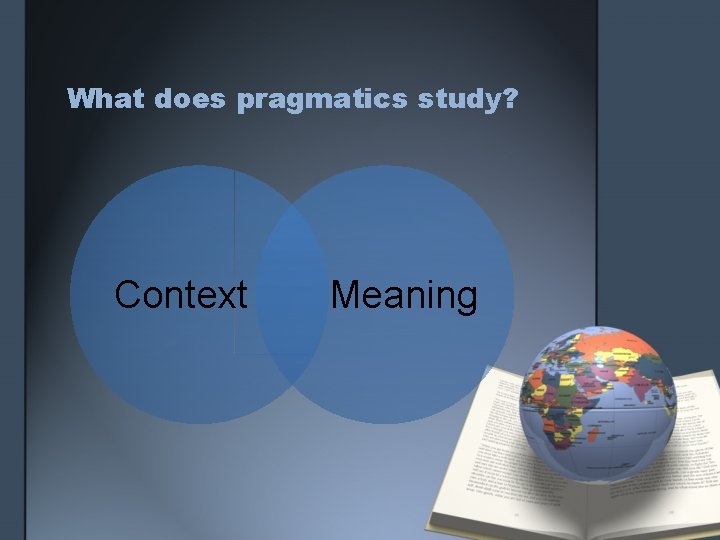
What does pragmatics study? Context Meaning
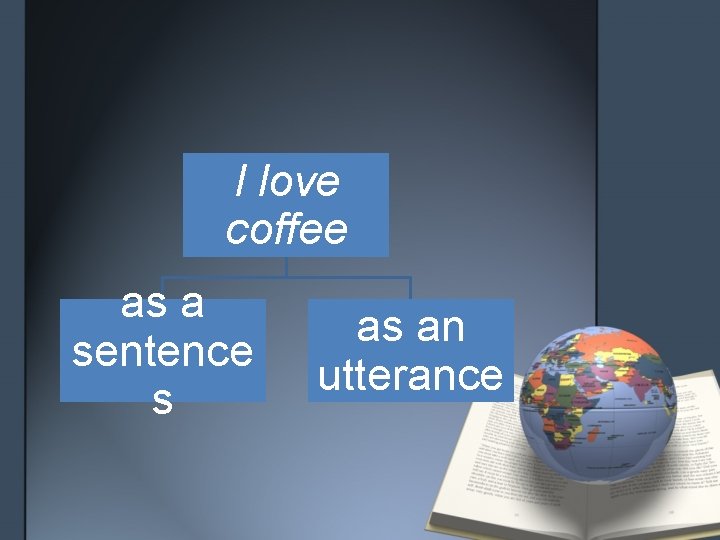
I love coffee as a sentence s as an utterance
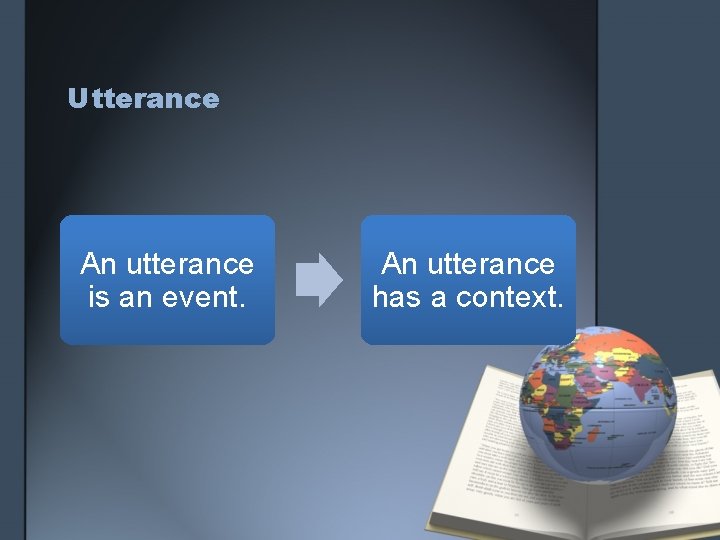
Utterance An utterance is an event. An utterance has a context.
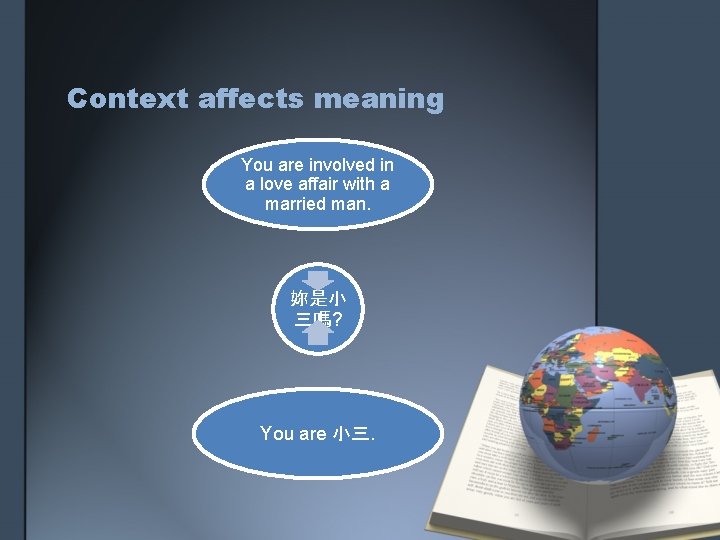
Context affects meaning You are involved in a love affair with a married man. 妳是小 三嗎? You are 小三.
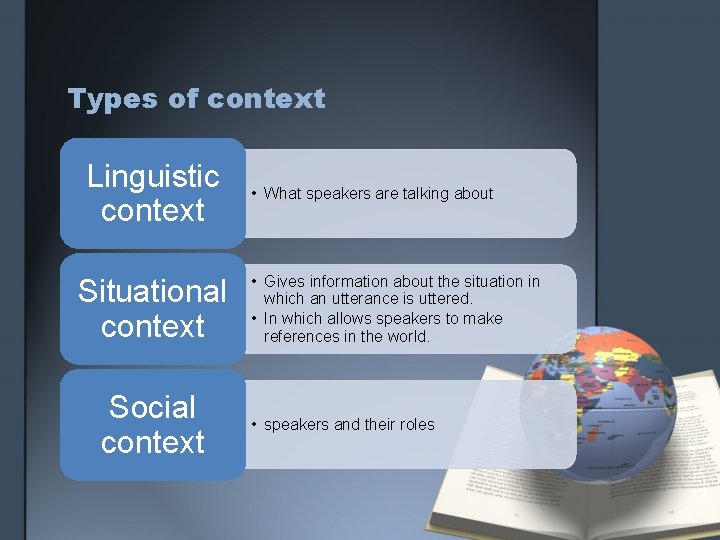
Types of context Linguistic context Situational context Social context • What speakers are talking about • Gives information about the situation in which an utterance is uttered. • In which allows speakers to make references in the world. • speakers and their roles
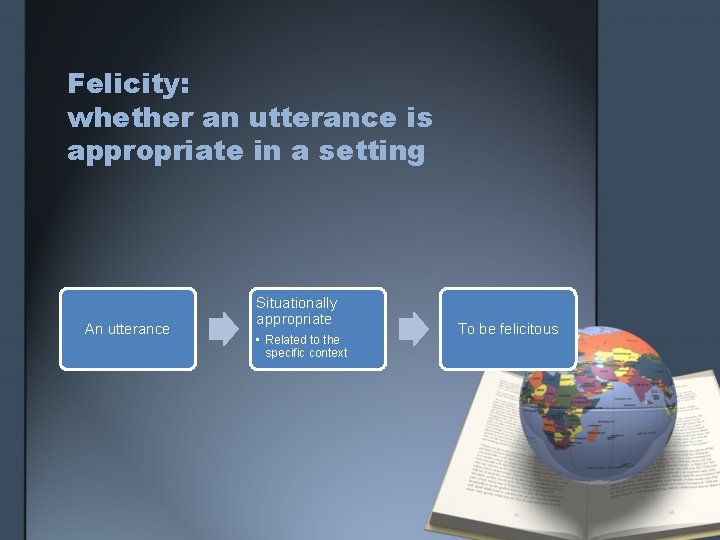
Felicity: whether an utterance is appropriate in a setting An utterance Situationally appropriate • Related to the specific context To be felicitous
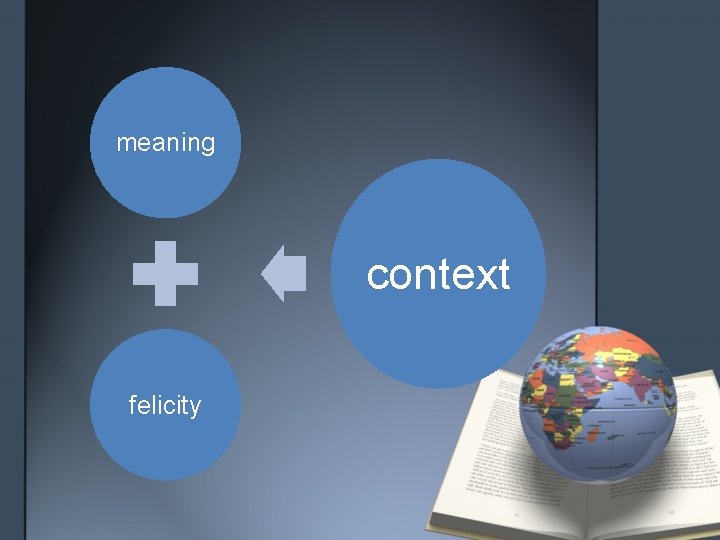
meaning context felicity
Rules of conversation
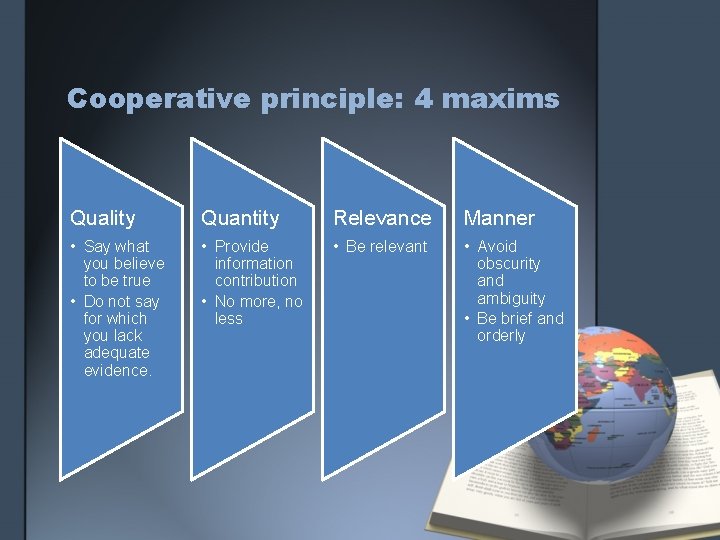
Cooperative principle: 4 maxims Quality Quantity Relevance Manner • Say what you believe to be true • Do not say for which you lack adequate evidence. • Provide information contribution • No more, no less • Be relevant • Avoid obscurity and ambiguity • Be brief and orderly
What happens if the maxims are flouted? Flouting Inferences
Drawing conclusions
Entailment Implication Inference Implicature
Entailment • Based on literal meaning • Ignore the context of an utterance.
Implication vs. inference • John and Mary are sitting in a romantic restaurant. John takes out a ring and puts it on the table. • What does John imply by doing so? • What can Mary infer from it?
Implication • Sending a message without saying it directly Inference • A conclusion that a person can reasonably draw on a set of conditions
implicatures • When a speaker uses language to imply something, the utterance contains an implicature. • Conclusions that are drawn about what people mean based on what we know about how conversation works.
• I’d like a cup of coffee. • Go to Starbucks.
Speech acts
What is a speech act? • Actions performed via utterances
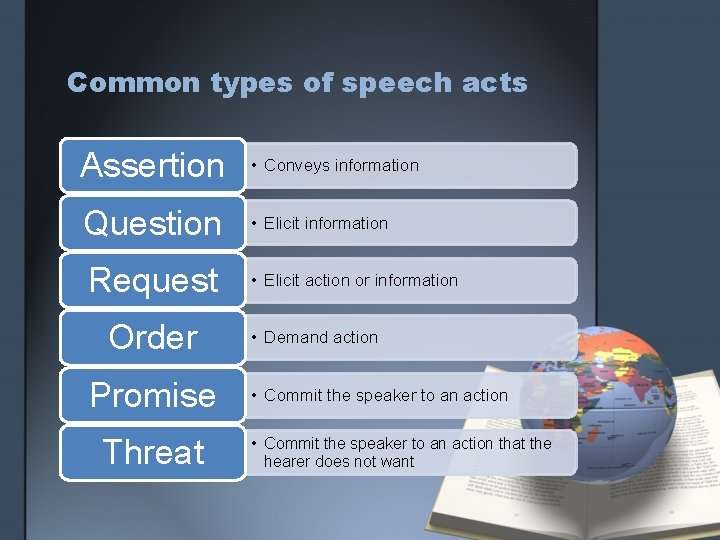
Common types of speech acts Assertion • Conveys information Question • Elicit information Request • Elicit action or information Order Promise Threat • Demand action • Commit the speaker to an action that the hearer does not want
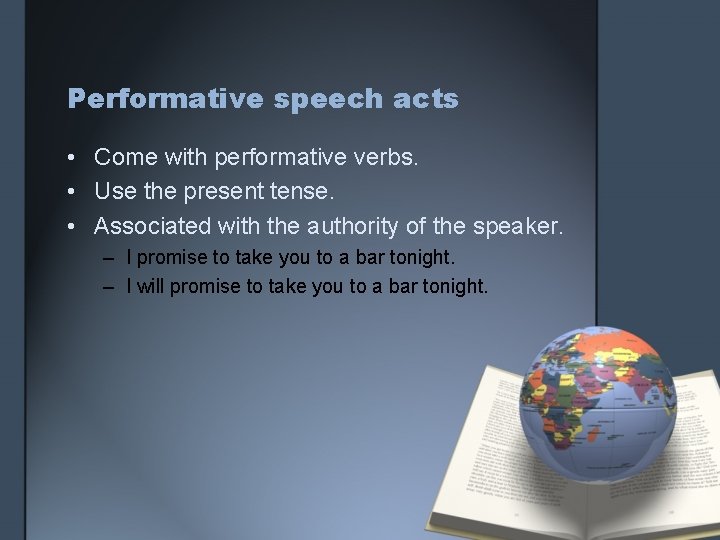
Performative speech acts • Come with performative verbs. • Use the present tense. • Associated with the authority of the speaker. – I promise to take you to a bar tonight. – I will promise to take you to a bar tonight.
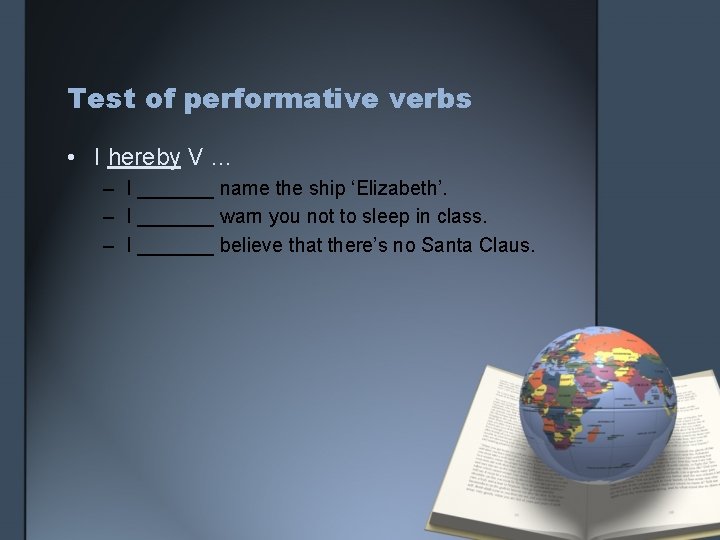
Test of performative verbs • I hereby V … – I _______ name the ship ‘Elizabeth’. – I _______ warn you not to sleep in class. – I _______ believe that there’s no Santa Claus.
Felicity conditions • The appropriate circumstances for the performance of a speech act to be recognized.
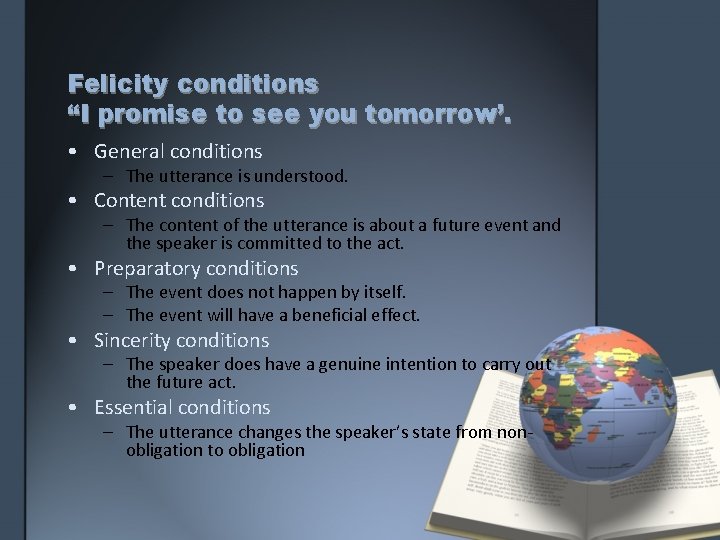
Felicity conditions “I promise to see you tomorrow’. • General conditions – The utterance is understood. • Content conditions – The content of the utterance is about a future event and the speaker is committed to the act. • Preparatory conditions – The event does not happen by itself. – The event will have a beneficial effect. • Sincerity conditions – The speaker does have a genuine intention to carry out the future act. • Essential conditions – The utterance changes the speaker’s state from nonobligation to obligation
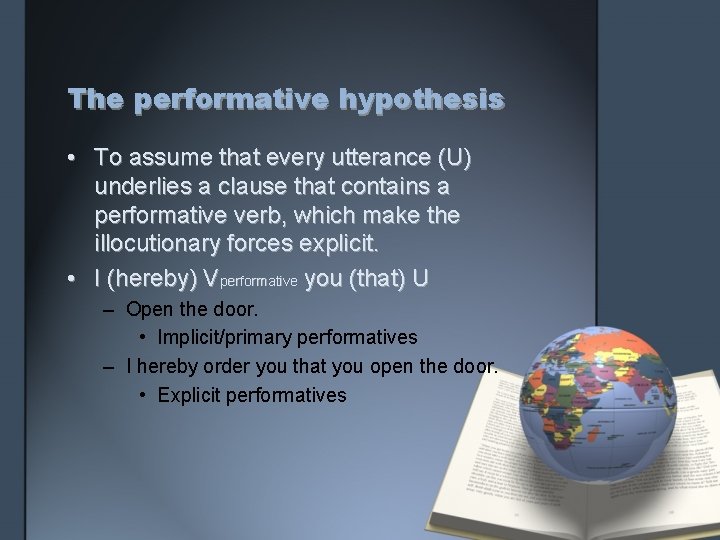
The performative hypothesis • To assume that every utterance (U) underlies a clause that contains a performative verb, which make the illocutionary forces explicit. • I (hereby) Vperformative you (that) U – Open the door. • Implicit/primary performatives – I hereby order you that you open the door. • Explicit performatives
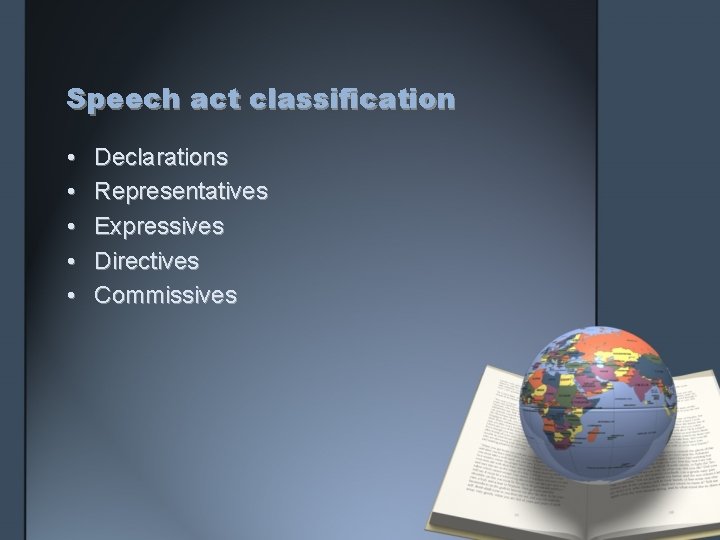
Speech act classification • • • Declarations Representatives Expressives Directives Commissives
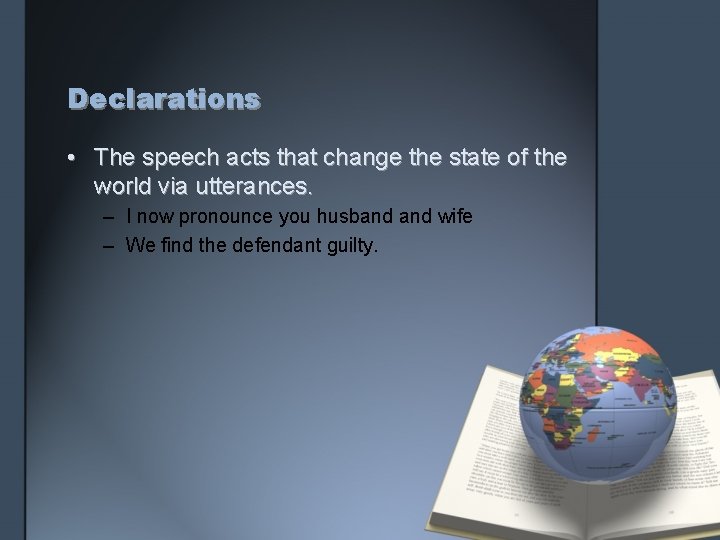
Declarations • The speech acts that change the state of the world via utterances. – I now pronounce you husband wife – We find the defendant guilty.
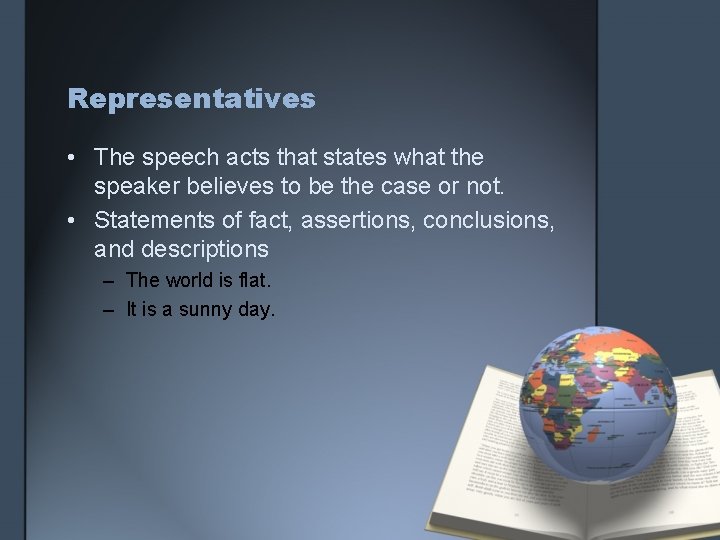
Representatives • The speech acts that states what the speaker believes to be the case or not. • Statements of fact, assertions, conclusions, and descriptions – The world is flat. – It is a sunny day.
Expressives • The speech acts that state what the speaker feels. • Psychological stats (pleasure, pain, likes, joy, sorrow…) – I am sorry. – Congratulations.
Directives • The speech acts used by the speaker to get someone else to do something. • Commands, orders, requests, suggestions. – Go away!
Commissives • The speech acts that speakers use to commit themselves to some future actions • Promises, threats, refusals, pledges. – I can’t do that.
QUESTIONS?