
Practising Graphs Why do we use graphs 1





- Slides: 11
Practising Graphs
Why do we use graphs? 1. To help us see trends 2. To see the relationship between 2 variables (e. g. how temperature of water cools over time) 3. To be able to predict the values of certain things
Read “Displaying your results” on page 6 of the books Which graph type do I choose? 1. 2. 3. If both the variables have numbers draw a line graph (e. g. temperature cooling over time) If one variable is a number and the other is a word or category draw a bar graph (e. g. mass of different types of trees) If one is a percentage and the other is a word or category draw a pie chart (e. g. percentage of time taken up doing variety of activities over the day)
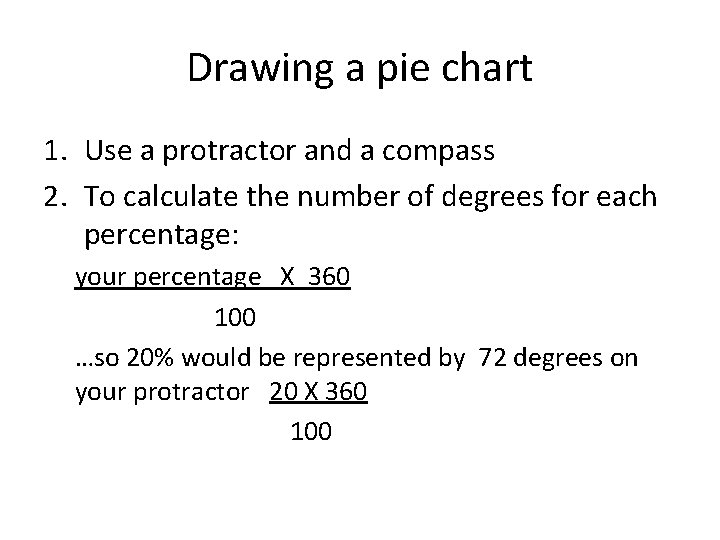
Drawing a pie chart 1. Use a protractor and a compass 2. To calculate the number of degrees for each percentage: your percentage X 360 100 …so 20% would be represented by 72 degrees on your protractor 20 X 360 100
Which variable goes where? The input variable always goes on the x axis and the outcome variable always goes on the y axis
How do I draw the line on a line graph? 1. Do not join up the dots 2. First look for a trend 3. If the trend shows a straight line, then use a ruler 4. If there is a curve, draw a neat curve
You must not forget to: 1. Label the axes 2. Include units in the labels (e. g. cm, mins, g) 3. Write a title
Look at the “Interpreting Graphs” part of your sheets • Cover with a piece of paper, all the information written next to the graphs • In pairs, discuss what each graph shows. Write down 2 sentences for each and then check your answers.
Now you will practice drawing some graphs 1. Draw a graph of the results on page 4 on the effect of the amount of protein in food on the weight of mice. Write a 1 line description. 2. P. 259, Q 3 – work out the missing value (don’t draw the table) and draw a pie chart of the values 3. P. 113, Q 3 – sketch the graph and answer a and b (not c).
Plenary • Design a quiz on graphs and ask your partner. • You have 3 minutes to design a quiz of 5 questions – including diagrams.