
Practicing the Genre Analyzing Opposing Arguments Get together
- Slides: 47
Practicing the Genre: Analyzing Opposing Arguments Get together with two or three students and follow these guidelines to practice analyzing a controversial issue. Ch. 5 Analyzing and Synthesizing Opposing Arguments
Part One Explore how people typically argue about a topic: �Choose a controversial issue with which you are all familiar. �Make a list of several pro and con arguments people use to support their opposing views of the issue you’ve chosen. You do not need to have an opinion on this issue yourself; you simply need to recall or guess what others have said or would say.
Part Two Discuss what you learned: �Was it easier to think of the pro or the con arguments? How did considering who benefits or whose interests are being served help you think of the opposing arguments? �Look back at the opposing arguments and try to identify the values driving them. How did you go about identifying an argument’s underlying values?
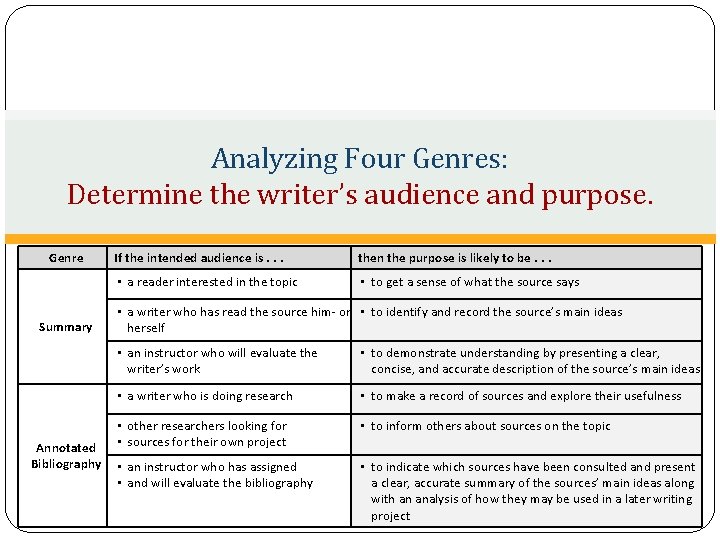
Analyzing Four Genres: Determine the writer’s audience and purpose. Genre Summary Annotated Bibliography If the intended audience is. . . then the purpose is likely to be. . . • a reader interested in the topic • to get a sense of what the source says • a writer who has read the source him- or • to identify and record the source’s main ideas herself • an instructor who will evaluate the writer’s work • to demonstrate understanding by presenting a clear, concise, and accurate description of the source’s main ideas • a writer who is doing research • to make a record of sources and explore their usefulness • other researchers looking for • sources for their own project • to inform others about sources on the topic • an instructor who has assigned • and will evaluate the bibliography • to indicate which sources have been consulted and present a clear, accurate summary of the sources’ main ideas along with an analysis of how they may be used in a later writing project
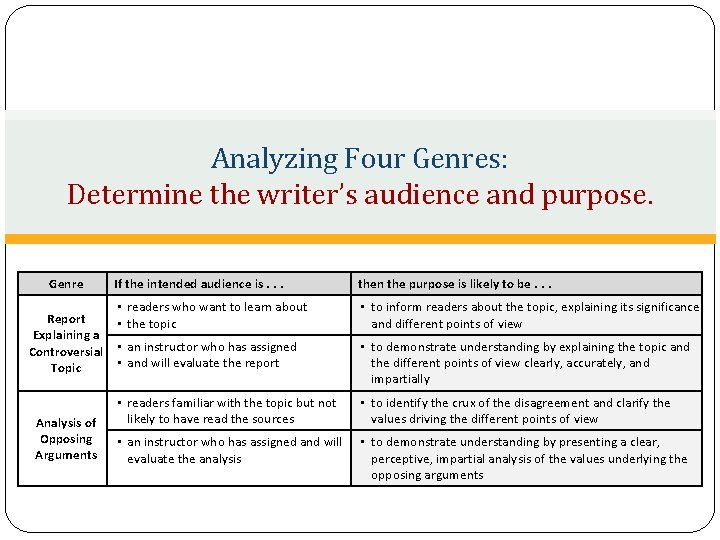
Analyzing Four Genres: Determine the writer’s audience and purpose. Genre If the intended audience is. . . • readers who want to learn about Report • the topic Explaining a Controversial • an instructor who has assigned • and will evaluate the report Topic Analysis of Opposing Arguments then the purpose is likely to be. . . • to inform readers about the topic, explaining its significance and different points of view • to demonstrate understanding by explaining the topic and the different points of view clearly, accurately, and impartially • readers familiar with the topic but not likely to have read the sources • to identify the crux of the disagreement and clarify the values driving the different points of view • an instructor who has assigned and will evaluate the analysis • to demonstrate understanding by presenting a clear, perceptive, impartial analysis of the values underlying the opposing arguments
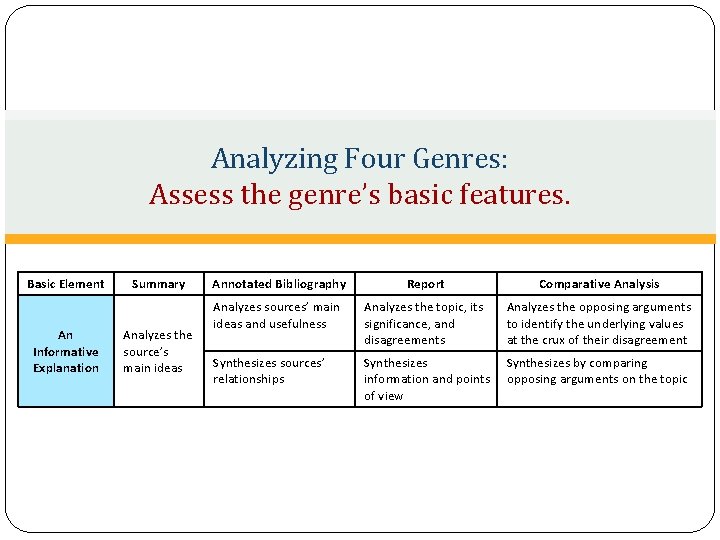
Analyzing Four Genres: Assess the genre’s basic features. Basic Element An Informative Explanation Summary Analyzes the source’s main ideas Annotated Bibliography Report Comparative Analysis Analyzes sources’ main ideas and usefulness Analyzes the topic, its significance, and disagreements Analyzes the opposing arguments to identify the underlying values at the crux of their disagreement Synthesizes sources’ relationships Synthesizes information and points of view Synthesizes by comparing opposing arguments on the topic
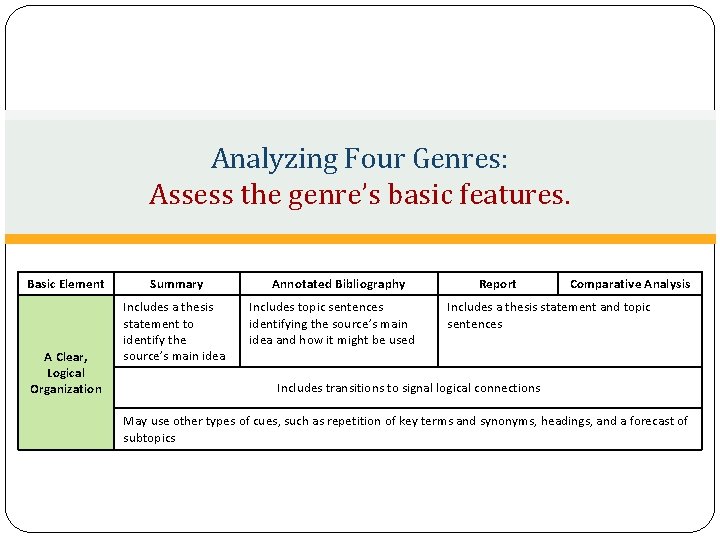
Analyzing Four Genres: Assess the genre’s basic features. Basic Element A Clear, Logical Organization Summary Includes a thesis statement to identify the source’s main idea Annotated Bibliography Includes topic sentences identifying the source’s main idea and how it might be used Report Comparative Analysis Includes a thesis statement and topic sentences Includes transitions to signal logical connections May use other types of cues, such as repetition of key terms and synonyms, headings, and a forecast of subtopics
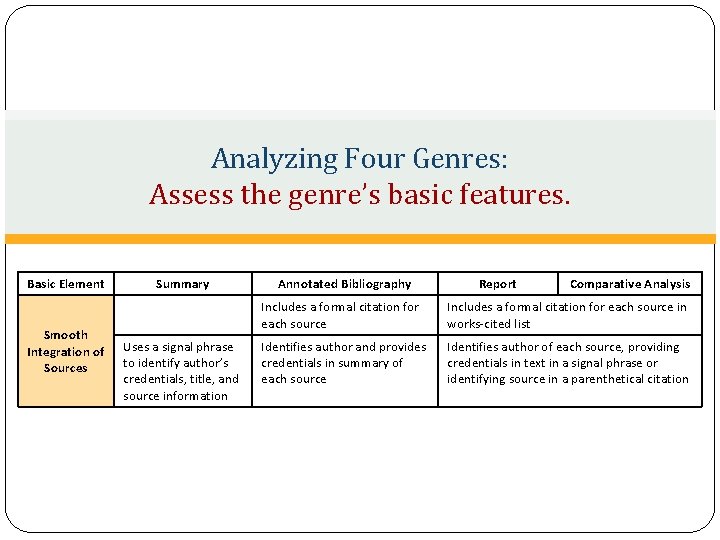
Analyzing Four Genres: Assess the genre’s basic features. Basic Element Smooth Integration of Sources Summary Uses a signal phrase to identify author’s credentials, title, and source information Annotated Bibliography Report Comparative Analysis Includes a formal citation for each source in works-cited list Identifies author and provides credentials in summary of each source Identifies author of each source, providing credentials in text in a signal phrase or identifying source in a parenthetical citation
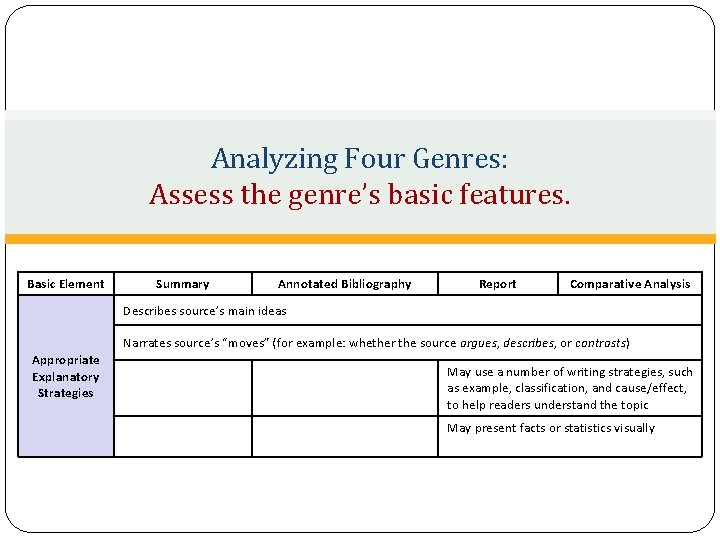
Analyzing Four Genres: Assess the genre’s basic features. Basic Element Summary Annotated Bibliography Report Comparative Analysis Describes source’s main ideas Narrates source’s “moves” (for example: whether the source argues, describes, or contrasts) Appropriate Explanatory Strategies May use a number of writing strategies, such as example, classification, and cause/effect, to help readers understand the topic May present facts or statistics visually
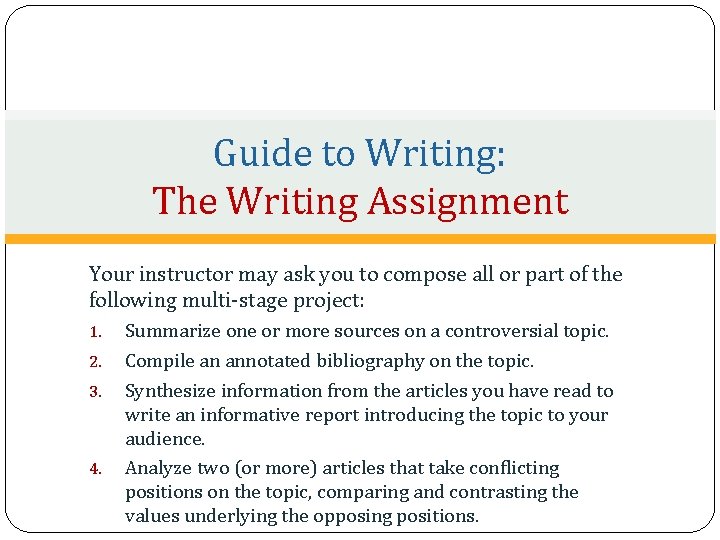
Guide to Writing: The Writing Assignment Your instructor may ask you to compose all or part of the following multi-stage project: 1. 2. 3. 4. Summarize one or more sources on a controversial topic. Compile an annotated bibliography on the topic. Synthesize information from the articles you have read to write an informative report introducing the topic to your audience. Analyze two (or more) articles that take conflicting positions on the topic, comparing and contrasting the values underlying the opposing positions.
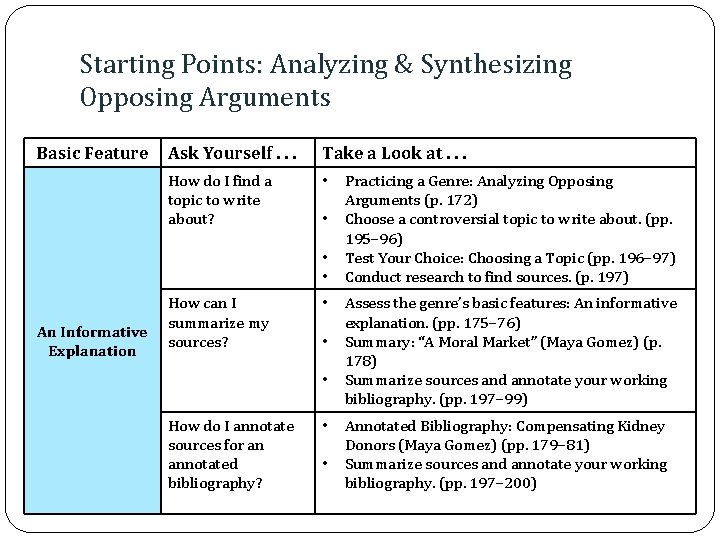
Starting Points: Analyzing & Synthesizing Opposing Arguments Basic Feature Ask Yourself. . . Take a Look at. . . How do I find a topic to write about? • • An Informative Explanation How can I summarize my sources? • • • How do I annotate sources for an annotated bibliography? • • Practicing a Genre: Analyzing Opposing Arguments (p. 172) Choose a controversial topic to write about. (pp. 195– 96) Test Your Choice: Choosing a Topic (pp. 196– 97) Conduct research to find sources. (p. 197) Assess the genre’s basic features: An informative explanation. (pp. 175– 76) Summary: “A Moral Market” (Maya Gomez) (p. 178) Summarize sources and annotate your working bibliography. (pp. 197– 99) Annotated Bibliography: Compensating Kidney Donors (Maya Gomez) (pp. 179– 81) Summarize sources and annotate your working bibliography. (pp. 197– 200)
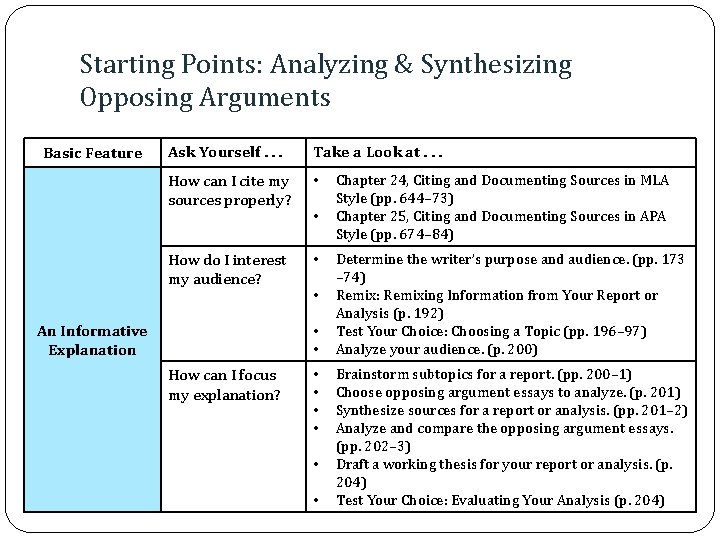
Starting Points: Analyzing & Synthesizing Opposing Arguments Basic Feature Ask Yourself. . . Take a Look at. . . How can I cite my sources properly? • How do I interest my audience? • An Informative Explanation • • How can I focus my explanation? • • • Chapter 24, Citing and Documenting Sources in MLA Style (pp. 644– 73) Chapter 25, Citing and Documenting Sources in APA Style (pp. 674– 84) Determine the writer’s purpose and audience. (pp. 173 – 74) Remix: Remixing Information from Your Report or Analysis (p. 192) Test Your Choice: Choosing a Topic (pp. 196– 97) Analyze your audience. (p. 200) Brainstorm subtopics for a report. (pp. 200– 1) Choose opposing argument essays to analyze. (p. 201) Synthesize sources for a report or analysis. (pp. 201– 2) Analyze and compare the opposing argument essays. (pp. 202– 3) Draft a working thesis for your report or analysis. (p. 204) Test Your Choice: Evaluating Your Analysis (p. 204)
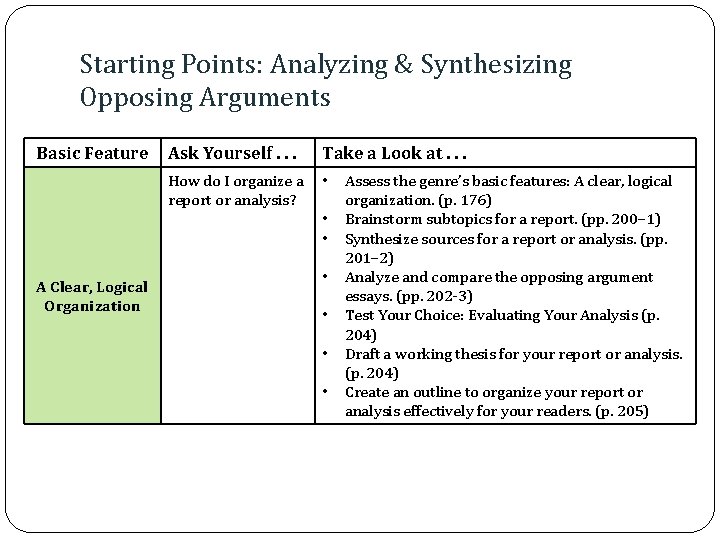
Starting Points: Analyzing & Synthesizing Opposing Arguments Basic Feature Ask Yourself. . . Take a Look at. . . How do I organize a report or analysis? • • • A Clear, Logical Organization • • Assess the genre’s basic features: A clear, logical organization. (p. 176) Brainstorm subtopics for a report. (pp. 200– 1) Synthesize sources for a report or analysis. (pp. 201– 2) Analyze and compare the opposing argument essays. (pp. 202 -3) Test Your Choice: Evaluating Your Analysis (p. 204) Draft a working thesis for your report or analysis. (p. 204) Create an outline to organize your report or analysis effectively for your readers. (p. 205)
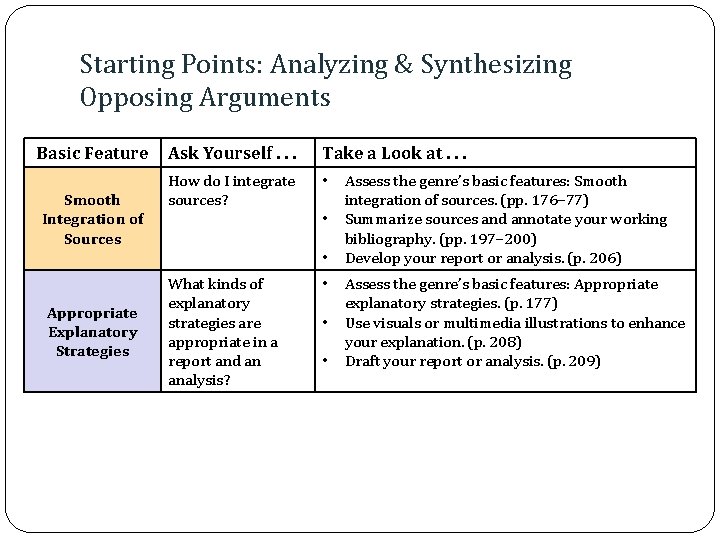
Starting Points: Analyzing & Synthesizing Opposing Arguments Basic Feature Smooth Integration of Sources Ask Yourself. . . Take a Look at. . . How do I integrate sources? • • • Appropriate Explanatory Strategies What kinds of explanatory strategies are appropriate in a report and an analysis? • • • Assess the genre’s basic features: Smooth integration of sources. (pp. 176– 77) Summarize sources and annotate your working bibliography. (pp. 197– 200) Develop your report or analysis. (p. 206) Assess the genre’s basic features: Appropriate explanatory strategies. (p. 177) Use visuals or multimedia illustrations to enhance your explanation. (p. 208) Draft your report or analysis. (p. 209)
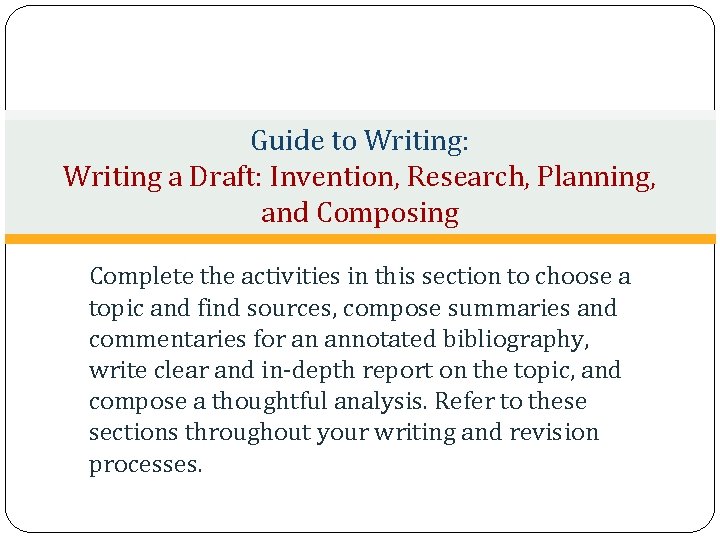
Guide to Writing: Writing a Draft: Invention, Research, Planning, and Composing Complete the activities in this section to choose a topic and find sources, compose summaries and commentaries for an annotated bibliography, write clear and in-depth report on the topic, and compose a thoughtful analysis. Refer to these sections throughout your writing and revision processes.
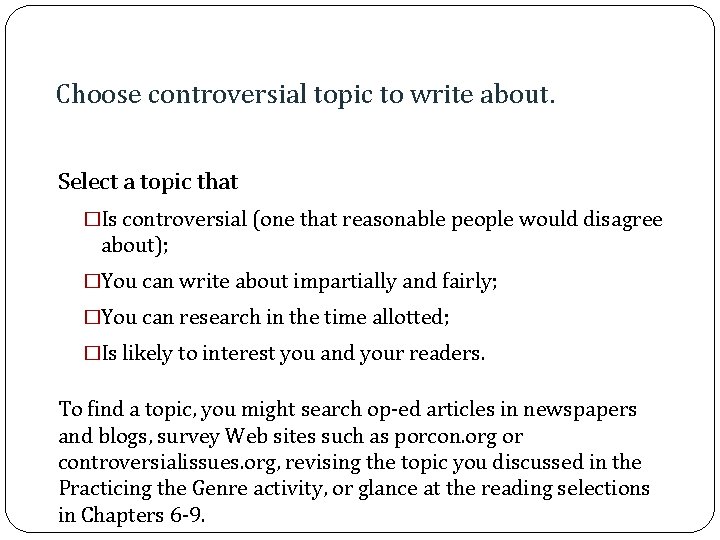
Choose controversial topic to write about. Select a topic that �Is controversial (one that reasonable people would disagree about); �You can write about impartially and fairly; �You can research in the time allotted; �Is likely to interest you and your readers. To find a topic, you might search op-ed articles in newspapers and blogs, survey Web sites such as porcon. org or controversialissues. org, revising the topic you discussed in the Practicing the Genre activity, or glance at the reading selections in Chapters 6 -9.
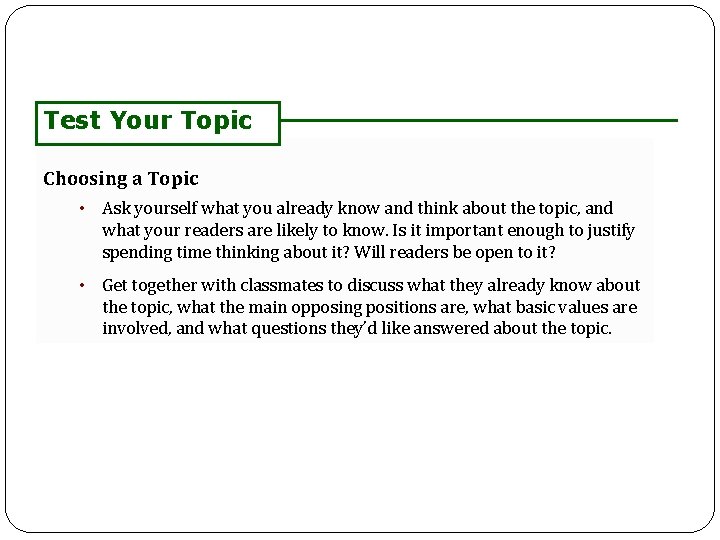
Test Your Topic Choosing a Topic • Ask yourself what you already know and think about the topic, and what your readers are likely to know. Is it important enough to justify spending time thinking about it? Will readers be open to it? • Get together with classmates to discuss what they already know about the topic, what the main opposing positions are, what basic values are involved, and what questions they’d like answered about the topic.
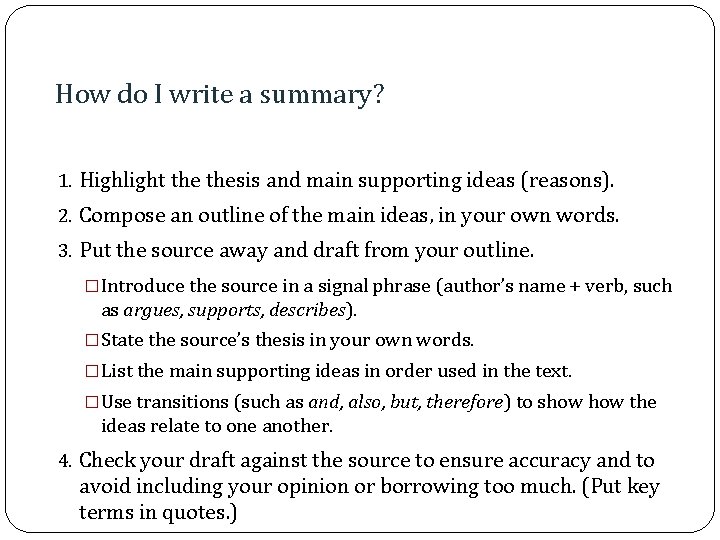
How do I write a summary? 1. Highlight thesis and main supporting ideas (reasons). 2. Compose an outline of the main ideas, in your own words. 3. Put the source away and draft from your outline. �Introduce the source in a signal phrase (author’s name + verb, such as argues, supports, describes). �State the source’s thesis in your own words. �List the main supporting ideas in order used in the text. �Use transitions (such as and, also, but, therefore) to show the ideas relate to one another. 4. Check your draft against the source to ensure accuracy and to avoid including your opinion or borrowing too much. (Put key terms in quotes. )
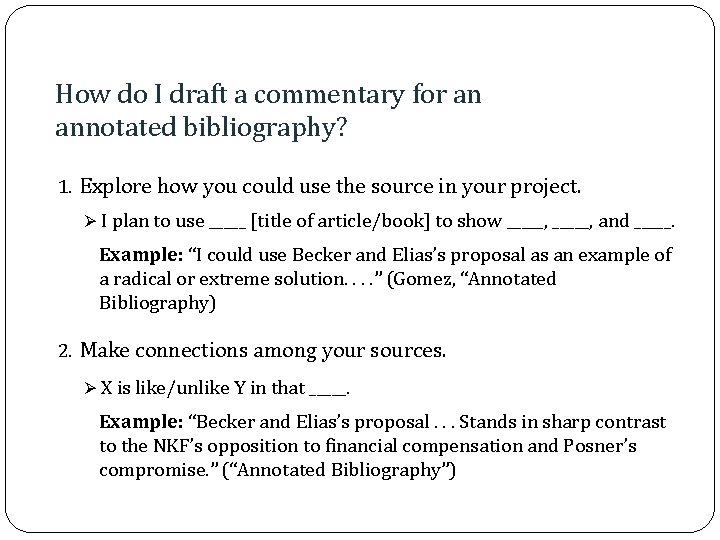
How do I draft a commentary for an annotated bibliography? 1. Explore how you could use the source in your project. Ø I plan to use _____ [title of article/book] to show _____, and _____. Example: “I could use Becker and Elias’s proposal as an example of a radical or extreme solution. . ” (Gomez, “Annotated Bibliography) 2. Make connections among your sources. Ø X is like/unlike Y in that _____. Example: “Becker and Elias’s proposal. . . Stands in sharp contrast to the NKF’s opposition to financial compensation and Posner’s compromise. ” (“Annotated Bibliography”)
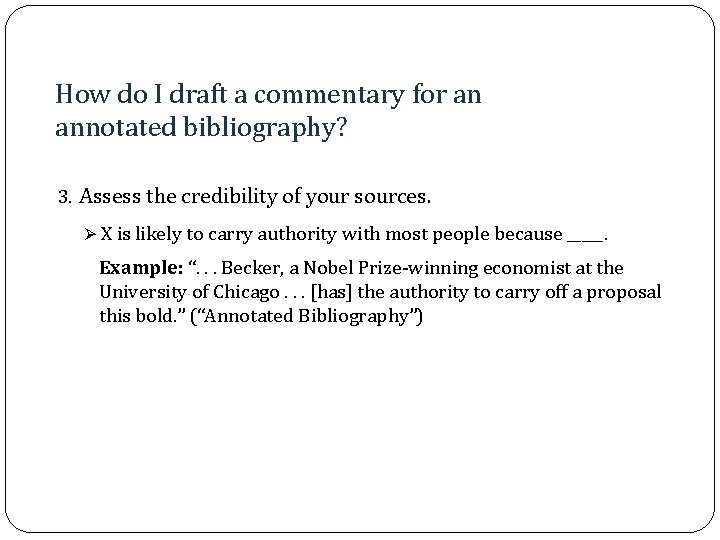
How do I draft a commentary for an annotated bibliography? 3. Assess the credibility of your sources. Ø X is likely to carry authority with most people because _____. Example: “. . . Becker, a Nobel Prize-winning economist at the University of Chicago. . . [has] the authority to carry off a proposal this bold. ” (“Annotated Bibliography”)
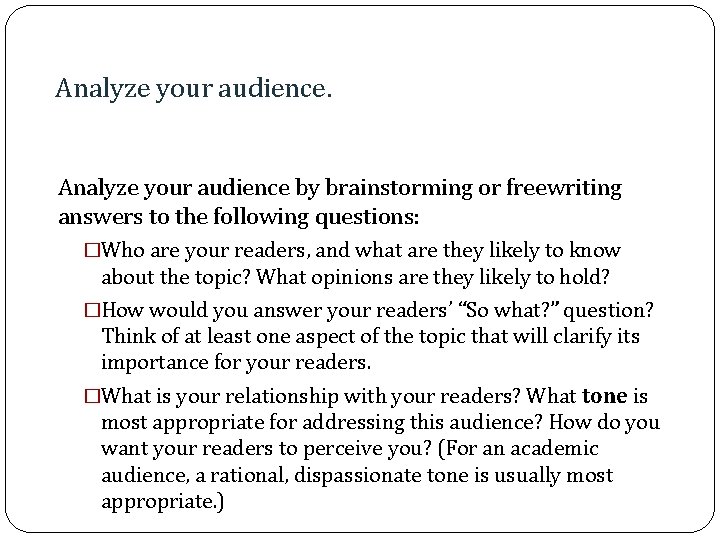
Analyze your audience by brainstorming or freewriting answers to the following questions: �Who are your readers, and what are they likely to know about the topic? What opinions are they likely to hold? �How would you answer your readers’ “So what? ” question? Think of at least one aspect of the topic that will clarify its importance for your readers. �What is your relationship with your readers? What tone is most appropriate for addressing this audience? How do you want your readers to perceive you? (For an academic audience, a rational, dispassionate tone is usually most appropriate. )
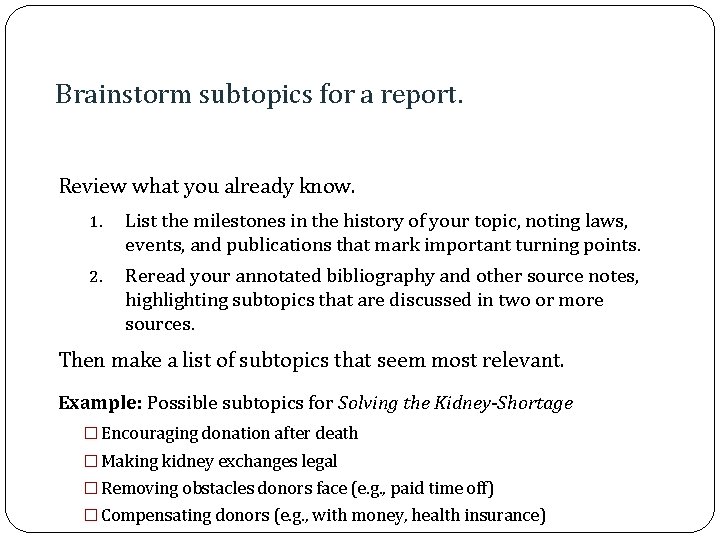
Brainstorm subtopics for a report. Review what you already know. 1. List the milestones in the history of your topic, noting laws, events, and publications that mark important turning points. 2. Reread your annotated bibliography and other source notes, highlighting subtopics that are discussed in two or more sources. Then make a list of subtopics that seem most relevant. Example: Possible subtopics for Solving the Kidney-Shortage � Encouraging donation after death � Making kidney exchanges legal � Removing obstacles donors face (e. g. , paid time off) � Compensating donors (e. g. , with money, health insurance)
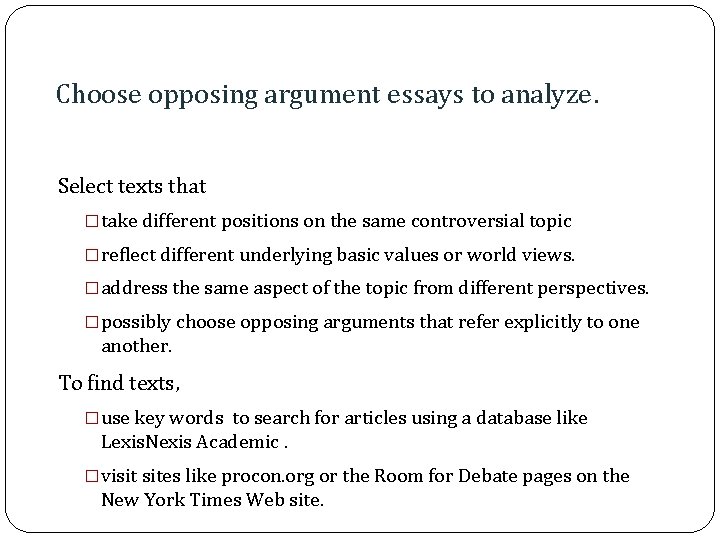
Choose opposing argument essays to analyze. Select texts that �take different positions on the same controversial topic �reflect different underlying basic values or world views. �address the same aspect of the topic from different perspectives. �possibly choose opposing arguments that refer explicitly to one another. To find texts, �use key words to search for articles using a database like Lexis. Nexis Academic. �visit sites like procon. org or the Room for Debate pages on the New York Times Web site.
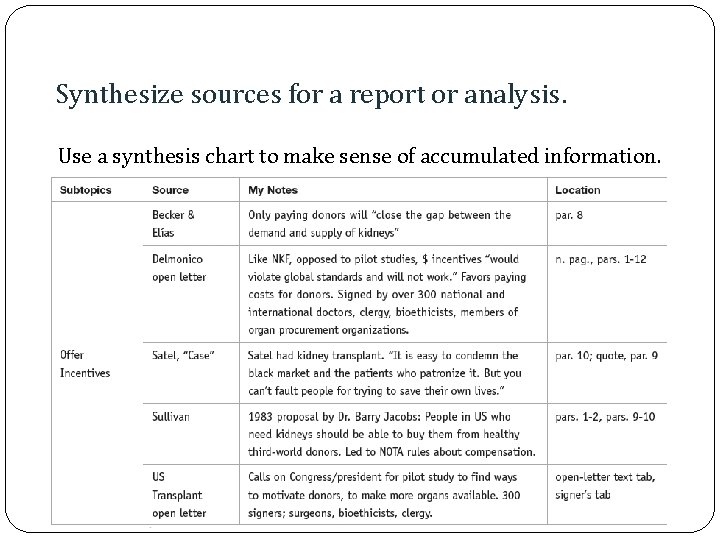
Synthesize sources for a report or analysis. Use a synthesis chart to make sense of accumulated information.
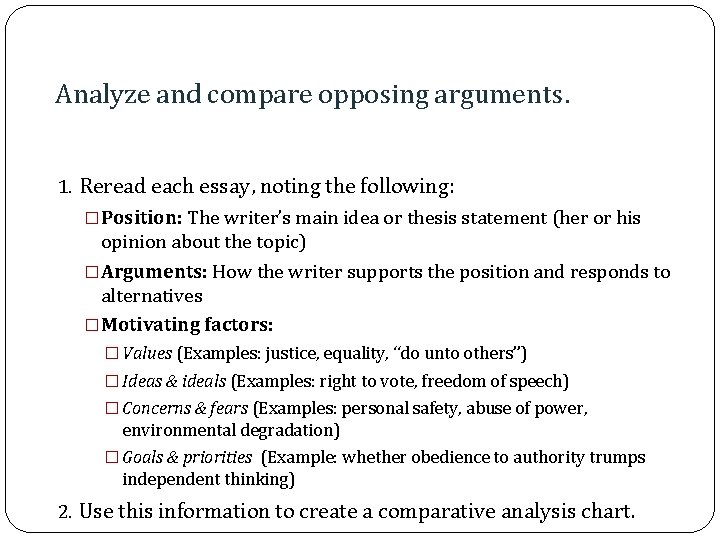
Analyze and compare opposing arguments. 1. Reread each essay, noting the following: �Position: The writer’s main idea or thesis statement (her or his opinion about the topic) �Arguments: How the writer supports the position and responds to alternatives �Motivating factors: � Values (Examples: justice, equality, “do unto others”) � Ideas & ideals (Examples: right to vote, freedom of speech) � Concerns & fears (Examples: personal safety, abuse of power, environmental degradation) � Goals & priorities (Example: whether obedience to authority trumps independent thinking) 2. Use this information to create a comparative analysis chart.
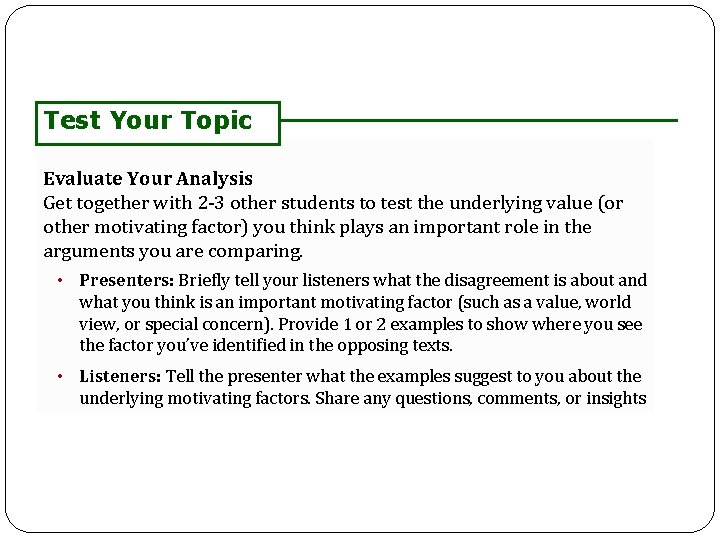
Test Your Topic Evaluate Your Analysis Get together with 2 -3 other students to test the underlying value (or other motivating factor) you think plays an important role in the arguments you are comparing. • Presenters: Briefly tell your listeners what the disagreement is about and what you think is an important motivating factor (such as a value, world view, or special concern). Provide 1 or 2 examples to show where you see the factor you’ve identified in the opposing texts. • Listeners: Tell the presenter what the examples suggest to you about the underlying motivating factors. Share any questions, comments, or insights
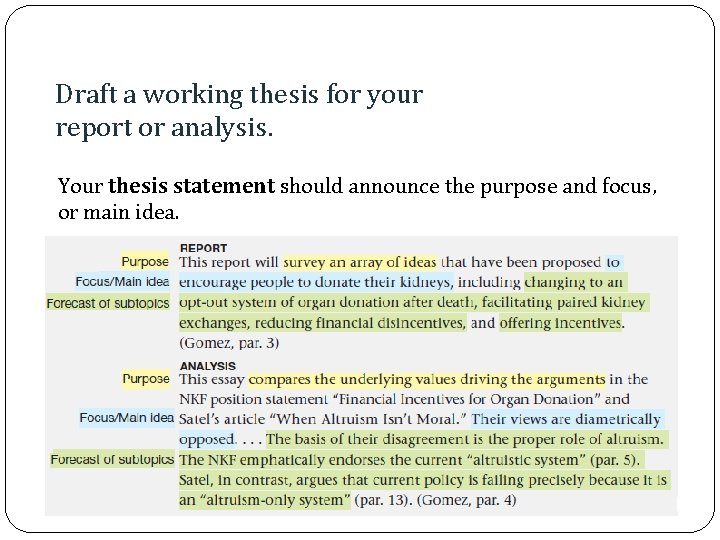
Draft a working thesis for your report or analysis. Your thesis statement should announce the purpose and focus, or main idea.
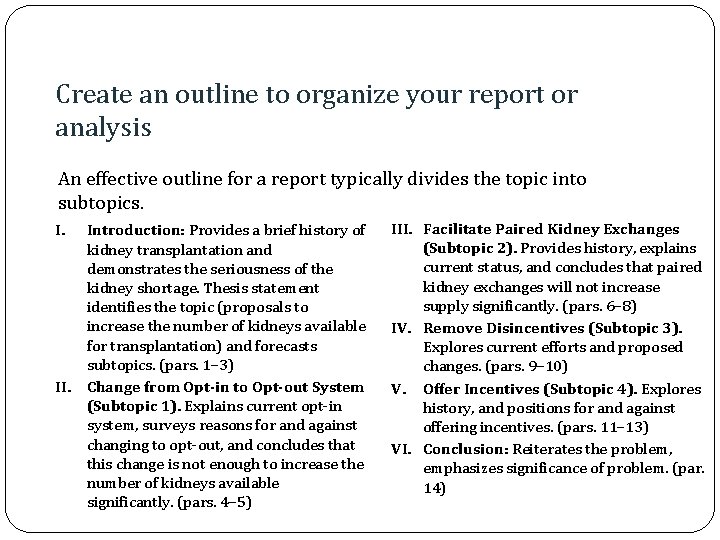
Create an outline to organize your report or analysis An effective outline for a report typically divides the topic into subtopics. I. Introduction: Provides a brief history of kidney transplantation and demonstrates the seriousness of the kidney shortage. Thesis statement identifies the topic (proposals to increase the number of kidneys available for transplantation) and forecasts subtopics. (pars. 1– 3) Change from Opt-in to Opt-out System (Subtopic 1). Explains current opt-in system, surveys reasons for and against changing to opt-out, and concludes that this change is not enough to increase the number of kidneys available significantly. (pars. 4– 5) III. Facilitate Paired Kidney Exchanges (Subtopic 2). Provides history, explains current status, and concludes that paired kidney exchanges will not increase supply significantly. (pars. 6– 8) IV. Remove Disincentives (Subtopic 3). Explores current efforts and proposed changes. (pars. 9– 10) V. Offer Incentives (Subtopic 4). Explores history, and positions for and against offering incentives. (pars. 11– 13) VI. Conclusion: Reiterates the problem, emphasizes significance of problem. (par. 14)
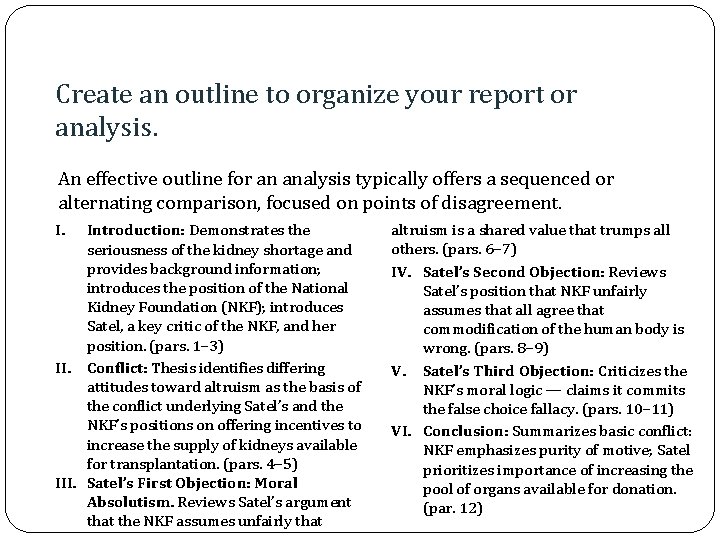
Create an outline to organize your report or analysis. An effective outline for an analysis typically offers a sequenced or alternating comparison, focused on points of disagreement. I. Introduction: Demonstrates the seriousness of the kidney shortage and provides background information; introduces the position of the National Kidney Foundation (NKF); introduces Satel, a key critic of the NKF, and her position. (pars. 1– 3) II. Conflict: Thesis identifies differing attitudes toward altruism as the basis of the conflict underlying Satel’s and the NKF’s positions on offering incentives to increase the supply of kidneys available for transplantation. (pars. 4– 5) III. Satel’s First Objection: Moral Absolutism. Reviews Satel’s argument that the NKF assumes unfairly that altruism is a shared value that trumps all others. (pars. 6– 7) IV. Satel’s Second Objection: Reviews Satel’s position that NKF unfairly assumes that all agree that commodification of the human body is wrong. (pars. 8– 9) V. Satel’s Third Objection: Criticizes the NKF’s moral logic — claims it commits the false choice fallacy. (pars. 10– 11) VI. Conclusion: Summarizes basic conflict: NKF emphasizes purity of motive; Satel prioritizes importance of increasing the pool of organs available for donation. (par. 12)
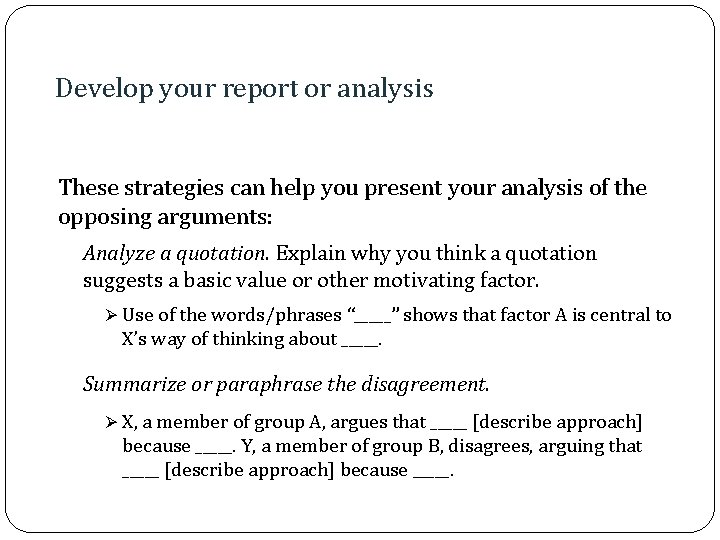
Develop your report or analysis These strategies can help you present your analysis of the opposing arguments: Analyze a quotation. Explain why you think a quotation suggests a basic value or other motivating factor. Ø Use of the words/phrases “_____” shows that factor A is central to X’s way of thinking about _____. Summarize or paraphrase the disagreement. Ø X, a member of group A, argues that _____ [describe approach] because _____. Y, a member of group B, disagrees, arguing that _____ [describe approach] because _____.
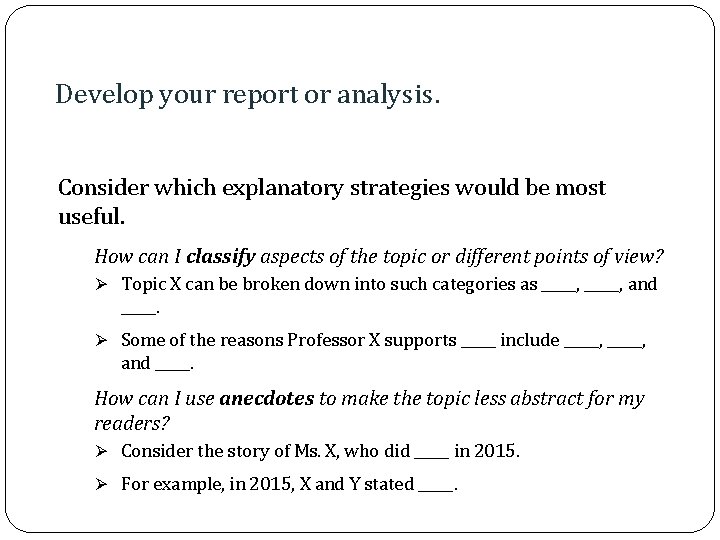
Develop your report or analysis. Consider which explanatory strategies would be most useful. How can I classify aspects of the topic or different points of view? Ø Topic X can be broken down into such categories as _____, and _____. Ø Some of the reasons Professor X supports _____ include _____, and _____. How can I use anecdotes to make the topic less abstract for my readers? Ø Consider the story of Ms. X, who did _____ in 2015. Ø For example, in 2015, X and Y stated _____.
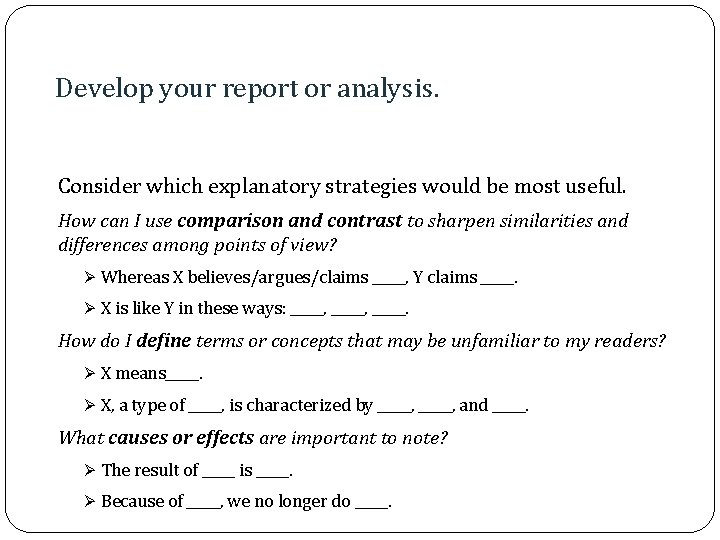
Develop your report or analysis. Consider which explanatory strategies would be most useful. How can I use comparison and contrast to sharpen similarities and differences among points of view? Ø Whereas X believes/argues/claims _____, Y claims _____. Ø X is like Y in these ways: _____, _____. How do I define terms or concepts that may be unfamiliar to my readers? Ø X means_____. Ø X, a type of _____, is characterized by _____, and _____. What causes or effects are important to note? Ø The result of _____ is _____. Ø Because of _____, we no longer do _____.
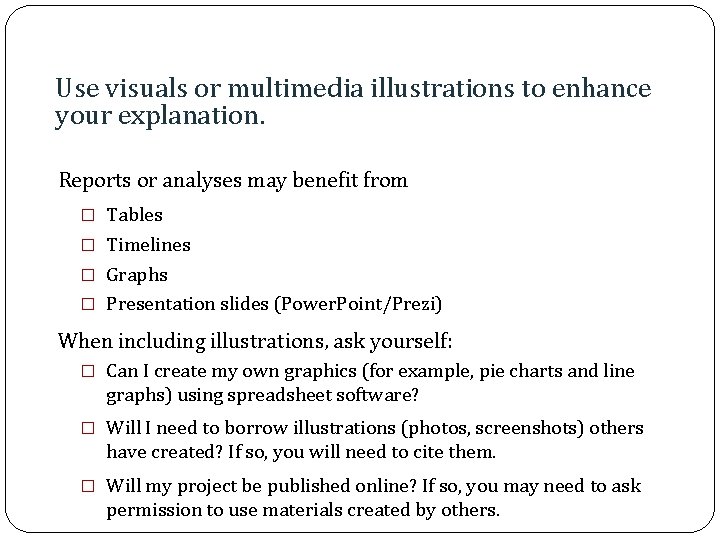
Use visuals or multimedia illustrations to enhance your explanation. Reports or analyses may benefit from � Tables � Timelines � Graphs � Presentation slides (Power. Point/Prezi) When including illustrations, ask yourself: � Can I create my own graphics (for example, pie charts and line graphs) using spreadsheet software? � Will I need to borrow illustrations (photos, screenshots) others have created? If so, you will need to cite them. � Will my project be published online? If so, you may need to ask permission to use materials created by others.
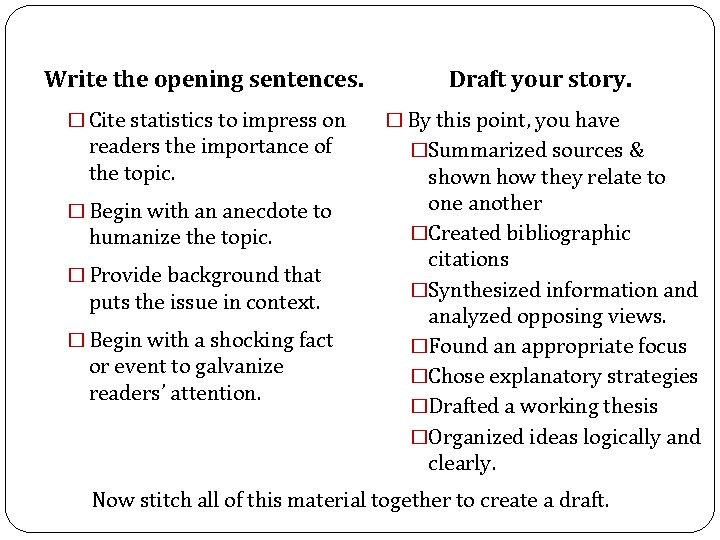
Write the opening sentences. � Cite statistics to impress on readers the importance of the topic. � Begin with an anecdote to humanize the topic. � Provide background that puts the issue in context. � Begin with a shocking fact or event to galvanize readers’ attention. Draft your story. � By this point, you have �Summarized sources & shown how they relate to one another �Created bibliographic citations �Synthesized information and analyzed opposing views. �Found an appropriate focus �Chose explanatory strategies �Drafted a working thesis �Organized ideas logically and clearly. Now stitch all of this material together to create a draft.
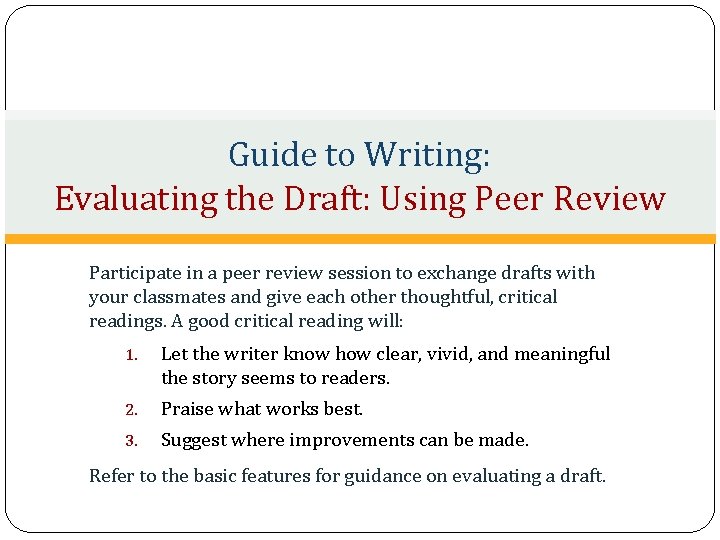
Guide to Writing: Evaluating the Draft: Using Peer Review Participate in a peer review session to exchange drafts with your classmates and give each other thoughtful, critical readings. A good critical reading will: 1. Let the writer know how clear, vivid, and meaningful the story seems to readers. 2. Praise what works best. 3. Suggest where improvements can be made. Refer to the basic features for guidance on evaluating a draft.
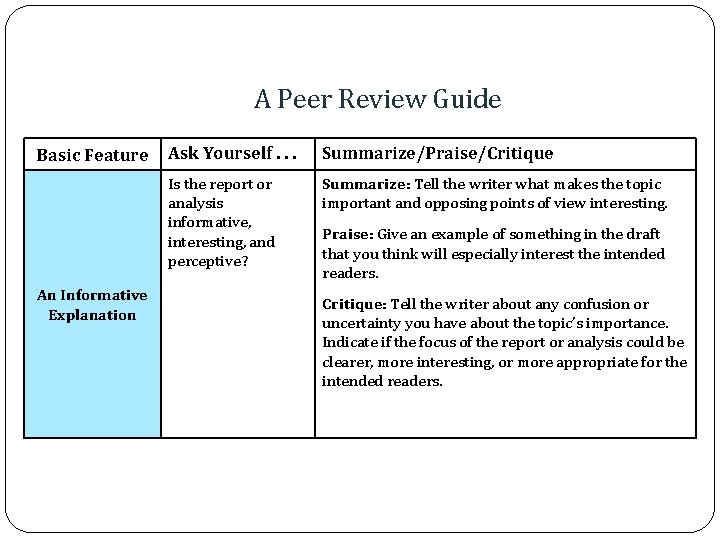
A Peer Review Guide Basic Feature An Informative Explanation Ask Yourself. . . Summarize/Praise/Critique Is the report or analysis informative, interesting, and perceptive? Summarize: Tell the writer what makes the topic important and opposing points of view interesting. Praise: Give an example of something in the draft that you think will especially interest the intended readers. Critique: Tell the writer about any confusion or uncertainty you have about the topic’s importance. Indicate if the focus of the report or analysis could be clearer, more interesting, or more appropriate for the intended readers.
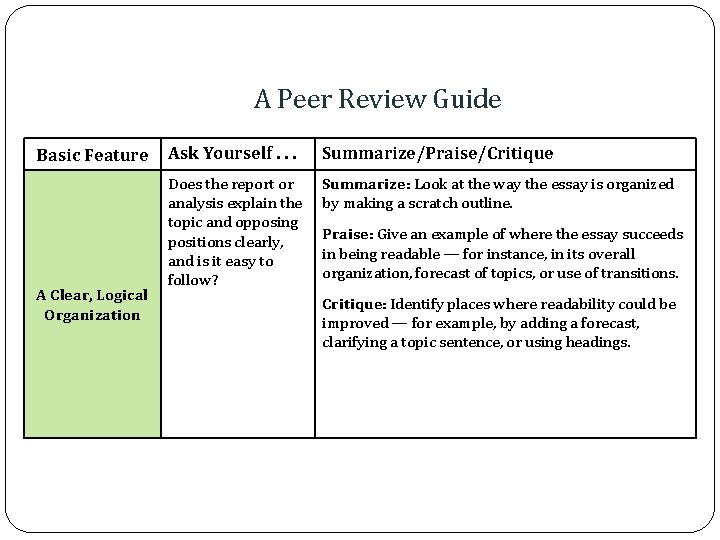
A Peer Review Guide Basic Feature A Clear, Logical Organization Ask Yourself. . . Summarize/Praise/Critique Does the report or analysis explain the topic and opposing positions clearly, and is it easy to follow? Summarize: Look at the way the essay is organized by making a scratch outline. Praise: Give an example of where the essay succeeds in being readable — for instance, in its overall organization, forecast of topics, or use of transitions. Critique: Identify places where readability could be improved — for example, by adding a forecast, clarifying a topic sentence, or using headings.
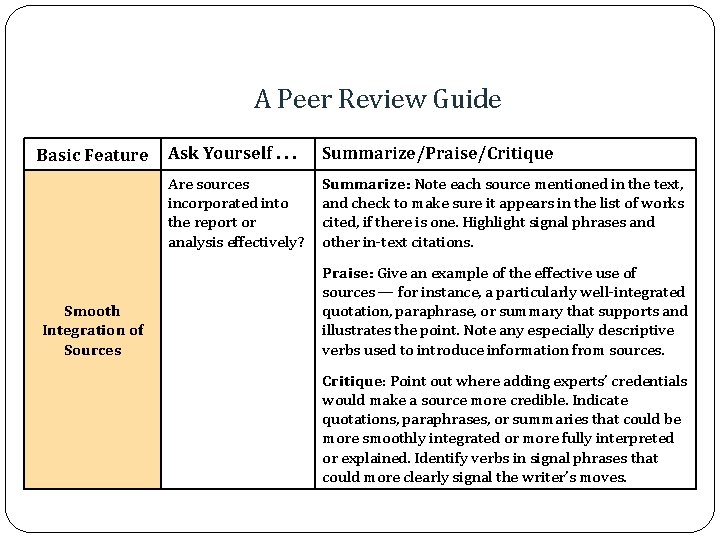
A Peer Review Guide Basic Feature Smooth Integration of Sources Ask Yourself. . . Summarize/Praise/Critique Are sources incorporated into the report or analysis effectively? Summarize: Note each source mentioned in the text, and check to make sure it appears in the list of works cited, if there is one. Highlight signal phrases and other in-text citations. Praise: Give an example of the effective use of sources — for instance, a particularly well-integrated quotation, paraphrase, or summary that supports and illustrates the point. Note any especially descriptive verbs used to introduce information from sources. Critique: Point out where adding experts’ credentials would make a source more credible. Indicate quotations, paraphrases, or summaries that could be more smoothly integrated or more fully interpreted or explained. Identify verbs in signal phrases that could more clearly signal the writer’s moves.
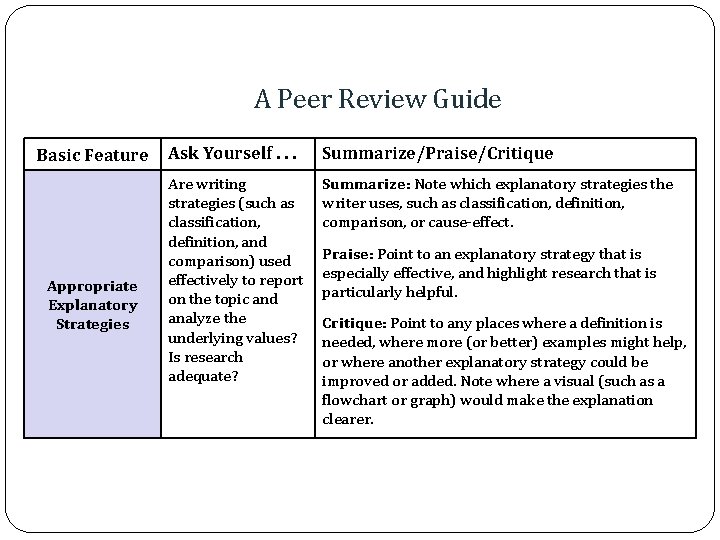
A Peer Review Guide Basic Feature Appropriate Explanatory Strategies Ask Yourself. . . Summarize/Praise/Critique Are writing strategies (such as classification, definition, and comparison) used effectively to report on the topic and analyze the underlying values? Is research adequate? Summarize: Note which explanatory strategies the writer uses, such as classification, definition, comparison, or cause-effect. Praise: Point to an explanatory strategy that is especially effective, and highlight research that is particularly helpful. Critique: Point to any places where a definition is needed, where more (or better) examples might help, or where another explanatory strategy could be improved or added. Note where a visual (such as a flowchart or graph) would make the explanation clearer.
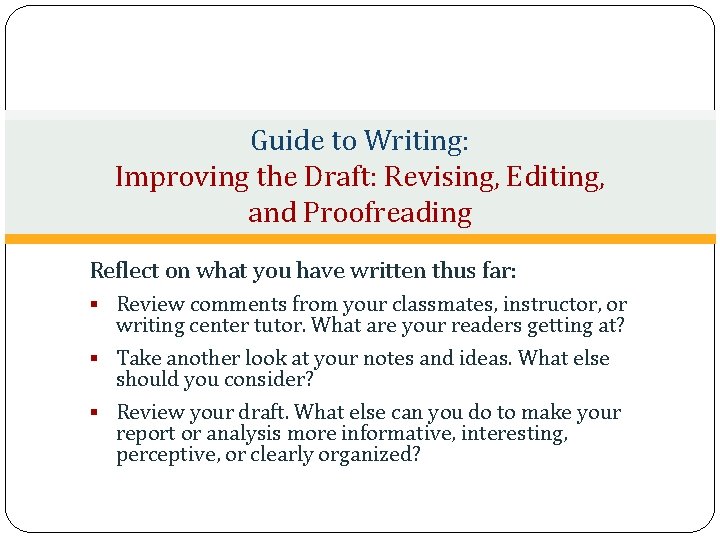
Guide to Writing: Improving the Draft: Revising, Editing, and Proofreading Reflect on what you have written thus far: § Review comments from your classmates, instructor, or writing center tutor. What are your readers getting at? § Take another look at your notes and ideas. What else should you consider? § Review your draft. What else can you do to make your report or analysis more informative, interesting, perceptive, or clearly organized?
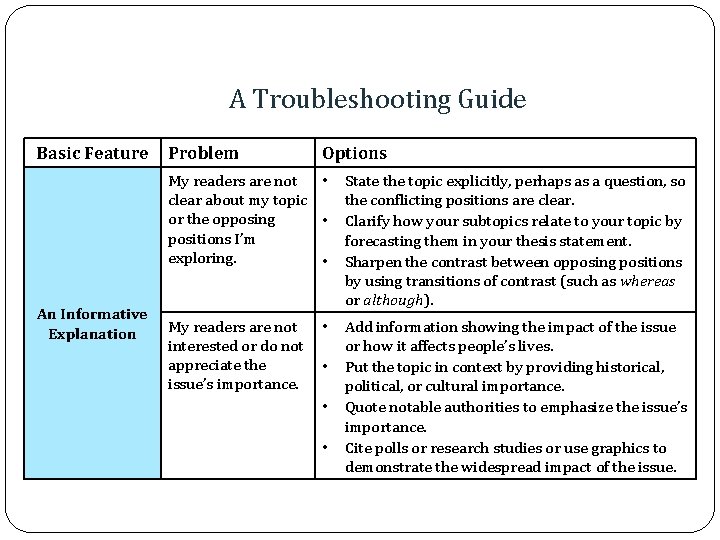
A Troubleshooting Guide Basic Feature An Informative Explanation Problem Options My readers are not • clear about my topic or the opposing • positions I’m exploring. • State the topic explicitly, perhaps as a question, so the conflicting positions are clear. Clarify how your subtopics relate to your topic by forecasting them in your thesis statement. Sharpen the contrast between opposing positions by using transitions of contrast (such as whereas or although). My readers are not interested or do not appreciate the issue’s importance. Add information showing the impact of the issue or how it affects people’s lives. Put the topic in context by providing historical, political, or cultural importance. Quote notable authorities to emphasize the issue’s importance. Cite polls or research studies or use graphics to demonstrate the widespread impact of the issue. • •
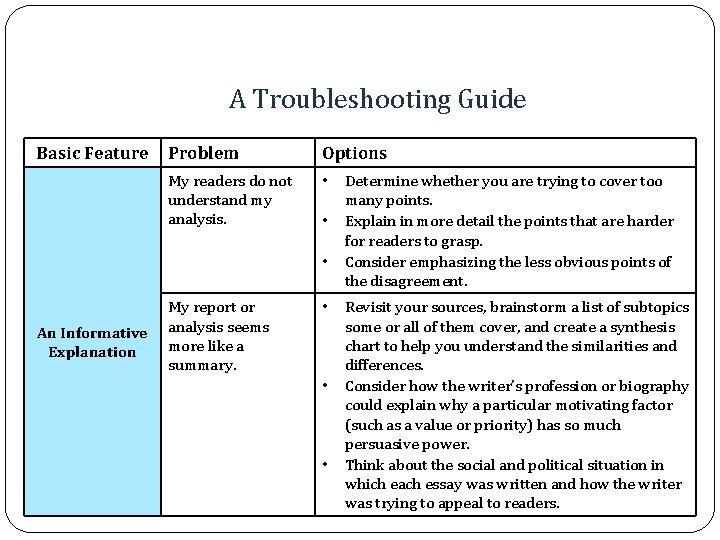
A Troubleshooting Guide Basic Feature Problem Options My readers do not understand my analysis. • • • An Informative Explanation My report or analysis seems more like a summary. • • • Determine whether you are trying to cover too many points. Explain in more detail the points that are harder for readers to grasp. Consider emphasizing the less obvious points of the disagreement. Revisit your sources, brainstorm a list of subtopics some or all of them cover, and create a synthesis chart to help you understand the similarities and differences. Consider how the writer’s profession or biography could explain why a particular motivating factor (such as a value or priority) has so much persuasive power. Think about the social and political situation in which each essay was written and how the writer was trying to appeal to readers.
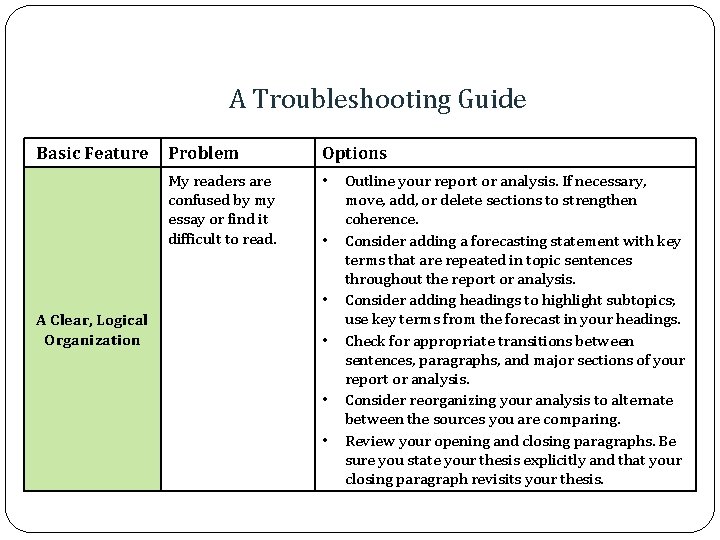
A Troubleshooting Guide Basic Feature Problem Options My readers are confused by my essay or find it difficult to read. • • • A Clear, Logical Organization • • • Outline your report or analysis. If necessary, move, add, or delete sections to strengthen coherence. Consider adding a forecasting statement with key terms that are repeated in topic sentences throughout the report or analysis. Consider adding headings to highlight subtopics; use key terms from the forecast in your headings. Check for appropriate transitions between sentences, paragraphs, and major sections of your report or analysis. Consider reorganizing your analysis to alternate between the sources you are comparing. Review your opening and closing paragraphs. Be sure you state your thesis explicitly and that your closing paragraph revisits your thesis.
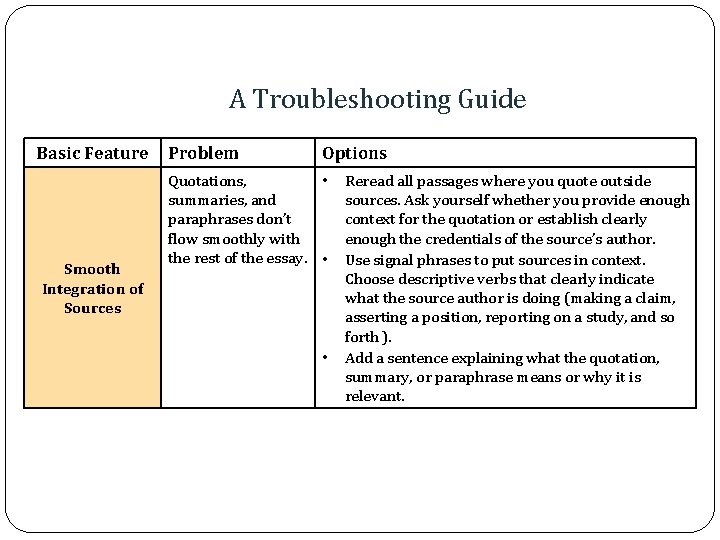
A Troubleshooting Guide Basic Feature Smooth Integration of Sources Problem Options Quotations, • summaries, and paraphrases don’t flow smoothly with the rest of the essay. • • Reread all passages where you quote outside sources. Ask yourself whether you provide enough context for the quotation or establish clearly enough the credentials of the source’s author. Use signal phrases to put sources in context. Choose descriptive verbs that clearly indicate what the source author is doing (making a claim, asserting a position, reporting on a study, and so forth ). Add a sentence explaining what the quotation, summary, or paraphrase means or why it is relevant.
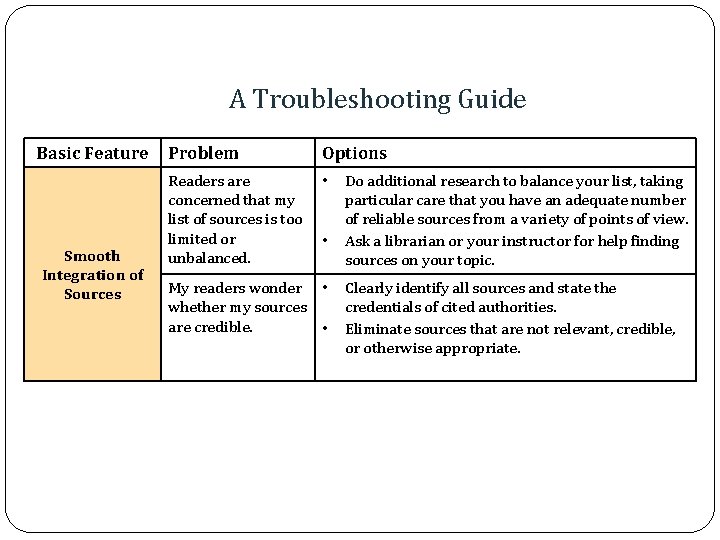
A Troubleshooting Guide Basic Feature Smooth Integration of Sources Problem Options Readers are concerned that my list of sources is too limited or unbalanced. • • My readers wonder • whether my sources are credible. • Do additional research to balance your list, taking particular care that you have an adequate number of reliable sources from a variety of points of view. Ask a librarian or your instructor for help finding sources on your topic. Clearly identify all sources and state the credentials of cited authorities. Eliminate sources that are not relevant, credible, or otherwise appropriate.
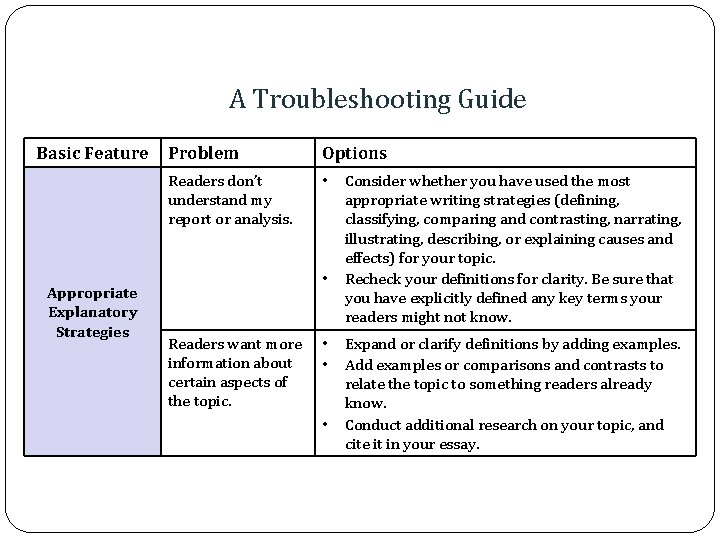
A Troubleshooting Guide Basic Feature Appropriate Explanatory Strategies Problem Options Readers don’t understand my report or analysis. • • Readers want more information about certain aspects of the topic. • • • Consider whether you have used the most appropriate writing strategies (defining, classifying, comparing and contrasting, narrating, illustrating, describing, or explaining causes and effects) for your topic. Recheck your definitions for clarity. Be sure that you have explicitly defined any key terms your readers might not know. Expand or clarify definitions by adding examples. Add examples or comparisons and contrasts to relate the topic to something readers already know. Conduct additional research on your topic, and cite it in your essay.
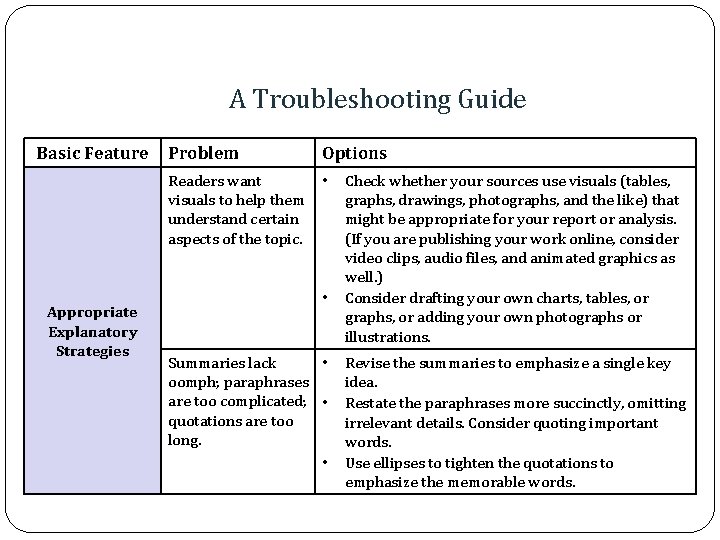
A Troubleshooting Guide Basic Feature Appropriate Explanatory Strategies Problem Options Readers want visuals to help them understand certain aspects of the topic. • • Summaries lack • oomph; paraphrases are too complicated; • quotations are too long. • Check whether your sources use visuals (tables, graphs, drawings, photographs, and the like) that might be appropriate for your report or analysis. (If you are publishing your work online, consider video clips, audio files, and animated graphics as well. ) Consider drafting your own charts, tables, or graphs, or adding your own photographs or illustrations. Revise the summaries to emphasize a single key idea. Restate the paraphrases more succinctly, omitting irrelevant details. Consider quoting important words. Use ellipses to tighten the quotations to emphasize the memorable words.