
Practicing the A B Cs Albert Ellis and

Practicing the A, B, C’s Albert Ellis and REBT
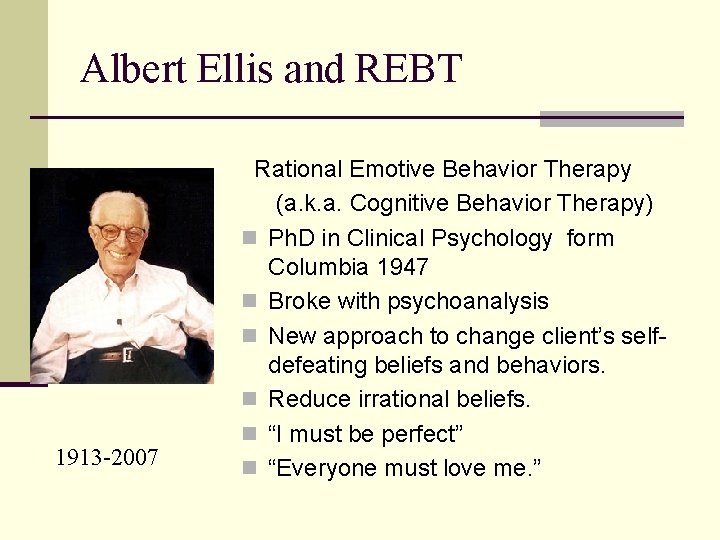
Albert Ellis and REBT 1913 -2007 Rational Emotive Behavior Therapy (a. k. a. Cognitive Behavior Therapy) n Ph. D in Clinical Psychology form Columbia 1947 n Broke with psychoanalysis n New approach to change client’s selfdefeating beliefs and behaviors. n Reduce irrational beliefs. n “I must be perfect” n “Everyone must love me. ”
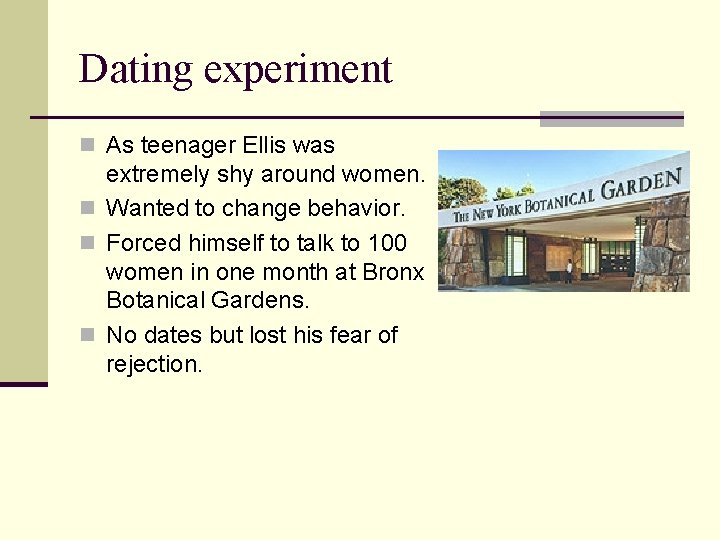
Dating experiment n As teenager Ellis was extremely shy around women. n Wanted to change behavior. n Forced himself to talk to 100 women in one month at Bronx Botanical Gardens. n No dates but lost his fear of rejection.
Basics of REBT n Humanistic approach: individuals have the capacity to create their own self-enhancing and self-defeating emotions. n Happiness is the goal: an individual’s belief system affects the level of happiness and selfactualization n Source of unhappiness: people inadvertently create personality and emotional disturbances through their irrational beliefs.
ABC Model n A. Activating event (thought or image) n B. Beliefs about the event n C. Beliefs will lead to emotional and/or behavioral Consequences
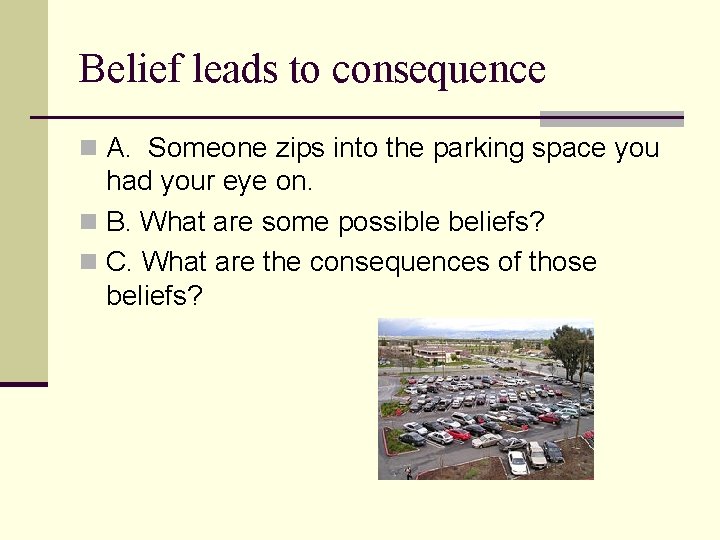
Belief leads to consequence n A. Someone zips into the parking space you had your eye on. n B. What are some possible beliefs? n C. What are the consequences of those beliefs?
Another example n A. Your best friend hasn’t returned your phone calls for several days. n B. You think ______. n C. What is the consequence of that belief?
Consequence n A. You and your partner have a fight. n B. You think “ I never do anything right. ” n C. You feel (or do) _______.
Alternative belief n A. You and your partner have a fight. n B. You think she (he) was in an awful mood. n C. You feel (or do) _______.
Another alternative belief n A. You and your partner have a fight. n B. I can always clear up misunderstandings. n C. You feel (or do) _______.
The ABC Model at work n ABC model helps people understand the connection between belief and consequence. n Individuals are influenced by what they tell themselves (what they believe to be true). n Most people begin only seeing that the consequence stems from the activating event. n For example: I yelled at the jerk who stole my parking place. n Don’t stop to consider or challenge their belief.
Rationality is the key n We all have the potential to think rationally. n Emotional disturbances comes from irrational thinking. n REBT theory holds that, if you think more rationally in the face of negative events, you will have less emotional distress. n Rationality is the key to achieving happiness.
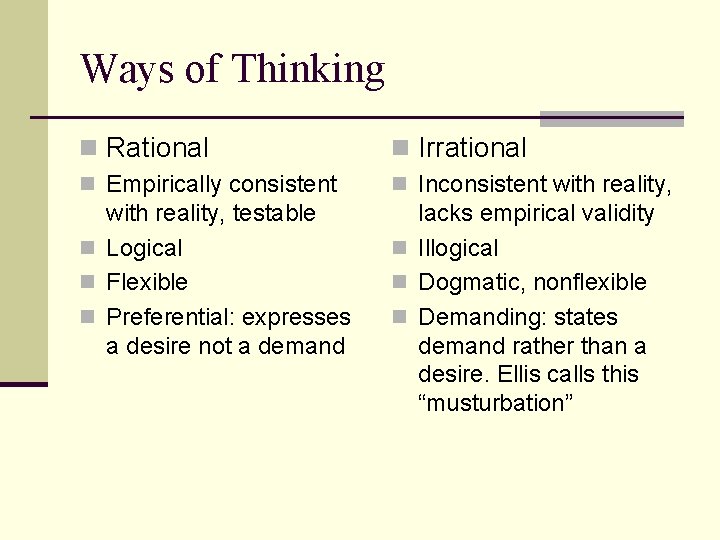
Ways of Thinking n Rational n Irrational n Empirically consistent n Inconsistent with reality, testable n Logical n Flexible n Preferential: expresses a desire not a demand lacks empirical validity n Illogical n Dogmatic, nonflexible n Demanding: states demand rather than a desire. Ellis calls this “musturbation”
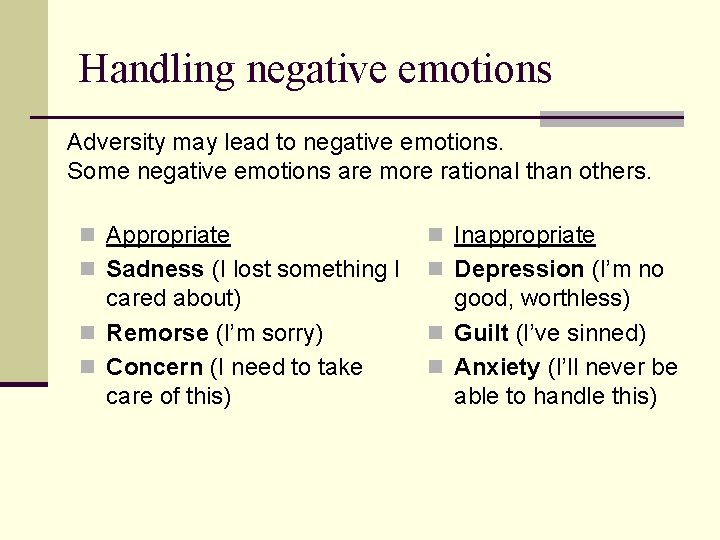
Handling negative emotions Adversity may lead to negative emotions. Some negative emotions are more rational than others. n Appropriate n Inappropriate n Sadness (I lost something I n Depression (I’m no cared about) n Remorse (I’m sorry) n Concern (I need to take care of this) good, worthless) n Guilt (I’ve sinned) n Anxiety (I’ll never be able to handle this)
Three REBT insights n Beliefs, not events, cause disturbance. We remain disturbed by adhering to irrational beliefs. n We perpetuate these beliefs by using them repeatedly. We make the same connections again and again, thereby strengthening our irrational beliefs. n We will have to work hard to restructure the beliefs that create unhappiness.
REBT Techniques n Homework: Clients are asked to complete homework assignments, keeping track of ABC connections. n Emotive Techniques: try out techniques through role playing, group sessions, using emotive imagery, laughter. n Behavioral Techniques: relaxation exercise, distraction, rewards.
Homework assignment n Until next class, work the A, B, C’s. n Adversity: describe situation being as objective as possible. n Belief: how did you interpret the adversity. Separate thoughts and feelings. n Beliefs can be evaluated. n Emotions must be accepted. n n Consequences: what you did
Next step n A. Smell cigarette smoke n B. I could start again and control it. n C. Bum a cigarette n D. Stop (Distraction or Disputation)
Doing the “D” n Distraction: think about something else. n Think Stop sign or snap wrist band n Dispuation: argument with self. n Remember negative consequences n Find good evidence n Come up with alternatives n Consider the implications n Decatastrophize
Active disputation n Therapist engaging client by asking questions. n Why is ______ so terrible or awful? n Is there another way you can think about this? n What is preventing you from doing so? n Why must you have it this way? n What is the worst that could happen if you give up this belief? n What is the best that could happen?
Tom and Mr. Jones n A. Tom not cast by good friend, Mr. Jones to be in community theater play. n B. Many: all negative n C. No longer friends. No contact. n D. Suggest possibilities to avoid pessimistic consequence. n E. Suggest more positive outcome.
Last step: Energize n Act on the energy created by resolution n Release the burden of carrying around negative thoughts and feelings
When not to use optimism n If your goal is to plan for a risky and uncertain future n Where the cost of failure is high. n Be careful is using optimism in cases of counseling others when the future is dim. n Important to focus on the changeable and specific.
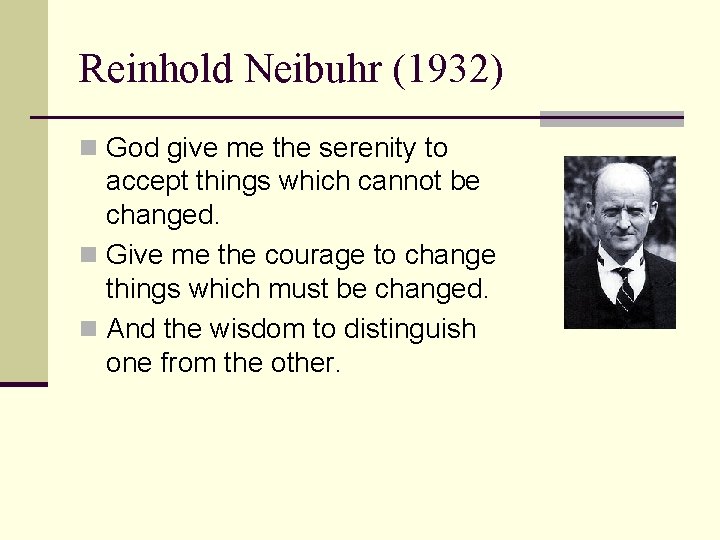
Reinhold Neibuhr (1932) n God give me the serenity to accept things which cannot be changed. n Give me the courage to change things which must be changed. n And the wisdom to distinguish one from the other.
- Slides: 24