
PRACTICING OBSERVING BELL WORK What are pointer stars

PRACTICING OBSERVING

BELL WORK What are pointer stars (answer with exampels)
ANSWER POINTER STARS Pointer stars allow us to find key objects in the sky (1 mark) The 2 stars at the plough end of the plough point towards polaris (1 mark) The handle of the plough points towards arcturus (1 mark) The 2 squares at the edge of the square of pegasus point towards formalhaut (1 mark) Corner to corner point towards the andromeda galaxy (1 mark) 6 Marks A* (1 Orions belt points towards aldebaran and sirius 5 Marks A either side) (1 mark) 4 Marks B 3 Marks C
APPLY Try to explain why we have seasonal stars
SEASONAL STARS ANSWER Because the Earth changes position around the sun throughout the year, we get a different view of the stars in the Milky Way Galaxy during different times of the year. This is because you will be facing a different part of the sky at night time as the earth moves around the sun. Also because nights draw in, and days get shorter in winter, we can see the stars better as they will rise earlier than in the summer (it will be dark quicker)

LESSON OBJECTIVES • To be able to use a planisphere, star chart or computer software to predict what planets and constellations can be observed on a particular date. • To understand the significance of ecliptic and zodiac on a star chart. • To appreciate the need for suitable equipment and warm clothing in a practical observing session.
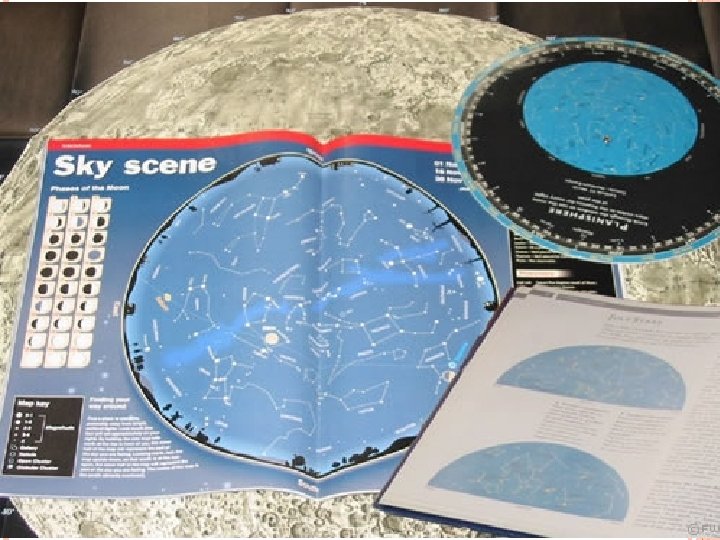
To be able to use a planisphere, star chart or computer software to predict what planets and constellations can be observed on a particular date. WHAT IS A PLANISPHERE? A planisphere is a quick and easy way to find out what stars are viewable at any time. It consists of two discs fastened to each other. On one of them is a hole so that a portion of the disc underneath can be seen. Around the edge are hours of the day. On the underneath disc is a star map showing every constellation available for viewing from a general location e. g. Northern Europe. Around the edges are equally spaced days of the year.
TASK Go to http: //www. gcseastronomy. co. uk/space/animation/fl ash_virtualplanisphere. html Log in user – king password - edward Have a look at the planisphere for a few different dates
STAR MAPS AND CHARTS Star maps and charts are published in books, newspapers and magazines. They tend to show what is in the sky during a month or season. Frequently there are two maps, one showing the view of east to west towards the south, the other showing the view of west to east towards the north.
SOFTWARE Software can show the sky at any given moment and can offer other features like maps of planets etc. Stellarium is free and is updated with new features and objects.
To understand the significance of ecliptic and zodiac on a star chart. WHAT IS THE ECLIPTIC AND ZODIAC? The ecliptic is a line through which the Sun and planets appear to move, and cuts through constellations known as the Zodiac.
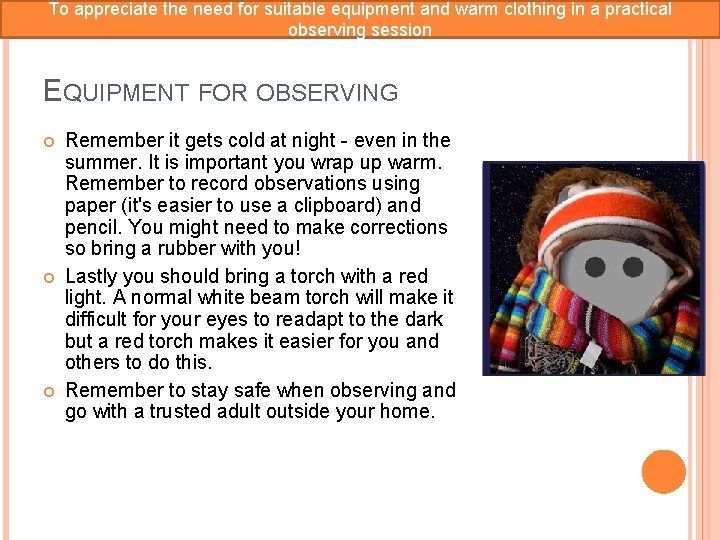
To appreciate the need for suitable equipment and warm clothing in a practical observing session EQUIPMENT FOR OBSERVING Remember it gets cold at night - even in the summer. It is important you wrap up warm. Remember to record observations using paper (it's easier to use a clipboard) and pencil. You might need to make corrections so bring a rubber with you! Lastly you should bring a torch with a red light. A normal white beam torch will make it difficult for your eyes to readapt to the dark but a red torch makes it easier for you and others to do this. Remember to stay safe when observing and go with a trusted adult outside your home.
APPLY YOUR KNOWLEDGE Produce an information leaflet detailing a guide to observation. Include the equipment you may need any information you may need to take with you.
- Slides: 14