
Practice session 6 The environment model Environment Model
- Slides: 17
Practice session #6: The environment model
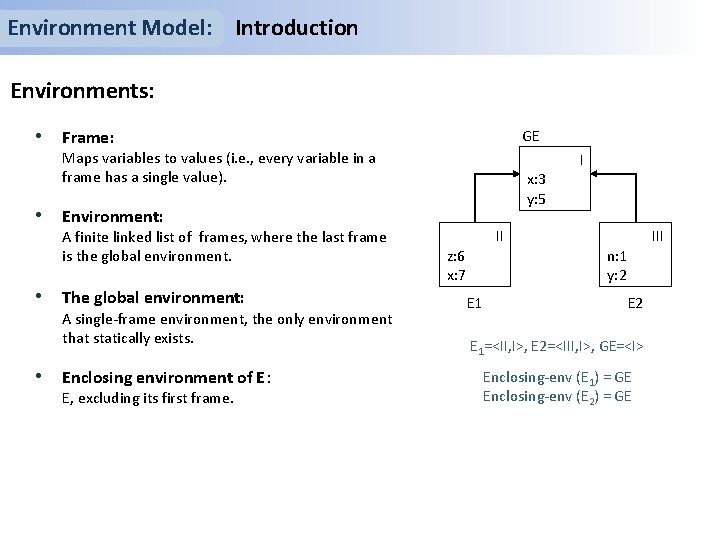
Environment Model: Introduction Environments: • Frame: GE Maps variables to values (i. e. , every variable in a frame has a single value). x: 3 y: 5 • Environment: A finite linked list of frames, where the last frame is the global environment. • The global environment: A single-frame environment, the only environment that statically exists. • Enclosing environment of E: E, excluding its first frame. II z: 6 x: 7 E 1 I n: 1 y: 2 E 1=<II, I>, E 2=<III, I>, GE=<I> Enclosing-env (E 1) = GE Enclosing-env (E 2) = GE III
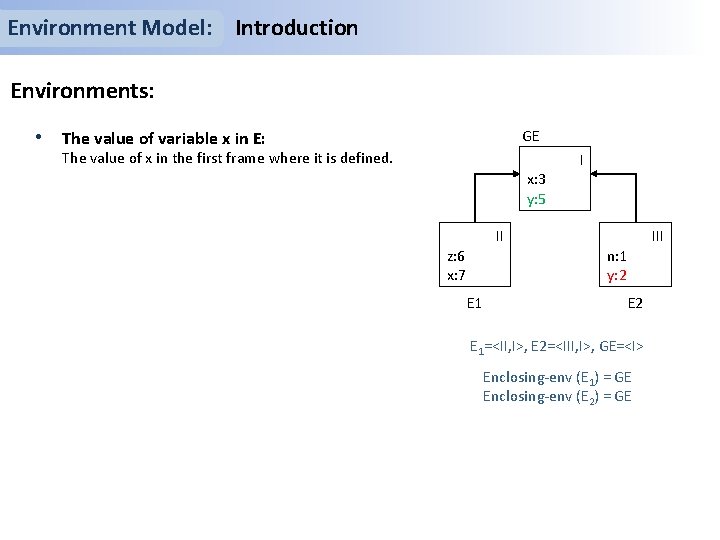
Environment Model: Introduction Environments: • The value of variable x in E: GE The value of x in the first frame where it is defined. x: 3 y: 5 II z: 6 x: 7 E 1 I n: 1 y: 2 E 1=<II, I>, E 2=<III, I>, GE=<I> Enclosing-env (E 1) = GE Enclosing-env (E 2) = GE III
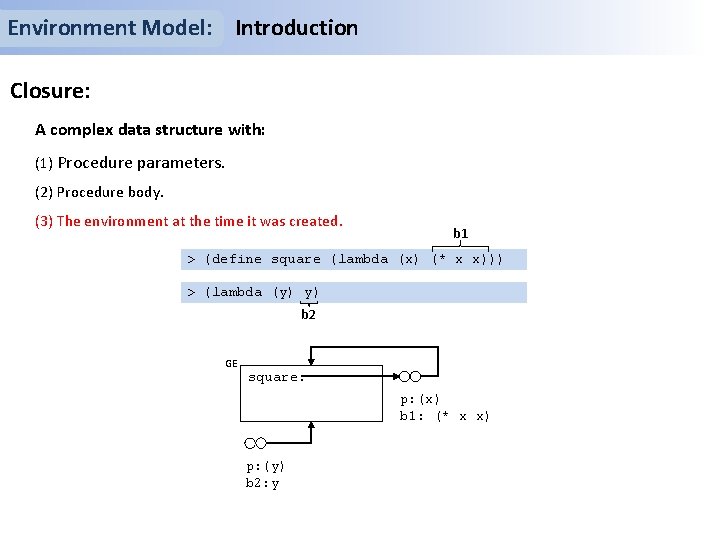
Environment Model: Introduction Closure: A complex data structure with: (1) Procedure parameters. (2) Procedure body. (3) The environment at the time it was created. b 1 > (define square (lambda (x) (* x x))) > (lambda (y) y) b 2 GE square: p: (x) b 1: (* x x) p: (y) b 2: y
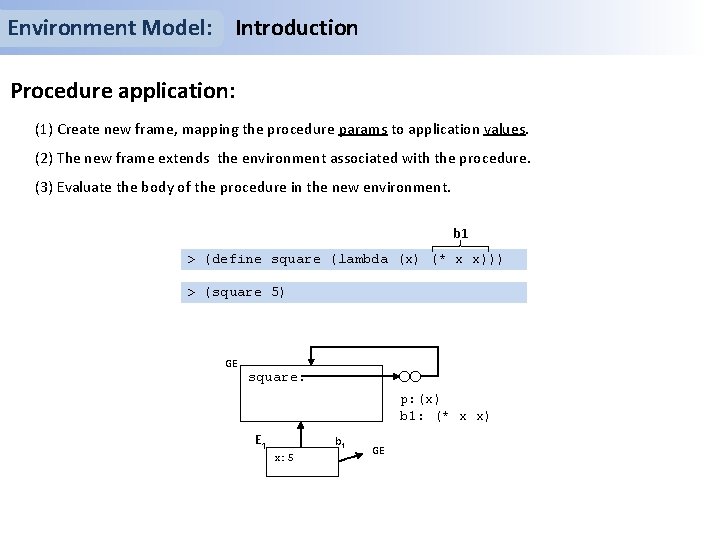
Environment Model: Introduction Procedure application: (1) Create new frame, mapping the procedure params to application values. (2) The new frame extends the environment associated with the procedure. (3) Evaluate the body of the procedure in the new environment. b 1 > (define square (lambda (x) (* x x))) > (square 5) GE square: p: (x) b 1: (* x x) E 1 b 1 x: 5 GE
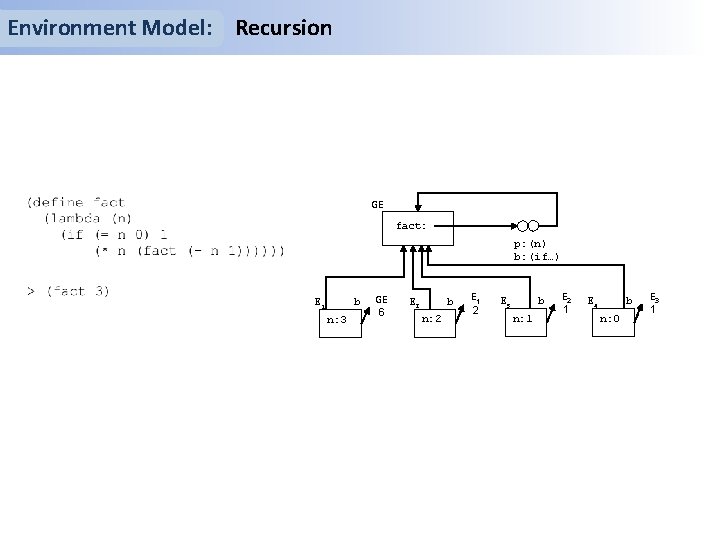
Environment Model: Recursion GE fact: p: (n) b: (if…) E 1 b n: 3 GE 6 E 2 b n: 2 E 1 2 E 3 b n: 1 E 2 1 E 4 b n: 0 E 3 1
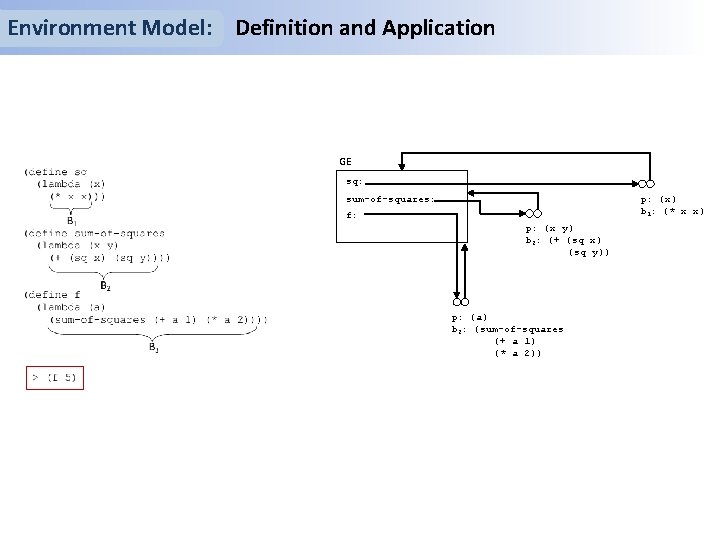
Environment Model: Definition and Application GE sq: p: (x) b 1: (* x x) sum-of-squares: f: p: (x y) b 2: (+ (sq x) (sq y)) p: (a) b 3: (sum-of-squares (+ a 1) (* a 2))
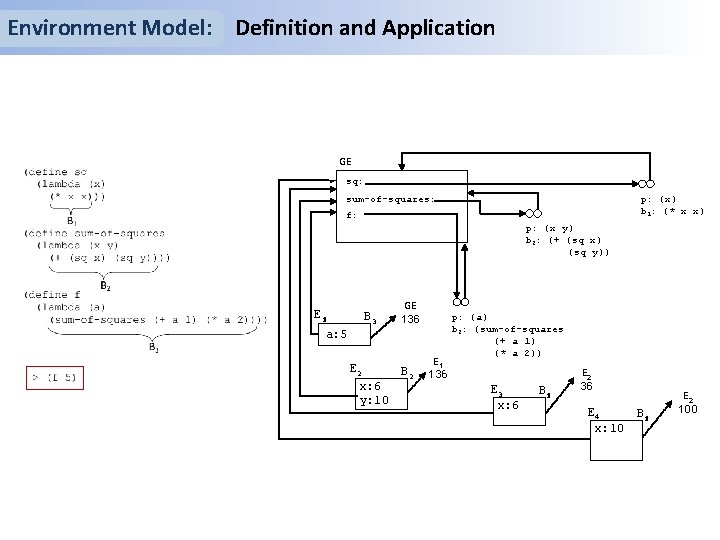
Environment Model: Definition and Application GE sq: p: (x) b 1: (* x x) sum-of-squares: f: p: (x y) b 2: (+ (sq x) (sq y)) E 1 B 3 GE 136 a: 5 E 2 x: 6 y: 10 B 2 E 1 136 p: (a) b 3: (sum-of-squares (+ a 1) (* a 2)) E 3 x: 6 B 1 E 2 36 E 4 x: 10 B 1 E 2 100
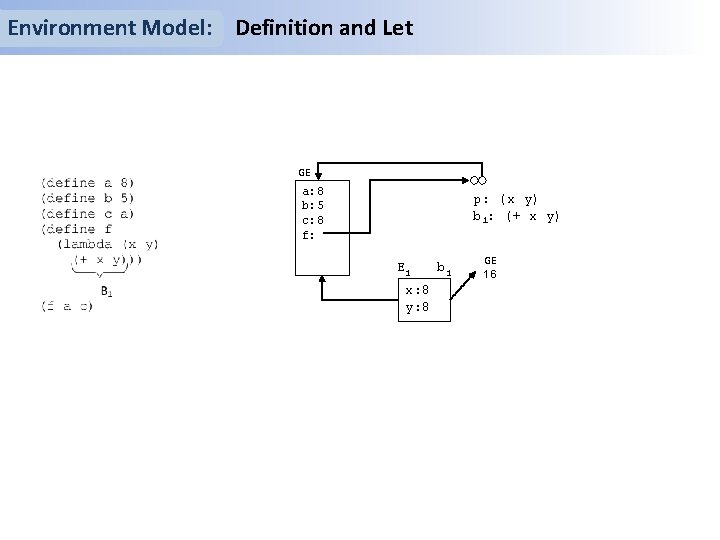
Environment Model: Definition and Let GE a: 8 b: 5 c: 8 f: p: (x y) b 1: (+ x y) E 1 x: 8 y: 8 b 1 GE 16
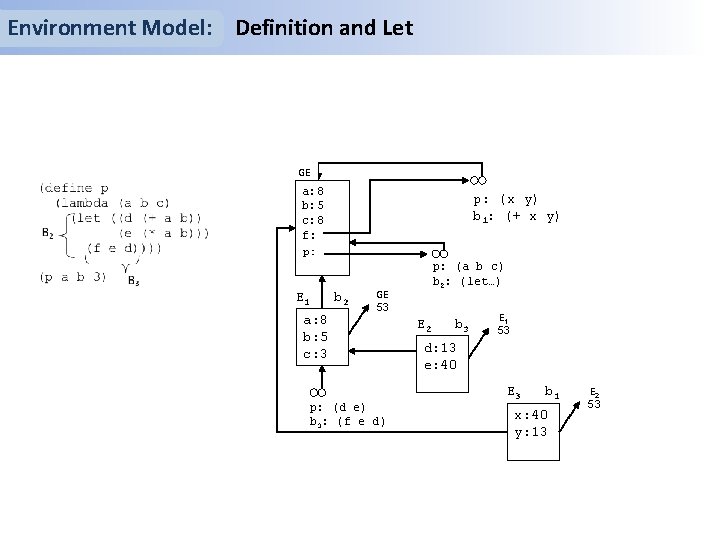
Environment Model: Definition and Let GE a: 8 b: 5 c: 8 f: p: (x y) b 1: (+ x y) p: E 1 b 2 a: 8 b: 5 c: 3 p: (a b c) b 2: (let…) GE 53 p: (d e) b 3: (f e d) E 2 b 3 E 1 53 d: 13 e: 40 E 3 b 1 x: 40 y: 13 E 2 53
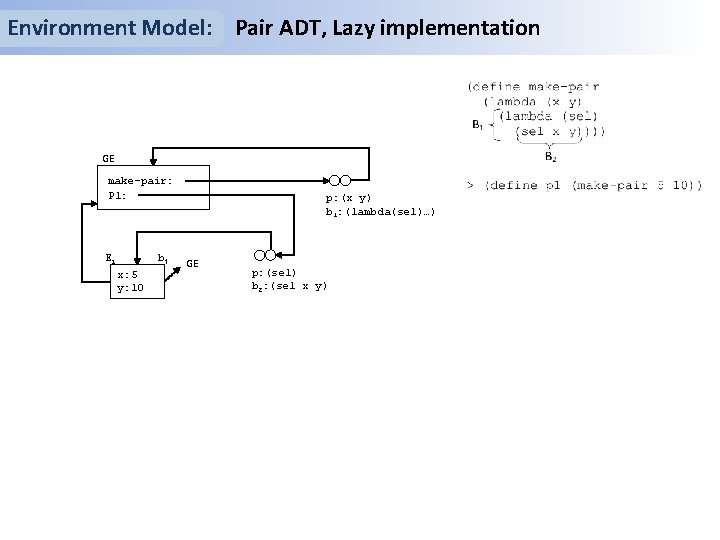
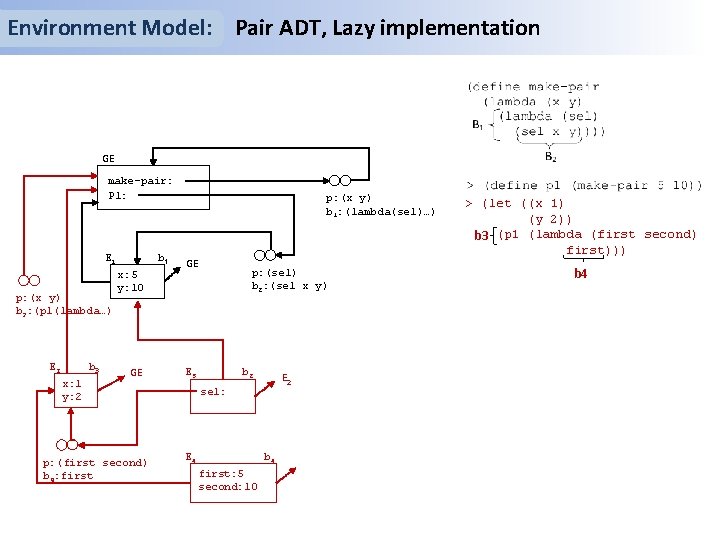
Environment Model: Pair ADT, Lazy implementation GE make-pair: P 1: E 1 b 1 x: 5 y: 10 p: (x y) b 1: (lambda(sel)…) GE p: (sel) b 2: (sel x y)
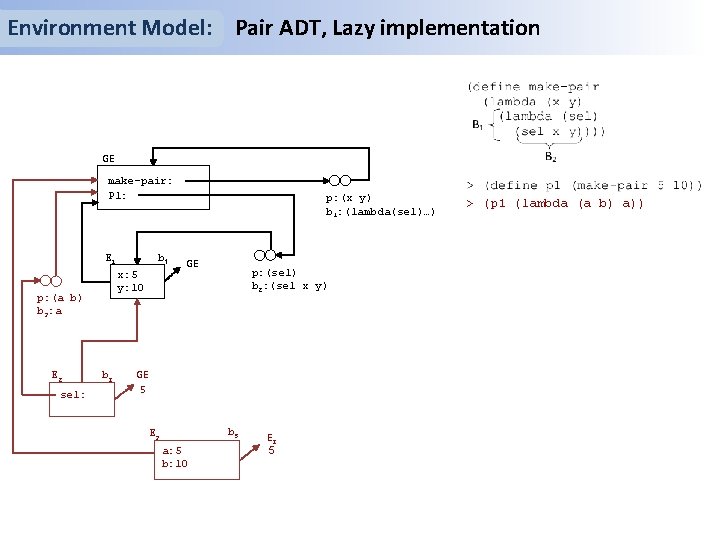
Environment Model: Pair ADT, Lazy implementation GE make-pair: P 1: E 1 x: 5 y: 10 p: (a b) b 3: a E 2 sel: b 1 b 2 p: (x y) b 1: (lambda(sel)…) GE p: (sel) b 2: (sel x y) GE 5 b 3 E 3 a: 5 b: 10 E 2 5 > (p 1 (lambda (a b) a))
Environment Model: Pair ADT, Lazy implementation GE make-pair: P 1: E 1 p: (x y) b 3: (p 1(lambda…) E 2 b 3 x: 1 y: 2 b 1 x: 5 y: 10 GE p: (first second) b 4: first p: (x y) b 1: (lambda(sel)…) GE p: (sel) b 2: (sel x y) E 3 b 2 E 2 sel: E 4 b 4 first: 5 second: 10 > (let ((x 1) (y 2)) b 3 (p 1 (lambda (first second) first))) b 4
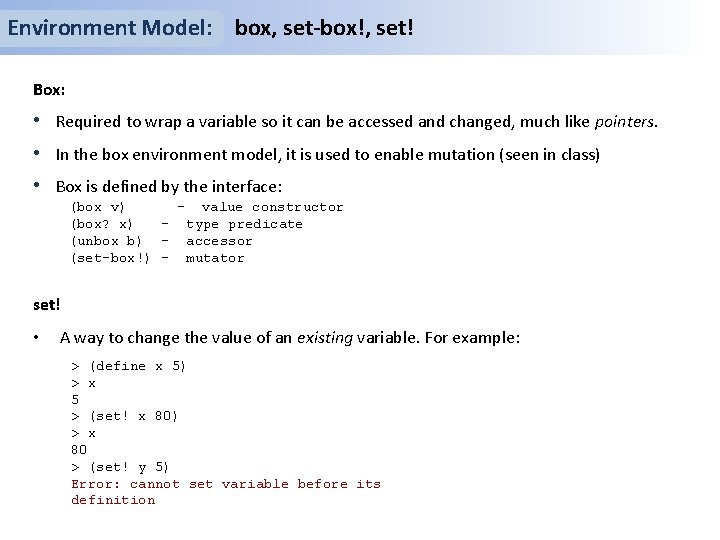
Environment Model: box, set-box!, set! Box: • Required to wrap a variable so it can be accessed and changed, much like pointers. • In the box environment model, it is used to enable mutation (seen in class) • Box is defined by the interface: (box v) - value constructor (box? x) - type predicate (unbox b) - accessor (set-box!) - mutator set! • A way to change the value of an existing variable. For example: > (define x 5) > x 5 > (set! x 80) > x 80 > (set! y 5) Error: cannot set variable before its definition
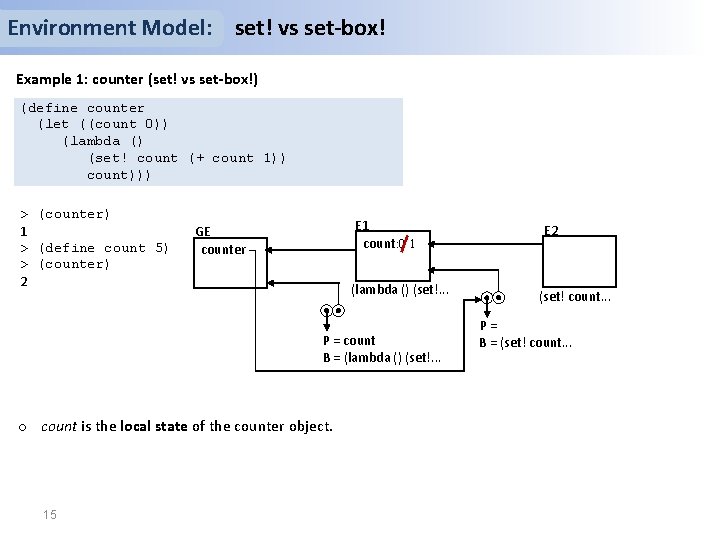
Environment Model: set! vs set-box! Example 1: counter (set! vs set-box!) (define counter (let ((count 0)) (lambda () (set! count (+ count 1)) count))) > (counter) 1 > (define count 5) > (counter) 2 E 1 count: 0 1 GE counter (lambda () (set!. . . P = count B = (lambda () (set!. . . o count is the local state of the counter object. 15 E 2 (set! count. . . P= B = (set! count. . .
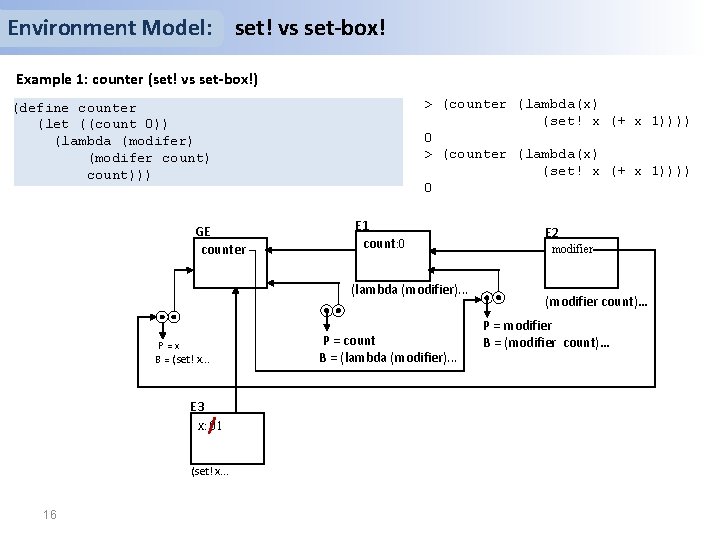
Environment Model: set! vs set-box! Example 1: counter (set! vs set-box!) > (counter (lambda(x) (set! x (+ x 1)))) 0 (define counter (let ((count 0)) (lambda (modifer) (modifer count))) GE counter E 1 count: 0 (lambda (modifier). . . P=x B = (set! x. . . E 3 x: 0 1 (set! x. . . 16 P = count B = (lambda (modifier). . . E 2 modifier (modifier count)… P = modifier B = (modifier count)…
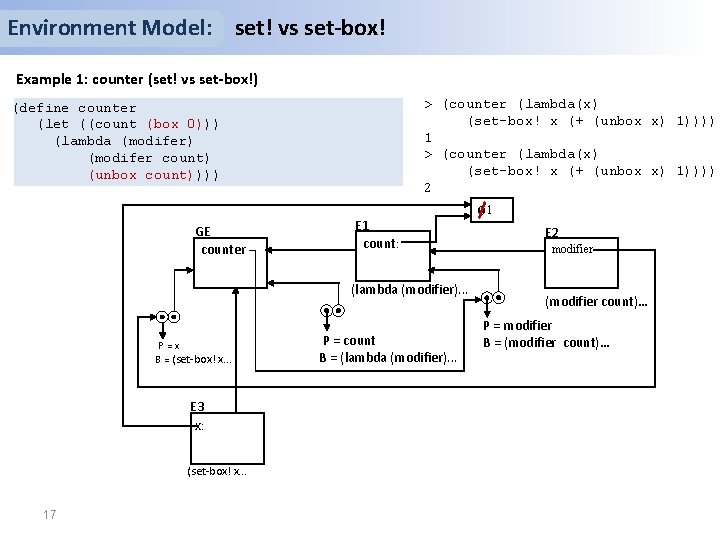
Environment Model: set! vs set-box! Example 1: counter (set! vs set-box!) > (counter (lambda(x) (set-box! x (+ (unbox x) 1)))) 1 > (counter (lambda(x) (set-box! x (+ (unbox x) 1)))) 2 (define counter (let ((count (box 0))) (lambda (modifer) (modifer count) (unbox count)))) GE counter E 1 count: (lambda (modifier). . . P=x B = (set-box! x. . . E 3 x: (set-box! x. . . 17 P = count B = (lambda (modifier). . . 01 E 2 modifier (modifier count)… P = modifier B = (modifier count)…