
PRACTICE QUIZ Solve the following equations 1 x

- Slides: 25
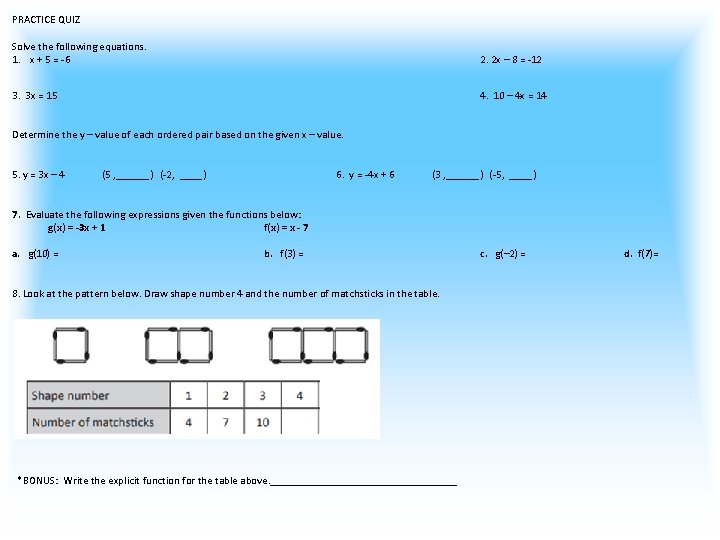
PRACTICE QUIZ Solve the following equations. 1. x + 5 = -6 2. 2 x – 8 = -12 3. 3 x = 15 4. 10 – 4 x = 14 Determine the y – value of each ordered pair based on the given x – value. 5. y = 3 x – 4 (5 , ______ ) (-2, ____ ) 6. y = -4 x + 6 (3 , ______ ) (-5, ____ ) 7. Evaluate the following expressions given the functions below: g(x) = -3 x + 1 f(x) = x - 7 a. g(10) = b. f(3) = 8. Look at the pattern below. Draw shape number 4 and the number of matchsticks in the table. *BONUS: Write the explicit function for the table above. _________________ c. g(– 2) = d. f(7)=
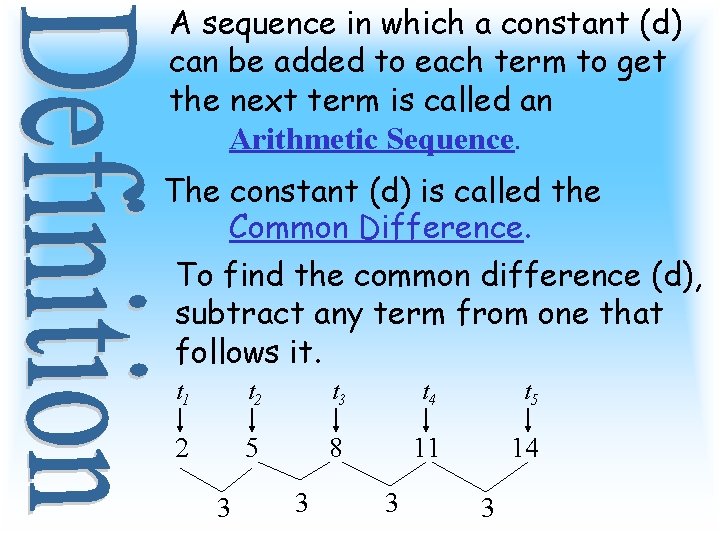
A sequence in which a constant (d) can be added to each term to get the next term is called an Arithmetic Sequence. The constant (d) is called the Common Difference. To find the common difference (d), subtract any term from one that follows it. t 1 t 2 t 3 t 4 t 5 2 5 8 11 14 3 3
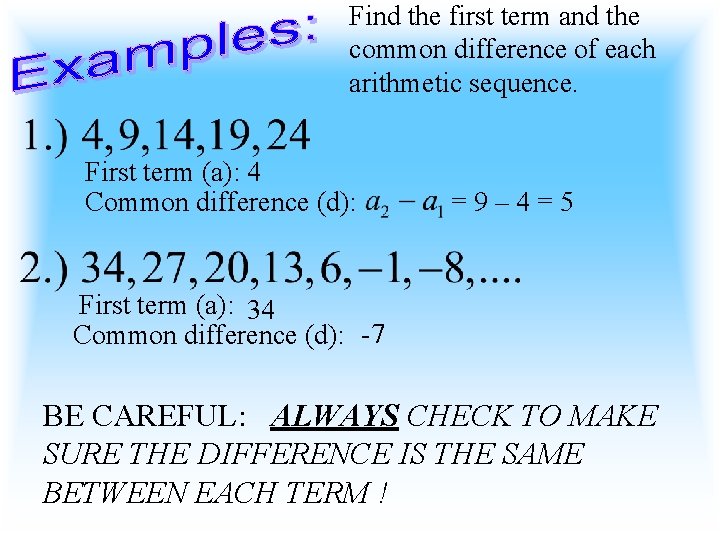
Find the first term and the common difference of each arithmetic sequence. First term (a): 4 Common difference (d): =9– 4=5 First term (a): 34 Common difference (d): -7 BE CAREFUL: ALWAYS CHECK TO MAKE SURE THE DIFFERENCE IS THE SAME BETWEEN EACH TERM !
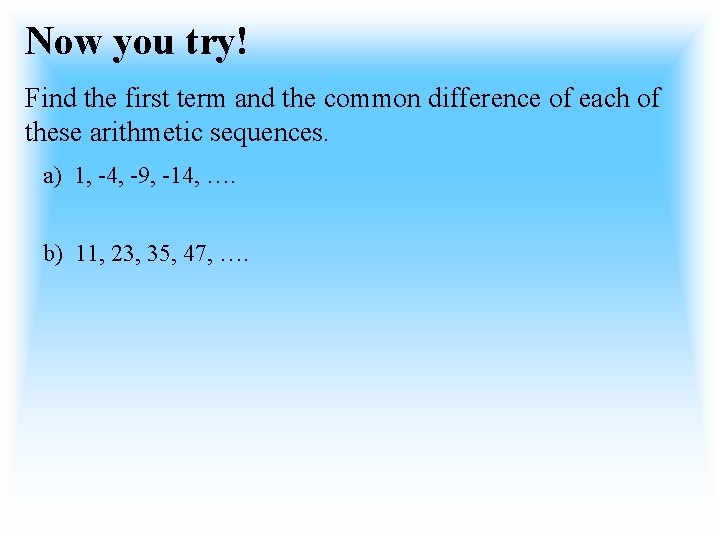
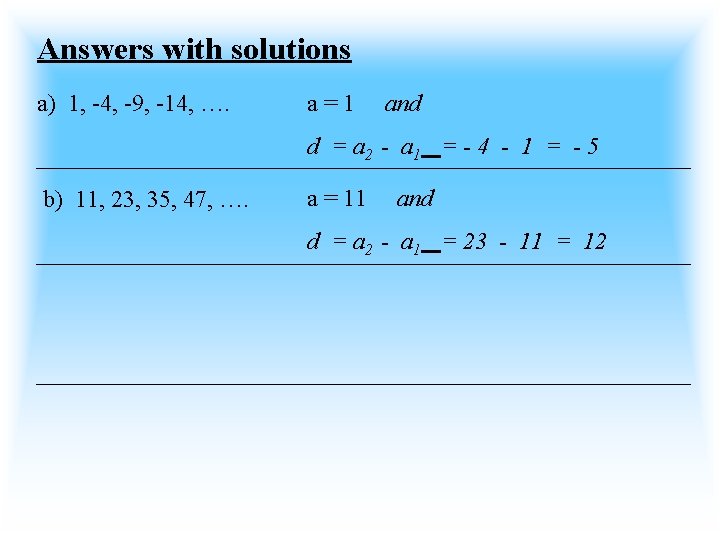
Now you try! Find the first term and the common difference of each of these arithmetic sequences. a) 1, -4, -9, -14, …. b) 11, 23, 35, 47, ….
Answers with solutions a) 1, -4, -9, -14, …. a=1 and d = a 2 - a 1 = - 4 - 1 = - 5 b) 11, 23, 35, 47, …. a = 11 and d = a 2 - a 1 = 23 - 11 = 12
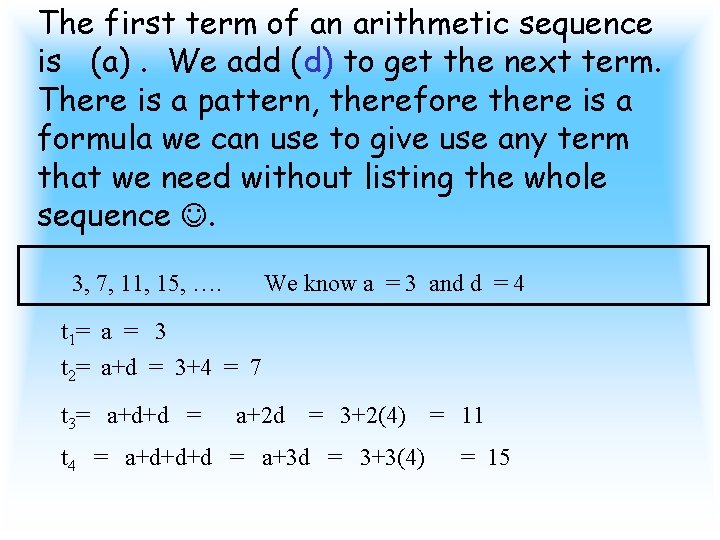
The first term of an arithmetic sequence is (a). We add (d) to get the next term. There is a pattern, therefore there is a formula we can use to give use any term that we need without listing the whole sequence . 3, 7, 11, 15, …. We know a = 3 and d = 4 t 1= a = 3 t 2= a+d = 3+4 = 7 t 3= a+d+d = a+2 d = 3+2(4) t 4 = a+d+d+d = a+3 d = 3+3(4) = 11 = 15
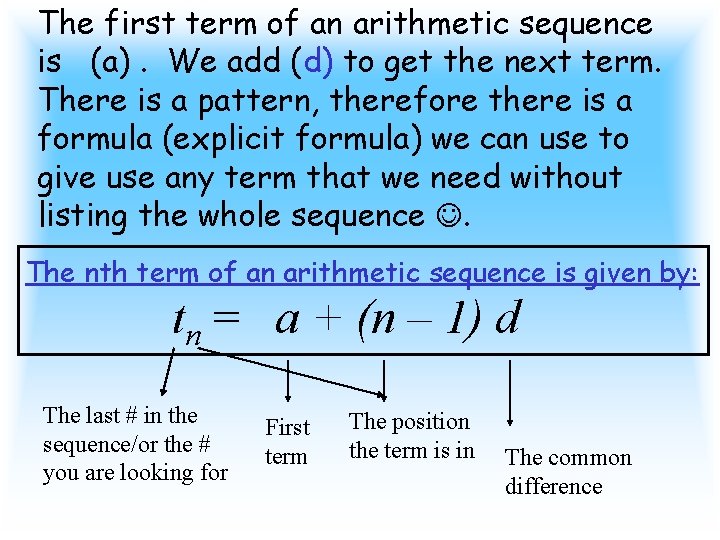
The first term of an arithmetic sequence is (a). We add (d) to get the next term. There is a pattern, therefore there is a formula (explicit formula) we can use to give use any term that we need without listing the whole sequence . The nth term of an arithmetic sequence is given by: tn = a + (n – 1) d The last # in the sequence/or the # you are looking for First term The position the term is in The common difference
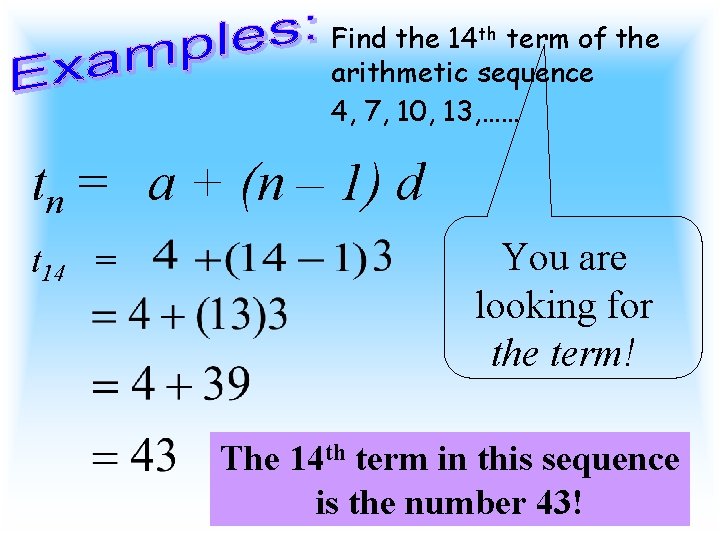
Find the 14 th term of the arithmetic sequence 4, 7, 10, 13, …… tn = a + (n – 1) d t 14 = You are looking for the term! The 14 th term in this sequence is the number 43!
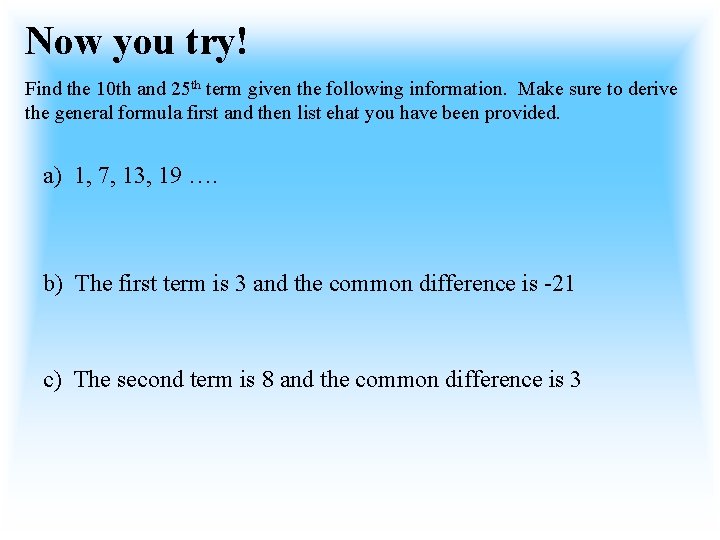
Now you try! Find the 10 th and 25 th term given the following information. Make sure to derive the general formula first and then list ehat you have been provided. a) 1, 7, 13, 19 …. b) The first term is 3 and the common difference is -21 c) The second term is 8 and the common difference is 3
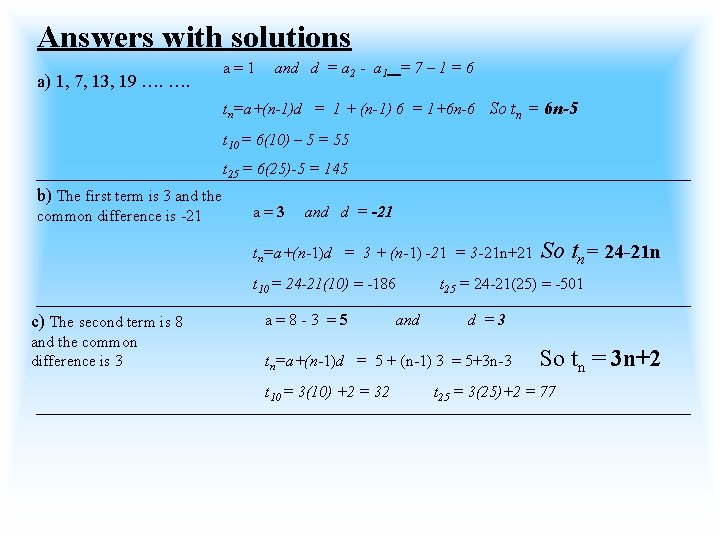
Answers with solutions a) 1, 7, 13, 19 …. …. a=1 and d = a 2 - a 1 = 7 – 1 = 6 tn=a+(n-1)d = 1 + (n-1) 6 = 1+6 n-6 So tn = 6 n-5 t 10 = 6(10) – 5 = 55 t 25 = 6(25)-5 = 145 b) The first term is 3 and the common difference is -21 a=3 and d = -21 tn=a+(n-1)d = 3 + (n-1) -21 = 3 -21 n+21 t 10 = 24 -21(10) = -186 t 25 = 24 -21(25) = -501 c) The second term is 8 a=8 -3 =5 and the common difference is 3 tn=a+(n-1)d = 5 + (n-1) 3 = 5+3 n-3 t 10 = 3(10) +2 = 32 and So tn= 24 -21 n d =3 So tn = 3 n+2 t 25 = 3(25)+2 = 77
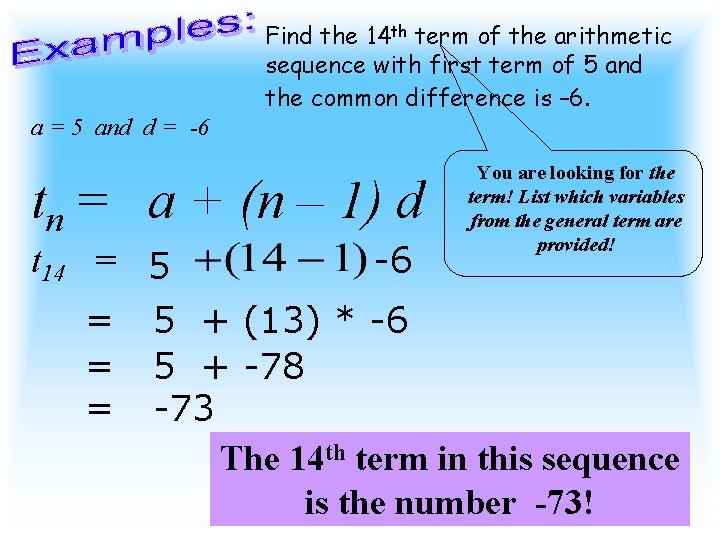
a = 5 and d = -6 Find the 14 th term of the arithmetic sequence with first term of 5 and the common difference is – 6. tn = a + (n – 1) d You are looking for the term! List which variables from the general term are provided! t 14 = 5 -6 = 5 + (13) * -6 = 5 + -78 = -73 The 14 th term in this sequence is the number -73!
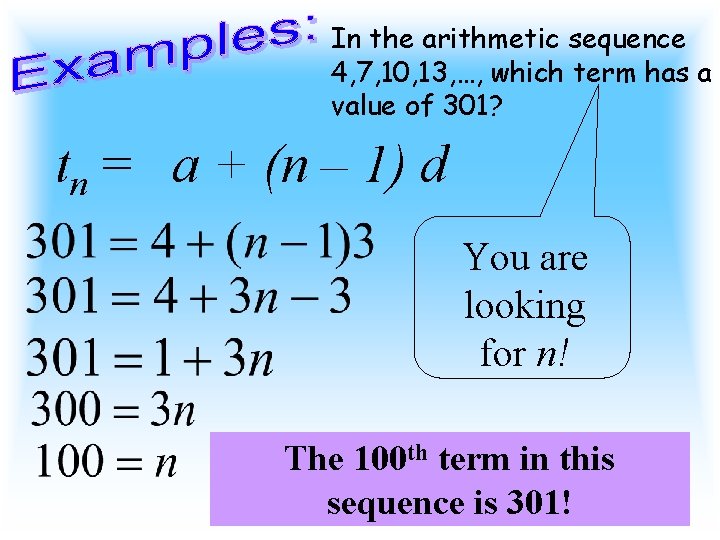
In the arithmetic sequence 4, 7, 10, 13, …, which term has a value of 301? tn = a + (n – 1) d You are looking for n! The 100 th term in this sequence is 301!
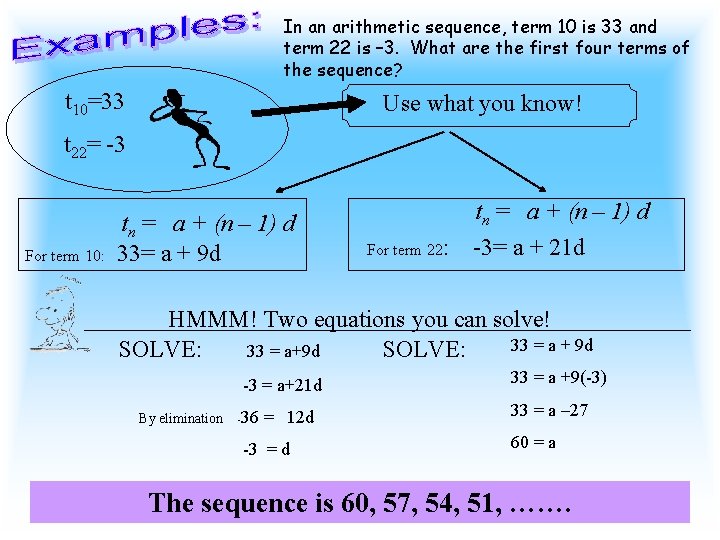
In an arithmetic sequence, term 10 is 33 and term 22 is – 3. What are the first four terms of the sequence? t 10=33 Use what you know! t 22= -3 For term 10: tn = a + (n – 1) d 33= a + 9 d tn = a + (n – 1) d For term 22: -3= a + 21 d HMMM! Two equations you can solve! 33 = a + 9 d SOLVE: 33 = a+9 d SOLVE: By elimination - -3 = a+21 d 33 = a +9(-3) 36 = 12 d 33 = a – 27 -3 = d 60 = a The sequence is 60, 57, 54, 51, …….
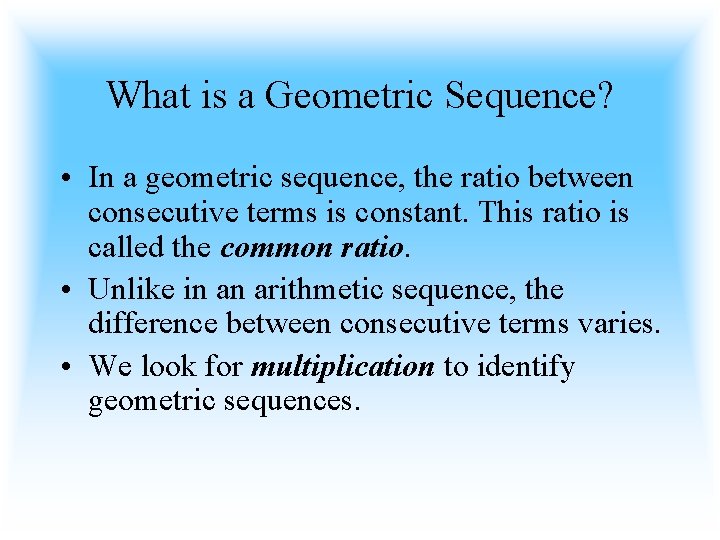
What is a Geometric Sequence? • In a geometric sequence, the ratio between consecutive terms is constant. This ratio is called the common ratio. • Unlike in an arithmetic sequence, the difference between consecutive terms varies. • We look for multiplication to identify geometric sequences.
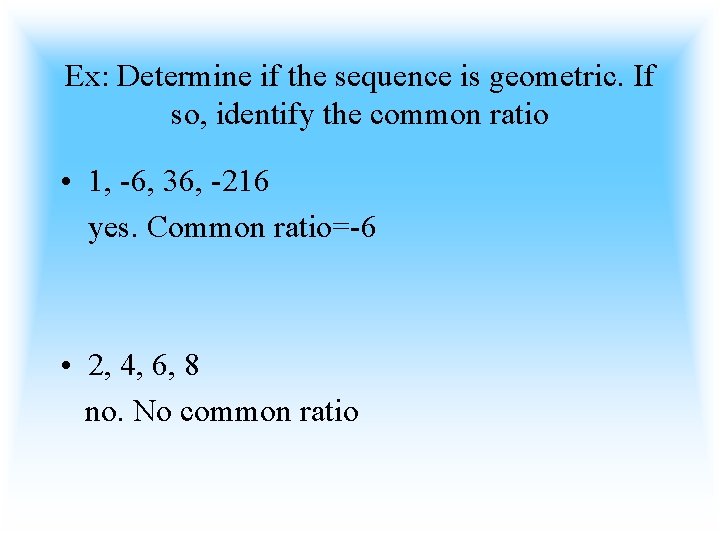
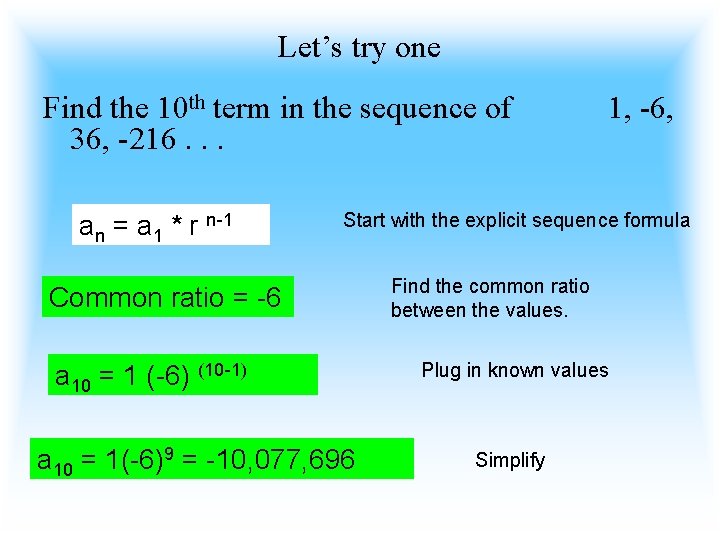
Ex: Determine if the sequence is geometric. If so, identify the common ratio • 1, -6, 36, -216 yes. Common ratio=-6 • 2, 4, 6, 8 no. No common ratio
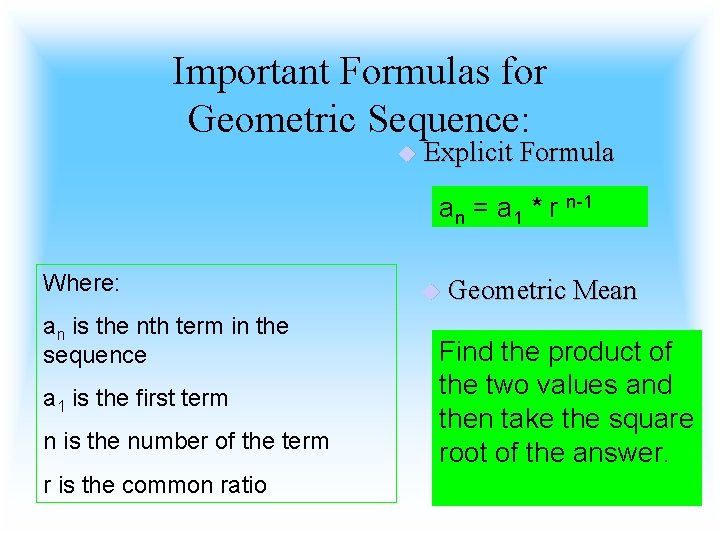
Important Formulas for Geometric Sequence: u Explicit Formula an = a 1 * r n-1 Where: an is the nth term in the sequence a 1 is the first term n is the number of the term r is the common ratio u Geometric Mean Find the product of the two values and then take the square root of the answer.
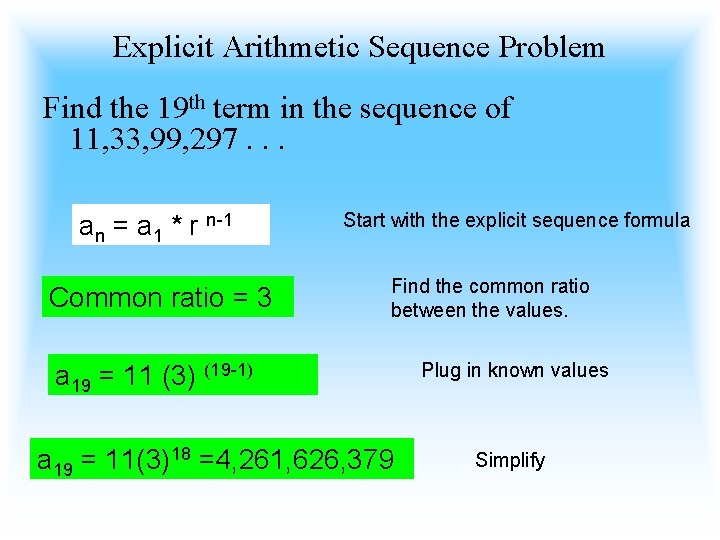
Explicit Arithmetic Sequence Problem Find the 19 th term in the sequence of 11, 33, 99, 297. . . an = a 1 * r n-1 Common ratio = 3 Start with the explicit sequence formula Find the common ratio between the values. a 19 = 11 (3) (19 -1) a 19 = 11(3)18 =4, 261, 626, 379 Plug in known values Simplify
Let’s try one Find the 10 th term in the sequence of 36, -216. . . an = a 1 * r n-1 1, -6, Start with the explicit sequence formula Common ratio = -6 a 10 = 1 (-6) (10 -1) a 10 = 1(-6)9 = -10, 077, 696 Find the common ratio between the values. Plug in known values Simplify
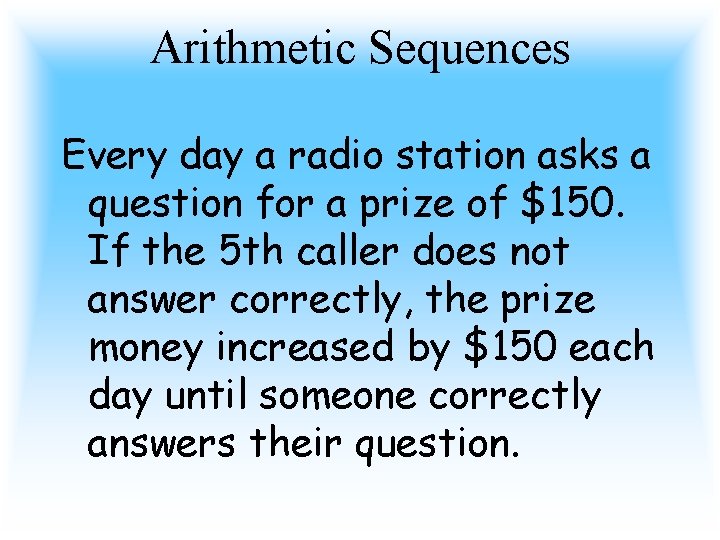
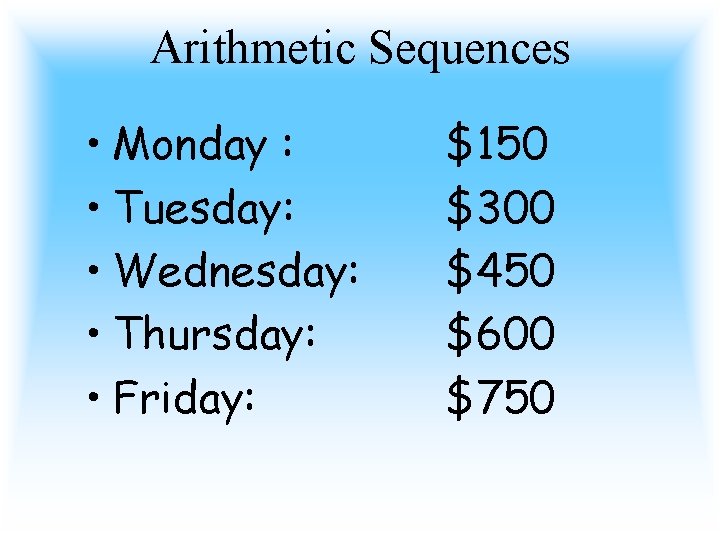
Arithmetic Sequences Every day a radio station asks a question for a prize of $150. If the 5 th caller does not answer correctly, the prize money increased by $150 each day until someone correctly answers their question.
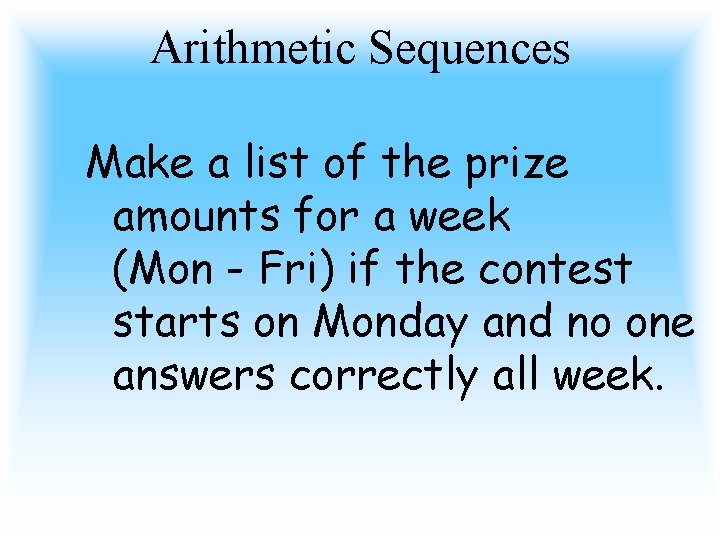
Arithmetic Sequences Make a list of the prize amounts for a week (Mon - Fri) if the contest starts on Monday and no one answers correctly all week.
Arithmetic Sequences • Monday : • Tuesday: • Wednesday: • Thursday: • Friday: $150 $300 $450 $600 $750
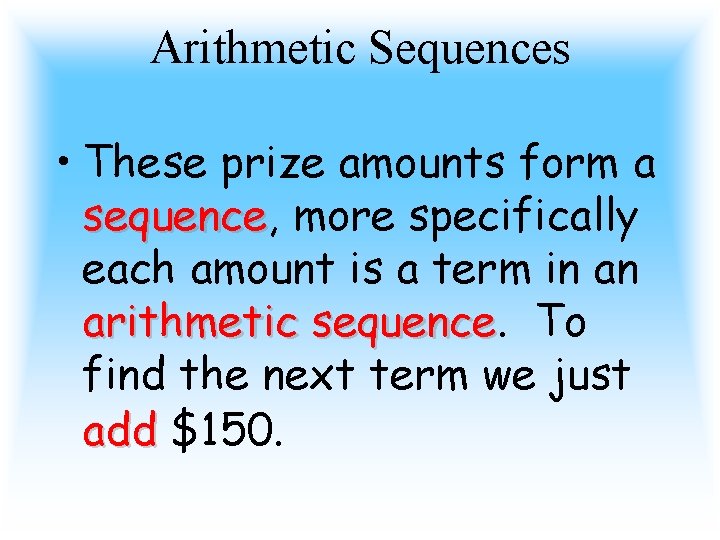
Arithmetic Sequences • These prize amounts form a sequence, sequence more specifically each amount is a term in an arithmetic sequence To find the next term we just add $150.
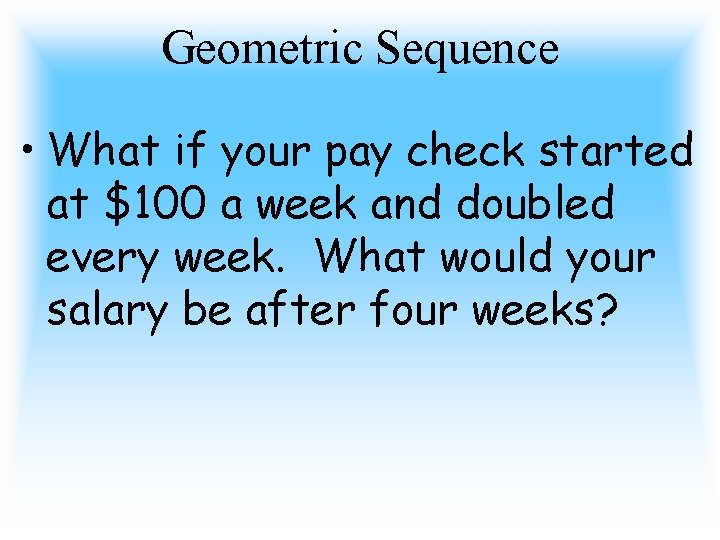
Geometric Sequence • What if your pay check started at $100 a week and doubled every week. What would your salary be after four weeks?
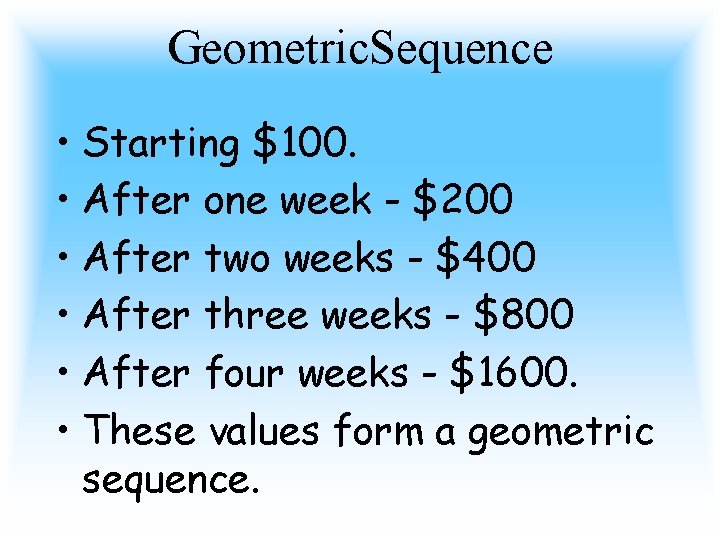
Geometric. Sequence • Starting $100. • After one week - $200 • After two weeks - $400 • After three weeks - $800 • After four weeks - $1600. • These values form a geometric sequence.