
Practice Questions Intro Materials Unit 1 1 The
- Slides: 14
Practice Questions Intro Materials Unit 1
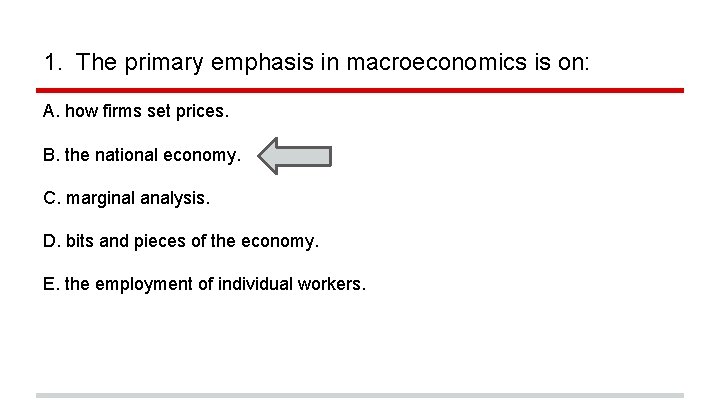
1. The primary emphasis in macroeconomics is on: A. how firms set prices. B. the national economy. C. marginal analysis. D. bits and pieces of the economy. E. the employment of individual workers.
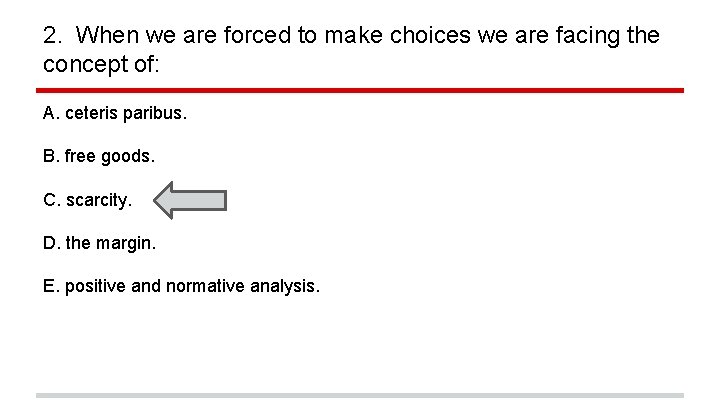
2. When we are forced to make choices we are facing the concept of: A. ceteris paribus. B. free goods. C. scarcity. D. the margin. E. positive and normative analysis.
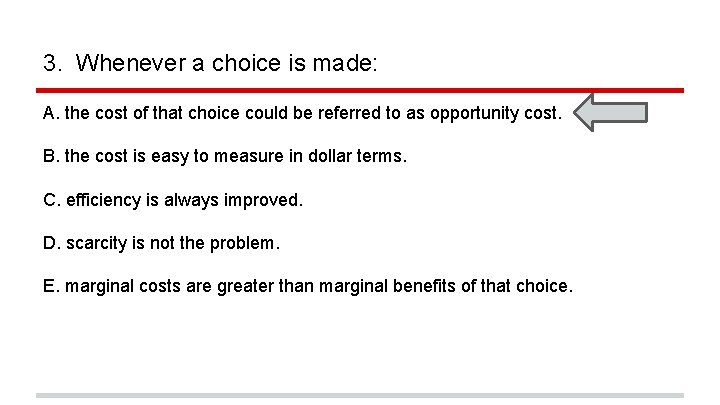
3. Whenever a choice is made: A. the cost of that choice could be referred to as opportunity cost. B. the cost is easy to measure in dollar terms. C. efficiency is always improved. D. scarcity is not the problem. E. marginal costs are greater than marginal benefits of that choice.
4. A new fast-food restaurant offered a free meal (valued at $5) a week for a year to its first 100 customers. Ramona camped out for 48 hours before the opening to be one of the first 100 customers. The cost of the free meal a week for a year for Ramona was: A. zero. B. $260. C. whatever she would have done with those 48 hours. D. the cost is impossible to determine. E. $500
5. Efficient production exists when the economy is: A. operating underneath its production possibility curve. B. operating on its production possibility curve. C. operating outside its production possibility curve. D. moving beyond its production possibility curve. E. in a recession.
6. If goods A and B are substitutes, a decrease in the price of good B will: A. increase the demand for good A. B. increase the demand for good B. C. decrease the demand for good A. D. increase the demand for good B and decrease the demand for good A. E. increase the quantity of good B demanded and increase the demand for good A.
7. Which of the following would result in a movement along the demand curve? A. a change in preferences B. an increase in the number of buyers C. an increase in the number of suppliers D. a decrease in income E. a decrease in the price of a substitute good
8. Good X and Good Y are related goods. If the price of Good X increases, and the demand for Good Y shifts left, then these goods are: A. complements. B. substitutes. C. inferior. D. normal. E. luxuries.
9. When the price of lamps increases, the: A. supply increases. B. quantity supplied increases. C. supply decreases. D. quantity supplied decreases. E. quantity demanded increases.
10. A decrease in supply means: A. a shift to the left of the entire supply curve. B. moving downward (to the left) along the supply curve with lower prices. C. less will be demanded at every price. D. more will be supplied at every price. E. a shift to the left of the entire demand curve.
11. High-fructose corn syrup, which is derived from corn, is an important ingredient in the production of many soft drinks. If the price of corn increases, one would expect: A. the supply curve for soft drinks to shift left. B. the quantity supplied of soft drinks to increase. C. the demand for soft drinks to increase. D. the supply curve for soft drinks to shift right. E. the demand supply curves will both shift to the left.
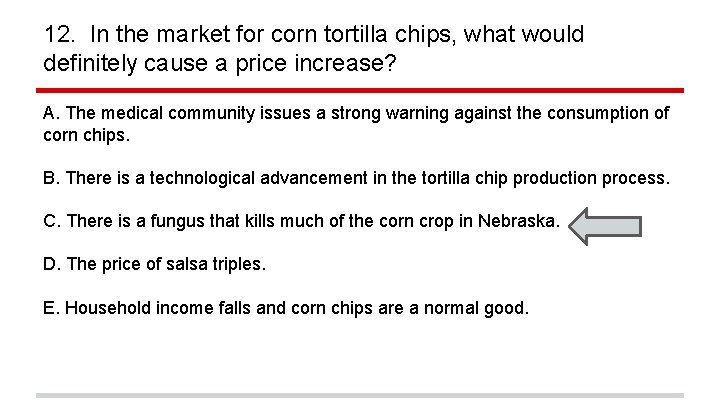
12. In the market for corn tortilla chips, what would definitely cause a price increase? A. The medical community issues a strong warning against the consumption of corn chips. B. There is a technological advancement in the tortilla chip production process. C. There is a fungus that kills much of the corn crop in Nebraska. D. The price of salsa triples. E. Household income falls and corn chips are a normal good.
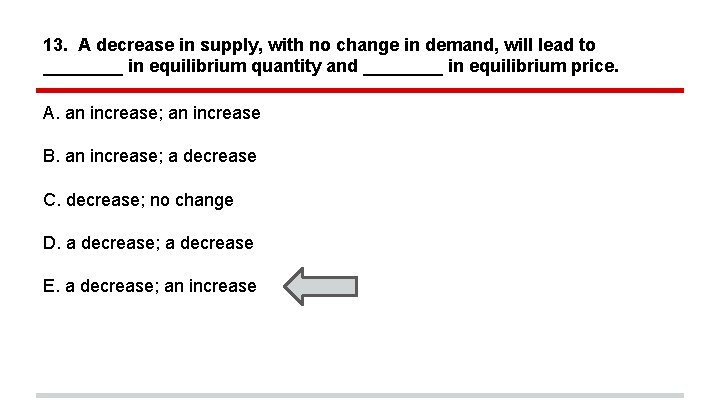
13. A decrease in supply, with no change in demand, will lead to ____ in equilibrium quantity and ____ in equilibrium price. A. an increase; an increase B. an increase; a decrease C. decrease; no change D. a decrease; a decrease E. a decrease; an increase