
Practice Questions Day 5 DNA Structure Molecular Genetics
- Slides: 3
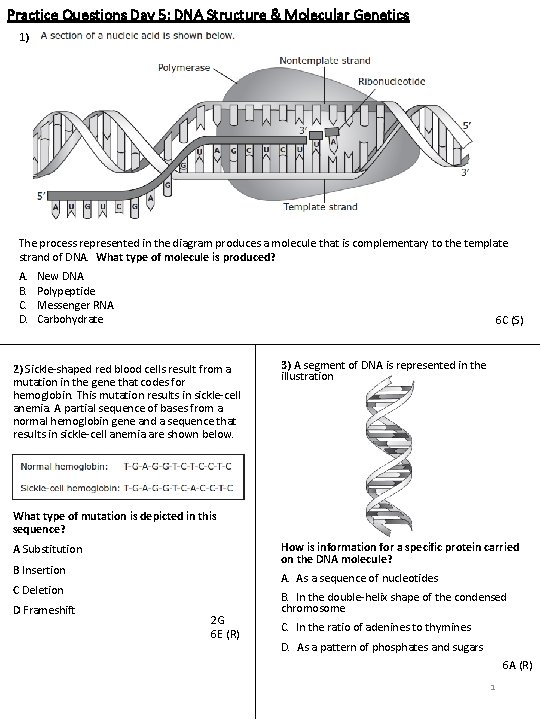
Practice Questions Day 5: DNA Structure & Molecular Genetics 1) The process represented in the diagram produces a molecule that is complementary to the template strand of DNA. What type of molecule is produced? A. B. C. D. New DNA Polypeptide Messenger RNA Carbohydrate 6 C (S) 2) Sickle-shaped red blood cells result from a mutation in the gene that codes for hemoglobin. This mutation results in sickle-cell anemia. A partial sequence of bases from a normal hemoglobin gene and a sequence that results in sickle-cell anemia are shown below. 3) A segment of DNA is represented in the illustration What type of mutation is depicted in this sequence? How is information for a specific protein carried on the DNA molecule? A Substitution B Insertion A. As a sequence of nucleotides C Deletion D Frameshift 2 G 6 E (R) B. In the double-helix shape of the condensed chromosome C. In the ratio of adenines to thymines D. As a pattern of phosphates and sugars 6 A (R) 1
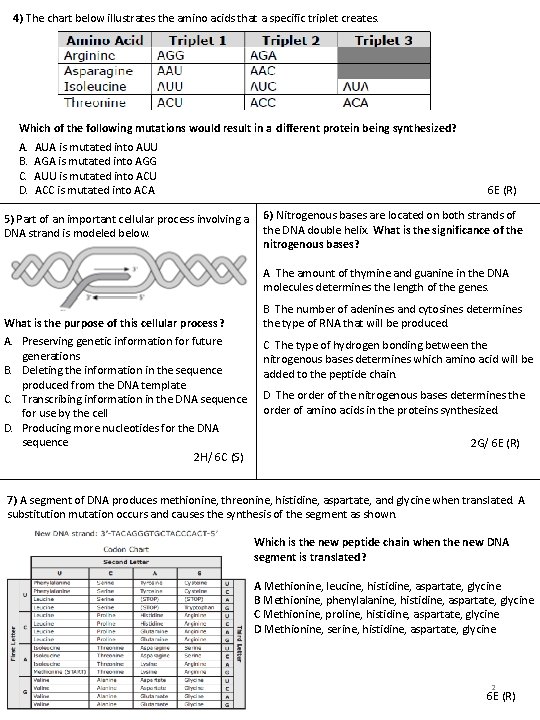
4) The chart below illustrates the amino acids that a specific triplet creates. Which of the following mutations would result in a different protein being synthesized? A. B. C. D. AUA is mutated into AUU AGA is mutated into AGG AUU is mutated into ACU ACC is mutated into ACA 5) Part of an important cellular process involving a DNA strand is modeled below. 6 E (R) 6) Nitrogenous bases are located on both strands of the DNA double helix. What is the significance of the nitrogenous bases? A The amount of thymine and guanine in the DNA molecules determines the length of the genes. What is the purpose of this cellular process? A. Preserving genetic information for future generations B. Deleting the information in the sequence produced from the DNA template C. Transcribing information in the DNA sequence for use by the cell D. Producing more nucleotides for the DNA sequence 2 H/ 6 C (S) B The number of adenines and cytosines determines the type of RNA that will be produced. C The type of hydrogen bonding between the nitrogenous bases determines which amino acid will be added to the peptide chain. D The order of the nitrogenous bases determines the order of amino acids in the proteins synthesized. 2 G/ 6 E (R) 7) A segment of DNA produces methionine, threonine, histidine, aspartate, and glycine when translated. A substitution mutation occurs and causes the synthesis of the segment as shown. Which is the new peptide chain when the new DNA segment is translated? A Methionine, leucine, histidine, aspartate, glycine B Methionine, phenylalanine, histidine, aspartate, glycine C Methionine, proline, histidine, aspartate, glycine D Methionine, serine, histidine, aspartate, glycine 2 6 E (R)
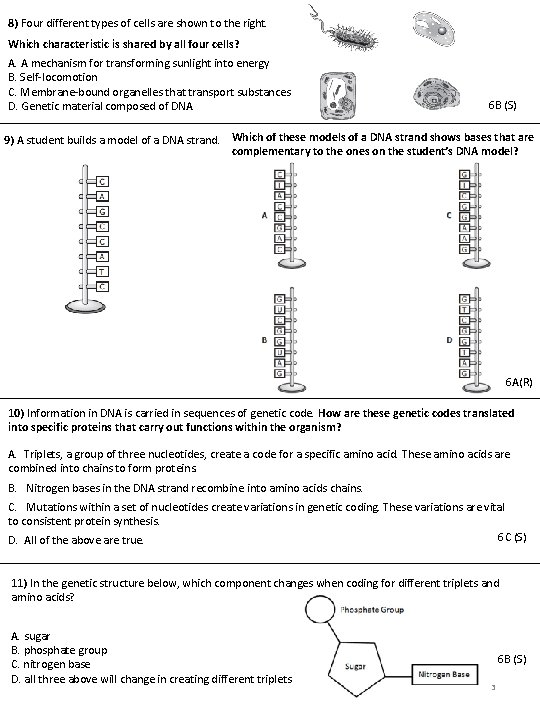
8) Four different types of cells are shown to the right. Which characteristic is shared by all four cells? A. A mechanism for transforming sunlight into energy B. Self-locomotion C. Membrane-bound organelles that transport substances D. Genetic material composed of DNA 6 B (S) 9) A student builds a model of a DNA strand. Which of these models of a DNA strand shows bases that are complementary to the ones on the student’s DNA model? 6 A(R) 10) Information in DNA is carried in sequences of genetic code. How are these genetic codes translated into specific proteins that carry out functions within the organism? A. Triplets, a group of three nucleotides, create a code for a specific amino acid. These amino acids are combined into chains to form proteins. B. Nitrogen bases in the DNA strand recombine into amino acids chains. C. Mutations within a set of nucleotides create variations in genetic coding. These variations are vital to consistent protein synthesis. 6 C (S) D. All of the above are true. 11) In the genetic structure below, which component changes when coding for different triplets and amino acids? A. sugar B. phosphate group C. nitrogen base D. all three above will change in creating different triplets 6 B (S) 3