
PRACTICE ORIENTED WORKSHOP ON SETTING OBJECTIVES AND PERFORMANCE
PRACTICE ORIENTED WORKSHOP ON SETTING OBJECTIVES AND PERFORMANCE COUNSELLING
OBJECTIVES OF THE PROGRAMME • Share the objectives of performance appraisals • Provide guidance and practice to the participants to set smart objectives • Share with the participants as to how to conduct effective performance reviews
HISTORY • Trait evaluation • Confidential reports • Evaluation against set objectives • Individual • Dyads • Groups/teams • Organisation/SBUs
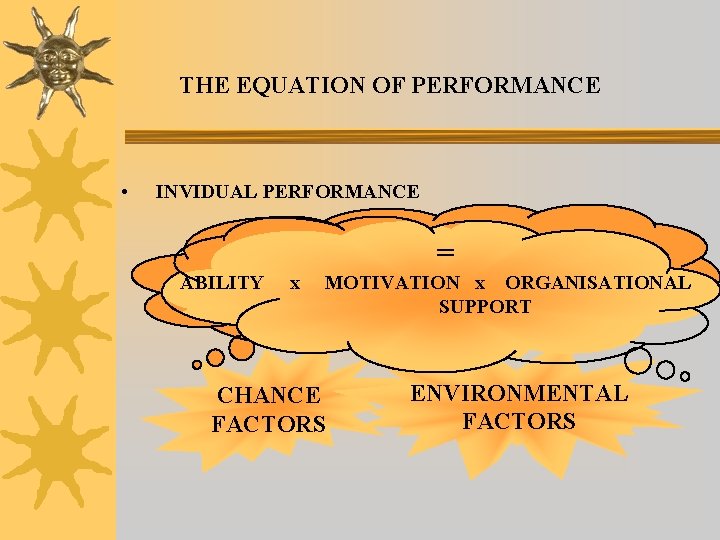
THE EQUATION OF PERFORMANCE • INVIDUAL PERFORMANCE = ABILITY x MOTIVATION x ORGANISATIONAL SUPPORT CHANCE FACTORS ENVIRONMENTAL FACTORS

FACTORS OF PERFORMANCE • Ability – training, retraining, instructions • Motivation – intrinsic/extrinsic • company policies, departmental atmosphere, personal matters • Organisational support – post training, developmental plans
WHY SET OBJECTIVES ? • Set a clear road map for individual contribution • Bring about role clarity • Clarify expectations between appraiser and appraisee • Provide a tool for continuous improvement • Inculcate result orientedness • Address conflicting targets • Bring about focus in actions While we set objectives in the beginning of the year, flexibility to fine tune the objectives is required to cater to changing situations
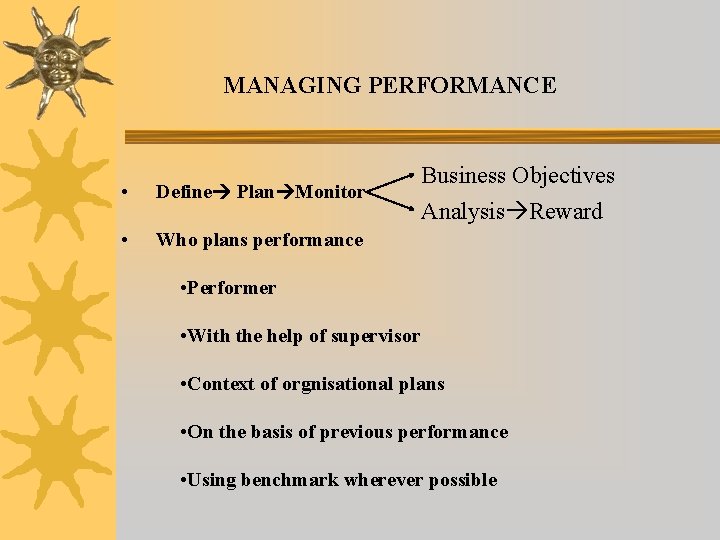
MANAGING PERFORMANCE • Define Plan Monitor • Who plans performance Business Objectives Analysis Reward • Performer • With the help of supervisor • Context of orgnisational plans • On the basis of previous performance • Using benchmark wherever possible
SMART CRITERIA • Specific – observable • Measurable – qualitatively and quantitively • Accountable – my own (not departmental) • Realistic – stretched but not beyond reach • Time bound – having start and end times Weightages may be assigned to the job objectives
SMART CRITERIA • SALES FROM Rs 2 CRORES TO Rs 3 • INCREASE IN SALES OF ABC IN THE SALES OF ABC FROM Rs 2 CRORES TO CRORES IN THE WESTERN REGION SALES OF ABC FROM Rs 2 CRORES TO WESTERN REGION FOR THE YEAR SALES OF ABC FROM Rs 2 CRORES TO Rs 3 CRORES FOR THE YEAR 2002 -03 THEIN YEAR Rs 3 FOR CRORES THE 2002 -03 WESTERN Rs 3 CRORES 2002 -03 IN THE WESTERN REGION FOR THE YEAR 2002 -03 REGION
JOB OBJECTIVES CHECK LIST • Do they cover almost all areas/aspects of the job where I am likely to make a difference ? • Are they linked to the overall performance of the department/unit ? • Do they fulfill the SMART criteria ? • Do they give me a sense of direction ? (future road map, dos, don'ts) • Do they clarify my role ? • Do I have an activity list or action plan for each JO ? • Do they relate to my performance as contrasted with that of my subordinates, peers or seniors ? Do they indicate the extent to which I will be spending my time and the extent to which each is important ?
EXERCISES – EVALUATE THESE OBJECTIVES • To assist the division head in conducting abc study on need basis • 2% training mandays for subordinates out of available mandays • To enforce adequate internal control in these areas relating to raw materials, store equipments and other service contracts. • To provide adequate working capital for operations including business driven variations • 15 days training for Mr. . Xyz
EXERCISES – EVALUATE THESE OBJECTIVES • To develop strong second and third line in the department over a period of 1 -2 years • Provide technical support to achieve x crores worth of production as per budget requirement • Training of staff/workmen for higher safety rules and regulations along with house keeping • Ensure timely completion of testing activities of QA FP section (approx. 5000 samples/year) • Improve profitability of abc product • To produce 50 Mt/month of product • Improve RM consumption norms
SOME GOOD OBJECTIVES • Increase in sale of 555 from 2 to 3 crores in the western region for the year 02 -03 • Develop a, b and c upto plant scale up by March 2003. • Achieve RM consumption of x kg/kg of FP to y kg/kg of FP by March 03 • Increase internal customer satisfaction from 65% to 70% by March 03 • Reduce absenteeism in the manufacturing area by 5% for the year 02 -03 • Achieve a average interest rate of X% for the year 02 -03
SOME QUESTIONS WE CAN ASK OURSELVES WHILE WE SET OBJECTIVES • What are the areas of my activity ? • What are the final outcomes of my activity? • What outcomes are desired by my management ? • What is the desired level of performance ? • What is significant about the job I do ? • What are the interesting/useful achievements of the past as regards your job ?
SOME GOOD OBJECTIVES • Improve past performance • Achieve new performance standards • Sustain performance • Towards improvement in quality, quantity, • Oriented around hard work, smart work • Utilisation of extra available time • Catering to general organisational requirements
TYPICAL QUESTIONS ONE MIGHT ASK … • Who are my customers ? • What are their needs ? • What are the gaps ? set objectives. Eg. Cheque preparation times, MTBF, MTTR etc…. • What were observable lapses in the past year ? • How could they be addressed them this year (strategy) ? • What could be my role ? set objectives. Eg. Ticket arrangements, transport arrangements, Report preparations, Uniform, sweets, calendar distribution, etc….
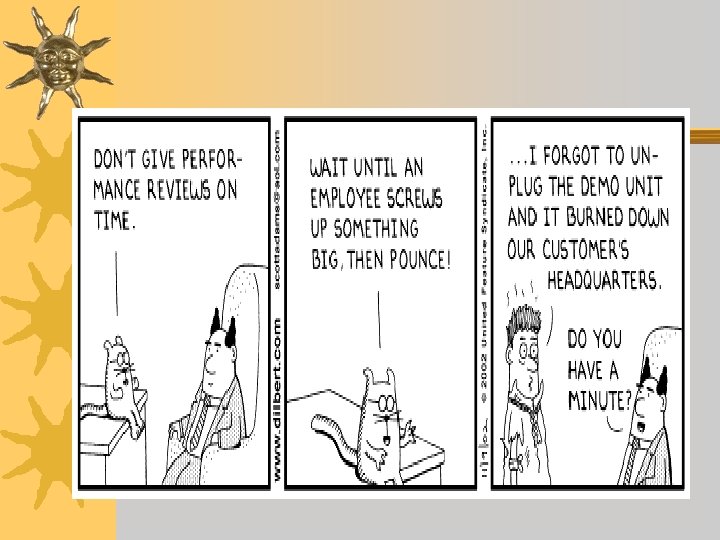
PERFORMANCE COUNSELLING - PURPOSE • Helping / enabling / empowering • Bridging perception gaps • Inspiring, motivating • Trust building • Creating choices and alternatives • Help recognise strength and weaknesses • Debottlenecking • Fine tuning the objectives
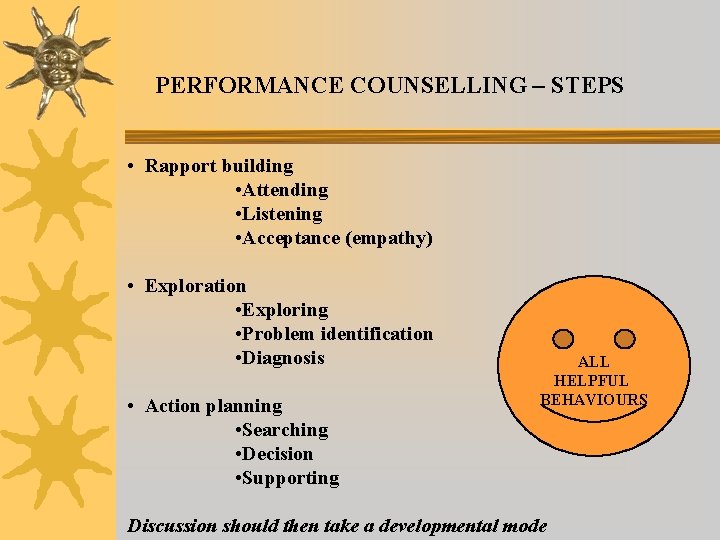
PERFORMANCE COUNSELLING – STEPS • Rapport building • Attending • Listening • Acceptance (empathy) • Exploration • Exploring • Problem identification • Diagnosis • Action planning • Searching • Decision • Supporting ALL HELPFUL BEHAVIOURS Discussion should then take a developmental mode
PERFORMANCE COUNSELLING Does AND Don'ts Dos • Greet • Invite to take a seat • Talk about personal matters • Maintain eye contact • Paraphrase • Keep all disturbances away • Share specific feelings • Be factual • Explore • Jointly identify problems • Jointly identify alternatives • Explore feasibility • Help taking decision • Offer help and support Don'ts • Starting off with a comment on behaviour • Attending to phone calls • Passive listening • Criticising, being judgmental • Suggesting a problem • Suggesting the cause • Advising • Directing, making a fixed plan • Promise of general help • Assumptions • Showing haste to end the meeting
PERFORMANCE COUNSELLING STATEMENTS THAT SWITCHES THE APPRAISEE OFF • Your work is not good ; You are not punctual – evaluative descriptive • Because of you, our department is getting a bad name – focused on person behaviour • I feel/understand that you don’t cooperate ; I am not sure if you are serious about the assignment that I gave you – Impression data based • Don’t waste company’s money by making so many customer visits – prescriptive Suggestive • I received a complaint from Suresh that you delay work; I am getting fed up of the complaints I receive for your department– based on what others say based on your views • Your IQ seems to be low, besides your height and complexion are irritating – Focused on behaviour that is difficult to change Focused on modifiable behaviour
GUIDELINES FOR A GOOD PERFORMANCE REVIEW MEETING • The meeting should be planned in advance • Sufficient time should be provided for the meeting (1 -1½ hours) • Meeting should take place neither in appraiser nor in the appraisee’s office. It should take place in a separate room as far as possible • An atmosphere of relaxation and trust should be established that would facilitate freedom of expression by both • All sources of distractions should be put away for the meeting
- Slides: 22