
Practice meeting Objectives Introduce the Antibiotic Optimisation online
Practice meeting Objectives Introduce the Antibiotic Optimisation online resources (HTTPS: //ANTIBIOTICOPTIMISATION. WEB. OX. AC. UK/) Introduce three strategies to optimise antibiotic use: 1. Tips on discussing antibiotics and using patient leaflet interactively 2. Using point-of-care C-Reactive Protein (POC CRP) tests 3. Using back-up/delayed antibiotic prescriptions Discuss the strategies and agree how you are going to use them in this practice V 1 Oct 2019
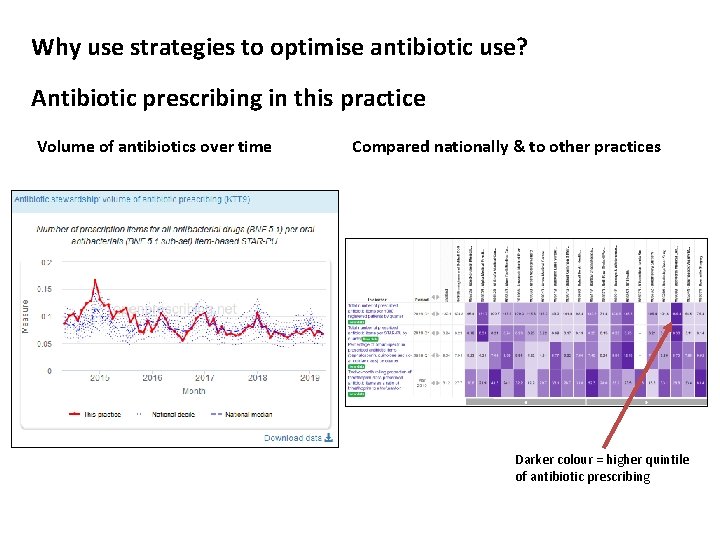
Why use strategies to optimise antibiotic use? Antibiotic prescribing in this practice Volume of antibiotics over time Compared nationally & to other practices Darker colour = higher quintile of antibiotic prescribing
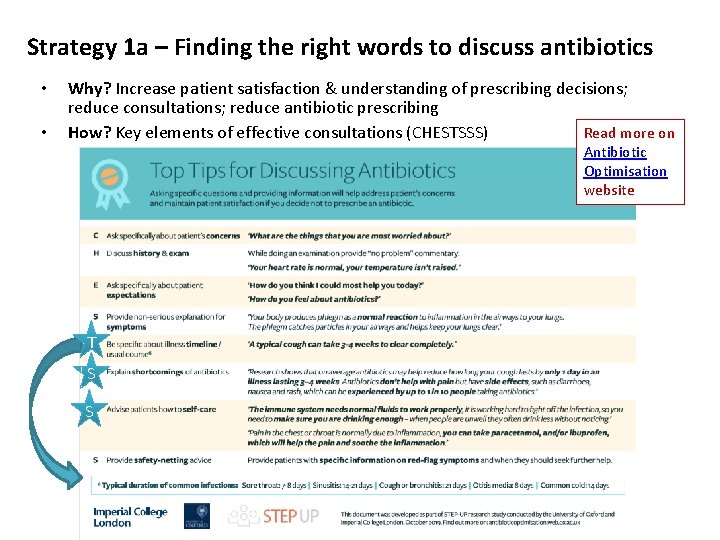
Strategy 1 a – Finding the right words to discuss antibiotics • • Why? Increase patient satisfaction & understanding of prescribing decisions; reduce consultations; reduce antibiotic prescribing Read more on How? Key elements of effective consultations (CHESTSSS) Antibiotic Optimisation website T S S
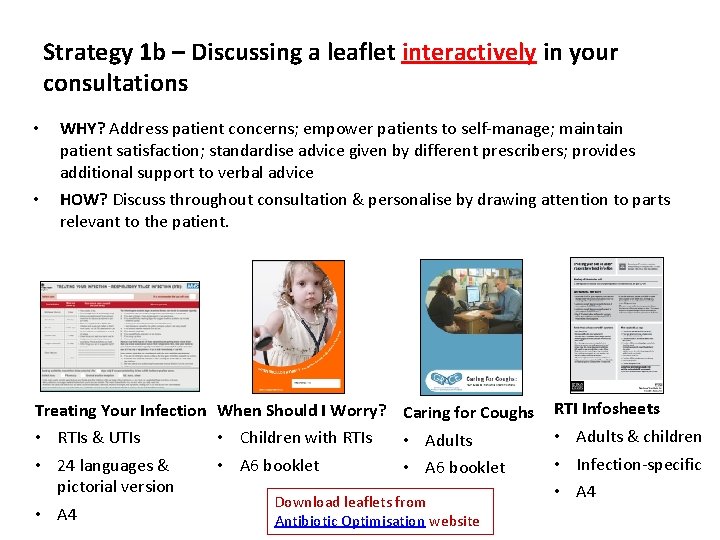
Strategy 1 b – Discussing a leaflet interactively in your consultations • WHY? Address patient concerns; empower patients to self-manage; maintain patient satisfaction; standardise advice given by different prescribers; provides additional support to verbal advice • HOW? Discuss throughout consultation & personalise by drawing attention to parts relevant to the patient. Treating Your Infection When Should I Worry? Caring for Coughs • RTIs & UTIs • Children with RTIs • Adults • 24 languages & pictorial version • A 4 • A 6 booklet Download leaflets from Antibiotic Optimisation website RTI Infosheets • Adults & children • Infection-specific • A 4

Strategy 2 – Using POC CRP testing • WHY? Useful in cases of clinical uncertainty to help differentiate a serious from selflimiting respiratory infection (NICE Guidelines (CG 191)); evidence shows it safely reduces antibiotic prescribing; relatively quick & easy; benchmarks your ‘gut feeling’ • HOW? Two types of tests are available as part of the study, giving you more flexibility CRP reading Afinion Sure. Screen Numeric result in range: Result as a line for CRP levels over: 10, 40 or 80 5 to over 200 Time for the result 3 -4 minutes Practicalities • Cartridges need to be removed from the fridge at least 15 min before use or can be stored at room temp for 4 weeks. 5 min (do not interpret the result after 8 minutes) • Tests can be stored at room temp until expiration date printed on the pouch. • The test must remain in the sealed pouch until use. • They need to be used within 10 min after opening the foil pouch. • Tests are portable. For instructions on how to use and interpret each test see Antibiotic Optimisation website
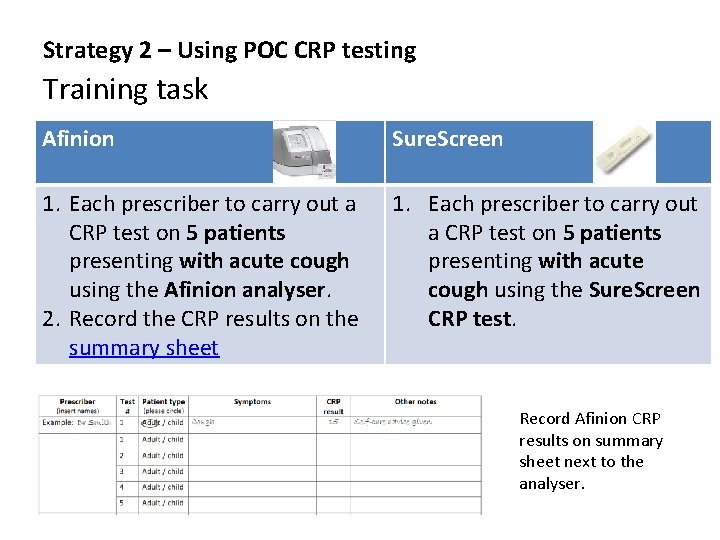
Strategy 2 – Using POC CRP testing Training task Afinion Sure. Screen 1. Each prescriber to carry out a CRP test on 5 patients presenting with acute cough using the Afinion analyser. 2. Record the CRP results on the summary sheet 1. Each prescriber to carry out a CRP test on 5 patients presenting with acute cough using the Sure. Screen CRP test. Record Afinion CRP results on summary sheet next to the analyser.
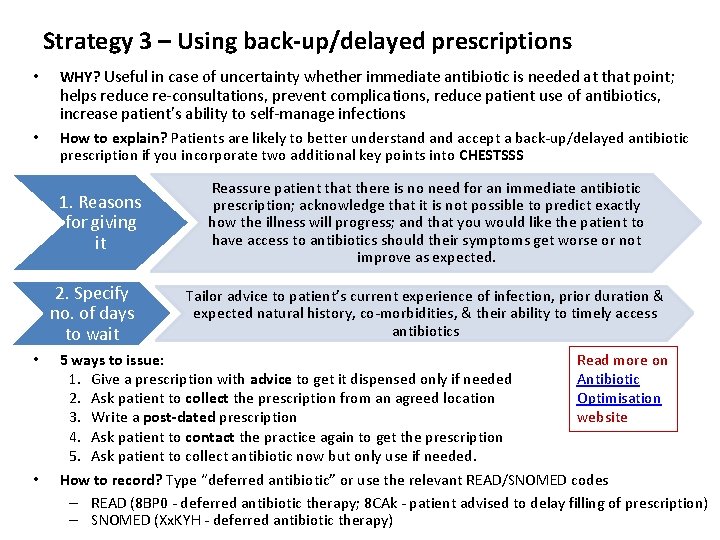
Strategy 3 – Using back-up/delayed prescriptions • WHY? Useful in case of uncertainty whether immediate antibiotic is needed at that point; • How to explain? Patients are likely to better understand accept a back-up/delayed antibiotic prescription if you incorporate two additional key points into CHESTSSS helps reduce re-consultations, prevent complications, reduce patient use of antibiotics, increase patient’s ability to self-manage infections 1. Reasons for giving it 2. Specify no. of days to wait • • Reassure patient that there is no need for an immediate antibiotic prescription; acknowledge that it is not possible to predict exactly how the illness will progress; and that you would like the patient to have access to antibiotics should their symptoms get worse or not improve as expected. Tailor advice to patient’s current experience of infection, prior duration & expected natural history, co-morbidities, & their ability to timely access antibiotics Read more on 5 ways to issue: Antibiotic 1. Give a prescription with advice to get it dispensed only if needed Optimisation 2. Ask patient to collect the prescription from an agreed location website 3. Write a post-dated prescription 4. Ask patient to contact the practice again to get the prescription 5. Ask patient to collect antibiotic now but only use if needed. How to record? Type “deferred antibiotic” or use the relevant READ/SNOMED codes – READ (8 BP 0 - deferred antibiotic therapy; 8 CAk - patient advised to delay filling of prescription) – SNOMED (Xx. KYH - deferred antibiotic therapy)
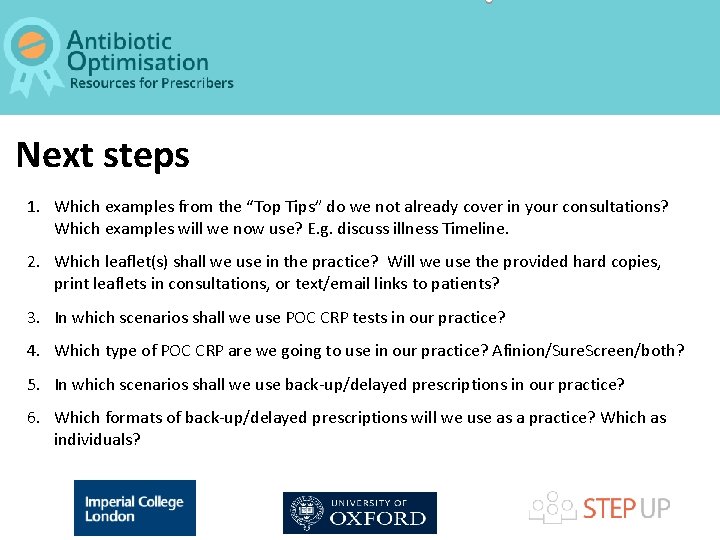
Next steps 1. Which examples from the “Top Tips” do we not already cover in your consultations? Which examples will we now use? E. g. discuss illness Timeline. 2. Which leaflet(s) shall we use in the practice? Will we use the provided hard copies, print leaflets in consultations, or text/email links to patients? 3. In which scenarios shall we use POC CRP tests in our practice? 4. Which type of POC CRP are we going to use in our practice? Afinion/Sure. Screen/both? 5. In which scenarios shall we use back-up/delayed prescriptions in our practice? 6. Which formats of back-up/delayed prescriptions will we use as a practice? Which as individuals?
- Slides: 8