
Practice Inquiry A Strong and Flexible Foundation for
Practice Inquiry A Strong and Flexible Foundation for the Medical Home Kimberly Duir MD, Contra Costa Regional Med Center Lucia Sommers Dr. PH, UCSF Nancy Morioka Douglas MD MPH, Stanford University
Overview • Introductions • Brief description of Practice Inquiry and potential role in the medical home. • Participate in Practice Inquiry Group • Debrief • Consider opportunities and challenges for implementation at home institution
History of Practice Inquiry • Dr. Lucia Sommers began these groups for primary care clinicians in 2002 • Original intent was epidemiologic and focused on clinical decision making. • “What kinds of cases are primary care MD’s stumped by? ” • Now shown to be helpful to clinicians in practice and residents in training.
Definition of Practice Inquiry • A facilitated small group process using group members’ most complex patients as content for practice based learning/improvement.
How is it Different? • Unlike most CME and QI it is inherently relevant. • Unlike Balint, it may include discussion of diagnostic, therapeutic, prognostic concerns, as well as doctor/patient relational concerns. • Unlike much QA/QI, clinicians experience it as helpful and supportive.
How is it Different? • Provides a supportive setting for sharing clinical uncertainty. • Logging presented cases allows us to track individual outcomes • Analyzing log data allows us to document need for targeted local CME and/or new directions for primary care research.
Why should it be built into the Medical Home? • As more simple functions are shunted to other team members, the proportion of complex patients for MD’s will increase. • The complexity and uncertainty of primary care practice is already burning out clinicians and scaring away medical students. • If we don’t create structural supports for primary care clinicians and residents, there may be nobody at the medical home when patients come knocking.
Why should it be built into the Medical Home? • Provides a structure for lifelong practice learning in a peer learning community. • Converts our most challenging patients into opportunities for creativity and iterative learning • Lessons learned benefit the entire practice. • The best outcomes for patients are achieved when doctors are given the time to talk and think together.
What are the essentials of Practice Inquiry? • Clinician identifies a case that creates “uncertainty” • Structure discussion with agenda that centers on the five inputs to clinical judgement. • The clinician whose case is being presented, “runs” the session by asking colleagues for help with the case.
What are the essentials of Practice Inquiry? • Blending the five inputs, the group crafts options for intervention for that patient. • Clinician provides the group with follow up on results of the intervention at the next session.
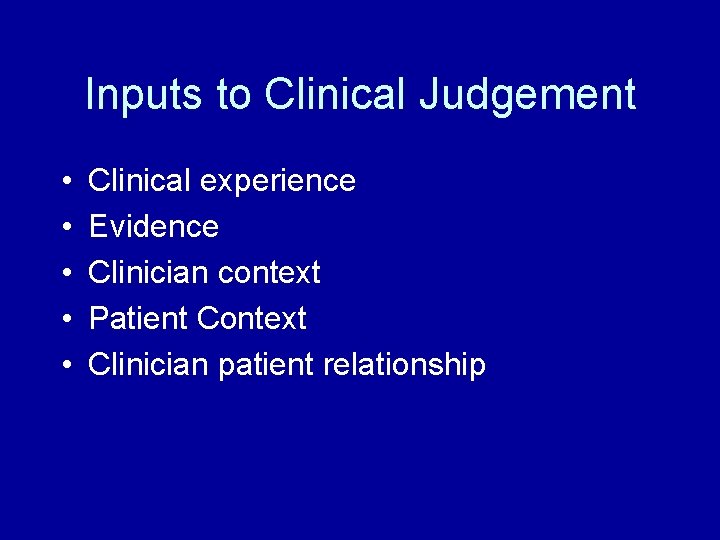
Inputs to Clinical Judgement • • • Clinical experience Evidence Clinician context Patient Context Clinician patient relationship
Role of the facilitator • Protect the presenter and the process. • Probe for all the inputs to clinical judgement. • Make sure that the group develops an intervention that feels good to the presenter before the session ends. • Maintain the case log, track follow up of cases, and reflect with the group on case log contents.
Let’s Do It! • Group of primary care clinicians with active patient panels (no more than 12) • Each think of a patient you saw last week that you “brought home” and write a brief descriptive phrase on a card. • Group of observers • While the clinicians are coming up with cases, review the observer tasks.
Debrief • How did it feel for the presenter? • How is uncertainty normalized and used to stimulate creativity? • What tactics did the facilitator use to help the group blend the inputs to clinical judgement and craft an intervention?
Debrief Were there examples of : • Identifying nature of uncertainty • Sharing relevant clinical experiences • Acknowledging knowledge/skill gaps • Probing for role of clinical literature • Checking back with presenter for their “take” on the process • Helping presenter to crystallize ideas on how to move forward with case. • Speculating on role of “relationship” in the case
Taking It Home • What ways could you imagine adapting this to your setting? • How does this work reinforce the foundational medical home principles for staff and learners? • How can PI strengthen the role of the personal physician, team practice, whole person orientation, quality and safety, coordination of care? • (review contents of take home packet)
- Slides: 16