
Practice guideline Occupational therapy in neonatal services and
- Slides: 26
Practice guideline Occupational therapy in neonatal services and early intervention Royal College of Occupational Therapists Specialist Section – Children, Young People and Families Neonatal Clinical Forum RCOT Implementation Toolkit/CPD Session © 2017 Royal College of Occupational Therapists. This Power. Point may be copied and adapted for non-commercial use www. RCOT. co. uk
Learning outcomes On completion of this professional development activity participants will be able to: • Explain the importance of using practice guidelines to inform practice. • Describe aspects of the practice guideline recommendations in relation to current practice. • Demonstrate how to use the RCOT Audit Form to benchmark against the evidence-based recommendations. RCOT Implementation Toolkit/CPD Session © 2017 Royal College of Occupational Therapists www. RCOT. co. uk 2
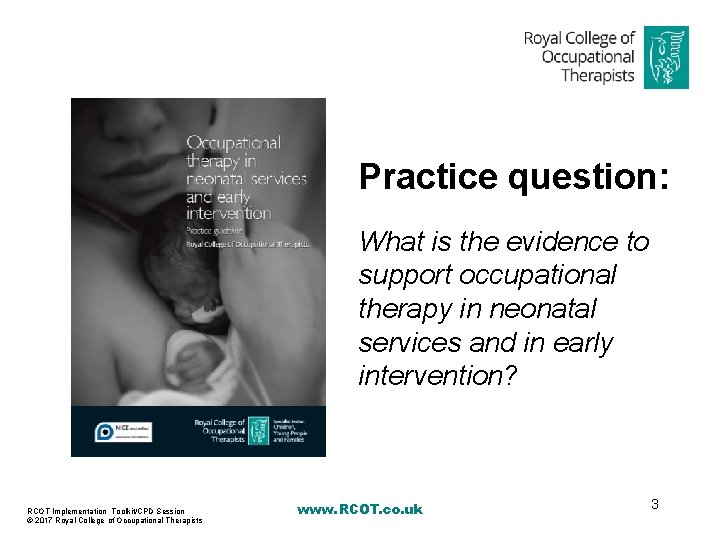
Practice question: What is the evidence to support occupational therapy in neonatal services and in early intervention? RCOT Implementation Toolkit/CPD Session © 2017 Royal College of Occupational Therapists www. RCOT. co. uk 3
Objective of the guideline To provide specific evidence-based recommendations which describe the most appropriate care or action to be taken by occupational therapists working in neonatal services or early intervention. RCOT Implementation Toolkit/CPD Session © 2017 Royal College of Occupational Therapists www. RCOT. co. uk 4
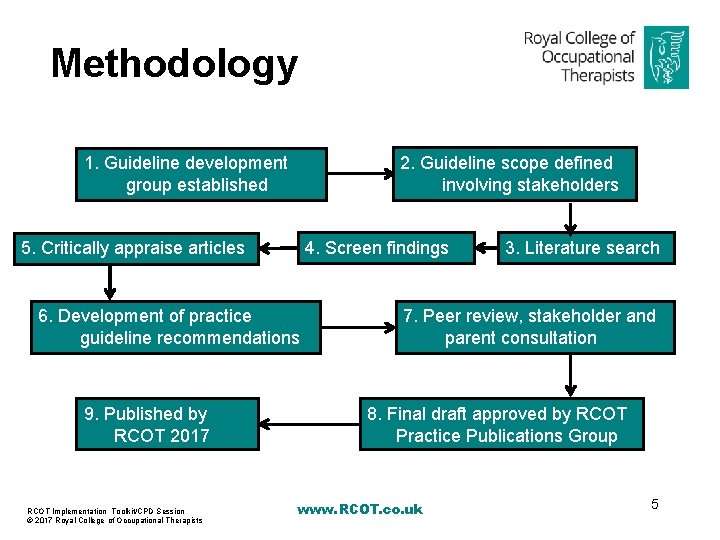
Methodology 2. Guideline scope defined involving stakeholders 1. Guideline development group established 4. Screen findings 5. Critically appraise articles 6. Development of practice guideline recommendations 9. Published by RCOT 2017 RCOT Implementation Toolkit/CPD Session © 2017 Royal College of Occupational Therapists 3. Literature search 7. Peer review, stakeholder and parent consultation 8. Final draft approved by RCOT Practice Publications Group www. RCOT. co. uk 5
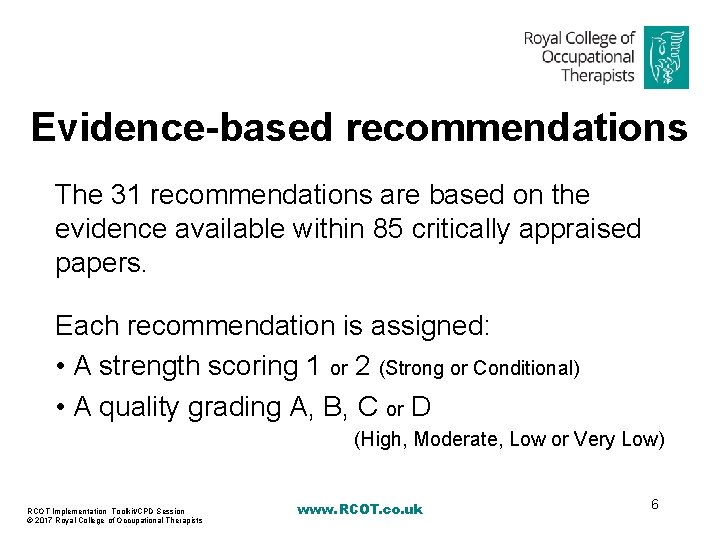
Evidence-based recommendations The 31 recommendations are based on the evidence available within 85 critically appraised papers. Each recommendation is assigned: • A strength scoring 1 or 2 (Strong or Conditional) • A quality grading A, B, C or D (High, Moderate, Low or Very Low) RCOT Implementation Toolkit/CPD Session © 2017 Royal College of Occupational Therapists www. RCOT. co. uk 6
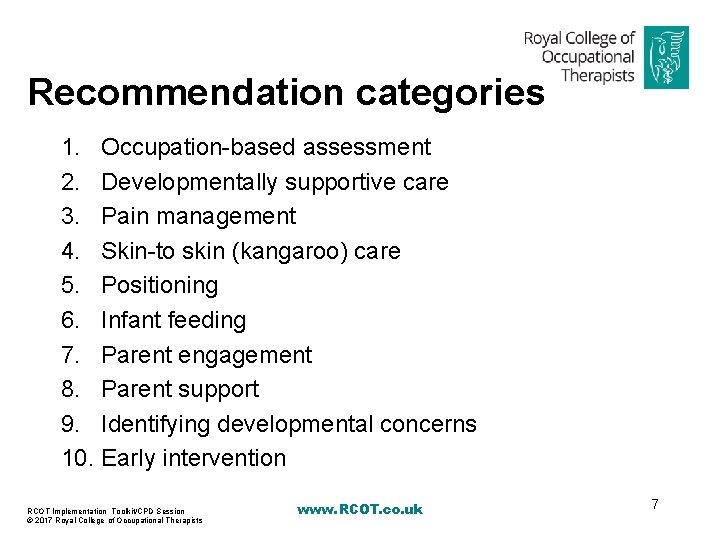
Recommendation categories 1. Occupation-based assessment 2. Developmentally supportive care 3. Pain management 4. Skin-to skin (kangaroo) care 5. Positioning 6. Infant feeding 7. Parent engagement 8. Parent support 9. Identifying developmental concerns 10. Early intervention RCOT Implementation Toolkit/CPD Session © 2017 Royal College of Occupational Therapists www. RCOT. co. uk 7
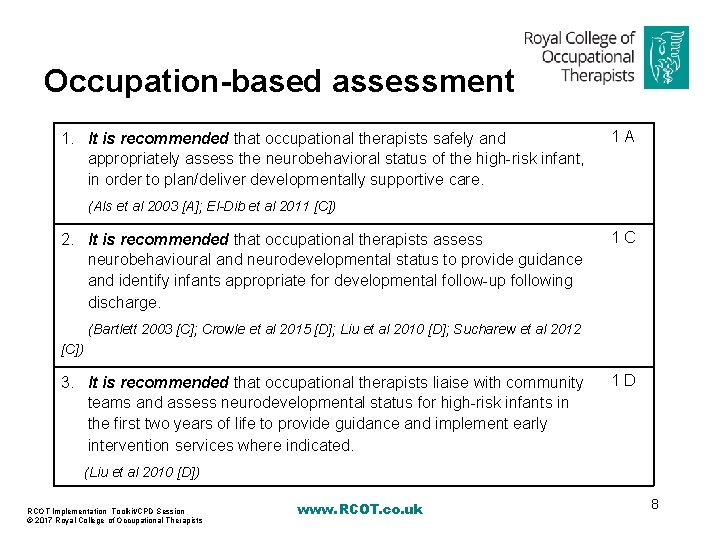
Occupation-based assessment 1. It is recommended that occupational therapists safely and appropriately assess the neurobehavioral status of the high-risk infant, in order to plan/deliver developmentally supportive care. 1 A (Als et al 2003 [A]; El-Dib et al 2011 [C]) 2. It is recommended that occupational therapists assess neurobehavioural and neurodevelopmental status to provide guidance and identify infants appropriate for developmental follow-up following discharge. 1 C (Bartlett 2003 [C]; Crowle et al 2015 [D]; Liu et al 2010 [D]; Sucharew et al 2012 [C]) 3. It is recommended that occupational therapists liaise with community teams and assess neurodevelopmental status for high-risk infants in the first two years of life to provide guidance and implement early intervention services where indicated. 1 D (Liu et al 2010 [D]) RCOT Implementation Toolkit/CPD Session © 2017 Royal College of Occupational Therapists www. RCOT. co. uk 8
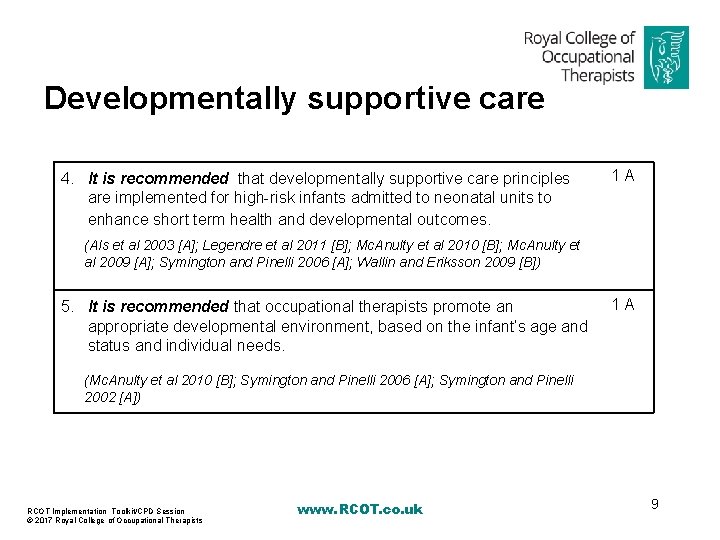
Developmentally supportive care 4. It is recommended that developmentally supportive care principles are implemented for high-risk infants admitted to neonatal units to enhance short term health and developmental outcomes. 1 A (Als et al 2003 [A]; Legendre et al 2011 [B]; Mc. Anulty et al 2010 [B]; Mc. Anulty et al 2009 [A]; Symington and Pinelli 2006 [A]; Wallin and Eriksson 2009 [B]) 5. It is recommended that occupational therapists promote an appropriate developmental environment, based on the infant’s age and status and individual needs. 1 A (Mc. Anulty et al 2010 [B]; Symington and Pinelli 2006 [A]; Symington and Pinelli 2002 [A]) RCOT Implementation Toolkit/CPD Session © 2017 Royal College of Occupational Therapists www. RCOT. co. uk 9
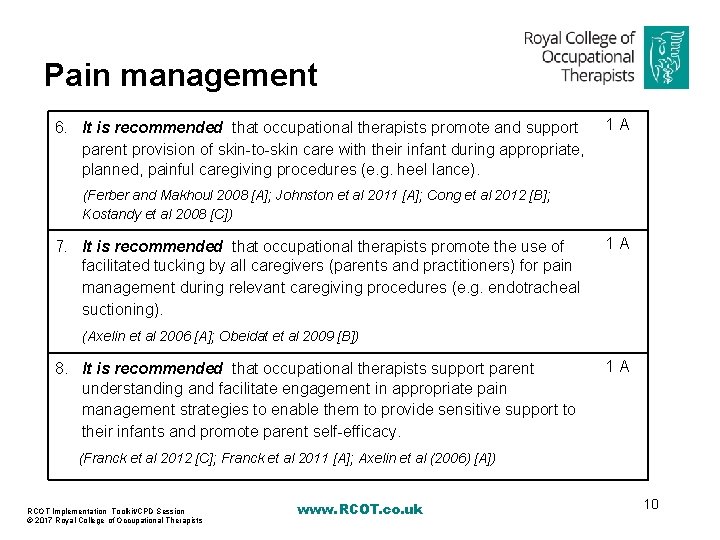
Pain management 6. It is recommended that occupational therapists promote and support parent provision of skin-to-skin care with their infant during appropriate, planned, painful caregiving procedures (e. g. heel lance). 1 A (Ferber and Makhoul 2008 [A]; Johnston et al 2011 [A]; Cong et al 2012 [B]; Kostandy et al 2008 [C]) 7. It is recommended that occupational therapists promote the use of facilitated tucking by all caregivers (parents and practitioners) for pain management during relevant caregiving procedures (e. g. endotracheal suctioning). 1 A (Axelin et al 2006 [A]; Obeidat et al 2009 [B]) 8. It is recommended that occupational therapists support parent understanding and facilitate engagement in appropriate pain management strategies to enable them to provide sensitive support to their infants and promote parent self-efficacy. 1 A (Franck et al 2012 [C]; Franck et al 2011 [A]; Axelin et al (2006) [A]) RCOT Implementation Toolkit/CPD Session © 2017 Royal College of Occupational Therapists www. RCOT. co. uk 10
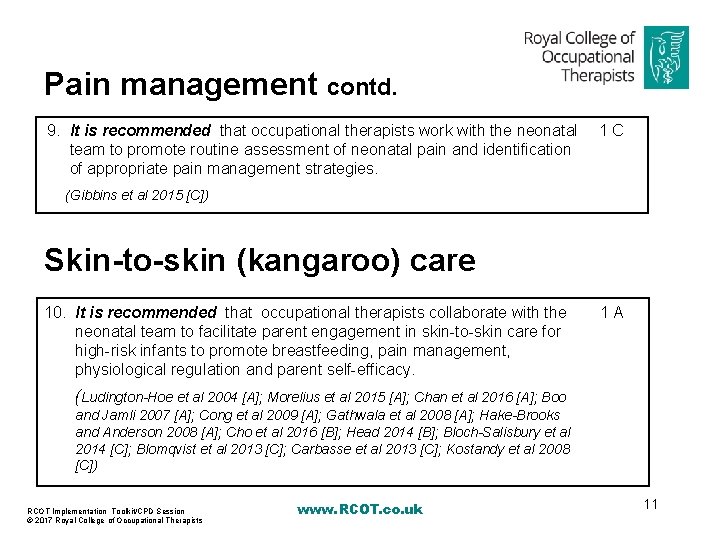
Pain management contd. 9. It is recommended that occupational therapists work with the neonatal team to promote routine assessment of neonatal pain and identification of appropriate pain management strategies. 1 C (Gibbins et al 2015 [C]) Skin-to-skin (kangaroo) care 10. It is recommended that occupational therapists collaborate with the neonatal team to facilitate parent engagement in skin-to-skin care for high-risk infants to promote breastfeeding, pain management, physiological regulation and parent self-efficacy. 1 A (Ludington-Hoe et al 2004 [A]; Morelius et al 2015 [A]; Chan et al 2016 [A]; Boo and Jamli 2007 [A]; Cong et al 2009 [A]; Gathwala et al 2008 [A]; Hake-Brooks and Anderson 2008 [A]; Cho et al 2016 [B]; Head 2014 [B]; Bloch-Salisbury et al 2014 [C]; Blomqvist et al 2013 [C]; Carbasse et al 2013 [C]; Kostandy et al 2008 [C]) RCOT Implementation Toolkit/CPD Session © 2017 Royal College of Occupational Therapists www. RCOT. co. uk 11
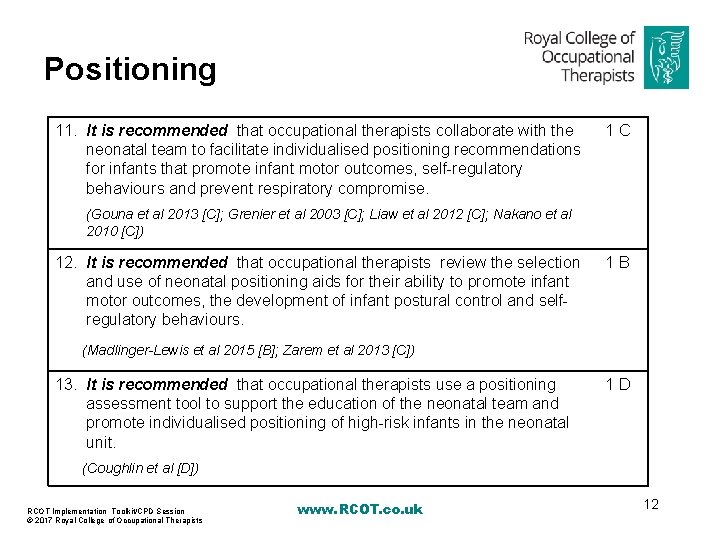
Positioning 11. It is recommended that occupational therapists collaborate with the neonatal team to facilitate individualised positioning recommendations for infants that promote infant motor outcomes, self-regulatory behaviours and prevent respiratory compromise. 1 C (Gouna et al 2013 [C]; Grenier et al 2003 [C]; Liaw et al 2012 [C]; Nakano et al 2010 [C]) 12. It is recommended that occupational therapists review the selection and use of neonatal positioning aids for their ability to promote infant motor outcomes, the development of infant postural control and selfregulatory behaviours. 1 B (Madlinger-Lewis et al 2015 [B]; Zarem et al 2013 [C]) 13. It is recommended that occupational therapists use a positioning assessment tool to support the education of the neonatal team and promote individualised positioning of high-risk infants in the neonatal unit. 1 D (Coughlin et al [D]) RCOT Implementation Toolkit/CPD Session © 2017 Royal College of Occupational Therapists www. RCOT. co. uk 12
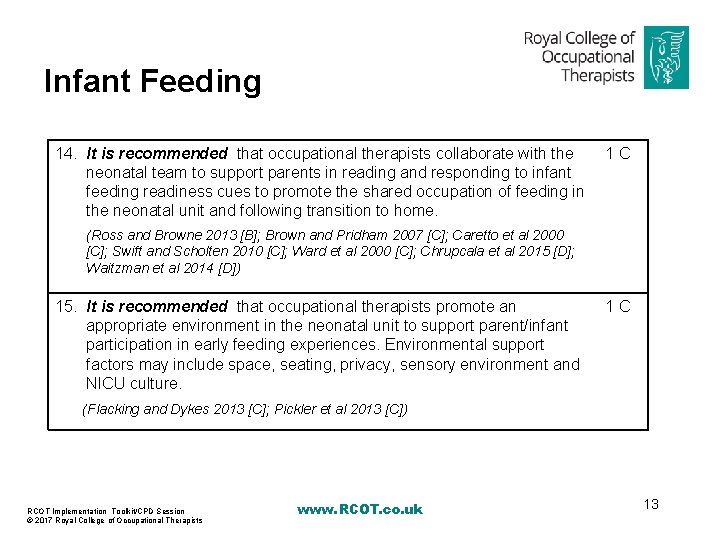
Infant Feeding 14. It is recommended that occupational therapists collaborate with the neonatal team to support parents in reading and responding to infant feeding readiness cues to promote the shared occupation of feeding in the neonatal unit and following transition to home. 1 C (Ross and Browne 2013 [B]; Brown and Pridham 2007 [C]; Caretto et al 2000 [C]; Swift and Scholten 2010 [C]; Ward et al 2000 [C]; Chrupcala et al 2015 [D]; Waitzman et al 2014 [D]) 15. It is recommended that occupational therapists promote an appropriate environment in the neonatal unit to support parent/infant participation in early feeding experiences. Environmental support factors may include space, seating, privacy, sensory environment and NICU culture. 1 C (Flacking and Dykes 2013 [C]; Pickler et al 2013 [C]) RCOT Implementation Toolkit/CPD Session © 2017 Royal College of Occupational Therapists www. RCOT. co. uk 13
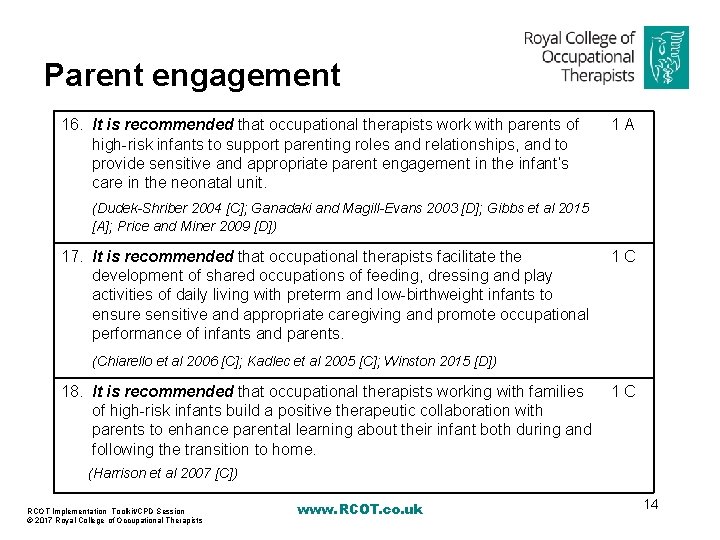
Parent engagement 16. It is recommended that occupational therapists work with parents of high-risk infants to support parenting roles and relationships, and to provide sensitive and appropriate parent engagement in the infant’s care in the neonatal unit. 1 A (Dudek-Shriber 2004 [C]; Ganadaki and Magill-Evans 2003 [D]; Gibbs et al 2015 [A]; Price and Miner 2009 [D]) 17. It is recommended that occupational therapists facilitate the development of shared occupations of feeding, dressing and play activities of daily living with preterm and low-birthweight infants to ensure sensitive and appropriate caregiving and promote occupational performance of infants and parents. 1 C (Chiarello et al 2006 [C]; Kadlec et al 2005 [C]; Winston 2015 [D]) 18. It is recommended that occupational therapists working with families of high-risk infants build a positive therapeutic collaboration with parents to enhance parental learning about their infant both during and following the transition to home. 1 C (Harrison et al 2007 [C]) RCOT Implementation Toolkit/CPD Session © 2017 Royal College of Occupational Therapists www. RCOT. co. uk 14
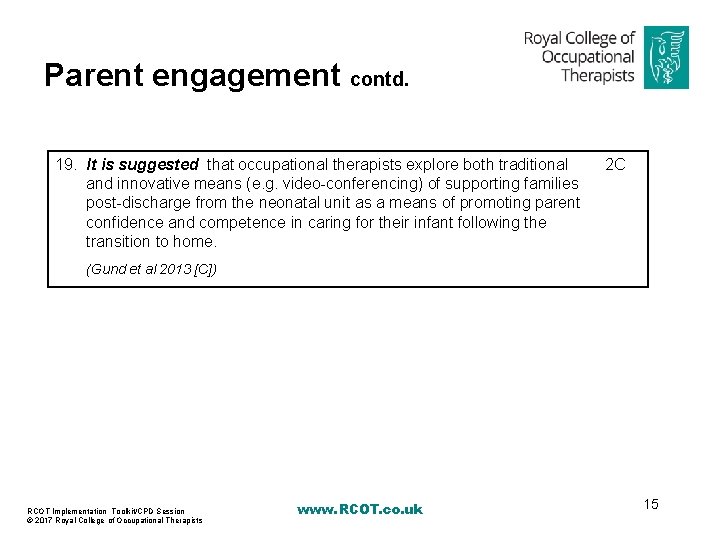
Parent engagement contd. 19. It is suggested that occupational therapists explore both traditional and innovative means (e. g. video-conferencing) of supporting families post-discharge from the neonatal unit as a means of promoting parent confidence and competence in caring for their infant following the transition to home. 2 C (Gund et al 2013 [C]) RCOT Implementation Toolkit/CPD Session © 2017 Royal College of Occupational Therapists www. RCOT. co. uk 15
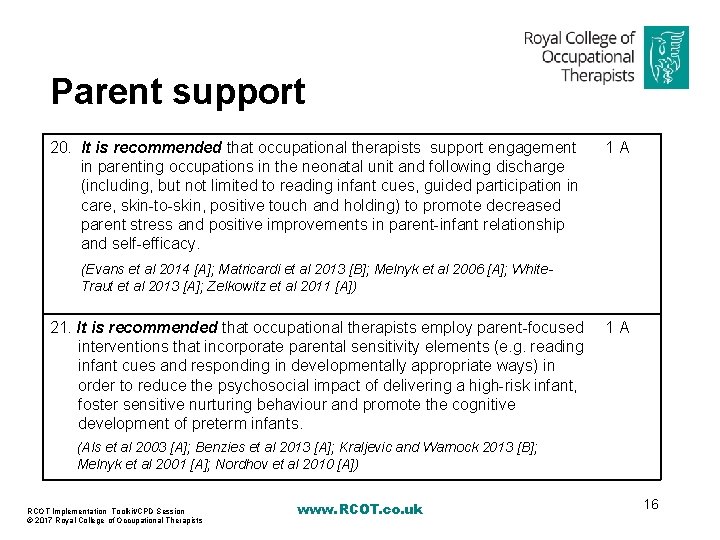
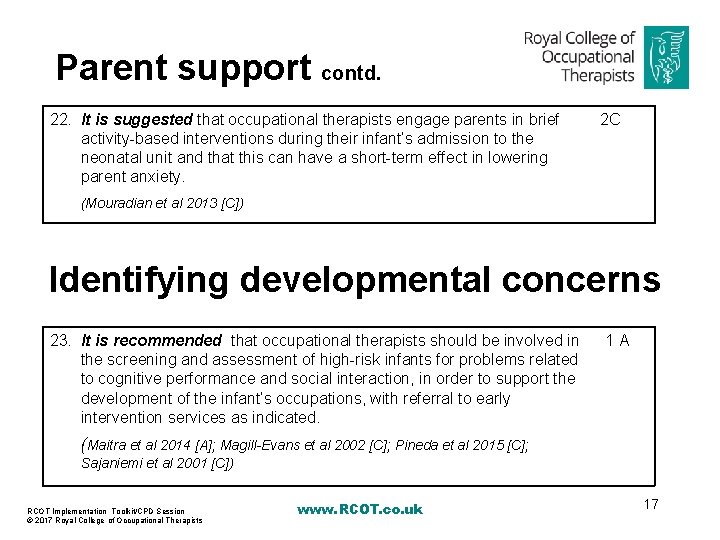
Parent support 20. It is recommended that occupational therapists support engagement in parenting occupations in the neonatal unit and following discharge (including, but not limited to reading infant cues, guided participation in care, skin-to-skin, positive touch and holding) to promote decreased parent stress and positive improvements in parent-infant relationship and self-efficacy. 1 A (Evans et al 2014 [A]; Matricardi et al 2013 [B]; Melnyk et al 2006 [A]; White. Traut et al 2013 [A]; Zelkowitz et al 2011 [A]) 21. It is recommended that occupational therapists employ parent-focused interventions that incorporate parental sensitivity elements (e. g. reading infant cues and responding in developmentally appropriate ways) in order to reduce the psychosocial impact of delivering a high-risk infant, foster sensitive nurturing behaviour and promote the cognitive development of preterm infants. 1 A (Als et al 2003 [A]; Benzies et al 2013 [A]; Kraljevic and Warnock 2013 [B]; Melnyk et al 2001 [A]; Nordhov et al 2010 [A]) RCOT Implementation Toolkit/CPD Session © 2017 Royal College of Occupational Therapists www. RCOT. co. uk 16
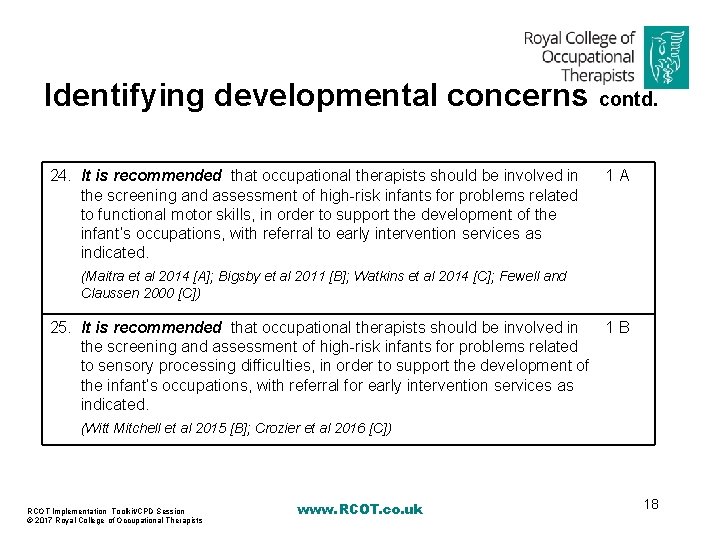
Parent support contd. 22. It is suggested that occupational therapists engage parents in brief activity-based interventions during their infant’s admission to the neonatal unit and that this can have a short-term effect in lowering parent anxiety. 2 C (Mouradian et al 2013 [C]) Identifying developmental concerns 23. It is recommended that occupational therapists should be involved in the screening and assessment of high-risk infants for problems related to cognitive performance and social interaction, in order to support the development of the infant’s occupations, with referral to early intervention services as indicated. 1 A (Maitra et al 2014 [A]; Magill-Evans et al 2002 [C]; Pineda et al 2015 [C]; Sajaniemi et al 2001 [C]) RCOT Implementation Toolkit/CPD Session © 2017 Royal College of Occupational Therapists www. RCOT. co. uk 17
Identifying developmental concerns contd. 24. It is recommended that occupational therapists should be involved in the screening and assessment of high-risk infants for problems related to functional motor skills, in order to support the development of the infant’s occupations, with referral to early intervention services as indicated. 1 A (Maitra et al 2014 [A]; Bigsby et al 2011 [B]; Watkins et al 2014 [C]; Fewell and Claussen 2000 [C]) 25. It is recommended that occupational therapists should be involved in 1 B the screening and assessment of high-risk infants for problems related to sensory processing difficulties, in order to support the development of the infant’s occupations, with referral for early intervention services as indicated. (Witt Mitchell et al 2015 [B]; Crozier et al 2016 [C]) RCOT Implementation Toolkit/CPD Session © 2017 Royal College of Occupational Therapists www. RCOT. co. uk 18
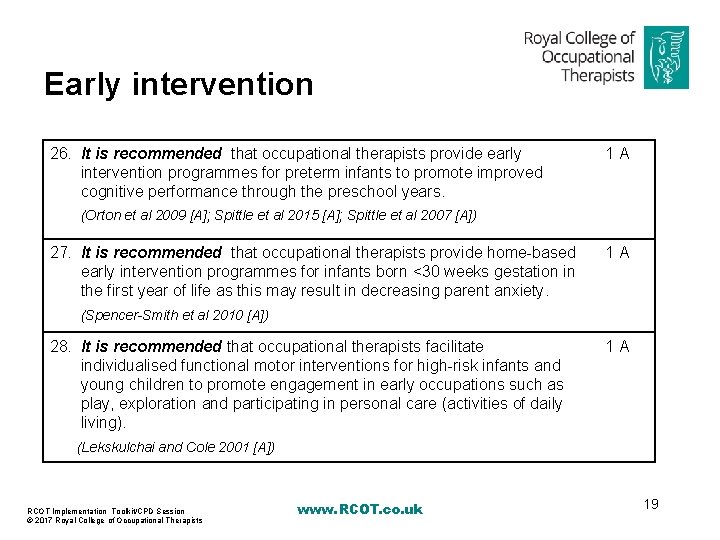
Early intervention 26. It is recommended that occupational therapists provide early intervention programmes for preterm infants to promote improved cognitive performance through the preschool years. 1 A (Orton et al 2009 [A]; Spittle et al 2015 [A]; Spittle et al 2007 [A]) 27. It is recommended that occupational therapists provide home-based early intervention programmes for infants born <30 weeks gestation in the first year of life as this may result in decreasing parent anxiety. 1 A (Spencer-Smith et al 2010 [A]) 28. It is recommended that occupational therapists facilitate individualised functional motor interventions for high-risk infants and young children to promote engagement in early occupations such as play, exploration and participating in personal care (activities of daily living). 1 A (Lekskulchai and Cole 2001 [A]) RCOT Implementation Toolkit/CPD Session © 2017 Royal College of Occupational Therapists www. RCOT. co. uk 19
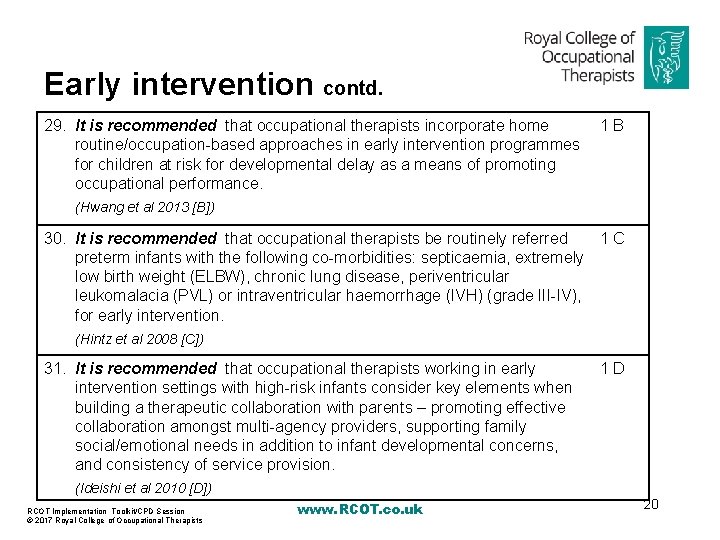
Early intervention contd. 29. It is recommended that occupational therapists incorporate home routine/occupation-based approaches in early intervention programmes for children at risk for developmental delay as a means of promoting occupational performance. 1 B (Hwang et al 2013 [B]) 30. It is recommended that occupational therapists be routinely referred 1 C preterm infants with the following co-morbidities: septicaemia, extremely low birth weight (ELBW), chronic lung disease, periventricular leukomalacia (PVL) or intraventricular haemorrhage (IVH) (grade III-IV), for early intervention. (Hintz et al 2008 [C]) 31. It is recommended that occupational therapists working in early intervention settings with high-risk infants consider key elements when building a therapeutic collaboration with parents – promoting effective collaboration amongst multi-agency providers, supporting family social/emotional needs in addition to infant developmental concerns, and consistency of service provision. 1 D (Ideishi et al 2010 [D]) RCOT Implementation Toolkit/CPD Session © 2017 Royal College of Occupational Therapists www. RCOT. co. uk 20
Parents perspectives In your experience, what do you think is the most important support that neonatal occupational therapists could/did provide to you and your baby? “Reassurance – some support that our daughter was progressing well. It was positive that OTs look at the ‘person’ not a scan; as a parent this is what you want to hear” “Helping us to feel confident about babies’ needs and developmental care” “Just having easy access to an OT” 21
Impact of practice guideline for you: the practitioner • Challenges / affirms your current practice. • Provides evidence-based recommendations to inform and support your practice. • Raises awareness of benefits and risks and organisational and financial barriers. • Provides a vehicle for you to audit your practice. • Assists in communicating your role to members of the multidisciplinary team. RCOT Implementation Toolkit/CPD Session © 2017 Royal College of Occupational Therapists www. RCOT. co. uk 22
Impact of practice guideline for managers • Provides evidence of the need for occupational therapy in neonatal services and early intervention • Provides a structure to audit the work of occupational therapists within the neonatal services to improve service quality. • Provides a vehicle for justifying service provision. RCOT Implementation Toolkit/CPD Session © 2017 Royal College of Occupational Therapists www. RCOT. co. uk 23
Impact of practice guideline for commissioners • Articulates the need for occupational therapy interventions within neonatal services. • Provides recommendations developed by a NICE Accredited process. • Can help educate commissioners to identify learning needs for the workforce. • Audit form provides a mechanism to review service delivery in accordance with the evidence. RCOT Implementation Toolkit/CPD Session © 2017 Royal College of Occupational Therapists www. RCOT. co. uk 24
Impact of practice guideline for parents and high-risk infants • The recommendations reinforce the fundamental importance of the parents’ perspective. • In being adopted by services and occupational therapists, the guideline should improve the consistency and quality of intervention for users of services. • Gives assurance that practitioners use the available evidence to support interventions. RCOT Implementation Toolkit/CPD Session © 2017 Royal College of Occupational Therapists www. RCOT. co. uk 25
Practice guideline resources • Royal College of Occupational Therapists (2017) Occupational therapy in neonatal services and early intervention: practice guideline. London: RCOT. • Audit form • Quick Reference Guide • Guideline implementation tips. Resources are available from the College’s website at: https: //www. rcot. co. uk/practice-resources/rcot-practiceguidelines RCOT Implementation Toolkit/CPD Session © 2017 Royal College of Occupational Therapists www. RCOT. co. uk 26