
Practice Exercise 5 Developing Deeper Understanding Expressing Respect

- Slides: 12
Practice Exercise 5 Developing Deeper Understanding & Expressing Respect
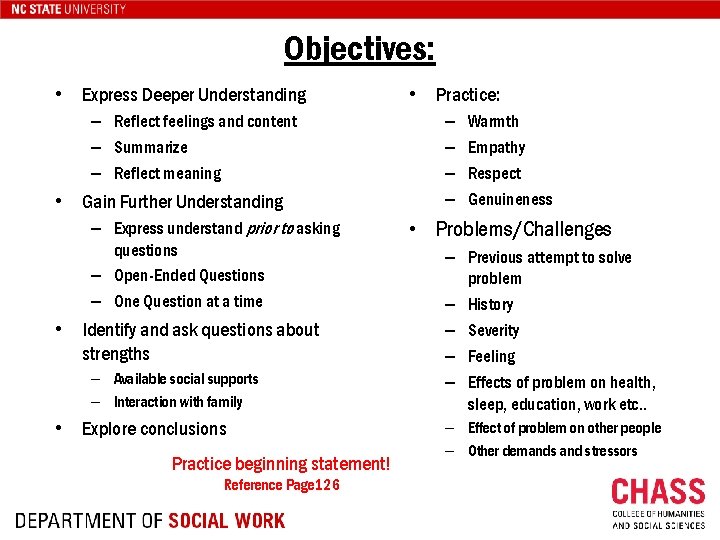
Objectives: • Express Deeper Understanding – Reflect feelings and content – Summarize – Reflect meaning • Gain Further Understanding – Express understand prior to asking questions – Open-Ended Questions – One Question at a time • Identify and ask questions about strengths – Available social supports – Interaction with family • Explore conclusions Practice beginning statement! Reference Page 126 • Practice: – – Warmth Empathy Respect Genuineness • Problems/Challenges – Previous attempt to solve problem – History – Severity – Feeling – Effects of problem on health, sleep, education, work etc. . – Effect of problem on other people – Other demands and stressors
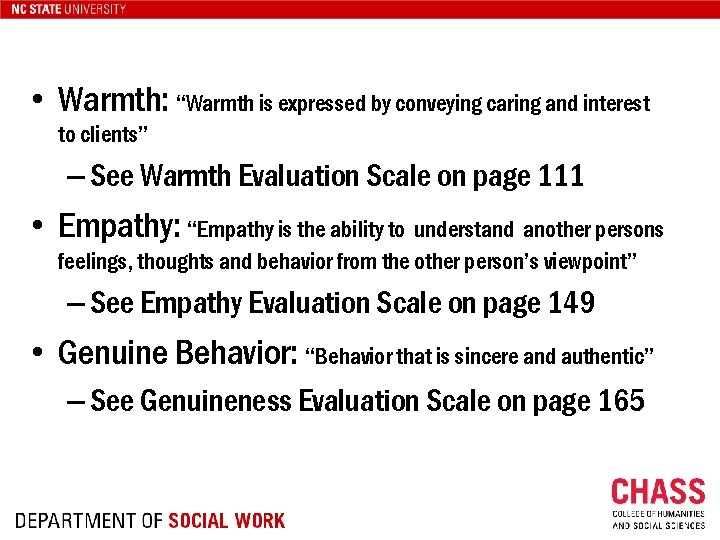
• Warmth: “Warmth is expressed by conveying caring and interest to clients” – See Warmth Evaluation Scale on page 111 • Empathy: “Empathy is the ability to understand another persons feelings, thoughts and behavior from the other person’s viewpoint” – See Empathy Evaluation Scale on page 149 • Genuine Behavior: “Behavior that is sincere and authentic” – See Genuineness Evaluation Scale on page 165
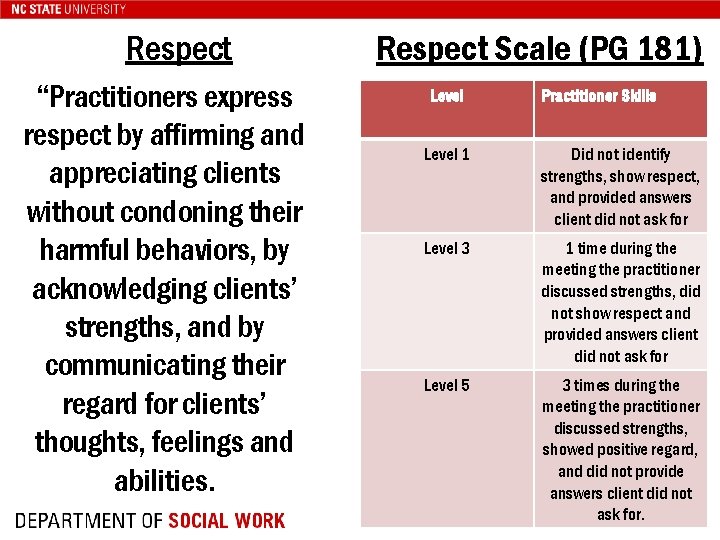
Respect “Practitioners express respect by affirming and appreciating clients without condoning their harmful behaviors, by acknowledging clients’ strengths, and by communicating their regard for clients’ thoughts, feelings and abilities. Respect Scale (PG 181) Level Practitioner Skills Level 1 Did not identify strengths, show respect, and provided answers client did not ask for Level 3 1 time during the meeting the practitioner discussed strengths, did not show respect and provided answers client did not ask for Level 5 3 times during the meeting the practitioner discussed strengths, showed positive regard, and did not provide answers client did not ask for.
Procedure • In your group please spend ten minutes on each role so that every person may have an opportunity. – Client – Practitioner – Peer Supervisor • The peer supervisor is the group time keeper
Role of the Client • Think about a problem from your own life • This can be a problem from the past or one that is more recent • If you discuss a past event please do so as your current self- be careful not to “role play” • Don’t forget to pause to allow the practitioner a chance to respond
Role of the Practitioner • Look for body language- is it present? – Explore meaning of body language • Use clarifying words – Ex from Video: “Has the doctor told you that? ” – Where did the conclusion come from? • You are practicing the following: – Expressing understanding – Gaining further information – Developing a deeper understanding • Allowing for silence
A few reminders… Its ok not to be perfect! You do not have to solve the problem! You may not use all of the skills
Role of the Peer Supervisor • Write down feedback – give as specific examples as possible • Goal is to provide practitioner with feedback and effectively evaluate skills – the purpose is to let them know how to improve and grow!
Notes about Feedback • Ask practitioner “how do you think you did? ” • Ask client “how was it for you? ” • Allow client to give perspective on ways practitioner expressed warmth, empathy, respect and genuineness. • Discuss with client ways experience could have been improved • Practitioner should self evaluate and discuss with group • Identify inappropriate responses
References Chang, V. , Scott, S. , & Decker, C. (2013). Developing helping skills a step-by-step approach to competency. Belmont: Cengage Learning.