
Practice Basics Chapter 14 Pharmacy Calculations Learning Outcomes
Practice Basics Chapter 14: Pharmacy Calculations
Learning Outcomes Explain importance of standardized approach for math Convert between fractions, decimals, percentages Convert between different systems of measurement Perform & check key pharmacy calculations: to interpret prescriptions involving patient-specific information
Key Terms Alligation method Apothecary system Avoirdupois system Body mass index (BMI) Body surface area (BSA) Days supply
Key Terms Denominator Fraction Household system Ideal body weight (IBW) Metric system Numerator Proportion Ratio strengths
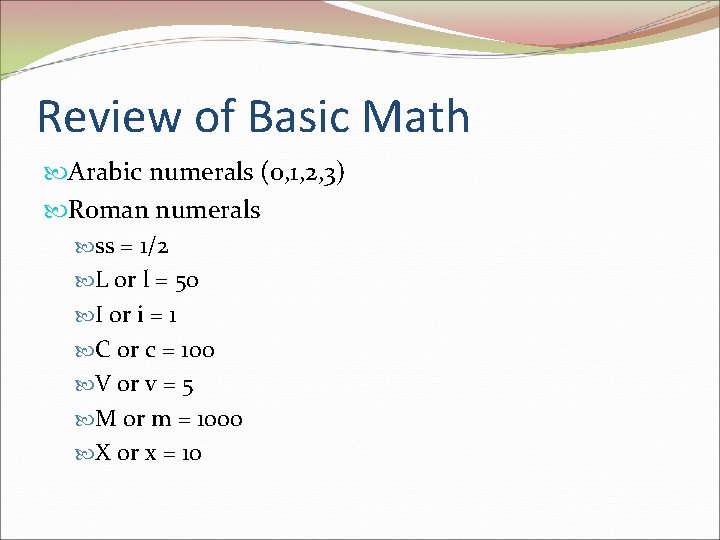
Review of Basic Math Arabic numerals (0, 1, 2, 3) Roman numerals ss = 1/2 L or l = 50 I or i = 1 C or c = 100 V or v = 5 M or m = 1000 X or x = 10
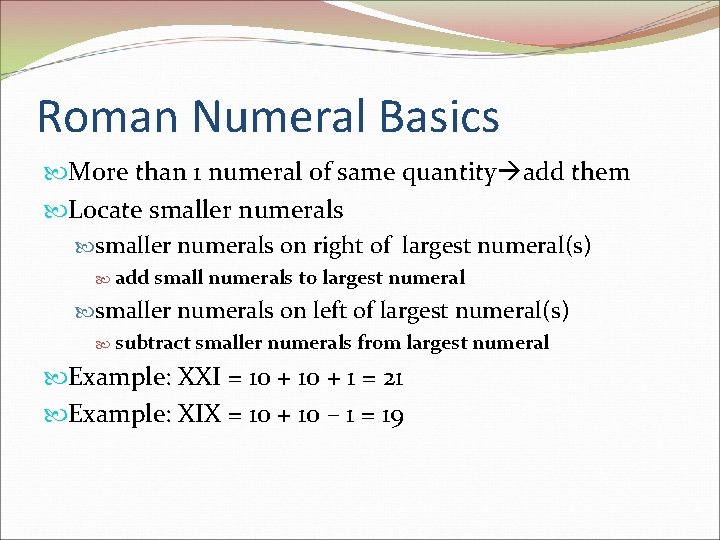
Roman Numeral Basics More than 1 numeral of same quantity add them Locate smaller numerals on right of largest numeral(s) add small numerals to largest numeral smaller numerals on left of largest numeral(s) subtract smaller numerals from largest numeral Example: XXI = 10 + 1 = 21 Example: XIX = 10 + 10 – 1 = 19
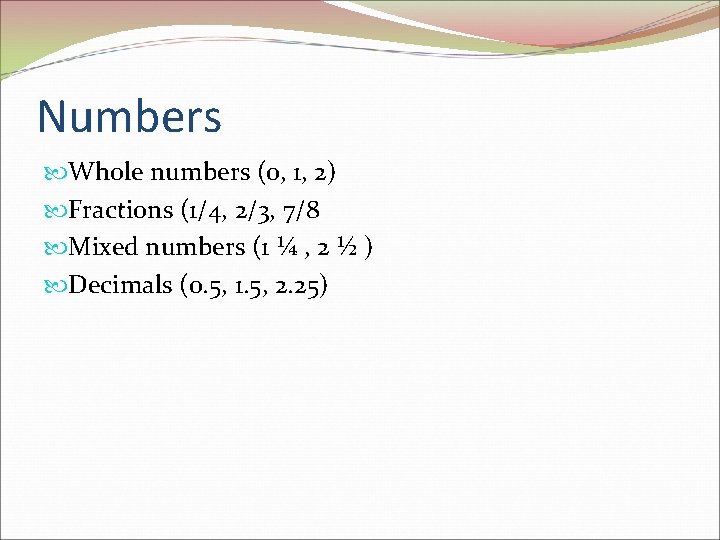
Numbers Whole numbers (0, 1, 2) Fractions (1/4, 2/3, 7/8 Mixed numbers (1 ¼ , 2 ½ ) Decimals (0. 5, 1. 5, 2. 25)
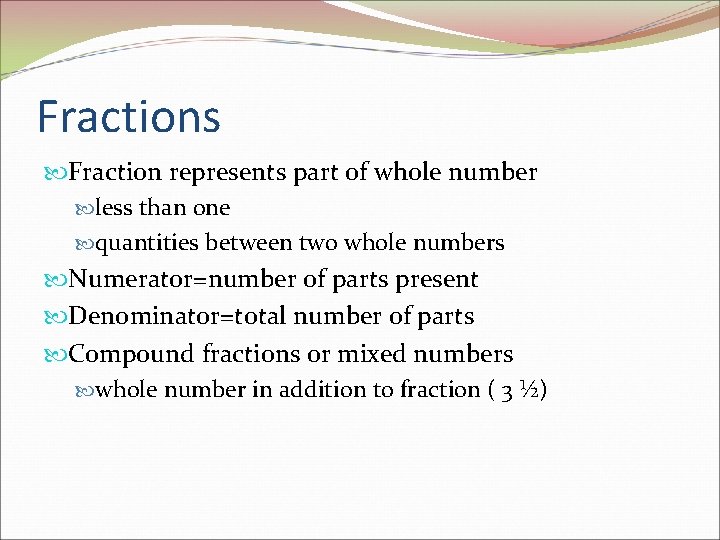
Fractions Fraction represents part of whole number less than one quantities between two whole numbers Numerator=number of parts present Denominator=total number of parts Compound fractions or mixed numbers whole number in addition to fraction ( 3 ½)
Fractions in Pharmacy IV fluids include 1/2 NS (one-half normal saline) 1/4 NS (one-quarter normal saline) 3/4 teaspoon Med errors may occur if someone mistakes the / for a 1
Simplify or Reduce Fractions Find greatest number that can divide into numerator and denominator evenly Fractions should be represented in simplest form Example: Simplify the fraction 66/100 66 divided by 2 ⇒ 33 100 divided by 2 ⇒ 50 This fraction cannot be reduced further because no single number can be divided into both 33 and 50 evenly Answer: 33/50
Adding Fractions 1. Make sure all fractions have common denominators Example: 3/4 + 2/3 3/4 * 3/3 = 9/12 2/3 * 4/4 = 8/12 2. Add the numerators 9/12 + 8/12 = 17/12 3. Reduce to simplest fraction or mixed number 17/12 = 1 5/12
Subtracting Fractions 1. Make sure all fractions have common denominators Example: 1 7/8 – ½ 1 7/8=1 + 7/8=8/8 + 7/8=15/8 1/2 * 4/4 = 4/8 2. Subtract the numerators 15/8 – 4/8 = 11/8 3. Simplify the fraction subtract 8 from the numerator to represent one whole number 11/8 = 1 3/8
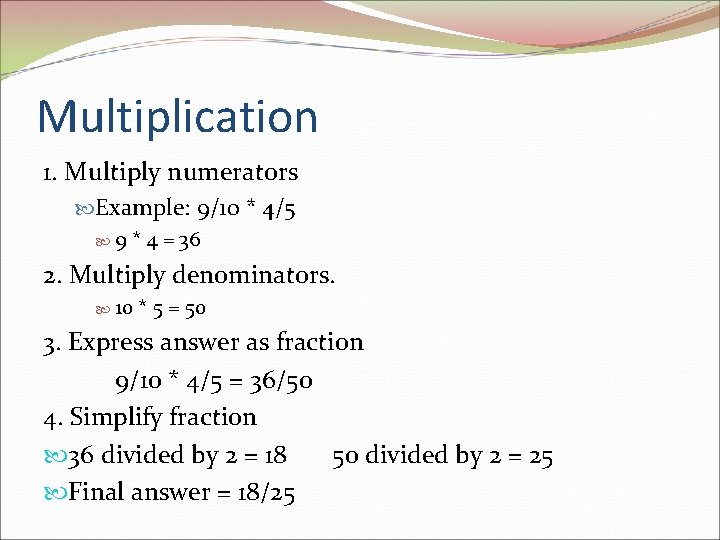
Multiplication 1. Multiply numerators Example: 9/10 * 4/5 9 * 4 = 36 2. Multiply denominators. 10 * 5 = 50 3. Express answer as fraction 9/10 * 4/5 = 36/50 4. Simplify fraction 36 divided by 2 = 18 50 divided by 2 = 25 Final answer = 18/25
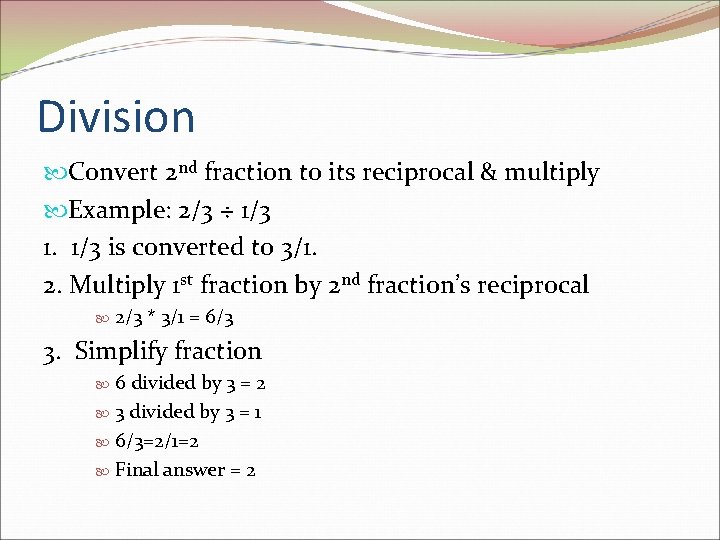
Division Convert 2 nd fraction to its reciprocal & multiply Example: 2/3 ÷ 1/3 1. 1/3 is converted to 3/1. 2. Multiply 1 st fraction by 2 nd fraction’s reciprocal 2/3 * 3/1 = 6/3 3. Simplify fraction 6 divided by 3 = 2 3 divided by 3 = 1 6/3=2/1=2 Final answer = 2
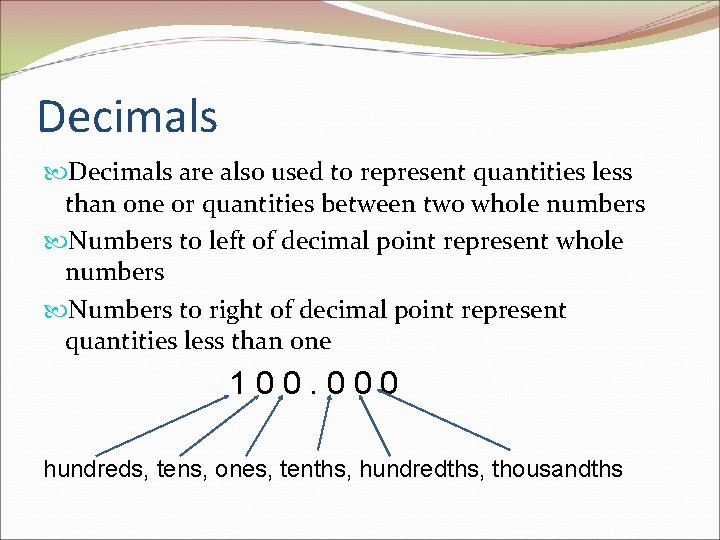
Decimals are also used to represent quantities less than one or quantities between two whole numbers Numbers to left of decimal point represent whole numbers Numbers to right of decimal point represent quantities less than one 100. 000 hundreds, tens, ones, tenths, hundredths, thousandths
Decimal Errors Medication errors can occur decimals are used incorrectly or misinterpreted sloppy handwriting, stray pen marks, poor quality faxes copies can lead to misinterpretation To avoid errors use decimals appropriately never use trailing zero- not needed ( 5 mg, not 5. 0 mg) always use leading zero (0. 5 mg not. 5 mg)
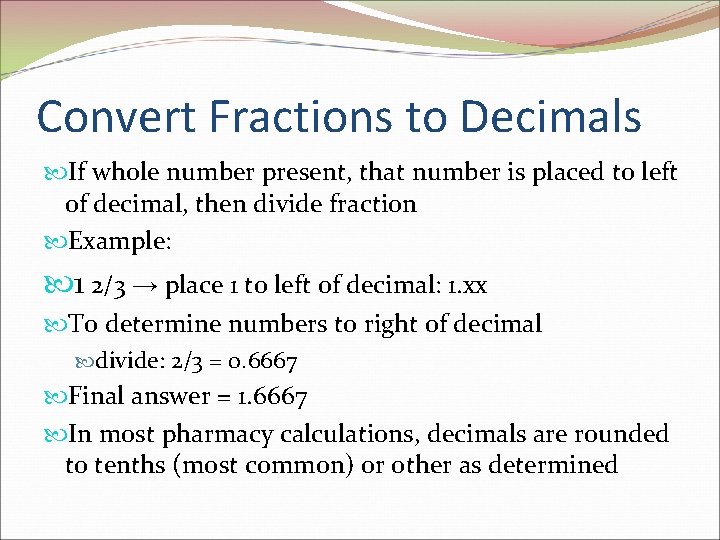
Convert Fractions to Decimals If whole number present, that number is placed to left of decimal, then divide fraction Example: 1 2/3 → place 1 to left of decimal: 1. xx To determine numbers to right of decimal divide: 2/3 = 0. 6667 Final answer = 1. 6667 In most pharmacy calculations, decimals are rounded to tenths (most common) or other as determined
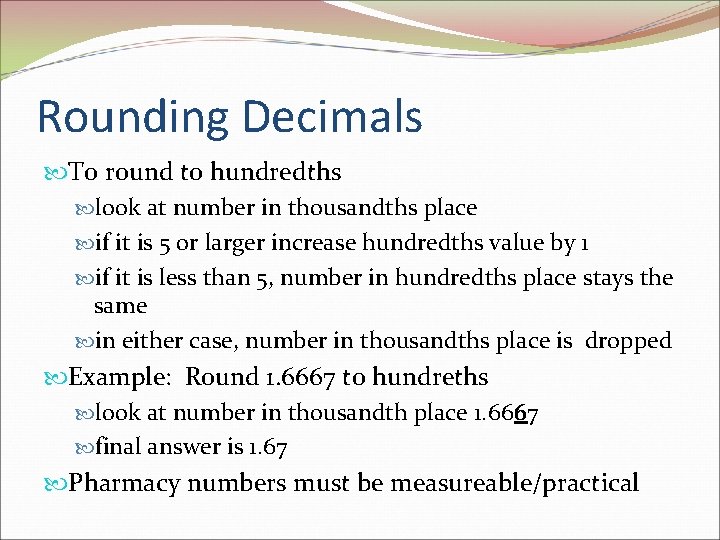
Rounding Decimals To round to hundredths look at number in thousandths place if it is 5 or larger increase hundredths value by 1 if it is less than 5, number in hundredths place stays the same in either case, number in thousandths place is dropped Example: Round 1. 6667 to hundreths look at number in thousandth place 1. 6667 final answer is 1. 67 Pharmacy numbers must be measureable/practical
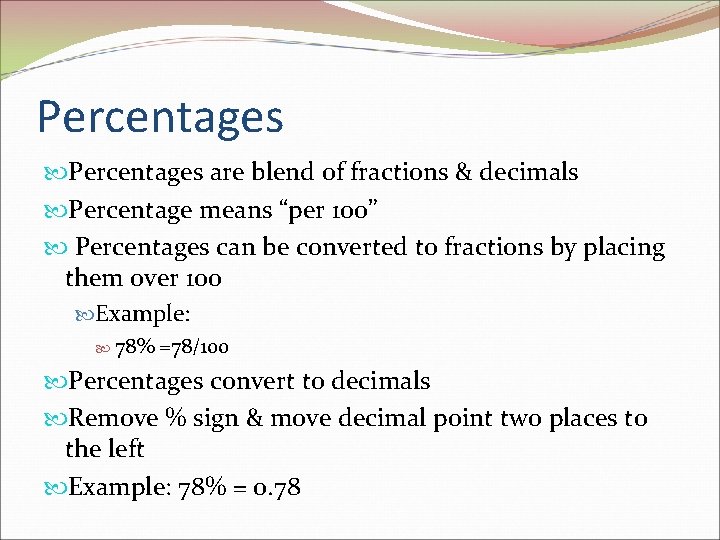
Percentages are blend of fractions & decimals Percentage means “per 100” Percentages can be converted to fractions by placing them over 100 Example: 78% =78/100 Percentages convert to decimals Remove % sign & move decimal point two places to the left Example: 78% = 0. 78
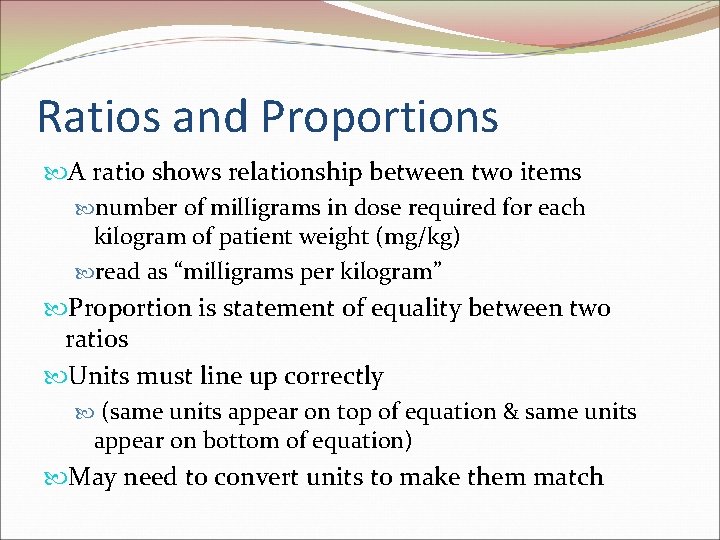
Ratios and Proportions A ratio shows relationship between two items number of milligrams in dose required for each kilogram of patient weight (mg/kg) read as “milligrams per kilogram” Proportion is statement of equality between two ratios Units must line up correctly (same units appear on top of equation & same units appear on bottom of equation) May need to convert units to make them match
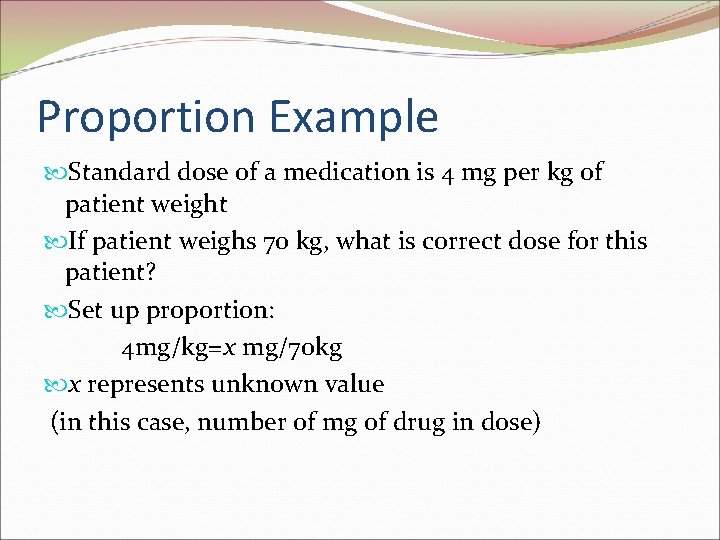
Proportion Example Standard dose of a medication is 4 mg per kg of patient weight If patient weighs 70 kg, what is correct dose for this patient? Set up proportion: 4 mg/kg=x mg/70 kg x represents unknown value (in this case, number of mg of drug in dose)
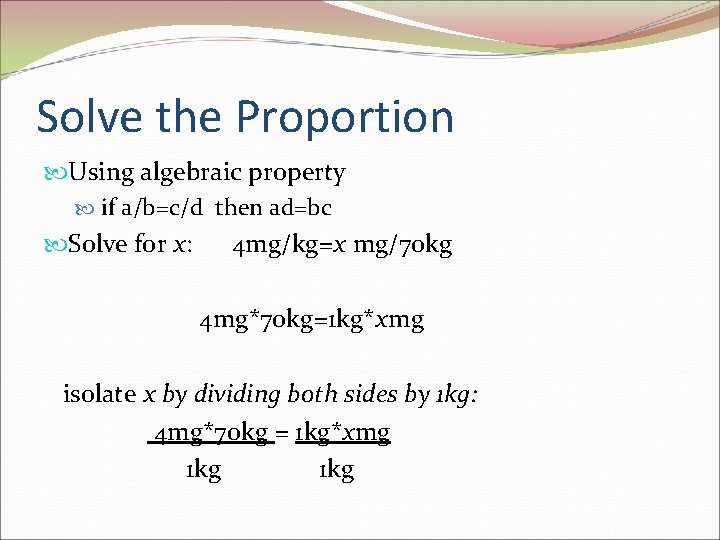
Solve the Proportion Using algebraic property if a/b=c/d then ad=bc Solve for x: 4 mg/kg=x mg/70 kg 4 mg*70 kg=1 kg*xmg isolate x by dividing both sides by 1 kg: 4 mg*70 kg = 1 kg*xmg 1 kg
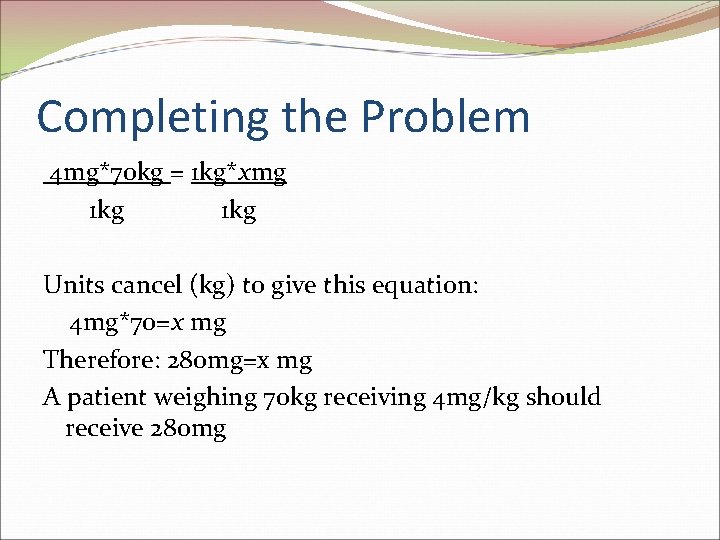
Completing the Problem 4 mg*70 kg = 1 kg*xmg 1 kg Units cancel (kg) to give this equation: 4 mg*70=x mg Therefore: 280 mg=x mg A patient weighing 70 kg receiving 4 mg/kg should receive 280 mg
Metric System Most widely used system of measurement in world Based on multiples of ten Standard units used in healthcare are: meter (distance) liter (volume) gram (mass) Relationship among these units is: 1 m. L of water occupies 1 cubic centimeter & weighs 1 gram
Metric Prefixes “Milli” means one thousandth 1 milliliter is 1/1000 of a liter Oral solid medications are usually mg or g Liquid medications are usually m. L or L
Metric Conversions Stem of unit represents type of measure Note relationship & decimal placement 0. 001 kg = 1 gram = 1000 mg = 1000000 mcg 1 kilogram is 1000 times as big as 1 milligram is 1000 times as big as 1 microgram Converting can be as simple as moving decimal point
Other Systems in Pharmacy Apothecary System developed in Greece for use by physicians/pharmacists has historical significance & has largely been replaced The Joint Commission (TJC) recommends avoid using apothecary units (institutional pharmacy) Apothecary units still used in community pharmacy Common apothecary measures still used grain is approximately 60 -65 mg dram is approximately 5 m. L
Other Systems in Pharmacy Avoirdupois System French system of mass: includes ounces & pounds 1 pound equals 16 ounces Household System familiar to people who like to cook teaspoons, tablespoons, etc. good practice to dispense dosing spoon or oral syringe with both metric & household system units
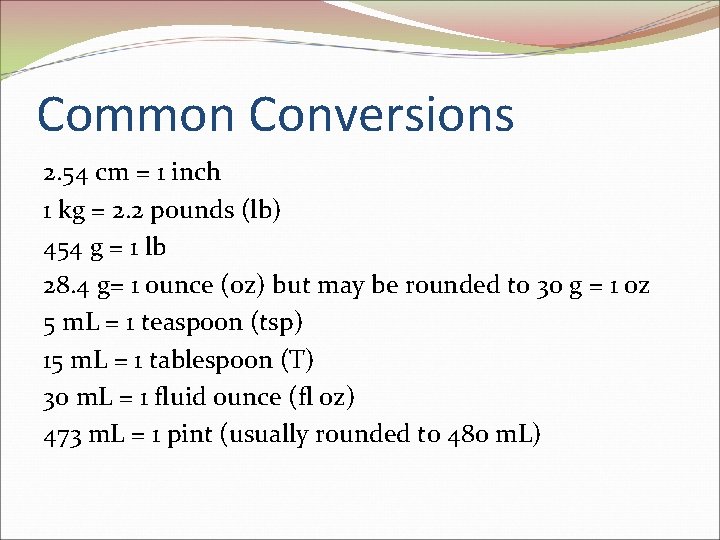
Common Conversions 2. 54 cm = 1 inch 1 kg = 2. 2 pounds (lb) 454 g = 1 lb 28. 4 g= 1 ounce (oz) but may be rounded to 30 g = 1 oz 5 m. L = 1 teaspoon (tsp) 15 m. L = 1 tablespoon (T) 30 m. L = 1 fluid ounce (fl oz) 473 m. L = 1 pint (usually rounded to 480 m. L)
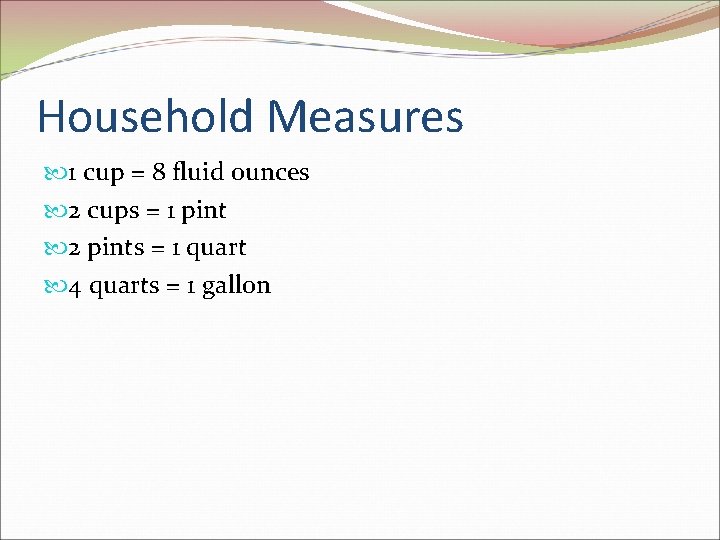
Household Measures 1 cup = 8 fluid ounces 2 cups = 1 pint 2 pints = 1 quart 4 quarts = 1 gallon
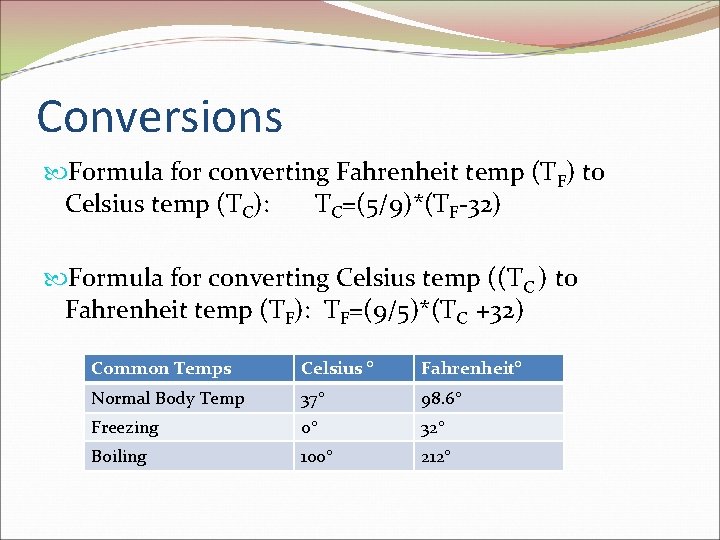
Conversions Formula for converting Fahrenheit temp (TF) to Celsius temp (TC): TC=(5/9)*(TF-32) Formula for converting Celsius temp ((TC ) to Fahrenheit temp (TF): TF=(9/5)*(TC +32) Common Temps Celsius ° Fahrenheit° Normal Body Temp 37° 98. 6° Freezing 0° 32° Boiling 100° 212°
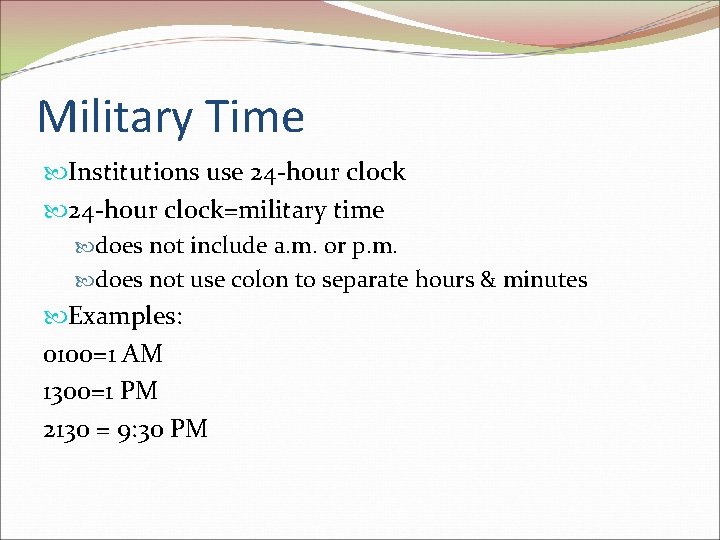
Military Time Institutions use 24 -hour clock=military time does not include a. m. or p. m. does not use colon to separate hours & minutes Examples: 0100=1 AM 1300=1 PM 2130 = 9: 3 o PM
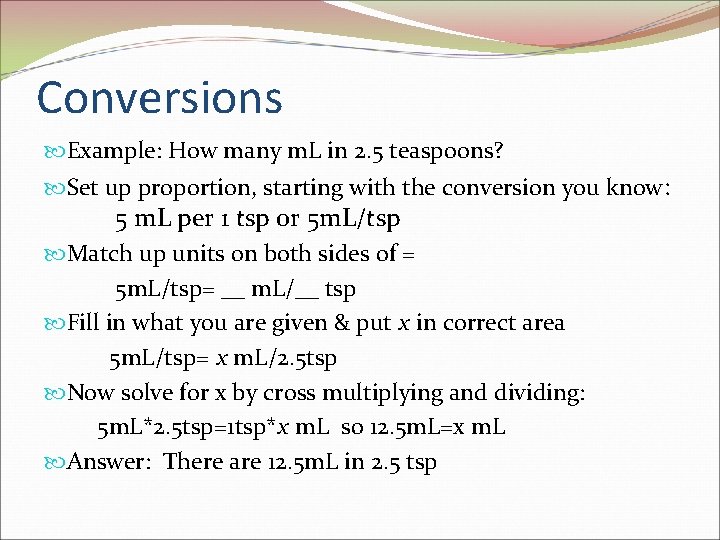
Conversions Example: How many m. L in 2. 5 teaspoons? Set up proportion, starting with the conversion you know: 5 m. L per 1 tsp or 5 m. L/tsp Match up units on both sides of = 5 m. L/tsp= __ m. L/__ tsp Fill in what you are given & put x in correct area 5 m. L/tsp= x m. L/2. 5 tsp Now solve for x by cross multiplying and dividing: 5 m. L*2. 5 tsp=1 tsp*x m. L so 12. 5 m. L=x m. L Answer: There are 12. 5 m. L in 2. 5 tsp
Patient-Specific Calculations Three examples of patient-specific calculations 1. body surface area 2. ideal body weight 3. body mass index
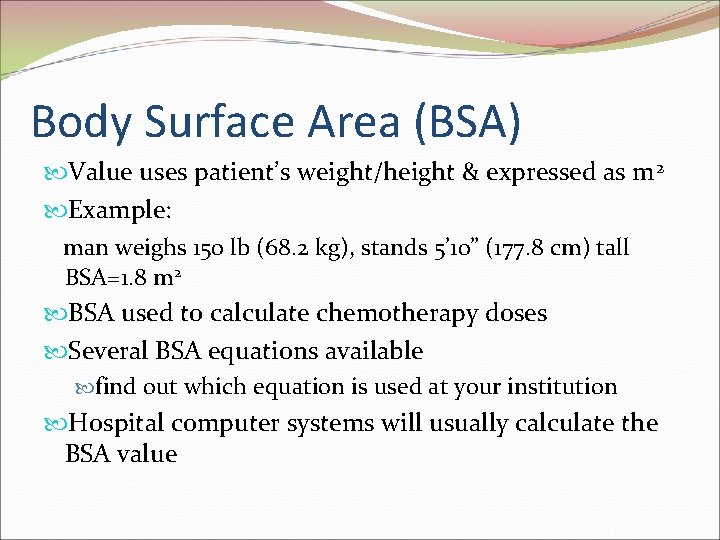
Body Surface Area (BSA) Value uses patient’s weight/height & expressed as m 2 Example: man weighs 150 lb (68. 2 kg), stands 5’ 10” (177. 8 cm) tall BSA=1. 8 m 2 BSA used to calculate chemotherapy doses Several BSA equations available find out which equation is used at your institution Hospital computer systems will usually calculate the BSA value
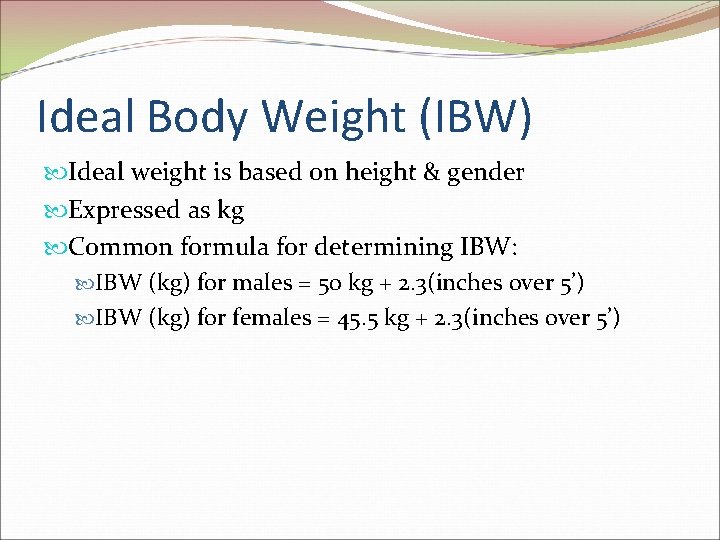
Ideal Body Weight (IBW) Ideal weight is based on height & gender Expressed as kg Common formula for determining IBW: IBW (kg) for males = 50 kg + 2. 3(inches over 5’) IBW (kg) for females = 45. 5 kg + 2. 3(inches over 5’)
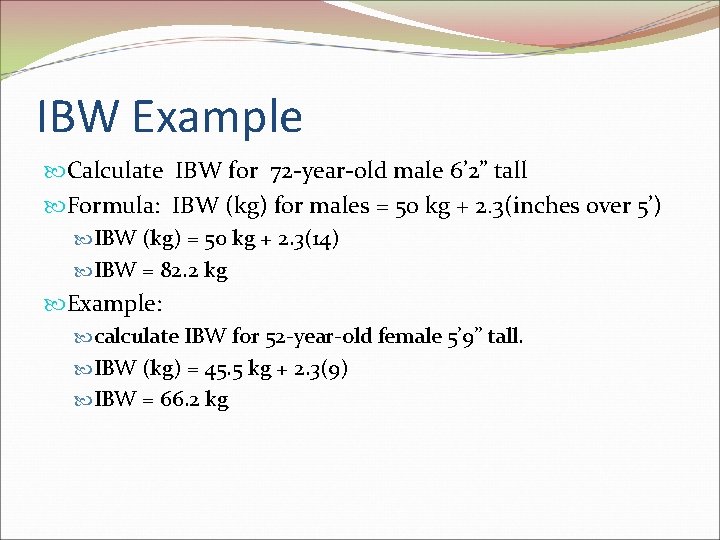
IBW Example Calculate IBW for 72 -year-old male 6’ 2” tall Formula: IBW (kg) for males = 50 kg + 2. 3(inches over 5’) IBW (kg) = 50 kg + 2. 3(14) IBW = 82. 2 kg Example: calculate IBW for 52 -year-old female 5’ 9” tall. IBW (kg) = 45. 5 kg + 2. 3(9) IBW = 66. 2 kg
Body Mass Index (BMI) Measure of body fat based on height & weight Determines if patient is underweight normal weight overweight obese BMI is not generally used in medication calculations
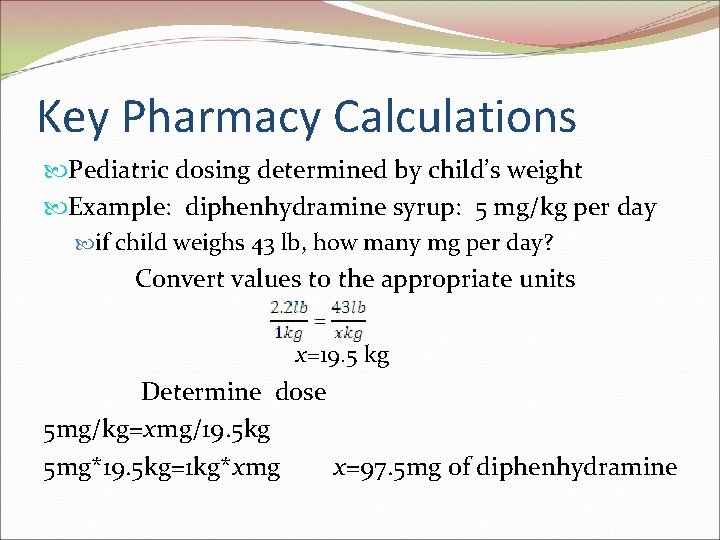
Key Pharmacy Calculations Pediatric dosing determined by child’s weight Example: diphenhydramine syrup: 5 mg/kg per day if child weighs 43 lb, how many mg per day? Convert values to the appropriate units x=19. 5 kg Determine dose 5 mg/kg=xmg/19. 5 kg 5 mg*19. 5 kg=1 kg*xmg x=97. 5 mg of diphenhydramine
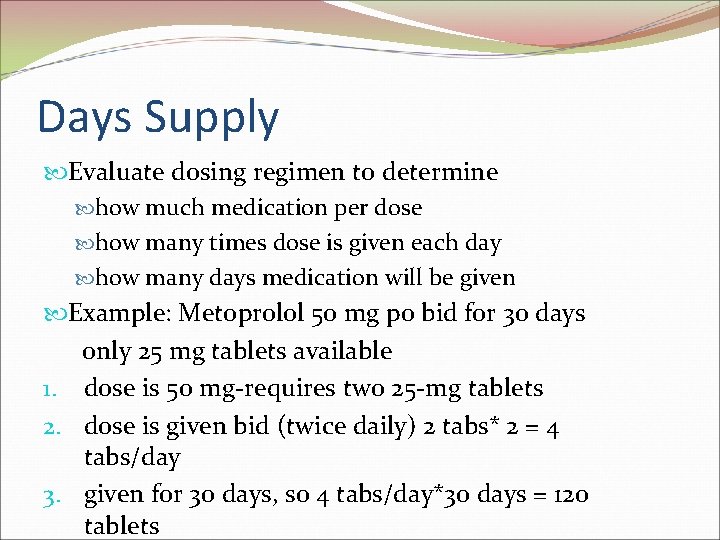
Days Supply Evaluate dosing regimen to determine how much medication per dose how many times dose is given each day how many days medication will be given Example: Metoprolol 50 mg po bid for 30 days only 25 mg tablets available 1. dose is 50 mg-requires two 25 -mg tablets 2. dose is given bid (twice daily) 2 tabs* 2 = 4 tabs/day 3. given for 30 days, so 4 tabs/day*30 days = 120 tablets
Concentration & Dilution Mixtures may be 2 solids added together percentage strength is measured as weight in weight (w/w) or grams of drug/100 grams of mixture Mixtures may be 2 liquids added together Percentage strength measured as volume in volume (v/v) or m. L of drug/100 m. L of mixture Mixtures may be solid in liquid percentage strength is measured as weight in volume (w/v) or grams of drug per 100 m. L of mixture
Standard Solutions To determine how much dextrose is in 1 liter of D 5 W weight (dextrose) in volume (water) mixture (w/v) Set up proportion-start with concentration you know & then solve for x Make sure you have matching units in the numerators & denominators D 5 W means 5% dextrose in water=5 g/100 m. L Start with 5 g/100 m. L Convert 1 liter to m. L so that denominator units are m. L on both sides of equation
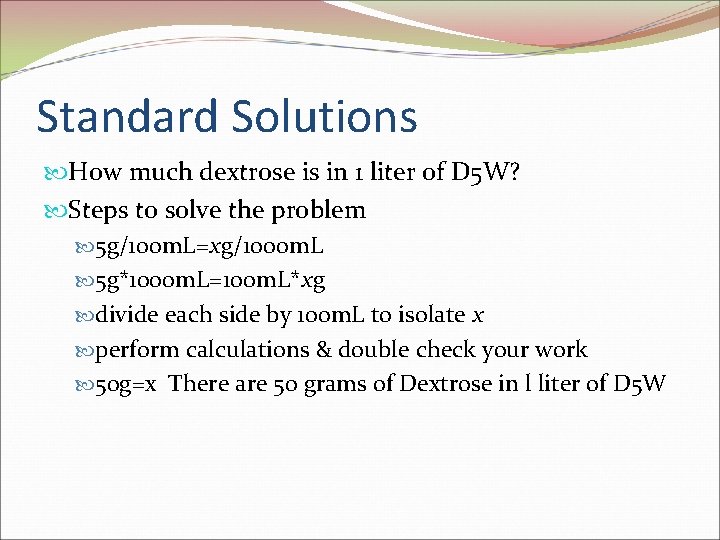
Standard Solutions How much dextrose is in 1 liter of D 5 W? Steps to solve the problem 5 g/100 m. L=xg/1000 m. L 5 g*1000 m. L=100 m. L*xg divide each side by 100 m. L to isolate x perform calculations & double check your work 50 g=x There are 50 grams of Dextrose in l liter of D 5 W
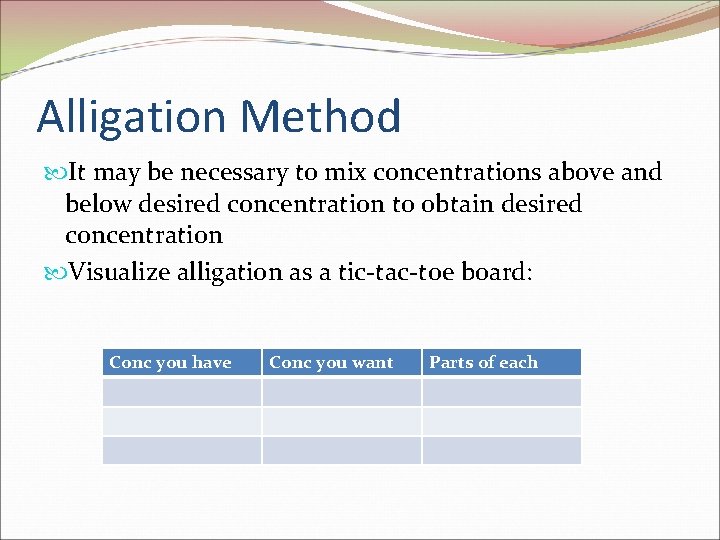
Alligation Method It may be necessary to mix concentrations above and below desired concentration to obtain desired concentration Visualize alligation as a tic-tac-toe board: Conc you have Conc you want Parts of each
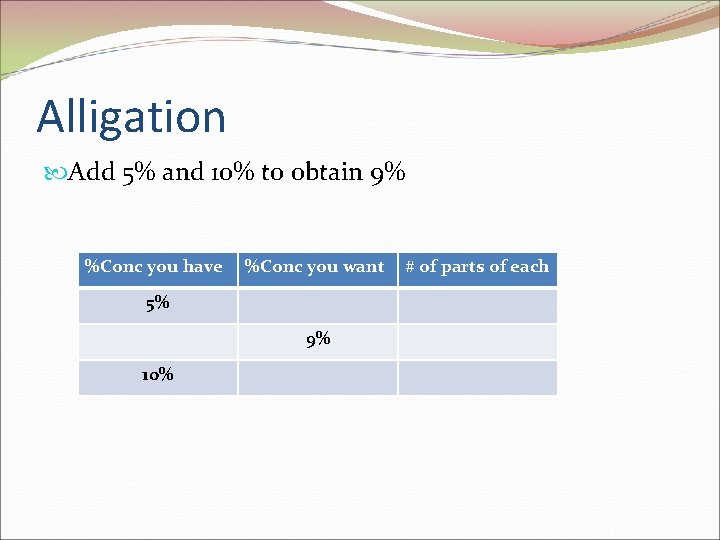
Alligation Add 5% and 10% to obtain 9% %Conc you have %Conc you want 5% 9% 10% # of parts of each
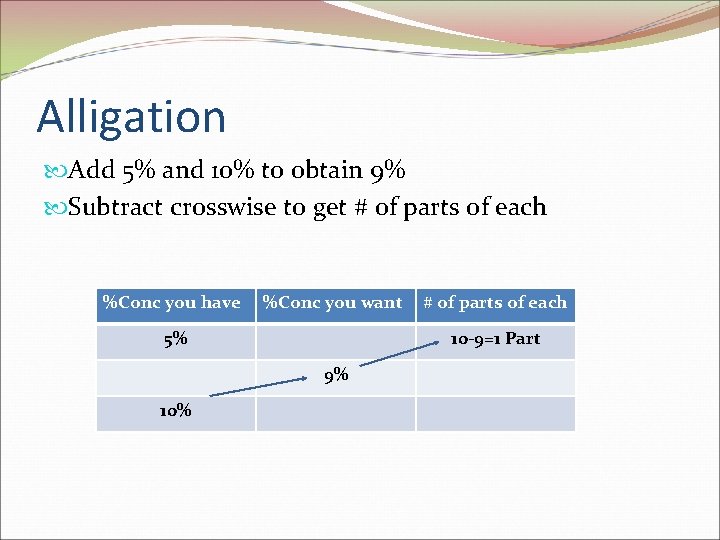
Alligation Add 5% and 10% to obtain 9% Subtract crosswise to get # of parts of each %Conc you have %Conc you want 5% 10 -9=1 Part 9% 10% # of parts of each
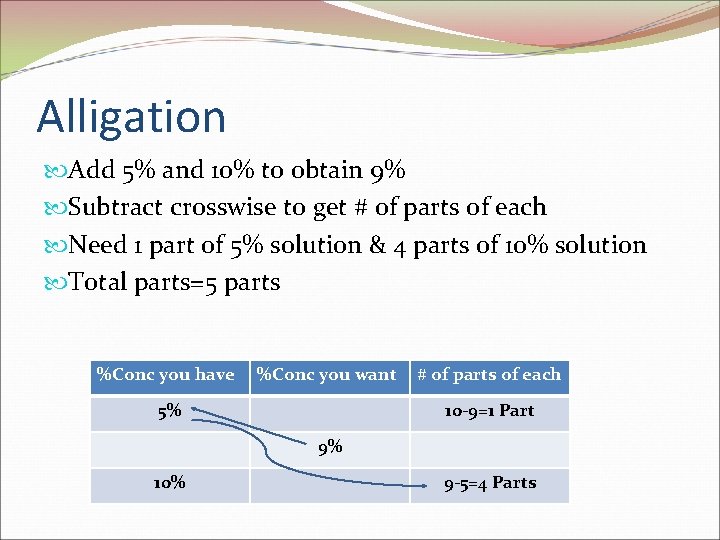
Alligation Add 5% and 10% to obtain 9% Subtract crosswise to get # of parts of each Need 1 part of 5% solution & 4 parts of 10% solution Total parts=5 parts %Conc you have %Conc you want 5% # of parts of each 10 -9=1 Part 9% 10% 9 -5=4 Parts
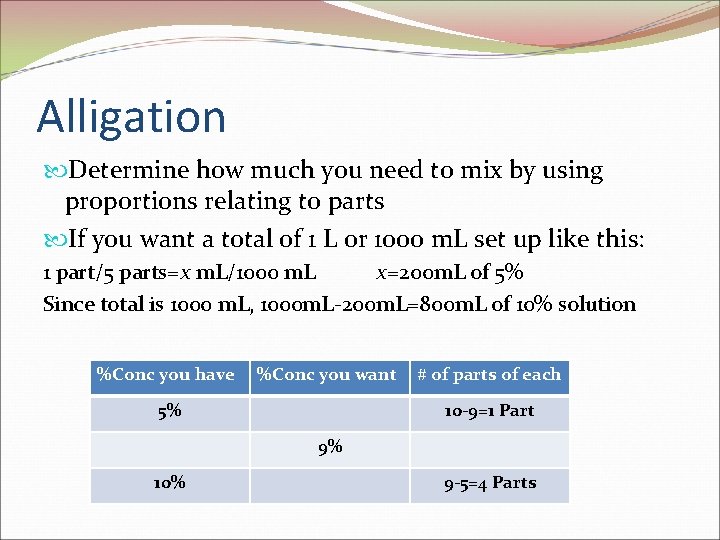
Alligation Determine how much you need to mix by using proportions relating to parts If you want a total of 1 L or 1000 m. L set up like this: 1 part/5 parts=x m. L/1000 m. L x=200 m. L of 5% Since total is 1000 m. L, 1000 m. L-200 m. L=800 m. L of 10% solution %Conc you have %Conc you want 5% # of parts of each 10 -9=1 Part 9% 10% 9 -5=4 Parts
Another Solution Another method to solve similar problems mixing 2 concentrations to obtain a 3 rd concentration somewhere between original 2 concentrations: C 1 V 1 = C 2 V 2 You need to know 3 of these values to solve for the 4 th
Specific Gravity Specific gravity is ratio of weight of compound to weight of same amount of water Specific gravity of milk is 1. 035 Specific gravity of ethanol is 0. 787 Generally, units do not appear with specific gravity In pharmacy calculations, specific gravity & density are used interchangeably specific gravity = weight (g) volume(m. L)
Chemotherapy Calculations System of checks & rechecks important in chemotherapy Example: medication order is received for amifostine 200 mg/m 2 over 3 minutes once daily 15– 30 minutes prior to radiation therapy patient is 79 -year-old man weighing 157 lb & standing 6’ tall BSA is 1. 9 m 2 What is the dose of amifostine for this patient?
Solution Set up equation Ordered dose of amifostine 200 mg/m 2 BSA is 1. 9 m 2 200 mg/m 2=xmg/1. 9 m 2 Note how units match up 200 mg*1. 9 m 2 =1 m 2 *xmg Now divide both sides by 1 m 2 380 mg=xmg The correct dose of amifostine is 380 mg
- Slides: 52