
Practice BaseParing Review Original strand ATTCCG Complement Original
Practice Base-Paring
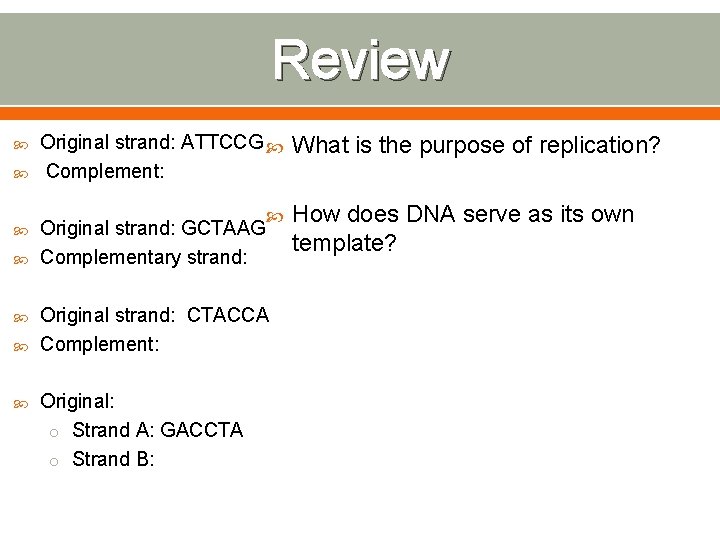
Review Original strand: ATTCCG Complement: Original strand: GCTAAG Complementary strand: Original strand: CTACCA Complement: Original: o Strand A: GACCTA o Strand B: What is the purpose of replication? How does DNA serve as its own template?
RNA Transcription & Protein Synthesis From DNA to Proteins 2 Types of nucleic acid
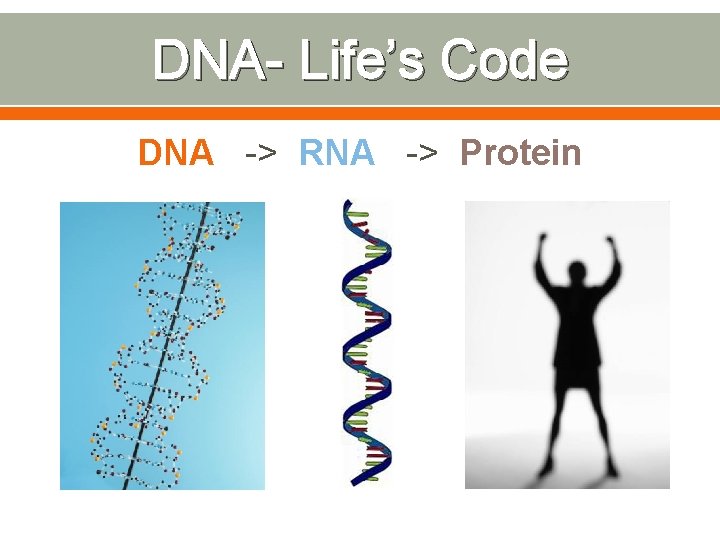
DNA- Life’s Code DNA -> RNA -> Protein
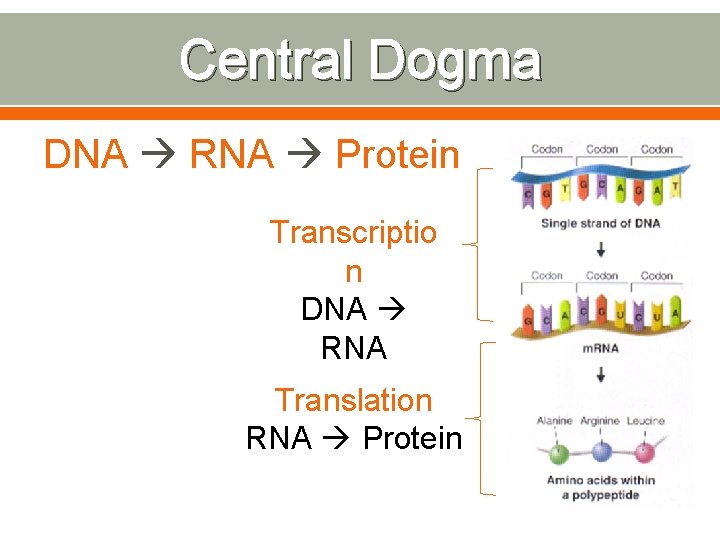
Central Dogma DNA RNA Protein Transcriptio n DNA RNA Translation RNA Protein
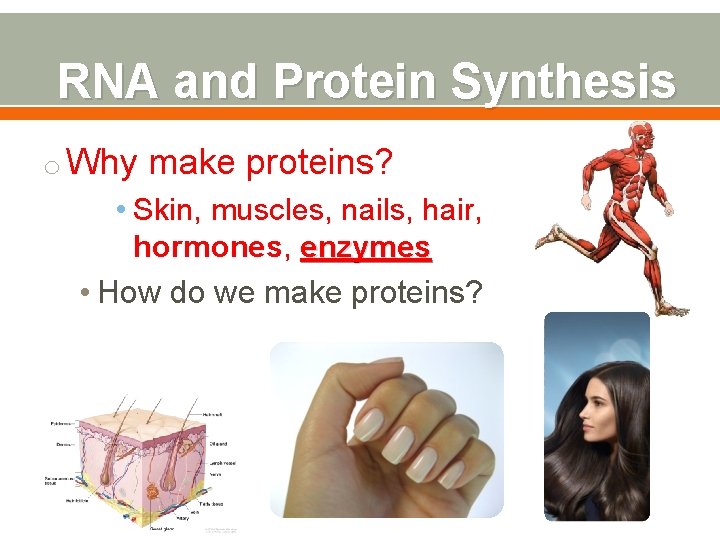
RNA and Protein Synthesis o Why make proteins? • Skin, muscles, nails, hair, hormones, enzymes • How do we make proteins?
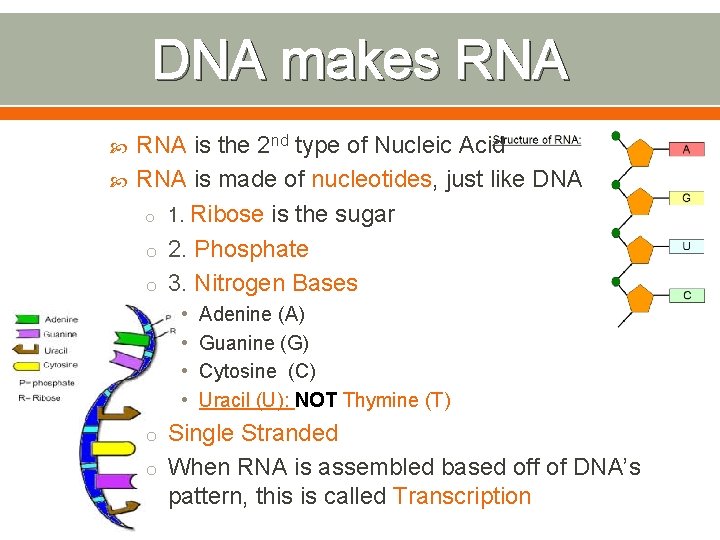
DNA makes RNA is the 2 nd type of Nucleic Acid RNA is made of nucleotides, just like DNA o 1. Ribose is the sugar o 2. Phosphate o 3. Nitrogen Bases • • Adenine (A) Guanine (G) Cytosine (C) Uracil (U): NOT Thymine (T) o Single Stranded o When RNA is assembled based off of DNA’s pattern, this is called Transcription
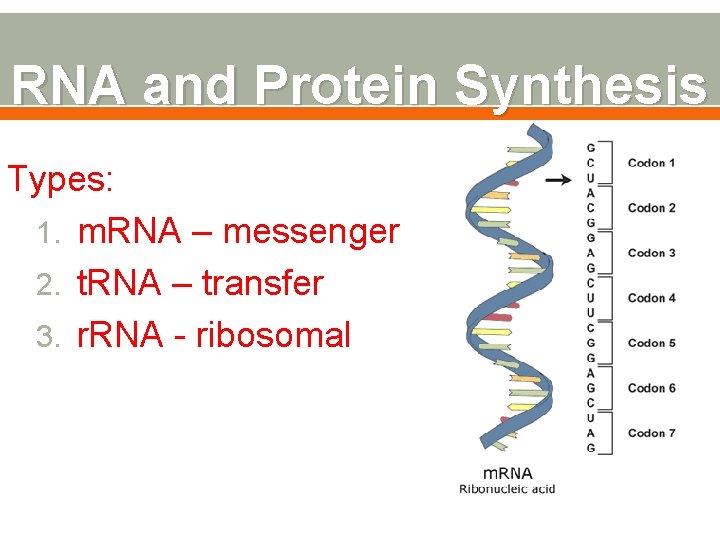
RNA and Protein Synthesis Types: 1. m. RNA – messenger 2. t. RNA – transfer 3. r. RNA - ribosomal
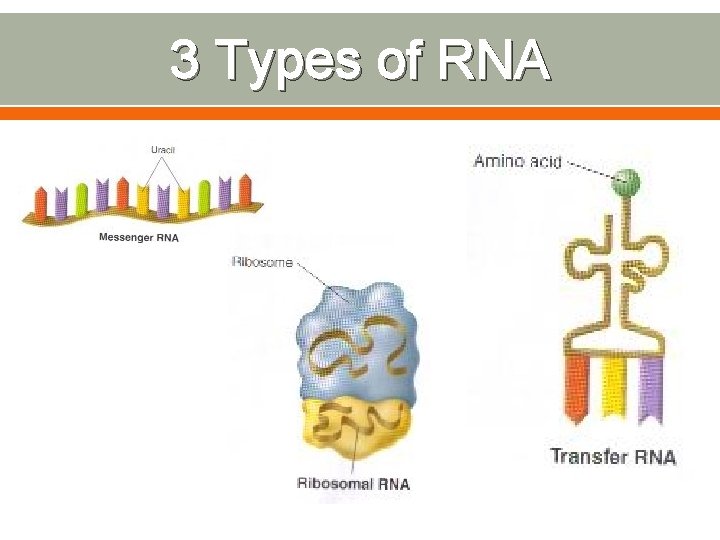
3 Types of RNA
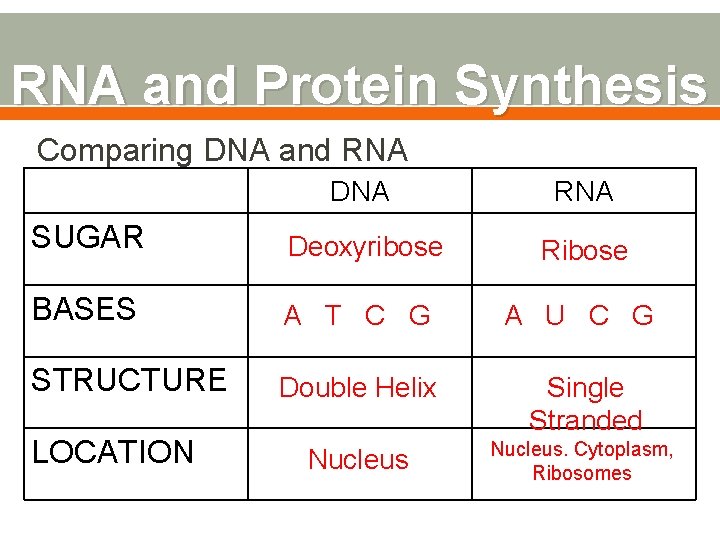
RNA and Protein Synthesis Comparing DNA and RNA DNA RNA SUGAR Deoxyribose Ribose BASES A T C G A U C G STRUCTURE Double Helix Single Stranded Nucleus. Cytoplasm, Ribosomes LOCATION
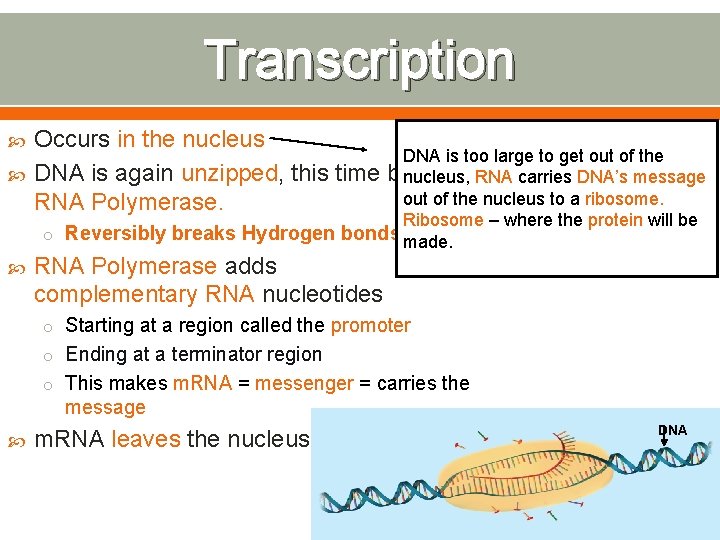
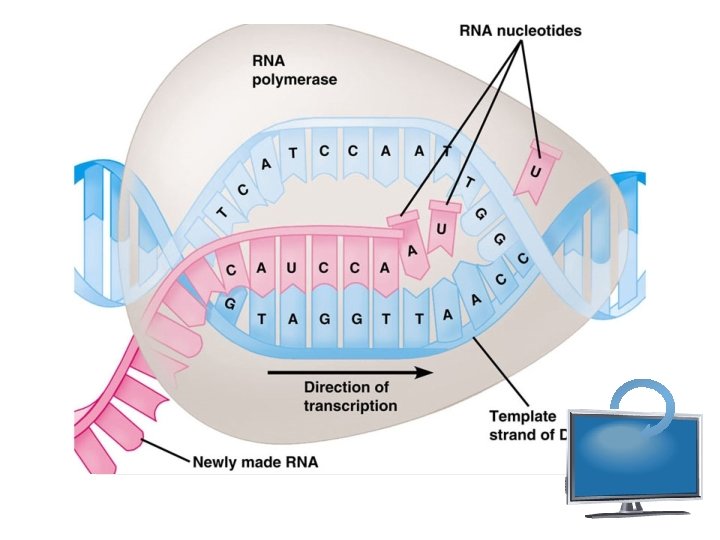
Transcription Occurs in the nucleus DNA is too large to get out of the DNA is again unzipped, this time bynucleus, RNA carries DNA’s message out of the nucleus to a ribosome. RNA Polymerase. Ribosome – where the protein will be o Reversibly breaks Hydrogen bonds made. RNA Polymerase adds complementary RNA nucleotides o Starting at a region called the promoter o Ending at a terminator region o This makes m. RNA = messenger = carries the message m. RNA leaves the nucleus DNA
3 Stages of Transcription Write on bottom of your notes… 1. Initiation: RNA polymerase binds to the DNA at the promoter region. 2. Elongation: RNA polymerase moves along the coding strand of DNA, adding complementary RNA nucleotides, building the RNA transcript 3. Termination: RNA polymerase reaches the terminator region of the DNA and is released, DNA re-coils
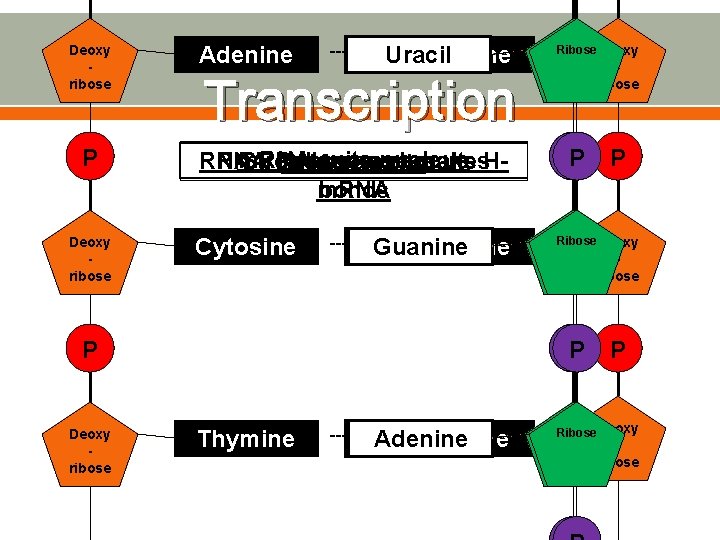
Deoxy ribose P Deoxy ribose Adenine ---H--- Thymine Uracil ribose Transcription m. RNA exits nucleus Strands move apart RNA Polymerase breaks makes. HDNA re-coils m. RNA bonds Cytosine ---H--Guanine P Deoxy ribose Ribose. Deoxy P P Ribose. Deoxy ribose P P Thymine ---H---Adenine P P Ribose. Deoxy ribose
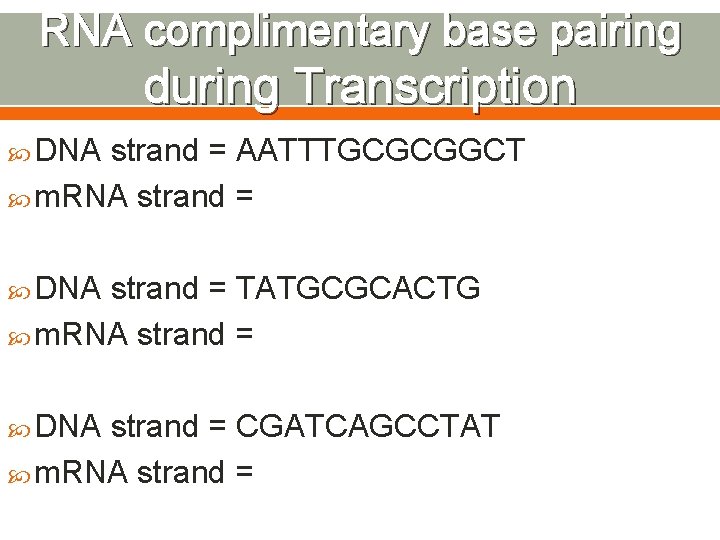
RNA complimentary base pairing during Transcription DNA strand = AATTTGCGCGGCT m. RNA strand = DNA strand = TATGCGCACTG m. RNA strand = DNA strand = CGATCAGCCTAT m. RNA strand =
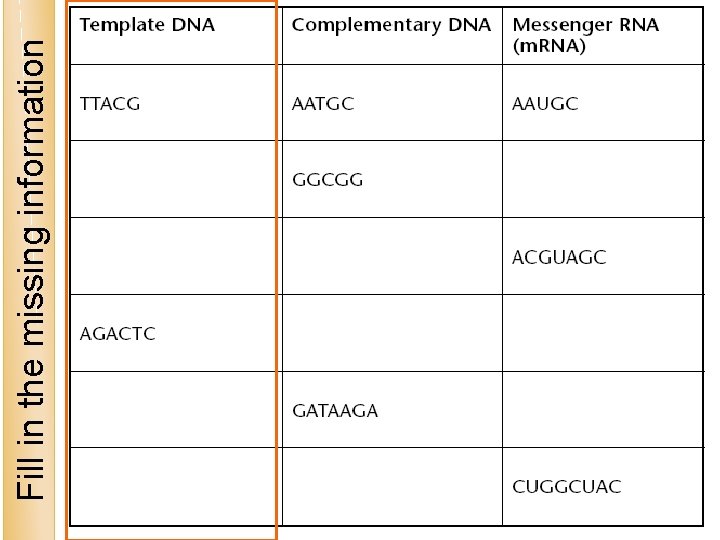
Fill in the missing information

Transcription
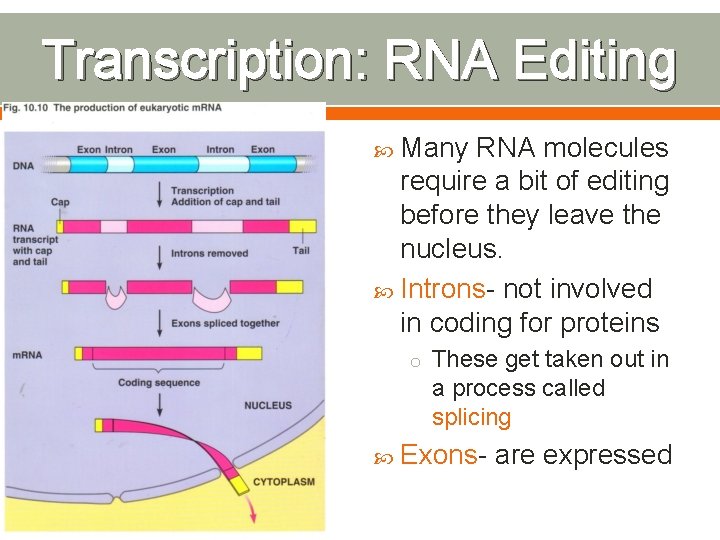
Transcription: RNA Editing Many RNA molecules require a bit of editing before they leave the nucleus. Introns- not involved in coding for proteins o These get taken out in a process called splicing Exons- are expressed
Replication vs Transcription Given the DNA chain below, make the complementary DNA strand the m. RNA strand that would be transcribed: o GGGCGTATTTAGCTAGACCCGAAACCC Answer the following questions: o What is the purpose of DNA replication? Of Transcription? o What is the final product of DNA replication? Of Transcription? Be Specific. o What is the name of the enzymes(s) used in DNA replication? In transcription? o Where does DNA replication occur in the cell? Transcription?
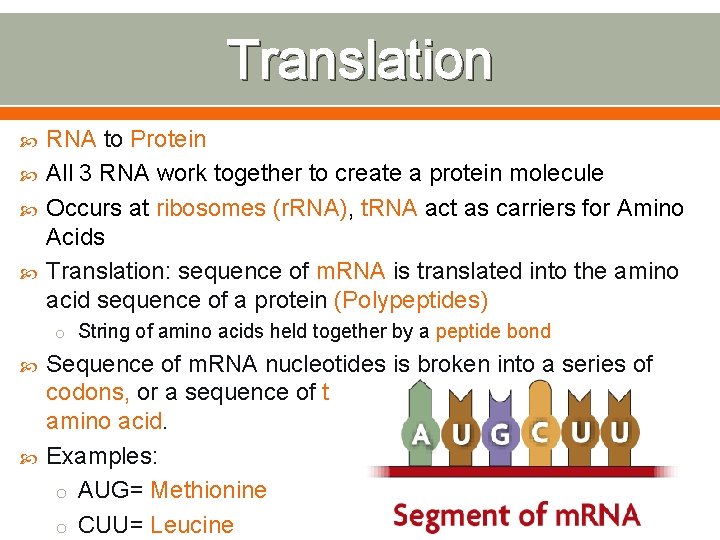
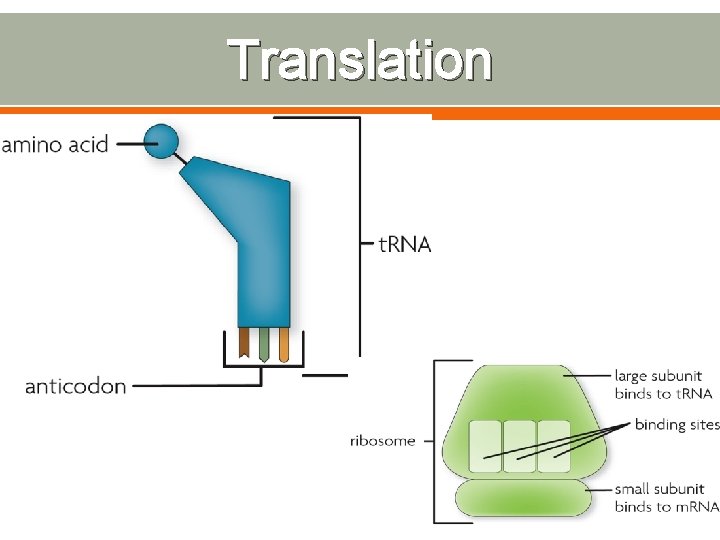
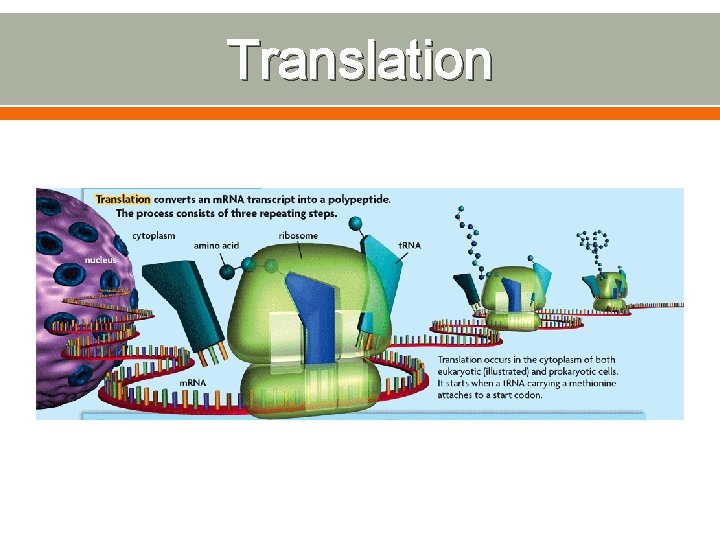
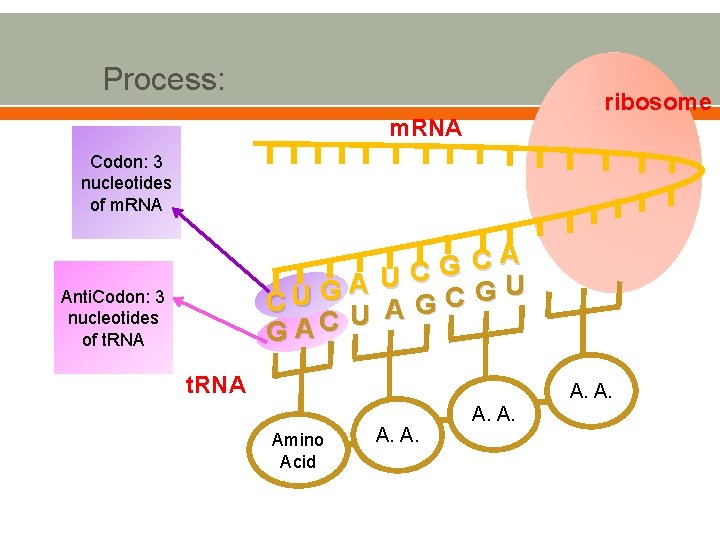
Translation RNA to Protein All 3 RNA work together to create a protein molecule Occurs at ribosomes (r. RNA), t. RNA act as carriers for Amino Acids Translation: sequence of m. RNA is translated into the amino acid sequence of a protein (Polypeptides) o String of amino acids held together by a peptide bond Sequence of m. RNA nucleotides is broken into a series of codons, or a sequence of three nucleotides that codes for an amino acid. Examples: o AUG= Methionine o CUU= Leucine
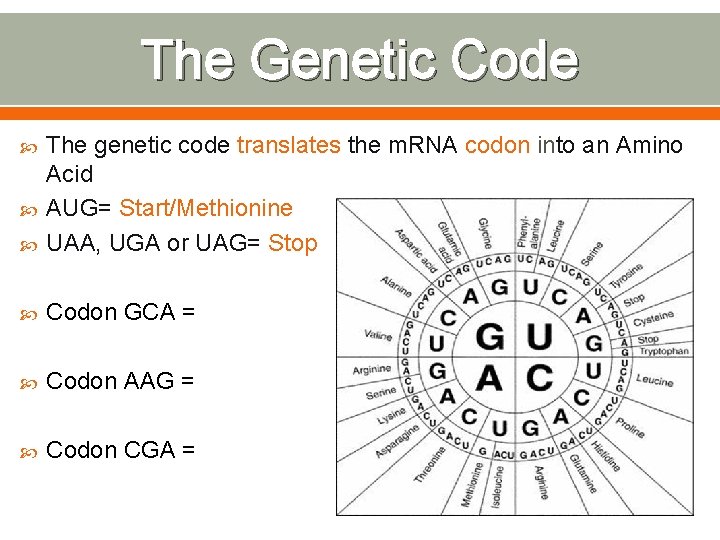
The Genetic Code The genetic code translates the m. RNA codon into an Amino Acid AUG= Start/Methionine UAA, UGA or UAG= Stop Codon GCA = Codon AAG = Codon CGA =
Translation Overview m. RNA carries the DNA instructions for making protein m. RNA enters the cytoplasm through nuclear pores m. RNA attaches to a ribosome (r. RNA) to be “read” Amino Acids are strung together (using t. RNA) as ribosome “reads” m. RNA to build a polypeptide chain Ribosome reaches stop codon and detaches from m. RNA Same 3 steps as transcription o Initiation o Elongation o Termination
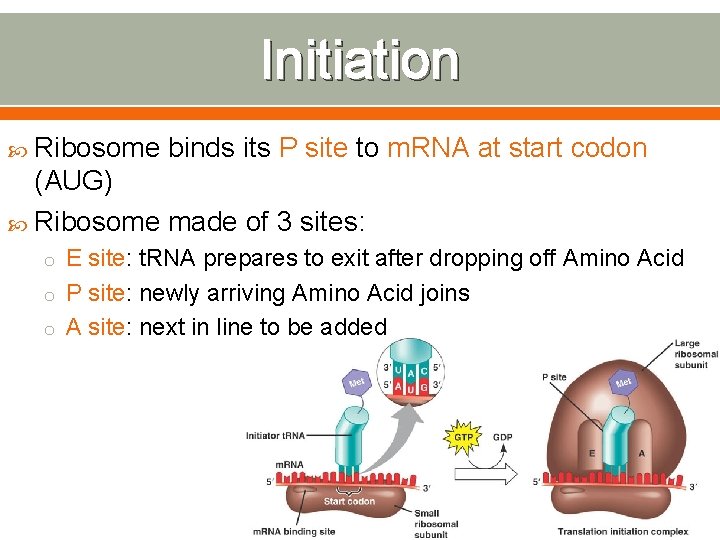
Initiation Ribosome binds its P site to m. RNA at start codon (AUG) Ribosome made of 3 sites: o E site: t. RNA prepares to exit after dropping off Amino Acid o P site: newly arriving Amino Acid joins o A site: next in line to be added
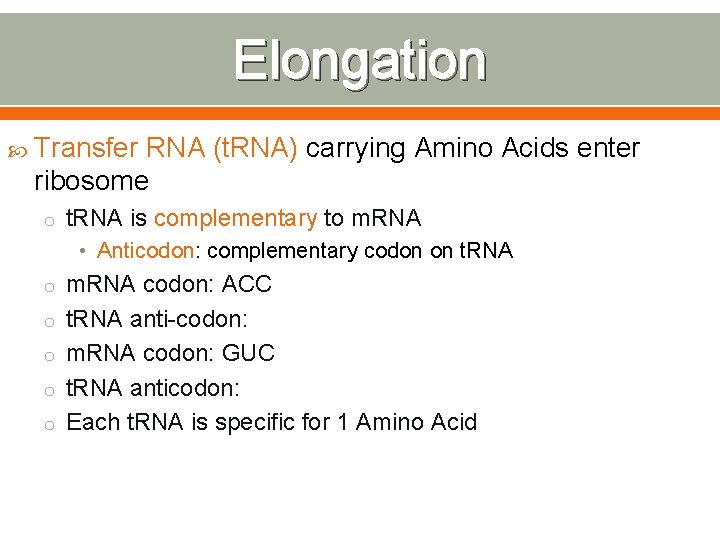
Elongation Transfer RNA (t. RNA) carrying Amino Acids enter ribosome o t. RNA is complementary to m. RNA • Anticodon: complementary codon on t. RNA o m. RNA codon: ACC o t. RNA anti-codon: o m. RNA codon: GUC o t. RNA anticodon: o Each t. RNA is specific for 1 Amino Acid
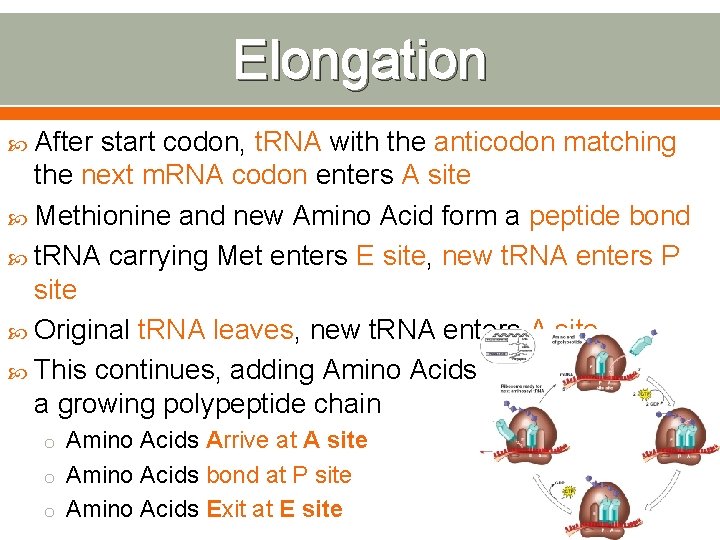
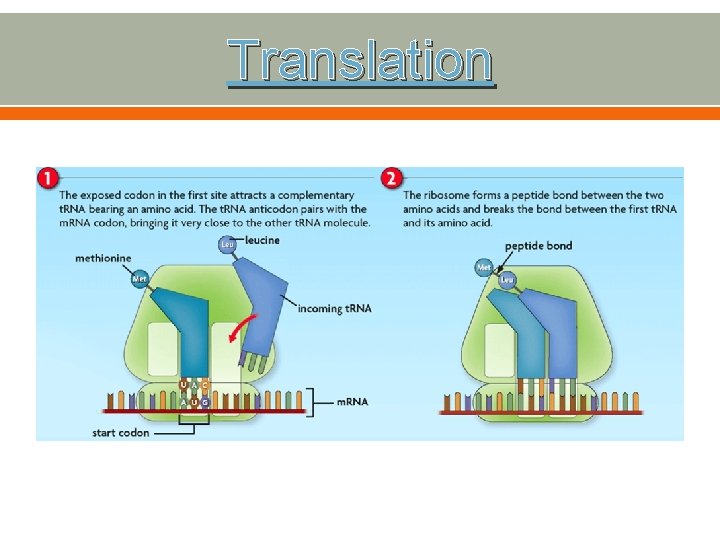
Elongation After start codon, t. RNA with the anticodon matching the next m. RNA codon enters A site Methionine and new Amino Acid form a peptide bond t. RNA carrying Met enters E site, new t. RNA enters P site Original t. RNA leaves, new t. RNA enters A site This continues, adding Amino Acids to a growing polypeptide chain o Amino Acids Arrive at A site o Amino Acids bond at P site o Amino Acids Exit at E site
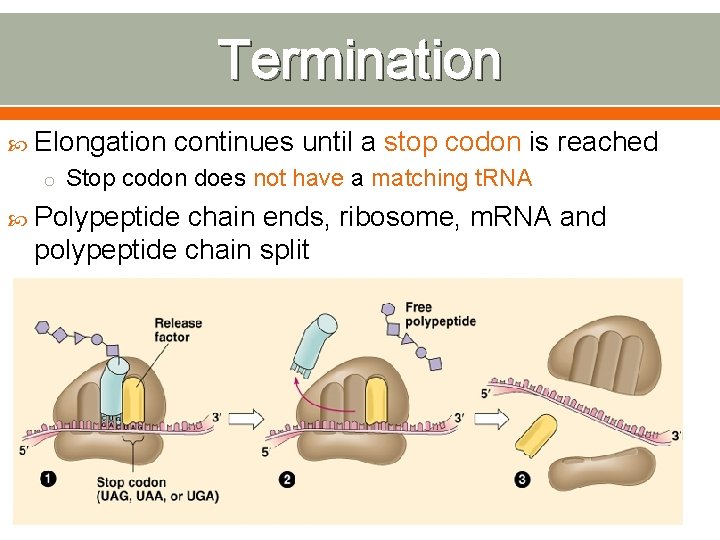
Termination Elongation continues until a stop codon is reached o Stop codon does not have a matching t. RNA Polypeptide chain ends, ribosome, m. RNA and polypeptide chain split
Translation
Translation
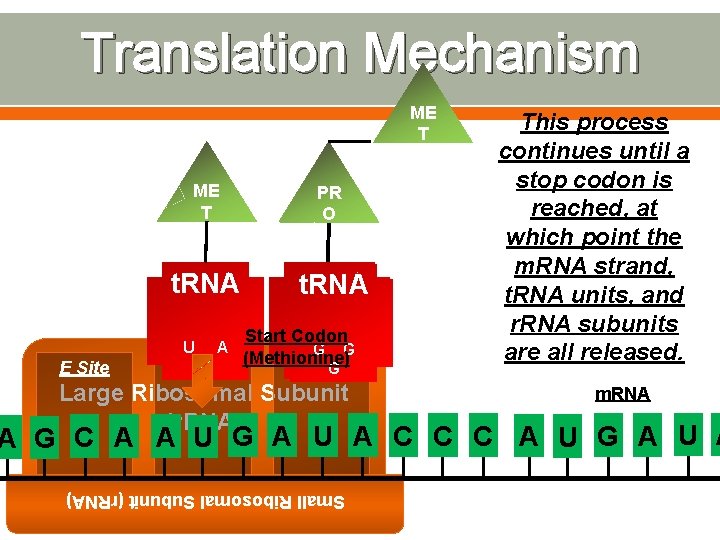
Translation Mechanism ME T PR ISO O t. RNA Start Codon UU G AA G (Methionine) C UU G A Site P Site U U E Site A A Large Ribosomal Subunit (r. RNA) This process continues until a stop codon is reached, at which point the m. RNA strand, t. RNA units, and r. RNA subunits are all released. m. RNA A A U G U G A G C A A U G A U A C C C A Small Ribosomal Subunit (r. RNA)
Translation
o Process: ribosome m. RNA Codon: 3 nucleotides of m. RNA A C G C U A U G G U C C G A U G AC Anti. Codon: 3 nucleotides of t. RNA A. A. Amino Acid A. A.
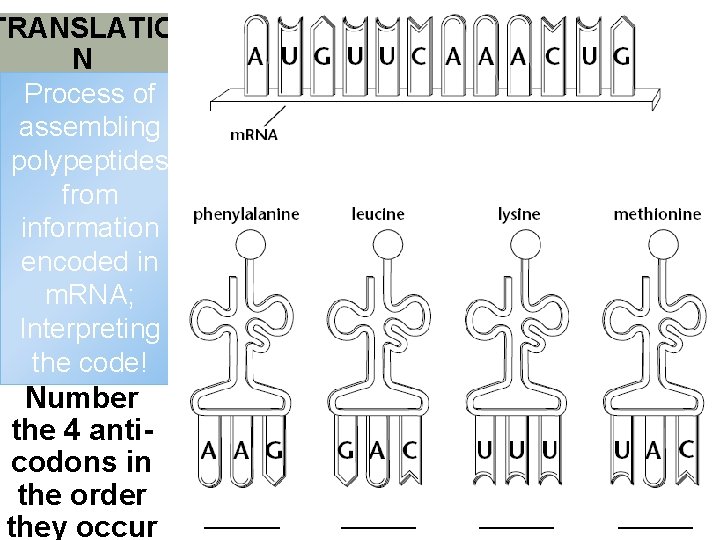
TRANSLATIO N Process of assembling polypeptides from information encoded in m. RNA; Interpreting the code! Number the 4 anticodons in the order they occur
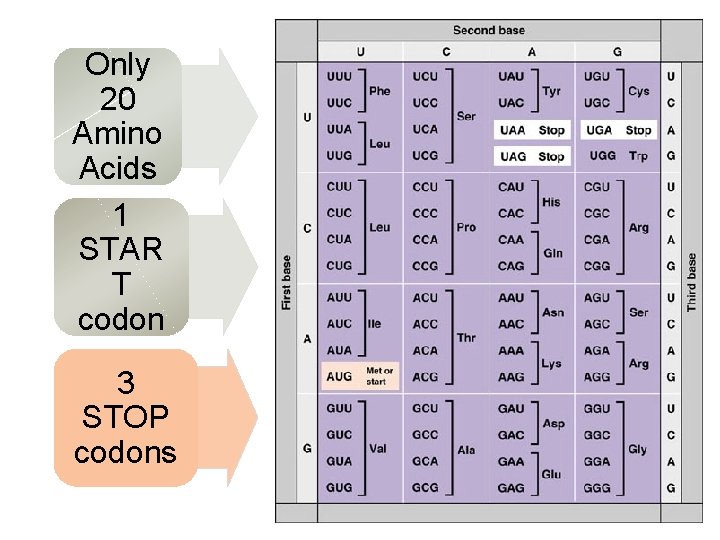
Only 20 Amino Acids 1 STAR T codon 3 STOP codons
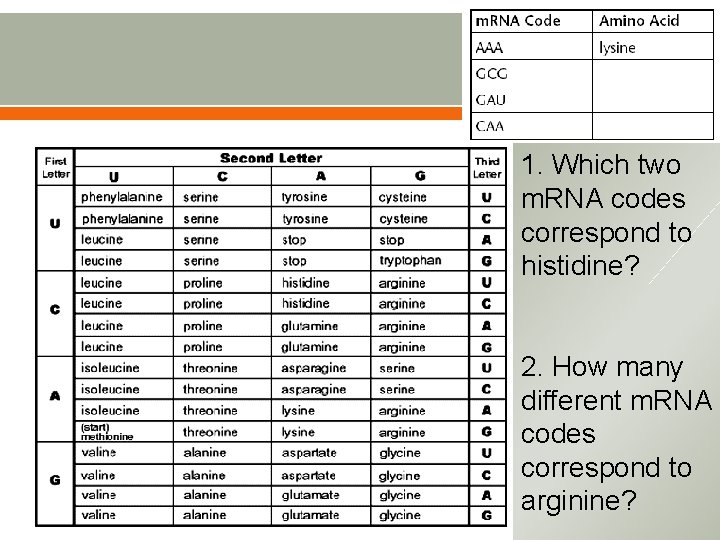
1. Which two m. RNA codes correspond to histidine? 2. How many different m. RNA codes correspond to arginine?
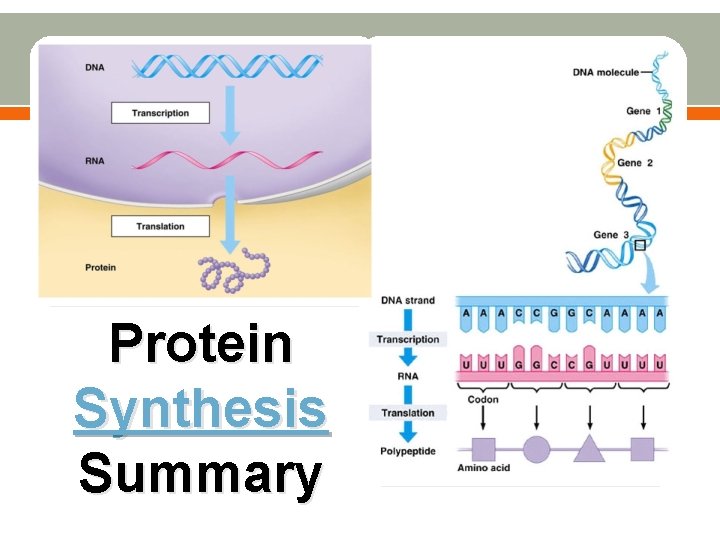
Protein Synthesis Summary
Review What are three parts to the Central Dogma? How is RNA similar to DNA? How is RNA different from DNA? What are the 3 types of RNA? Recall: What How do amino acids differ from each other? are the bonds that hold together the amino acids?
Mutations can happen in two locations: o Sex cells: affect the offspring o Body cells: affect the individual only Mutations can have one of three affects: o Those that cause a disease o Those that are beneficial o Silent mutations: do not cause disease – most common Mutations can be one of two types: o Point mutations: affecting single nucleotide o Chromosomal mutations: affect section of or whole chromosome
Causes of Mutations Mistakes in base paring during DNA Replication o DNA Polymerase can usually detect such errors o When missed, may cause many genetic disorders Chemicals: like tobacco o Can lead to cancer because it changes the genes that regulate mitosis Radiation: including UV (sun) and X-ray o Can lead to cancer because it changes the genes that regulate mitosis
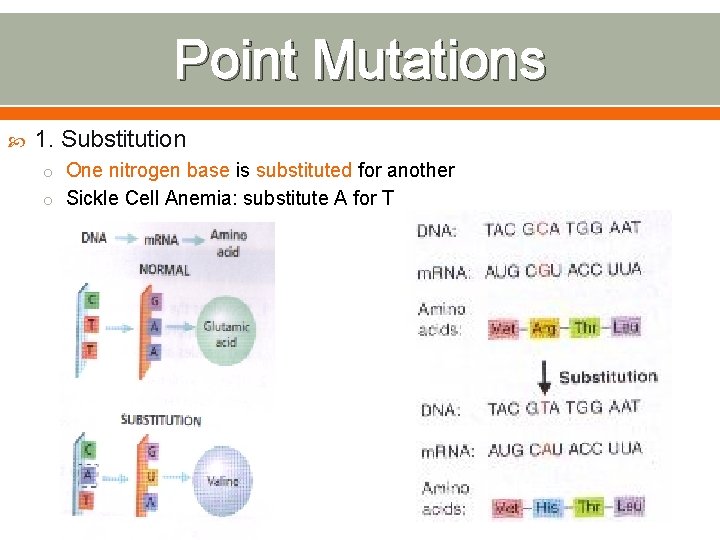
Point Mutations 1. Substitution o One nitrogen base is substituted for another o Sickle Cell Anemia: substitute A for T
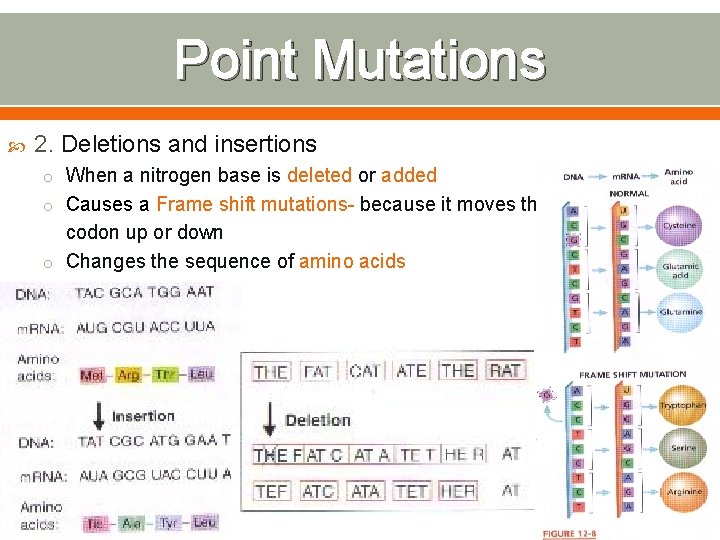
Point Mutations 2. Deletions and insertions o When a nitrogen base is deleted or added o Causes a Frame shift mutations- because it moves the codon up or down o Changes the sequence of amino acids
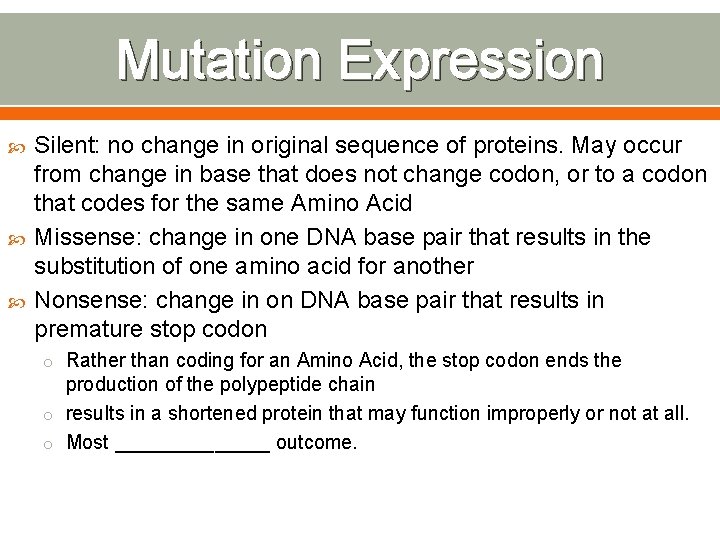
Mutation Expression Silent: no change in original sequence of proteins. May occur from change in base that does not change codon, or to a codon that codes for the same Amino Acid Missense: change in one DNA base pair that results in the substitution of one amino acid for another Nonsense: change in on DNA base pair that results in premature stop codon o Rather than coding for an Amino Acid, the stop codon ends the production of the polypeptide chain o results in a shortened protein that may function improperly or not at all. o Most _______ outcome.
- Slides: 41