
Practicalities of Conducting Biological Assessments for Drug Use
Practicalities of Conducting Biological Assessments for Drug Use Kenzie L. Preston, Ph. D. Chief, Clinical Pharmacology and Therapeutics Research Branch National Institute on Drug Abuse ACTTION/MOST Meeting, March 2015

Why Use Biological Measures? Costly Inconvenient Unnecessary? Good evidence that people under report use Adds credibility to results
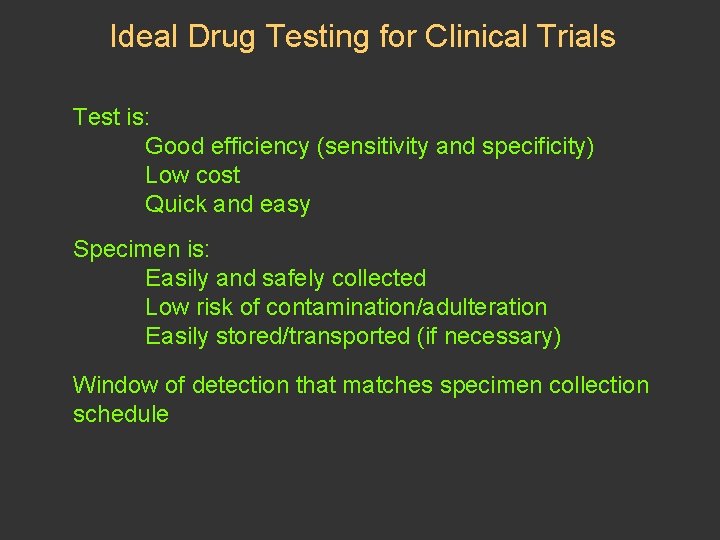
Ideal Drug Testing for Clinical Trials Test is: Good efficiency (sensitivity and specificity) Low cost Quick and easy Specimen is: Easily and safely collected Low risk of contamination/adulteration Easily stored/transported (if necessary) Window of detection that matches specimen collection schedule
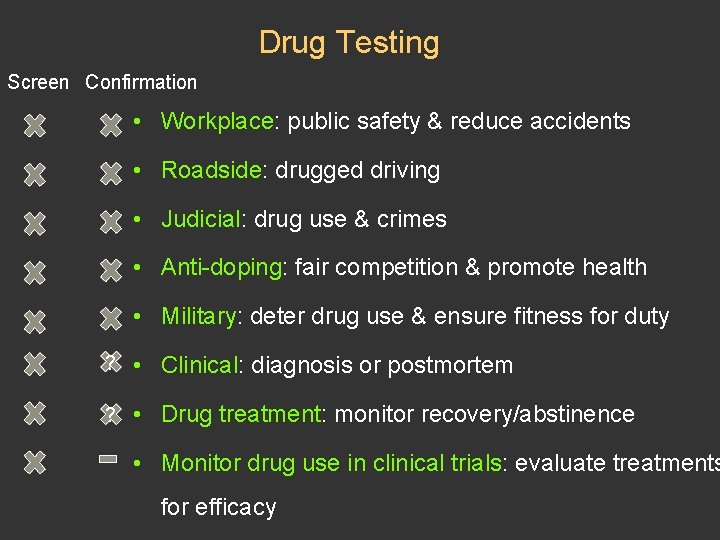
Drug Testing Screen Confirmation • Workplace: public safety & reduce accidents • Roadside: drugged driving • Judicial: drug use & crimes • Anti-doping: fair competition & promote health • Military: deter drug use & ensure fitness for duty ? • Clinical: diagnosis or postmortem ? • Drug treatment: monitor recovery/abstinence • Monitor drug use in clinical trials: evaluate treatments for efficacy

Drug Testing and Addiction Urine Hair Sweat Oral Fluid Breath Dried Blood Spot
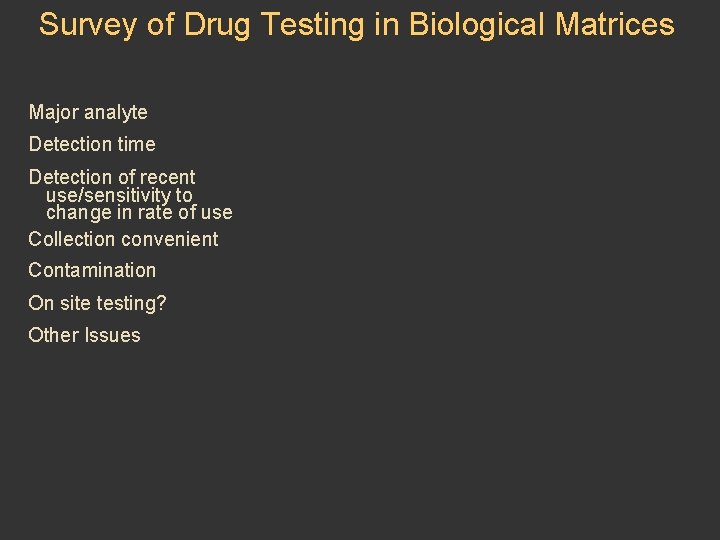
Survey of Drug Testing in Biological Matrices Major analyte Detection time Detection of recent use/sensitivity to change in rate of use Collection convenient Contamination On site testing? Other Issues
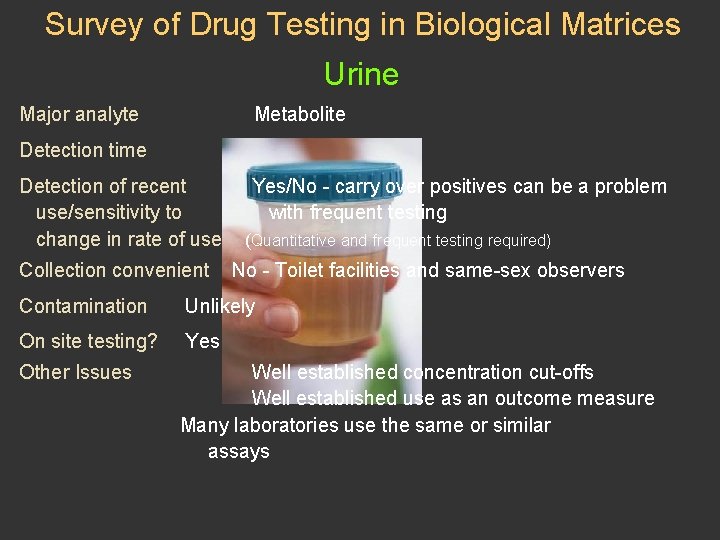
Survey of Drug Testing in Biological Matrices Urine Major analyte Metabolite Detection time 2 -4 days Detection of recent use/sensitivity to change in rate of use Yes/No - carry over positives can be a problem with frequent testing Collection convenient (Quantitative and frequent testing required) No - Toilet facilities and same-sex observers Contamination Unlikely On site testing? Yes Other Issues Well established concentration cut-offs Well established use as an outcome measure Many laboratories use the same or similar assays
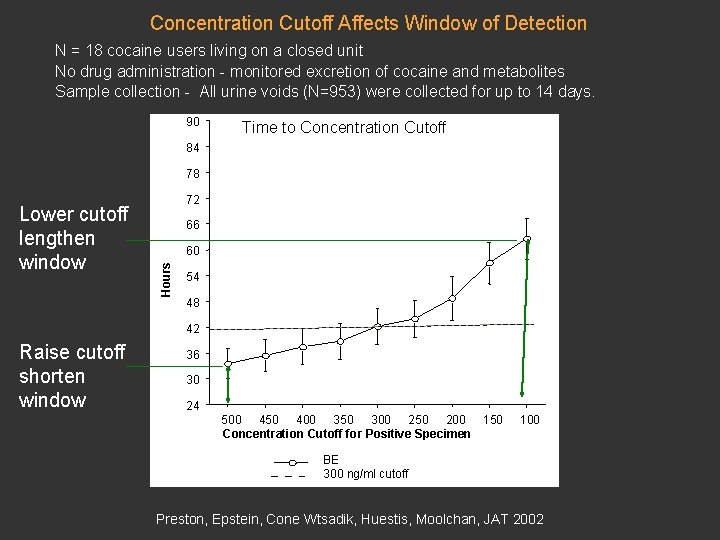
Concentration Cutoff Affects Window of Detection N = 18 cocaine users living on a closed unit No drug administration - monitored excretion of cocaine and metabolites Sample collection - All urine voids (N=953) were collected for up to 14 days. 90 Time to Concentration Cutoff 84 78 66 60 Hours Lower cutoff lengthen window 72 54 48 42 Raise cutoff shorten window 36 30 24 500 450 400 350 300 250 200 150 Concentration Cutoff for Positive Specimen 100 BE 300 ng/ml cutoff Preston, Epstein, Cone Wtsadik, Huestis, Moolchan, JAT 2002
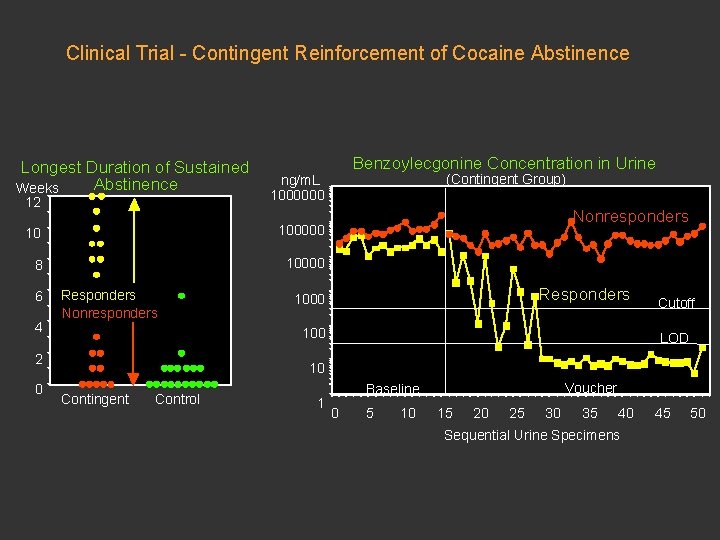
Clinical Trial - Contingent Reinforcement of Cocaine Abstinence Longest Duration of Sustained Abstinence Weeks 12 ng/m. L 1000000 10 100000 8 10000 6 4 Responders Nonresponders (Contingent Group) Nonresponders Responders 1000 100 2 0 Benzoylecgonine Concentration in Urine Cutoff LOD 10 Contingent Control 1 Voucher Baseline 0 5 10 15 20 25 30 35 40 Sequential Urine Specimens 45 50
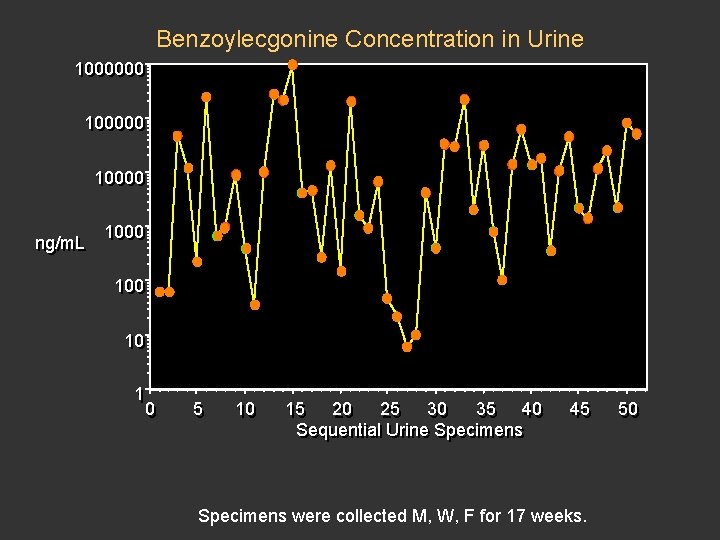
Benzoylecgonine Concentration in Urine 1000000 100000 10000 ng/m. L 1000 100 10 10 11 00 55 10 10 15 15 20 20 25 25 30 30 35 35 40 40 Sequential Urine Specimens 45 45 Specimens were collected M, W, F for 17 weeks. 50 50
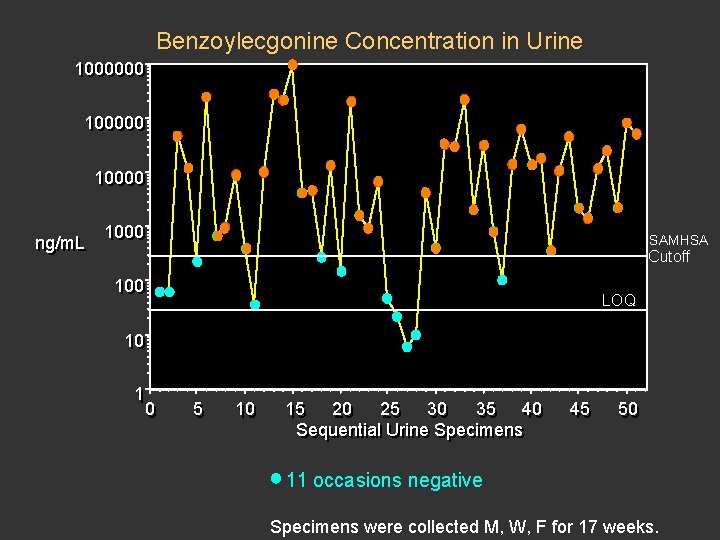
Benzoylecgonine Concentration in Urine 1000000 100000 10000 ng/m. L 1000 SAMHSA Cutoff 100 LOQ 10 10 11 00 55 10 10 15 15 20 20 25 25 30 30 35 35 40 40 Sequential Urine Specimens 45 45 50 50 11 occasions negative Specimens were collected M, W, F for 17 weeks.
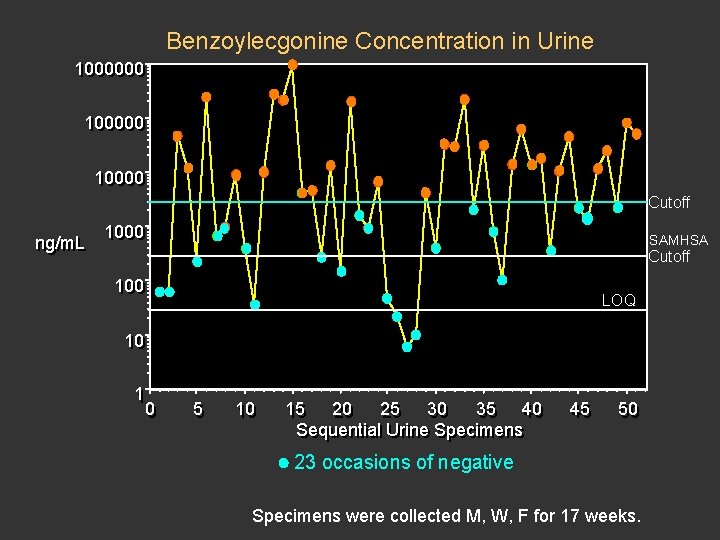
Benzoylecgonine Concentration in Urine 1000000 100000 10000 Cutoff ng/m. L 1000 SAMHSA Cutoff 100 LOQ 10 10 11 00 55 10 10 15 15 20 20 25 25 30 30 35 35 40 40 Sequential Urine Specimens 45 45 50 50 23 occasions of negative Specimens were collected M, W, F for 17 weeks.
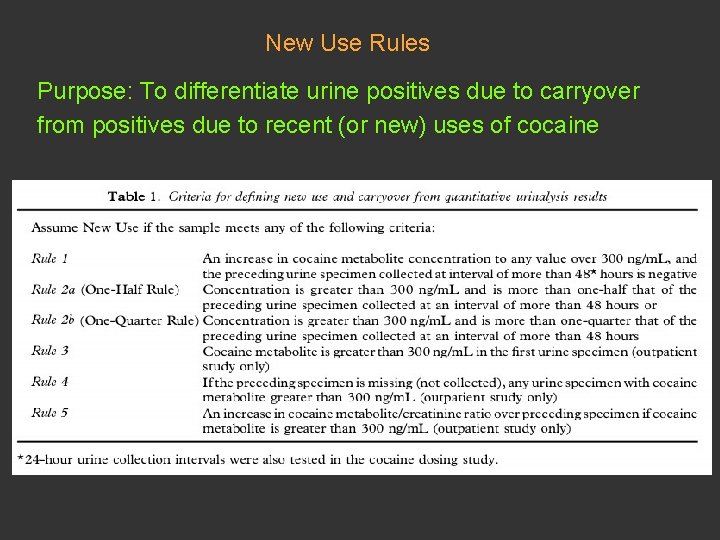
New Use Rules Purpose: To differentiate urine positives due to carryover from positives due to recent (or new) uses of cocaine
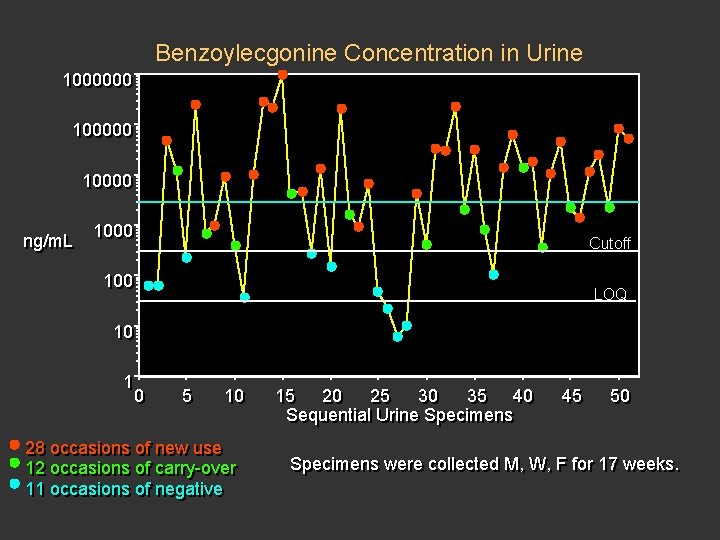
Benzoylecgonine Concentration in Urine 1000000 100000 10000 ng/m. L 1000 Cutoff 100 LOQ 10 10 11 00 55 10 10 28 28 occasions of of new use 12 12 occasions of of carry-over 11 11 occasions of of negative 15 15 20 20 25 25 30 30 35 35 40 40 Sequential Urine Specimens 45 45 50 50 Specimens were collected M, M, W, W, FF for 17 17 weeks.
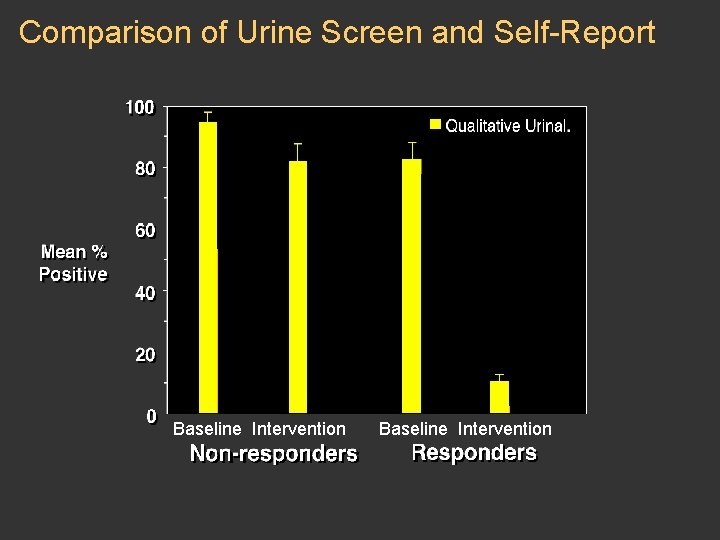
Comparison of Urine Screen and Self-Report Baseline Intervention
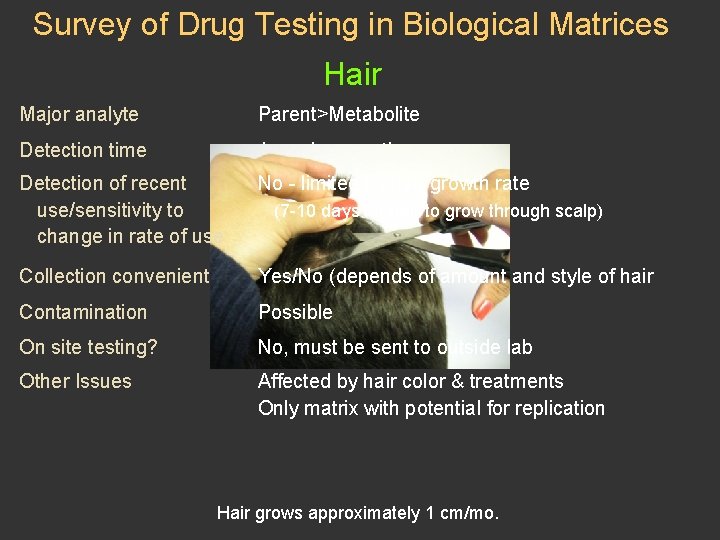
Survey of Drug Testing in Biological Matrices Hair Major analyte Parent>Metabolite Detection time 1 week – months Detection of recent use/sensitivity to change in rate of use No - limited by hair growth rate Collection convenient Yes/No (depends of amount and style of hair Contamination Possible On site testing? No, must be sent to outside lab Other Issues Affected by hair color & treatments Only matrix with potential for replication (7 -10 days for hair to grow through scalp) Hair grows approximately 1 cm/mo.
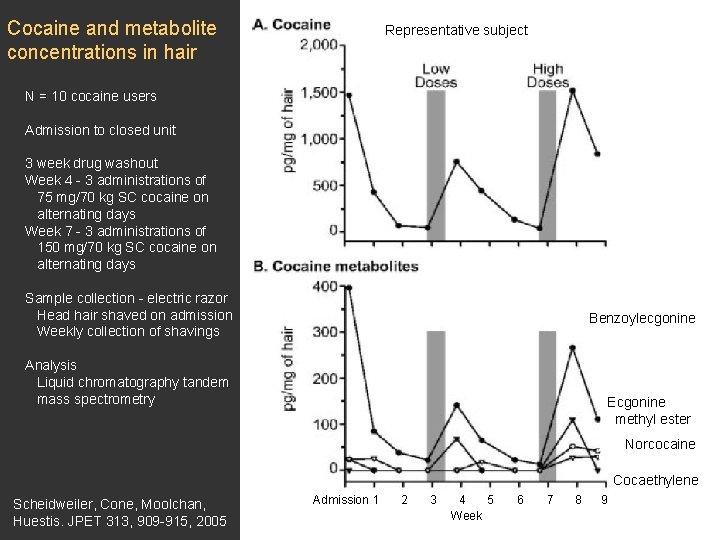
Cocaine and metabolite concentrations in hair Representative subject N = 10 cocaine users Admission to closed unit 3 week drug washout Week 4 - 3 administrations of 75 mg/70 kg SC cocaine on alternating days Week 7 - 3 administrations of 150 mg/70 kg SC cocaine on alternating days Sample collection - electric razor Head hair shaved on admission Weekly collection of shavings Benzoylecgonine Analysis Liquid chromatography tandem mass spectrometry Ecgonine methyl ester Norcocaine Cocaethylene Scheidweiler, Cone, Moolchan, Huestis. JPET 313, 909 -915, 2005 Admission 1 2 3 4 5 Week 6 7 8 9
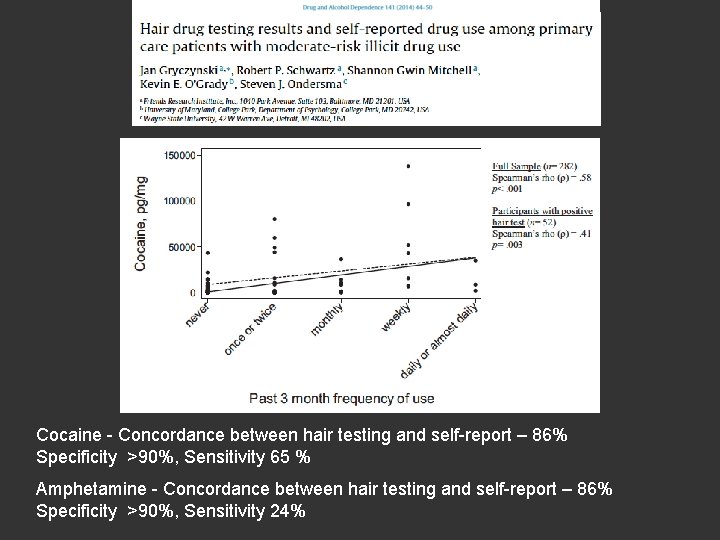
Cocaine - Concordance between hair testing and self-report – 86% Specificity >90%, Sensitivity 65 % Amphetamine - Concordance between hair testing and self-report – 86% Specificity >90%, Sensitivity 24%
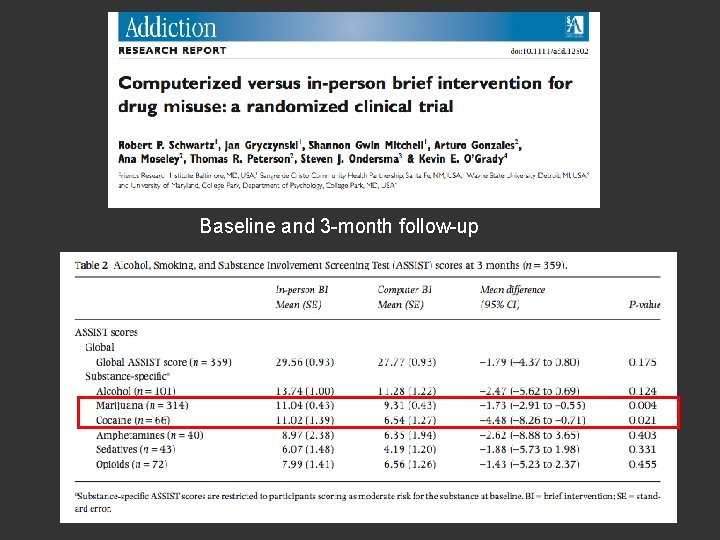
Baseline and 3 -month follow-up
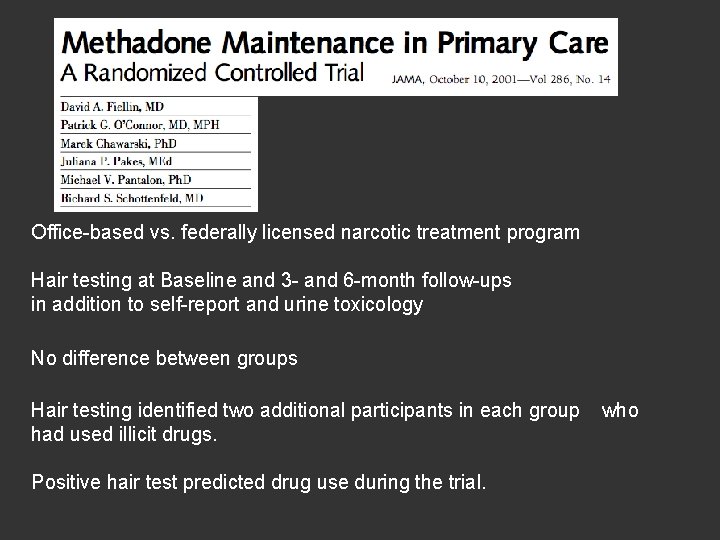
Office-based vs. federally licensed narcotic treatment program Hair testing at Baseline and 3 - and 6 -month follow-ups in addition to self-report and urine toxicology No difference between groups Hair testing identified two additional participants in each group had used illicit drugs. Positive hair test predicted drug use during the trial. who
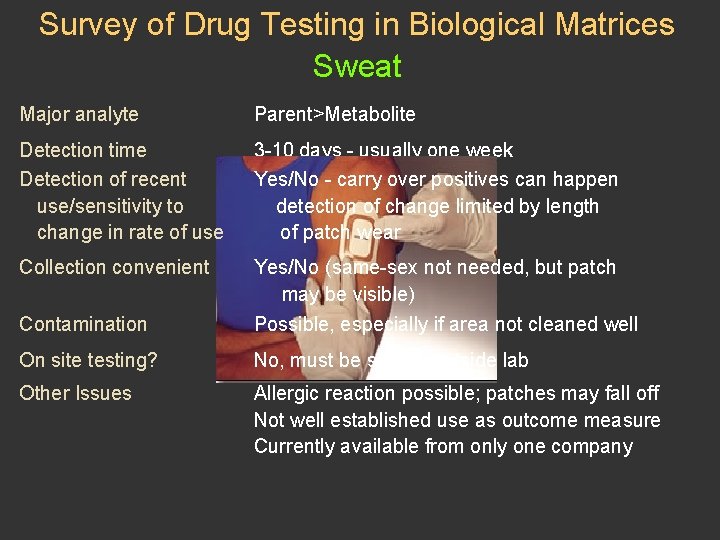
Survey of Drug Testing in Biological Matrices Sweat Major analyte Parent>Metabolite Detection time Detection of recent use/sensitivity to change in rate of use 3 -10 days - usually one week Yes/No - carry over positives can happen detection of change limited by length of patch wear Collection convenient Yes/No (same-sex not needed, but patch may be visible) Contamination Possible, especially if area not cleaned well On site testing? No, must be sent to outside lab Other Issues Allergic reaction possible; patches may fall off Not well established use as outcome measure Currently available from only one company
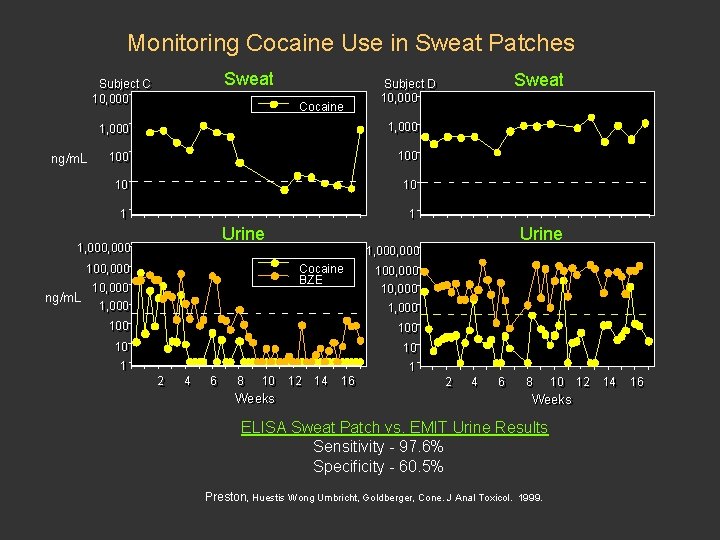
Monitoring Cocaine Use in Sweat Patches Sweat Subject C C 10, 000 ng/m. L Cocaine 1, 000 100 100 10 10 11 11 Urine 1, 000, 000 ng/m. L Sweat Subject D D 10, 000 Urine 1, 000, 000 100, 000 10, 000 Cocaine BZE 100, 000 10, 000 1, 000 100 100 10 10 11 22 44 66 88 10 10 12 12 14 14 Weeks 16 16 22 44 66 88 10 10 12 12 14 14 Weeks ELISA Sweat Patch vs. EMIT Urine Results Sensitivity - 97. 6% Specificity - 60. 5% Preston, Huestis Wong Umbricht, Goldberger, Cone. J Anal Toxicol. 1999. 16 16
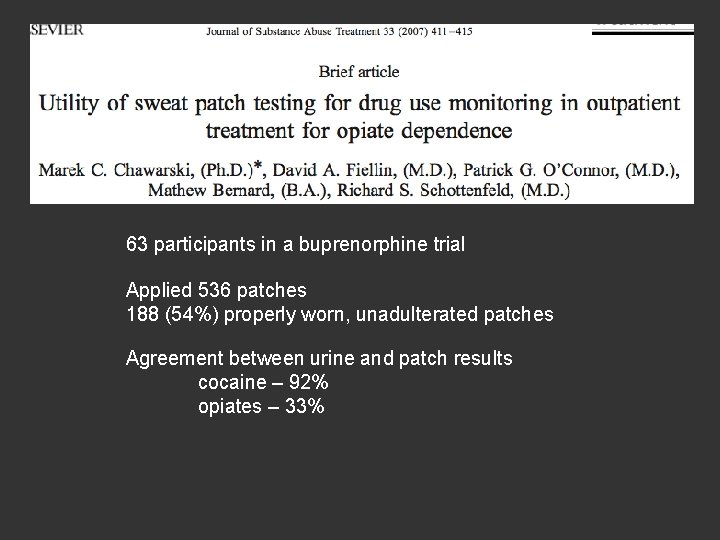
63 participants in a buprenorphine trial Applied 536 patches 188 (54%) properly worn, unadulterated patches Agreement between urine and patch results cocaine – 92% opiates – 33%
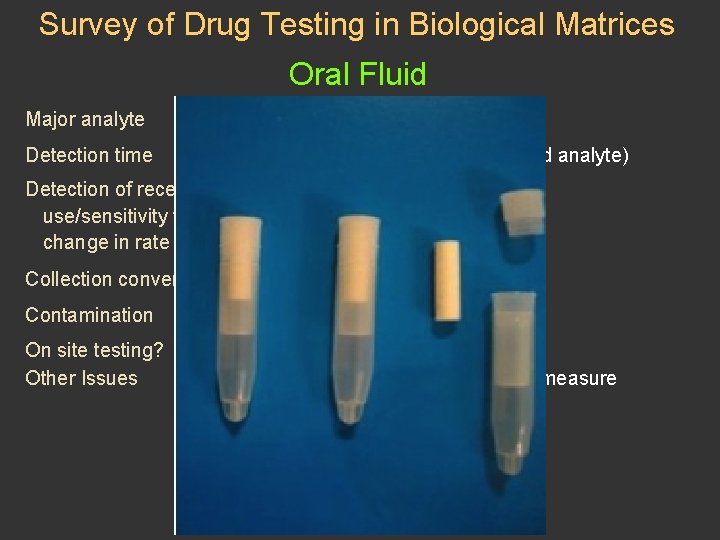
Survey of Drug Testing in Biological Matrices Oral Fluid Major analyte Parent>Metabolite Detection time 1 -2 days (depends on cut off and analyte) Detection of recent use/sensitivity to change in rate of use Yes Collection convenient Yes Contamination Yes/No On site testing? Other Issues Yes Not established as an outcome measure Affected by flow rate & p. H
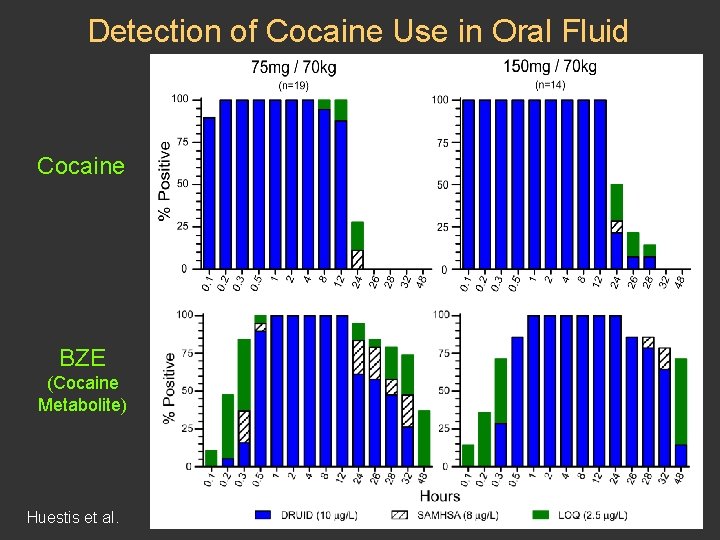
Detection of Cocaine Use in Oral Fluid Cocaine BZE (Cocaine Metabolite) Huestis et al.
Potential Areas of Research § Optimize concentration cut-offs/detection windows § Combine different biological matrices to optimize windows of drug detection § Investigate methods to improve adherence to specimen collection § Investigate methods to improve remote collection of specimens

Questions?
- Slides: 27