
Practical Universal Computers Bits Wires Gates Turing Machines
Practical Universal Computers Bits Wires Gates Turing Machines Lecture 4 Prof. Bienvenido Velez Fall 2002 INEL 4206 Microprocessors Lecture 4 1
Outline • The von Neumann Architecture – Big Ideas: • Interpretation • Stored program concept • Designing a simple processor – Instruction Set Architecture – Data Paths – Control Unit Fall 2002 INEL 4206 Microprocessors Lecture 4 2
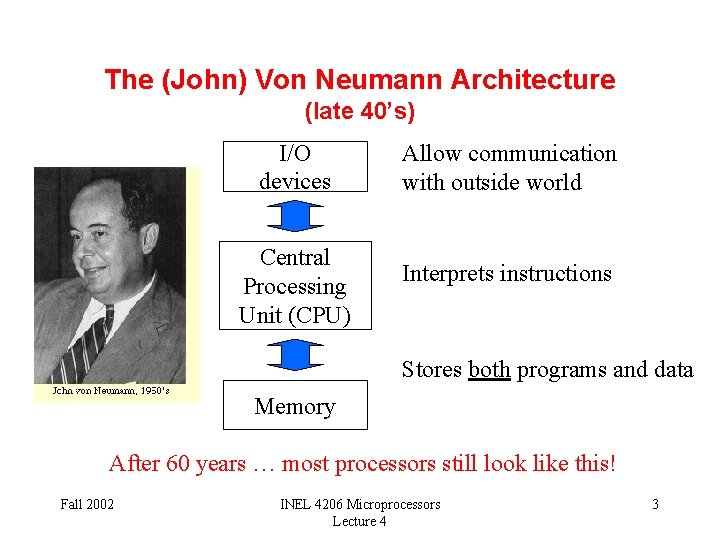
The (John) Von Neumann Architecture (late 40’s) I/O devices Central Processing Unit (CPU) Allow communication with outside world Interprets instructions Stores both programs and data Memory After 60 years … most processors still look like this! Fall 2002 INEL 4206 Microprocessors Lecture 4 3
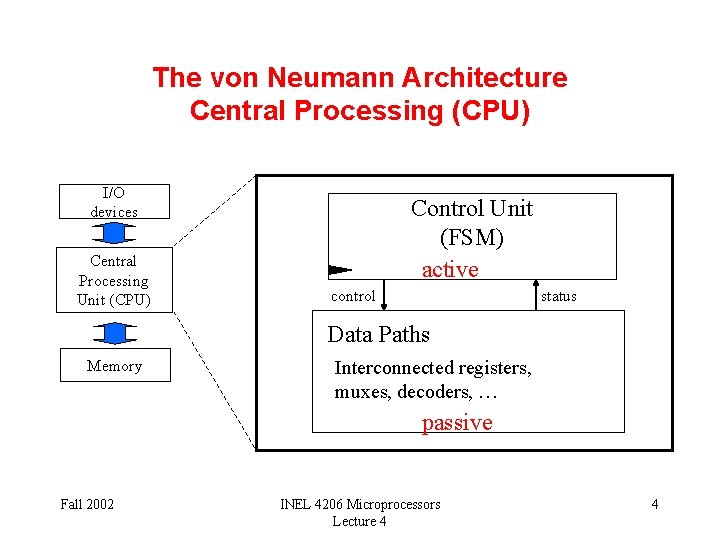
The von Neumann Architecture Central Processing (CPU) I/O devices Central Processing Unit (CPU) Control Unit (FSM) active control status Data Paths Memory Interconnected registers, muxes, decoders, … passive Fall 2002 INEL 4206 Microprocessors Lecture 4 4
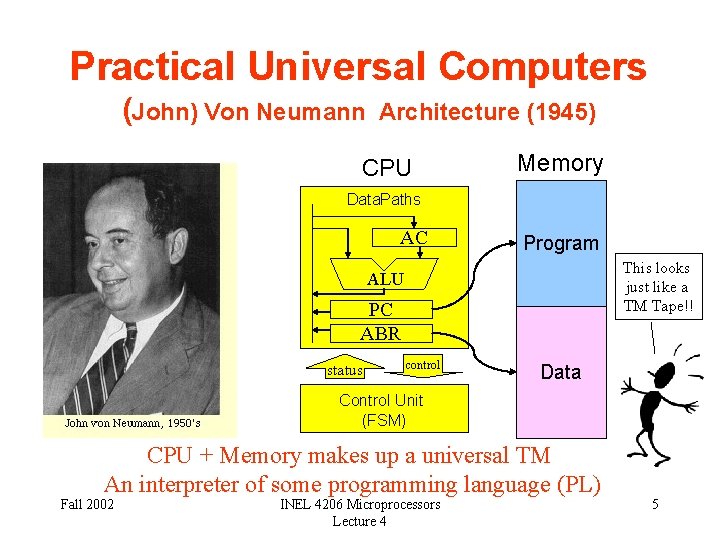
Practical Universal Computers (John) Von Neumann Architecture (1945) CPU Memory Data. Paths AC Program This looks just like a TM Tape!! ALU PC ABR status control Data Control Unit (FSM) CPU + Memory makes up a universal TM An interpreter of some programming language (PL) Fall 2002 INEL 4206 Microprocessors Lecture 4 5
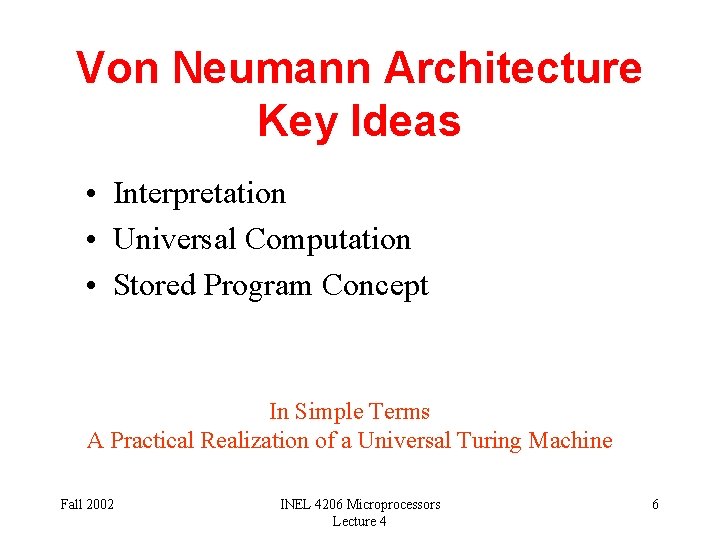
Von Neumann Architecture Key Ideas • Interpretation • Universal Computation • Stored Program Concept In Simple Terms A Practical Realization of a Universal Turing Machine Fall 2002 INEL 4206 Microprocessors Lecture 4 6
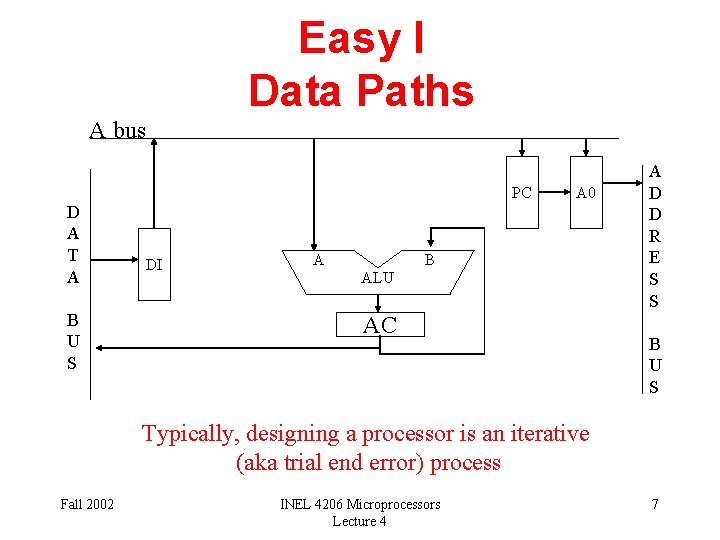
Easy I Data Paths A bus PC D A T A B U S DI A A 0 B ALU AC A D D R E S S B U S Typically, designing a processor is an iterative (aka trial end error) process Fall 2002 INEL 4206 Microprocessors Lecture 4 7
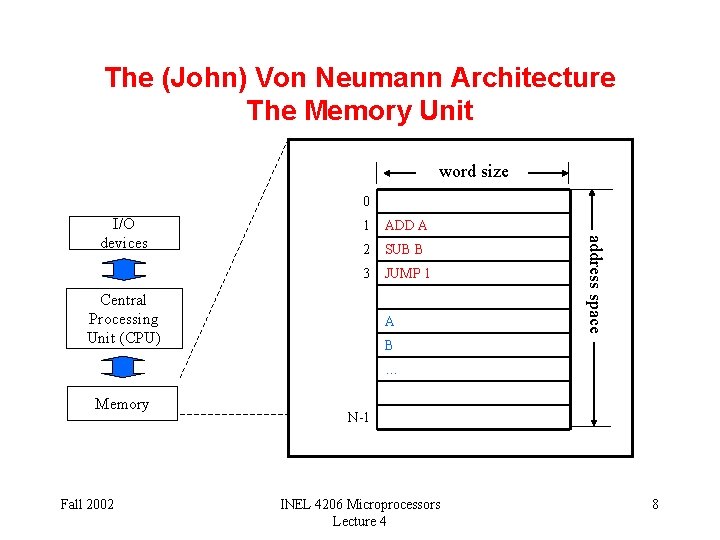
The (John) Von Neumann Architecture The Memory Unit word size 0 1 ADD A 2 SUB B 3 JUMP 1 Central Processing Unit (CPU) A address space I/O devices B … Memory Fall 2002 N-1 INEL 4206 Microprocessors Lecture 4 8
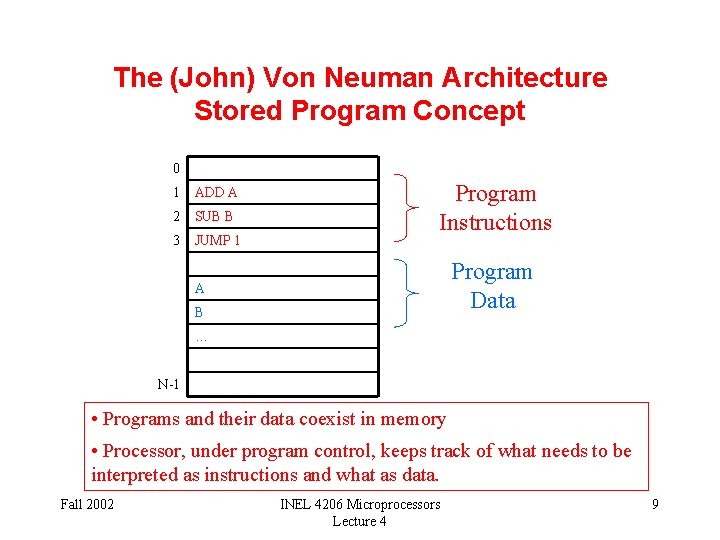
The (John) Von Neuman Architecture Stored Program Concept 0 1 ADD A 2 SUB B 3 JUMP 1 Program Instructions Program Data A B … N-1 • Programs and their data coexist in memory • Processor, under program control, keeps track of what needs to be interpreted as instructions and what as data. Fall 2002 INEL 4206 Microprocessors Lecture 4 9
Definition Instruction Set Architecture • What it is: – The programmers view of the processor – Visible registers, instruction set, execution model, memory model, I/O model • What it is not: – How the processors if build – The processor’s internal structure Fall 2002 INEL 4206 Microprocessors Lecture 4 10
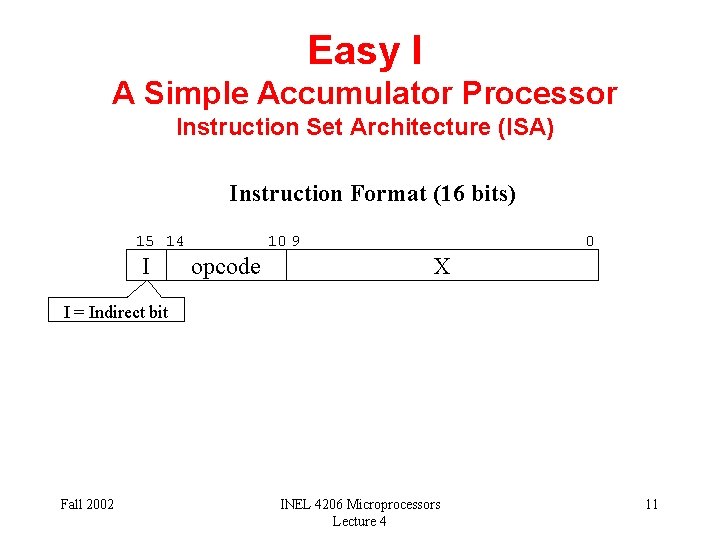
Easy I A Simple Accumulator Processor Instruction Set Architecture (ISA) Instruction Format (16 bits) 15 14 I 10 9 opcode 0 X I = Indirect bit Fall 2002 INEL 4206 Microprocessors Lecture 4 11
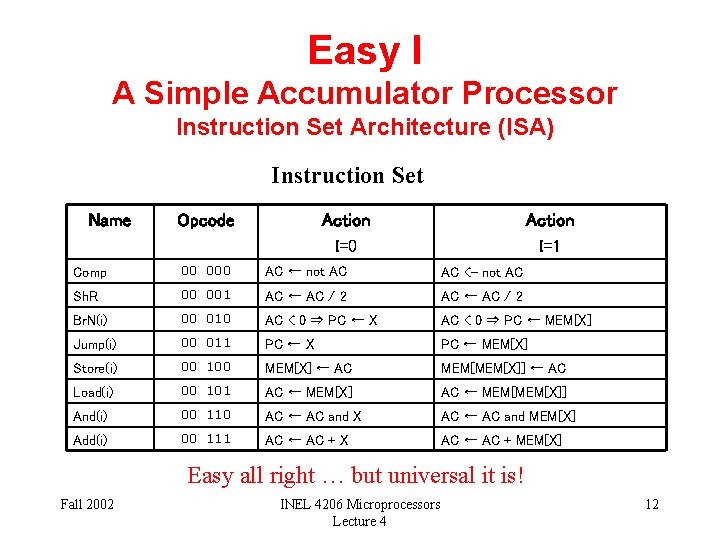
Easy I A Simple Accumulator Processor Instruction Set Architecture (ISA) Instruction Set Name Opcode Action I=0 Action I=1 Comp 00 000 AC ← not AC AC <- not AC Sh. R 00 001 AC ← AC / 2 Br. N(i) 00 010 AC < 0 ⇒ PC ← X AC < 0 ⇒ PC ← MEM[X] Jump(i) 00 011 PC ← X PC ← MEM[X] Store(i) 00 100 MEM[X] ← AC MEM[X]] ← AC Load(i) 00 101 AC ← MEM[X]] And(i) 00 110 AC ← AC and X AC ← AC and MEM[X] Add(i) 00 111 AC ← AC + X AC ← AC + MEM[X] Easy all right … but universal it is! Fall 2002 INEL 4206 Microprocessors Lecture 4 12
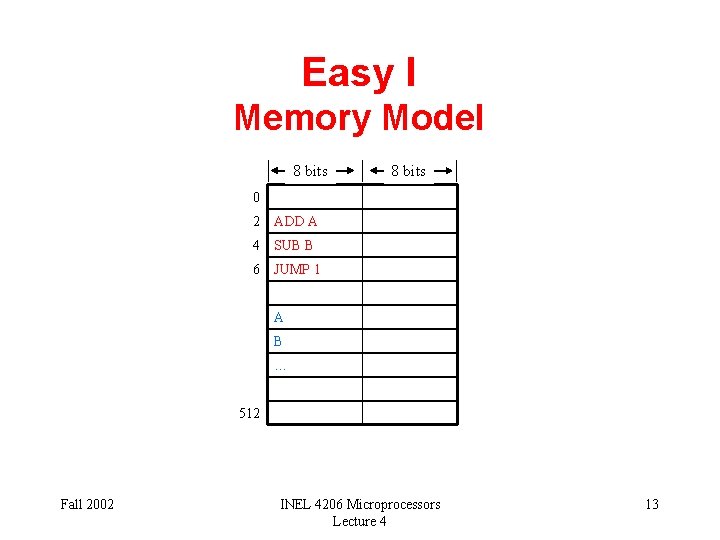
Easy I Memory Model 8 bits 0 2 ADD A 4 SUB B 6 JUMP 1 A B … 512 Fall 2002 INEL 4206 Microprocessors Lecture 4 13
Easy I A Simple 16 -bit Accumulator Processor Instruction Set Architecture (ISA) Some Immediate Observations on the Easy I ISA • Accumulator (AC) is implicit operand to many instructions. No need to use instruction bits to specify one of the operands. More bits left for address and opcodes. • Although simple, Easy I is universal. (given enough memory). Can you see this? • Immediate bit specifies level of indirection for the location of the operand. I = 0: operand in X field (immediate). I=1 operand in memory location X (indirect). Fall 2002 INEL 4206 Microprocessors Lecture 4 14
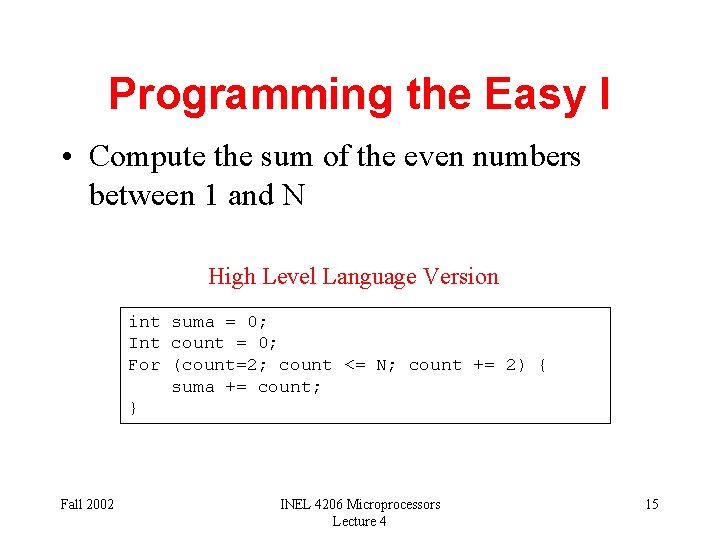
Programming the Easy I • Compute the sum of the even numbers between 1 and N High Level Language Version int suma = 0; Int count = 0; For (count=2; count <= N; count += 2) { suma += count; } Fall 2002 INEL 4206 Microprocessors Lecture 4 15
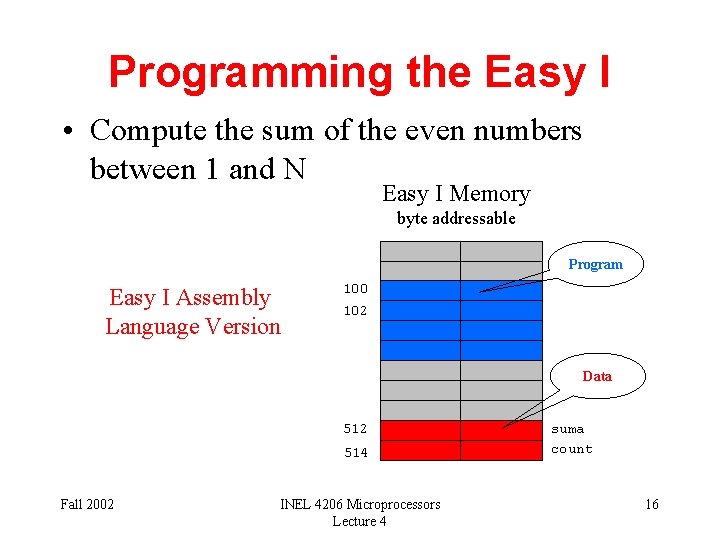
Programming the Easy I • Compute the sum of the even numbers between 1 and N Easy I Memory byte addressable Program Easy I Assembly Language Version 100 102 Data 512 514 Fall 2002 INEL 4206 Microprocessors Lecture 4 suma count 16
Programming the Easy I • Compute the sum of the even numbers between 1 and N [Blackboard] Fall 2002 INEL 4206 Microprocessors Lecture 4 17
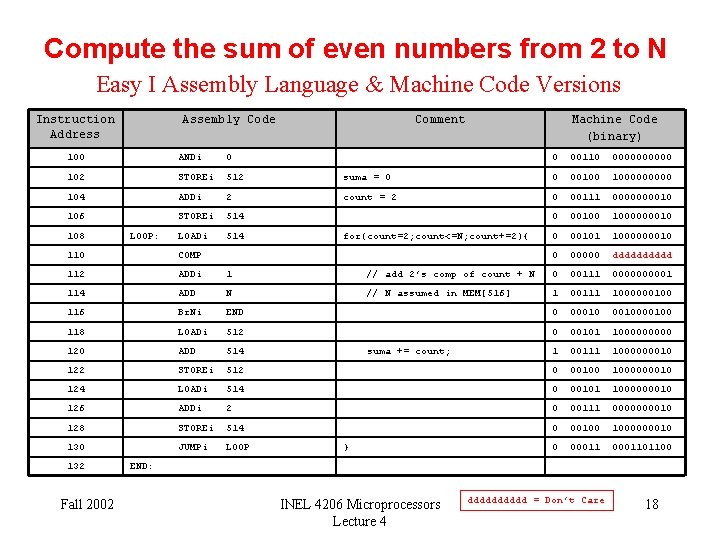
Compute the sum of even numbers from 2 to N Easy I Assembly Language & Machine Code Versions Instruction Address Assembly Code 100 ANDi 0 102 STOREi 512 104 ADDi 2 106 STOREi 514 LOADi 514 108 LOOP: Comment Machine Code (binary) 0 00110 00000 suma = 0 0 00100 100000 count = 2 0 00111 000010 0 00100 1000000010 0 00101 1000000010 0 00000 ddddd for(count=2; count<=N; count+=2){ 110 COMP 112 ADDi 1 // add 2’s comp of count + N 0 00111 000001 114 ADD N // N assumed in MEM[516] 1 00111 1000000100 116 Br. Ni END 0 000100 118 LOADi 512 0 00101 100000 120 ADD 514 1 00111 1000000010 122 STOREi 512 0 00100 1000000010 124 LOADi 514 0 00101 1000000010 126 ADDi 2 0 00111 000010 128 STOREi 514 0 00100 1000000010 130 JUMPi LOOP 0 0001101100 132 Fall 2002 suma += count; } END: INEL 4206 Microprocessors Lecture 4 ddddd = Don’t Care 18
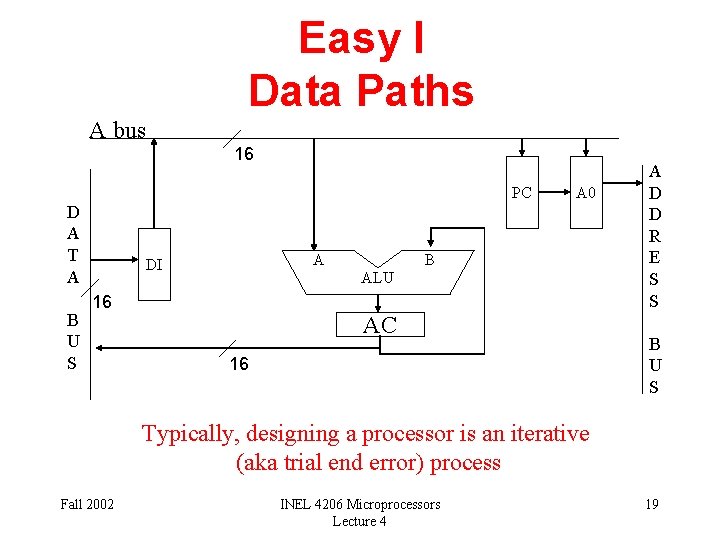
Easy I Data Paths A bus 16 PC D A T A B U S A DI A 0 B ALU 16 AC 16 A D D R E S S B U S Typically, designing a processor is an iterative (aka trial end error) process Fall 2002 INEL 4206 Microprocessors Lecture 4 19
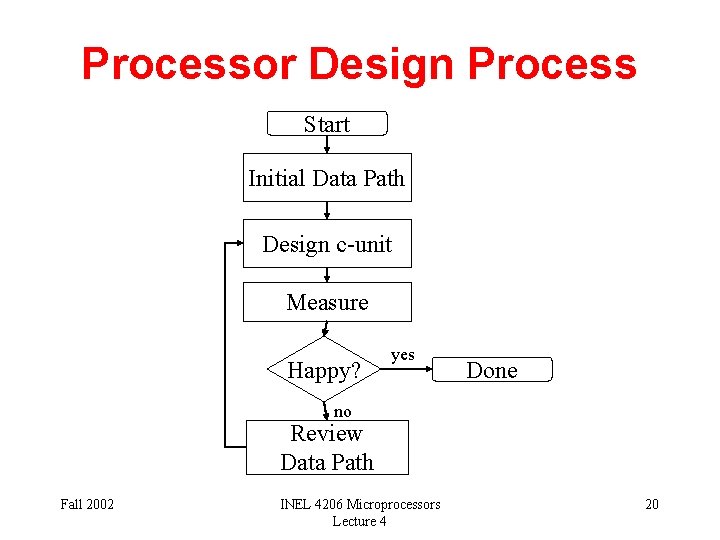
Processor Design Process Start Initial Data Path Design c-unit Measure Happy? yes Done no Review Data Path Fall 2002 INEL 4206 Microprocessors Lecture 4 20
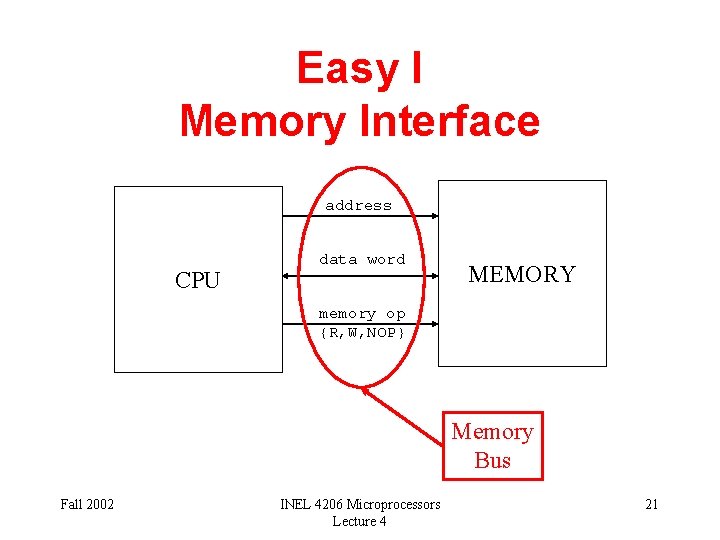
Easy I Memory Interface address CPU data word MEMORY memory op {R, W, NOP} Memory Bus Fall 2002 INEL 4206 Microprocessors Lecture 4 21
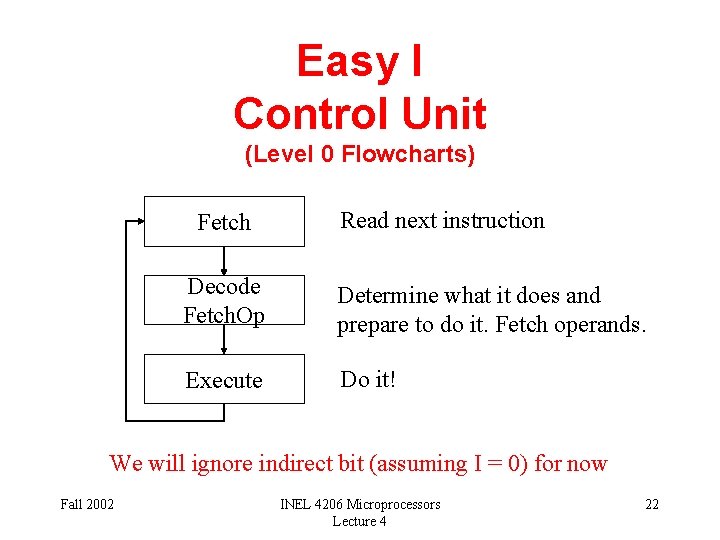
Easy I Control Unit (Level 0 Flowcharts) Fetch Read next instruction Decode Fetch. Op Determine what it does and prepare to do it. Fetch operands. Execute Do it! We will ignore indirect bit (assuming I = 0) for now Fall 2002 INEL 4206 Microprocessors Lecture 4 22
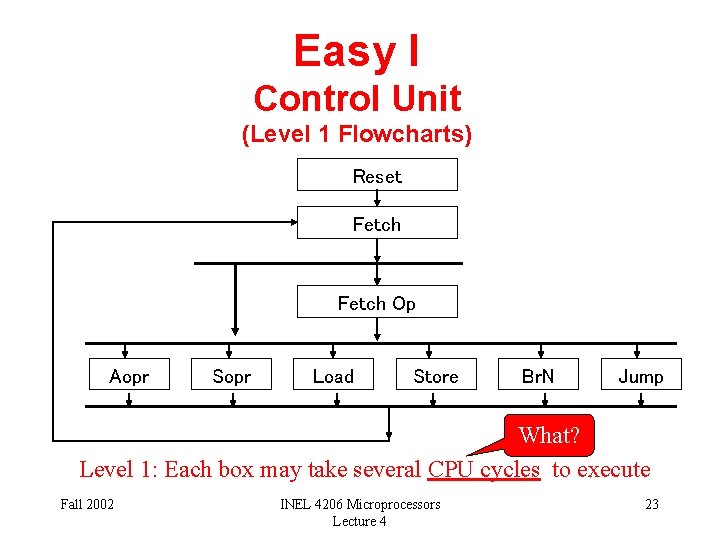
Easy I Control Unit (Level 1 Flowcharts) Reset Fetch Op Aopr Sopr Load Store Br. N Jump What? Level 1: Each box may take several CPU cycles to execute Fall 2002 INEL 4206 Microprocessors Lecture 4 23
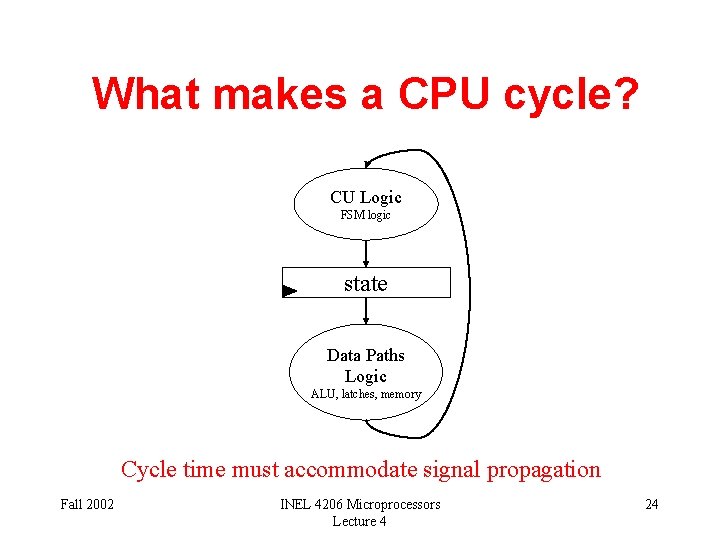
What makes a CPU cycle? CU Logic FSM logic state Data Paths Logic ALU, latches, memory Cycle time must accommodate signal propagation Fall 2002 INEL 4206 Microprocessors Lecture 4 24
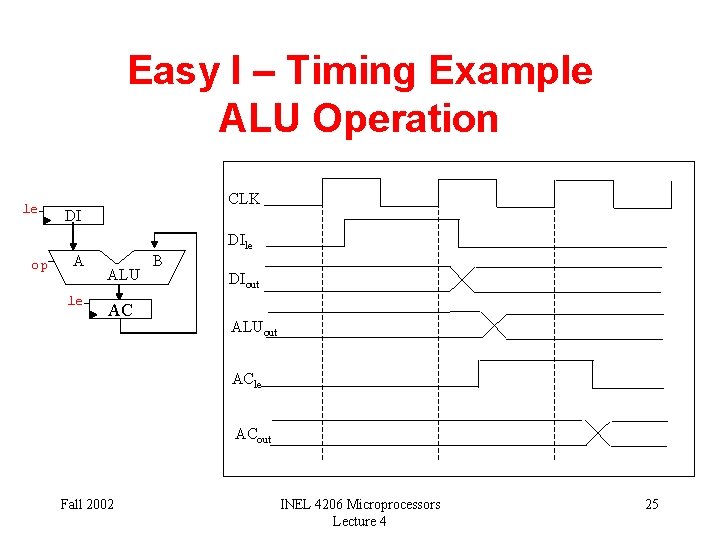
Easy I – Timing Example ALU Operation le CLK DI DIle op A le ALU AC B DIout ALUout ACle ACout Fall 2002 INEL 4206 Microprocessors Lecture 4 25
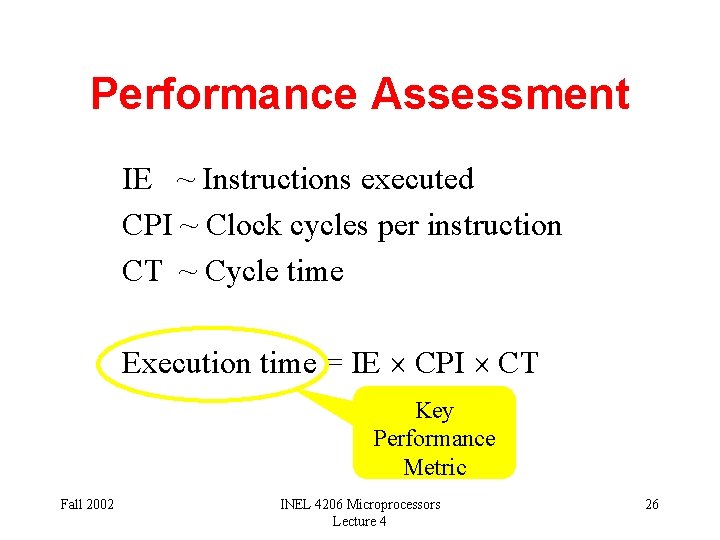
Performance Assessment IE ~ Instructions executed CPI ~ Clock cycles per instruction CT ~ Cycle time Execution time = IE CPI CT Key Performance Metric Fall 2002 INEL 4206 Microprocessors Lecture 4 26
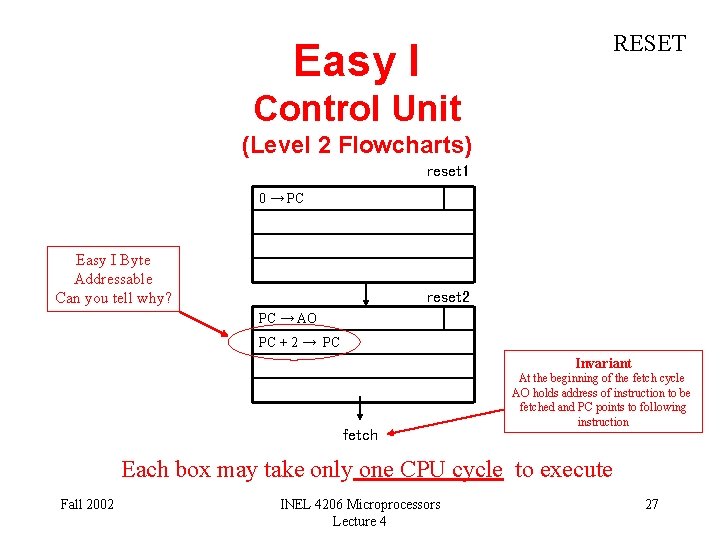
RESET Easy I Control Unit (Level 2 Flowcharts) reset 1 0 → PC Easy I Byte Addressable Can you tell why? reset 2 PC → AO PC + 2 → PC Invariant fetch At the beginning of the fetch cycle AO holds address of instruction to be fetched and PC points to following instruction Each box may take only one CPU cycle to execute Fall 2002 INEL 4206 Microprocessors Lecture 4 27
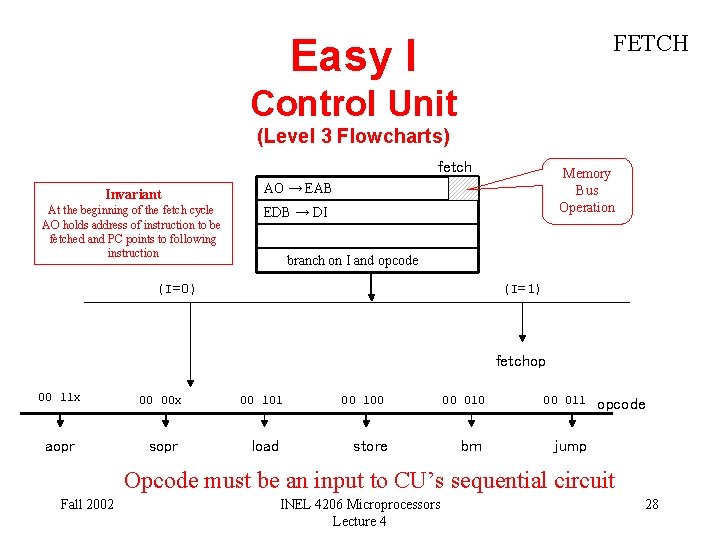
FETCH Easy I Control Unit (Level 3 Flowcharts) fetch Invariant At the beginning of the fetch cycle AO holds address of instruction to be fetched and PC points to following instruction Memory Bus Operation AO → EAB EDB → DI branch on I and opcode (I=0) (I=1) fetchop 00 11 x 00 00 x 00 101 aopr sopr load 00 100 00 011 store brn jump opcode Opcode must be an input to CU’s sequential circuit Fall 2002 INEL 4206 Microprocessors Lecture 4 28
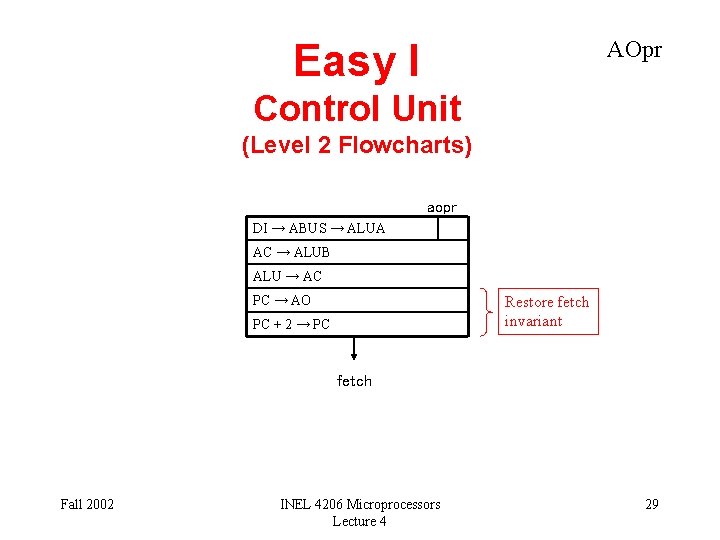
AOpr Easy I Control Unit (Level 2 Flowcharts) aopr DI → ABUS → ALUA AC → ALUB ALU → AC PC → AO Restore fetch invariant PC + 2 → PC fetch Fall 2002 INEL 4206 Microprocessors Lecture 4 29
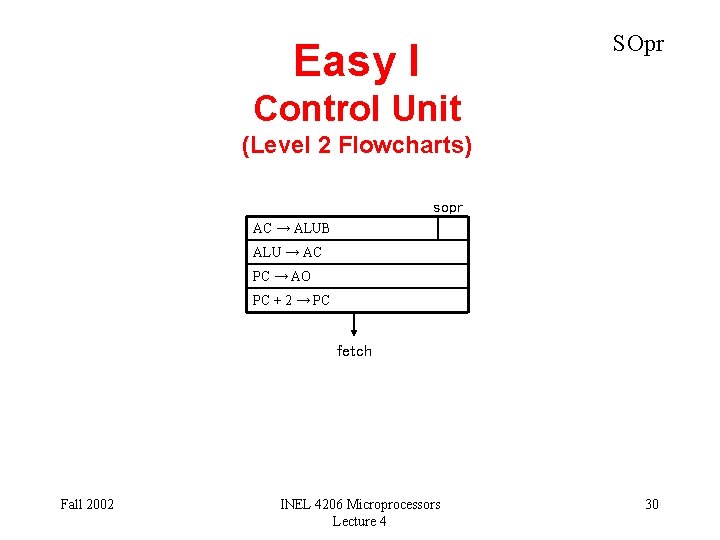
SOpr Easy I Control Unit (Level 2 Flowcharts) sopr AC → ALUB ALU → AC PC → AO PC + 2 → PC fetch Fall 2002 INEL 4206 Microprocessors Lecture 4 30
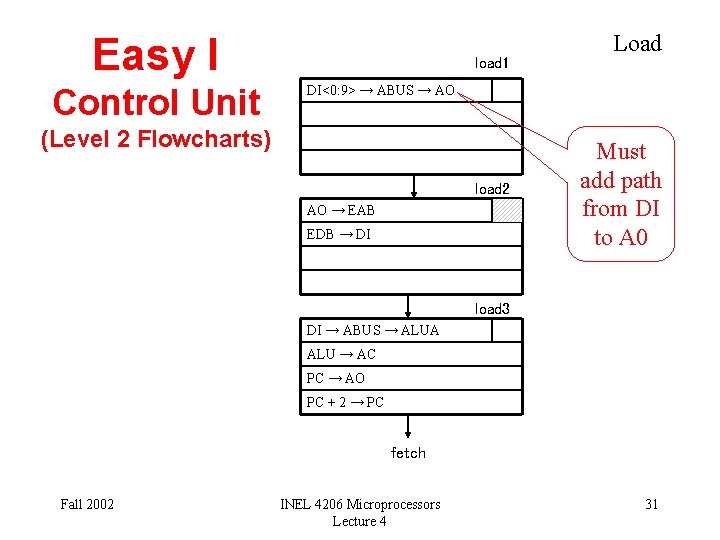
Easy I Control Unit load 1 Load DI<0: 9> → ABUS → AO (Level 2 Flowcharts) load 2 AO → EAB EDB → DI Must add path from DI to A 0 load 3 DI → ABUS → ALUA ALU → AC PC → AO PC + 2 → PC fetch Fall 2002 INEL 4206 Microprocessors Lecture 4 31
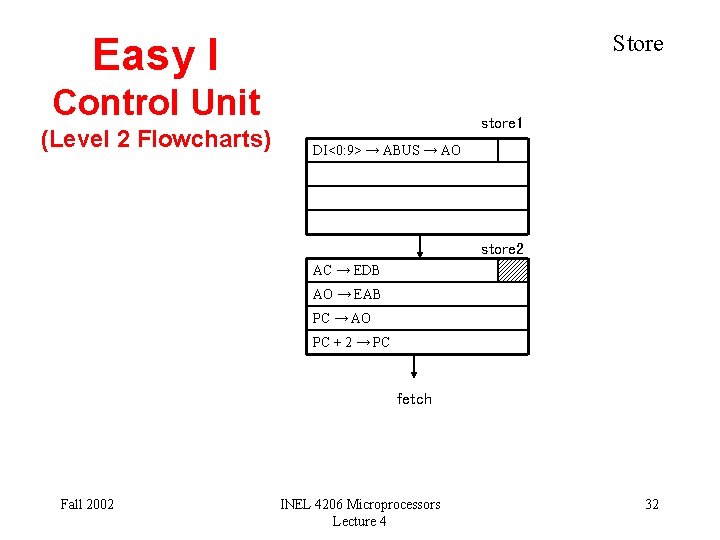
Store Easy I Control Unit (Level 2 Flowcharts) store 1 DI<0: 9> → ABUS → AO store 2 AC → EDB AO → EAB PC → AO PC + 2 → PC fetch Fall 2002 INEL 4206 Microprocessors Lecture 4 32
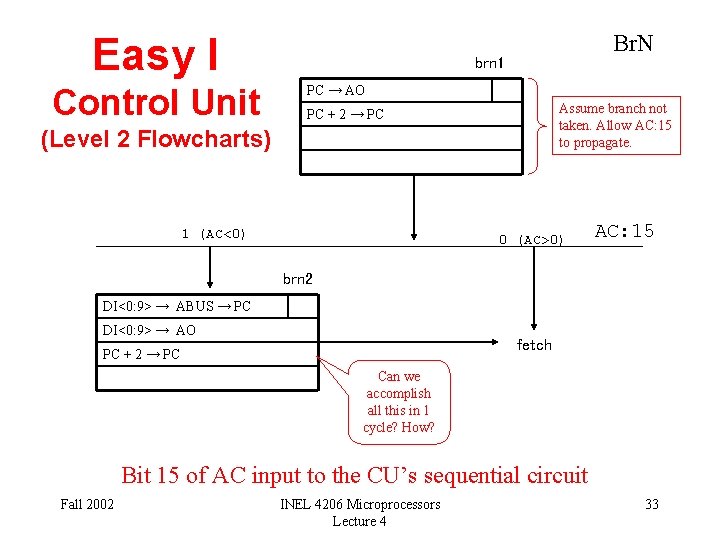
Easy I Control Unit Br. N brn 1 PC → AO Assume branch not taken. Allow AC: 15 to propagate. PC + 2 → PC (Level 2 Flowcharts) 1 (AC<0) 0 (AC>0) AC: 15 brn 2 DI<0: 9> → ABUS → PC DI<0: 9> → AO fetch PC + 2 → PC Can we accomplish all this in 1 cycle? How? Bit 15 of AC input to the CU’s sequential circuit Fall 2002 INEL 4206 Microprocessors Lecture 4 33
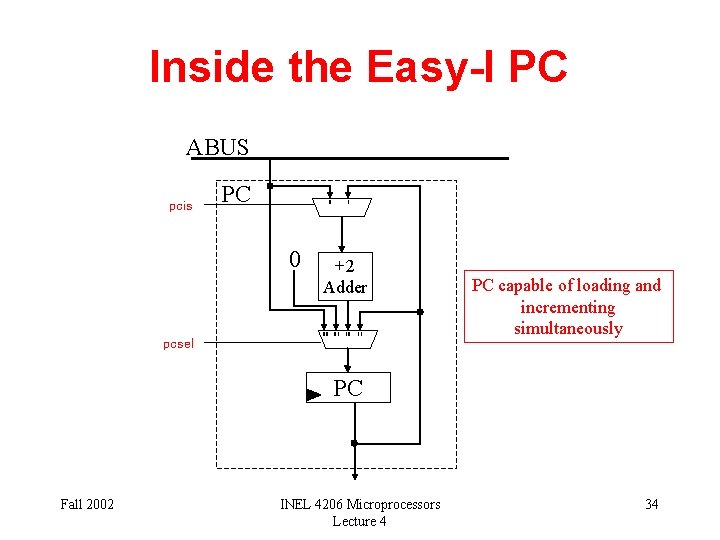
Inside the Easy-I PC ABUS pcis PC 0 0 pcsel 1 +2 Adder 00 01 10 11 PC capable of loading and incrementing simultaneously PC Fall 2002 INEL 4206 Microprocessors Lecture 4 34
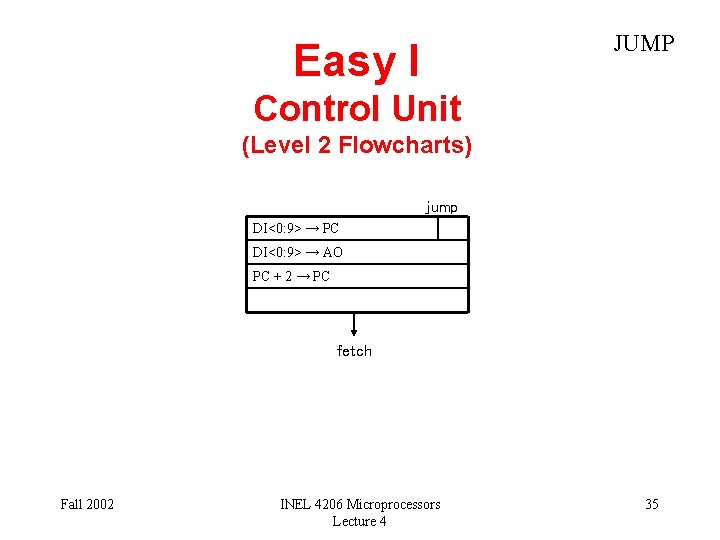
JUMP Easy I Control Unit (Level 2 Flowcharts) jump DI<0: 9> → PC DI<0: 9> → AO PC + 2 → PC fetch Fall 2002 INEL 4206 Microprocessors Lecture 4 35
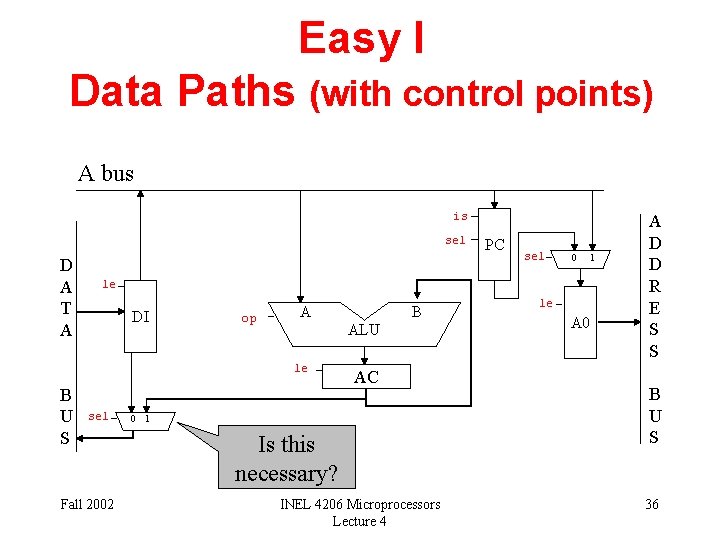
Easy I Data Paths (with control points) A bus is sel D A T A sel 0 le DI op A sel Fall 2002 B ALU le B U S PC AC 0 1 Is this necessary? INEL 4206 Microprocessors Lecture 4 le A 0 1 A D D R E S S B U S 36
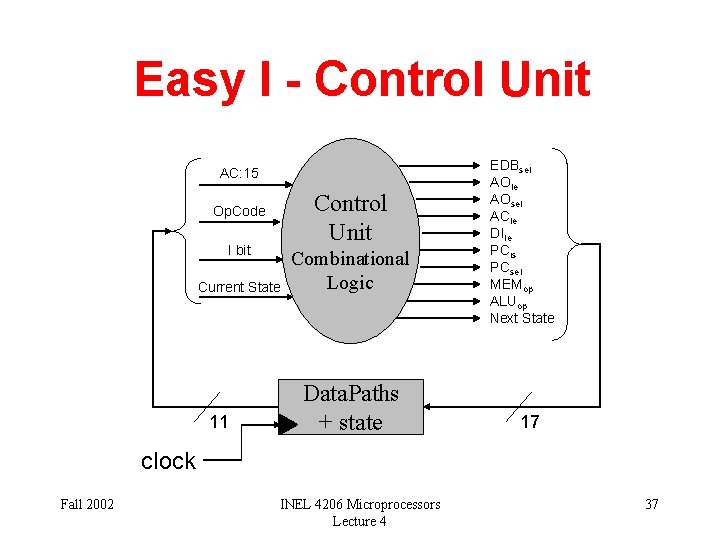
Easy I - Control Unit AC: 15 Control Unit Op. Code I bit Current State 11 Combinational Logic Data. Paths + state EDBsel AOle AOsel ACle DIle PCis PCsel MEMop ALUop Next State 17 clock Fall 2002 INEL 4206 Microprocessors Lecture 4 37
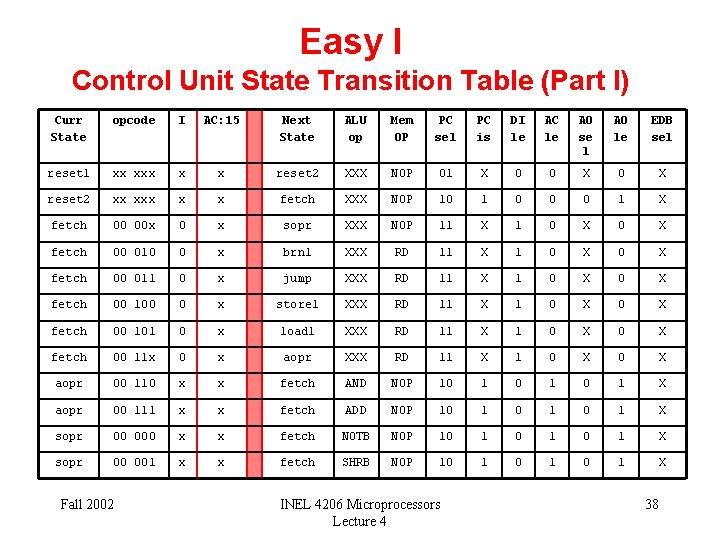
Easy I Control Unit State Transition Table (Part I) Curr State opcode I AC: 15 Next State ALU op Mem OP PC sel PC is DI le AC le AO se l AO le EDB sel reset 1 xx x x reset 2 XXX NOP 01 X 0 0 X reset 2 xx x x fetch XXX NOP 10 1 0 0 0 1 X fetch 00 00 x 0 x sopr XXX NOP 11 X 1 0 X fetch 00 010 0 x brn 1 XXX RD 11 X 1 0 X fetch 00 011 0 x jump XXX RD 11 X 1 0 X fetch 00 100 0 x store 1 XXX RD 11 X 1 0 X fetch 00 101 0 x load 1 XXX RD 11 X 1 0 X fetch 00 11 x 0 x aopr XXX RD 11 X 1 0 X aopr 00 110 x x fetch AND NOP 10 1 0 1 X aopr 00 111 x x fetch ADD NOP 10 1 0 1 X sopr 00 000 x x fetch NOTB NOP 10 1 0 1 X sopr 00 001 x x fetch SHRB NOP 10 1 0 1 X Fall 2002 INEL 4206 Microprocessors Lecture 4 38
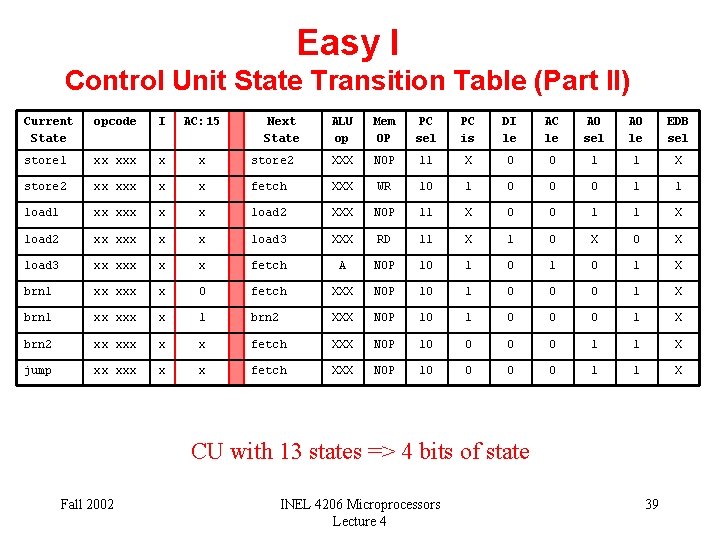
Easy I Control Unit State Transition Table (Part II) Current State opcode I AC: 15 store 1 xx x x store 2 xx x load 1 xx xxx load 2 Next State ALU op Mem OP PC sel PC is DI le AC le AO sel AO le EDB sel store 2 XXX NOP 11 X 0 0 1 1 X x fetch XXX WR 10 1 0 0 0 1 1 x x load 2 XXX NOP 11 X 0 0 1 1 X xx x x load 3 XXX RD 11 X 1 0 X load 3 xx x x fetch A NOP 10 1 0 1 X brn 1 xx x 0 fetch XXX NOP 10 1 0 0 0 1 X brn 1 xx x 1 brn 2 XXX NOP 10 1 0 0 0 1 X brn 2 xx x x fetch XXX NOP 10 0 1 1 X jump xx x x fetch XXX NOP 10 0 1 1 X CU with 13 states => 4 bits of state Fall 2002 INEL 4206 Microprocessors Lecture 4 39
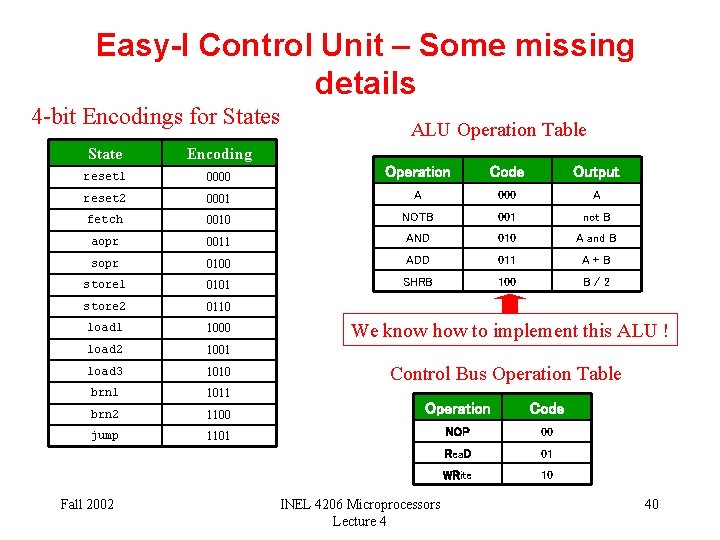
Easy-I Control Unit – Some missing details 4 -bit Encodings for States ALU Operation Table State Encoding reset 1 0000 Operation Code Output reset 2 0001 A 000 A fetch 0010 NOTB 001 not B aopr 0011 AND 010 A and B sopr 0100 ADD 011 A+B store 1 0101 SHRB 100 B/2 store 2 0110 load 1 1000 load 2 1001 load 3 1010 brn 1 1011 brn 2 1100 Operation Code jump 1101 NOP 00 Rea. D 01 WRite 10 Fall 2002 We know how to implement this ALU ! Control Bus Operation Table INEL 4206 Microprocessors Lecture 4 40
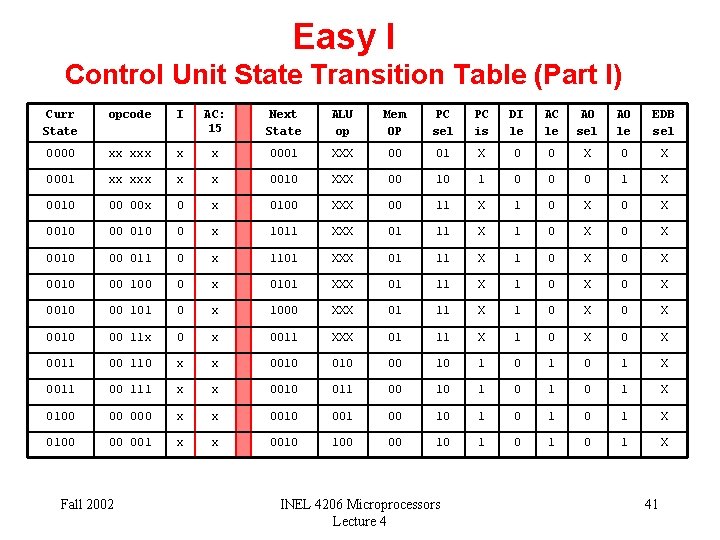
Easy I Control Unit State Transition Table (Part I) Curr State opcode I AC: 15 Next State ALU op Mem OP PC sel PC is DI le AC le AO sel AO le EDB sel 0000 xx x x 0001 XXX 00 01 X 0 0 X 0001 xx x x 0010 XXX 00 10 1 0 0 0 1 X 0010 00 00 x 0 x 0100 XXX 00 11 X 1 0 X 0010 00 010 0 x 1011 XXX 01 11 X 1 0 X 0010 00 011 0 x 1101 XXX 01 11 X 1 0 X 0010 00 100 0 x 0101 XXX 01 11 X 1 0 X 0010 00 101 0 x 1000 XXX 01 11 X 1 0 X 0010 00 11 x 0 x 0011 XXX 01 11 X 1 0 X 0011 00 110 x x 0010 00 10 1 0 1 X 0011 00 111 x x 0010 011 00 10 1 0 1 X 0100 00 000 x x 0010 001 00 10 1 0 1 X 0100 00 001 x x 0010 100 00 10 1 0 1 X Fall 2002 INEL 4206 Microprocessors Lecture 4 41
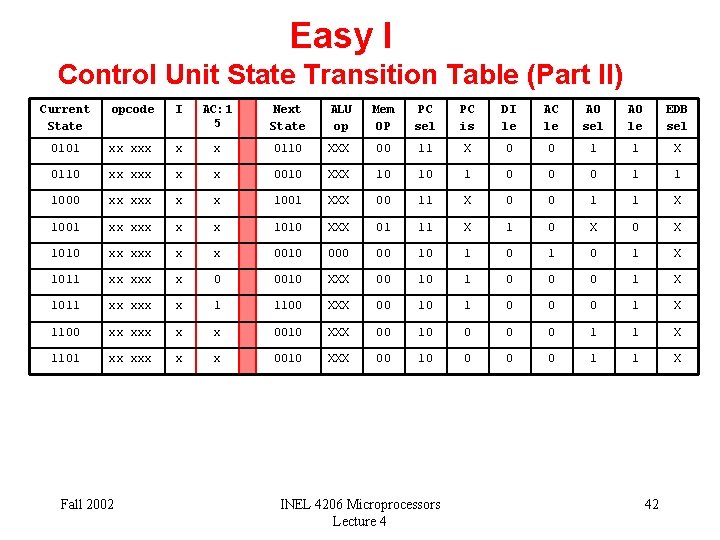
Easy I Control Unit State Transition Table (Part II) Current State opcode I AC: 1 5 Next State ALU op Mem OP PC sel PC is DI le AC le AO sel AO le EDB sel 0101 xx x x 0110 XXX 00 11 X 0 0 1 1 X 0110 xx x x 0010 XXX 10 10 1 0 0 0 1 1 1000 xx x x 1001 XXX 00 11 X 0 0 1 1 X 1001 xx x x 1010 XXX 01 11 X 1 0 X 1010 xx x x 0010 00 10 1 0 1 X 1011 xx x 0 0010 XXX 00 10 1 0 0 0 1 X 1011 xx x 1 1100 XXX 00 10 1 0 0 0 1 X 1100 xx x x 0010 XXX 00 10 0 1 1 X 1101 xx x x 0010 XXX 00 10 0 1 1 X Fall 2002 INEL 4206 Microprocessors Lecture 4 42
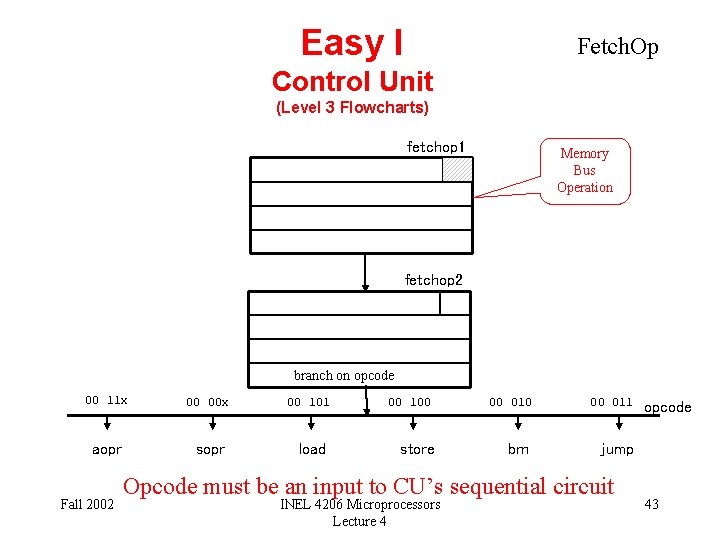
Easy I Fetch. Op Control Unit (Level 3 Flowcharts) fetchop 1 Memory Bus Operation fetchop 2 branch on opcode 00 11 x 00 00 x 00 101 aopr sopr load Fall 2002 00 100 00 011 store brn jump Opcode must be an input to CU’s sequential circuit INEL 4206 Microprocessors Lecture 4 opcode 43
Building the Easy-I C-Unit 2 Approaches • Hardwired – Apply well known sequential circuit techniques • Micro-programmed A program – Treat state transition table as a program – Build a new abstraction layer The Microprogramming abstraction level Fall 2002 INEL 4206 Microprocessors Lecture 4 44
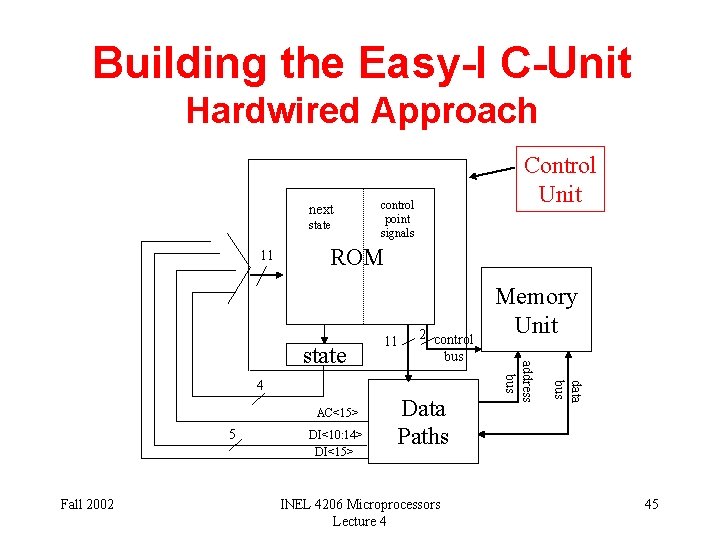
Building the Easy-I C-Unit Hardwired Approach next state 11 Control Unit control point signals ROM 2 control bus AC<15> 5 Fall 2002 DI<10: 14> DI<15> Data Paths INEL 4206 Microprocessors Lecture 4 data bus 4 address bus state 11 Memory Unit 45
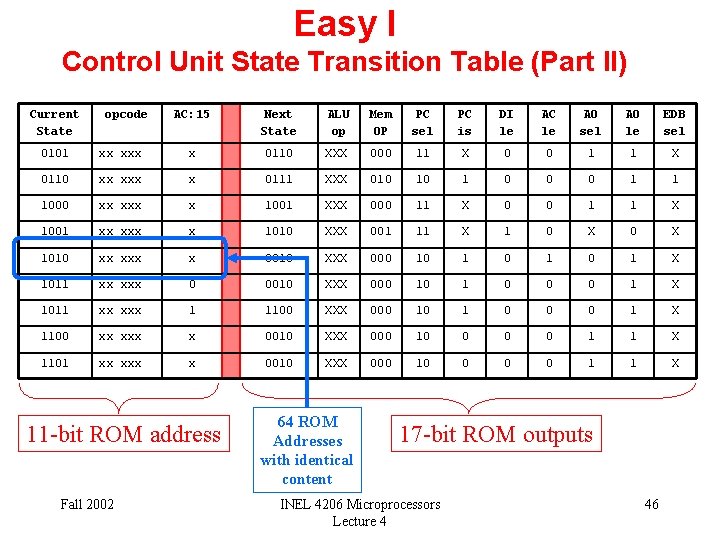
Easy I Control Unit State Transition Table (Part II) Current State opcode AC: 15 Next State ALU op Mem OP PC sel PC is DI le AC le AO sel AO le EDB sel 0101 xx x 0110 XXX 000 11 X 0 0 1 1 X 0110 xx x 0111 XXX 010 10 1 0 0 0 1 1 1000 xx x 1001 XXX 000 11 X 0 0 1 1 X 1001 xx x 1010 XXX 001 11 X 1 0 X 1010 xx x 0010 XXX 000 10 1 0 1 X 10¹¹ xx xxx 0 0010 XXX 000 10 1 0 0 0 1 X 10¹¹ xx xxx 1 1100 XXX 000 10 1 0 0 0 1 X 1100 xx x 0010 XXX 000 10 0 1 1 X 1101 xx x 0010 XXX 000 10 0 1 1 X 11 -bit ROM address Fall 2002 64 ROM Addresses with identical content 17 -bit ROM outputs INEL 4206 Microprocessors Lecture 4 46
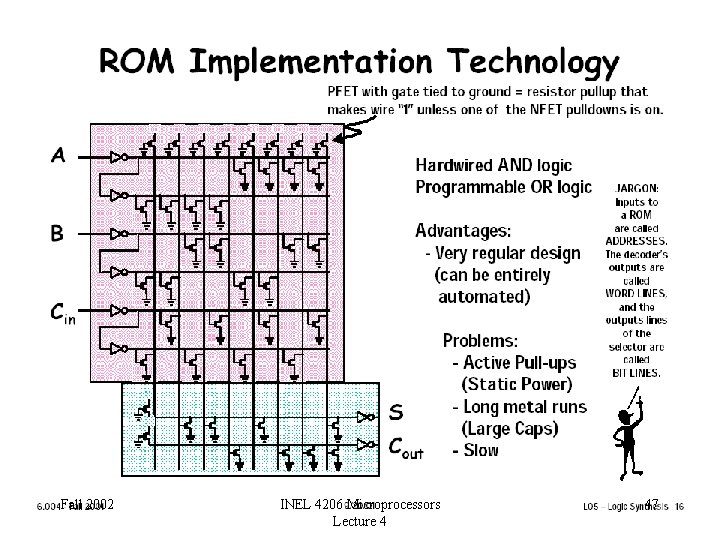
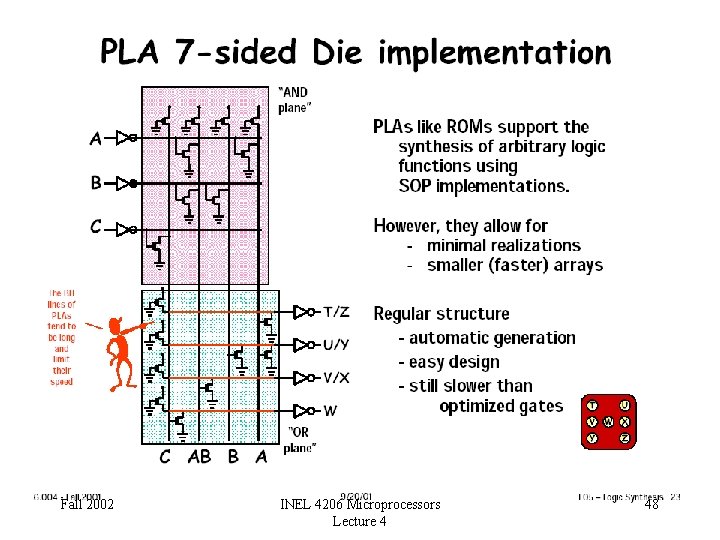
Programmable Logic Arrays Fall 2002 INEL 4206 Microprocessors Lecture 4 47
Fall 2002 INEL 4206 Microprocessors Lecture 4 48
Building the Easy-I C-Unit 2 Approaches • Hardwired – Apply well known sequential circuit techniques • Micro-programmed A program – Treat state transition table as a program – Build a new abstraction layer The Microprogramming abstraction level Fall 2002 INEL 4206 Microprocessors Lecture 4 49
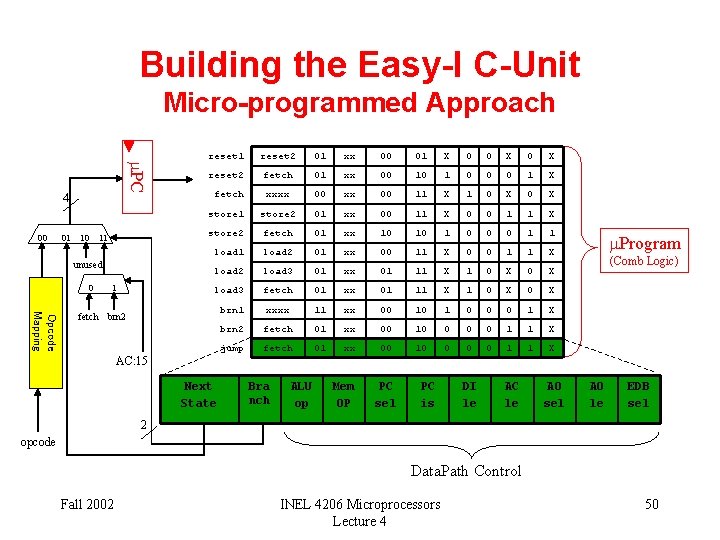
Building the Easy-I C-Unit Micro-programmed Approach PC 4 00 01 10 11 unused 0 1 Opcode Mapping reset 1 reset 2 01 xx 00 01 X 0 0 X reset 2 fetch 01 xx 00 10 1 0 0 0 1 X fetch xxxx 00 11 X 1 0 X store 1 store 2 01 xx 00 11 X 0 0 1 1 X store 2 fetch 01 xx 10 10 1 0 0 0 1 1 load 2 01 xx 00 11 X 0 0 1 1 X load 2 load 3 01 xx 01 11 X 1 0 X load 3 fetch 01 xx 01 11 X 1 0 X brn 1 xxxx 11 xx 00 10 1 0 0 0 1 X brn 2 fetch 01 xx 00 10 0 1 1 X jump fetch 01 xx 00 10 0 1 1 X fetch brn 2 Program (Comb Logic) AC: 15 Next State Bra nch ALU op Mem OP PC sel PC is DI le AC le AO sel AO le EDB sel 2 opcode Data. Path Control Fall 2002 INEL 4206 Microprocessors Lecture 4 50
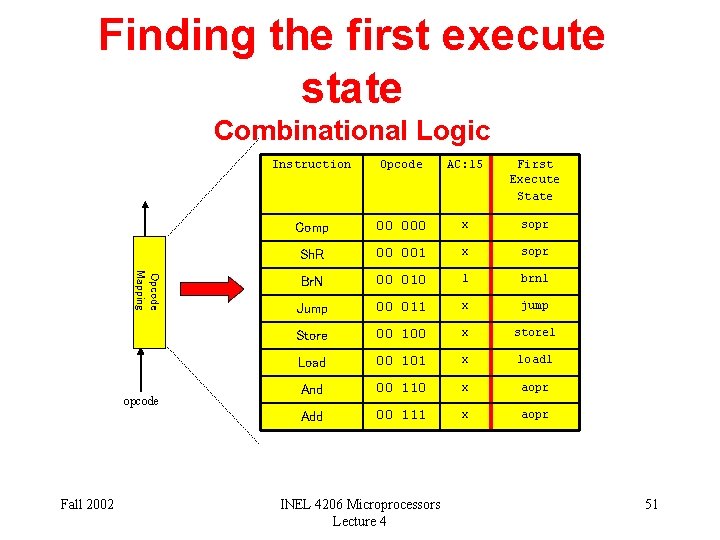
Finding the first execute state Combinational Logic Opcode Mapping opcode Fall 2002 Instruction Opcode AC: 15 First Execute State Comp 00 000 x sopr Sh. R 00 001 x sopr Br. N 00 010 1 brn 1 Jump 00 011 x jump Store 00 100 x store 1 Load 00 101 x load 1 And 00 110 x aopr Add 00 111 x aopr INEL 4206 Microprocessors Lecture 4 51
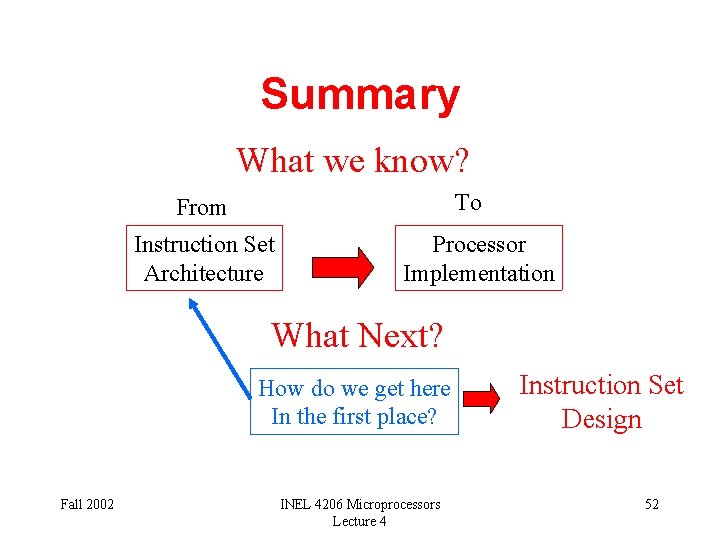
Summary What we know? To From Instruction Set Architecture Processor Implementation What Next? How do we get here In the first place? Fall 2002 INEL 4206 Microprocessors Lecture 4 Instruction Set Design 52
- Slides: 52