
Practical Strategies for Treatment of Common Voice Disorders
- Slides: 25
Practical Strategies for Treatment of Common Voice Disorders Carol Krusemark, M. A. , CCC-SLP Voice Pathologist/Singing Voice Specialist MGH Center for Laryngeal Surgery and Voice Rehabilitation
Common Voice Disorders u Muscle Tension Dysphonia • Primary • Secondary u Vocal pathology associated with abuse/misuse • Nodules • Vocal scarring or loss of vibratory layer
Primary Muscle Tension Dysphonia u u a posterior glottic “chink” caused by simultaneous activation of vocal fold “closers” and “openers” Can be normal in females
Primary Muscle Tension Dysphonia u False vocal fold approximation: medio-lateral supraglottic compression
Primary Muscle Tension Dysphonia u Supraglottic compression in the anterior to posterior axis
Primary Muscle Tension Dysphonia u Compression from both the AP and mediolateral directions
Vocal Nodules u Reactive fibrovascular lesions formed at the site of greatest vocal fold contact
Scar or loss of vibratory layer u Loss of superficial lamina propria, resulting in reduced musocal wave
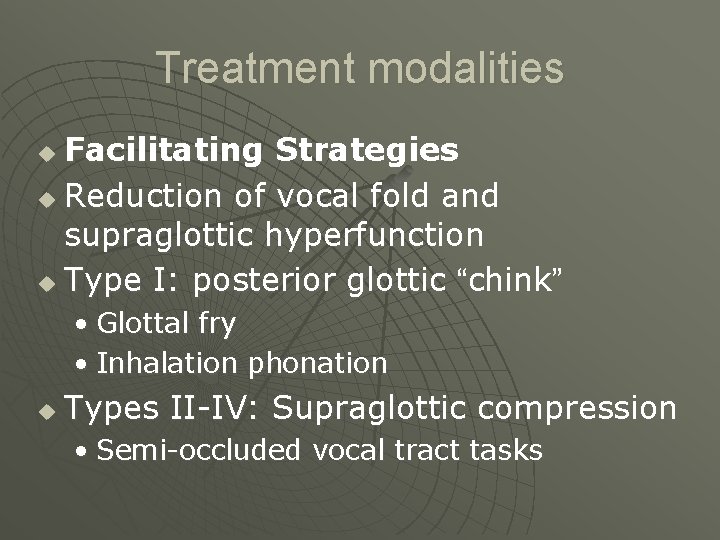
Treatment modalities Facilitating Strategies u Reduction of vocal fold and supraglottic hyperfunction u Type I: posterior glottic “chink” u • Glottal fry • Inhalation phonation u Types II-IV: Supraglottic compression • Semi-occluded vocal tract tasks
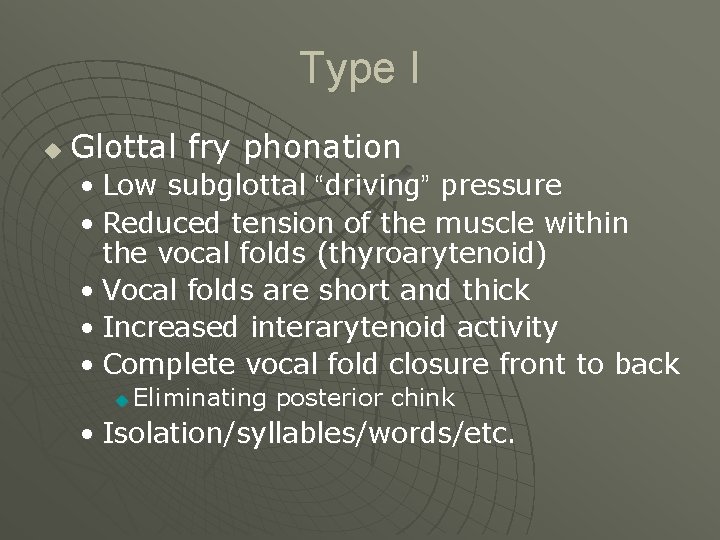
Type I u Glottal fry phonation • Low subglottal “driving” pressure • Reduced tension of the muscle within the vocal folds (thyroarytenoid) • Vocal folds are short and thick • Increased interarytenoid activity • Complete vocal fold closure front to back u Eliminating posterior chink • Isolation/syllables/words/etc.
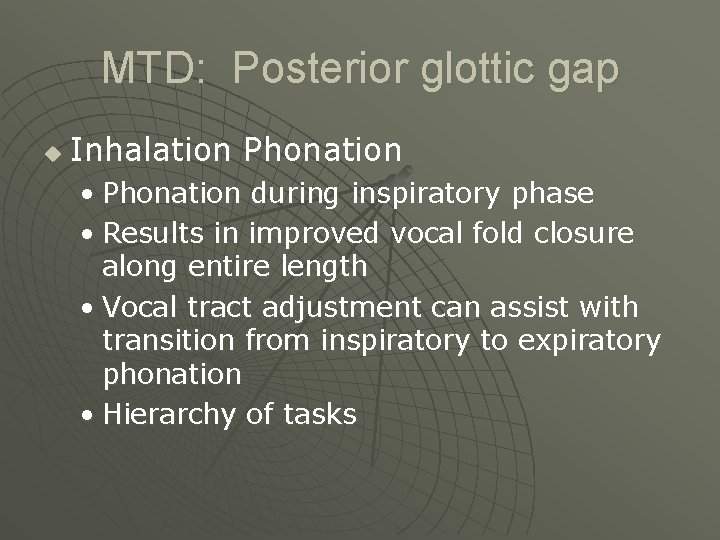
MTD: Posterior glottic gap u Inhalation Phonation • Phonation during inspiratory phase • Results in improved vocal fold closure along entire length • Vocal tract adjustment can assist with transition from inspiratory to expiratory phonation • Hierarchy of tasks
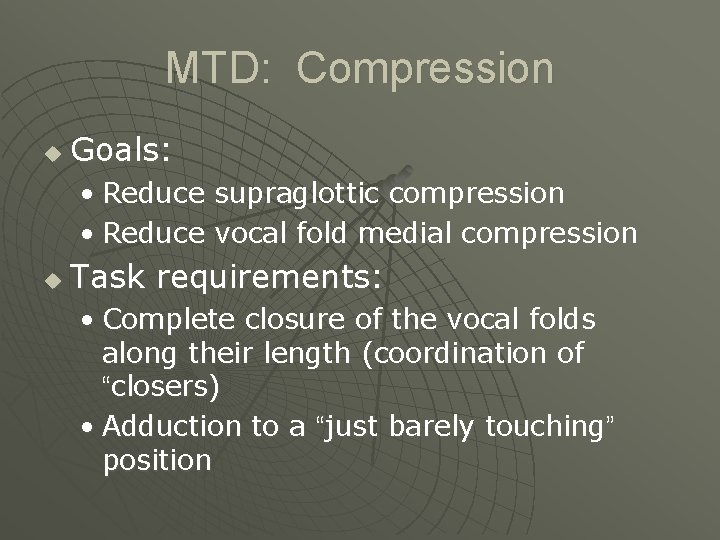
MTD: Compression u Goals: • Reduce supraglottic compression • Reduce vocal fold medial compression u Task requirements: • Complete closure of the vocal folds along their length (coordination of “closers) • Adduction to a “just barely touching” position
Semi-occluded vocal tract tasks u u u Lowers phonation threshold pressure Decreases medial compression Reduces laryngeal muscular tension Improves laryngeal muscular coordination “squares up” vocal fold edges for efficient vibration u u u u Phonation through a straw (small is better) Sustained phonation of voiced fricative consonants Lip bubbles/trills Tongue trills Rolled /r/ Humming Fringe benefit: highlights oral resonance
Straw phonation u u Daily exercises program (2 -3 times) Three Principles: • • • u Lips around straw Sound through straw only Vibratory feeling at the lips Four tasks: • One long, slow slide from low to high and back again • A series of slow slides on a single breath • A series of accented slides (revving) • Song phonation
From straw to speech Assure correct production through straw u Practice phrases before and after straw u Note auditory and ideally kinesthetic contrast u Maintenance of kinesthetic similarity “Make it feel like it did after you used the straw” u Gradually fade straw use u
Circumlaryngeal massage Addresses paralaryngeal resting muscle tension u Massage and manipulation of the supporting muscular “sling” u Focuses on muscular attachments to the thyroid cartilage and hyoid bone u Muscle relaxation encourages inferior movement of the thyroid cartilage u
Circumlaryngeal Massage/Evidence u u u Significant changes in patient severity ratings (Roy, 1993) and acoustic voice measures (Roy, 1997) after one session 93% able to maintain improvement for a week without further treatment (Roy, 1993) Improved voice was maintained for up to 5 months for 72% of patients (Roy 1997)
Circumlaryngeal Massage/Evidence u Professional voice users with moderate to severed muscle tension dysphonia • 25 sessions • Improvements in acoustic measurements u Strain u Highest frequency u Average fundamental frequency u Jitter and shimmer • Improvements in Dysphonia Severity Index
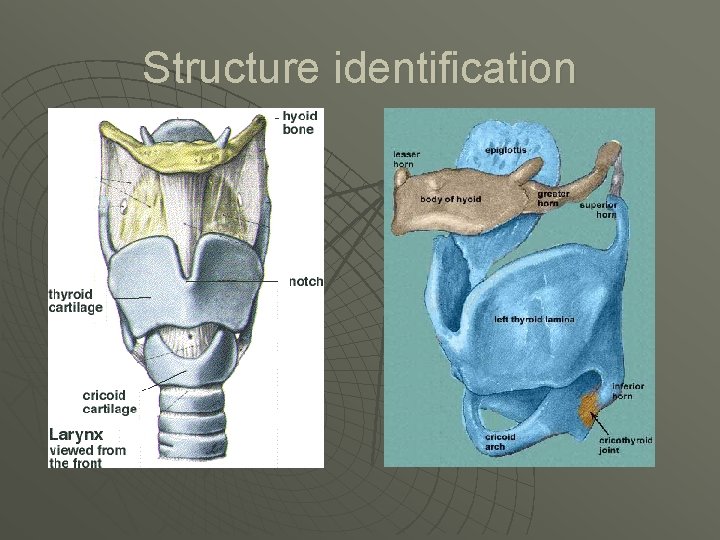
Structure identification
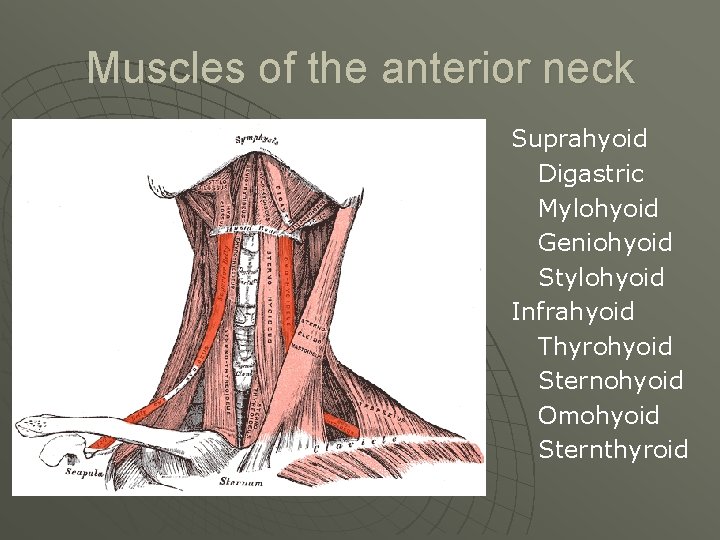
Muscles of the anterior neck Suprahyoid Digastric Mylohyoid Geniohyoid Stylohyoid Infrahyoid Thyrohyoid Sternohyoid Omohyoid Sternthyroid
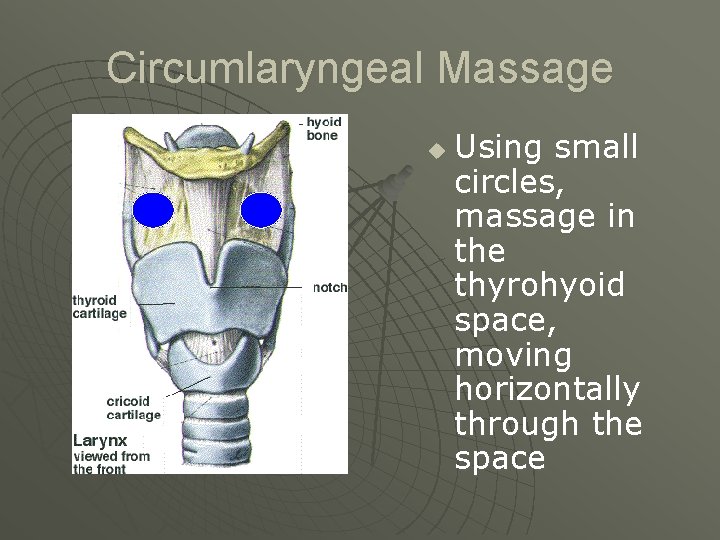
Circumlaryngeal Massage u Using small circles, massage in the thyrohyoid space, moving horizontally through the space
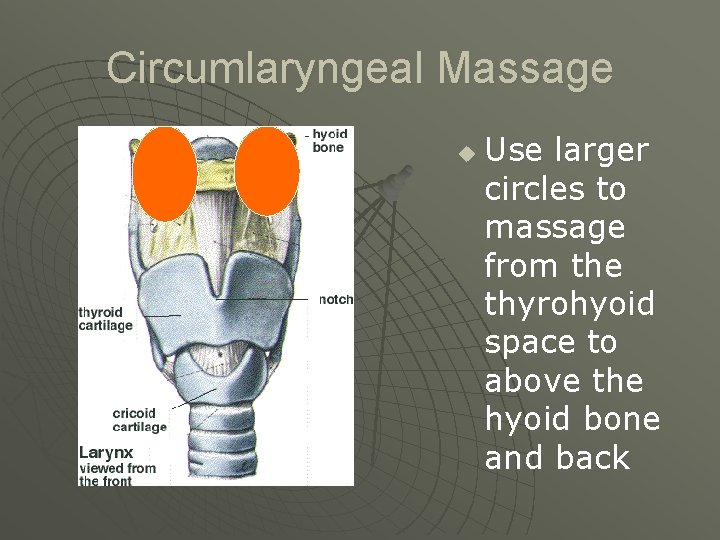
Circumlaryngeal Massage u Use larger circles to massage from the thyrohyoid space to above the hyoid bone and back
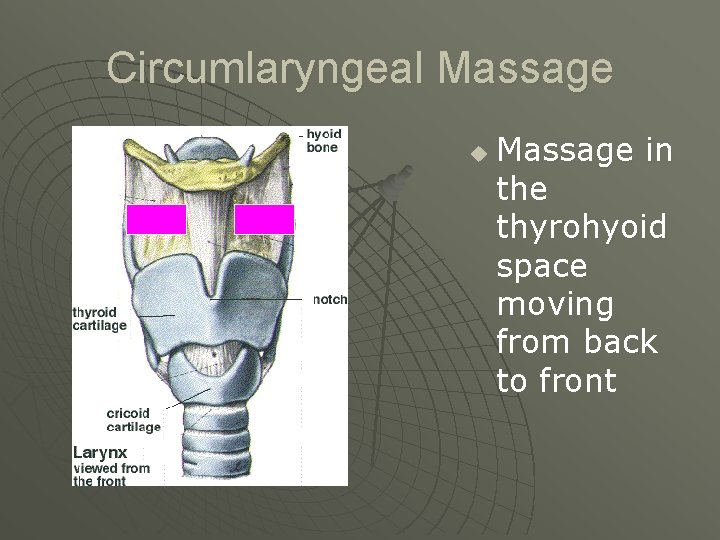
Circumlaryngeal Massage u Massage in the thyrohyoid space moving from back to front
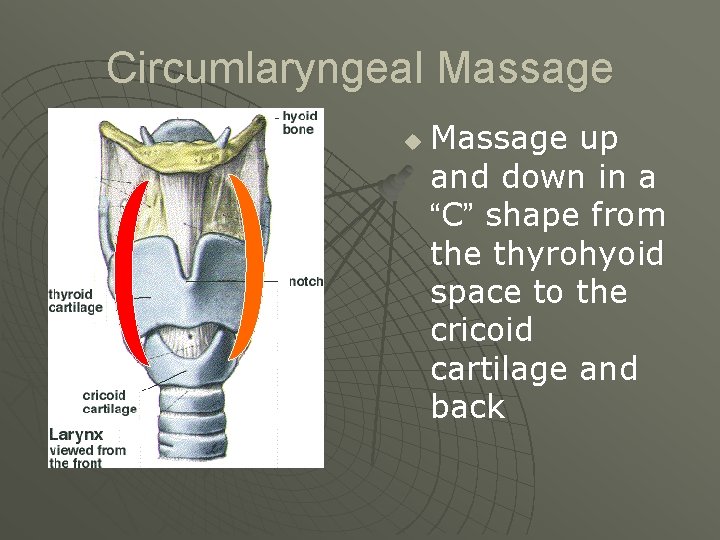
Circumlaryngeal Massage up and down in a “C” shape from the thyrohyoid space to the cricoid cartilage and back
Questions? ?