
Practical Skills You have been given the title
Practical Skills • You have been given the title of one of the required practicals we have carried out this year • Jot down anything your can remember about this practical – variables, equipment, results, 1. 2. 3. 4. 5. 6. Enzymes Root tip squash Permeability of membranes Osmosis Dissection Aseptic Technique
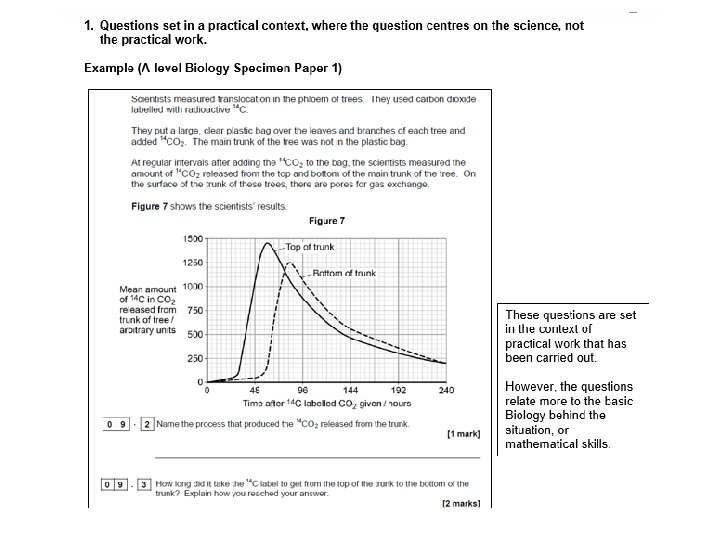
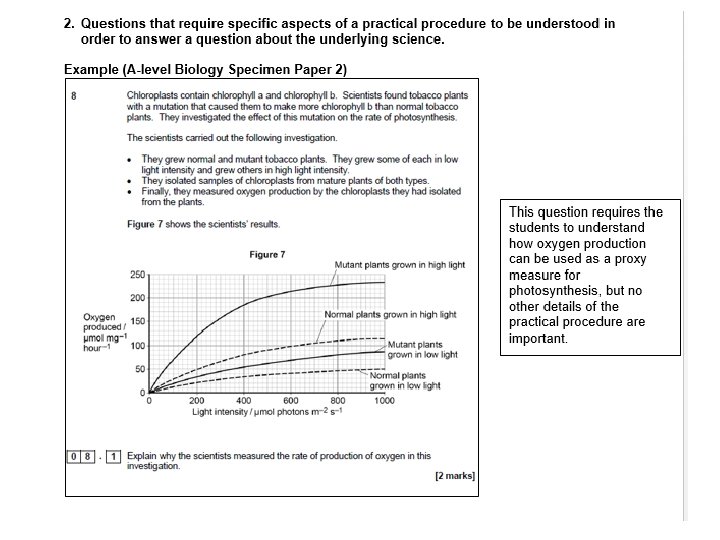
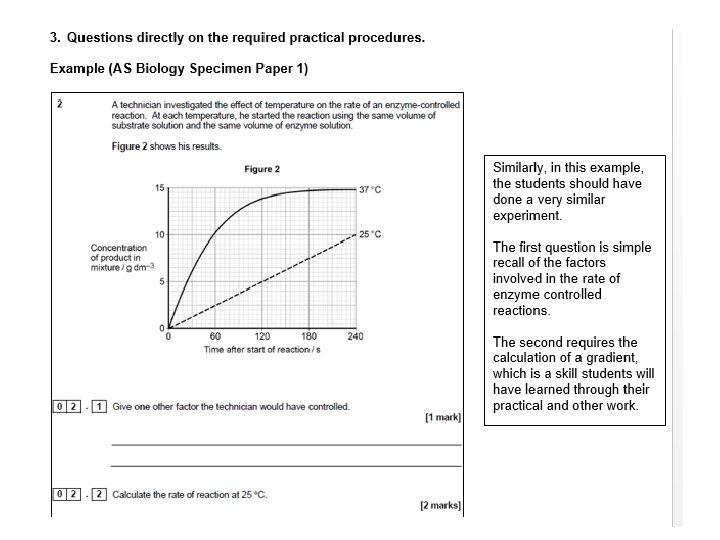
Investigation into the effect of named variable on the rate of an enzyme controlled reaction You could be asked about any enzyme Named variable – substrate conc, temp, enzyme conc, p. H What would be the control variables? What could you measure – Volume of product formed? Time taken for colour change? • Tables • Graphs • Calculating Rates – something divided by time… • •
Root tip Squash • How to set up and use the microscope • How to prepare a slide – stain, single layer of cells… • Identifying cells undergoing mitosis – looking for cells with visible chromosomes • Calculating mitotic index – percentage of cells undergoing mitosis

Investigation into the effect of a named variable on permeability of cell-surface membranes • Named variable – temperature, alcohol concentration • Dependent variable? We used beetroot so we could measure amount of pigment released • We could use our judgement to record colour change. This is qualitative and subjective • We could use a colorimeter to get quantitative results for colour
Production of dilution series of a solute to produce a calibration curve with which to identify the water potential of plant tissue • Dilution series – how could you use a stock solution and distilled water to get a range of concentrations? • Dependent variable – percentage change in mass of plant tissue (different starting masses) • Control variables – temp, species of plant, surface area to volume ratio of plant tissue • Plotting a graph • Identifying where concentration of solution and potato is equal
Dissection • Animal or plant gas exchange system – lung, fish gills • Animal or plant mass transport system/organ – heart • Safety – scalpels, disinfecting work area etc • Biological drawings?
Using aseptic techniques to investigate the effect of antimicrobial substances on microbial growth • Aseptic techniques – make sure you can explain each step e. g. sterilising equipment, using the Bunsen, keeping the lid on for as long as possible • Safety – sterilising tools, what would you do if you were growing pathogenic bacteria? • Calculating zone of inhibition (πr 2)
Statistical Tests • T-test – comparing means • Chi squared (X 2) – looking for the difference between observed and expected frequencies • Spearman’s rank – correlation between two variables
Null hypothesis • T-test – “there is no significant difference between x and y” • Chi squared (X 2) – “there is no significant difference between observed and expected values” • Spearman’s rank – “there is no significant correlation between x and y”
P values • If p≤ 0. 05 it means that there is a less than 5% probability that the results are due to chance so we reject the null hypothesis • If p> 0. 05 it means that there is a greater than 5% probability that the results are due to chance so we accept the null hypothesis

Exam Questions • Extra exam questions about practicals are in your text book
- Slides: 14