
Practical Requirements for a Flow System Introduction to
- Slides: 28
Practical Requirements for a Flow System
Introduction to practical requirements • Key requirements for a Flow Chemistry System • Introduction to important practical aspects • Pumping technology • Reactor technology • Sample Introduction • Pressure Control • Product Collection • Post-Synthesis Modules
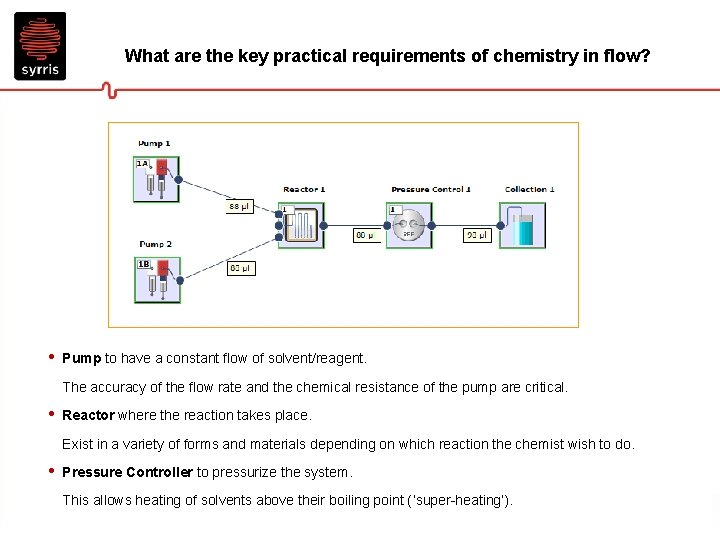
What are the key practical requirements of chemistry in flow? • Pump to have a constant flow of solvent/reagent. The accuracy of the flow rate and the chemical resistance of the pump are critical. • Reactor where the reaction takes place. Exist in a variety of forms and materials depending on which reaction the chemist wish to do. • Pressure Controller to pressurize the system. This allows heating of solvents above their boiling point (‘super-heating’).
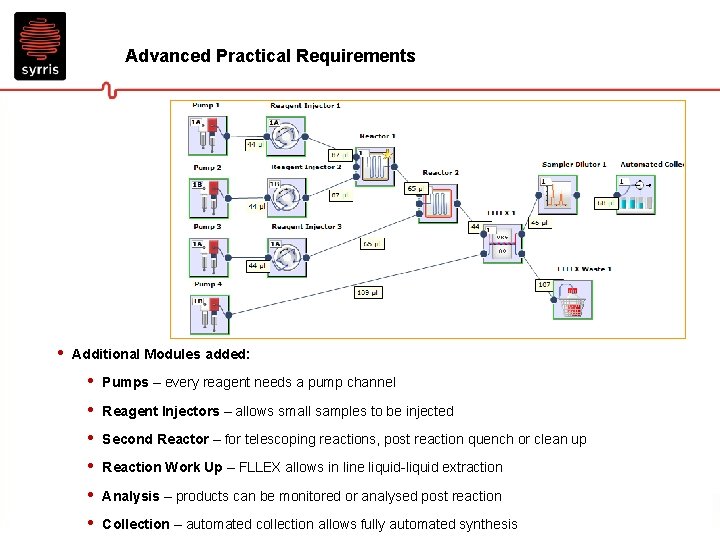
Advanced Practical Requirements • Additional Modules added: • • • Pumps – every reagent needs a pump channel Reagent Injectors – allows small samples to be injected Second Reactor – for telescoping reactions, post reaction quench or clean up Reaction Work Up – FLLEX allows in line liquid-liquid extraction Analysis – products can be monitored or analysed post reaction Collection – automated collection allows fully automated synthesis
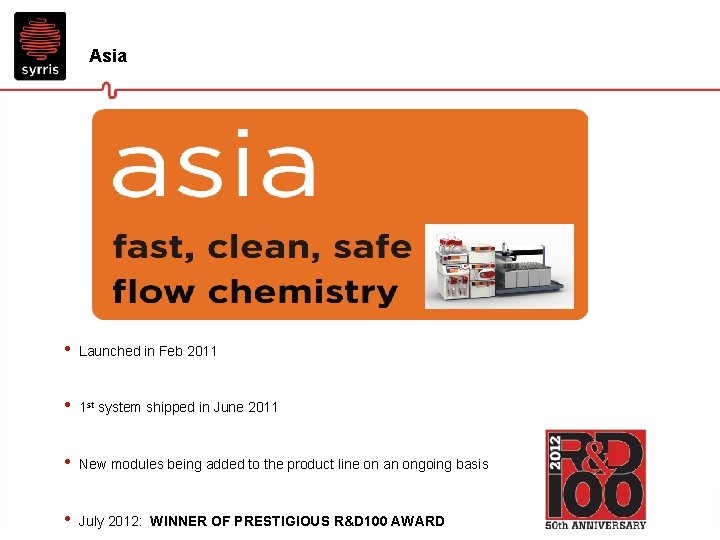
Asia • Launched in Feb 2011 • 1 st system shipped in June 2011 • New modules being added to the product line on an ongoing basis • July 2012: WINNER OF PRESTIGIOUS R&D 100 AWARD
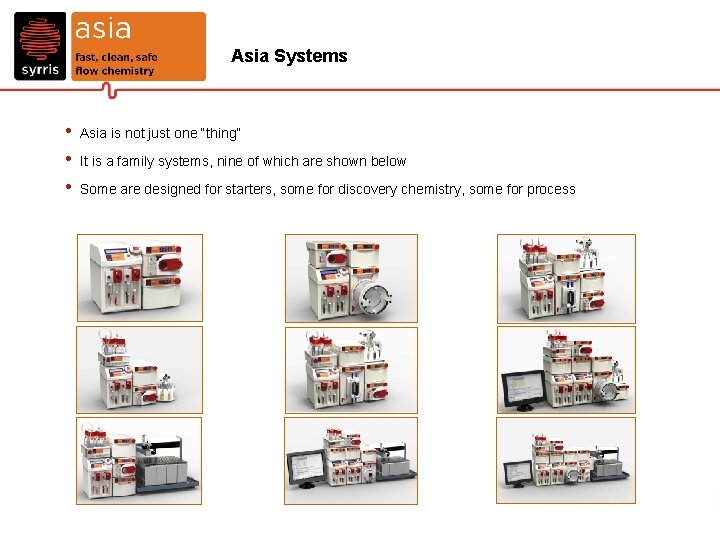
Asia Systems • • • Asia is not just one “thing” It is a family systems, nine of which are shown below Some are designed for starters, some for discovery chemistry, some for process
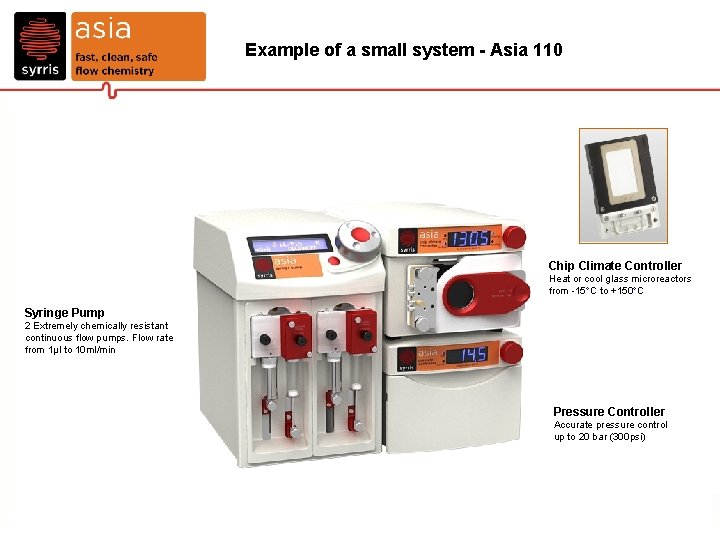
Example of a small system - Asia 110 Chip Climate Controller Heat or cool glass microreactors from -15°C to +150°C Syringe Pump 2 Extremely chemically resistant continuous flow pumps. Flow rate from 1μl to 10 ml/min Pressure Controller Accurate pressure control up to 20 bar (300 psi)
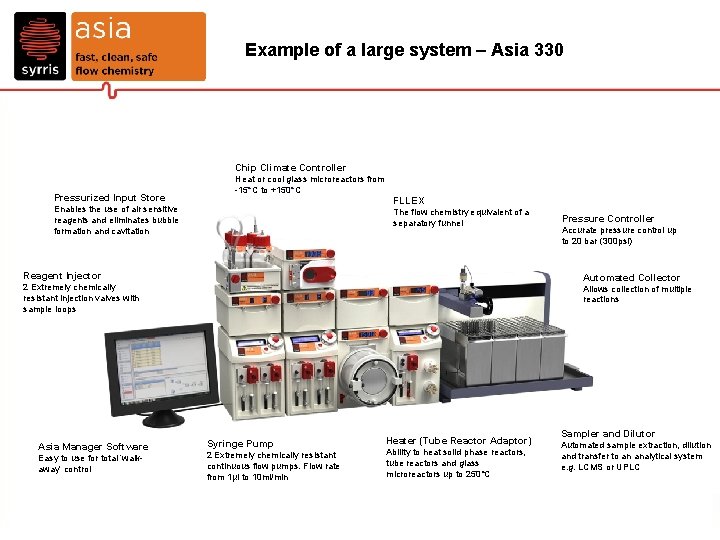
Example of a large system – Asia 330 Chip Climate Controller Pressurized Input Store Heat or cool glass microreactors from -15°C to +150°C FLLEX Enables the use of air sensitive reagents and eliminates bubble formation and cavitation The flow chemistry equivalent of a separatory funnel Reagent Injector Easy to use for total ‘walkaway’ control Accurate pressure control up to 20 bar (300 psi) Automated Collector 2 Extremely chemically resistant injection valves with sample loops Asia Manager Software Pressure Controller Allows collection of multiple reactions Syringe Pump 2 Extremely chemically resistant continuous flow pumps. Flow rate from 1μl to 10 ml/min Heater (Tube Reactor Adaptor) Ability to heat solid phase reactors, tube reactors and glass microreactors up to 250°C Sampler and Dilutor Automated sample extraction, dilution and transfer to an analytical system e. g. LCMS or UPLC
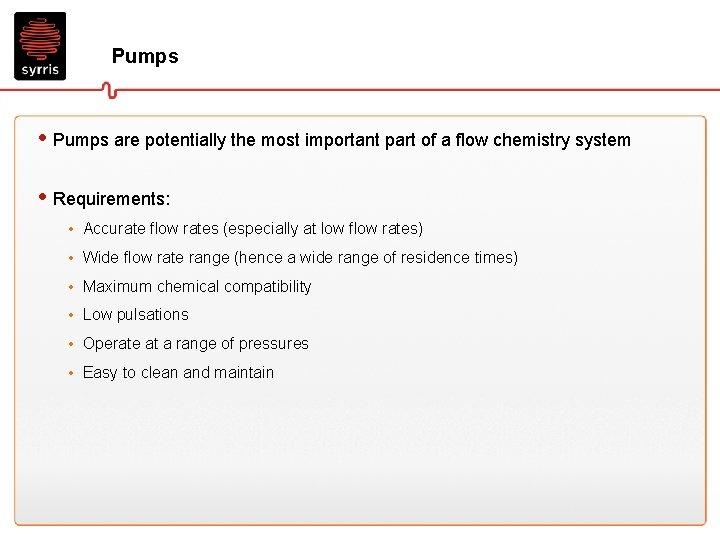
Pumps • Pumps are potentially the most important part of a flow chemistry system • Requirements: • Accurate flow rates (especially at low flow rates) • Wide flow rate range (hence a wide range of residence times) • Maximum chemical compatibility • Low pulsations • Operate at a range of pressures • Easy to clean and maintain
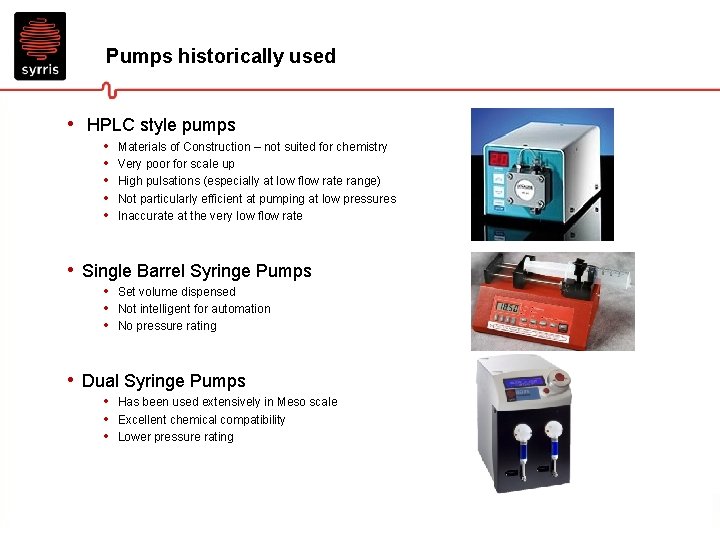
Pumps historically used • HPLC style pumps • • • Materials of Construction – not suited for chemistry Very poor for scale up High pulsations (especially at low flow rate range) Not particularly efficient at pumping at low pressures Inaccurate at the very low flow rate • Single Barrel Syringe Pumps • Set volume dispensed • Not intelligent for automation • No pressure rating • Dual Syringe Pumps • Has been used extensively in Meso scale • Excellent chemical compatibility • Lower pressure rating
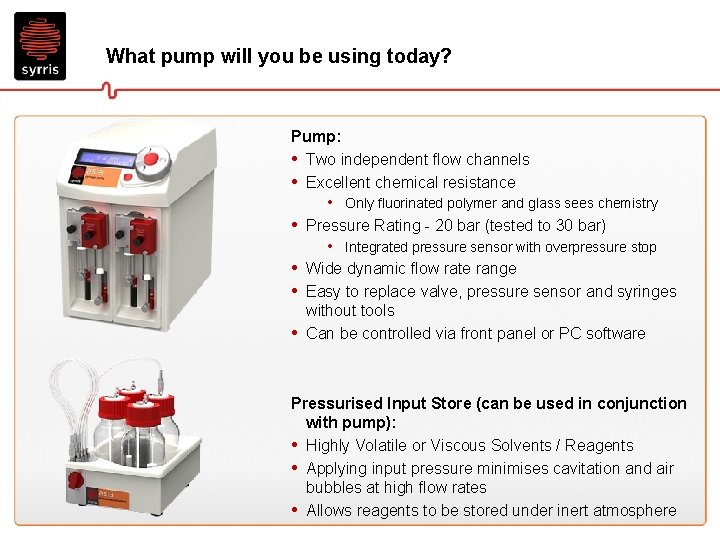
What pump will you be using today? Pump: • Two independent flow channels • Excellent chemical resistance • Only fluorinated polymer and glass sees chemistry • Pressure Rating - 20 bar (tested to 30 bar) • Integrated pressure sensor with overpressure stop • Wide dynamic flow rate range • Easy to replace valve, pressure sensor and syringes • without tools Can be controlled via front panel or PC software Pressurised Input Store (can be used in conjunction with pump): • Highly Volatile or Viscous Solvents / Reagents • Applying input pressure minimises cavitation and air bubbles at high flow rates • Allows reagents to be stored under inert atmosphere
Flow reactors • Reactors should provide: • Flexibility in volume to allow large range of residence times • Excellent mixing • Excellent heat transfer • Good visibility where possible • Ability to perform different types of chemistry (ie. Homogeneous and heterogeneous)
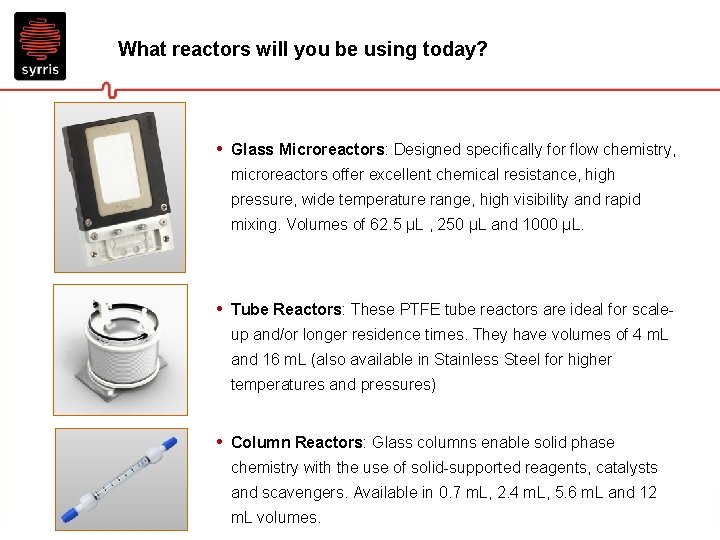
What reactors will you be using today? • Glass Microreactors: Designed specifically for flow chemistry, microreactors offer excellent chemical resistance, high pressure, wide temperature range, high visibility and rapid mixing. Volumes of 62. 5 µL , 250 µL and 1000 µL. • Tube Reactors: These PTFE tube reactors are ideal for scaleup and/or longer residence times. They have volumes of 4 m. L and 16 m. L (also available in Stainless Steel for higher temperatures and pressures) • Column Reactors: Glass columns enable solid phase chemistry with the use of solid-supported reagents, catalysts and scavengers. Available in 0. 7 m. L, 2. 4 m. L, 5. 6 m. L and 12 m. L volumes.
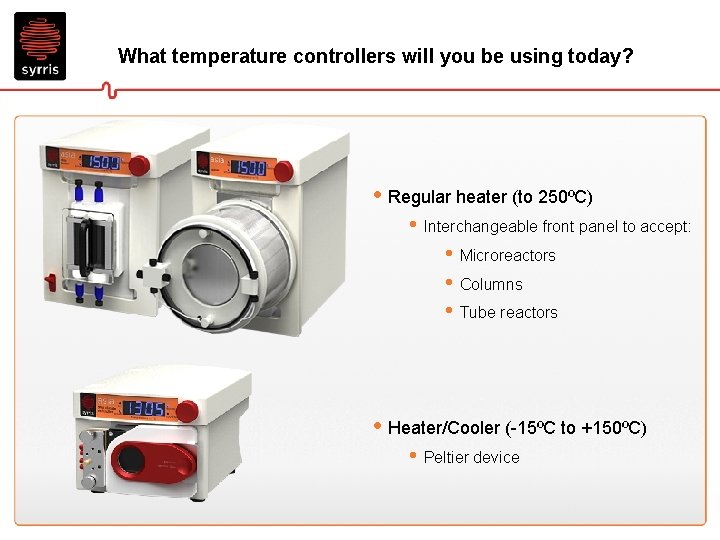
What temperature controllers will you be using today? • Regular heater (to 250ºC) • Interchangeable front panel to accept: • Microreactors • Columns • Tube reactors • Heater/Cooler (-15ºC to +150ºC) • Peltier device
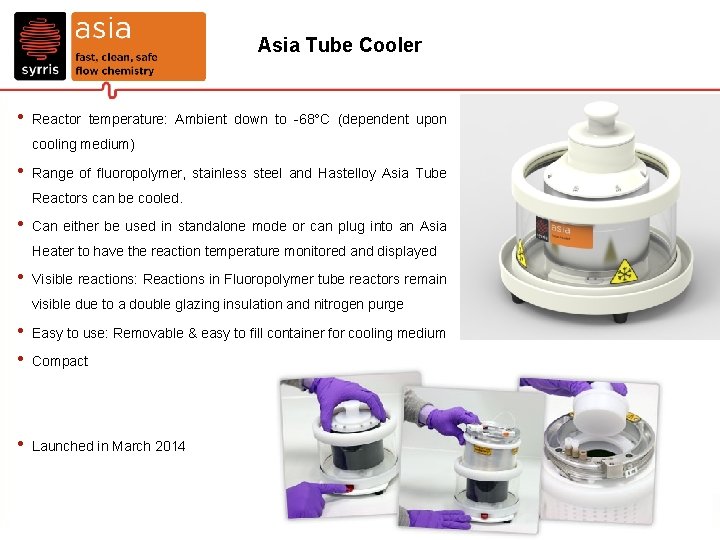
Asia Tube Cooler • Reactor temperature: Ambient down to -68°C (dependent upon cooling medium) • Range of fluoropolymer, stainless steel and Hastelloy Asia Tube Reactors can be cooled. • Can either be used in standalone mode or can plug into an Asia Heater to have the reaction temperature monitored and displayed • Visible reactions: Reactions in Fluoropolymer tube reactors remain visible due to a double glazing insulation and nitrogen purge • • Easy to use: Removable & easy to fill container for cooling medium • Launched in March 2014 Compact
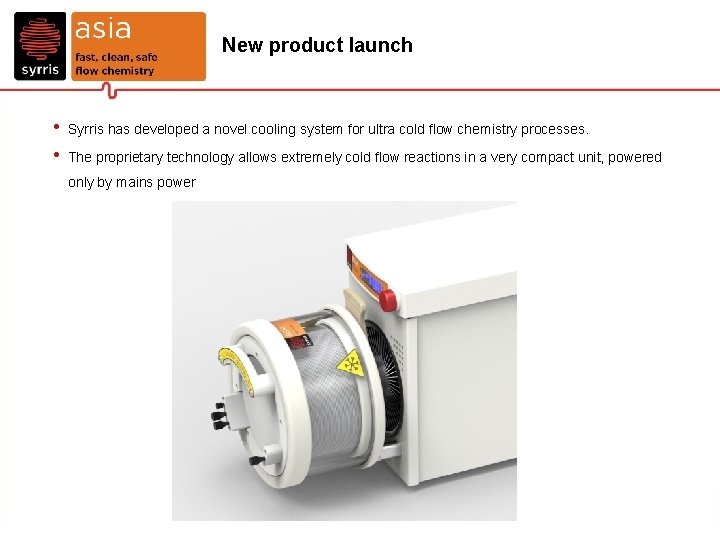
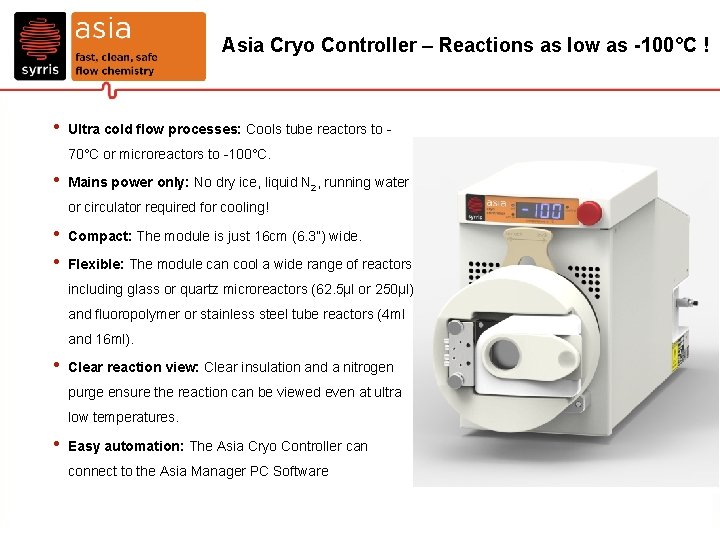
New product launch • • Syrris has developed a novel cooling system for ultra cold flow chemistry processes. The proprietary technology allows extremely cold flow reactions in a very compact unit, powered only by mains power
Asia Cryo Controller – Reactions as low as -100°C ! • Ultra cold flow processes: Cools tube reactors to 70°C or microreactors to -100°C. • Mains power only: No dry ice, liquid N 2, running water or circulator required for cooling! • • Compact: The module is just 16 cm (6. 3”) wide. Flexible: The module can cool a wide range of reactors including glass or quartz microreactors (62. 5μl or 250μl) and fluoropolymer or stainless steel tube reactors (4 ml and 16 ml). • Clear reaction view: Clear insulation and a nitrogen purge ensure the reaction can be viewed even at ultra low temperatures. • Easy automation: The Asia Cryo Controller can connect to the Asia Manager PC Software
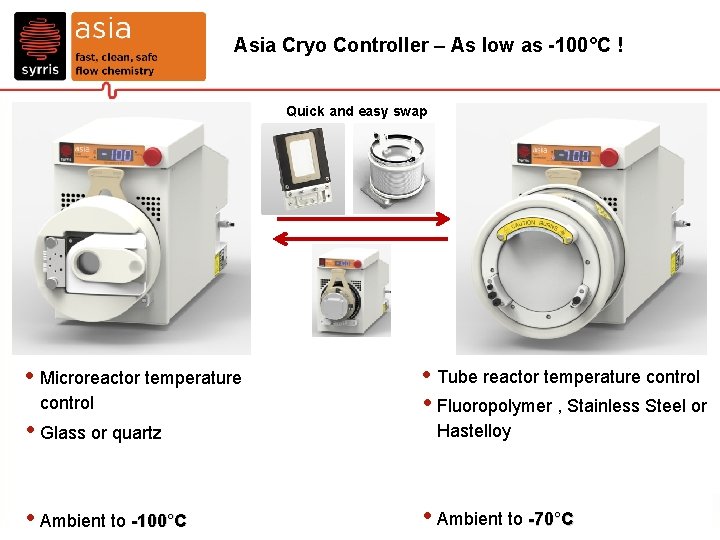
Asia Cryo Controller – As low as -100°C ! Quick and easy swap • Microreactor temperature control • Glass or quartz • Ambient to -100°C • Tube reactor temperature control • Fluoropolymer , Stainless Steel or Hastelloy • Ambient to -70°C
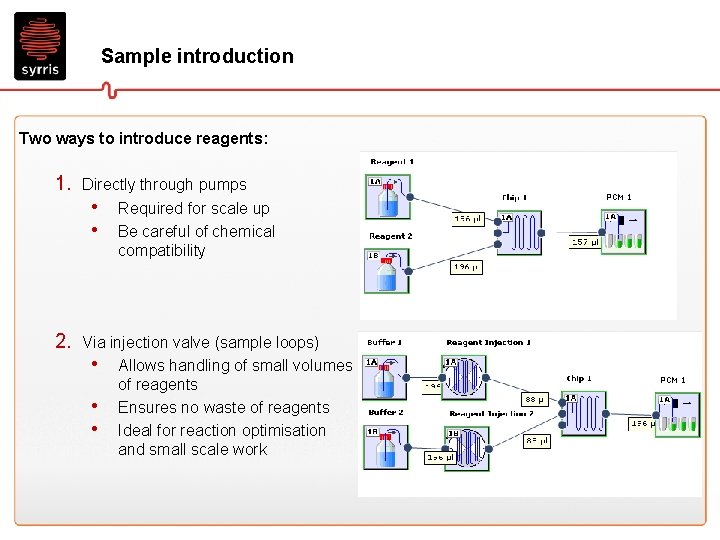
Sample introduction Two ways to introduce reagents: 1. Directly through pumps • Required for scale up • Be careful of chemical compatibility 2. Via injection valve (sample loops) • Allows handling of small volumes • • of reagents Ensures no waste of reagents Ideal for reaction optimisation and small scale work
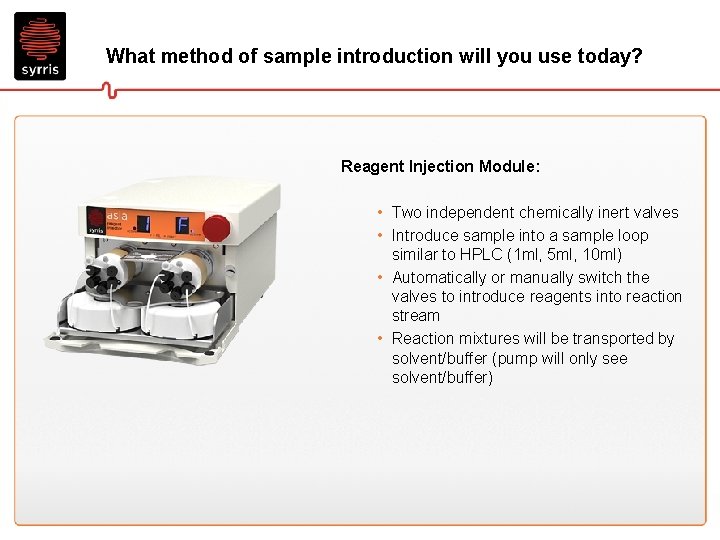
What method of sample introduction will you use today? Reagent Injection Module: • Two independent chemically inert valves • Introduce sample into a sample loop similar to HPLC (1 ml, 5 ml, 10 ml) • Automatically or manually switch the valves to introduce reagents into reaction stream • Reaction mixtures will be transported by solvent/buffer (pump will only see solvent/buffer)
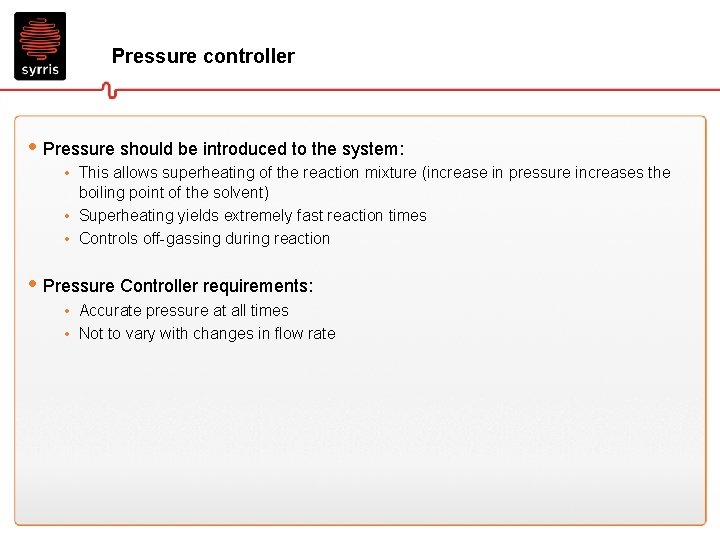
Pressure controller • Pressure should be introduced to the system: • This allows superheating of the reaction mixture (increase in pressure increases the boiling point of the solvent) • Superheating yields extremely fast reaction times • Controls off-gassing during reaction • Pressure Controller requirements: • Accurate pressure at all times • Not to vary with changes in flow rate
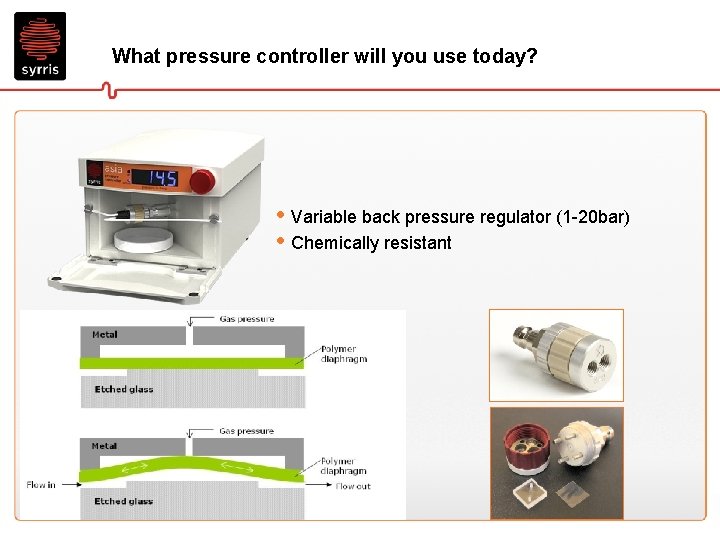
What pressure controller will you use today? • Variable back pressure regulator (1 -20 bar) • Chemically resistant
Product Collection Production Collection: • Manual Control • Automatic control for one reaction (diverts transport solvent to waste) • Full automatic control for multi- experiments • Require pressure regulator to be as close to the output/collection as possible
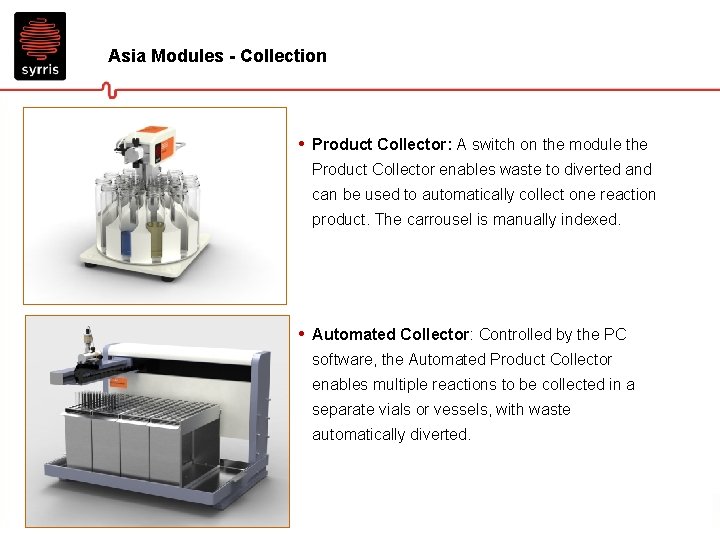
Asia Modules - Collection • Product Collector: A switch on the module the Product Collector enables waste to diverted and can be used to automatically collect one reaction product. The carrousel is manually indexed. • Automated Collector: Controlled by the PC software, the Automated Product Collector enables multiple reactions to be collected in a separate vials or vessels, with waste automatically diverted.
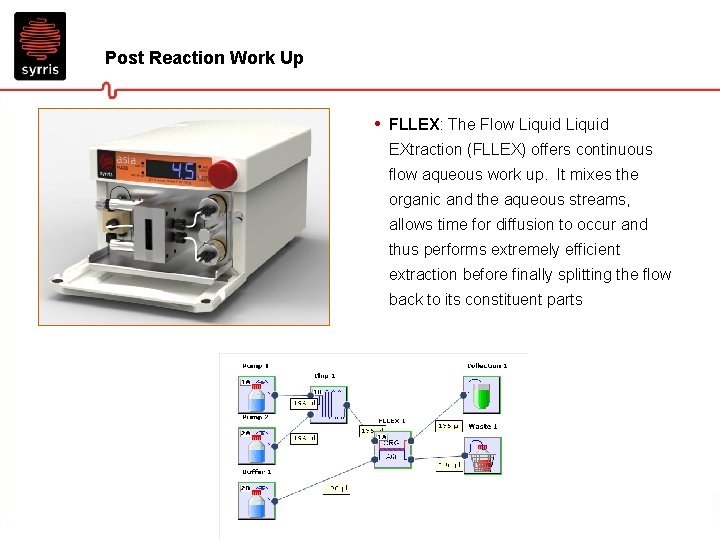
Post Reaction Work Up • FLLEX: The Flow Liquid EXtraction (FLLEX) offers continuous flow aqueous work up. It mixes the organic and the aqueous streams, allows time for diffusion to occur and thus performs extremely efficient extraction before finally splitting the flow back to its constituent parts
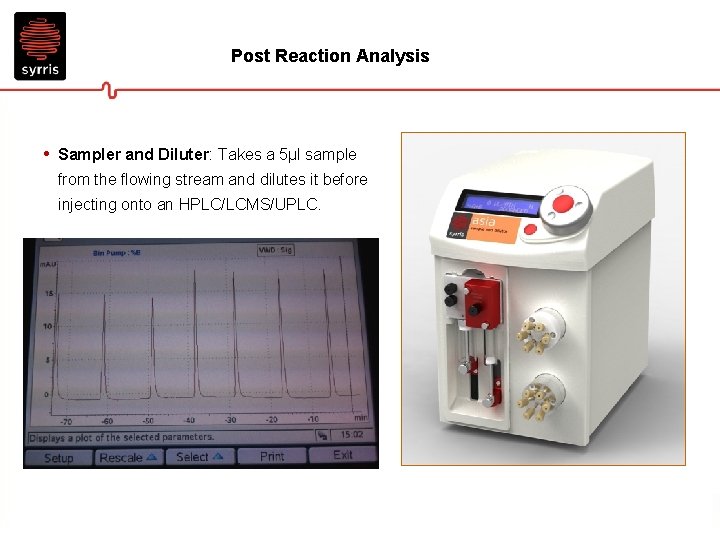
Post Reaction Analysis • Sampler and Diluter: Takes a 5μl sample from the flowing stream and dilutes it before injecting onto an HPLC/LCMS/UPLC.
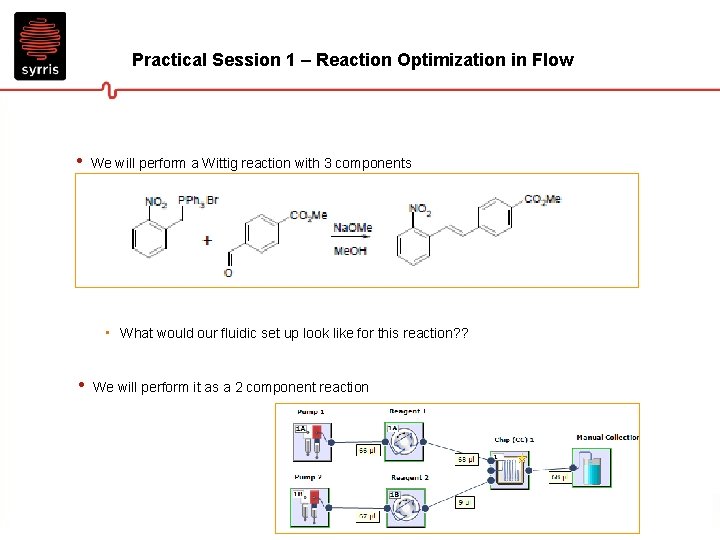
Practical Session 1 – Reaction Optimization in Flow • We will perform a Wittig reaction with 3 components • What would our fluidic set up look like for this reaction? ? • We will perform it as a 2 component reaction
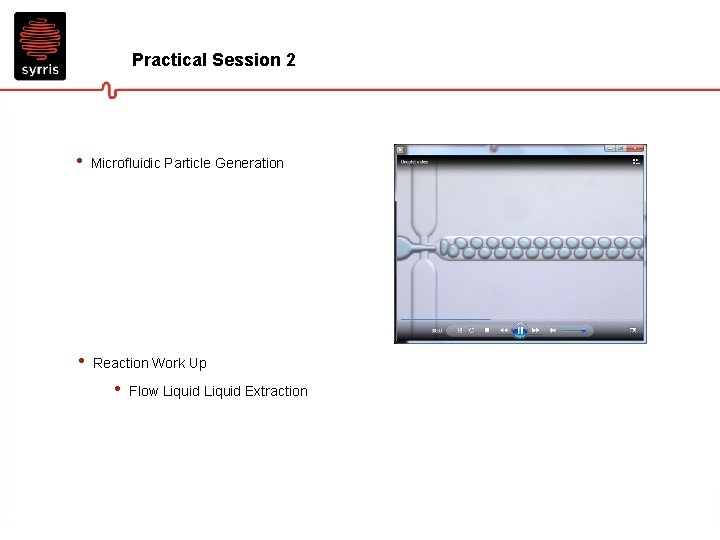
Practical Session 2 • Microfluidic Particle Generation • Reaction Work Up • Flow Liquid Extraction