
Practical Recommendations for Creating a Trauma Informed and

- Slides: 32
Practical Recommendations for Creating a Trauma Informed and Responsive Initiative and College Institutions a collaborative university commitment to prevent retraumatization and foster empowerment through a unified and supportive campus community response to trauma.
TRIGGER WARNING a collaborative university commitment to prevent retraumatization and foster empowerment through a unified and supportive campus community response to trauma.
Overview v. ACEs v. Trauma and College Students v. Culture and Trauma v. Basics of Trauma Informed Care v. Retraumatization v. Examples of Institutional Approaches v. Next Steps a collaborative university commitment to prevent retraumatization and foster empowerment through a unified and supportive campus community response to trauma.
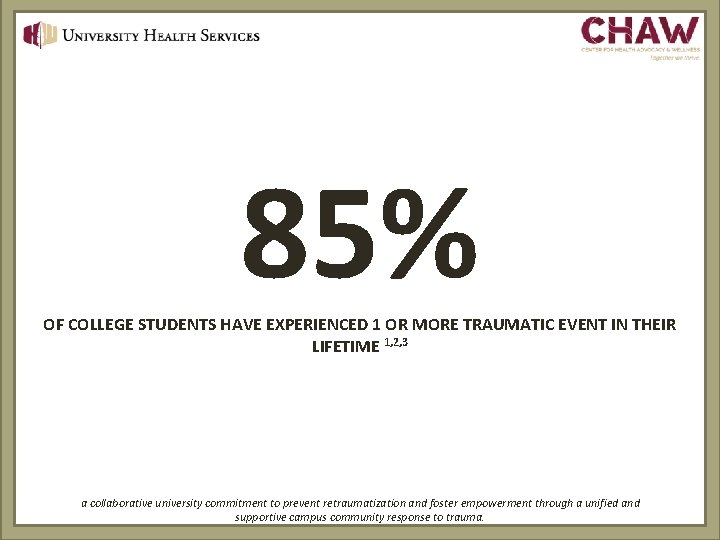
85% OF COLLEGE STUDENTS HAVE EXPERIENCED 1 OR MORE TRAUMATIC EVENT IN THEIR LIFETIME 1, 2, 3 a collaborative university commitment to prevent retraumatization and foster empowerment through a unified and supportive campus community response to trauma.
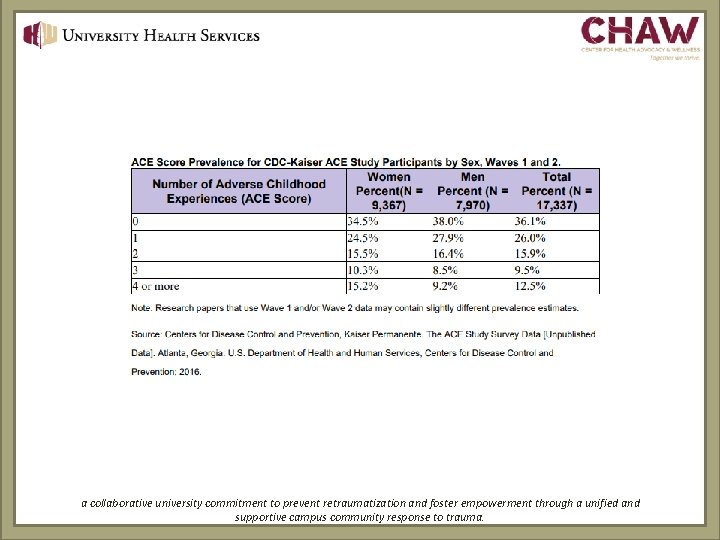
FINDING YOUR ACE SCORE 4 a collaborative university commitment to prevent retraumatization and foster empowerment through a unified and supportive campus community response to trauma.
WHERE ARE WE AT? a collaborative university commitment to prevent retraumatization and foster empowerment through a unified and supportive campus community response to trauma.
a collaborative university commitment to prevent retraumatization and foster empowerment through a unified and supportive campus community response to trauma.
What is trauma? A deeply distressing or disturbing experience which impacts not only the individual but their extended networks. a collaborative university commitment to prevent retraumatization and foster empowerment through a unified and supportive campus community response to trauma.
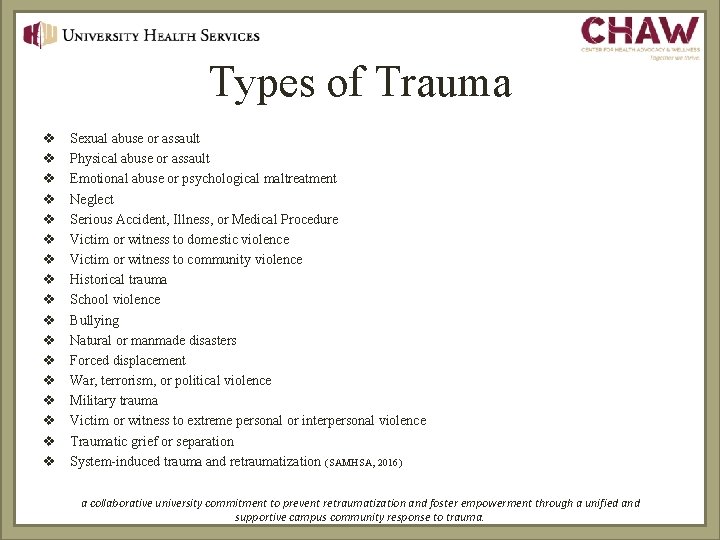
Types of Trauma v v v v v Sexual abuse or assault Physical abuse or assault Emotional abuse or psychological maltreatment Neglect Serious Accident, Illness, or Medical Procedure Victim or witness to domestic violence Victim or witness to community violence Historical trauma School violence Bullying Natural or manmade disasters Forced displacement War, terrorism, or political violence Military trauma Victim or witness to extreme personal or interpersonal violence Traumatic grief or separation System-induced trauma and retraumatization (SAMHSA, 2016) a collaborative university commitment to prevent retraumatization and foster empowerment through a unified and supportive campus community response to trauma.
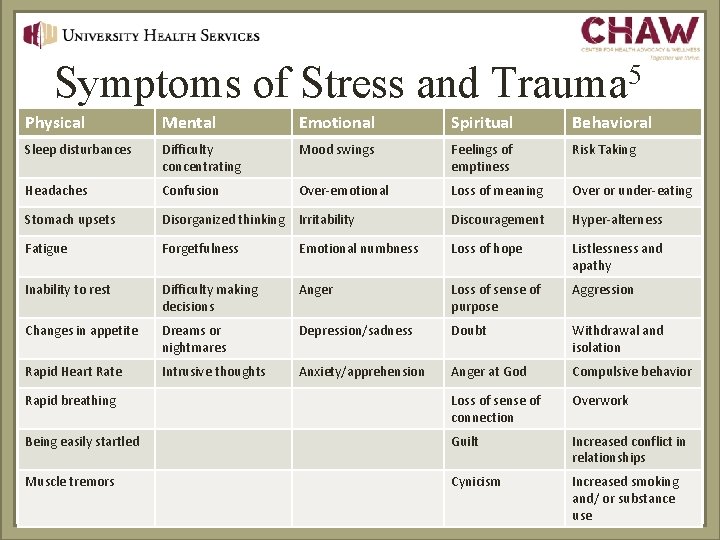
Symptoms of Stress and 5 Trauma Physical Mental Emotional Spiritual Behavioral Sleep disturbances Difficulty concentrating Mood swings Feelings of emptiness Risk Taking Headaches Confusion Over-emotional Loss of meaning Over or under-eating Stomach upsets Disorganized thinking Irritability Discouragement Hyper-alterness Fatigue Forgetfulness Emotional numbness Loss of hope Listlessness and apathy Inability to rest Difficulty making decisions Anger Loss of sense of purpose Aggression Changes in appetite Dreams or nightmares Depression/sadness Doubt Withdrawal and isolation Rapid Heart Rate Intrusive thoughts Anxiety/apprehension Anger at God Compulsive behavior Rapid breathing Loss of sense of connection Overwork Being easily startled Guilt Increased conflict in relationships Muscle tremors Cynicism Increased smoking or substance a collaborative university commitment to prevent retraumatization and foster empowerment throughand/ a unified and use supportive campus community response to trauma.
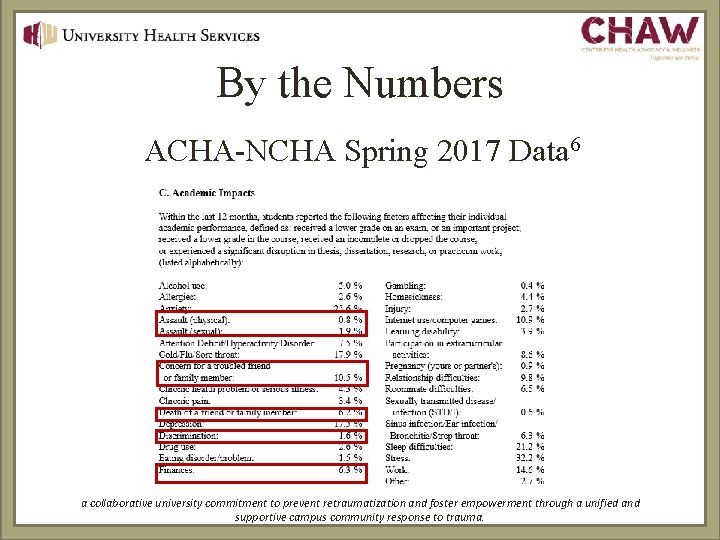
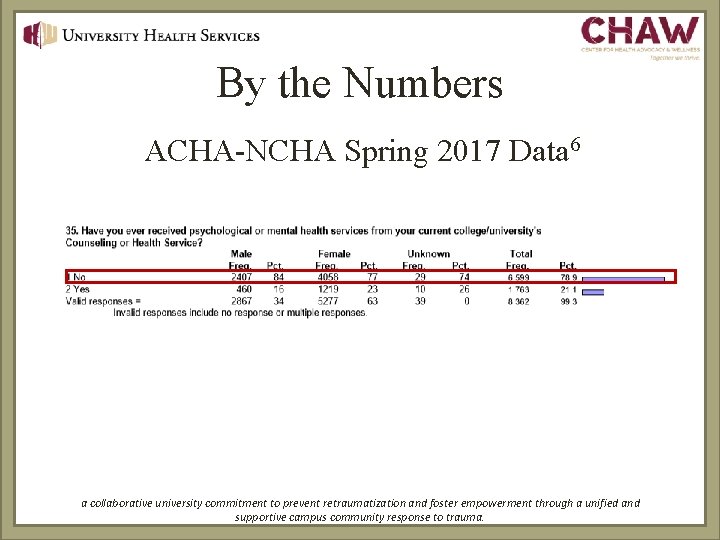
By the Numbers ACHA-NCHA Spring 2017 Data 6 a collaborative university commitment to prevent retraumatization and foster empowerment through a unified and supportive campus community response to trauma.
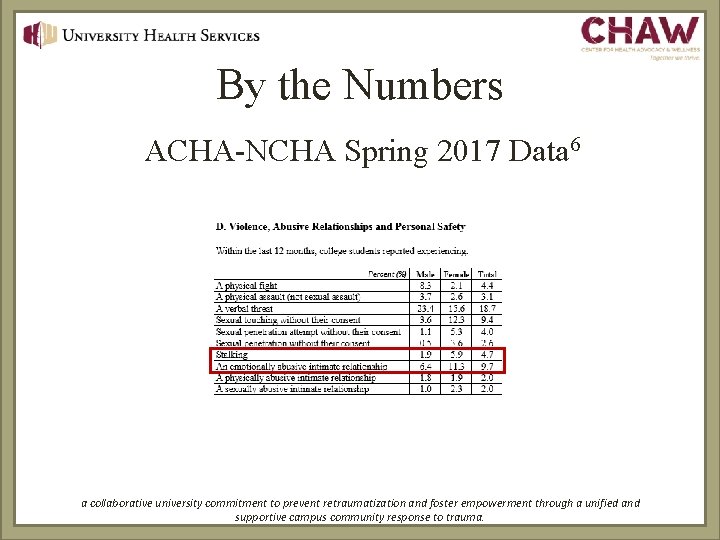
By the Numbers ACHA-NCHA Spring 2017 Data 6 a collaborative university commitment to prevent retraumatization and foster empowerment through a unified and supportive campus community response to trauma.
By the Numbers ACHA-NCHA Spring 2017 Data 6 a collaborative university commitment to prevent retraumatization and foster empowerment through a unified and supportive campus community response to trauma.
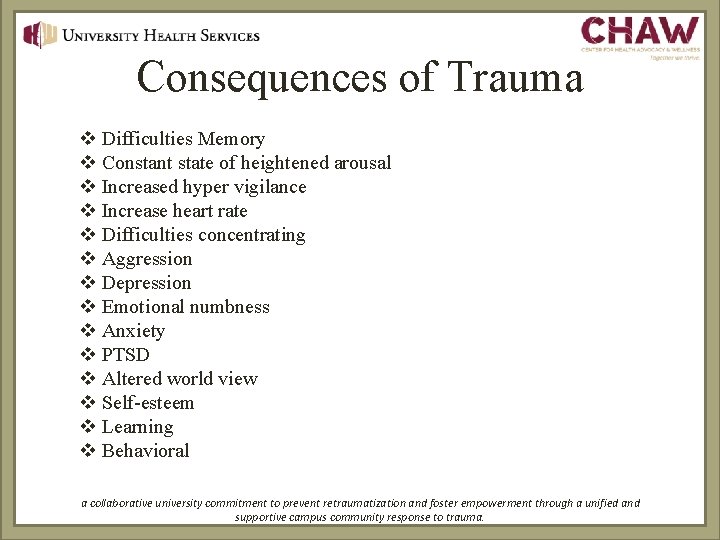
Consequences of Trauma v Difficulties Memory v Constant state of heightened arousal v Increased hyper vigilance v Increase heart rate v Difficulties concentrating v Aggression v Depression v Emotional numbness v Anxiety v PTSD v Altered world view v Self-esteem v Learning v Behavioral a collaborative university commitment to prevent retraumatization and foster empowerment through a unified and supportive campus community response to trauma.
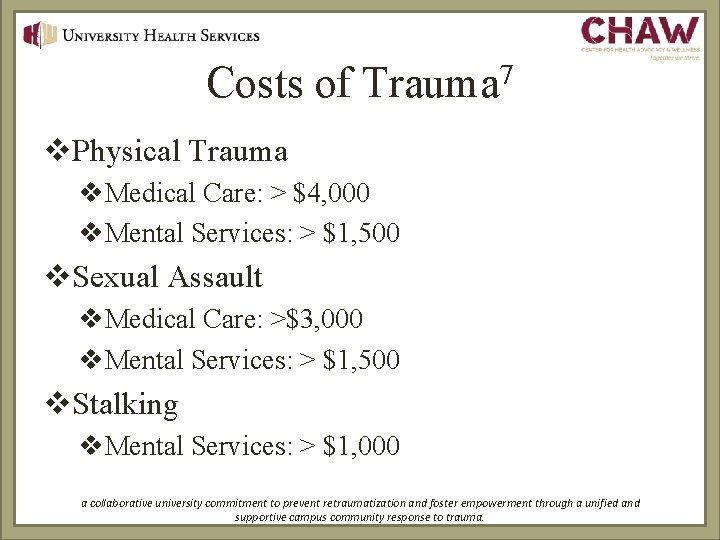
Costs of 7 Trauma v. Physical Trauma v. Medical Care: > $4, 000 v. Mental Services: > $1, 500 v. Sexual Assault v. Medical Care: >$3, 000 v. Mental Services: > $1, 500 v. Stalking v. Mental Services: > $1, 000 a collaborative university commitment to prevent retraumatization and foster empowerment through a unified and supportive campus community response to trauma.
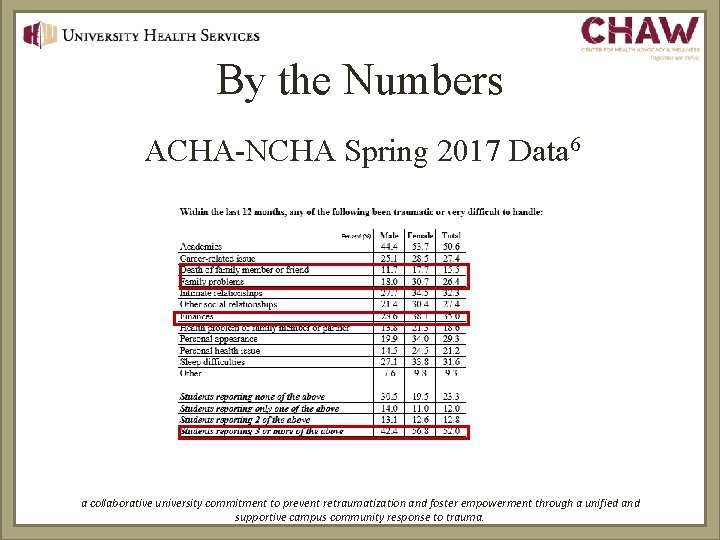
By the Numbers ACHA-NCHA Spring 2017 Data 6 a collaborative university commitment to prevent retraumatization and foster empowerment through a unified and supportive campus community response to trauma.
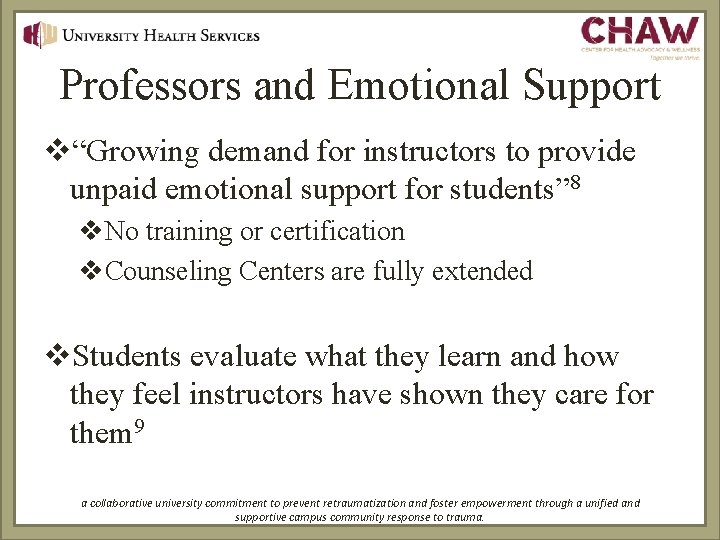
Professors and Emotional Support v“Growing demand for instructors to provide unpaid emotional support for students” 8 v. No training or certification v. Counseling Centers are fully extended v. Students evaluate what they learn and how they feel instructors have shown they care for them 9 a collaborative university commitment to prevent retraumatization and foster empowerment through a unified and supportive campus community response to trauma.
“KNOWING IS NOT ENOUGH; WE MUST APPLY. WILLING IS NOT ENOUGH; WE MUST DO. ” Johann Wolfgang von Goethe a collaborative university commitment to prevent retraumatization and foster empowerment through a unified and supportive campus community response to trauma.
Guiding Questions v. How do trauma survivors at FSU utilize existing FSU resources? v. What does it look like for FSU to be trauma responsive and informed? a collaborative university commitment to prevent retraumatization and foster empowerment through a unified and supportive campus community response to trauma.
Our Next Steps q. Gathering Data q. Examining Existing Department Infrastructure ü Creating and Piloting a Trauma Training with UHS ü Securing Funding and Institutional Support ü Creation of FSU Resilience Project a collaborative university commitment to prevent retraumatization and foster empowerment through a unified and supportive campus community response to trauma.
a collaborative university commitment to prevent retraumatization and foster empowerment through a unified and supportive campus community response to trauma.
So what is Trauma 10 Informed Care? Trauma Informed Care is an organizational structure and treatment framework that involves understanding, recognizing, and responding to the effects of all types of trauma. a collaborative university commitment to prevent retraumatization and foster empowerment through a unified and supportive campus community response to trauma.
WHAT IS WRONG WITH YOU? a collaborative university commitment to prevent retraumatization and foster empowerment through a unified and supportive campus community response to trauma.
Trauma Informed Care v. The Four “R’s” 10 v. Realize v. Recognize v. Responds v. Resist Re-Traumatization a collaborative university commitment to prevent retraumatization and foster empowerment through a unified and supportive campus community response to trauma.
10 Retraumatization v. Normalize Trauma v. Role of language v. Triggers v. Referral Process v. Secondary Trauma a collaborative university commitment to prevent retraumatization and foster empowerment through a unified and supportive campus community response to trauma.
Three-Prong Approach to TIC (SAMHSA)10 v. Create a Safe Environment v. Strive to Enhance Connectedness and Build Supportive Relationships v. Support and Empower Community Healing a collaborative university commitment to prevent retraumatization and foster empowerment through a unified and supportive campus community response to trauma.
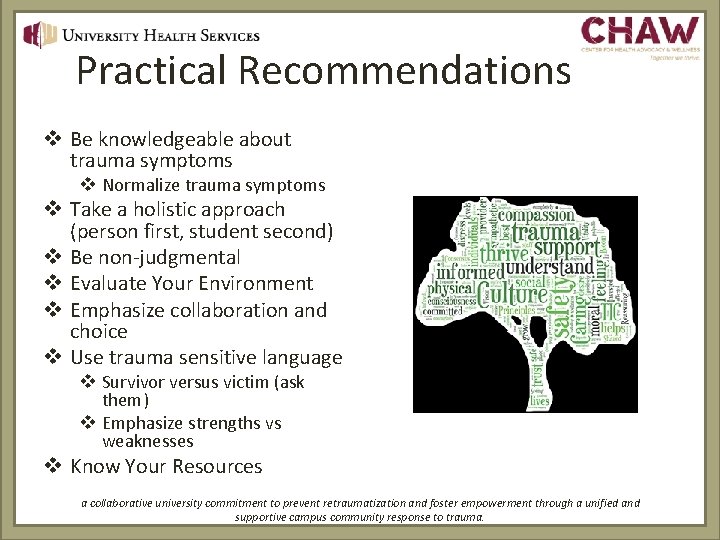
Practical Recommendations v Be knowledgeable about trauma symptoms v Normalize trauma symptoms v Take a holistic approach (person first, student second) v Be non-judgmental v Evaluate Your Environment v Emphasize collaboration and choice v Use trauma sensitive language v Survivor versus victim (ask them) v Emphasize strengths vs weaknesses v Know Your Resources a collaborative university commitment to prevent retraumatization and foster empowerment through a unified and supportive campus community response to trauma.
10 Questions To Ask 11 1. How do I create an environment that promotes a sense of physical safety and calm for students, faculty, and staff? 2. How do I help students, faculty, and staff identify strategies that contribute to their empowerment and psychological safety? 3. How do I incorporate culturally competent and gender-specific policies and practices? 4. How do I integrate peer support on campus? 5. What am I doing to ensure the continuity of care between organizations and support systems on campus? 6. How am I promoting self-care of faculty and staff? 7. Do I realize that behaviors of students, faculty, and staff may be coping strategies and defense mechanisms for current or past traumas? 8. How do I help people recognize and manage the immediate and delayed signs of trauma? 9. What is the impact of trauma on my own health and well-being? 10. How am I practicing self care? a collaborative university commitment to prevent retraumatization and foster empowerment through a unified and supportive campus community response to trauma.
Culture Competence 10, 11 v. Adopt an inclusive view of cultural identity v. Recognize cultural variations in the perceptions of trauma and traumatic stress response v. Understand the role of beliefs in interpretation of trauma and the recovery process a collaborative university commitment to prevent retraumatization and foster empowerment through a unified and supportive campus community response to trauma.
Discussion v. How do you currently implement TIC on: in your role? v. In what way can you improve your environment? v. How can you implement tic within your sphere of influence? a collaborative university commitment to prevent retraumatization and foster empowerment through a unified and supportive campus community response to trauma.
Contact Information v. Ashley Fryer, Ph. D vfryer 824@gmail. com v. Kori Pruett, MS vkpruett@admin. fsu. edu a collaborative university commitment to prevent retraumatization and foster empowerment through a unified and supportive campus community response to trauma.
References 1. Benton, S. A. , Robertson, J. M. , Tseng, W. C. , Newton, F. B. , & Benton, S. L. (2003). Changes in counseling center client problems across 13 years. Professional Psychology: Research and Practice, 34, 66 -72. 2. Canto, A. I. , Cox, B. E. , Osborn, D. , Swanbrow Becker, M. , & Hayden, S. (2017). College students in crisis: prevention, identification, and response options for campus housing professionals. The Journal of College and University Housing, 43, 44 - 56. 3. Twenge, J. M. , Gentile, B. , De. Wall, C. N. , Ma, D. , Lacefield, K. , & Shurz, D. R. (2010). Birth cohort increases in psychopathology among young Americans, 1938 -2007: A cross-temporal meta-analysis of the MMPI. Clinical Psychology Review, 30, 145 -154. 4. Feliti, V. J. , Anda, R. F. , Nordenberg, D. , Williamson, D. F. , Spitz, A. M. , Edwards, V. , Koss, M. P. , & Marks, J. S. (1998). Relationship of childhood abuse and household dysfunction to many of the leading causes of death in adults. American Journal of Preventative Medicine, 14, 245 -258. 5. Headington Institute. (n. d). Symptoms of stress and trauma. http: //headington-institure. org/Portals/32/resources/Signs and symptoms of stresss. pdf 6. American College Health Association. (2017). American College Health Association-National College Health Assessment II: Custom Reference Group Executive Summary Spring 2017. Hanover, MD: American College Health Association. 7. National Center for Injury Prevention and Control, “Costs of Intimate Partner Violence Against Women in the United States, ” (Atlanta, GA: Department of Health and Human Services, Centers for Disease Control and Prevention, 2003). http: //www. cdc. gov/violenceprevention/pdf/ipvbook-a. pdf 8. Bernhagen, L. (2017, October). Professors are the new therapists [Blog post]. Retrieved from http: //www. slate. com/blogs/better_life_lab/ 2017/10/05/professors_are_the_new_therapists. html 9. Teven, J. J. , & Mc. Croskey, J. C. (1997). The relationship of perceived teacher caring with student learning and teacher evaluation. Communication Education, 46, 1 -9 10. Substance Abuse and Mental Health Services Administration. SAMHSA’s concept of trauma and guidance for a trauma-informed approach. HHS Publication No. (SMA) 14 -4884. Rockville, MD: Substance Abuse and Mental Health Services Administration, 2014. 11. Center for Evidence-Based Practices at Case Western Reserve University. (n. d. ). Transforming culture, policy & practice of organizations. Retrieved from https: //www. centerforebp. case. edu/client-files/pdf/tic-transform-reminder. pdf Video 12. [60 Minutes]. (2018, March). The “life changing” story Oprah reports this week [Video File]. Retrieved from https: //www. youtube. com/watch? v=d. F 20 Fa. Qz. YUI a collaborative university commitment to prevent retraumatization and foster empowerment through a unified and supportive campus community response to trauma.