
Practical Project Management Taking Projects from Inception to
- Slides: 60
Practical Project Management Taking Projects from Inception to Completion Supplemental Self-Study Presentation
Practical Project Management Overview
Practical Project Management Introduction Projects represent much of the work done in today’s organizations. Unfortunately, many organizations devote valuable resources, including employees’ time, to poorly conceived and implemented projects that do not achieve meaningful goals or are never completed. In fact, an extensive study by Pricewaterhouse. Coopers found that fewer than 3% of companies successfully completed all of their projects. The effects of poorly conceived and implemented projects can be devastating to company success. The Harvard Business Review reported that the failure of IT projects in the United States costs $50 $150 billion each year. Effective project management is essential if organizations are to succeed in today’s rapidly changing and highly competitive environment.
Practical Project Management Introduction Part 2 Learning to manage projects effectively not only benefits your organization, it benefits you. Today’s organizations rely on employees who can carry a project through from inception to completion, on time and on budget, making a more efficient use of resources and achieving a quality outcome. Thus, being able to manage projects successfully makes you more valuable to your organization and improves your career prospects by providing you with a critical skill.
Practical Project Management What is a Project? Harvard Business Essentials defines a project as “…the allocation, tracking, and utilization of resources to achieve a particular objective within a specified period of time. ” Projects are onetime undertakings, of any size or scope, with a specified, desired outcome. They are not: • a series of tasks (part of a project) • a process • a procedure • an ongoing activity (such as a program to improve employees’ health)
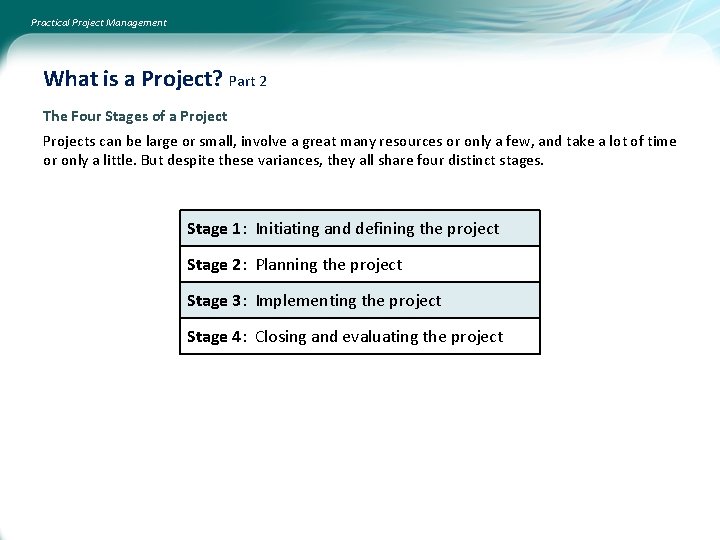
Practical Project Management What is a Project? Part 2 The Four Stages of a Projects can be large or small, involve a great many resources or only a few, and take a lot of time or only a little. But despite these variances, they all share four distinct stages. Stage 1: Initiating and defining the project Stage 2: Planning the project Stage 3: Implementing the project Stage 4: Closing and evaluating the project
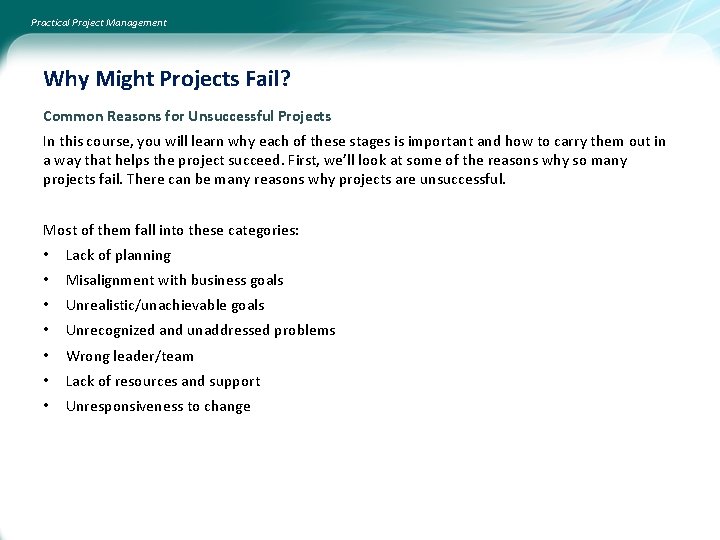
Practical Project Management Why Might Projects Fail? Common Reasons for Unsuccessful Projects In this course, you will learn why each of these stages is important and how to carry them out in a way that helps the project succeed. First, we’ll look at some of the reasons why so many projects fail. There can be many reasons why projects are unsuccessful. Most of them fall into these categories: • Lack of planning • Misalignment with business goals • Unrealistic/unachievable goals • Unrecognized and unaddressed problems • Wrong leader/team • Lack of resources and support • Unresponsiveness to change
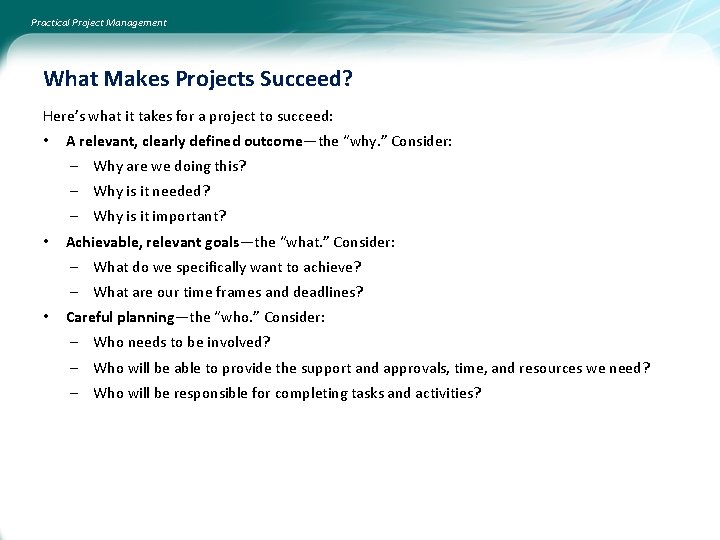
Practical Project Management What Makes Projects Succeed? Here’s what it takes for a project to succeed: • A relevant, clearly defined outcome—the “why. ” Consider: – Why are we doing this? – Why is it needed? – Why is it important? • Achievable, relevant goals—the “what. ” Consider: – What do we specifically want to achieve? – What are our time frames and deadlines? • Careful planning—the “who. ” Consider: – Who needs to be involved? – Who will be able to provide the support and approvals, time, and resources we need? – Who will be responsible for completing tasks and activities?
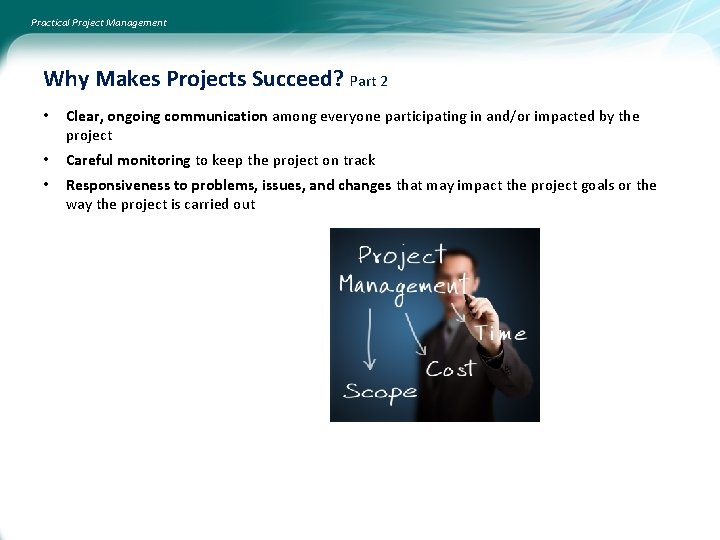
Practical Project Management Why Makes Projects Succeed? Part 2 • Clear, ongoing communication among everyone participating in and/or impacted by the project • Careful monitoring to keep the project on track • Responsiveness to problems, issues, and changes that may impact the project goals or the way the project is carried out
Practical Project Management Module 1: Initiating and Defining a Project
Practical Project Management Why this Project? There can be many “triggers” or reasons for undertaking a project, such as: • An organizational or customer need • A client request • Market demand • A government requirement • New technology *Example of an organizational need: An organization wants to reduce its health insurance costs. To do this they decide they need to improve their employees’ health and that the best way to do that is by building an on-site fitness center. The need to improve employees’ health becomes the desired outcome of building this center. The outcome is important because it affects their bottom line: it not only reduces health insurance costs, but increases employee satisfaction and productivity (which is often influenced by personal well-being). *Note: This scenario is used throughout this course as a frame of reference for examples on the techniques and steps inherent in each stage of a project.
Practical Project Management How Can the Need be Met? There are nearly always several ways for achieving a desired outcome. Here are the steps you can take to help generate options and decide which one is best. • Identify the criteria the outcome must meet, such as within a certain budget, by a certain time, with the use of certain resources, or to a certain standard of quality. • Brainstorm all the possible ways to achieve the outcome. Take the time to generate as many ideas you can – one idea may trigger others. Jot down ideas without discussing, judging or evaluating them. • Discuss and narrow the ideas. Eliminate those that are unrealistic, impractical, or unlikely to achieve the outcome. Also eliminate any that are not aligned with the organization’s goals. New ideas may come up at this stage — include them in your discussion. • Evaluate the remaining options to select the one that appears to have the best chance of success at achieving the outcome. Describe this option in specific terms—what product, facility, procedures, service, etc. will exist when the project is complete.
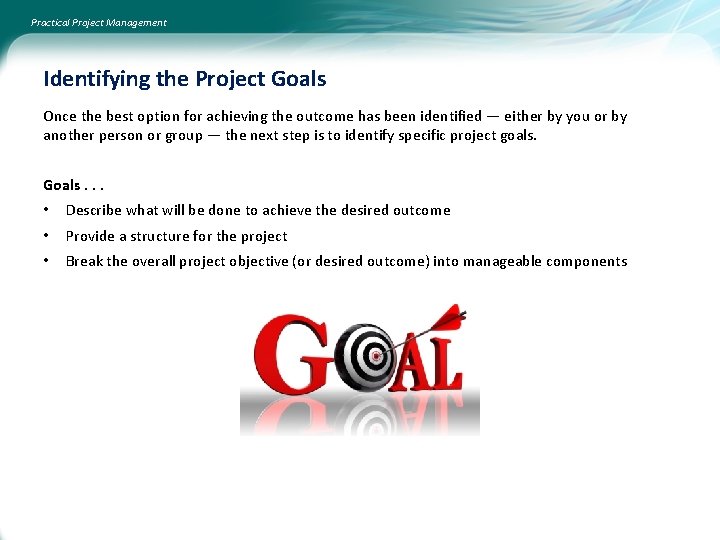
Practical Project Management Identifying the Project Goals Once the best option for achieving the outcome has been identified — either by you or by another person or group — the next step is to identify specific project goals. Goals. . . • Describe what will be done to achieve the desired outcome • Provide a structure for the project • Break the overall project objective (or desired outcome) into manageable components
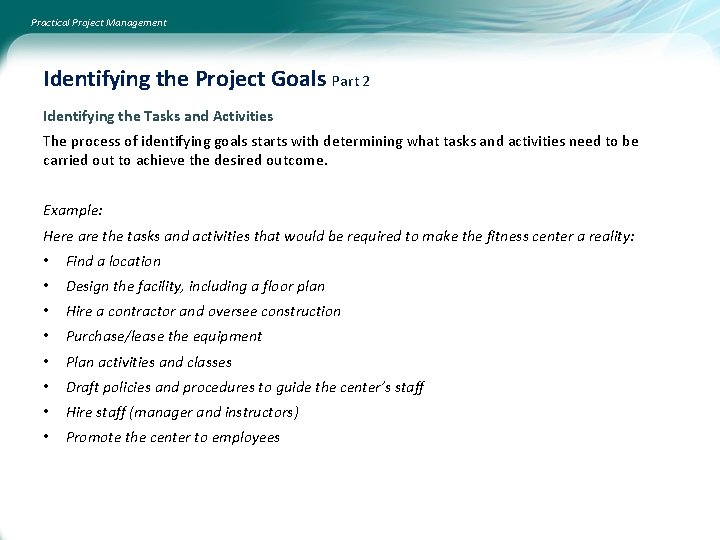
Practical Project Management Identifying the Project Goals Part 2 Identifying the Tasks and Activities The process of identifying goals starts with determining what tasks and activities need to be carried out to achieve the desired outcome. Example: Here are the tasks and activities that would be required to make the fitness center a reality: • Find a location • Design the facility, including a floor plan • Hire a contractor and oversee construction • Purchase/lease the equipment • Plan activities and classes • Draft policies and procedures to guide the center’s staff • Hire staff (manager and instructors) • Promote the center to employees
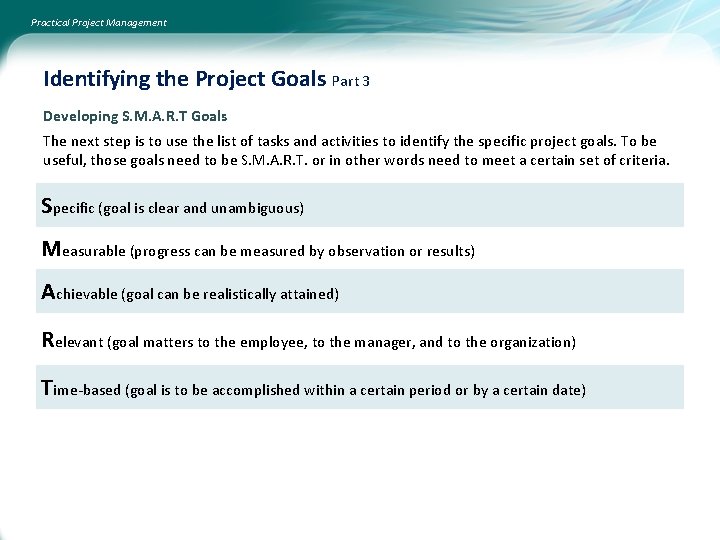
Practical Project Management Identifying the Project Goals Part 3 Developing S. M. A. R. T Goals The next step is to use the list of tasks and activities to identify the specific project goals. To be useful, those goals need to be S. M. A. R. T. or in other words need to meet a certain set of criteria. Specific (goal is clear and unambiguous) Measurable (progress can be measured by observation or results) Achievable (goal can be realistically attained) Relevant (goal matters to the employee, to the manager, and to the organization) Time-based (goal is to be accomplished within a certain period or by a certain date)
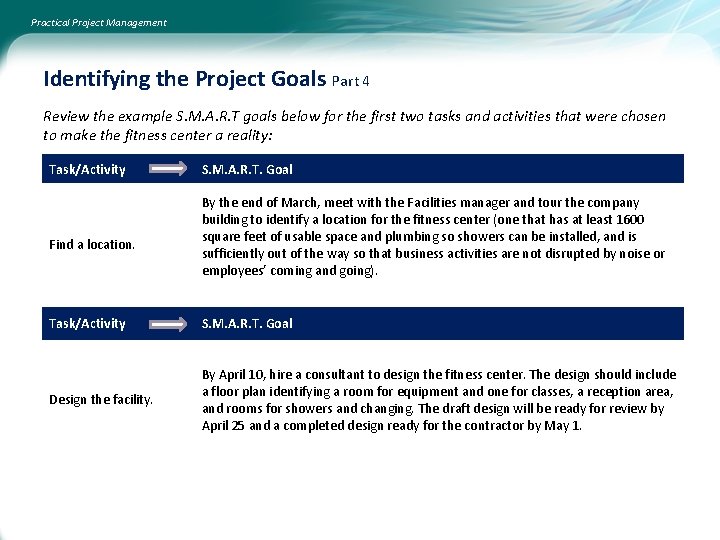
Practical Project Management Identifying the Project Goals Part 4 Review the example S. M. A. R. T goals below for the first two tasks and activities that were chosen to make the fitness center a reality: Task/Activity Find a location. S. M. A. R. T. Goal By the end of March, meet with the Facilities manager and tour the company building to identify a location for the fitness center (one that has at least 1600 square feet of usable space and plumbing so showers can be installed, and is sufficiently out of the way so that business activities are not disrupted by noise or employees’ coming and going). Task/Activity S. M. A. R. T. Goal Design the facility. By April 10, hire a consultant to design the fitness center. The design should include a floor plan identifying a room for equipment and one for classes, a reception area, and rooms for showers and changing. The draft design will be ready for review by April 25 and a completed design ready for the contractor by May 1.
Practical Project Management Identifying the Stakeholders Another very important part of getting a project started is to identify the stakeholders. The success of your project depends to a large extent on whether they understand agree with what you are trying to accomplish. Stakeholders are people who have a vested interest in the success of a project. They may include managers and executives, colleagues within or outside of your department, and/or your customers. The specific stakeholders depend on the project and the situation. They generally include: • Those who are directly affected by the outcome • Those whose participation is essential for the project to succeed • Those whose approval and support you need
Practical Project Management Test Your Knowledge Read the question, then click on the answer. Which statement accurately describes the way that projects are initiated? A. Projects may be triggered by a customer or organizational need. B. In general, projects are initiated by upper management. C. The project manager is the one who is responsible for initiating the project. D. Projects are most likely to be initiated by people who want to stand out from the crowd.
Practical Project Management Module 2: Planning a Project
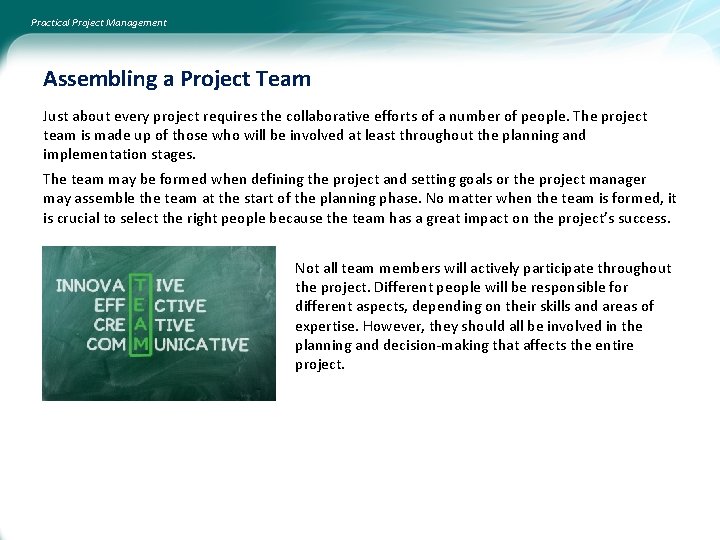
Practical Project Management Assembling a Project Team Just about every project requires the collaborative efforts of a number of people. The project team is made up of those who will be involved at least throughout the planning and implementation stages. The team may be formed when defining the project and setting goals or the project manager may assemble the team at the start of the planning phase. No matter when the team is formed, it is crucial to select the right people because the team has a great impact on the project’s success. Not all team members will actively participate throughout the project. Different people will be responsible for different aspects, depending on their skills and areas of expertise. However, they should all be involved in the planning and decision-making that affects the entire project.
Practical Project Management Assembling a Project Team Part 2 Selecting the Right People An effective project team is more than a group of people who take on various tasks. It’s a cohesive yet diverse group of people who can make specific contributions, who care about the success of the project, and who can work well together. To help you identify those people, consider the questions below. • Who has the necessary skills and experience? You may need the help of people with specific skills or expertise that you do not possess. • How large should the team be? There are no one-size-fits-all criteria. The team should be large enough to get the work done and include a sufficient diversity of skills, experience, and perspectives. And it should be small enough so that people can meet as needed and so that coordinating team activities doesn’t take up all your time. • Who has an interest in the success of this project? Projects are more successful when team members recognize the importance of the project to the organization and themselves and are committed to achieving the outcome.
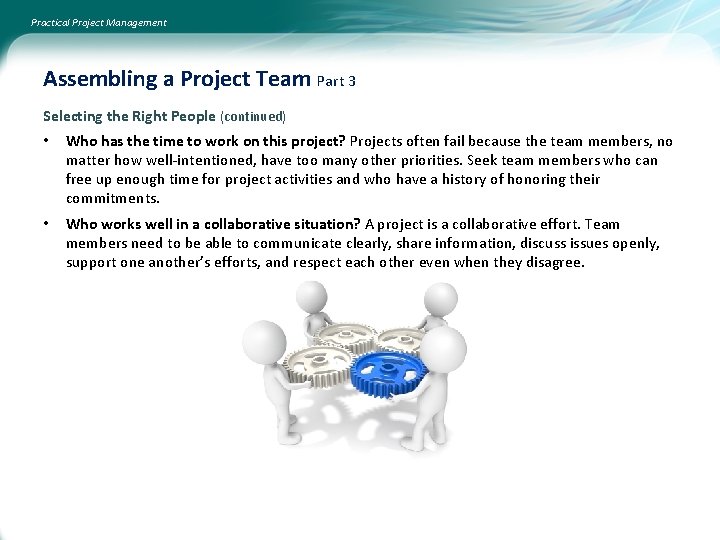
Practical Project Management Assembling a Project Team Part 3 Selecting the Right People (continued) • Who has the time to work on this project? Projects often fail because the team members, no matter how well-intentioned, have too many other priorities. Seek team members who can free up enough time for project activities and who have a history of honoring their commitments. • Who works well in a collaborative situation? A project is a collaborative effort. Team members need to be able to communicate clearly, share information, discuss issues openly, support one another’s efforts, and respect each other even when they disagree.
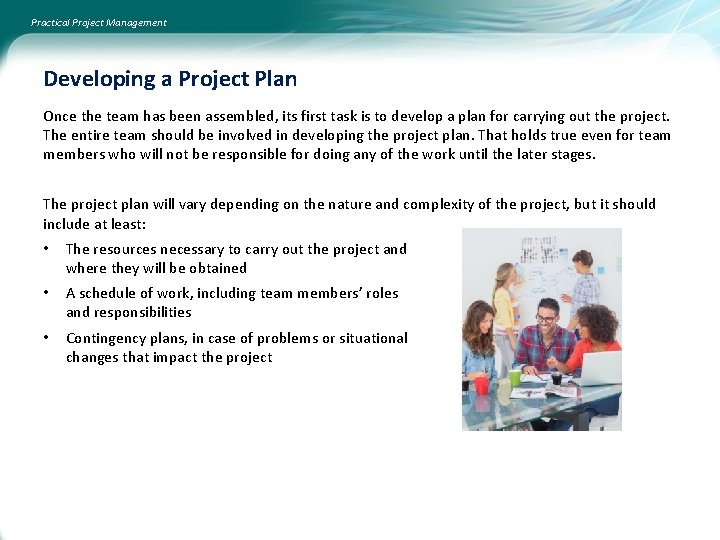
Practical Project Management Developing a Project Plan Once the team has been assembled, its first task is to develop a plan for carrying out the project. The entire team should be involved in developing the project plan. That holds true even for team members who will not be responsible for doing any of the work until the later stages. The project plan will vary depending on the nature and complexity of the project, but it should include at least: • The resources necessary to carry out the project and where they will be obtained • A schedule of work, including team members’ roles and responsibilities • Contingency plans, in case of problems or situational changes that impact the project
Practical Project Management Identifying Essential Resources An important part of planning a project is identifying the resources you will need to achieve the desired outcome. A project can quickly get off track or even be brought to a sudden stop if you do not have or cannot obtain essential resources. Types of Resources The specific resources that project teams need fall into these general categories. Your project may not require all the resources listed here, but these are the types of resources you may need to obtain to achieve your goals. • Money: Most projects require at least some expenditures. – Example: The fitness center would require funds to design the space, to construct the building, purchase or lease equipment, and hire consultants to help with various phases of the project. • Space: Some projects require a certain amount and type of space. – Example: For the fitness center, an essential resource is a space that is or can be made available that meets the criteria specified for the location. For another project it might be office space or a space in which people can meet.
Practical Project Management Identifying Essential Resources Part 2 Types of Resources (continued) • Expertise: Many projects require the help of people with certain expertise. – Example: The fitness center project requires a designer with fitness center experience and a contractor who has built this type of facility. It may also require a consultant for what type of equipment should be purchased another consultant to help plan classes and activities. • Software and/or equipment: Project teams may need specialized software or equipment to meet their goals. • Information: Teams may need studies, reports, and other information to carry out their projects. – Example: The fitness center project may require examples of manuals for corporate fitness center operations.
Practical Project Management Identifying Essential Resources Dealing with Unavailable Resources It’s important to identify the necessary resources early in the planning process to ensure you have or can get what you need to meet your goals. Projects are likely to fail if you try to move things forward without essential resources. To avoid these kinds of failures, do the following when it becomes clear that you do not have or cannot obtain one or more of those resources. • Rethink the project scope and goals. Perhaps you can re-size and reshape the project to fit the budget and the time available. • Look for other ways to obtain the resources. Perhaps you can convince management to increase the budget or find the expertise you need outside the company rather than within it. • Find an alternative. There may be another way to achieve the desired outcome, one that requires a different set of resources. • If necessary, put the project on hold, or call a halt. It’s a waste of everyone’s time and the organization’s money to continue without the resources you need to succeed. You may need to delay the project until resources become available. In some cases, you might realize that it is simply too impractical to proceed.
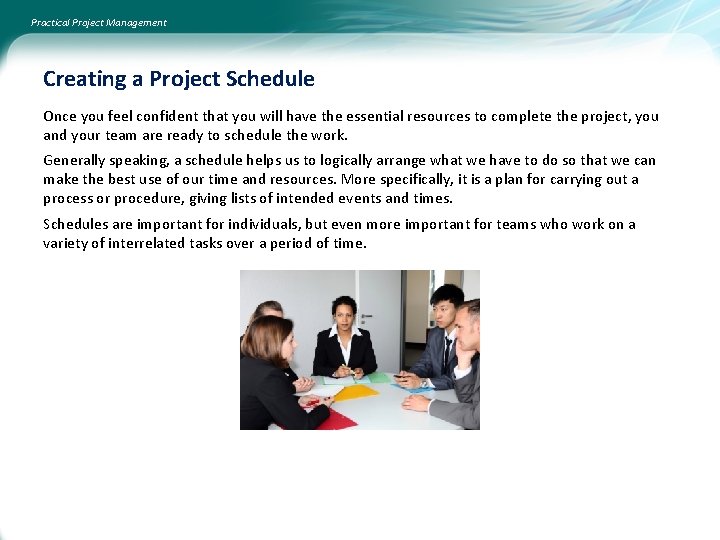
Practical Project Management Creating a Project Schedule Once you feel confident that you will have the essential resources to complete the project, you and your team are ready to schedule the work. Generally speaking, a schedule helps us to logically arrange what we have to do so that we can make the best use of our time and resources. More specifically, it is a plan for carrying out a process or procedure, giving lists of intended events and times. Schedules are important for individuals, but even more important for teams who work on a variety of interrelated tasks over a period of time.
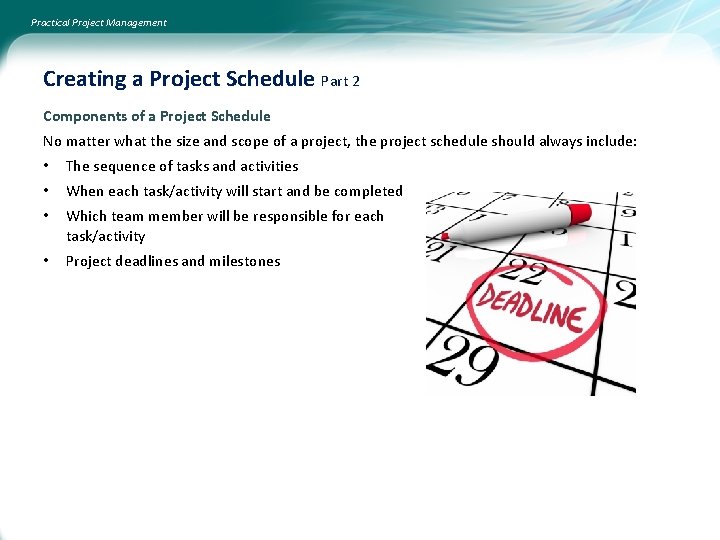
Practical Project Management Creating a Project Schedule Part 2 Components of a Project Schedule No matter what the size and scope of a project, the project schedule should always include: • The sequence of tasks and activities • When each task/activity will start and be completed • Which team member will be responsible for each task/activity • Project deadlines and milestones
Practical Project Management Creating a Project Schedule Part 3 The Scheduling Process The larger and more complex your project, the more time and effort it will take you and your team to develop a workable schedule. Following a logical series of steps can help. 1. List the specific tasks/activities needed to accomplish each goal. Do not stop to organize or evaluate them. Example: If the overall task/activity was to design the facility and the specific goal for that was to hire a consultant by April 10 to develop a floor plan, then the specific tasks are to hire the consultant and meet with them to tour the space and discuss requirements. 1. Organize task/activity lists into major tasks and subtasks. One key to completing a project successfully is to break tasks and activities into manageable parts or smaller milestone goals. Example: – Major task: Hire a design consultant. – Subtask: Interview potential consultants. – Subtask: Check consultants’ references.
Practical Project Management Creating a Project Schedule Part 4 The Scheduling Process (continued) 3. Determine the order in which all tasks and activities (main tasks and subtasks) should be worked on. Some aspects of the work can be done simultaneously, while others must be done in a specific order; i. e. , if one task is dependent upon the completion of another. 4. Determine how long each task/activity will take and set deadlines. Some of the work may take only a couple of hours; some may take weeks or even months. What’s important is to be realistic. Things often take longer than you think they will, and it’s better to over-estimate the time than to under-estimate it. Leaving some “lag” time in the schedule can help keep you from falling behind. 5. Determine who will be responsible for the work. One team member should take on the responsibility for each of the primary tasks and activities needed to accomplish a goal. That person may not actually do the work, but he or she should be in charge of making sure it gets done.
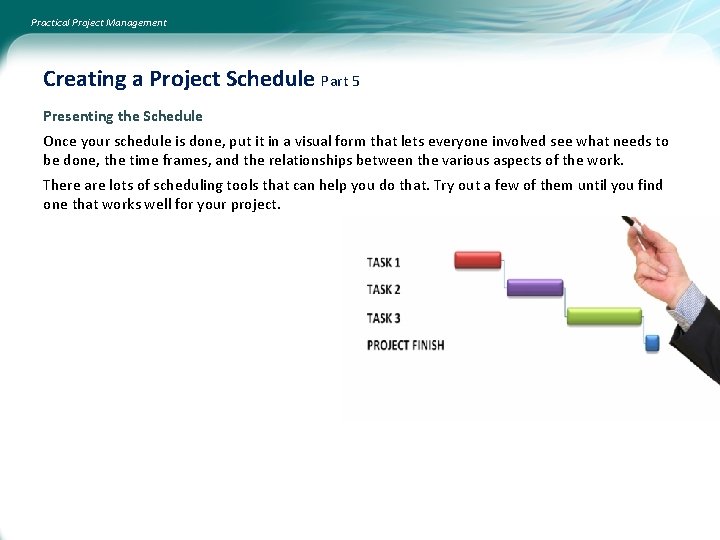
Practical Project Management Creating a Project Schedule Part 5 Presenting the Schedule Once your schedule is done, put it in a visual form that lets everyone involved see what needs to be done, the time frames, and the relationships between the various aspects of the work. There are lots of scheduling tools that can help you do that. Try out a few of them until you find one that works well for your project.
Practical Project Management Planning for Contingencies A well-thought-out schedule goes a long way towards helping all the pieces of your project fit together smoothly. But it doesn’t ensure that things will go according to plan. No matter how carefully you plan, things can go wrong. That’s why it’s very important to prepare for contingencies. Contingency planning is the process of thinking about what could go wrong on your project and what you will do if any of those things happen in order to keep the project moving forward. The larger and more complex your project, the greater the possibility that things will go wrong, although problems can come up with projects of any scope and size.
Practical Project Management Planning for Contingencies Part 2 Types of Project Barriers Here is a list of some of the typical problems that can arise during a project. • People are unavailable. – Example: The fitness center project requires the facilities manager. The team for that project would need to consider what they’ll do if this person isn’t available. Otherwise, they may need to delay, change, or drop a goal — or even the project itself. • Resources are unavailable. – Example: The fitness center requires a certain amount and type of space. If an appropriate space cannot be located within the building, the team needs to find another space. Otherwise, the project cannot go forward. Think about what alternatives you have if a key resource is unavailable. What changes would you have to make in the project? • Approvals are not forthcoming. – Example: The fitness center project team will need to seek approval from the executive team for the choice of space, the fitness center design, and at other points during the project, and they can proceed only with those approvals. Think about what approvals you will need and what you will do if you are unable to obtain them.
Practical Project Management Planning for Contingencies Part 3 Types of Project Barriers (continued) • Loss of team members. No matter how committed to the project, team members have other priorities, may be transferred to different jobs, and may even leave the company. Obviously, the longer a project takes, the greater the chance that the team will lose members. Think about how you would replace any lost team members. • Internal or external change. – Example: If the organization heading the fitness center project gets a new CEO, that person might decide that the project is no longer a priority or that project budgets need to be slashed by 20%. Consider all the possible changes that could have an impact on your project. What kinds of changes would mean calling a halt to your project or would require you to restructure goals. • Significant delays and issues. – Example: The fitness center team needs to think about what they’ll do if unexpected problems cause construction delays. They also need to identify other points during the process where the work can get bogged down or off track and how to handle those kinds of problems.
Practical Project Management Test Your Knowledge Read the question, then click on the answer. Which is a question to ask when deciding who should be on a project team? A. Who wants to be on the team? B. Who works well in a collaborative environment? C. Who has essentially the same level of skill and expertise as the rest of the team members? D. Who is most likely to encourage everyone to take the project seriously?
Practical Project Management Module 3: Implementing a Project Plan
Practical Project Management Launching the Project What’s the Purpose? An official project launch is an exciting and important moment. An effective launch meeting or event goes a long way towards helping your project succeed. The project launch serves several functions: • It gives those who will be involved in the project in some way the opportunity to meet the project team and vice versa • It provides an opportunity to obtain commitment from the people who are key to the project’s success • It ensures everyone has the same understanding of the project’s importance, goals, and the roles and responsibilities of those involved
Practical Project Management Launching the Project Part 2 Who Do You Invite? For the launch meeting to be useful, the right people need to be there. You’ll want to invite: team members, stakeholders, and key people from other areas whose participation in the project will be important. Try to hold the meeting when key people can be physically present. If it is not possible to gather everyone in the same place at the same time, use videoconferencing or other software so that people can be present virtually. What Do You Cover? Topics for a launch meeting should include: • Each person’s relationship to the project • A description of the desired project outcome and why it’s important • The project goals and timetables, including critical deadlines • Roles and responsibilities of team members and others • What will be done to keep everyone informed during the project
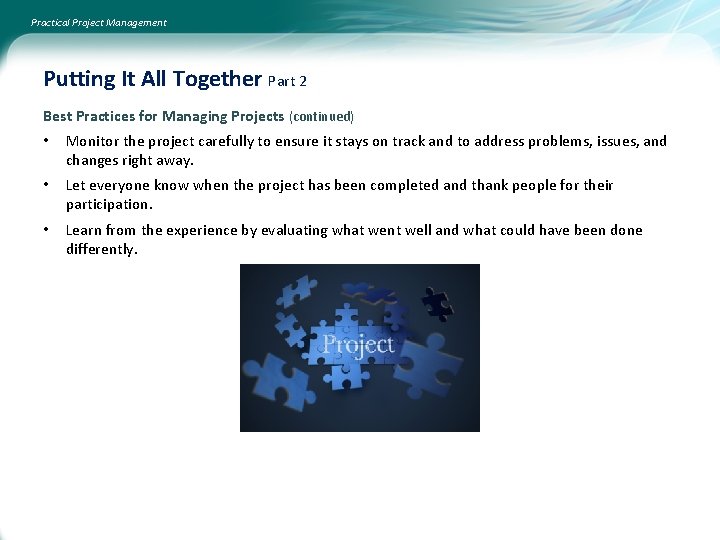
Practical Project Management Keeping the Project on Track How to Keep Things Moving Once the project has been launched, it’s time to get to work. By their very nature, projects involve tasks and activities that need to be carried out by different people at different times, and often in different places. One of your most important jobs as a project lead will be to help them keep the project moving forward. Implementing a project is somewhat like completing a jigsaw puzzle: all the pieces need to be put in the right place at the right time. Making that happen requires time and attention. Here are suggestions for helping to ensure the pieces fit together properly. Monitor the work. The project schedule describes what needs to be done and when specific tasks and activities need to be completed. • Work with your team to set up a system for monitoring that work. • Check with the responsible team members to make sure that things are getting started at the right times and being done the right way.
Practical Project Management Keeping the Project on Track Part 2 How to Keep Things Moving (continued) Communicate clearly with everyone involved. • Hold regular face-to-face team meetings to review progress, resolve problems, and discuss issues. If team members are in different locations, use meeting software or videoconferencing so people can see one another. Use an agenda to keep meetings focused and to ensure time is used efficiently. • Use email and other electronic media as needed to share information and ideas and to keep team members and others up to date. Try to avoid inundating people with email they do not need by considering who needs to be on the distribution list. • Request written progress reports. Written reports at key stages of the project, such as milestones, summarize accomplishments, issues, and any significant changes to the goals or schedule. They help the team and the stakeholders see what has been done and what is left to do. Once the project is over, the written reports can be used to evaluate the project.
Practical Project Management Handling Issues and Problems A single delay or problem can throw the entire project off track. That’s why it is crucial to monitor projects closely so you and the team can spot and address problems as soon as they arise. The way the project manager and team handle the issues that are undoubtedly going to come up can make the difference between a successful project and one that fails to meet its goals. Here are some guidelines. • Address issues and problems promptly. Most problems can be resolved quickly if they are caught at the early stages. To keep problems from escalating, address them right away. Determine the extent to which the problem is likely to impact the project plan and schedule. Calculate whether the problem can be solved with available resources and within the allotted time frame. • If necessary, revise the project plan and schedule. If a problem is serious enough to throw the project off track, call the team together. Review the project plan and schedule to determine what, if any, changes you may need to make and decide how best to proceed. • Respond quickly to change. As soon as you become aware of a change that might affect your project, work with the team to respond quickly. Review your project goals and scope, explore the possible impacts, and decide what actions to take. If the project or any part of it no longer seems relevant, it’s better to abandon it so everyone can move on to other priorities.
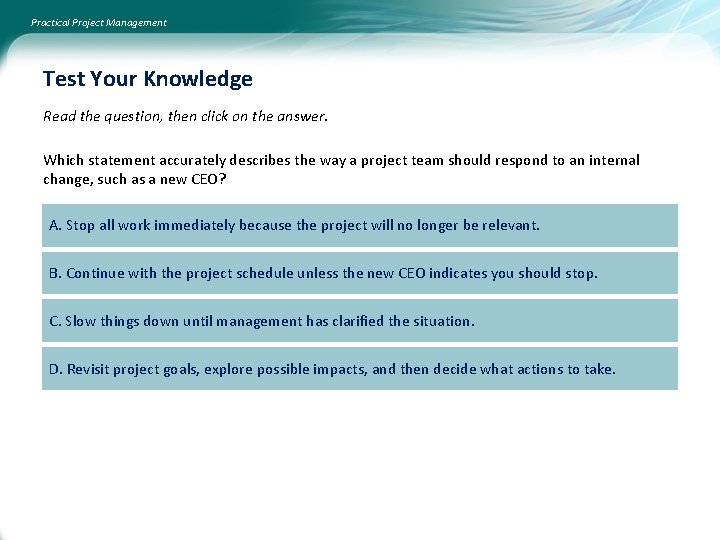
Practical Project Management Test Your Knowledge Read the question, then click on the answer. Which statement accurately describes the way a project team should respond to an internal change, such as a new CEO? A. Stop all work immediately because the project will no longer be relevant. B. Continue with the project schedule unless the new CEO indicates you should stop. C. Slow things down until management has clarified the situation. D. Revisit project goals, explore possible impacts, and then decide what actions to take.
Practical Project Management Module 4: Closing and Evaluating a Project
Practical Project Management Bringing the Project to a Close Wrapping Things Up It’s not unusual for a project to be abandoned once the desired outcome has been achieved. But to make sure that all the i’s have been dotted and t’s crossed, it is important to bring the project to a proper close and wrap up any loose ends. As a project comes to an end, take the time to: • Ensure there are no remaining administrative tasks to be completed, such as processing outstanding vendor invoices. • Make a formal announcement of the project’s completion to all involved or impacted by it. – Let them know what happens next, if appropriate. – Thank them for their participation and contributions to the project’s success. • Help team members move on to other priorities, if appropriate. This is particularly important when people have been devoting all or most of their time to the project.
Practical Project Management Evaluating the Process What is the Purpose of a Project Evaluation? Once a project is completed, it is important to take the time to evaluate the process. Any project, even one that is unsuccessful, offers a valuable learning opportunity that team members, stakeholders, and others can use to help future projects succeed. What Questions Should You Consider? These kinds of questions can help you and your team determine what went well and what could be improved in the future. You can discuss these questions among yourselves and/or meet with stakeholders and others who were involved to get their thoughts and perspectives. • How well was the desired outcome met? Was the outcome the one envisioned by the people who initiated the project? Did it differ in any way? Exceed expectations? Did it fall short? If it fell short, what were the reasons? • Were all the deadlines and milestones achieved? Was the team able to stick to the schedule? If not, why not, and what were the impacts when the schedule went off track? Was there anything that could have been done to avoid getting off schedule or deal more effectively with those impacts?
Practical Project Management Evaluating the Process Part 2 What Questions Should You Consider? (continued) • Did the project stay within the budget? If the project went over budget, what were the reasons? Was there anything that could have been done to stay within the budget? • What did we learn? What went right, and what went wrong? What did we do well? Were there any problems we could have avoided? How? What could we have done differently to improve the process and/or the outcome?
Practical Project Management Putting It All Together Best Practices for Managing Projects No matter what a project’s size and scope, these best practices can increase the likelihood that it will go smoothly and achieve the desired outcome. • Begin a project by clearly defining the desired outcome and why it is important. • Take the time to explore options for achieving the outcome, decide which will be best, and develop S. M. A. R. T. goals that describe how to achieve it. • Identify stakeholders, assemble the right team, and set up a system for communicating information throughout the project. • Develop a detailed project plan that includes essential resources, a realistic schedule, roles and responsibilities, milestones, and contingency plans. • Hold a launch meeting to ensure that key stakeholders and participants have the same understanding of the project and to encourage commitment to the project.
Practical Project Management Putting It All Together Part 2 Best Practices for Managing Projects (continued) • Monitor the project carefully to ensure it stays on track and to address problems, issues, and changes right away. • Let everyone know when the project has been completed and thank people for their participation. • Learn from the experience by evaluating what went well and what could have been done differently.
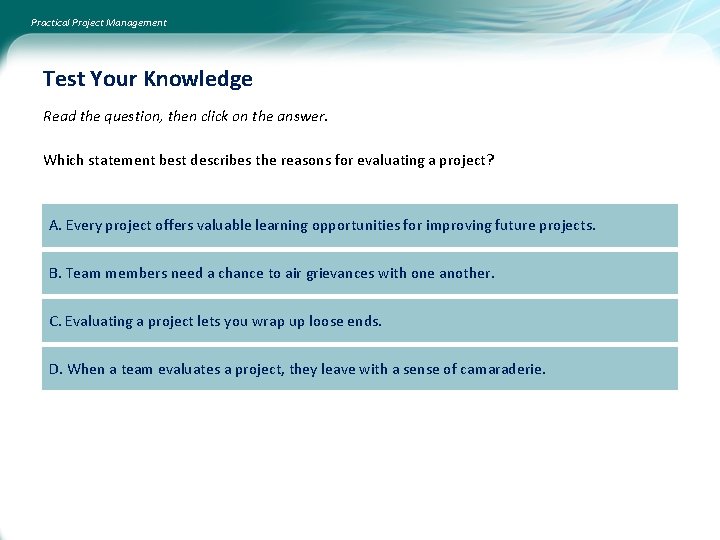
Practical Project Management Test Your Knowledge Read the question, then click on the answer. Which statement best describes the reasons for evaluating a project? A. Every project offers valuable learning opportunities for improving future projects. B. Team members need a chance to air grievances with one another. C. Evaluating a project lets you wrap up loose ends. D. When a team evaluates a project, they leave with a sense of camaraderie.
Practical Project Management Review
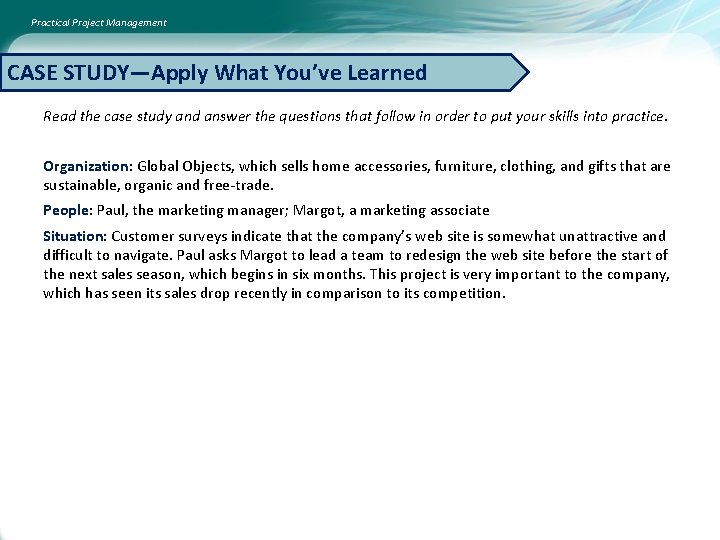
Practical Project Management CASE STUDY—Apply What You’ve Learned Read the case study and answer the questions that follow in order to put your skills into practice. Organization: Global Objects, which sells home accessories, furniture, clothing, and gifts that are sustainable, organic and free-trade. People: Paul, the marketing manager; Margot, a marketing associate Situation: Customer surveys indicate that the company’s web site is somewhat unattractive and difficult to navigate. Paul asks Margot to lead a team to redesign the web site before the start of the next sales season, which begins in six months. This project is very important to the company, which has seen its sales drop recently in comparison to its competition.
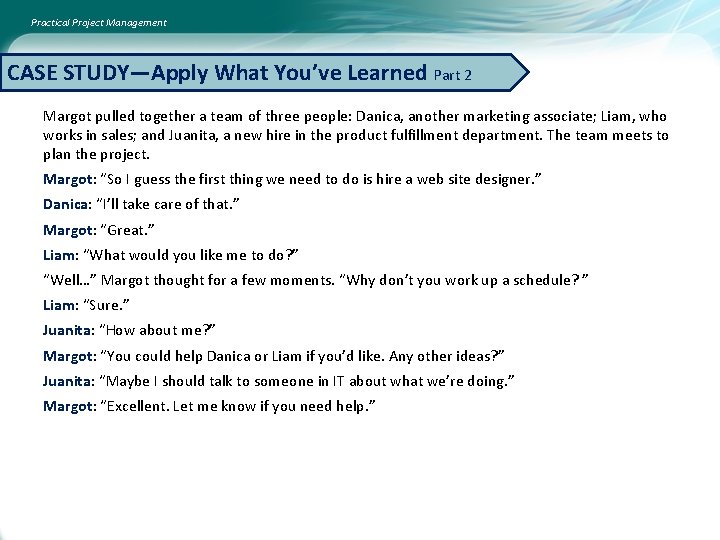
Practical Project Management CASE STUDY—Apply What You’ve Learned Part 2 Margot pulled together a team of three people: Danica, another marketing associate; Liam, who works in sales; and Juanita, a new hire in the product fulfillment department. The team meets to plan the project. Margot: “So I guess the first thing we need to do is hire a web site designer. ” Danica: “I’ll take care of that. ” Margot: “Great. ” Liam: “What would you like me to do? ” “Well…” Margot thought for a few moments. “Why don’t you work up a schedule? ” Liam: “Sure. ” Juanita: “How about me? ” Margot: “You could help Danica or Liam if you’d like. Any other ideas? ” Juanita: “Maybe I should talk to someone in IT about what we’re doing. ” Margot: “Excellent. Let me know if you need help. ”
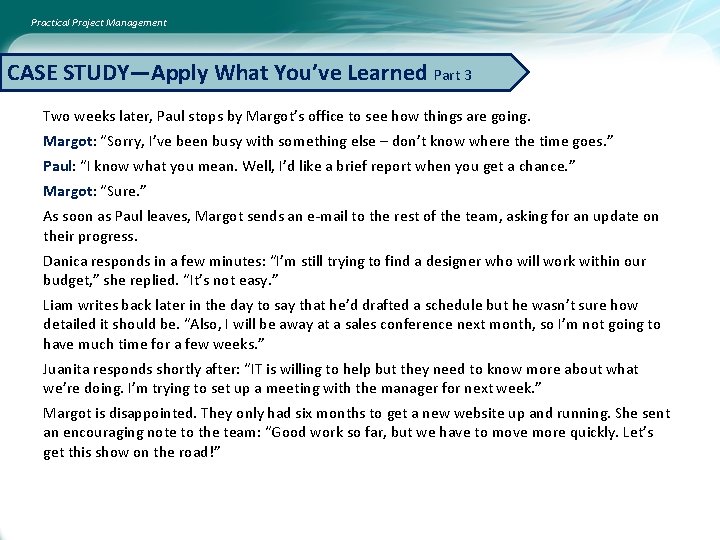
Practical Project Management CASE STUDY—Apply What You’ve Learned Part 3 Two weeks later, Paul stops by Margot’s office to see how things are going. Margot: “Sorry, I’ve been busy with something else – don’t know where the time goes. ” Paul: “I know what you mean. Well, I’d like a brief report when you get a chance. ” Margot: “Sure. ” As soon as Paul leaves, Margot sends an e-mail to the rest of the team, asking for an update on their progress. Danica responds in a few minutes: “I’m still trying to find a designer who will work within our budget, ” she replied. “It’s not easy. ” Liam writes back later in the day to say that he’d drafted a schedule but he wasn’t sure how detailed it should be. “Also, I will be away at a sales conference next month, so I’m not going to have much time for a few weeks. ” Juanita responds shortly after: “IT is willing to help but they need to know more about what we’re doing. I’m trying to set up a meeting with the manager for next week. ” Margot is disappointed. They only had six months to get a new website up and running. She sent an encouraging note to the team: “Good work so far, but we have to move more quickly. Let’s get this show on the road!”
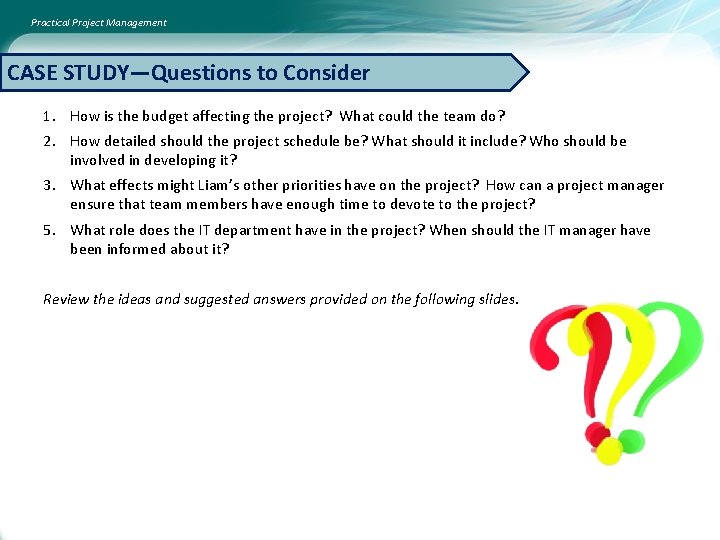
Practical Project Management CASE STUDY—Questions to Consider 1. How is the budget affecting the project? What could the team do? 2. How detailed should the project schedule be? What should it include? Who should be involved in developing it? 3. What effects might Liam’s other priorities have on the project? How can a project manager ensure that team members have enough time to devote to the project? 5. What role does the IT department have in the project? When should the IT manager have been informed about it? Review the ideas and suggested answers provided on the following slides.
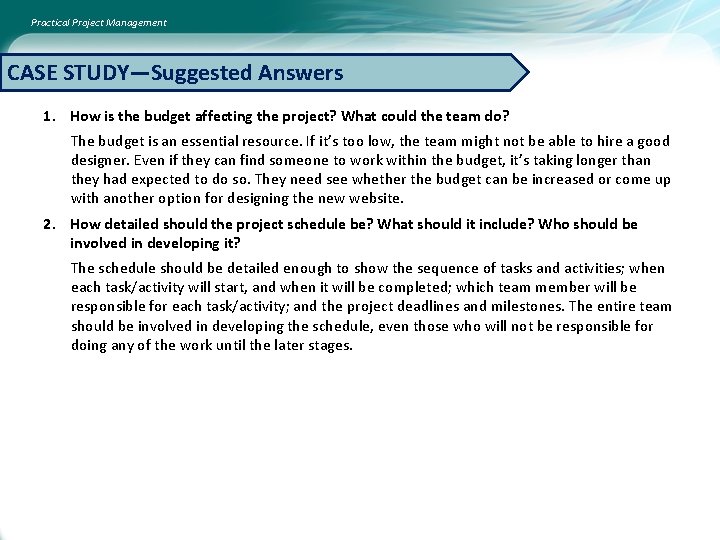
Practical Project Management CASE STUDY—Suggested Answers 1. How is the budget affecting the project? What could the team do? The budget is an essential resource. If it’s too low, the team might not be able to hire a good designer. Even if they can find someone to work within the budget, it’s taking longer than they had expected to do so. They need see whether the budget can be increased or come up with another option for designing the new website. 2. How detailed should the project schedule be? What should it include? Who should be involved in developing it? The schedule should be detailed enough to show the sequence of tasks and activities; when each task/activity will start, and when it will be completed; which team member will be responsible for each task/activity; and the project deadlines and milestones. The entire team should be involved in developing the schedule, even those who will not be responsible for doing any of the work until the later stages.
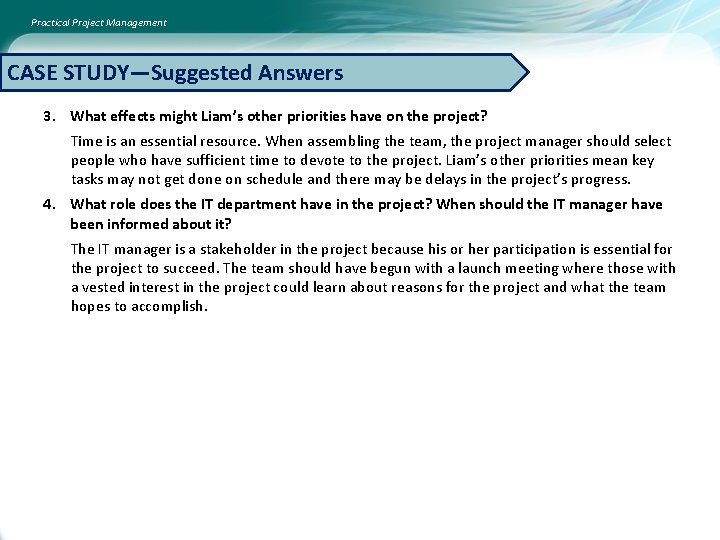
Practical Project Management CASE STUDY—Suggested Answers 3. What effects might Liam’s other priorities have on the project? Time is an essential resource. When assembling the team, the project manager should select people who have sufficient time to devote to the project. Liam’s other priorities mean key tasks may not get done on schedule and there may be delays in the project’s progress. 4. What role does the IT department have in the project? When should the IT manager have been informed about it? The IT manager is a stakeholder in the project because his or her participation is essential for the project to succeed. The team should have begun with a launch meeting where those with a vested interest in the project could learn about reasons for the project and what the team hopes to accomplish.
Practical Project Management Congratulations! By now you should be able to: • Describe the four stages of a project. • Understand what makes a project succeed. • Learn how to initiate and define a project. • Discuss how to get a project started. • Explore how to keep a project on track. • Explain how to close and evaluate a project.
Practical Project Management Appendix
Practical Project Management References Agile Project Management: Essentials from the Project Management Journal. Jossey-Bass, 2013. Campbell, Michael G. The Complete Idiot’s Guide to Project Management. 5 th ed. New York, NY: Alpha, 2011. Chan, Janis Fisher. How to Manage Your Priorities. 2 nd ed. American Management Association, 2007. Haynes, Marion E. Project Management: From Idea to Implementation. Menlo Park, CA: Crisp Publications, 1989. Kerzner, Harold. Project Management: A Systems Approach to Planning, Scheduling, and Controlling. 8 th ed. Wiley, 2003. Lewis, James P. Fundamentals of Project Management. 3 rd ed. New York, NY: AMACOM, 2007. Managing Projects Large and Small: The Fundamental Skills for Delivering on Budget and on Time. Boston, MA: Harvard Business School Press, 2004. Portny, Stanley E. Project Management for Dummies. 3 rd ed. Hoboken, NJ: Wiley, 2010. The Project Management Institute, www. pmi. org
Practical Project Management © 2016 HRDQ. All rights reserved. Published by HRDQ and the HRDQ logo are registered trademarks of Organization Design and Development, Inc. This publication is distributed under the terms and conditions of the Reproducible Content End User License Agreement (EULA). For specific details, visit www. hrdq. com/legal. For more information about this publication or to order additional copies, please contact the HRDQ Customer Service Team by phone at 610279 -2002 or by email at custserv@hrdq. com. For more information about HRDQ products, visit www. hrdq. com. ISBN 978 -1 -58854 -857 -3 Title slide image: Ollyy/Shutterstock. com. Images used under license from Shutterstock. com. Microsoft®, Word®, Power. Point®, and Outlook® are registered trademarks of Microsoft Corporation. 2750 E 1 PRM EN-01 -DC-18