
Practical Proctor Class Division of Fire Prevention Control






- Slides: 57
Practical Proctor Class Division of Fire Prevention & Control Presented by DFPC Regional Proctors Updated 11/2016
Introductions �Networking �Building a proctor pool �Build working relationships �Getting involved
Class Objectives �Understanding of the DFPC certification system �How to organize and manage a certification test �Learn the basic overview of the “Records Management System” �Practice session/scenarios
Contacts/Organizations �Colorado Division of Fire Prevention & Control (DFPC) 690 Kipling, Suite 2000 Denver, Colorado 80215 (303) 239 - 4600 www. colorado. gov/dfpc �Colorado Fire Training Officers Association www. cftoa. org
Our Intent �That all candidates taking any examination for certification receive equal explanations, assistance and evaluations from a Proctor �To maintain a secure certification program, based on integrity, consistency and credibility
Compensation Remember to Plan Ahead…. The Division will not compensate any proctor for their time, meals and lodging expenses under any condition.
Proctor Prerequisites/Requirements Attend and successfully complete a Division approved Practical Proctor and/or Driver Operator Practical Proctor training program Practical and Driver Operator Proctors must maintain a valid Colorado DFPC certification at or above the level that they are proctoring All Proctors must be affiliated with a Colorado Emergency Service Agency or Educational Institution
Proctor Prerequisites/Requirements �Complete and submit all required forms/applications �Maintain upmost security with examinations in your possession �Follow all Proctor requirements and instructions given by the Division �Agree to abide by all rules and regulations adopted by the Colorado Fire Service Training and Certification Advisory Board
Proctor Information �Proctor certification - will be awarded for a three (3) year period �Proctor Renewal – Documentation of having administered a minimum of one (1) practical examination per year during the certification period �Loss of Proctor certification – maintain integrity, credibility & honesty
Regional Proctors �Provide Proctor training classes �Assist with questions regarding practical exams �Periodically review and validation of written test banks and JPRs �Review, update, and edit JPRs www. colorado. gov/dfpc
Lead/Assistant Proctors �Lead Proctor �Organize, supervise, manage, evaluate, prepare, record �AHJ liaison contact person �Validate AHJ administered JPRs �Accountable for the entire skills evaluation process �Assistant Proctor �Assist Lead Proctor �Evaluate candidates
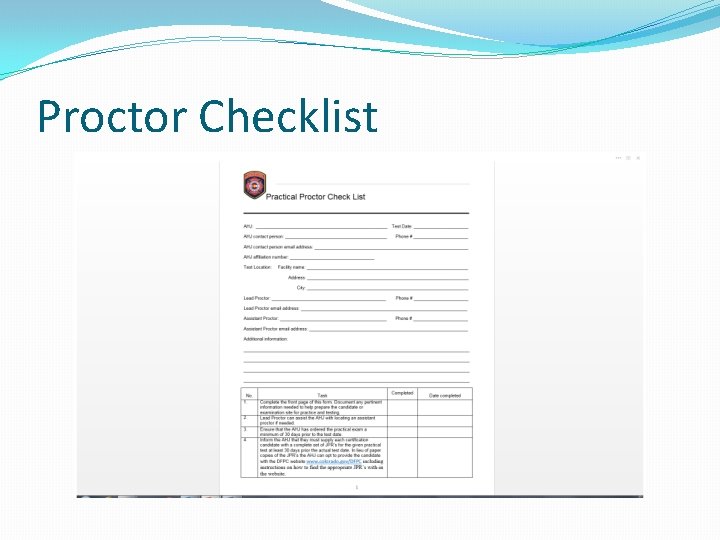
How to Organize and Manage a Practical Exam �Every practical exam will have a minimum of two proctors, one of which will be the Lead Proctor �To aid the Lead Proctor a Proctor Check List has been developed
Proctor Checklist
Proctor Checklist
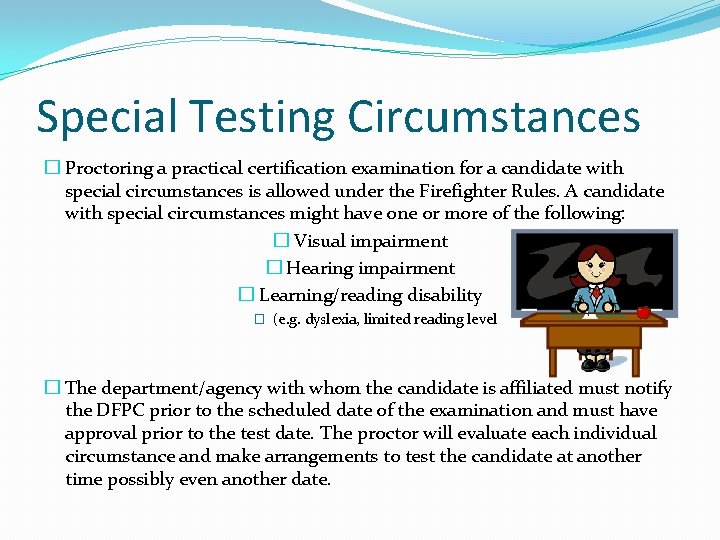
Special Testing Circumstances � Proctoring a practical certification examination for a candidate with special circumstances is allowed under the Firefighter Rules. A candidate with special circumstances might have one or more of the following: � Visual impairment � Hearing impairment � Learning/reading disability � (e. g. dyslexia, limited reading level � The department/agency with whom the candidate is affiliated must notify the DFPC prior to the scheduled date of the examination and must have approval prior to the test date. The proctor will evaluate each individual circumstance and make arrangements to test the candidate at another time possibly even another date.
Special Circumstances �The candidate(s) examination(s) must be rescheduled if any of the following occurs: Ø If test is unable to be conducted on the scheduled date Ø Sudden illness Ø Change in work schedule Ø Severe weather Ø Emergency response Ø Other unexpected family emergency (e. g. illness, death) Ø Unauthorized leaving of the test site �Contact the Division for direction and documentation needs regarding these circumstances.
Receiving the Test �Mandatory and random JPRs �Candidate check-off sheet �Affidavit �Facilities form �Practical results form (RMS) �Candidate Work Sheets (DO series)
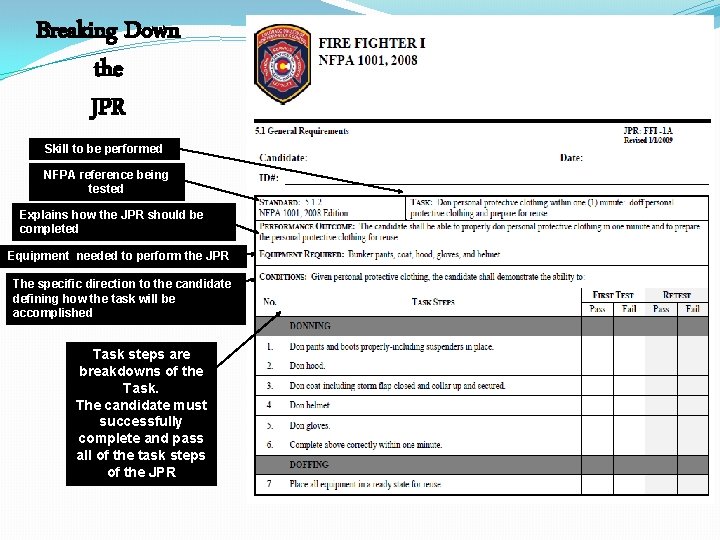
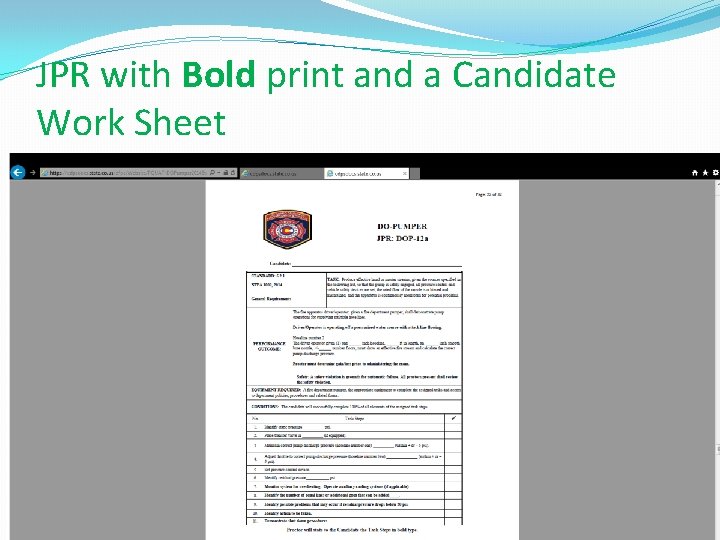
Breaking Down the JPR Skill to be performed NFPA reference being tested Explains how the JPR should be completed Equipment needed to perform the JPR The specific direction to the candidate defining how the task will be accomplished Task steps are breakdowns of the Task. The candidate must successfully complete and pass all of the task steps of the JPR
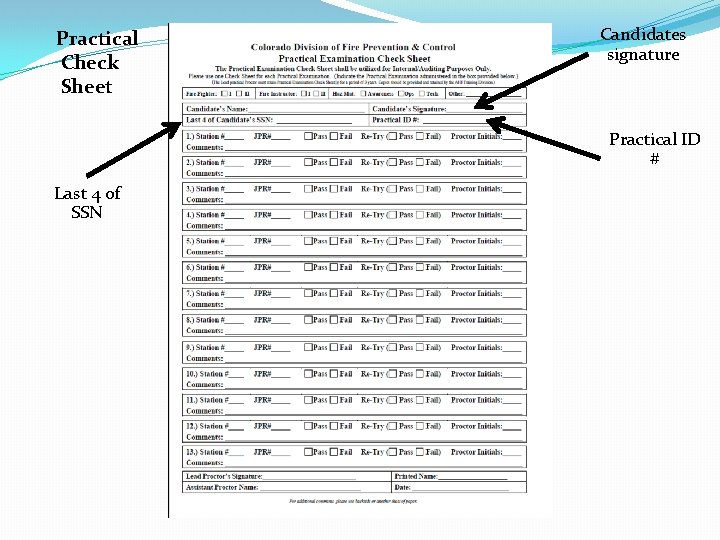
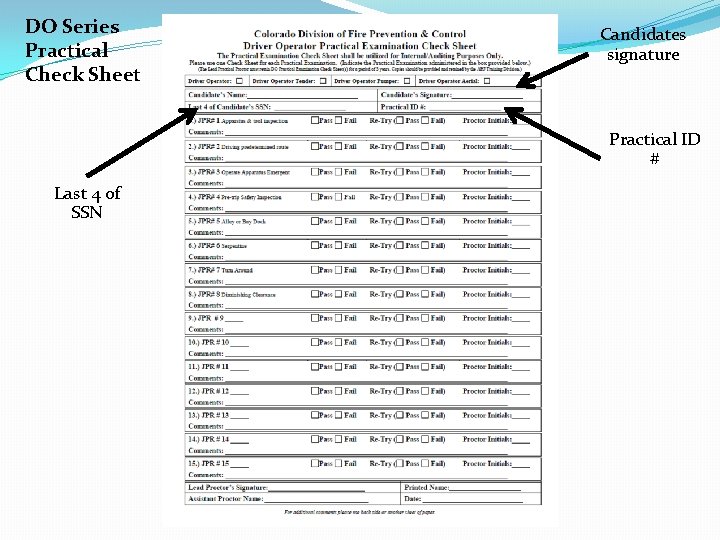
Practical Check Sheet Candidates signature Practical ID # Last 4 of SSN
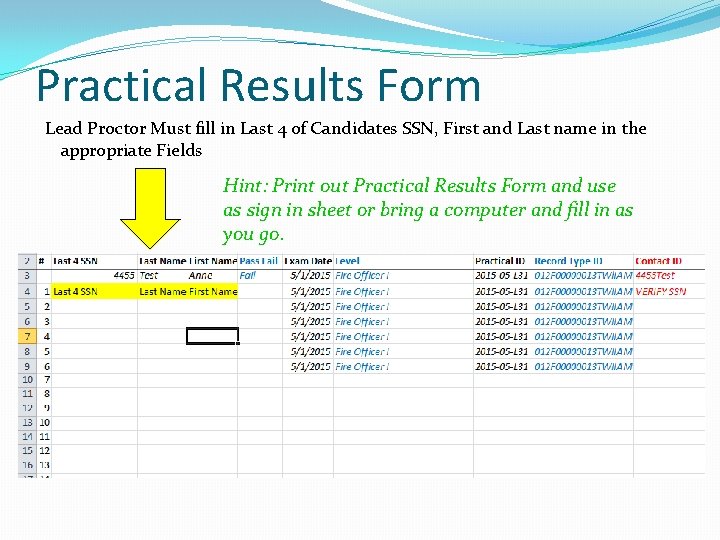
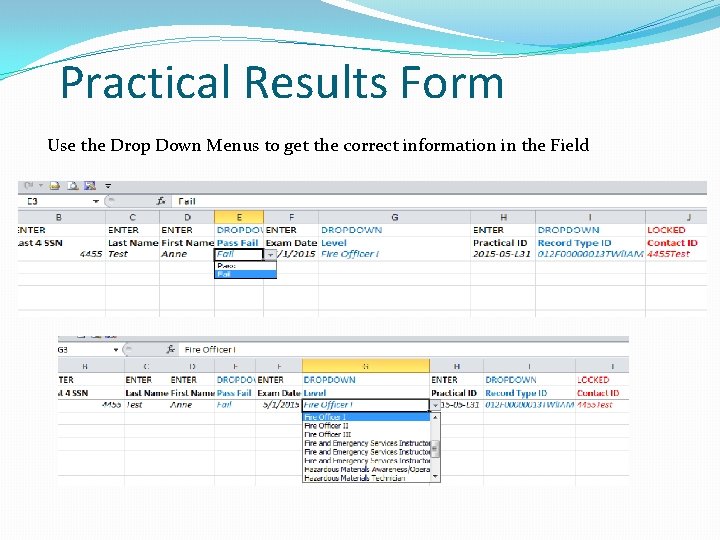
Practical Results Form Lead Proctor Must fill in Last 4 of Candidates SSN, First and Last name in the appropriate Fields Hint: Print out Practical Results Form and use as sign in sheet or bring a computer and fill in as you go.
Proctoring Practical Tests on Test Day �Ensure all practical stations are properly set up and all equipment is in good working order �Ensure you have enough manpower to conduct the test, i. e. proctors, runners, spotters, helpers, etc. �Hold a proctor briefing �Fill out all appropriate forms, i. e. affidavit, facilities, skills check sheets
Proctoring Practical Tests on Test Day �Schedule the day to include time for breaks, lunch, and retakes �Confirm a candidate staging area �Check candidate Identification �Conduct candidate briefing(s) �Ensure all candidates have proper PPE �Begin practical testing.
Proctoring Practical Tests Open the Practical Examination Proctor Policies: Page 10 thru 11 Proctor Instructions Steps 1 thru 18
Candidate Briefing Must be read to all candidates prior to beginning the practical test. NO EXCEPTIONS! Practical Policies pages 12 thru 14
You tube �FFI 3 A Don SCBA in less than one minute �Pass or Fail �What would you do as a proctor?
Open Discussion Scenarios �Running chain saw up a ladder �Chief or others pressure you to pass all candidates �Candidate gets angry over test results �What to do when you as a proctor makes a mistake and fails somebody that should not have failed
Live Burn Be mentally and physically prepared to spend your day in a hot smoky environment The Lead Proctor must currently hold these State of Colorado certifications �Firefighter I �Fire Instructor I �Firefighter Proctor
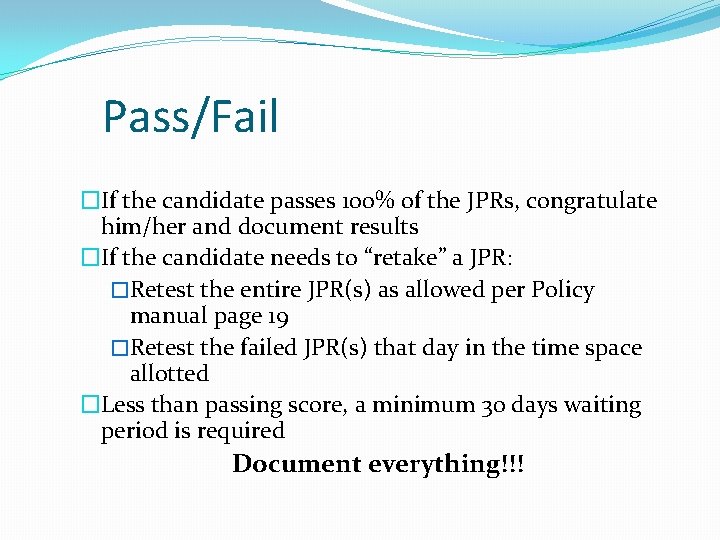
Pass/Fail �If the candidate passes 100% of the JPRs, congratulate him/her and document results �If the candidate needs to “retake” a JPR: �Retest the entire JPR(s) as allowed per Policy manual page 19 �Retest the failed JPR(s) that day in the time space allotted �Less than passing score, a minimum 30 days waiting period is required Document everything!!!
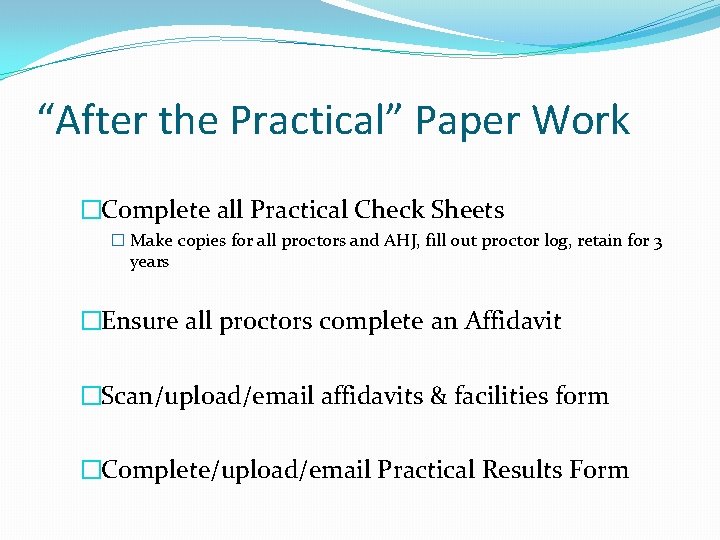
“After the Practical” Paper Work �Complete all Practical Check Sheets � Make copies for all proctors and AHJ, fill out proctor log, retain for 3 years �Ensure all proctors complete an Affidavit �Scan/upload/email affidavits & facilities form �Complete/upload/email Practical Results Form
Practical Results Form Use the Drop Down Menus to get the correct information in the Field
Testing Improprieties �Allow the candidate to finish the JPR in progress then stop the evaluation process �Consult the other proctors/witnesses involved �Investigate your suspicions �Notify the appropriate department personnel and the DFPC Fire Training Director with both verbal and written documentation �Follow procedures outlined in Policy manual
Examination Challenge �Try to resolve the dispute at the testing site �Include the AHJ liaison �The Lead Proctor will make the final decision �If not accepted, the candidate must submit a written challenge form �Follow procedures outlined in Policy manual
Proctoring Driver Operator, Driver Operator Pumper, and Driver Operator Aerial Practical's
Practical Skills Testing �A MINIMUM of two proctors shall evaluate each candidate to provide a check and balance capability within the evaluation process � The driving course measurements are accurate and the cones are properly placed � The driving course is set-up so that there is an easy to follow flow path from one JPR to the next � The pumping/aerial stations and/or the equipment stations are set-up in a safe, non-destructive manner
Spotters �Spotters are used anytime an apparatus is in reverse gear. The spotter’s only duty is to stop a candidate prior to striking an object that will cause injury or property damage. �Spotters are not there for the purpose of guiding a candidate while on the driving course. icatio �Preferably a person from the AHJ who currently holds a certification equal too or higher than the practical test level.
DO Proctor Materials List �General Driving Guidelines for briefing �Practical Proctor Policies �JPR’s � 25’ & 100’ tape measures or wheel �Chalk for cone location � 100’ Dry line (masonry string line) �DOP and DOA: Supply the candidates with a clean copy of the AHJ or DFPC pump chart if applicable
AHJ must provide: q Apparatus and equipment needed for the practical evaluation q Apparatus info, pump cards (if applicable), and if needed certified operators/spotters q Completed JPR #s 1 -3 for each candidate q Suitable Driving Course: set-up in accordance with JPRs, with proper cone deployment q Drafting capabilities ( DOP ) q Pressurized water source ( DOP and DOA ) q Building / Structure for Aerial operations ( DOA ) Find a testing site - preferably a wide-open space with no obstructions (i. e. structurally sound parking lots, bus depot, dirt field, airport property, open drill ground, etc. )
JPR Format Initial Certification - JPR Requirements: Driver Operator (DO): 8 Mandatory Driver Operator Pumper (DOP) : 8 Mandatory and 7 Random Driver Operator Aerial (DOA): 8 Mandatory and 7 Random ___________________________ For JPR #s 1 -3, the Authority Having Jurisdiction will administer these skills prior to the candidate participating in the Driver/Operator Practical (Two random task steps from JPR #1 will be retested at the practical, and will include one task related to a piece of equipment) ___________________________ #4 – 8 Driving Course #9 -15 Practical evolutions (DOP and DOA)
JPR with Bold print and a Candidate Work Sheet
DO Series Practical Check Sheet Candidates signature Practical ID # Last 4 of SSN
Candidate Briefing This should be done by lead Proctor � Timeline of the day � Disclose any problems with the equipment or track that the candidate may encounter � Staging and the flow of stations � Proctor must read: � Candidate Briefing instructions - pages 15 -17 in DFPC Practical Exam Proctor Guidelines � General Driving Rules
Practical Testing/Re-testing �The candidate must successfully complete all task steps in all of the JPR’s in order to pass the practical examination. �During the DO test the candidate can fail 1 JPR and retest that day. �During the DOP & DOA test the candidate can fail 1 JPR in the driving section and 1 JPR in the pumping or aerial operational section and retest on the fail JPRs that day. �If the candidate fails any of the JPRs during the retest stage he has failed the entire practical exam and must wait a minimum of 30 days before the next attempt
Tips & Tricks for DO � Place both proctors on the ground outside of the apparatus � Remove distractions from the candidate � Have the assistant proctor be the lead during at least one evaluation � Do not intimidate the candidate � Be prepared to react to mechanical problems. Prevent/stop damage or injury � Be flexible with problems that can occur
Driving Course Demo
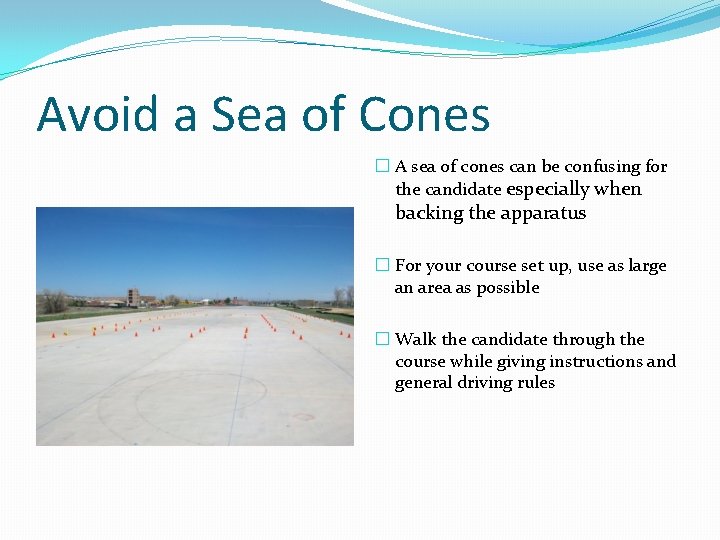
Avoid a Sea of Cones � A sea of cones can be confusing for the candidate especially when backing the apparatus � For your course set up, use as large an area as possible � Walk the candidate through the course while giving instructions and general driving rules
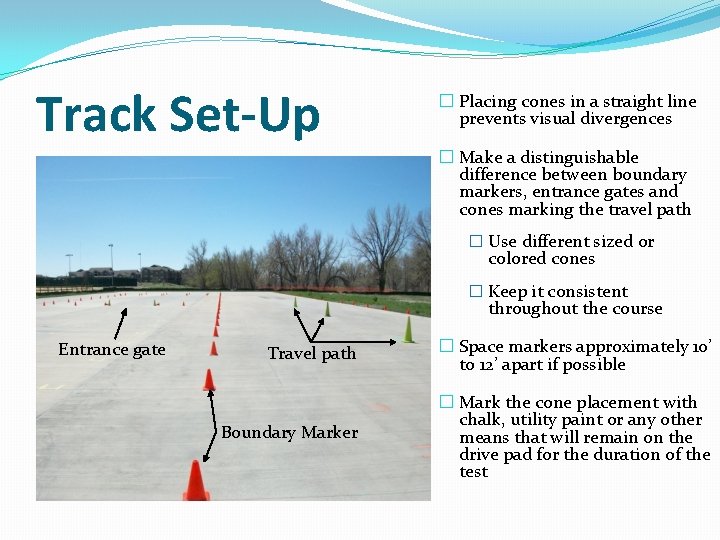
Track Set-Up � Placing cones in a straight line prevents visual divergences � Make a distinguishable difference between boundary markers, entrance gates and cones marking the travel path � Use different sized or colored cones � Keep it consistent throughout the course Entrance gate Travel path � Space markers approximately 10’ to 12’ apart if possible Boundary Marker � Mark the cone placement with chalk, utility paint or any other means that will remain on the drive pad for the duration of the test
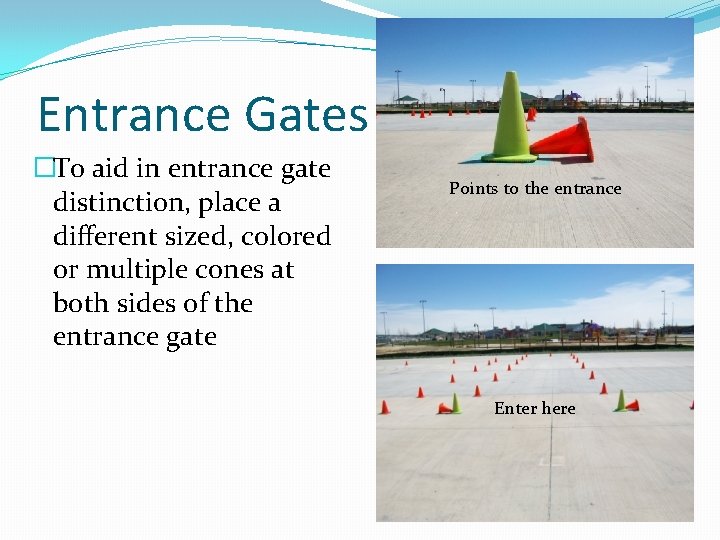
Entrance Gates �To aid in entrance gate distinction, place a different sized, colored or multiple cones at both sides of the entrance gate Points to the entrance Enter here
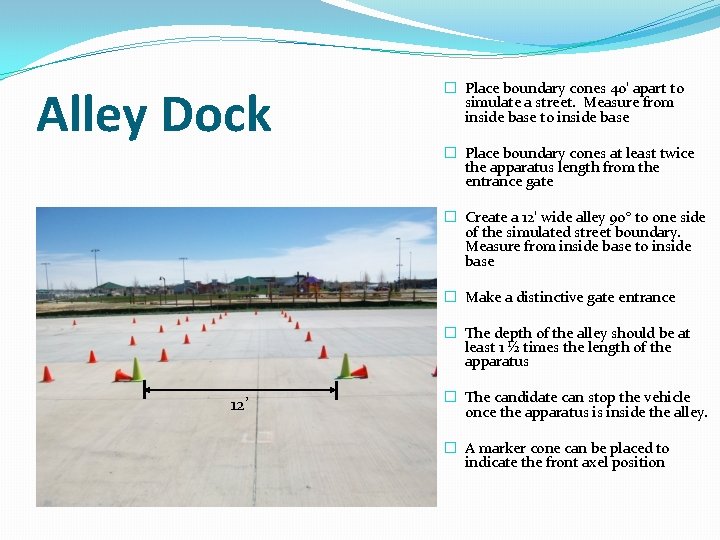
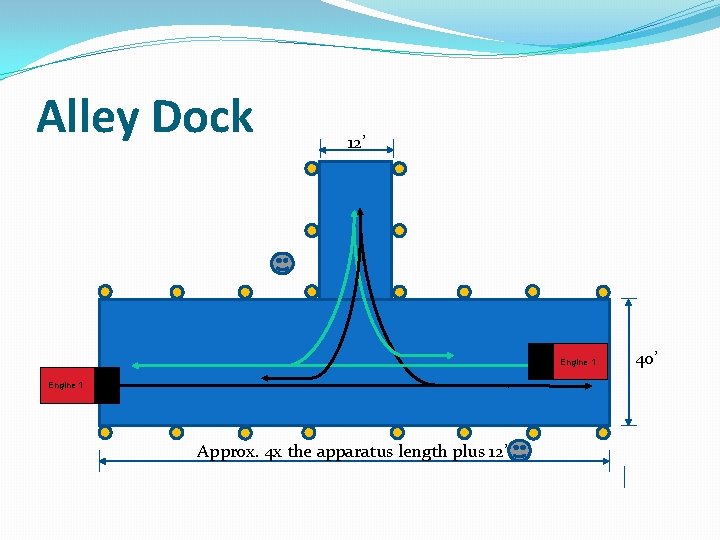
Alley Dock � Place boundary cones 40’ apart to simulate a street. Measure from inside base to inside base � Place boundary cones at least twice the apparatus length from the entrance gate � Create a 12’ wide alley 90° to one side of the simulated street boundary. Measure from inside base to inside base � Make a distinctive gate entrance � The depth of the alley should be at least 1 ½ times the length of the apparatus 12’ � The candidate can stop the vehicle once the apparatus is inside the alley. � A marker cone can be placed to indicate the front axel position
Alley Dock 12’ Engine 1 Approx. 4 x the apparatus length plus 12’ 40’
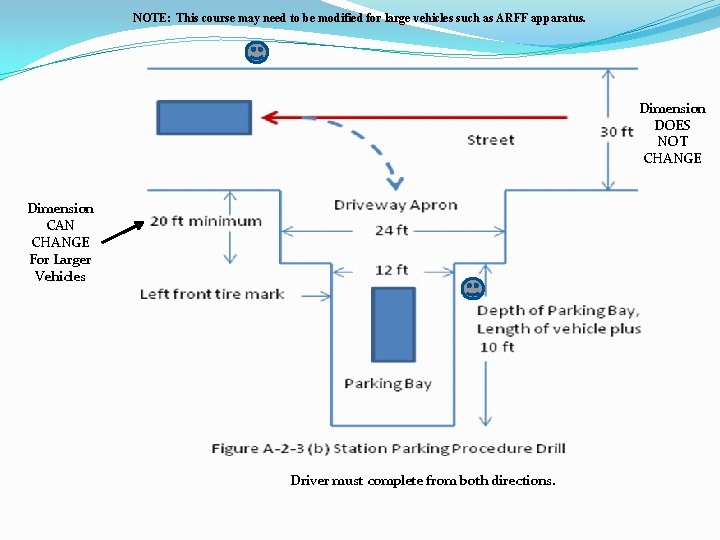
NOTE: This course may need to be modified for large vehicles such as ARFF apparatus. Dimension DOES NOT CHANGE Dimension CAN CHANGE For Larger Vehicles Driver must complete from both directions.
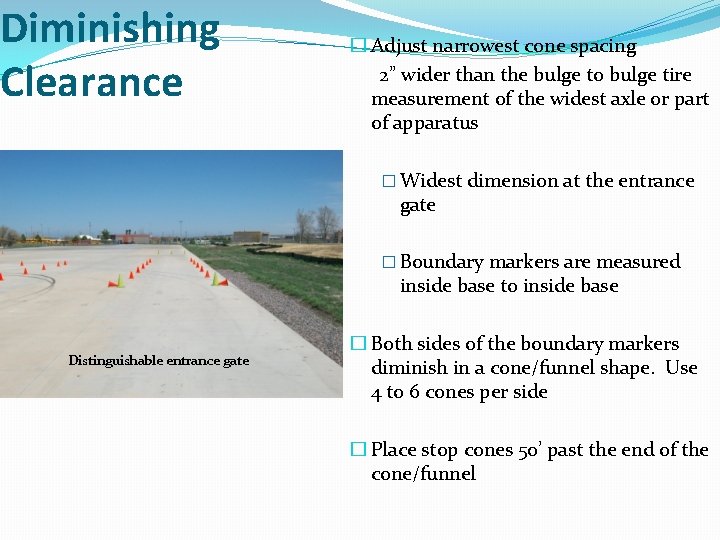
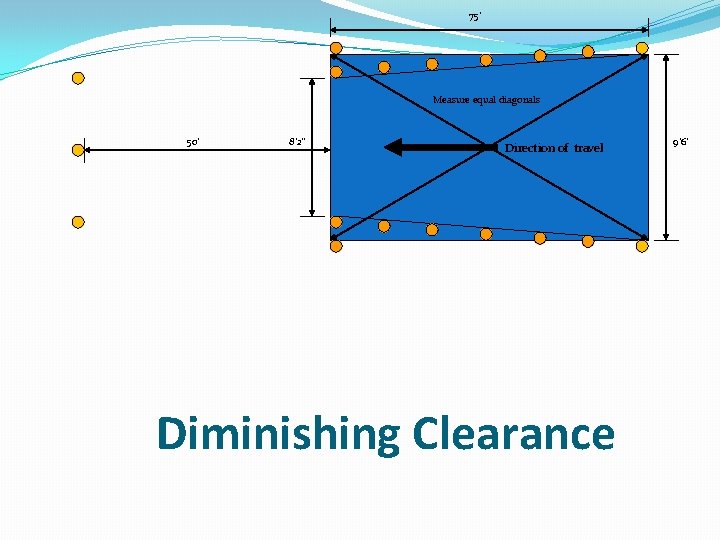
Diminishing Clearance � Adjust narrowest cone spacing 2” wider than the bulge to bulge tire measurement of the widest axle or part of apparatus � Widest dimension at the entrance gate � Boundary markers are measured inside base to inside base Distinguishable entrance gate � Both sides of the boundary markers diminish in a cone/funnel shape. Use 4 to 6 cones per side � Place stop cones 50’ past the end of the cone/funnel
75’ Measure equal diagonals 50’ 8’ 2” Direction of travel Diminishing Clearance 9’ 6’
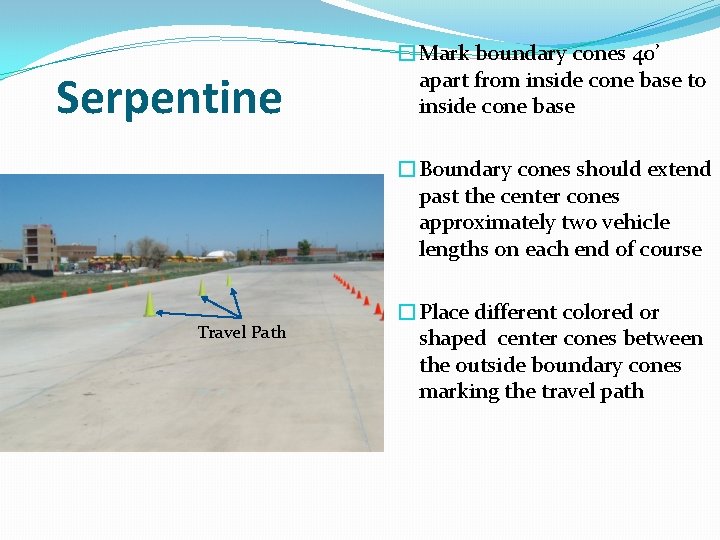
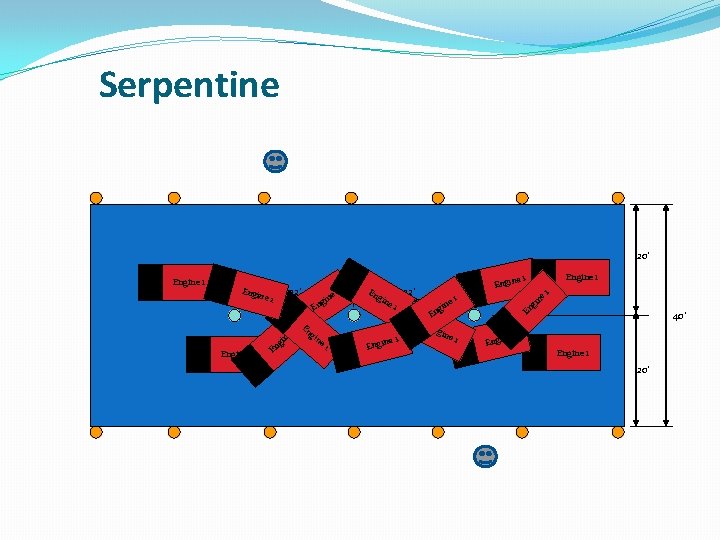
Serpentine �Mark boundary cones 40’ apart from inside cone base to inside cone base �Boundary cones should extend past the center cones approximately two vehicle lengths on each end of course Travel Path �Place different colored or shaped center cones between the outside boundary cones marking the travel path
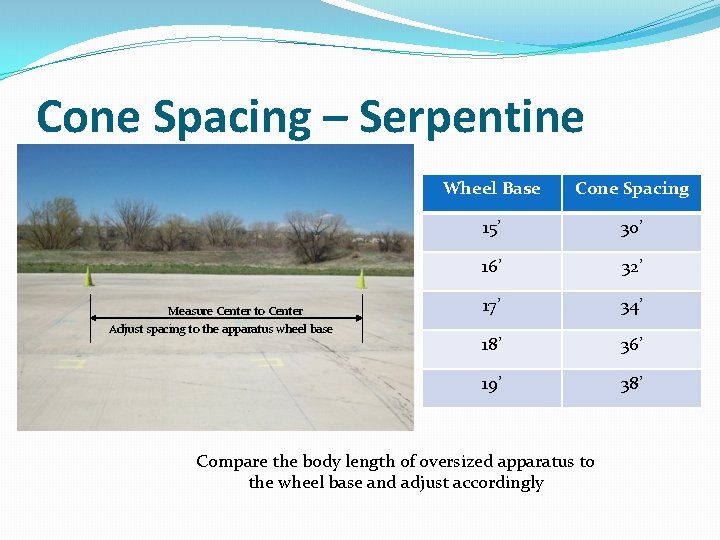
Cone Spacing – Serpentine Measure Center to Center Adjust spacing to the apparatus wheel base Wheel Base Cone Spacing 15’ 30’ 16’ 32’ 17’ 34’ 18’ 36’ 19’ 38’ Compare the body length of oversized apparatus to the wheel base and adjust accordingly
Serpentine 20’ Engine 1 e 1 Engi n 32’ En gin 1 Eng in ne i e 1 g n E e 1 En g ine Engin 32’ e Engin e 1 g En in ng 1 1 E En g ine 1 1 e Engin 40’ 1 Engine 1 20’
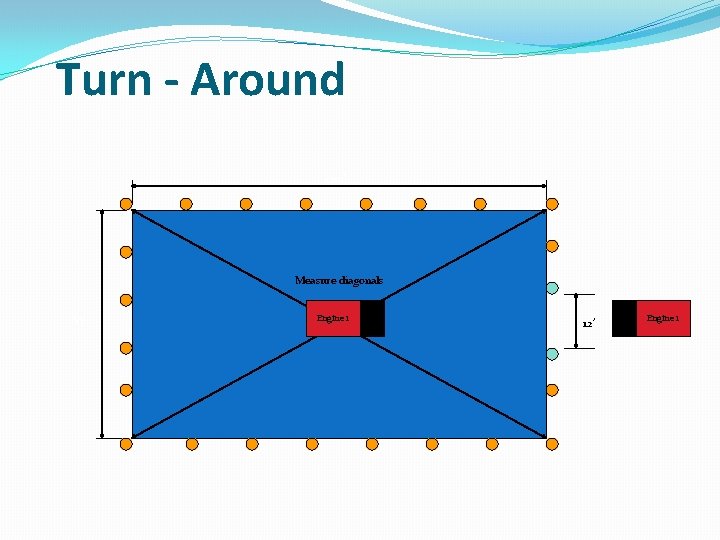
Turn - Around 100’ Measure diagonals 50’ Engine 1 12’ Engine 1
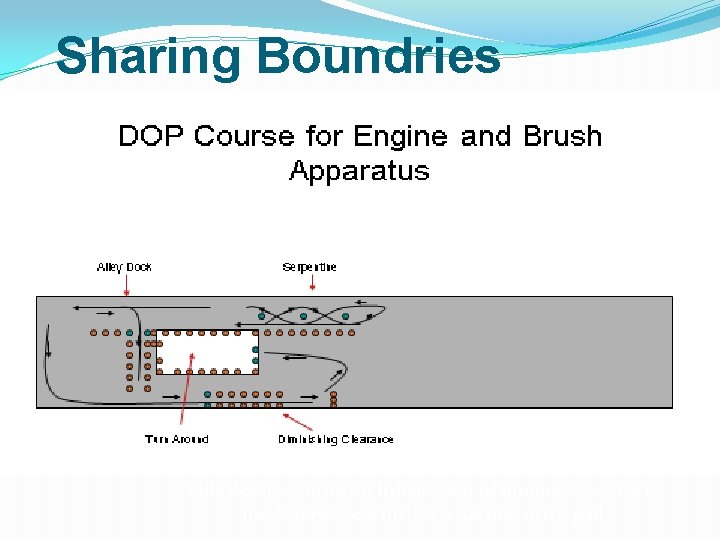
Sharing Boundries This demonstrates an integration of boundary markers for different events for a narrow drive pad