
Practical parasitology Lab 5 A L Lamieaa Gh
Practical parasitology Lab 5 A. L. Lamieaa Gh. Fajir
Classification of Parasitology Parasites of medical importance come under the kingdom called protista and animalia. The science Parasitology includes the study of the three important phyla : I. Phylum protozoa. II. Phylum helminthes( worms). III. Phylum arthropods.
Phylum protozoa Protozoa (singular, protozoan), from the Greek ‘protos’ and ‘zoon’ meaning “first animal”, are members of eukaryotic protists. They may be distinguished from other eukaryotic protists by their ability to move at some stage of their life cycle and by their lack of cell wall. # Protozoa of medical importance are classified based on their morphology and locomotion organs : I. III. IV. Class Rhizopoda (or Sarcodina) : move by pseudopodia. Class Mastigophora (or Flagellata) : move by flagella. Class Ciliophora (or Ciliata) : move by cilia. Class Sporozoa (Apicomplexa) : no movement organs
Class Rhizopoda (or Sarcodina) The Amoebae: Most Amoebae are free living and a few are parasitic on human and animals. They movement by pseudopodia. Amoebae classification: 1 - pathogenic: ►intestinal amoebae: Entamoeba histolytica 2 - non pathogenic: ►Mouth amoebae: Entamoeba gingivalis ►intestinal amoebae: Entamoeba coli, Endolimax nana, Iodamoeba butschlii.
Entamoeba histolytica is identified as a human intestinal pathogen and anaerobic parasitic protozoan. E. histolytica is estimated to infect about 50 million people worldwide
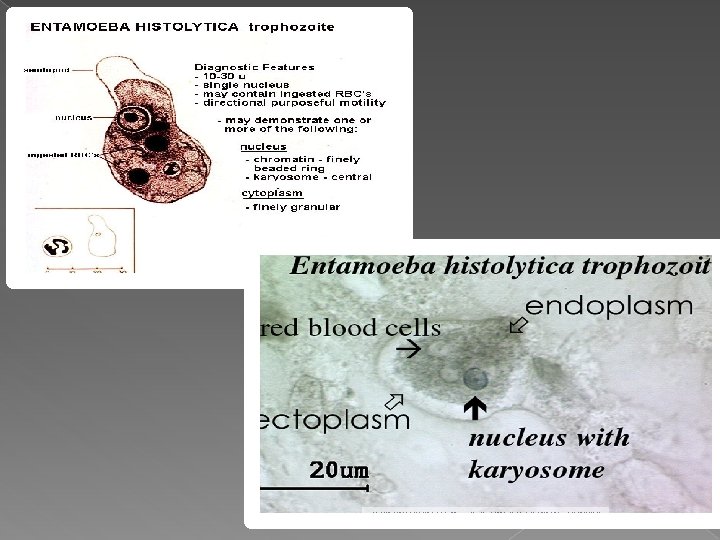
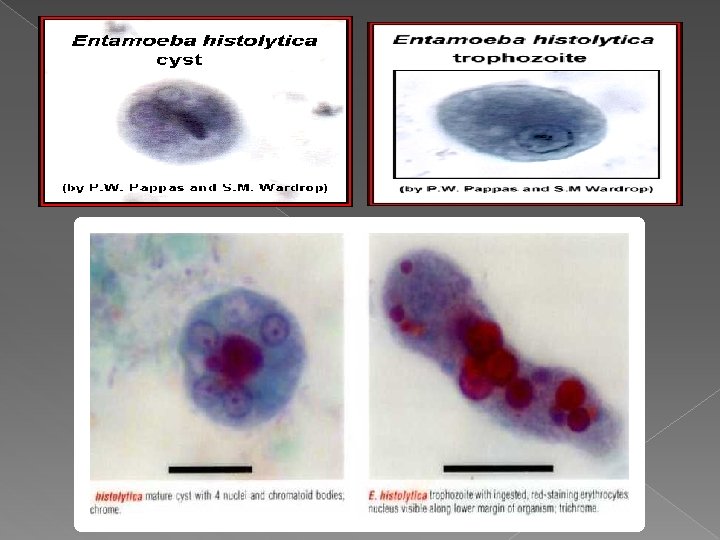
Morphologic forms(Trophozoite form) Shape & size range: amoebic shape , 10 -60 μm. Cytoplasm: (2/3 endoplasm and 1/3 ectoplasm, finely granular). Motility : progressive with hyaline finger-like pseudopodia. Nucleus: circle with karyosome. Number of nucleus : one. Cytoplasmic inclusions : ingested red blood cells (R. B. Cs).
Morphologic forms (Cysts form) � Shape & size range: 10 -20 μm , Small and large race cysts. spherical to round. � Stable and non motile. � Number of nucleus : 1 to 4. � karyosome, chromatoide body and glycogen in nucleus. � Cytoplasmic inclusions : chromatoid bars(or bodies) , diffuse glycogen mass
Transmission : - transmitted by cysts. � 1 - Direct transmission: - with contaminated hands. � 2 - indirect transmission: - Contaminated food , water and arthropod. Pathogenesis : - amoebic dysentery. Diagnosis : - � Detection of trophozoite and cysts of parasites in fresh stool by general stool examination. � After 30 min trophozoite form will destroy. Diagnostics stage : trophozoites and cysts. Infective stage : cysts
- Slides: 10