
PRACTICAL INTERVENTION STRATEGIES AND MATERIALS FOR ELLS WITH










- Slides: 58
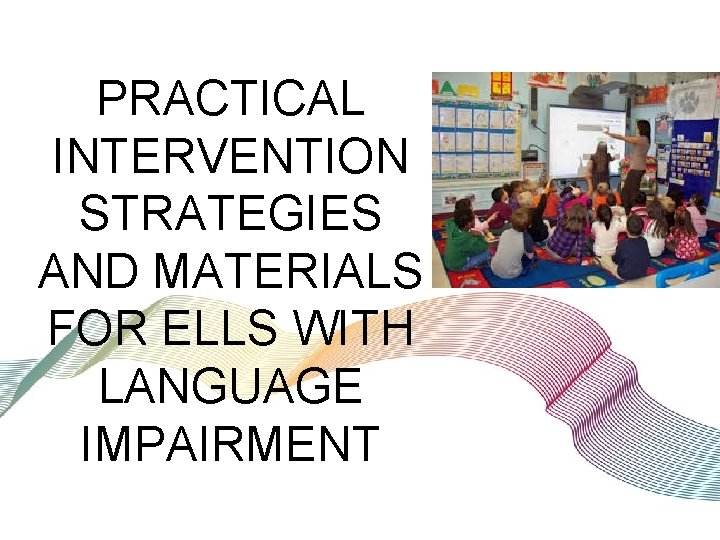
PRACTICAL INTERVENTION STRATEGIES AND MATERIALS FOR ELLS WITH LANGUAGE IMPAIRMENT
I. HOLISTIC STRATEGIES APPROACH** Ultimate goal: vocational success!
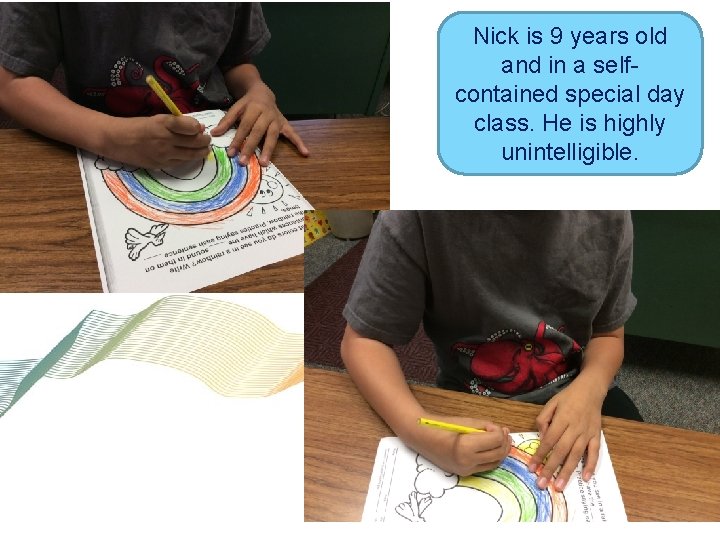
Ni Nick is 9 years old and in a selfcontained special day class. He is highly unintelligible.
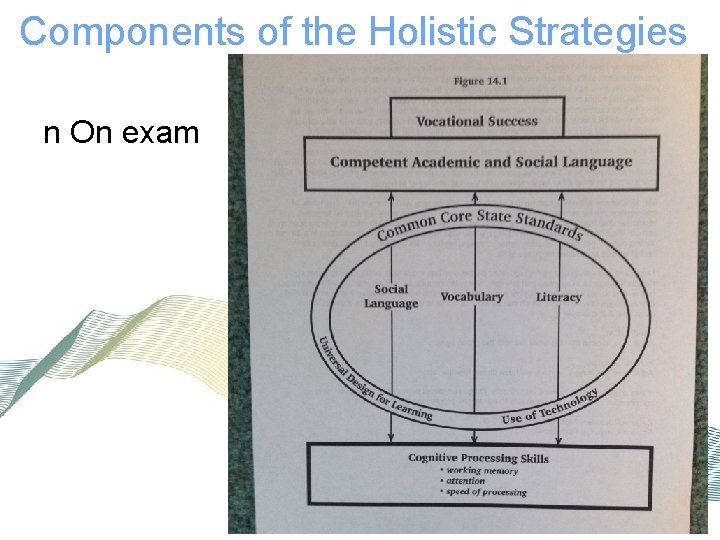
Components of the Holistic Strategies Approach n On exam
II. STRAEGIES FOR MODIFYING THE PHYSICAL AND LINGUISTIC ENVIRONMENT FOR ELL STUDENTS WITH LI
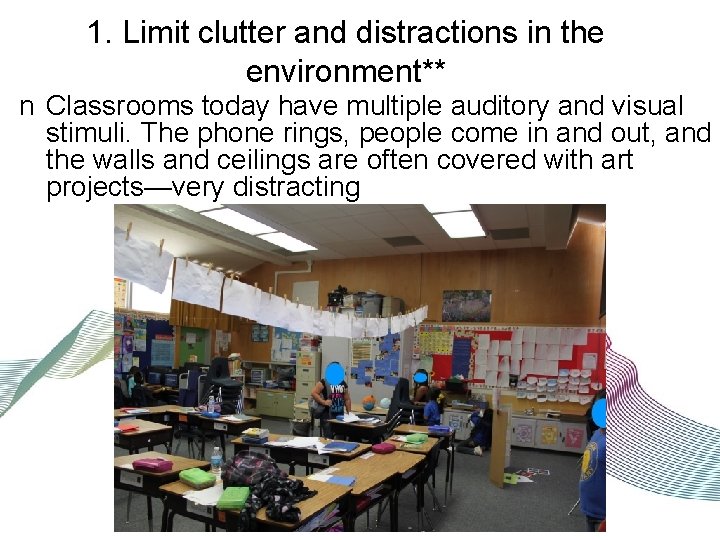
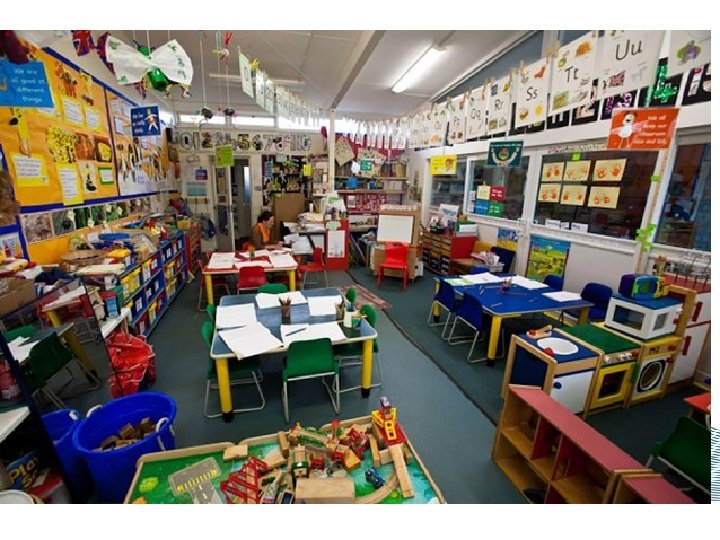
1. Limit clutter and distractions in the environment** n Classrooms today have multiple auditory and visual stimuli. The phone rings, people come in and out, and the walls and ceilings are often covered with art projects—very distracting
Use the office n Corner of room, nothing on wall—like a library carrel/cubicle n Headphones--block out noise
2. Do not give important information when the room is noisy. ** n Students often have difficulty with figure-ground ability, or the ability to “pick out” the professional’s voice from other auditory stimuli. n Even typically-developing ELL students may have extra difficulty if there is a poor signal-to-noise ratio and the teacher is speaking rapidly using decontextualized language that is so typical of classrooms.
Listening conditions in the classroom need to be favorable. ** n Processing information in L 2 under less-thanideal conditions is a risk factor for ELLs with LI n In some places, teachers are using FM units that make them 20 -30 decibels louder; research shows that children perform better when the teacher’s voice is amplified. This is especially true of ELL students with LI.
3. Make good seating arrangements in classroom settings: ** n Seat speakers of the same language together. In this way, they can provide assistance to each other, using L 1 for support in learning academic content. n ELL students with LI need to sit close to the front of the classroom.
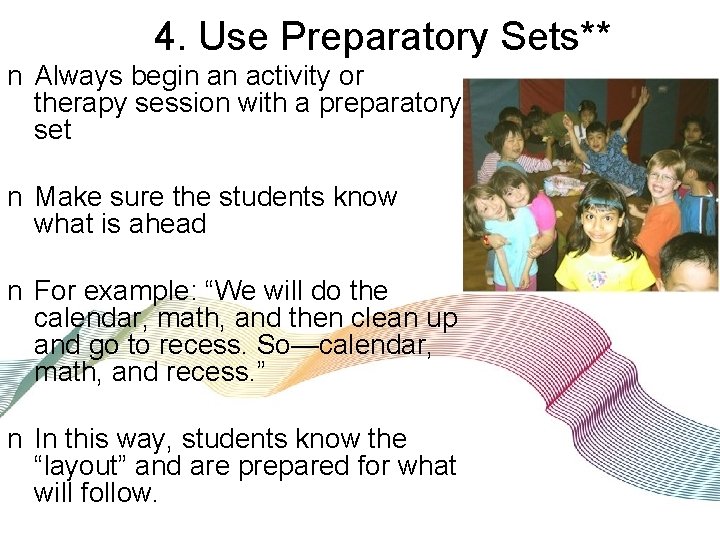
4. Use Preparatory Sets** n Always begin an activity or therapy session with a preparatory set n Make sure the students know what is ahead n For example: “We will do the calendar, math, and then clean up and go to recess. So—calendar, math, and recess. ” n In this way, students know the “layout” and are prepared for what will follow.
n Esp. important for students not accustomed to structure n Many low-SES students have little experience with structure—teach it explicitly
5. Slow down your rate of speech. ** n Students benefit if we pause frequently to give them processing time. Research shows that LI students process more slowly than typically-developing students. n LI students—especially those who are ELLs—profit when professionals slow down and pause more often.
6. Do a great deal of review—repeat information and rephrase it. ** n It is estimated that the average, monolingual English-speaking adult forgets 95% of what he heard within 72 hours of hearing it. n ELL students with LI benefit from hearing information repeated and reviewed often. n Rephrasing is helpful. For example: n “There are 8 planets in the solar system. The earth is one of the planets closest to the sun. – The earth, one of 8 planets in the solar system, is close to the sun. ”
7. Emphasize content words through increased volume and stress. ** n Research has shown that LI students lack the ability to identify the “big” words, or content words and separate them out from the smaller words (function words). n Increasing the auditory salience of content words through increased volume and stress can support low-SES ELL students with LI. For example: n “The ocean is a source of life for our planet. The ocean provides food, water, and other things that are important. ”
8. Give extra processing time. n Give 4 -5 seconds after asking a question. n Better performance if “wait time” to process info
9. Incorporate movement and movement breaks** n Fidget toys helpful— have a basket of them n Brief 20 -second brain gym exercises such as cross-crawl, arm wave to “wake up the brain” and cross midline
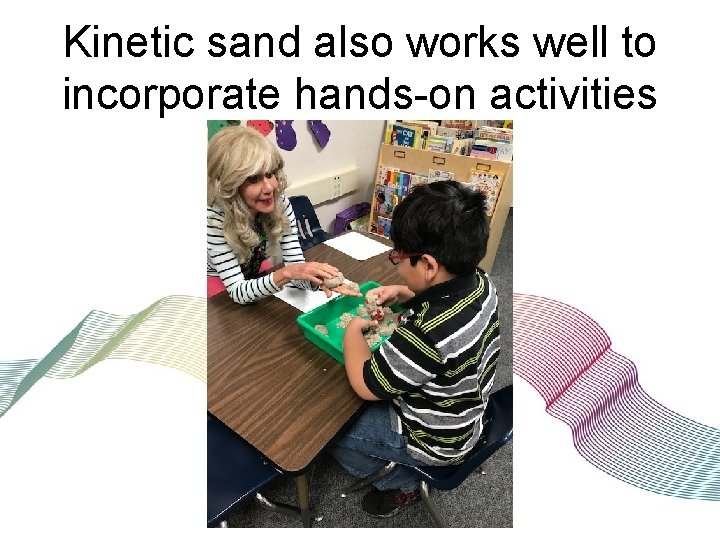
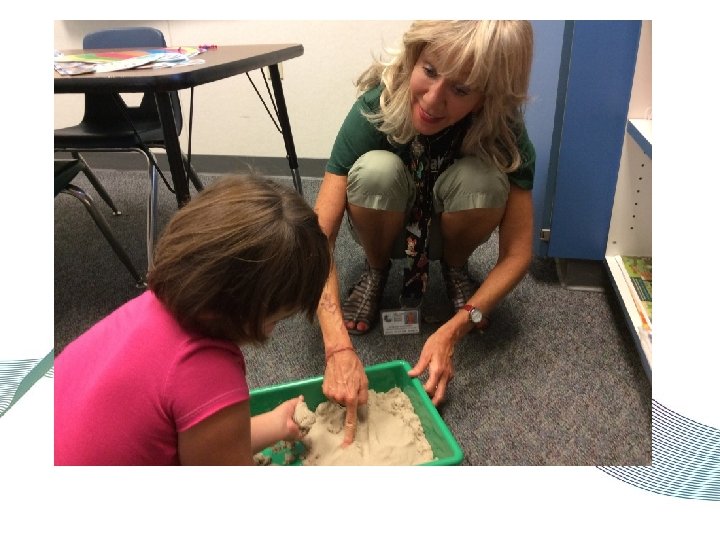
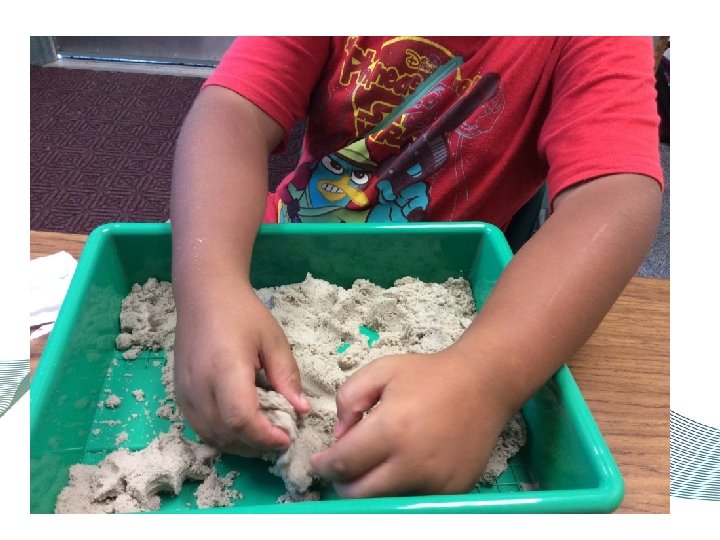
Kinetic sand also works well to incorporate hands-on activities
MOVEMENT BREAK!** n Cross crawls from Brain Gym— designed to increase communication between the right and left hemisphere n Wake up the brain! (Justin Timberlake can’t stop the feeling)
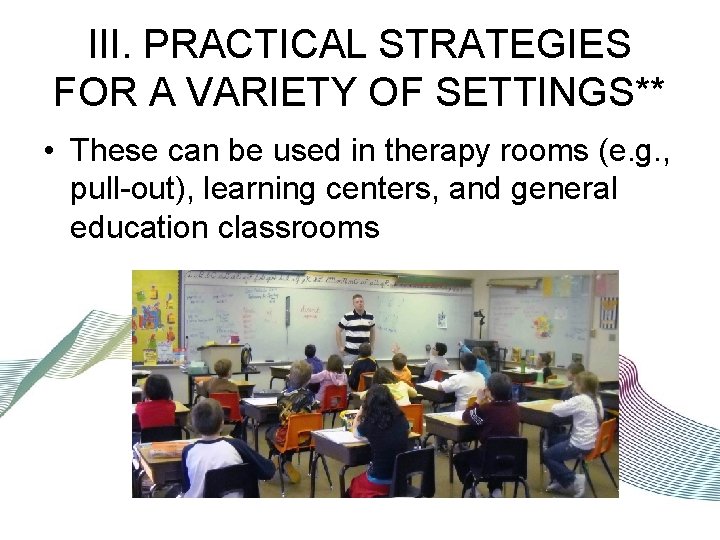
III. PRACTICAL STRATEGIES FOR A VARIETY OF SETTINGS** • These can be used in therapy rooms (e. g. , pull-out), learning centers, and general education classrooms
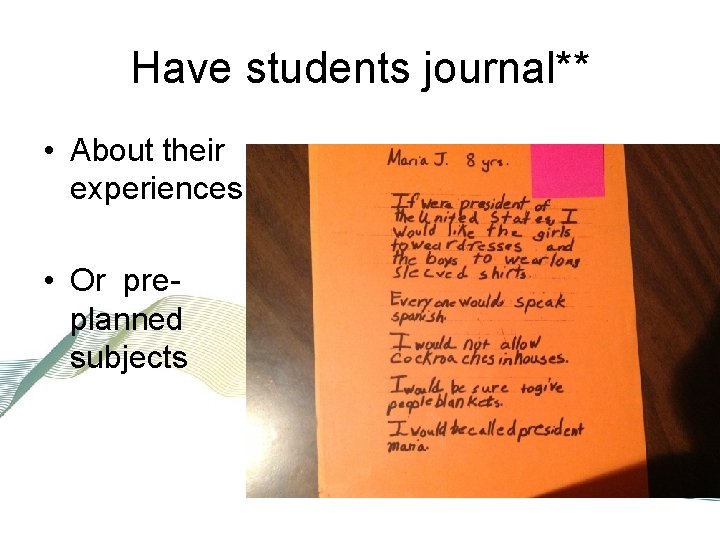
Have students journal** • About their experiences • Or preplanned subjects
Have the students…** • Engage in drama and roleplaying activities in order to encourage expressive language and social interaction skills. • Costumes and puppets help if they are shy! • So do karaoke machines and microphones
With regard to notetaking, students often need to be explicitly taught to: • Write only key/content words —not function words • Distinguish between content and function words—”big” and “little” words
For example, students can underline or highlight the key/content words in sentences. ** • The weather is hot in the summer. • Abraham Lincoln was a president of the United States. • Many people think that dogs are man’s best friend. • When they learn to do this, they can then be taught to take notes, writing down just the key/content words.
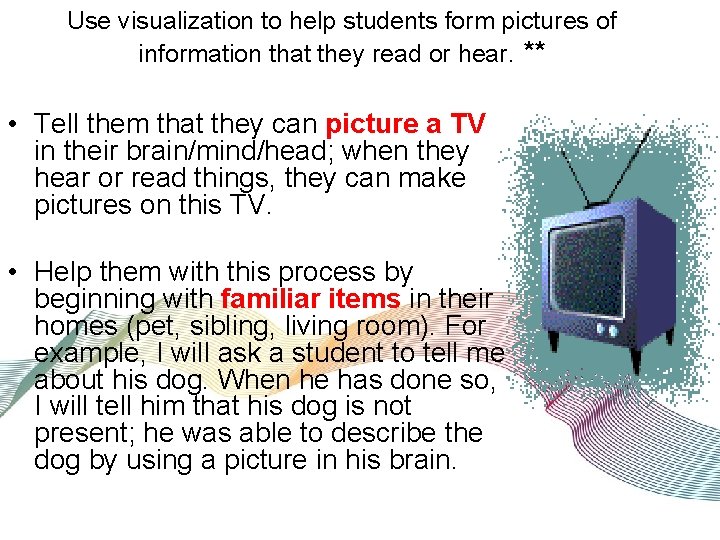
Use visualization to help students form pictures of information that they read or hear. ** • Tell them that they can picture a TV in their brain/mind/head; when they hear or read things, they can make pictures on this TV. • Help them with this process by beginning with familiar items in their homes (pet, sibling, living room). For example, I will ask a student to tell me about his dog. When he has done so, I will tell him that his dog is not present; he was able to describe the dog by using a picture in his brain.
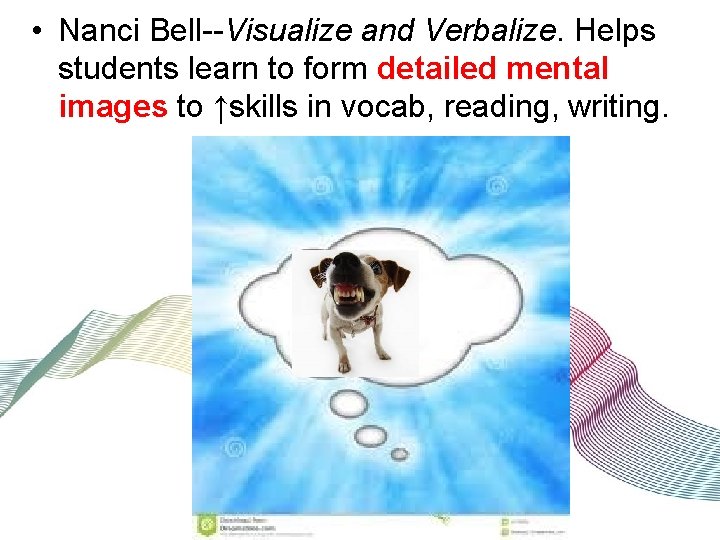
• Nanci Bell--Visualize and Verbalize. Helps students learn to form detailed mental images to ↑skills in vocab, reading, writing.
I have found that…** • Students especially benefit from visualizing, or making pictures in their brain as an adjunct to reading or listening. Visualizing helps information to be retained better, thus aiding in listening and reading comprehension.
Youtube video** • Youtube Channel Celeste Roseberry • Go to Intervention for ELLs with Language Impairment: Using Visualization • http: //www. youtube. com/watch? v= Jcae. Y 7 Mc. Xr. Q
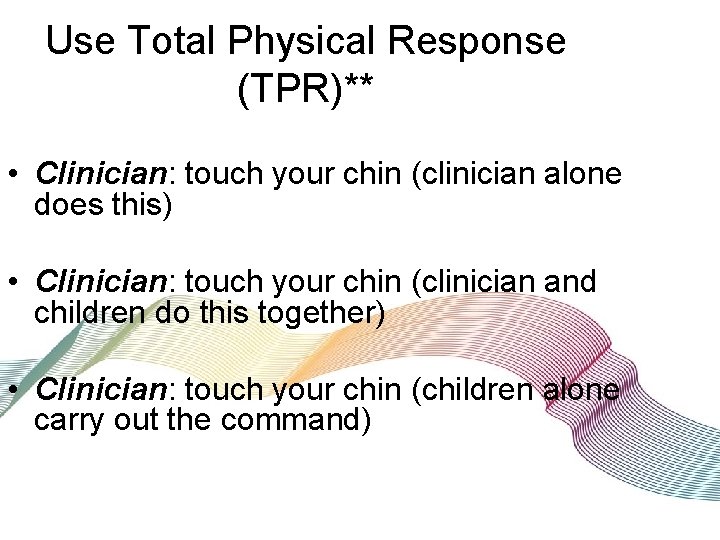
Use Total Physical Response (TPR)** • Clinician: touch your chin (clinician alone does this) • Clinician: touch your chin (clinician and children do this together) • Clinician: touch your chin (children alone carry out the command)
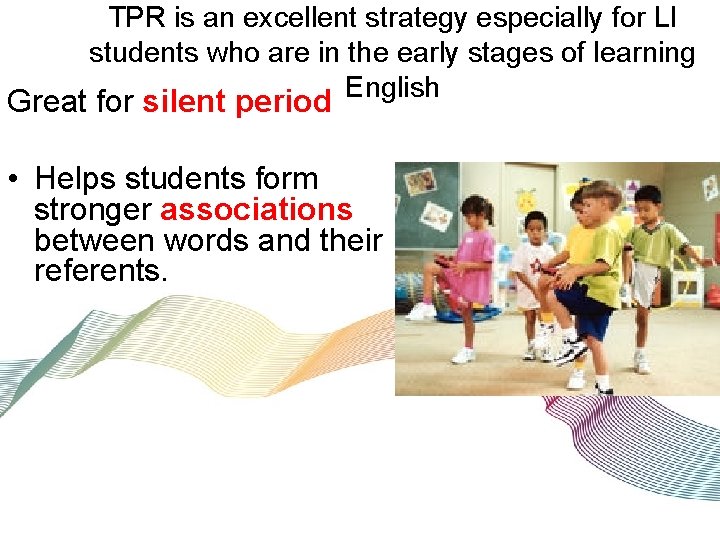
TPR is an excellent strategy especially for LI students who are in the early stages of learning English Great for silent period • Helps students form stronger associations between words and their referents.
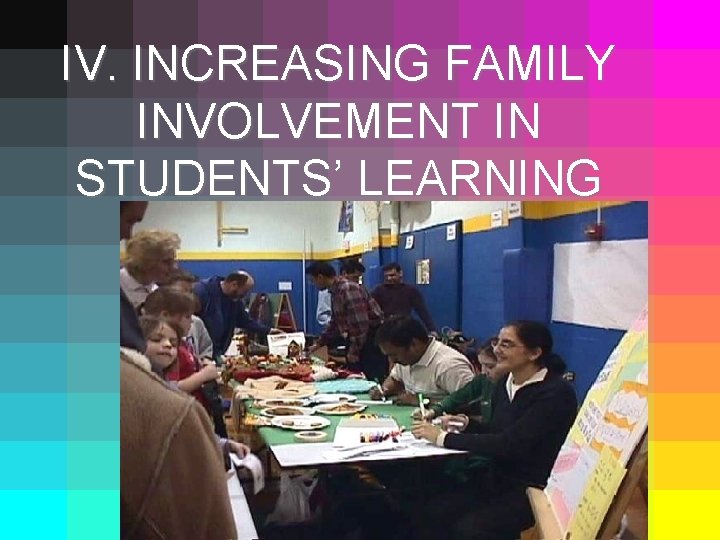
IV. INCREASING FAMILY INVOLVEMENT IN STUDENTS’ LEARNING
Hammer et al. 2017: ** § Analyzed data from a national longitudinal study based on 9, 600 children § Found: children who were late talkers at 24 months of age were 3 x more likely than typically developing (TD) children to have low vocabulary scores at 48 months of age § Poverty substantially contributed to low vocabulary
Hammer et al. 2017 also found: § Having a low vocab prior to school more than tripled the odds of low reading and math scores § Ch more likely to have behavior problems § Participation in ch care for 10+ hours a week led to improvements in ch’s vocab
§ : Parents of children who speak a minority language should be encouraged to use this language at home**
I tell parents…** • That being bilingual is a great advantage in today’s world • That if their child can grow up bilingual, she will be quite valuable in the job market
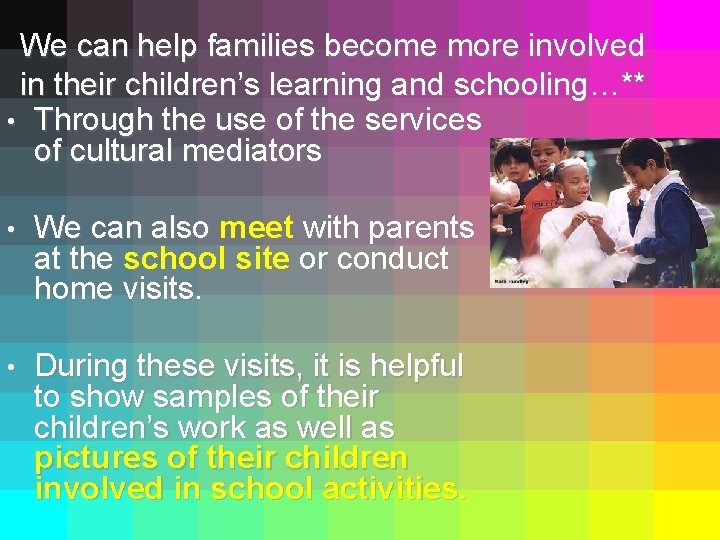
We can help families become more involved in their children’s learning and schooling…** • Through the use of the services of cultural mediators • We can also meet with parents at the school site or conduct home visits. • During these visits, it is helpful to show samples of their children’s work as well as pictures of their children involved in school activities.
We can help parents understand what U. S. schools expect of them and their children** • Parents need to understand the academic/ curricular standards of their children’s schools. • If parents can volunteer in their children’s classrooms, they will understand the demands of the curriculum much better.
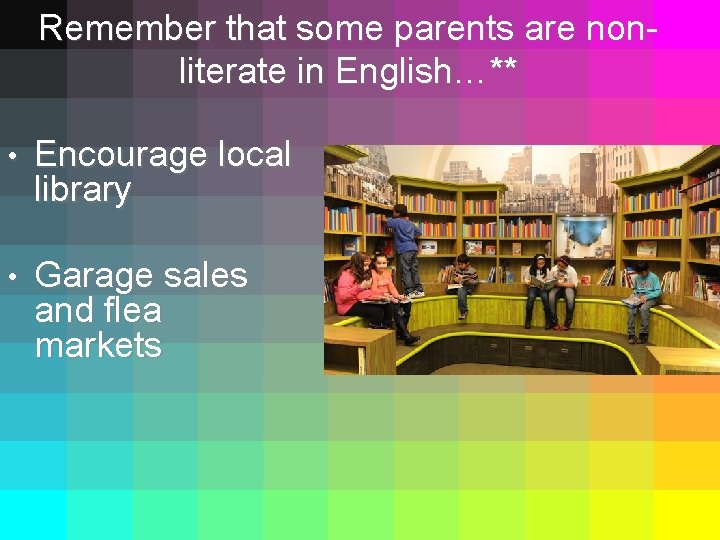
Remember that some parents are nonliterate in English…** • Encourage local library • Garage sales and flea markets
Help parents find out** • About local adult literacy services and English classes. • For example, English classes are often offered at night through local educational agencies.
Many families are surviving…** • Keep assignments short and simple. • When we do give homework, it needs to only take a few minutes to do, and it needs to be understandable to families. • I often tell the student what needs to be done, make sure she has a parent sign the assignment, and offer a sticker or small prize for returning it.
Help parents understand the relevance of talking to and reading with infants and small children**
Marklund et al. . Pause and utterance duration… Journal of Child Language, 42, 1158 -1171. § Study carried out in Sweden with parents and 1; 6 year olds § Found: ch whose parents responded the fastest to their utterances had the largest vocabularies § Ch of slow responding parents had smaller vocabularies
Lewis, N, (2017). Our role in early identification. The ASHA Leader, 22(1), 6 -7. ** § It is very important to help parents learn the signs of potential LI, ASD, etc. —they need to understand typical developmental milestones § New resource: Learn the signs, act early § www. cdc. gov/ncbddd/actearly § All materials are available in English and Spanish; some are translated into Arabic, Korean, Vietnamese, Somali, and Portuguese
Duran et al. (2016). Bilingual and home language interventions… Language, Speech, and Hearing Services in Schools, 47, 347 -371. ** § Conducted a meta-analysis of what bilingual or home language interventions are effective for 2 -6 year old bilinguals with LI
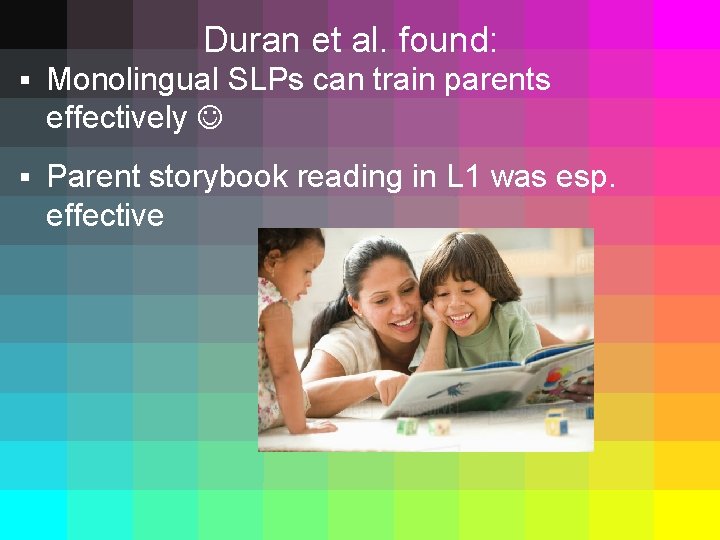
Duran et al. found: § Monolingual SLPs can train parents effectively § Parent storybook reading in L 1 was esp. effective
Bitetti, C. , & Hammer, C. The home literacy environment… Journal of Speech, Language, and Hearing Research, 59, 1159 -1171. ** § Examined the home literacy environment (HLE) on the English narrative development of Spanish-English bilingual children from lowincome backgrounds § 91 bilingual children preschool-first grade § Looked at narrative micro-and macrostructure (microstructure = MLU and # of different words)
Bitetti & Hammer found: § The availability of books in the home was key—many homes owned very few books § We need to ↑ the # of books available § The more often the moms read with their ch, the ↑r the ch’s narrative growth
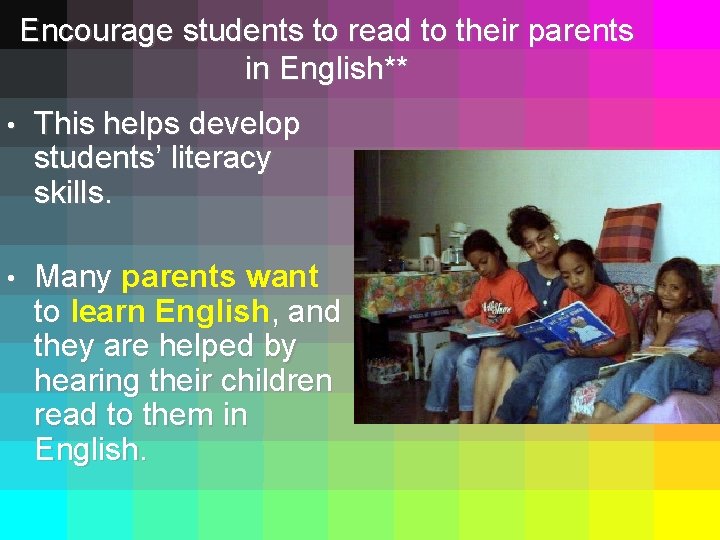
Encourage students to read to their parents in English** • This helps develop students’ literacy skills. • Many parents want to learn English, and they are helped by hearing their children read to them in English.
Research (Ron Gillam) was conducted: § Low-SES (some bilingual) parents given wordless books to read; others—books with print Wordless books generated richer lang during reading than print books! § Parents ↑ animated, discussed wordless books more creatively
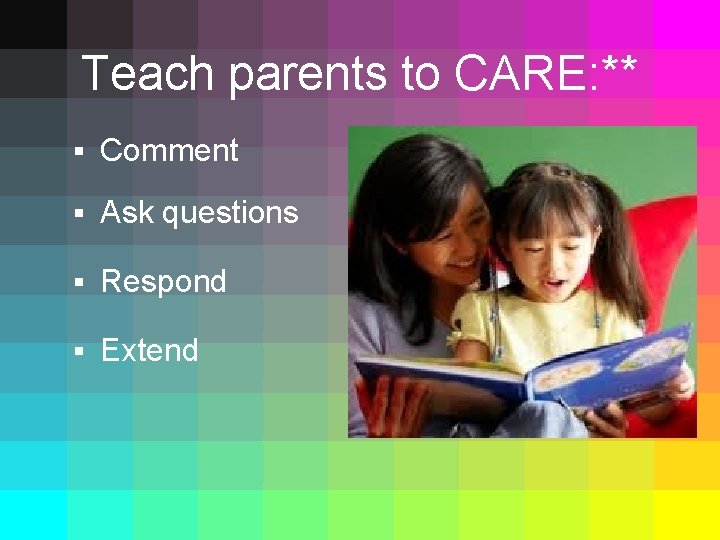
Teach parents to CARE: ** § Comment § Ask questions § Respond § Extend
Youtube video on CARE** § Youtube channel Celeste Roseberry § Intervention for ELLs: Increasing Preliteracy Skills Through CARE and Wordless Books § http: //www. youtube. com/watch? v=B NPWL-WCp 98
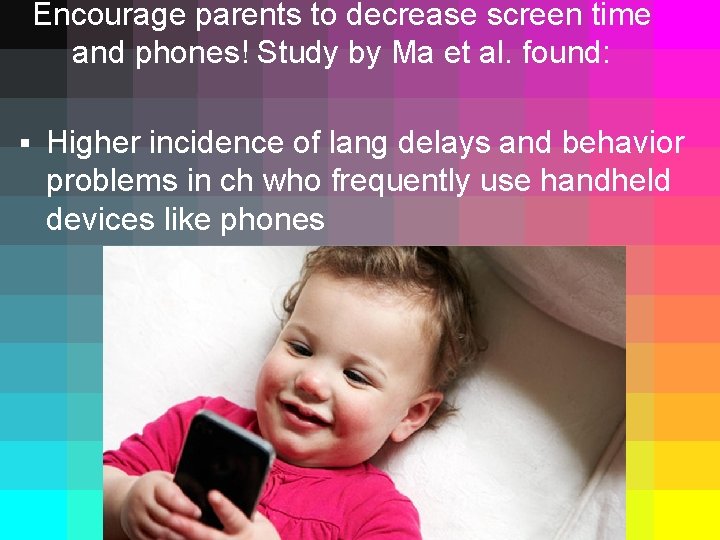
Encourage parents to decrease screen time and phones! Study by Ma et al. found: § Higher incidence of lang delays and behavior problems in ch who frequently use handheld devices like phones
Remember… § We are in the business of providing hope for a bright future