
Practical Hematology Transfusion Wendy Blount DVM Practical Hematology

Practical Hematology Transfusion Wendy Blount, DVM
Practical Hematology 1. Anemia 101 2. Blood Loss Anemia 3. Hemolysis 4. Non-Regenerative Anemias 5. Transfusion Medicine 6. Polycythemia 7. Bone Marrow Disease 8. Coagulopathy 9. Central IV Lines 10. Leukophilia 11. Leukopenias 12. Splenic Disease
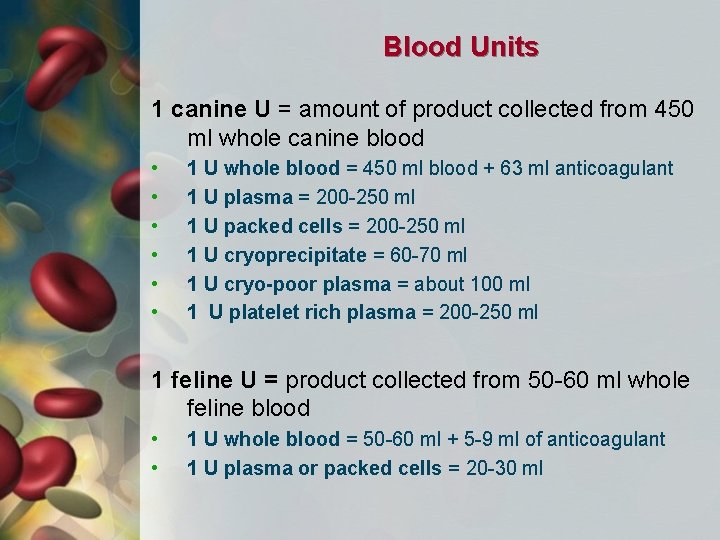
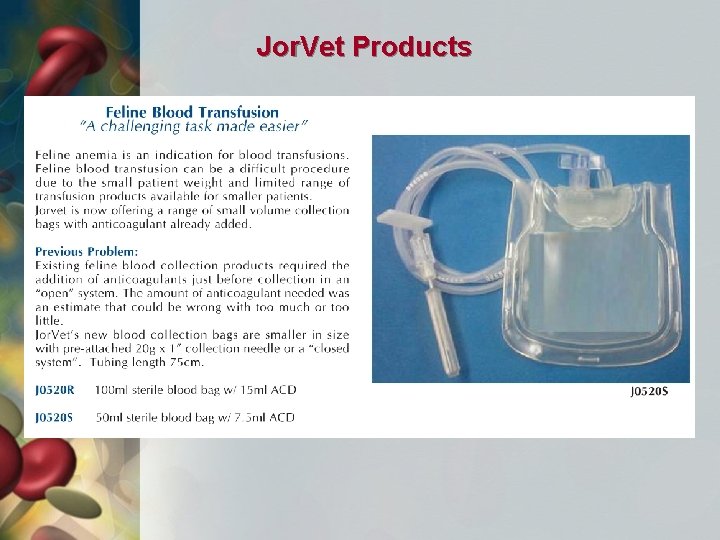
Blood Units 1 canine U = amount of product collected from 450 ml whole canine blood • • • 1 U whole blood = 450 ml blood + 63 ml anticoagulant 1 U plasma = 200 -250 ml 1 U packed cells = 200 -250 ml 1 U cryoprecipitate = 60 -70 ml 1 U cryo-poor plasma = about 100 ml 1 U platelet rich plasma = 200 -250 ml 1 feline U = product collected from 50 -60 ml whole feline blood • • 1 U whole blood = 50 -60 ml + 5 -9 ml of anticoagulant 1 U plasma or packed cells = 20 -30 ml
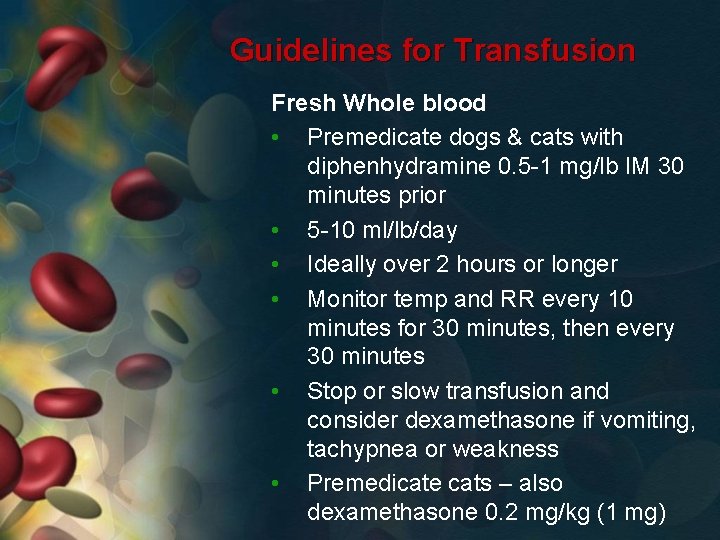
Guidelines for Transfusion Fresh Whole blood • Premedicate dogs & cats with diphenhydramine 0. 5 -1 mg/lb IM 30 minutes prior • 5 -10 ml/lb/day • Ideally over 2 hours or longer • Monitor temp and RR every 10 minutes for 30 minutes, then every 30 minutes • Stop or slow transfusion and consider dexamethasone if vomiting, tachypnea or weakness • Premedicate cats – also dexamethasone 0. 2 mg/kg (1 mg)
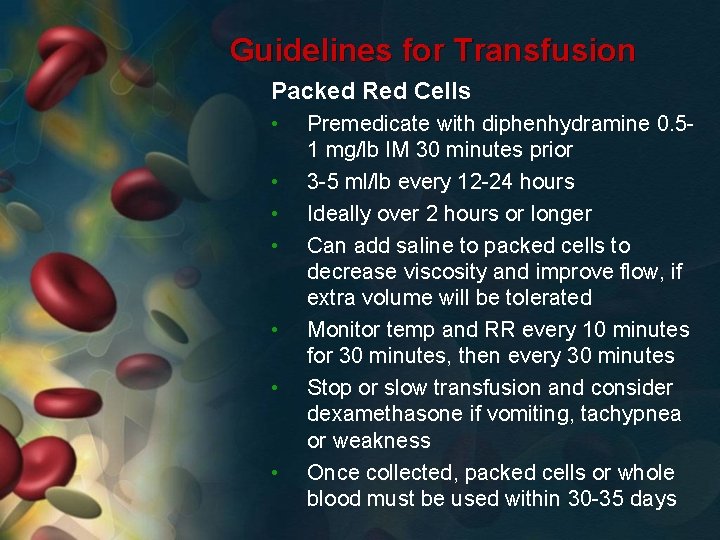
Guidelines for Transfusion Packed Red Cells • • Premedicate with diphenhydramine 0. 51 mg/lb IM 30 minutes prior 3 -5 ml/lb every 12 -24 hours Ideally over 2 hours or longer Can add saline to packed cells to decrease viscosity and improve flow, if extra volume will be tolerated Monitor temp and RR every 10 minutes for 30 minutes, then every 30 minutes Stop or slow transfusion and consider dexamethasone if vomiting, tachypnea or weakness Once collected, packed cells or whole blood must be used within 30 -35 days
Guidelines for Transfusion Fresh Frozen Plasma • 3 -5 ml/kg every 8 -12 hours • Centrifuged within 6 hours for FFP • Otherwise “frozen plasma” • FFP better than FP for labile proteins: anti-inflammatory effects, Factors 5 & 8, v. WF • Once frozen, coag factors are stable for one year • Albumin is stable for more than 5 years • No data on how refreezing affects plasma
Guidelines for Transfusion Fresh Frozen Plasma • Not a good source of albumin • 45 ml/kg needed to increase albumin 1 g/dl • Try hetastarch instead • Failure of passive transfer in puppies and kittens • 50 ml/kg SC or IP x 3 days • FFP or FP equally effective • When whole blood expires, spin it and freeze the FP which is good for 5 years for proteins
Guidelines for Transfusion Platelet Rich Plasma • 3 -5 ml/kg every 8 -12 hours Frozen platelet concentrate • • • Platelets in DMSO and plasma Collected by plasmapharesis 1 U/10 kg every 8 -12 hours Used for IMT DMSO can cause bradycardia – slow rate 1 dose increases platelets 20, 000/ul for 24 hours
Guidelines for Transfusion Cryoprecipitate • • • Factors 8, 13, v. WF and fibrinogen 1 U/10 kg every 6 -12 hours Once frozen, should be used within 1 year Cryo-Poor Plasma • • • What remains after cryoprecipitate is removed Good for rodenticide intoxication • Contains factors 2, 7, 9 and 10 3 -5 ml/kg every 8 -12 hours
Guidelines for Transfusion Human Immunoglobulin • • 1 unit produced from plasma of 1, 000 donors Very expensive Has been used to treat IMHA and IMT in dogs Overwhelming the RBC and platelets with blocking antibodies decreases extravascular hemolysis Human Ig. G may also neutralize anti. RBC and anti-platelet antibodies Second infusion could theoretically produce severe anaphylaxis 0. 5 -1 g/kg IV over 6 -8 hours
Guidelines for Transfusion Autotransfusion • • Blood collected from the abdomen with blood bag and anticoagulant Given back to the patient using a filter • • • No limit on administration rate • • blood administration set for drip Hemonate filter for syringe Large bore IV sets for fastest rate Contraindications: peritonitis • • Septic abdomen Uroabdomen Bile peritonitis neoplasia

Guidelines for Transfusion Hemo. Nate filter Jor. Vet J 0522 H Hemo. Tap Spike Jor. Vet J 0522 T

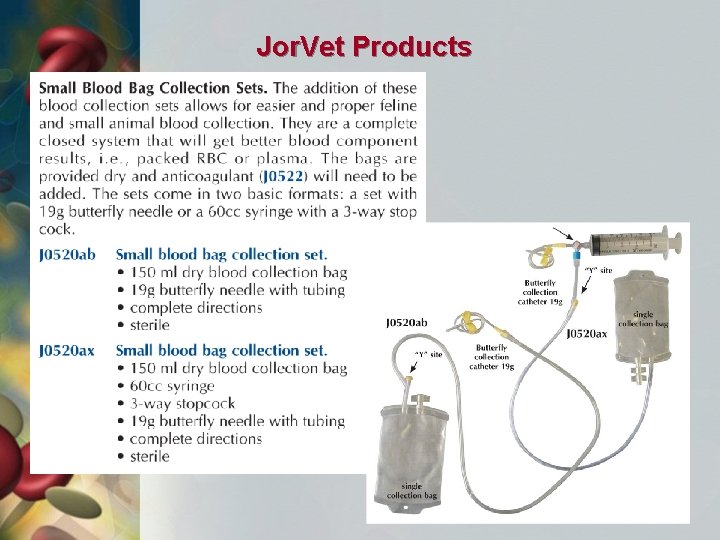
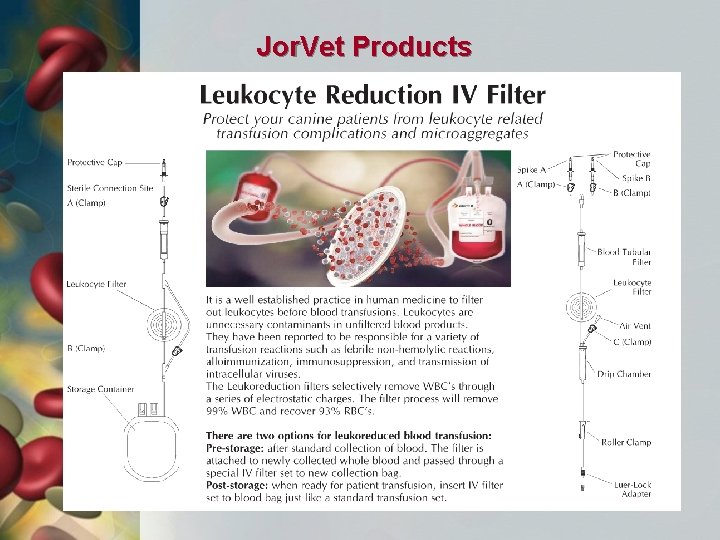
Guidelines for Transfusion Anticoagulants – ACD, CPD-A 1 Bags or Bottles? ? • With anticoagulant added, or add your own Always administer through a filter • Hemonate tap, Hemonate filter • Blood administration set Jor. Vet has all needed supplies • Hematology Product List • Feline Transfusion Supplies • Intravenous, Transfusion Supplies
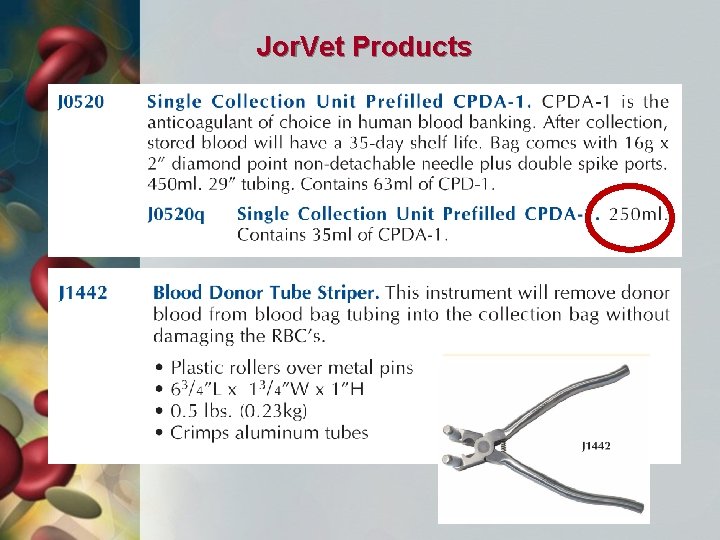
Jor. Vet Products
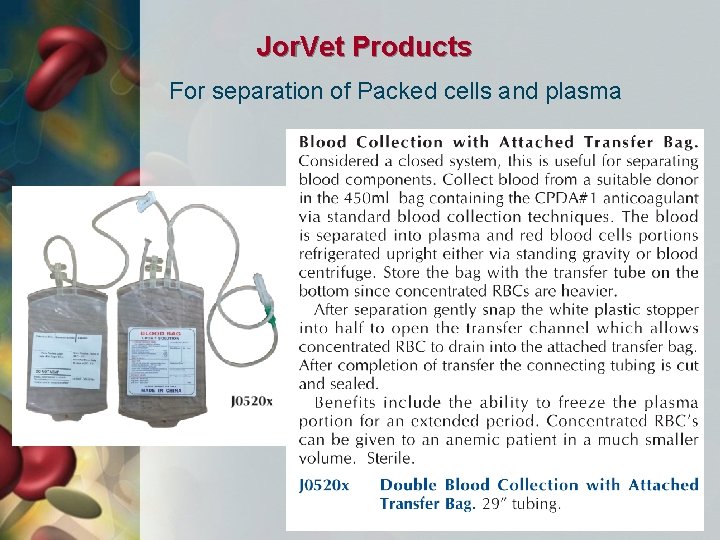
Jor. Vet Products For separation of Packed cells and plasma
Jor. Vet Products
Jor. Vet Products
Jor. Vet Products
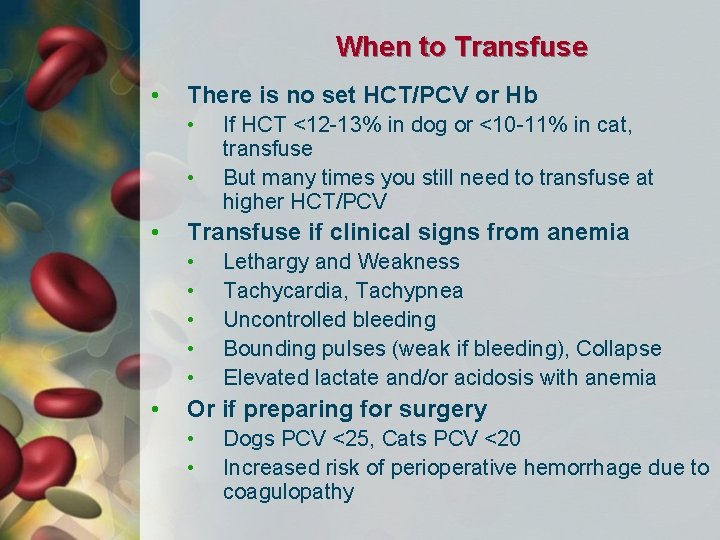
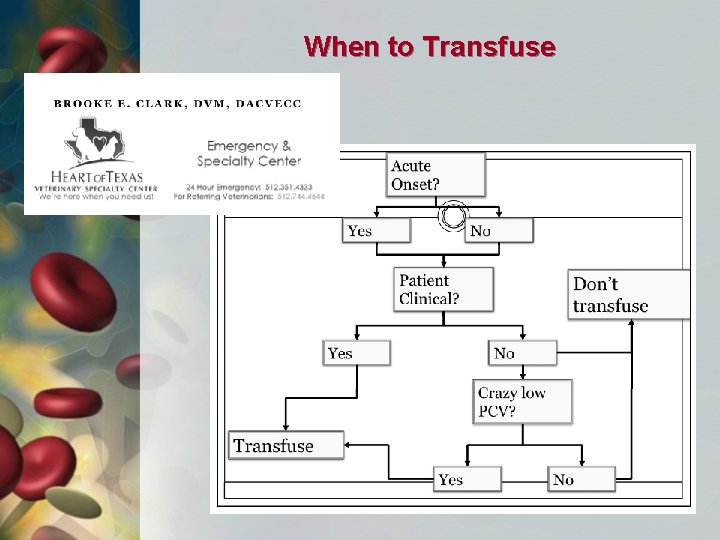
When to Transfuse • There is no set HCT/PCV or Hb • • • Transfuse if clinical signs from anemia • • • If HCT <12 -13% in dog or <10 -11% in cat, transfuse But many times you still need to transfuse at higher HCT/PCV Lethargy and Weakness Tachycardia, Tachypnea Uncontrolled bleeding Bounding pulses (weak if bleeding), Collapse Elevated lactate and/or acidosis with anemia Or if preparing for surgery • • Dogs PCV <25, Cats PCV <20 Increased risk of perioperative hemorrhage due to coagulopathy
When to Transfuse • • • Transfuse sooner if • Evidence of bone marrow disease or lack of marrow response • Simultaneous cardiopulmonary disease • Blood loss or hemolysis is rapid More conservative with cat transfusions • Increased rate of fatal reaction • Fewer symptoms with severe anemia • More susceptible to volume overload Remember that with each successive transfusion, risk of reaction is higher and duration of efficacy is shorter
When to Transfuse
Acute Transfusion Reaction • Fever, restlessness, tachypnea are first signs • Hemolysis • Anaphylaxis: • • Salivation, vomiting, bloody diarrhea, abdominal pain in the dog Lab tests – serum hemolysis, Hb. Uria Pulmonary edema in the cat (tachypnea) Increased ALT within an hour Coagulopathy within hours (PTT > PT) Shock, pallor, weak pulses, collapse Ultrasound – AFAST® • • GB edema, flat caudal vena cava, hemoabdomen DIC, SIRS
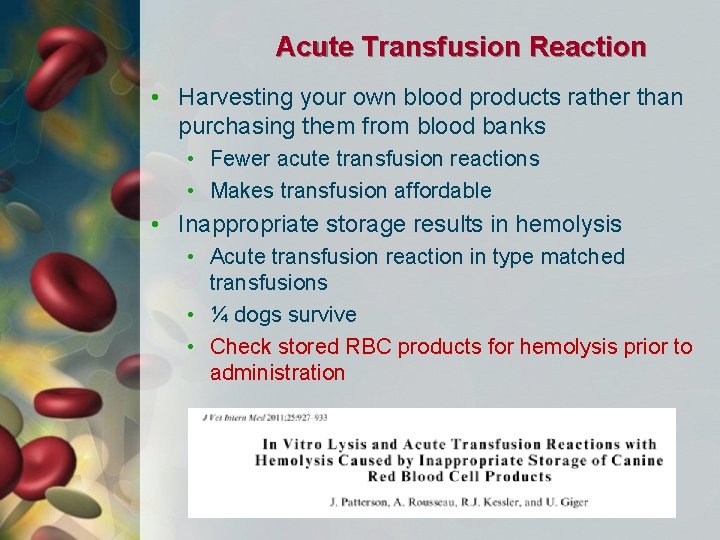
Acute Transfusion Reaction • Harvesting your own blood products rather than purchasing them from blood banks • Fewer acute transfusion reactions • Makes transfusion affordable • Inappropriate storage results in hemolysis • Acute transfusion reaction in type matched transfusions • ¼ dogs survive • Check stored RBC products for hemolysis prior to administration
Acute Transfusion Reaction • Treatment: • Stop transfusion!! • Dexamethasone if not already given (diphenhydramine should be on board) • IV fluids for hypovolemia
Delayed Transfusion Reaction • • Shortened RBC lifespan Icterus Post-transfusion purpura Immune mediated joint disease
Blood Donor Selection ACVIM Guidelines – 2016 • Blood Donor Forms – Canine – Feline • Completed at enrollment and before each donation • Complete Exam prior to each donation • Annual bloodwork, and repeat infectious disease screening according to risk assessment • CBC, panel, UA, fecal • Fe. LV/FIV for cats at risk • Annual vaccinations current • PCV prior to each blood draw
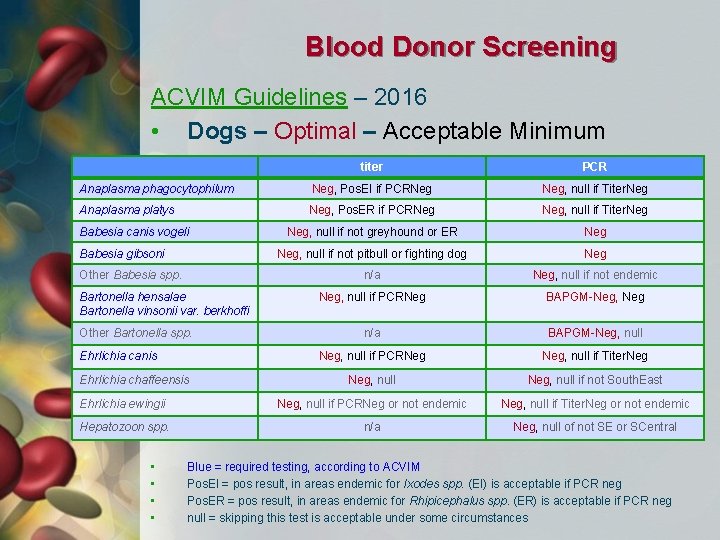
Blood Donor Screening ACVIM Guidelines – 2016 • Dogs – Optimal – Acceptable Minimum titer PCR Anaplasma phagocytophilum Neg, Pos. EI if PCRNeg Neg, null if Titer. Neg Anaplasma platys Neg, Pos. ER if PCRNeg Neg, null if Titer. Neg, null if not greyhound or ER Neg, null if not pitbull or fighting dog Neg n/a Neg, null if not endemic Neg, null if PCRNeg BAPGM-Neg, Neg n/a BAPGM-Neg, null if PCRNeg Neg, null if Titer. Neg, null if not South. East Ehrlichia ewingii Neg, null if PCRNeg or not endemic Neg, null if Titer. Neg or not endemic Hepatozoon spp. n/a Neg, null of not SE or SCentral Babesia canis vogeli Babesia gibsoni Other Babesia spp. Bartonella hensalae Bartonella vinsonii var. berkhoffi Other Bartonella spp. Ehrlichia canis Ehrlichia chaffeensis • • Blue = required testing, according to ACVIM Pos. EI = pos result, in areas endemic for Ixodes spp. (EI) is acceptable if PCR neg Pos. ER = pos result, in areas endemic for Rhipicephalus spp. (ER) is acceptable if PCR neg null = skipping this test is acceptable under some circumstances
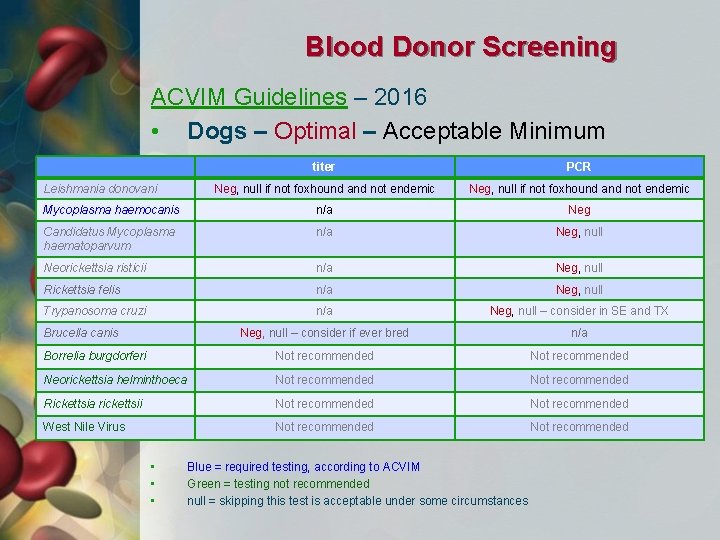
Blood Donor Screening ACVIM Guidelines – 2016 • Dogs – Optimal – Acceptable Minimum titer PCR Neg, null if not foxhound and not endemic Mycoplasma haemocanis n/a Neg Candidatus Mycoplasma haematoparvum n/a Neg, null Neorickettsia risticii n/a Neg, null Rickettsia felis n/a Neg, null Trypanosoma cruzi n/a Neg, null – consider in SE and TX Neg, null – consider if ever bred n/a Borrelia burgdorferi Not recommended Neorickettsia helminthoeca Not recommended Rickettsia rickettsii Not recommended West Nile Virus Not recommended Leishmania donovani Brucella canis • • • Blue = required testing, according to ACVIM Green = testing not recommended null = skipping this test is acceptable under some circumstances
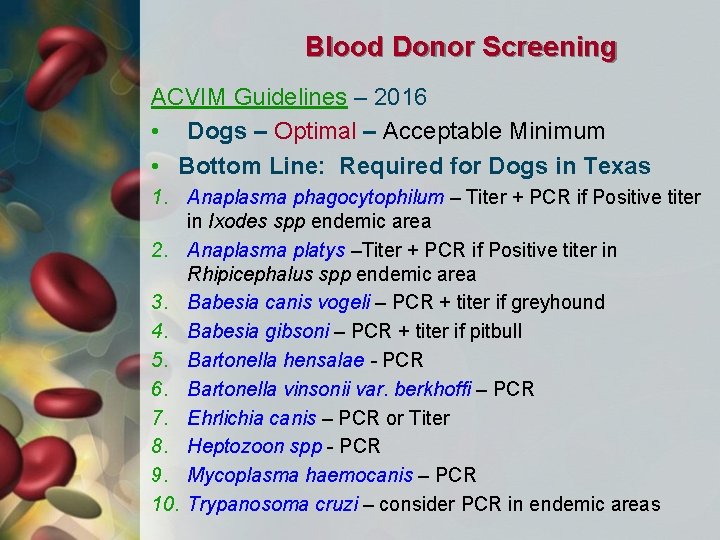
Blood Donor Screening ACVIM Guidelines – 2016 • Dogs – Optimal – Acceptable Minimum • Bottom Line: Required for Dogs in Texas 1. Anaplasma phagocytophilum – Titer + PCR if Positive titer in Ixodes spp endemic area 2. Anaplasma platys –Titer + PCR if Positive titer in Rhipicephalus spp endemic area 3. Babesia canis vogeli – PCR + titer if greyhound 4. Babesia gibsoni – PCR + titer if pitbull 5. Bartonella hensalae - PCR 6. Bartonella vinsonii var. berkhoffi – PCR 7. Ehrlichia canis – PCR or Titer 8. Heptozoon spp - PCR 9. Mycoplasma haemocanis – PCR 10. Trypanosoma cruzi – consider PCR in endemic areas
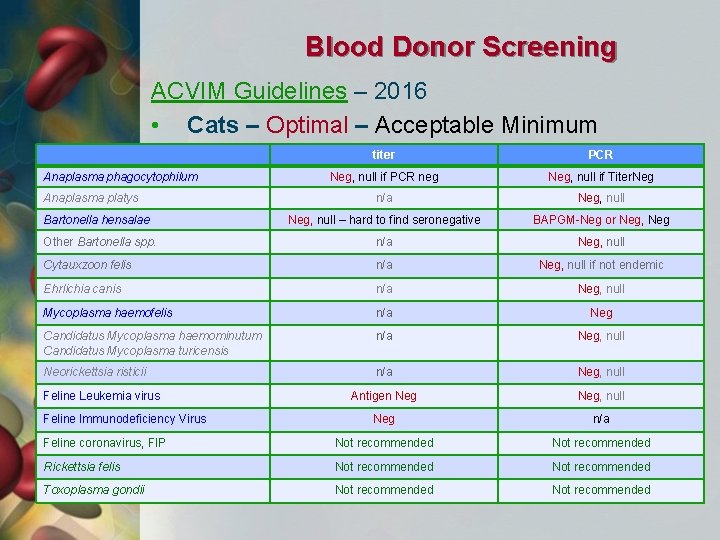
Blood Donor Screening ACVIM Guidelines – 2016 • Cats – Optimal – Acceptable Minimum titer PCR Neg, null if PCR neg Neg, null if Titer. Neg n/a Neg, null – hard to find seronegative BAPGM-Neg or Neg, Neg Other Bartonella spp. n/a Neg, null Cytauxzoon felis n/a Neg, null if not endemic Ehrlichia canis n/a Neg, null Mycoplasma haemofelis n/a Neg Candidatus Mycoplasma haemominutum Candidatus Mycoplasma turicensis n/a Neg, null Neorickettsia risticii n/a Neg, null Antigen Neg, null Neg n/a Feline coronavirus, FIP Not recommended Rickettsia felis Not recommended Toxoplasma gondii Not recommended Anaplasma phagocytophilum Anaplasma platys Bartonella hensalae Feline Leukemia virus Feline Immunodeficiency Virus
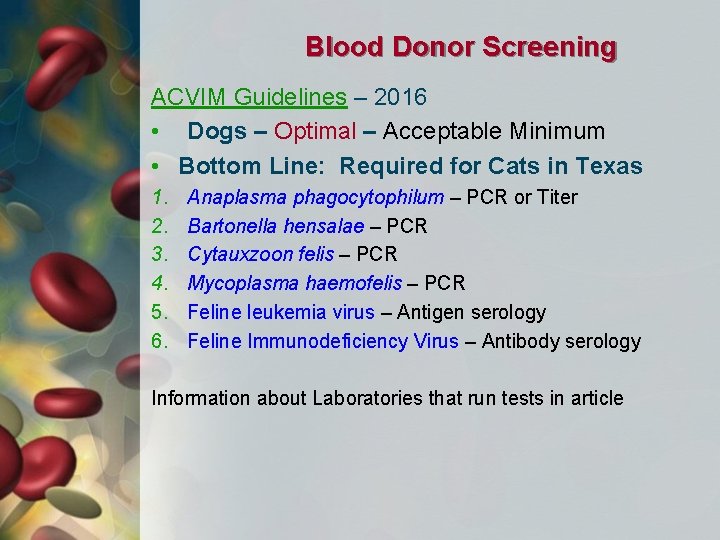
Blood Donor Screening ACVIM Guidelines – 2016 • Dogs – Optimal – Acceptable Minimum • Bottom Line: Required for Cats in Texas 1. 2. 3. 4. 5. 6. Anaplasma phagocytophilum – PCR or Titer Bartonella hensalae – PCR Cytauxzoon felis – PCR Mycoplasma haemofelis – PCR Feline leukemia virus – Antigen serology Feline Immunodeficiency Virus – Antibody serology Information about Laboratories that run tests in article
Transfusion Record Keeping • • Blood Donor Form in the Donor Record Transfusion recorded in donor and recipient records • Stored blood products are properly labeled • Inspect the blood products for contamination prior to administration, and document • white spots in the blood bag • purple tone to RBC • zone of hemolysis above the RBC mass • Clots • discolored plasma • Store an aliquot of blood in case later testing is needed
Summary Power. Points • . pptx, . pdf 1 slide per page, . pdf 6 slides per page Articles • ACVIM – Blood Donor Guidelines – 2016 Feline Blood Donor Form Canine Blood Donor Form Transfusion Products – Jor. Vet 2021 Catalog • Jor. Vet IV Supplies • Jor. Vet Transfusion Supplies • Jor. Vet Feline Transfusion Supplies • Jor. Vet Hematology Supply List
Acknowledgements Chapter 2: The Complete Blood Count, Bone Marrow Examination, and Blood Banking • Douglass Weiss and Harold Tvedten • Small Animal Clinical Diagnosis by Laboratory Methods, eds Michael D Willard and Harold Tvedten, 5 th Ed 2012 Chapter 3: Erythrocyte Disorders • Douglass Weiss and Harold Tvedten • Small Animal Clinical Diagnosis by Laboratory Methods, eds Michael D Willard and Harold Tvedten, 5 th Ed 2012
- Slides: 34