
Practical HACCP implementation in meat sector How to

- Slides: 30
Practical HACCP implementation in meat sector How to identify and solve problems Implementation of HACCP principles in small food producing establishments, AGR 32375, Croatia, April 2009 Milorad Radakovic BVSc, Cert VPH(MH), MRCVS Veterinary Adviser Food Standards Agency
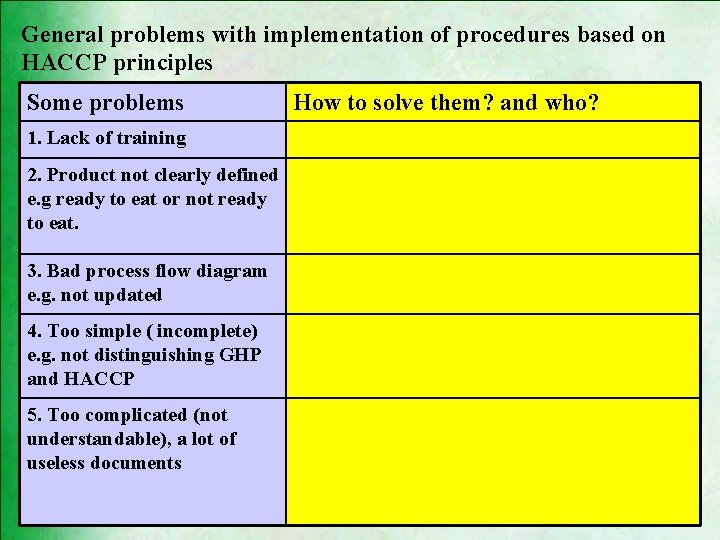
General problems with implementation of procedures based on HACCP principles Some problems 1. Lack of training 2. Product not clearly defined e. g ready to eat or not ready to eat. 3. Bad process flow diagram e. g. not updated 4. Too simple ( incomplete) e. g. not distinguishing GHP and HACCP 5. Too complicated (not understandable), a lot of useless documents How to solve them? and who?
Today • A brief introduction – FSA, Hygiene Regulations and HACCP. Some questions! Easy to identify/control realistic hazards? Does controlling mean preventing hazards, eliminating or reducing to an acceptable level? Who is responsible for HACCP? etc. • Practical problems! – How to identify and solve problems? An example – small slaughterhouse.
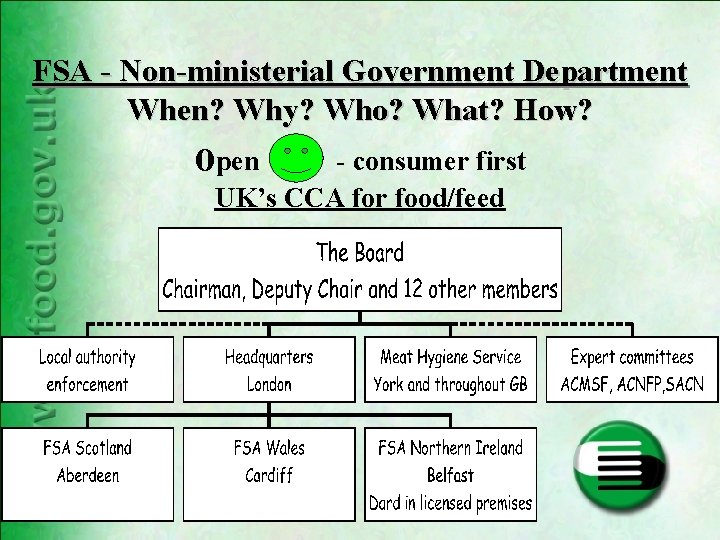
FSA - Non-ministerial Government Department When? Why? Who? What? How? open - consumer first UK’s CCA for food/feed
Differences; economic, social, religion, language, tradition, agricultural farming, approach to official controls etc…… Official controller e. g. Veterinarian In common; food/feed/animal health, welfare rules and regulations
“Hygiene Regulations” (17 Directives - simplified & consolidated into) • Regulations (EC) No 852/2004 On the hygiene of the foodstuffs; (EC) No 853/2004 Specific hygiene rules for POAO; (EC) No 854/2004 Specific rules for the organisation of official controls on POAO; Directive 2002/99/EC - Animal health rules; Links with other relevant Regs, eg Zoonoses Directive, Welfare, Animal by products etc. • Other rules Regulations (EC) 178/2002 - On General principles of food law, (EC) 882/2004 - On Official Controls to ensure compliance with Food & Feed law (EC) 2073/2005 on Microbiological criteria, (EC) 2074/2005 Implementing measures, (EC) 2076/2005 Transitional arrangements, (EC) 2075/2005 - Trichinella and Amending Regulation (EC) 1662/1663/1664/1665/1666……. . • “Buzzwords” from farm to table/fork, from production to consumption, relevant, risk based, transparent, precautionary principle, adequate, flexible, improved traceabilty…etc….
Guidance documents (some draft, some finished? ) “Guidance”, “guideline”, Oxford Dictionary “help or advice given”, “official organisation telling you how to do something” or “something that can be used to help you to make a decision or form an opinion” • EC guidance documents On the Implementation of Hygiene Regulations, Import requirements, Official controls, HACCP principles and facilitation of the implementation of HACCP principles etc. • UK Guidance documents Industry Guides – Sector specific, e. g. meat, milk, treated stomach, bladders, minced meat, meat products , ABP, etc. HACCP (Diary for small businesses) • Enforcers Guides and Codes of Practice Local Authority and Meat Hygiene Service (DARD in NI) HACCP
In common; law, guidance, code. . To respect basic principles of WHO, OIE, WTO, SPS agreement - not compromising food safety, animal health and possibly animal welfare; • Clear FBO’s responsibility for production, including primary producers for the first time; • Flexible approaches to production and enforcement that are less prescriptive taking into consideration small/traditional business using precautionary principle Be reasonable !!!
“ The reasonable man adapts himself to suit the world, while the unreasonable man seeks to adjust the world to suit him. Therefore all progress depends on the unreasonable man. ” George Bernard Shaw Man and Superman
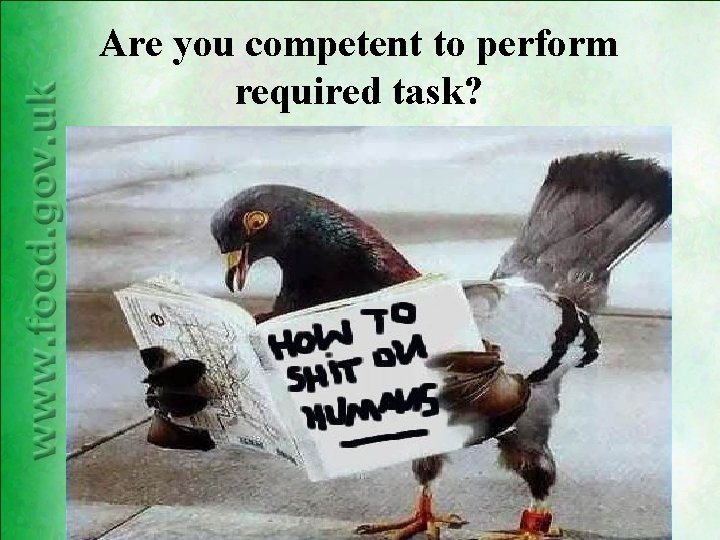
Are you competent to perform required task?
Competent person? One with adequate and appropriate skills and knowledge to perform required tasks effectively This room is full of competent people in food production, legislative procedures, enforcement. Combined “competency level” (skills and knowledge) is frightening - hundreds years of experience etc….
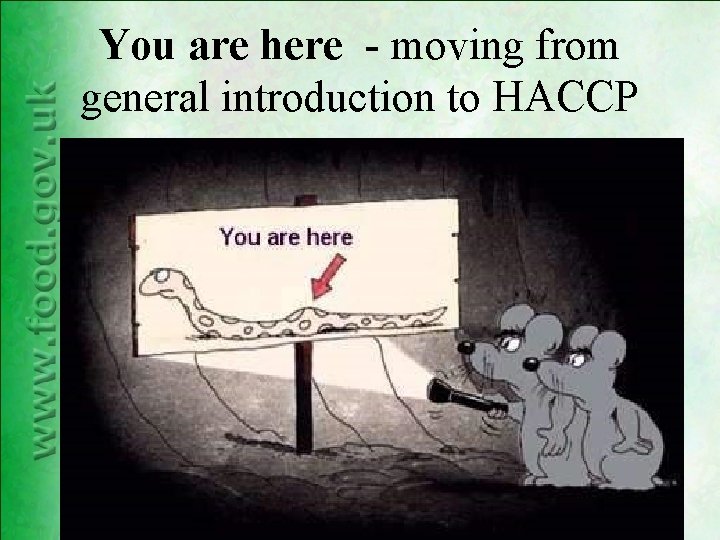
You are here - moving from general introduction to HACCP
Developing/implementing HACCP? Depends on many factors (size, product etc, however general requirements are: • a will and knowledge - theoretical, practical, operational, managerial then simply • Define the scope of HACCP plan ( from the beginning till the end of process, including description and intended use of product) • Produce a process flow diagram and • Apply logical step by step approach
HACCP in ‘defined’ meat sector? The objectives are the same Establishments – Slaughterhouses, Cutting plants, MM, MPREP, Meat products, Cold stores, Edible coproducts, Butcher shops etc Products – not ready to eat (fresh meat) or ready to eat (fermented sausages, canned meat) etc. Species – cattle, sheep, turkeys, chicken, snails, horses, deer etc. Quantity – establishment’s size/throughput – large industrial – small processing a few animals, small quantities of product
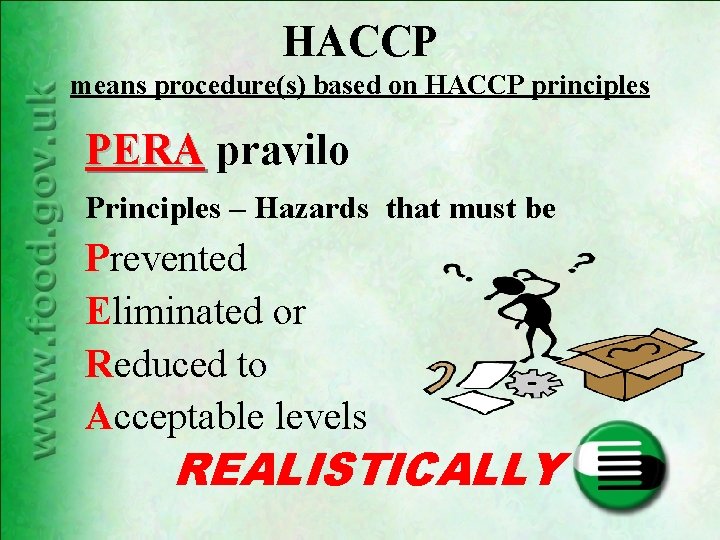
HACCP means procedure(s) based on HACCP principles PERA pravilo Principles – Hazards that must be Prevented Eliminated or Reduced to Acceptable levels REALISTICALLY
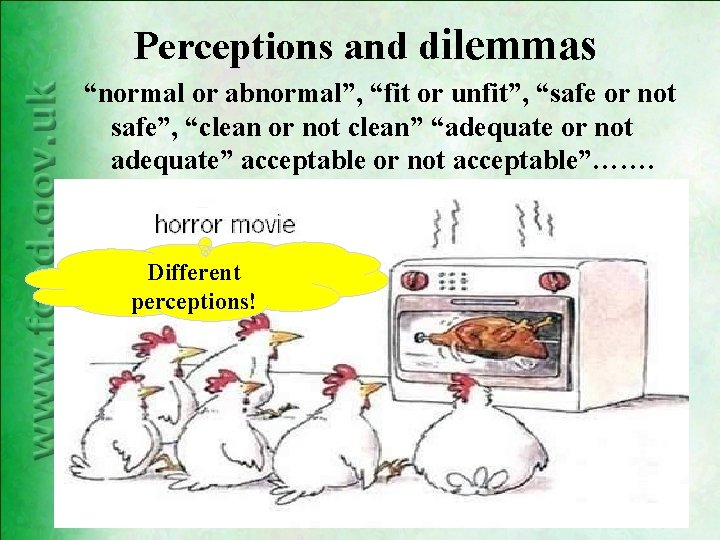
Perceptions and dilemmas “normal or abnormal”, “fit or unfit”, “safe or not safe”, “clean or not clean” “adequate or not adequate” acceptable or not acceptable”……. Different perceptions!
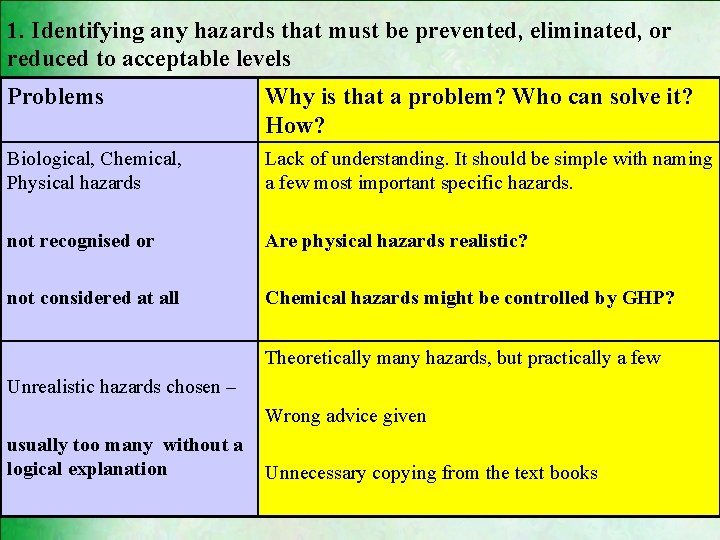
1. Identifying any hazards that must be prevented, eliminated, or reduced to acceptable levels Problems Why is that a problem? Who can solve it? How? Biological, Chemical, Physical hazards Lack of understanding. It should be simple with naming a few most important specific hazards. not recognised or Are physical hazards realistic? not considered at all Chemical hazards might be controlled by GHP? Theoretically many hazards, but practically a few Unrealistic hazards chosen – Wrong advice given usually too many without a logical explanation Unnecessary copying from the text books
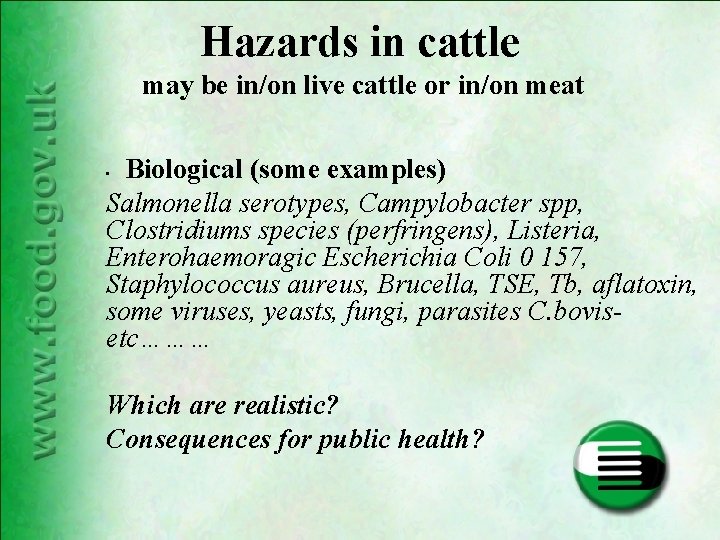
Hazards in cattle may be in/on live cattle or in/on meat Biological (some examples) Salmonella serotypes, Campylobacter spp, Clostridiums species (perfringens), Listeria, Enterohaemoragic Escherichia Coli 0 157, Staphylococcus aureus, Brucella, TSE, Tb, aflatoxin, some viruses, yeasts, fungi, parasites C. bovisetc……… • Which are realistic? Consequences for public health?
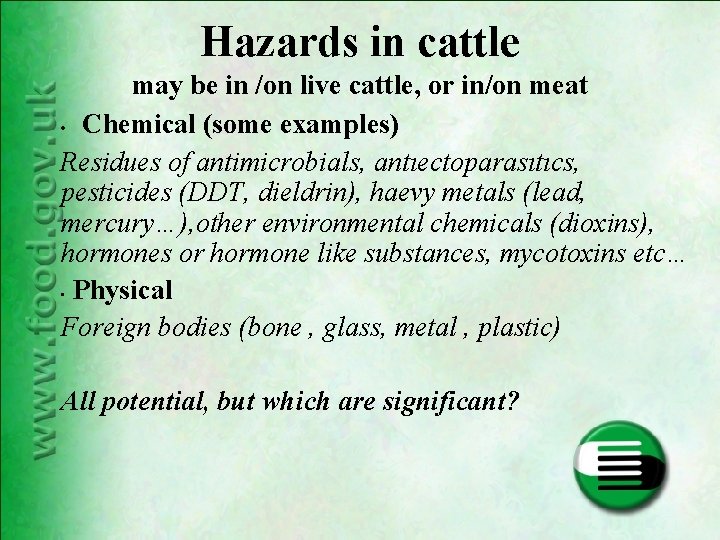
Hazards in cattle may be in /on live cattle, or in/on meat • Chemical (some examples) Residues of antimicrobials, antıectoparasıtıcs, pesticides (DDT, dieldrin), haevy metals (lead, mercury…), other environmental chemicals (dioxins), hormones or hormone like substances, mycotoxins etc… • Physical Foreign bodies (bone , glass, metal , plastic) All potential, but which are significant?
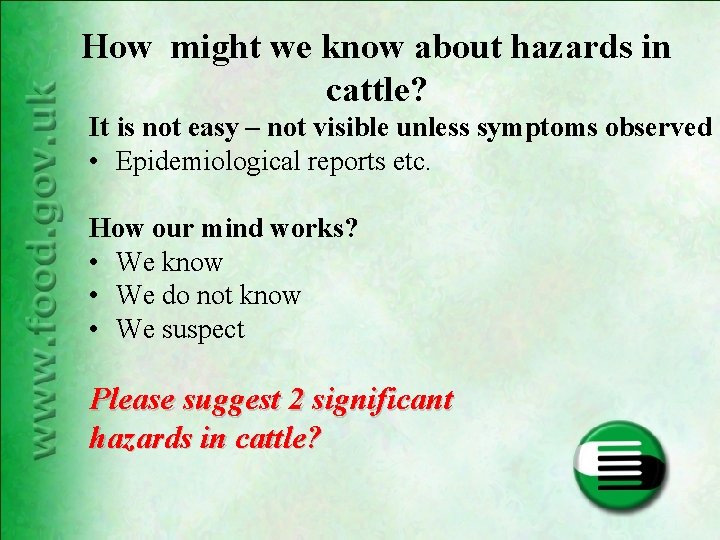
How might we know about hazards in cattle? It is not easy – not visible unless symptoms observed • Epidemiological reports etc. How our mind works? • We know • We do not know • We suspect Please suggest 2 significant hazards in cattle?
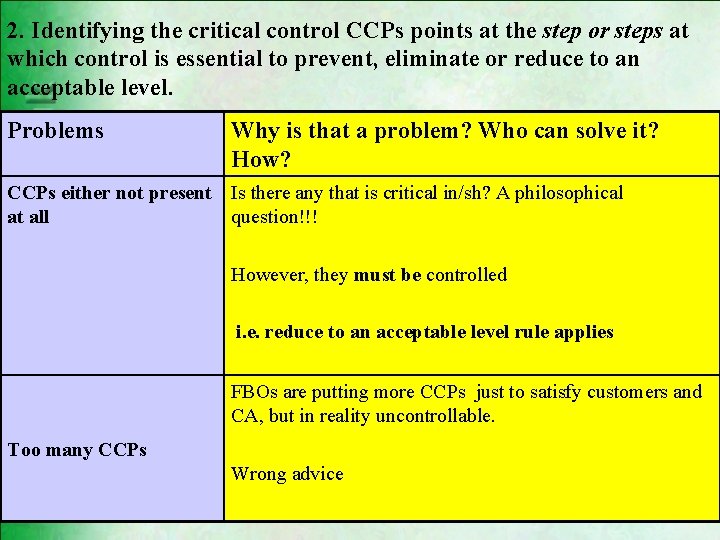
2. Identifying the critical control CCPs points at the step or steps at which control is essential to prevent, eliminate or reduce to an acceptable level. Problems Why is that a problem? Who can solve it? How? CCPs either not present Is there any that is critical in/sh? A philosophical at all question!!! However, they must be controlled i. e. reduce to an acceptable level rule applies FBOs are putting more CCPs just to satisfy customers and CA, but in reality uncontrollable. Too many CCPs Wrong advice
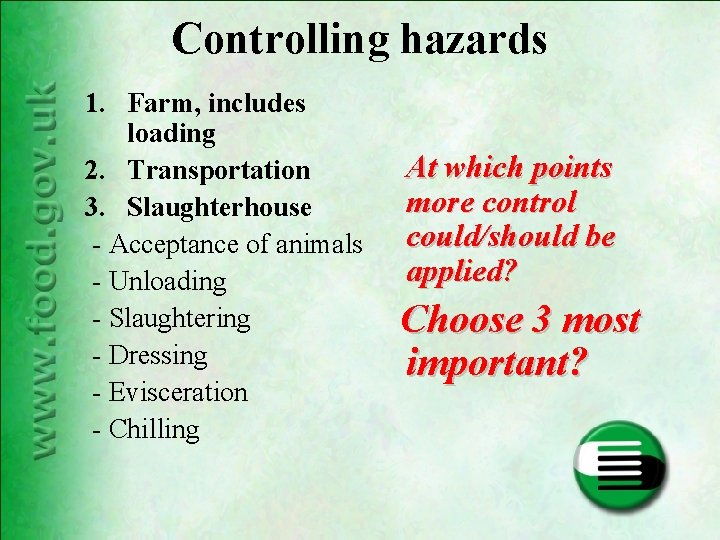
Controlling hazards 1. Farm, includes loading 2. Transportation 3. Slaughterhouse - Acceptance of animals - Unloading - Slaughtering - Dressing - Evisceration - Chilling At which points more control could/should be applied? Choose 3 most important?
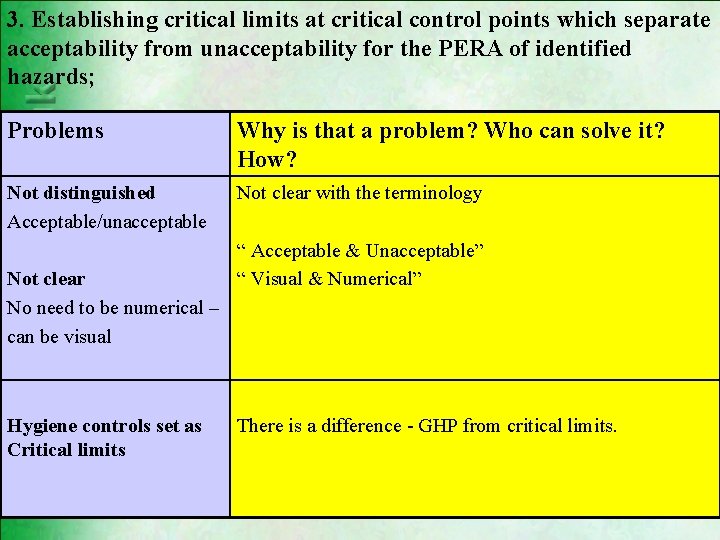
3. Establishing critical limits at critical control points which separate acceptability from unacceptability for the PERA of identified hazards; Problems Why is that a problem? Who can solve it? How? Not distinguished Acceptable/unacceptable Not clear with the terminology Not clear No need to be numerical – can be visual Hygiene controls set as Critical limits “ Acceptable & Unacceptable” “ Visual & Numerical” There is a difference - GHP from critical limits.
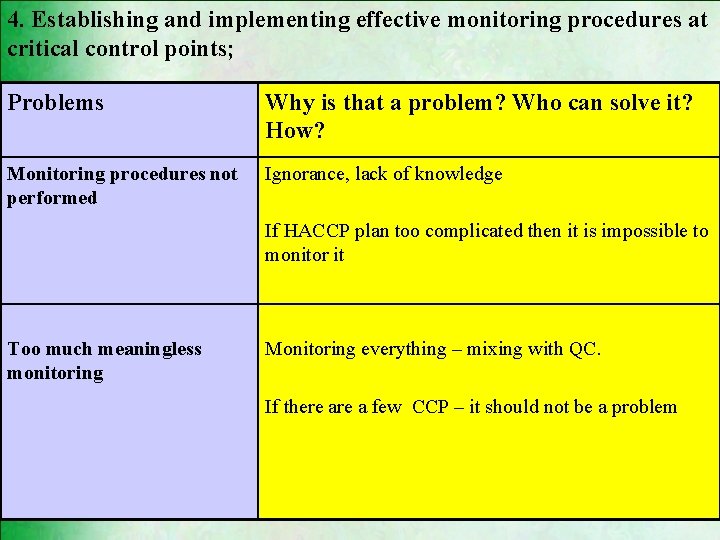
4. Establishing and implementing effective monitoring procedures at critical control points; Problems Why is that a problem? Who can solve it? How? Monitoring procedures not performed Ignorance, lack of knowledge If HACCP plan too complicated then it is impossible to monitor it Too much meaningless monitoring Monitoring everything – mixing with QC. If there a few CCP – it should not be a problem
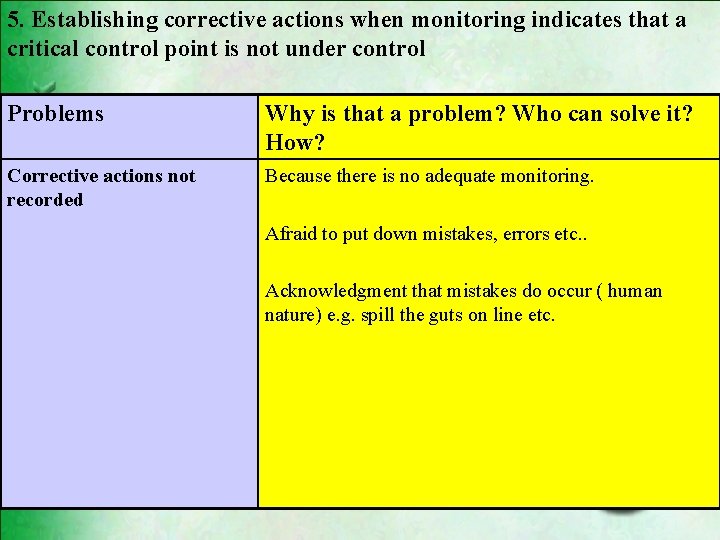
5. Establishing corrective actions when monitoring indicates that a critical control point is not under control Problems Why is that a problem? Who can solve it? How? Corrective actions not recorded Because there is no adequate monitoring. Afraid to put down mistakes, errors etc. . Acknowledgment that mistakes do occur ( human nature) e. g. spill the guts on line etc.
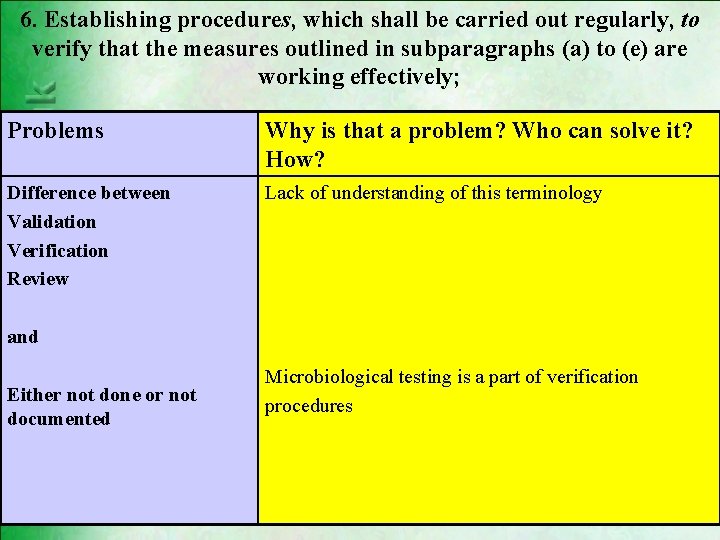
6. Establishing procedures, which shall be carried out regularly, to verify that the measures outlined in subparagraphs (a) to (e) are working effectively; Problems Why is that a problem? Who can solve it? How? Difference between Validation Verification Review Lack of understanding of this terminology and Either not done or not documented Microbiological testing is a part of verification procedures
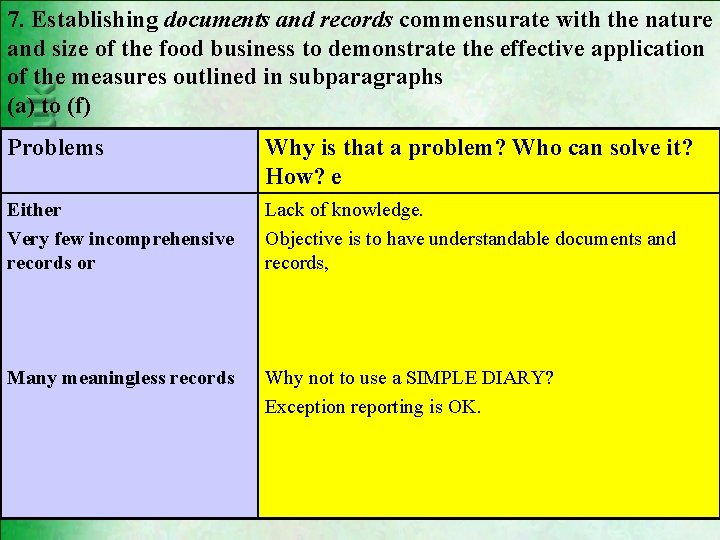
7. Establishing documents and records commensurate with the nature and size of the food business to demonstrate the effective application of the measures outlined in subparagraphs (a) to (f) Problems Why is that a problem? Who can solve it? How? e Either Very few incomprehensive records or Lack of knowledge. Objective is to have understandable documents and records, Many meaningless records Why not to use a SIMPLE DIARY? Exception reporting is OK.
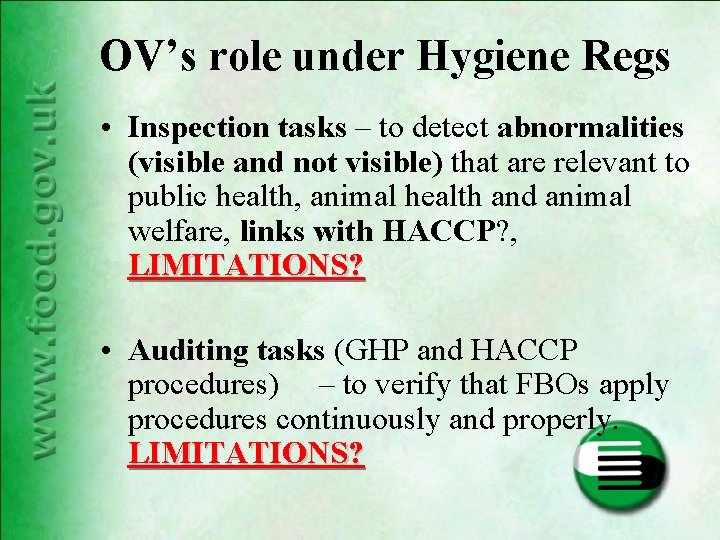
OV’s role under Hygiene Regs • Inspection tasks – to detect abnormalities (visible and not visible) that are relevant to public health, animal health and animal welfare, links with HACCP? , LIMITATIONS? • Auditing tasks (GHP and HACCP procedures) – to verify that FBOs apply procedures continuously and properly. LIMITATIONS?
useful websites • http: //ec. europa. eu/ • http: //www. food. gov. uk/