
Practical Formal Verification of MPI and Thread Programs

- Slides: 50
Practical Formal Verification of MPI and Thread Programs Sarvani Vakkalanka Anh Vo* Michael De. Lisi Sriram Aananthakrishnan Alan Humphrey Christopher Derrick Yu Yang Ganesh Gopalakrishnan* Robert M. Kirby* * = presenters School of Computing, University of Utah, Salt Lake City, UT 84112, USA http: // www. cs. utah. edu / formal_verification / europvm 09 -tutorial-mpi-threading-fv Supported by NSF CNS 0509379, CCF 0811429, CCF 0903408, SRC tasks TJ 1847. 001 and TJ 1993, and Microsoft 1
Additional Acknowledgements for this tutorial • Other students involved: Salman Pervez, Robert Palmer, Guodong Li, Geof Sawaya, Subodh Sharma, Grzegorz Szubzda, Jason Williams, Simone Atzeni, Wei-Fan Chiang • External Collaborators: ANL / UIUC : Rajeev Thakur, Bill Gropp, Rusty Lusk IBM : Beth Tibbits LLNL : Bronis de Supinski, Martin Schulz, Dan Quinlan Microsoft : Robert Palmer, Dennis Crain, Shahrokh Mortazavi
9: 00 to 10: 30 • • • Overview of Formal Verification, especially Dynamic Verification Overview of MPI Demo of our tool ISP Architecture of ISP Presentation of Any_src_can_deadlock (from Umpire test suite) Our algorithm POE (Partial Order avoiding Elusive interleavings) Presentation of POE-Illustration Present details of POE-Illustration: ISP’s Eclipse framework and GUI Boot into Live. DVD and practice on POE-Illustration
10: 30 to 11: 00 • Coffee Break • IMPORTANT : Please give feedback before it is too late • Too fast ? • Too slow ? • Just right !! ? • Assuming a lot ? • Other suggestions ? • We will TRY to take into account these valuable suggestions!
11: 00 to 12: 00 • • • Illustration of Resource Dependent Deadlocks, and Detection Illustration of Resource Leak, and Detection Iprobe behavior, and illustration using GUI Assertion Violation in Red/Blue Problem Audience Participation in Above Exercises ISP’s Theory : MPI Happens-before • Also called “matches before, completes before” in the tool
12: 00 to 12: 30 • Example of Matrix Multiplication: Four Variations • Analysis of these variations using ISP, with Audience Participation
14: 00 to 15: 00 • Assisted Problem Solving by Audience
15: 00 to 15: 30 • Overview of Dynamic Verification of Shared Memory Thread Programs
16: 00 to 17: 30 • Dynamic Verification of Thread Programs using Inspect • Concluding Remarks
Overview of Formal Verification methods for Validating Concurrent Systems About 30 minutes – by Ganesh 10
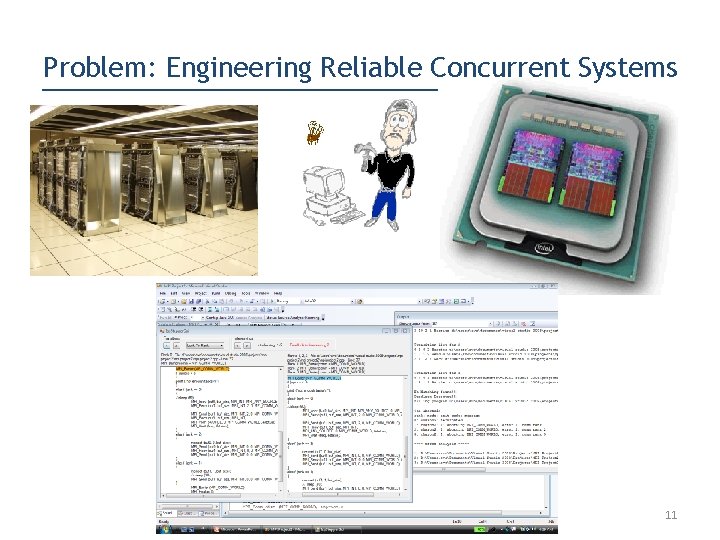
Problem: Engineering Reliable Concurrent Systems 11
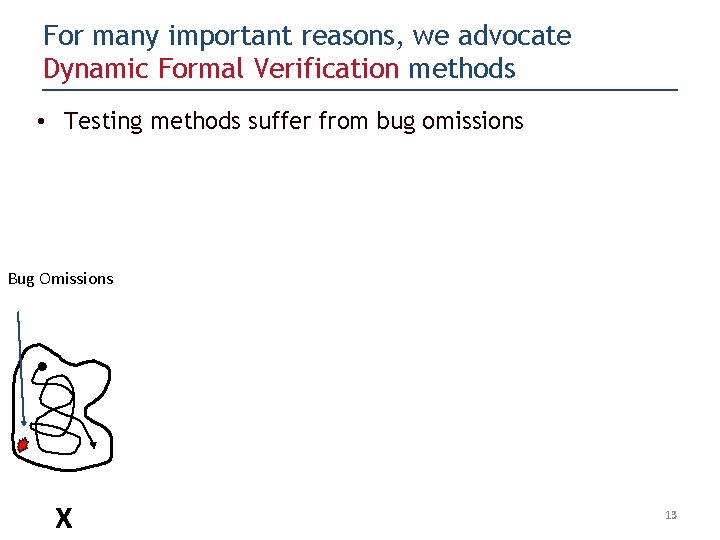
For many important reasons, we advocate Dynamic Formal Verification methods • Designers require a push-button debugger-like interface – But one that offers coverage guarantees and deeper insights
For many important reasons, we advocate Dynamic Formal Verification methods • Testing methods suffer from bug omissions Bug Omissions X 13
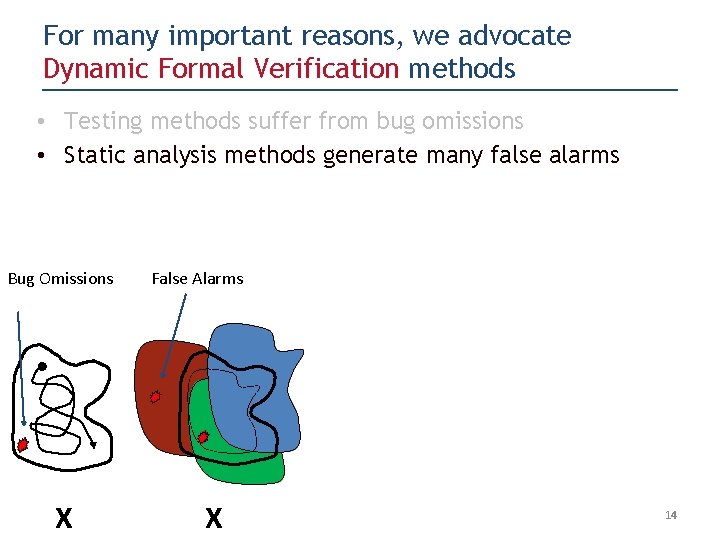
For many important reasons, we advocate Dynamic Formal Verification methods • Testing methods suffer from bug omissions • Static analysis methods generate many false alarms Bug Omissions X False Alarms X 14
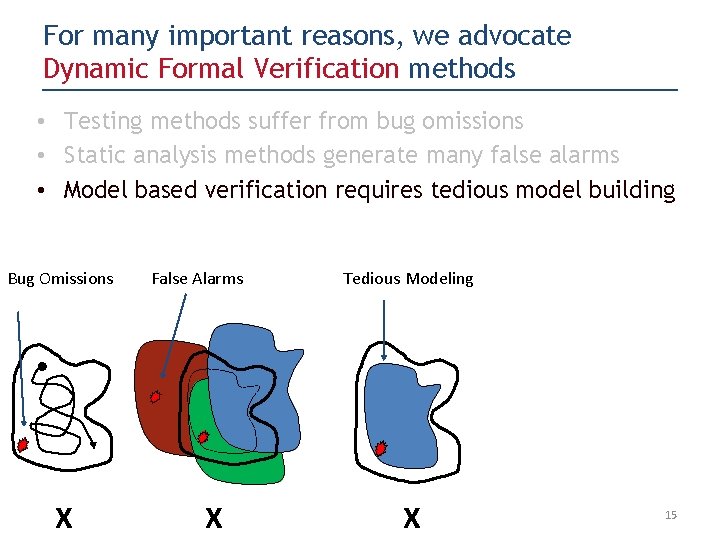
For many important reasons, we advocate Dynamic Formal Verification methods • Testing methods suffer from bug omissions • Static analysis methods generate many false alarms • Model based verification requires tedious model building Bug Omissions X False Alarms X Tedious Modeling X 15
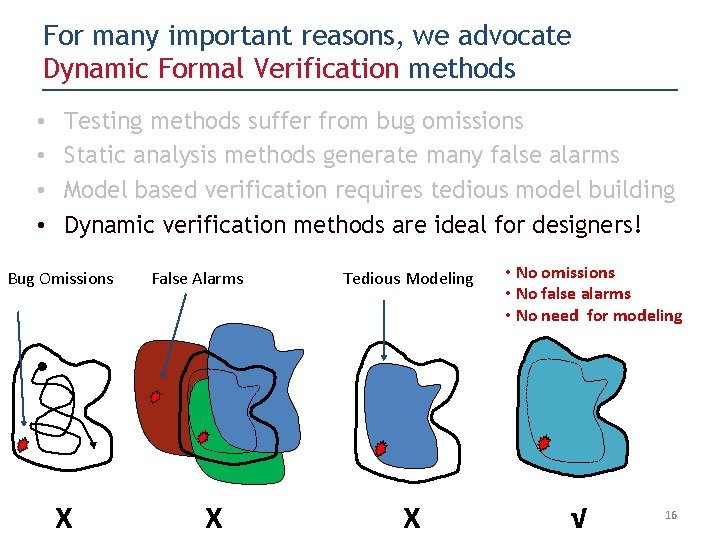
For many important reasons, we advocate Dynamic Formal Verification methods • • Testing methods suffer from bug omissions Static analysis methods generate many false alarms Model based verification requires tedious model building Dynamic verification methods are ideal for designers! Bug Omissions X False Alarms X Tedious Modeling X • No omissions • No false alarms • No need for modeling √ 16
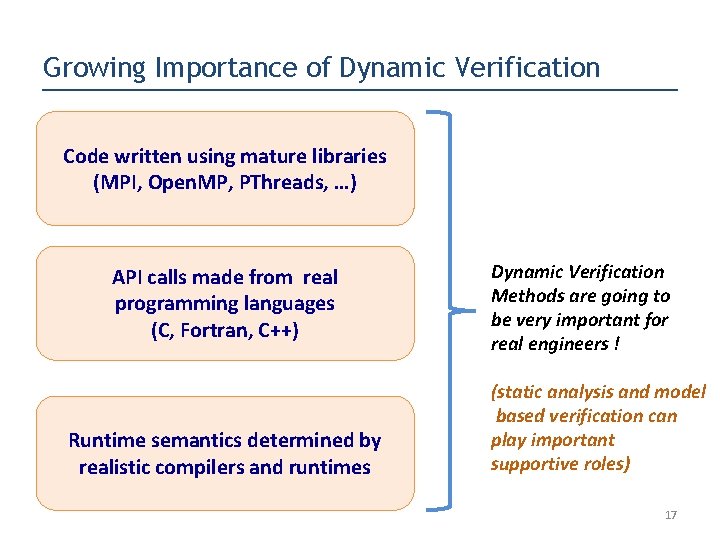
Growing Importance of Dynamic Verification Code written using mature libraries (MPI, Open. MP, PThreads, …) API calls made from real programming languages (C, Fortran, C++) Runtime semantics determined by realistic compilers and runtimes Dynamic Verification Methods are going to be very important for real engineers ! (static analysis and model based verification can play important supportive roles) 17
A Brief Survey of Dynamic Verification tools • Verisoft Project – Used for telephone switch software verification in Bell Labs – Available
A Brief Survey of Dynamic Verification tools • Verisoft Project – Used for telephone switch software verification in Bell Labs – Available • The Java Pathfinder Project – Developed at NASA for Java Control Software – On Source. Forge
A Brief Survey of Dynamic Verification tools • Verisoft Project – Used for telephone switch software verification in Bell Labs – Available • The Java Pathfinder Project – Developed at NASA for Java Control Software – On Source. Forge • The CHESS Project – Microsoft Research ; available for academic institutions – In use within Microsoft product groups, and used by academics
A Brief Survey of Dynamic Verification tools • Verisoft Project – Used for telephone switch software verification in Bell Labs – Available • The Java Pathfinder Project – Developed at NASA for Java Control Software – On Source. Forge • The CHESS Project – Microsoft Research ; available for academic institutions – In use within Microsoft product groups, and used by academics • Inspect : Our fairly unique Pthread / C verifier – Discussed in this tutorial
A Brief Survey of Dynamic Verification tools • Verisoft Project – Used for telephone switch software verification in Bell Labs – Available • The Java Pathfinder Project – Developed at NASA for Java Control Software – On Source. Forge • The CHESS Project – Microsoft Research ; available for academic institutions – In use within Microsoft product groups, and used by academics • Inspect : Our fairly unique Pthread / C verifier – Discussed in this tutorial • ISP : Our very unique MPI / C program verifier – Main focus of THIS TUTORIAL !!
Example : How ISP Effects Dynamic Verification – Through PMPI • Runs the code under a verification scheduler – ‘Hijacks’ native scheduler • By interposing a profiler – Exerts its own Interleaving Generation Control • Selective replay, Dynamic Instruction Rewriting – TRIES HARD to generate only RELEVANT interleavings • Only replays around “non-determinism” – Does ‘stateless’ (replay) verification • Restarts from MPI_Init for each new interleaving
Example : How ISP Effects Dynamic Verification • Somehow Instruments the Source / Binary – Through PMPI • Runs the code under a verification scheduler – ‘Hijacks’ native scheduler • By interposing a profiler – Exerts its own Interleaving Generation Control • Selective replay, Dynamic Instruction Rewriting – TRIES HARD to generate only RELEVANT interleavings • Only replays around “non-determinism” – Does ‘stateless’ (replay) verification • Restarts from MPI_Init for each new interleaving
Example : How ISP Effects Dynamic Verification • Somehow Instruments the Source / Binary – Through PMPI at source level • Runs the code under a verification scheduler – ‘Hijacks’ native scheduler • By interposing a profiler – Exerts its own Interleaving Generation Control • Selective replay, Dynamic Instruction Rewriting – TRIES HARD to generate only RELEVANT interleavings • Only replays around “non-determinism” – Does ‘stateless’ (replay) verification • Restarts from MPI_Init for each new interleaving
Example : How ISP Effects Dynamic Verification • Somehow Instruments the Source / Binary – Through PMPI • Runs the code under a verification scheduler – ‘Hijacks’ native scheduler • By interposing a profiler – Exerts its own Interleaving Generation Control • Selective replay, Dynamic Instruction Rewriting – TRIES HARD to generate only RELEVANT interleavings • Only replays around “non-determinism” – Does ‘stateless’ (replay) verification • Restarts from MPI_Init for each new interleaving
Example : How ISP Effects Dynamic Verification • Somehow Instruments the Source / Binary – Through PMPI • Runs the code under a verification scheduler – ‘Hijacks’ MPI Function Calls • By interposing a profiler – Exerts its own Interleaving Generation Control • Selective replay, Dynamic Instruction Rewriting – TRIES HARD to generate only RELEVANT interleavings • Only replays around “non-determinism” – Does ‘stateless’ (replay) verification • Restarts from MPI_Init for each new interleaving
Example : How ISP Effects Dynamic Verification • Somehow Instruments the Source / Binary – Through PMPI • Runs the code under a verification scheduler – ‘Hijacks’ MPI Function Calls • By interposing a profiler – Exerts its own Interleaving Generation Control • Selective replay, Dynamic Instruction Rewriting – TRIES HARD to generate only RELEVANT interleavings • Only replays around “non-determinism” – Does ‘stateless’ (replay) verification • Restarts from MPI_Init for each new interleaving
Example : How ISP Effects Dynamic Verification • Somehow Instruments the Source / Binary – Through PMPI • Runs the code under a verification scheduler – ‘Hijacks’ MPI Function Calls • By interposing a profiler – Exerts its own Interleaving Generation Control • Selective replay, Dynamic Instruction Rewriting – TRIES HARD to generate only RELEVANT interleavings • Only replays around “non-determinism” – Does ‘stateless’ (replay) verification • Restarts from MPI_Init for each new interleaving
Example : How ISP Effects Dynamic Verification • Somehow Instruments the Source / Binary – Through PMPI • Runs the code under a verification scheduler – ‘Hijacks’ MPI Function Calls • By interposing a profiler – Exerts its own Interleaving Generation Control • Selective replay, Dynamic Instruction Rewriting – TRIES HARD to generate only RELEVANT interleavings • Only replays around “non-determinism” – Does ‘stateless’ (replay) verification • Restarts from MPI_Init for each new interleaving
Example : How ISP Effects Dynamic Verification • Somehow Instruments the Source / Binary – Through PMPI • Runs the code under a verification scheduler – ‘Hijacks’ MPI Function Calls • By interposing a profiler – Exerts its own Interleaving Generation Control • Selective replay, Dynamic Instruction Rewriting – TRIES HARD to generate only RELEVANT interleavings • Only replays around “non-determinism” – Does ‘stateless’ (replay) verification • Restarts from MPI_Init for each new interleaving
Example : How ISP Effects Dynamic Verification • Somehow Instruments the Source / Binary – Through PMPI • Runs the code under a verification scheduler – ‘Hijacks’ MPI Function Calls • By interposing a profiler – Exerts its own Interleaving Generation Control • Selective replay, Dynamic Instruction Rewriting – TRIES HARD to generate only RELEVANT interleavings • Only replays around “non-determinism” – Does ‘stateless’ (replay) verification • Restarts from MPI_Init for each new interleaving
Example : How ISP Effects Dynamic Verification • Somehow Instruments the Source / Binary – Through PMPI • Runs the code under a verification scheduler – ‘Hijacks’ MPI Function Calls • By interposing a profiler – Exerts its own Interleaving Generation Control • Selective replay, Dynamic Instruction Rewriting – TRIES HARD to generate only RELEVANT interleavings • Only replays around “non-determinism” – Does ‘stateless’ (replay) verification • Restarts from MPI_Init for each new interleaving
Example : How ISP Effects Dynamic Verification • Somehow Instruments the Source / Binary – Through PMPI • Runs the code under a verification scheduler – ‘Hijacks’ MPI Function Calls • By interposing a profiler – Exerts its own Interleaving Generation Control • Selective replay, Dynamic Instruction Rewriting – TRIES HARD to generate only RELEVANT interleavings • Only replays around “non-determinism” – Does ‘stateless’ (replay) verification • Restarts from MPI_Init for each new interleaving
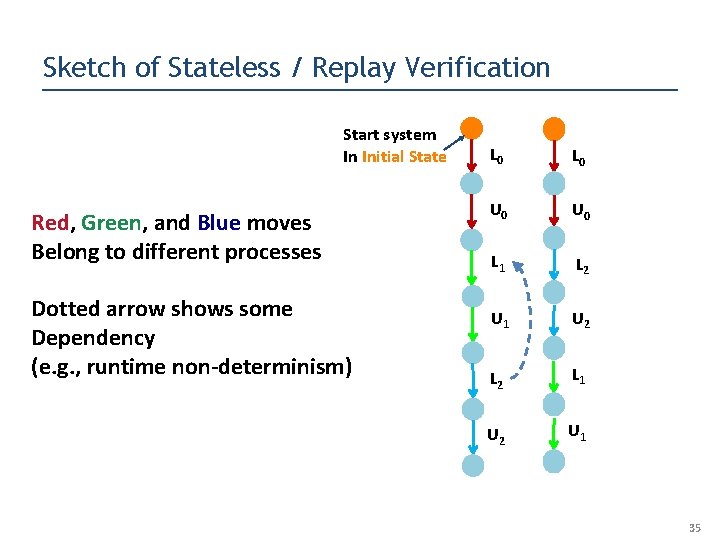
Sketch of Stateless / Replay Verification Start system In Initial State Red, Green, and Blue moves Belong to different processes Dotted arrow shows some Dependency (e. g. , runtime non-determinism) L 0 U 0 L 1 L 2 U 1 U 2 L 1 U 2 U 1 35
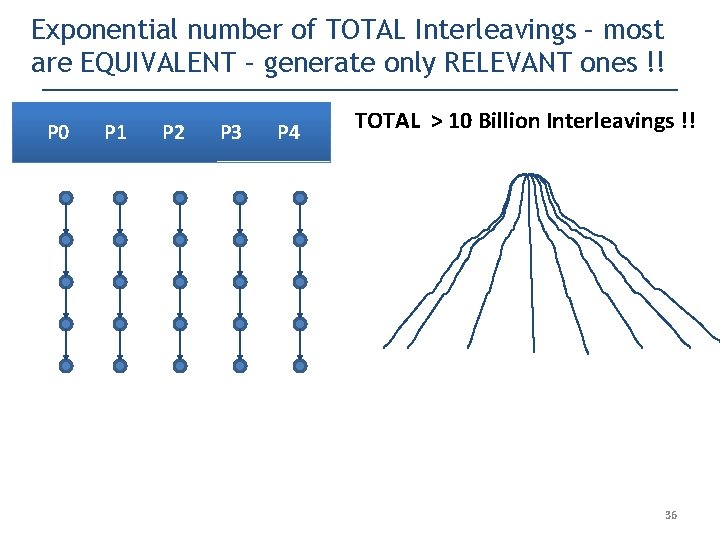
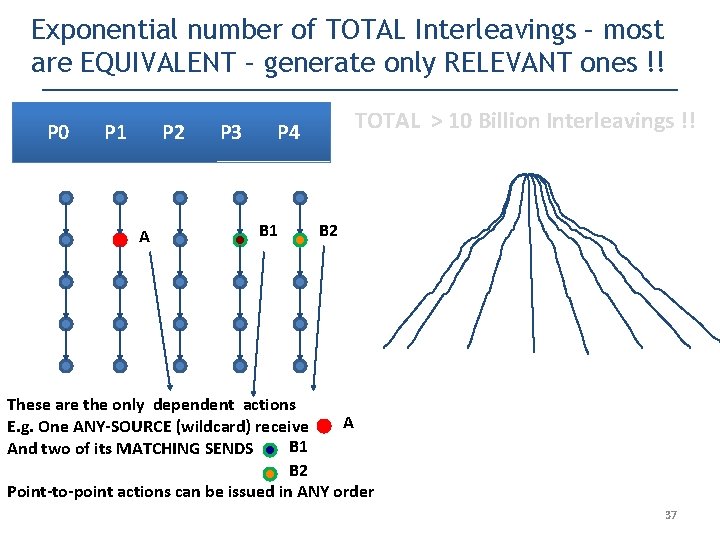
Exponential number of TOTAL Interleavings – most are EQUIVALENT – generate only RELEVANT ones !! P 0 P 1 P 2 P 3 P 4 TOTAL > 10 Billion Interleavings !! 36
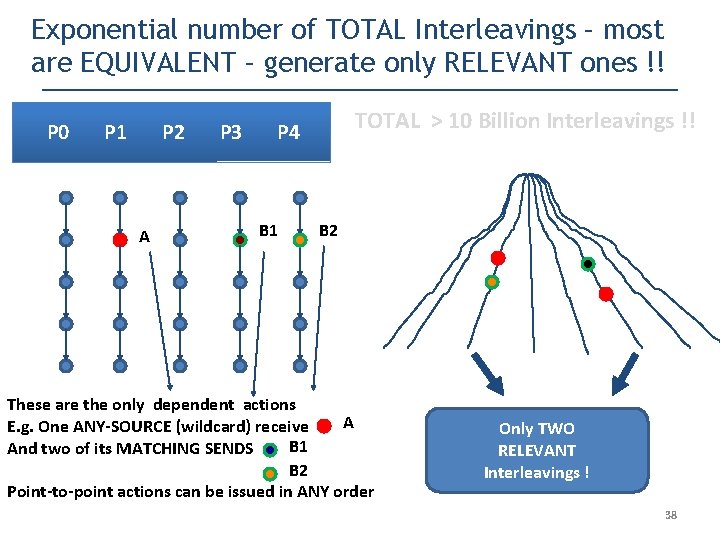
Exponential number of TOTAL Interleavings – most are EQUIVALENT – generate only RELEVANT ones !! P 0 P 1 P 2 A P 3 TOTAL > 10 Billion Interleavings !! P 4 B 1 B 2 These are the only dependent actions A E. g. One ANY-SOURCE (wildcard) receive B 1 And two of its MATCHING SENDS B 2 Point-to-point actions can be issued in ANY order 37
Exponential number of TOTAL Interleavings – most are EQUIVALENT – generate only RELEVANT ones !! P 0 P 1 P 2 A P 3 TOTAL > 10 Billion Interleavings !! P 4 B 1 B 2 These are the only dependent actions A E. g. One ANY-SOURCE (wildcard) receive B 1 And two of its MATCHING SENDS B 2 Point-to-point actions can be issued in ANY order Only TWO RELEVANT Interleavings ! 38
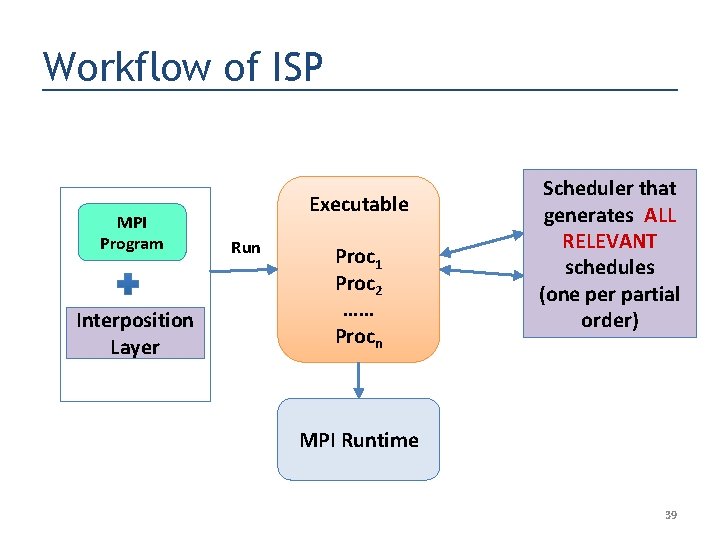
Workflow of ISP MPI Program Interposition Layer Executable Run Proc 1 Proc 2 …… Procn Scheduler that generates ALL RELEVANT schedules (one per partial order) MPI Runtime 39
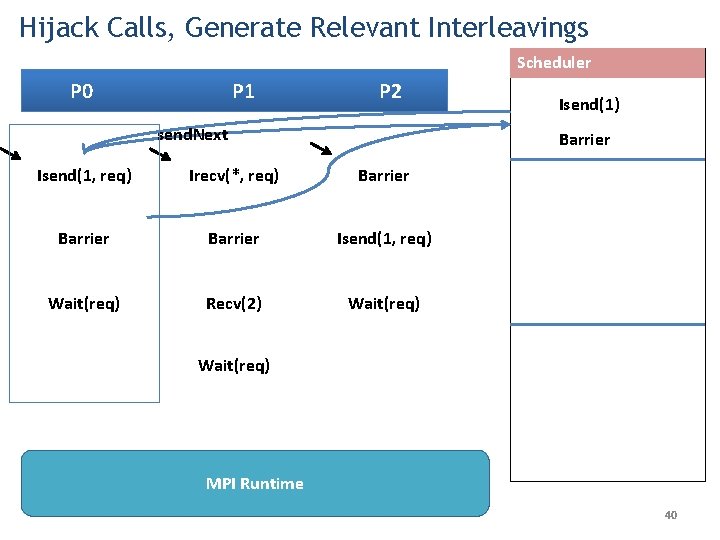
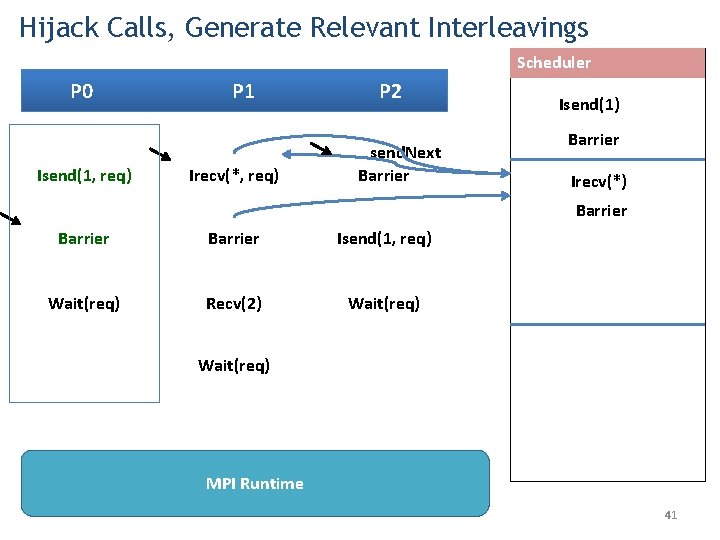
Hijack Calls, Generate Relevant Interleavings Scheduler P 0 P 1 P 2 send. Next Isend(1) Barrier Isend(1, req) Irecv(*, req) Barrier Isend(1, req) Wait(req) Recv(2) Wait(req) MPI Runtime 40
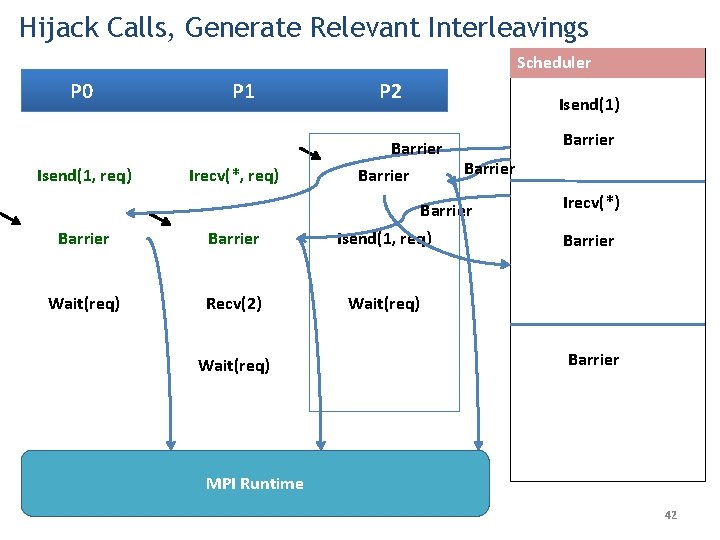
Hijack Calls, Generate Relevant Interleavings Scheduler P 0 Isend(1, req) P 1 Irecv(*, req) P 2 send. Next Barrier Isend(1) Barrier Irecv(*) Barrier Isend(1, req) Wait(req) Recv(2) Wait(req) MPI Runtime 41
Hijack Calls, Generate Relevant Interleavings Scheduler P 0 Isend(1, req) P 1 Irecv(*, req) P 2 Isend(1) Barrier Barrier Isend(1, req) Wait(req) Recv(2) Wait(req) Irecv(*) Barrier MPI Runtime 42
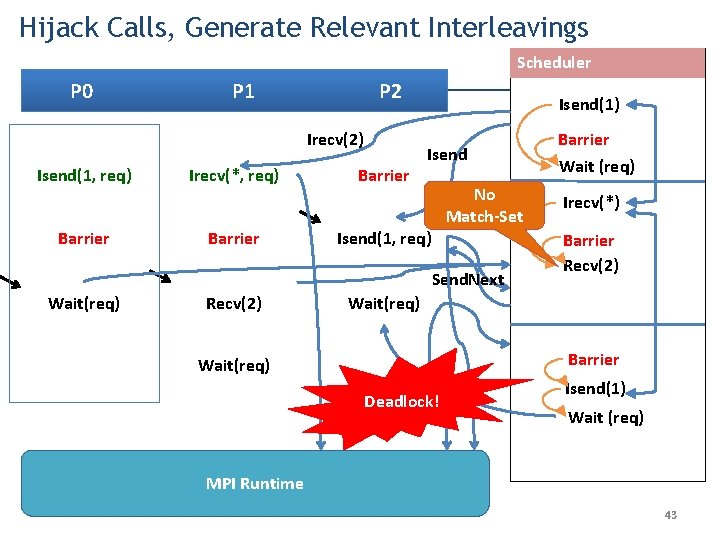
Hijack Calls, Generate Relevant Interleavings Scheduler P 0 P 1 P 2 Irecv(2) Isend(1, req) Barrier Irecv(*, req) Barrier Isend(1) Isend No Match-Set Isend(1, req) Send. Next Wait(req) Recv(2) Barrier Wait (req) Irecv(*) Barrier Recv(2) Wait(req) Barrier Wait(req) Wait Deadlock! Isend(1) Wait (req) MPI Runtime 43
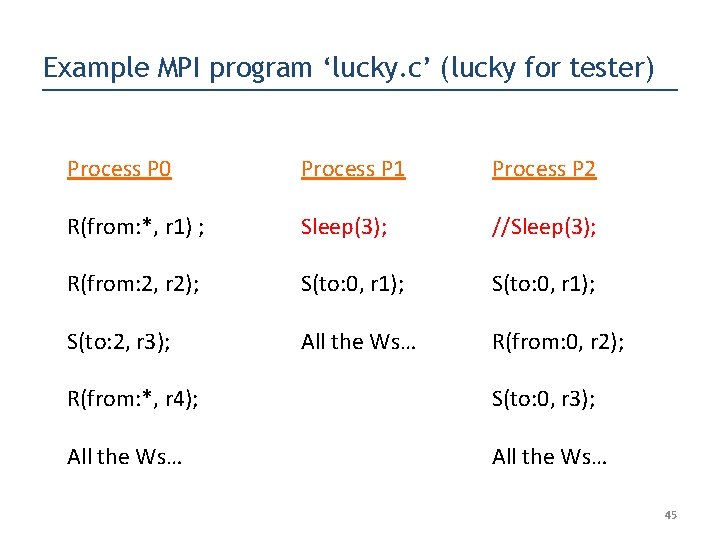
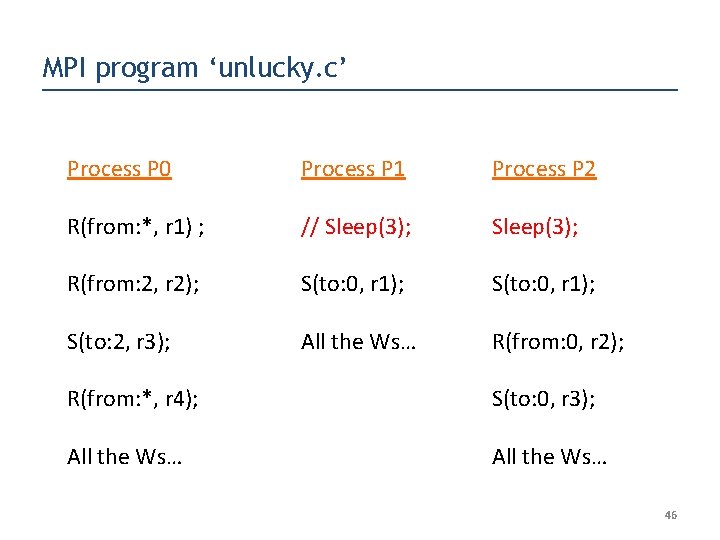
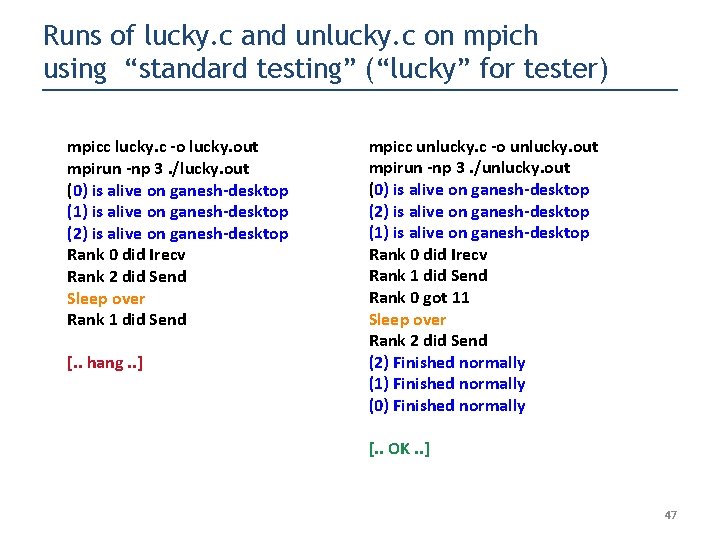
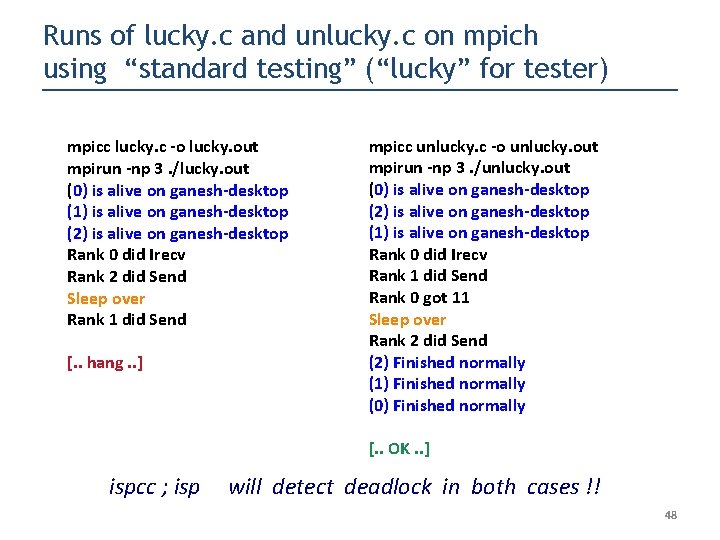
Let us see ISP in action on ‘lucky. c’ and ‘unlucky. c’ • lucky. c has a deadlock that shows upon testing • unlucky. c does not reveal a deadlock upon testing • Testing is done using mpicc ; mpirun • Verification is done using ispcc ; isp
Example MPI program ‘lucky. c’ (lucky for tester) Process P 0 Process P 1 Process P 2 R(from: *, r 1) ; Sleep(3); //Sleep(3); R(from: 2, r 2); S(to: 0, r 1); S(to: 2, r 3); All the Ws… R(from: 0, r 2); R(from: *, r 4); S(to: 0, r 3); All the Ws… 45
MPI program ‘unlucky. c’ Process P 0 Process P 1 Process P 2 R(from: *, r 1) ; // Sleep(3); R(from: 2, r 2); S(to: 0, r 1); S(to: 2, r 3); All the Ws… R(from: 0, r 2); R(from: *, r 4); S(to: 0, r 3); All the Ws… 46
Runs of lucky. c and unlucky. c on mpich using “standard testing” (“lucky” for tester) mpicc lucky. c -o lucky. out mpirun -np 3. /lucky. out (0) is alive on ganesh-desktop (1) is alive on ganesh-desktop (2) is alive on ganesh-desktop Rank 0 did Irecv Rank 2 did Send Sleep over Rank 1 did Send [. . hang. . ] mpicc unlucky. c -o unlucky. out mpirun -np 3. /unlucky. out (0) is alive on ganesh-desktop (2) is alive on ganesh-desktop (1) is alive on ganesh-desktop Rank 0 did Irecv Rank 1 did Send Rank 0 got 11 Sleep over Rank 2 did Send (2) Finished normally (1) Finished normally (0) Finished normally [. . OK. . ] 47
Runs of lucky. c and unlucky. c on mpich using “standard testing” (“lucky” for tester) mpicc lucky. c -o lucky. out mpirun -np 3. /lucky. out (0) is alive on ganesh-desktop (1) is alive on ganesh-desktop (2) is alive on ganesh-desktop Rank 0 did Irecv Rank 2 did Send Sleep over Rank 1 did Send [. . hang. . ] mpicc unlucky. c -o unlucky. out mpirun -np 3. /unlucky. out (0) is alive on ganesh-desktop (2) is alive on ganesh-desktop (1) is alive on ganesh-desktop Rank 0 did Irecv Rank 1 did Send Rank 0 got 11 Sleep over Rank 2 did Send (2) Finished normally (1) Finished normally (0) Finished normally [. . OK. . ] ispcc ; isp will detect deadlock in both cases !! 48
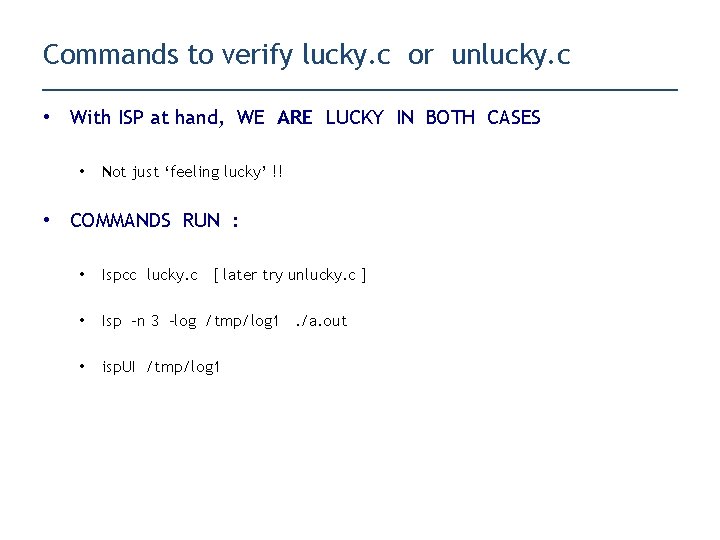
Commands to verify lucky. c or unlucky. c • With ISP at hand, WE ARE LUCKY IN BOTH CASES • Not just ‘feeling lucky’ !! • COMMANDS RUN : • Ispcc lucky. c [ later try unlucky. c ] • Isp -n 3 -log /tmp/log 1. /a. out • isp. UI /tmp/log 1
End of A 50